
 Alfred Viskain
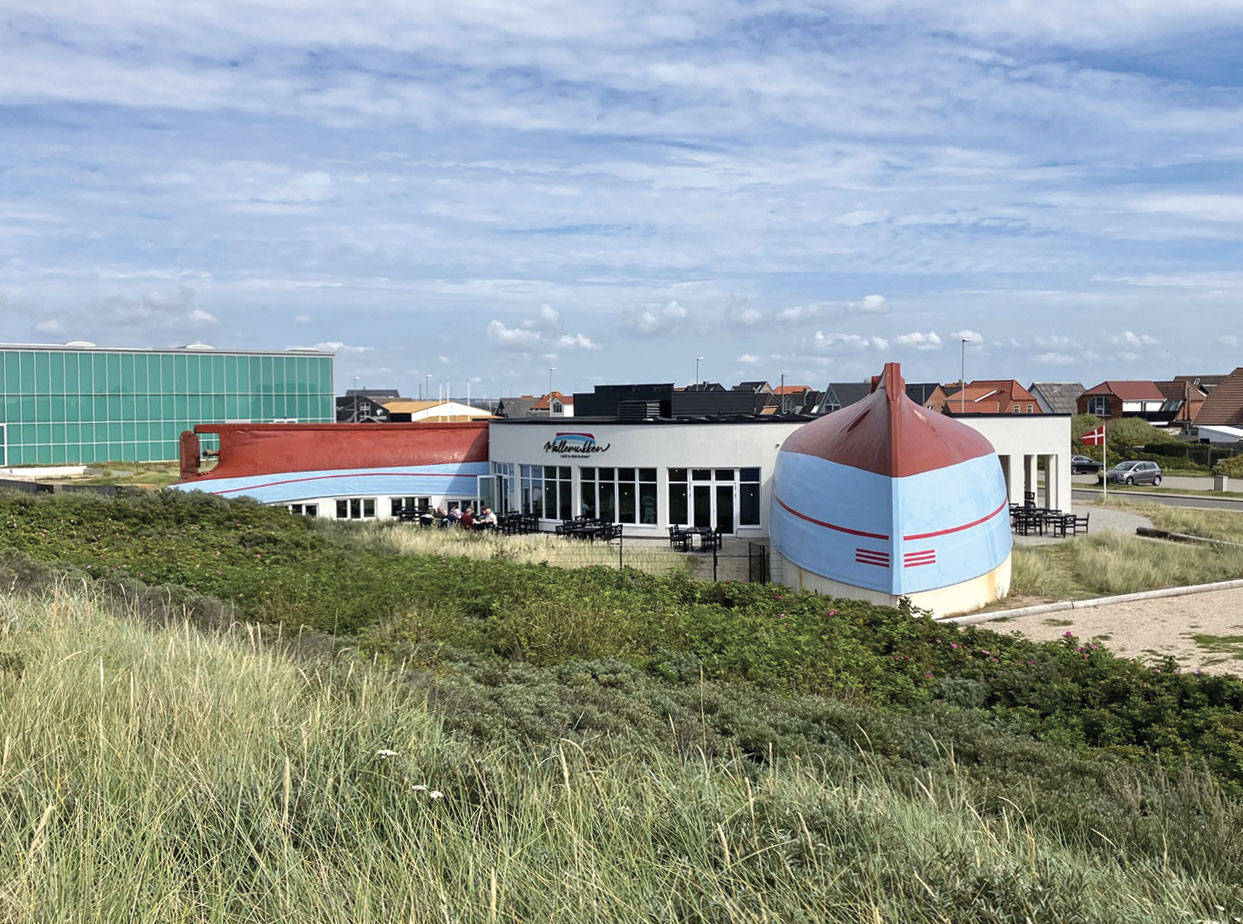
Two obsolete fishing boats, each forming a roof over a wing of the building, were recycled for the purpose of creating a restaurant.
Fine Dining in a Boat Hull
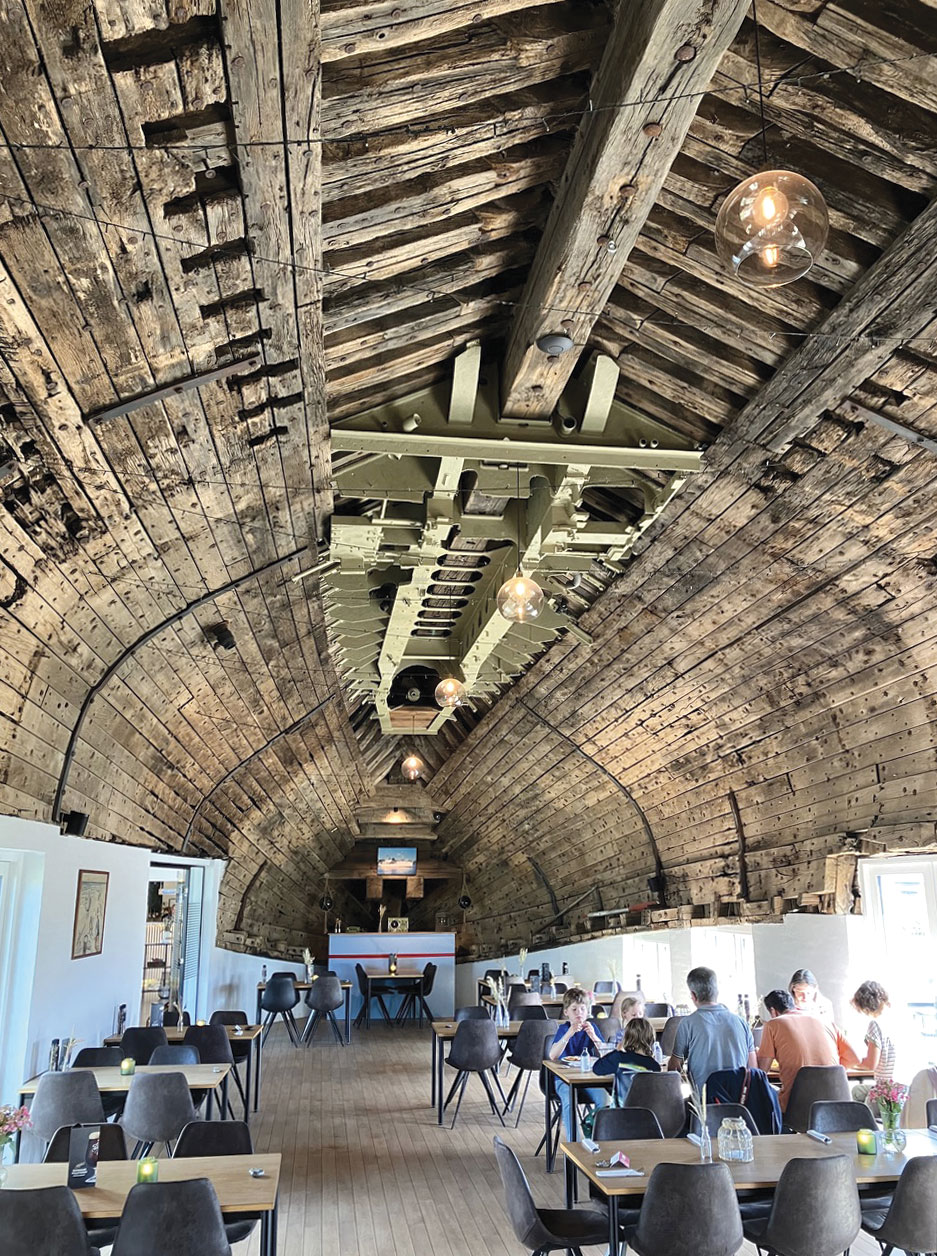
Perhaps taking a cue from my article (“No More to See” WoodenBoat No. 295) about ships turned into restaurants in New York City, Alfred Viskain of South Freeport, Maine, sent us photos of an unusual restaurant he encountered during travels in Denmark: “I join my friends each summer for a few weeks cruising in Danish waters. Last summer, we cruised the Limfjord waterway in northern Jutland. In the town of Thyborøn at the western outlet to the North Sea, we came across the striking view of two large, wooden fishing boats inverted to become a restaurant [Restaurant Mallemukken]. We only had coffees there, but the walk-through was amazing. It must have been an incredible project, given the size of the boats and the need to account for the much different stresses on the boats’ structure. Inside the restaurant, we could see a few places of reinforcement, but it seemed that most of the weight was handled by the original boat structure.”
 Alfred Viskain
In Thyborøn, Denmark, a very large fishing boat hull forms a roof over restaurant seating.
Thyborøn is a safe harbor that was formerly a significant North Sea port for fishing boats. More recently, the port services offshore wind-farm construction. It’s also a common port of call for transiting pleasure boats. “On one hand, it was sad to see these large wooden boats relegated to a restaurant venue,” Alfred writes, “but still better than being cut up for firewood. It was beautiful to walk around inside.”
What’s old is new again—there are known examples of using boats as roof structures elsewhere, especially in the Shetland and Orkney islands of Scotland, often for crofters’ huts.
 Bob Mazza
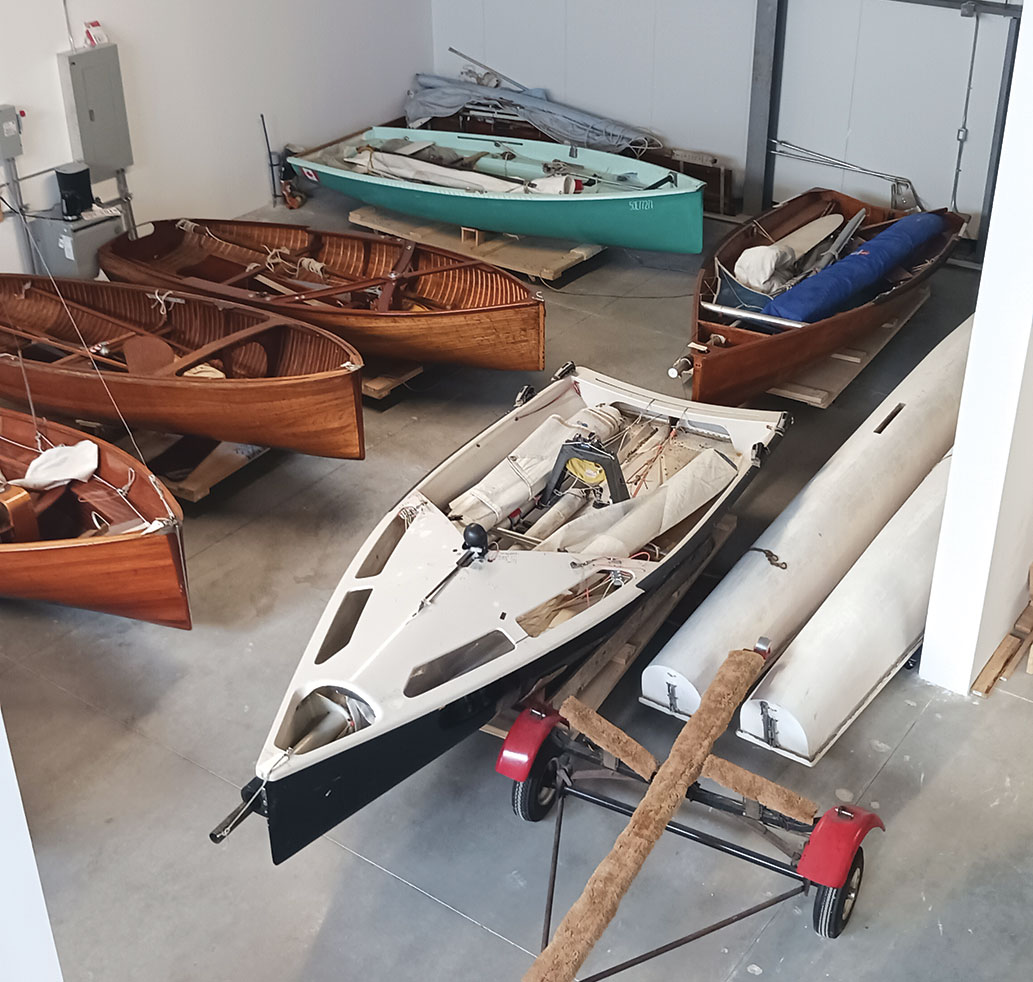
A growing collection of 14′ racing dinghies in Ontario is now stored in a sizable “condo” warehouse.
An Update on Canadian Racing Dingies
Rob Mazza, a naval architect in Ontario, Canada, has been a faithful correspondent regarding vintage and classic Canadian 14′ racing dinghies, which were highly instrumental in developing racing-design talent and dinghy designs (see Currents, WB Nos. 284 and 295). He writes from Hamilton with an update:
“When we last spoke, we were still in our rental facility with about eight boats in the collection. We now have 16 boats located in a brand-new ‘condo warehouse’ near Hamilton that has two large garage doors and ceilings high enough to allow us to step masts indoors. The majority are wooden boats. We are finding that wooden boats are cherished and preserved, while fiberglass boats seem to be cast off and abandoned in backyards and fields…. Most of these wooden boats were owned by the children and grandchildren of the original owners, and they were considered family heirlooms. The latest additions to the collection include:
“A 1940s U.S. One-Design 14. We picked up this boat just outside Annapolis, Maryland, with help from class enthusiasts Rod Mincher, Tom Price, and Bob Ames. This is a hot-molded International 14 from the 1940s built by Sandy Douglas based on Uffa Fox’s 1935 ALARM. Douglas and Fox used to race against each other in International Canoes in the Thousand Islands. A scaled-up version of this boat was the foundation of the Thistle Class, and the same boat with a Snipe rig became the Jet 14. The One-Design 14 was popular in the United States and attracted top sailors, including Dick Carter and Bill Lapworth, both of whom would go on to illustrious careers in yacht design. Although not strictly Canadian, U.S.–designed 14s would venture up to Canada in the 1940s and ’50s to race in the Canadian Dinghy Association Regattas in Montreal, Ottawa, and Toronto, and the class was very popular across Lake Ontario in Rochester, New York. These boats were the first monocoque 14s, soon followed by the hot-molded Fairey Marine Uffa Fox design in Britain and the ’51 Bourkes in Canada, one of which we also have in the collection.
“A 1954 Proctor II International 14. This was Ian Proctor’s second design. Proctor would go on to dominate the class in the late 1950s and early ’60s with the Proctor V. She was triple-planked by Chippendale and came to Canada in the early 1960s. We acquired her from the widow of the son of her original owner, who had preserved the boat for 40 years.
“A 1930s or ’40s George Corneil Lake Skiff Sailing Association 14. This boat, our latest addition, is believed to be a 1930s or 1940s George Corneil 14-footer designed and built to the LSSA rules. These boats predate the International 14, originating in the 1890s as a lapstrake-built (or clinker), cat-rigged, decked racing dinghy. The most famous example of those original 14s is the ubiquitous Aykroyd Dinghy, still very popular on Stony Lake in Muskoka, Ontario. In the 1930s, under the influence of the International 14, the LSSA 14 adopted the sloop rig but still maintained the deck and lapstrake construction. Both types raced in regattas, which is the reason that the Canadian Dinghy Association was created in the late ’50s to cater to both the LSSA and the International 14. (The merger of the International 14 and Australian 14 classes to create a new type in 2000 made all earlier boats obsolete, leaving many as ‘barn finds.’) This boat was completely refinished in 2019 and is in excellent condition.
“We continue to search out old 14s to fill in the gaps in the narrative that this collection represents in the development and evolution of small-boat sailing in Canada. [Contact him at robertLmazza@gmail.com.] The person who initiated this remarkable collection is Toronto sailor Fred Eaton, whose immediate goal is to collect and preserve. The ultimate goal is to partner with an existing museum to create a dedicated space for the display of these boats. If that space happens to be on the water, so much the better—at that point, sailing the boats becomes a definite option, but we are not there yet.”
It’s “Now or Never” for L’HERMIONE
Nigel Pert wrote in spring 2024 (Currents, WB No. 298) about the struggle to halt the rot problems brought on by fungi in the hull of the French replica frigate L’HERMIONE. The frigate’s owner, Association L’HERMIONE-La Fayette, hauled the ship out in Bayonne in southwestern France to deal with rot in her planking and structural oak timbers and hoped to be sailing this year. The project and the problems continue, however.
The ship, 17 years in construction at Rochefort, France, and launched in 2012, had been sailing for just seven years by the time the rot was detected. Now, an article in the English newspaper The Guardian brings to our attention the fact that the organization is raising an alarm for a “now or never” infusion of about €5 million (about $5.84 million) in addition to a like sum that has already gone into the complex repairs. The hope is that work can resume in September with a goal of relaunching in 2027 to keep the hull from drying out more than she already has.
The ship was built as a replica of the 32-gun flagship frigate that carried the Marquis de Lafayette’s fleet to the fledgling United States in 1780 to support the war of independence against Great Britain. The action turned the tide of the war in favor of the American colonies. The replica was well received in the United States after sailing to the East Coast in 2015, and the Friends of Fondation de France, USA helped support the project by providing a tax-deductible donation mechanism for Americans.
Above Image: Two obsolete fishing boats, each forming a roof over a wing of the building, were recycled for the purpose of creating a restaurant. Courtesy: Alfred Viskain.