
 Courtesy of the Museum of the Viking Age
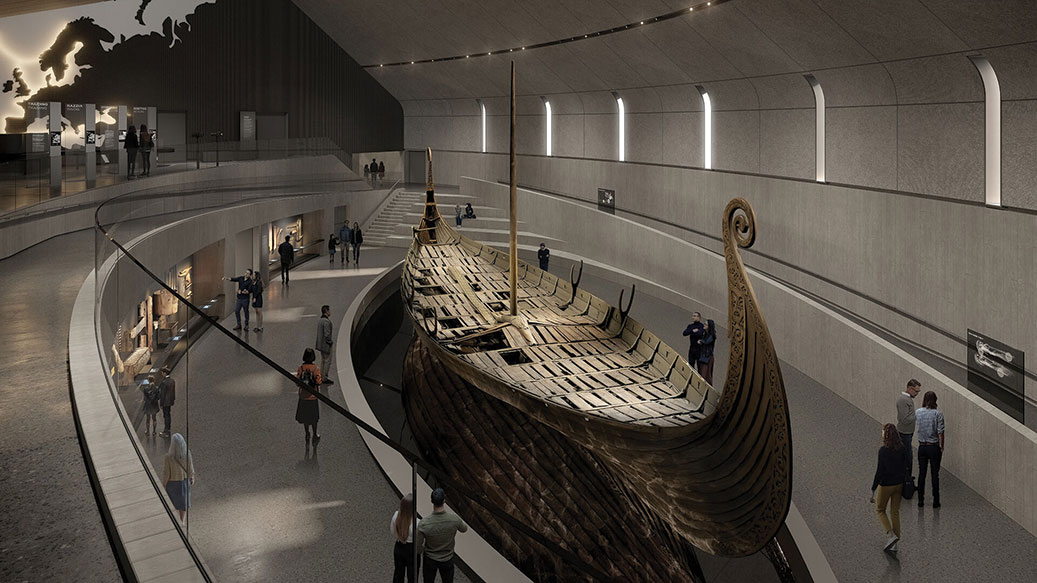
The ships will not only be better protected by building systems but also more visible from a variety of angles, as envisioned in an architect’s rendering. The museum will reopen in 2027.
A boat afloat is a remarkably easy thing to move. At equilibrium, it’s nearly a weightless thing. One person can easily get a line around a cleat to sway even a large boat into a dock. Ashore, it’s a different story, and there has never been a more elegant illustration of this eternal principle than the September and October 2025 relocation of Viking-age museum ships in Oslo, Norway.
These are the famous ships recovered by archaeologists from burial mounds around the Oslofjord between 1876 and 1904 bearing the names of the properties where they were found. The Gokstad and Oseberg ships are the stars of the museum’s exhibits, but the smaller, fragmentary Tune ship is not to be overlooked. Unfortunately, during the century that they have been on exhibit in a purpose-built museum on Bygdøy peninsula in Oslo, they have become increasingly subject to deterioration, largely due to humidity fluctuations and floor vibrations. A new wing, nearing completion, was developed by the Danish firm AART Architects for the Museum of the Viking Age, which is the new name for the re-envisioned Viking Ship Museum. The project is a fine-grained study of dramatic changes that have taken place in archaeology, museum science, and building technology in the past 100 years.
 Courtesy of the Museum of the Viking Age
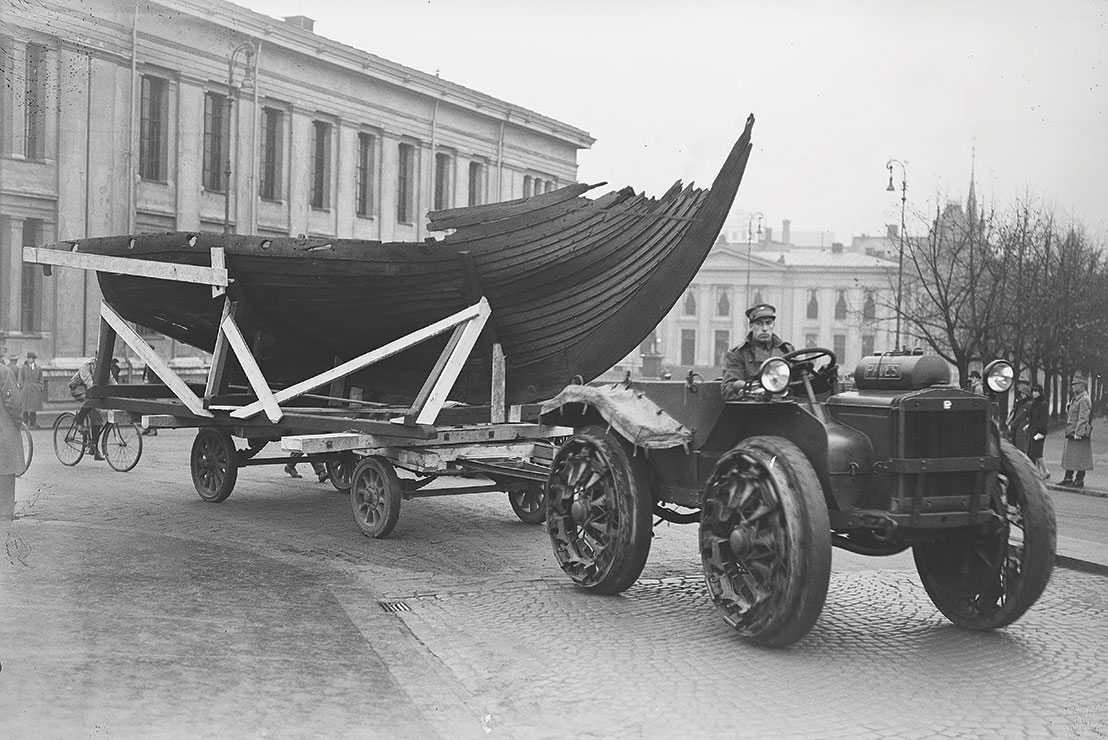
The precision of the move, which required extreme care to protect delicate wood, stood in contrast to the move to a museum purposely constructed in 1926.
The original much-admired building, designed by Arnstein Arneberg of Norway, has a cruciform floor plan, like a cathedral; the new and very clever addition connects the apse, the end farthest from the entry, in a sweeping curve to meet one wing of the transept. The addition will have state-of-the-art climate controls and less ultraviolet-light exposure, independent of the old building’s systems. To keep the ships as motionless as possible, the new wing will have heavy footings under the ships that will not only guard against shocks such as earthquake motion but also will be independent of the part of the floor that’s subject to vibrations from foot traffic.
The museum has celebrated—exalted, really—these ships as stunning examples of the key to the Scandinavian world’s early medieval period. The Gokstad ship of the year 890 is 76′ long and was buried in 900; the Oseberg ship of 820 is 70′ 8″ long and was buried in 834. Both are spectacular and largely original. Two more different ships would be hard to imagine: Gokstad, excavated in 1880, was a powerful oceangoing ship and a grave for a single robust man; Oseberg, excavated in 1904, was an elaborate ship ornate with awe-inspiring carvings and was richly laden with treasures buried with two women. Grave-robbers ransacked Gokstad but not the Oseberg burial. Both show how critically important and central to the culture boats were—and also how ubiquitous: you don’t bury a huge boat after only 10 years of service unless many others remain to serve critical needs. A third, the fragmentary Tune ship, estimated at 61′ long and built in 910, was the first ever recovered from a burial mound, in 1867, but at that time, modern archaeological standards were in their infancy.
 Courtesy of the Museum of the Viking Age
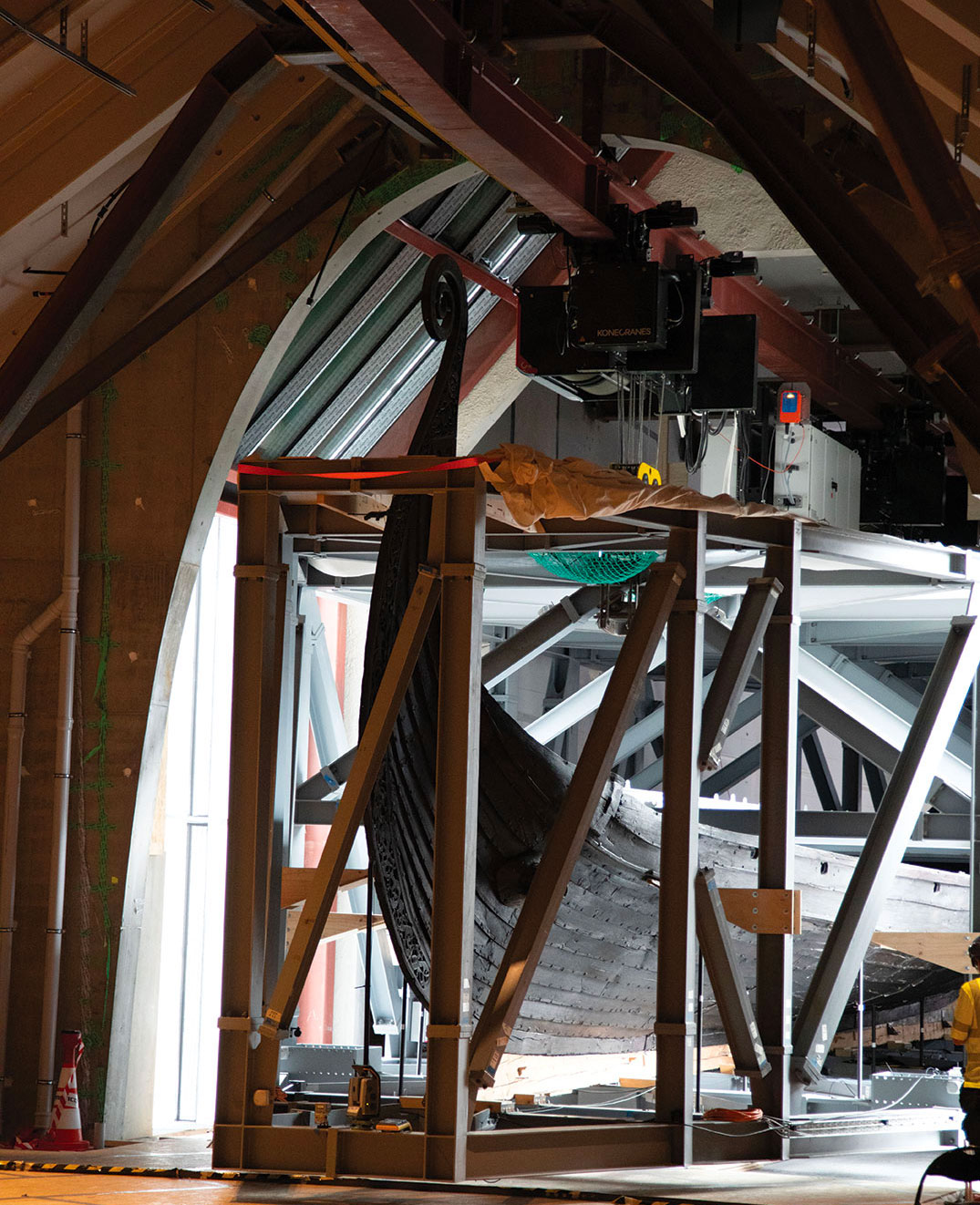
The intricately carved Oseberg ship was transferred on September 10 after a decade of planning for the technical challenge of safe transit.
The Bygdøy museum was built in 1926 specifically to house the ships, which have not been moved at all since. But the world moved on, with a century’s worth of accrued understanding of humidity, stability, and wood preservation but also the emergence of dendrochronology, genetic research, laser measurements, photogrammetry, and a dozen other specialties. The ships—and the astonishing grave goods found with them—were showing serious cracks and degradation. They had to be moved to safety if they were to survive.
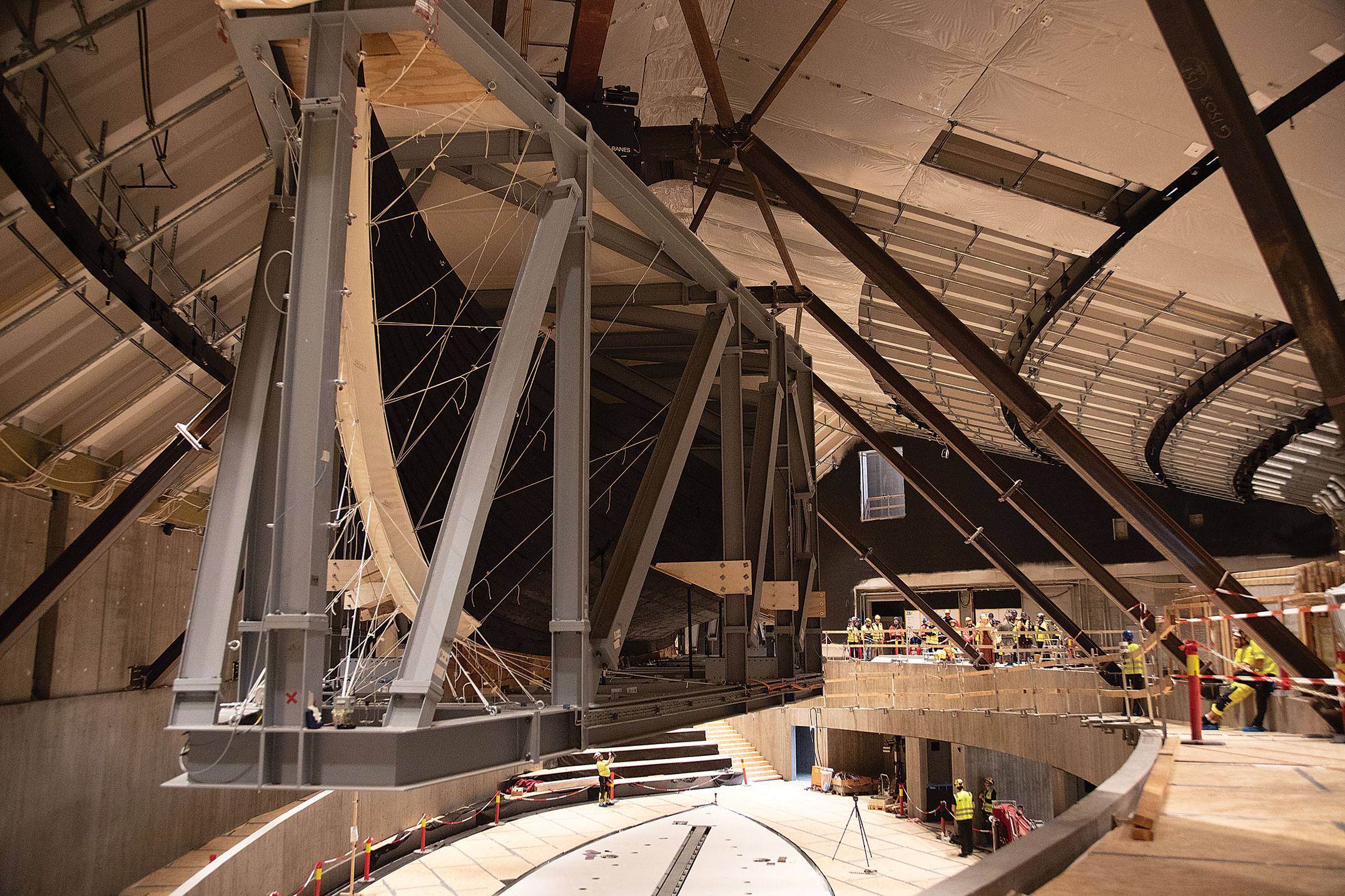
To do so, once the new building’s shell was completed an overhead steel rail system for rolling cranes was installed. Heavy support structures for the move were built specifically for each ship to keep movement within very narrow and strict parameters during the hoist. In September, the Oseberg ship was rolled 350′ to its new setting via the apse at a speed of about 10″ per minute; in October, the Gokstad ship followed, rolling 308′ via the transept. (See a time-lapse sequence of the move at the Museum of the Viking Age website.)
The Gokstad ship had never been moved in one piece, at least not since it was carried to the grave more than a thousand years ago. The grave robbers damaged its hull amidships, so when the University of Oslo archaeologist Nicolay Nicolaysen was ready to extract the ship in 1880, he set a different kind of plan in motion: “When all the other necessary preparatory measures were taken, the vessel was by winches, with tolerable ease, pulled out of the mound and then divided in two…. The larger or foremost part of it was then further strengthened and put on a large sledge provided with wheels. Eight and later nine horses were then put before it, but we proceeded but very slowly and were obliged very frequently to stop on account of the soft condition of the road….” It took 36 hours to get the forward section to the barge. At the University of Oslo, the ship was brought ashore and stored in a building but wasn’t fully reassembled until the museum itself was constructed more than three decades later. Incredibly, some of the planking was sound enough to be steam-bent to restore shapes.
 Courtesy of the Museum of the Viking Age
On October 29, 2025, the 76′ Gokstad ship, built in the year 890 and excavated in 1880, was moved into a new wing of the Museum of the Viking Age.
The era of the original Viking ship excavations coincides with a flowering of archaeology. The sensationalistic—albeit highly destructive—work at Troy in 1870 and Mycenae in 1876 by the German businessman-turned-archaeologist Heinrich Schliemann captured public imagination. Just before the Oseberg ship was uncovered, Sir Arthur Evans’s great work in excavating the Minoan city of Knossos on the island of Crete was under way, in 1900, following its discovery in 1877. The ship burials represent a Norwegian, and Scandinavian, version of classical antiquity. By the time the Gokstad and Oseberg work was undertaken—partly because landowners were getting curious enough to start digging on their own—archaeology had made a great leap into the modern era. Both ships were carefully documented and were considered exemplary excavations in their day. The new building and the ships’ move prove that technology and science are advancing still.
The latest move has been a decade in planning and was executed, by all accounts, without flaw by Statsbygg and Imenco in conjunction with the museum staff. But the work is not over. The Tune ship was the last of the three to move, and then the extremely rich and delicate grave goods—especially from the Oseberg ship but including three spectacular small boats found with the Gokstad ship—will need care of their own. Afterward, the climate of the new building will be controlled independent from the original building, which will serve as an architecturally preserved entry and interpretive area.
The museum is scheduled to reopen in 2027. When I visited in 2005, I saw in person the Gokstad faering that started me on a path of boatbuilding and study; a single photograph I saw of that boat when I was very young left an impression that never faded. Artists’ renderings of the new exhibits show that the ships—which for a boatbuilder were frustratingly hard to examine closely and from various angles—promise to be much easier to view. (But my advice: if you go, take birdwatching binoculars anyway.) They’ll be there long into the future. They’ll inspire other young people to study and to start building. And that, too, is not such a light load to carry. 
Tom Jackson is WoodenBoat’s senior editor.