
 Tom Jackson (both)
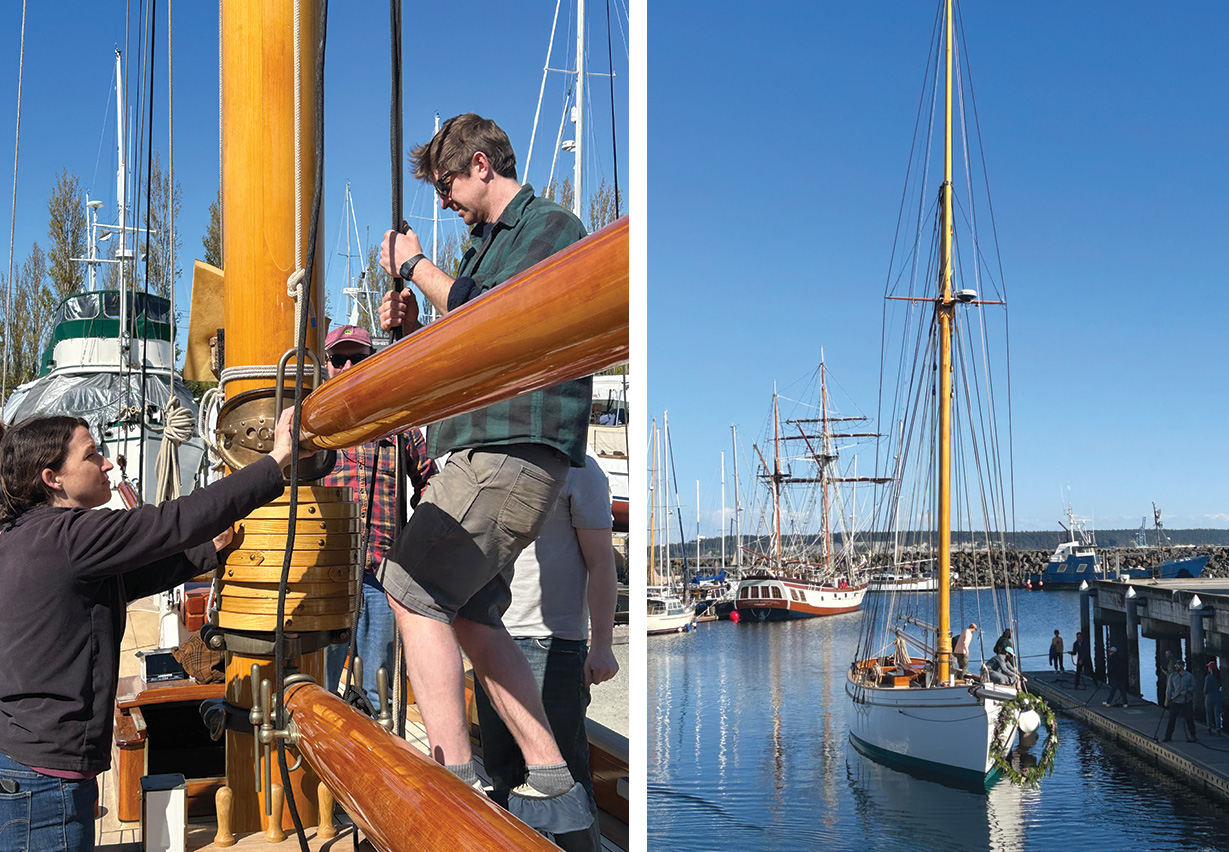
The English boatbuilder Leo Goolden relaunched TALLY HO on April 18 in Port Townsend, Washington, but has much more to do before sea trials. Left—The day before the launching, Leo and his crew of independent contractors brought the gaff aboard and later hoisted the topmast. The gaff is of Sitka spruce, as are all of her spars.
Almost everyone who has built or restored a boat faces a question: are you fitting your life into a boat, or are you fitting a boat into your life?
I was reminded of this at Leo Goolden’s April 18, 2024, launching of the 47′6″ yacht TALLY HO at the Haven Marina in Port Townsend, Washington. Leo, a native of southwest England, has been restoring the Albert Strange–designed 1910 yacht for the past seven years. The project has been all-consuming. He bought the boat from the Albert Strange Association for $1—and, as one boatyard owner once joked to me about a similar arrangement, “he should have got change back.” Leo’s videos have covered every facet of the project, starting with yanking deck planks off by hand as she lay deteriorating in Brookings, Oregon. Leo’s quality of craftsmanship and his nearly 200 engaging videos have made the reconstruction a spectacular success. He’ll be sailing soon. (An article about the project is forthcoming.)
In the couple of days ahead of the launching, I listened and observed, staying out of the way of the work. The actual launching was as quiet as such a high-profile case could be; about a hundred people waited, most of them marine-trade folk, as the Travelift hoisted the yacht free of her blocks and jackstands. Then we all followed, as natural as bioluminescence in a wake, during the slow drive to the waterfront. Leo gave a short speech that started off with “I don’t like speeches.” As TALLY HO floated free, he scrambled forward and aft, checking the load waterline and awarding it a thumbs-up.
As I later replayed that day in my mind, I turned back to “Four under 35,” the article I wrote about Leo and three other builders of similar age (he was 29 then) taking on major restorations (see WB No. 267). Leo also wrote about replacing TALLY HO’s keel in that issue. He started off working solo, but that didn’t last long. His videos soon attracted volunteers, and later came independent contractors—a flock of them, most of them about Leo’s age (he’s 34 now), swarmed the boat in the days before launching. The three other builders featured in the article remained largely solo. What all four had in common was ambition, purposefulness, and abundant energy.
Sawyer Theriault, then 27 (now 32), was the youngest. Weary of sitting behind a computer, he took on the restoration of a Rhodes 19, which he renamed ALETHEIA. “I still have the Rhodes and will be sailing her for her fifth season this summer,” he said in May. “Since speaking with you last, I have actually become pretty entrenched in the boatbuilding world.” He’s in Portland, Maine, where he worked two years as a marine carpenter at Portland Yacht Services. Since leaving there, he has worked three years full-time for the owner of a private yacht under the direction of lead shipwright Richard Stanley of Mount Desert Island. But it all started with something the Rhodes project taught him: “I learned that I loved it, basically. And I think being able to see a project to completion like that was really substantial in terms of getting me further along and deciding to do it as a career.” He gravitates toward joinerwork; one of his favorite projects lately has been building a butterfly hatch for a 60-footer. He’s getting married this fall, and in his spare time he’s refitting a ’glass-hulled 1967 Hinckley Pilot 35 he bought for his own use. As for the Rhodes, he said, “I don’t think I’d ever get rid of this boat.”
Sarah Schelbert, who was restoring the 1960 Danish-built 36′ sailboat ALANI in Guatemala largely by herself in 2019, finished her project. She now lives aboard at the Grenadine island of Carriacou, where she has been working as a sailing instructor and charter skipper. Now 35, she has raced ALANI in the Antigua Classic Yacht Regatta every year since 2022.
Ian McMurdo still has the 34′ gillnetter, SEA SHADOW, whose hull he rebuilt with some help from his father in British Columbia. He is now 38 and married, has a 14-month-old daughter, bought a house in North Vancouver, and found a new job as maintenance supervisor for SeaSpan Marine’s fleet of more than 100 barges. His house is near his boat’s moorage, but he has had a hard time finding time to finish the interior. His envisioned Inside Passage cruises will have to wait. “I can keep up with the basic maintenance, doing an annual haulout, and keeping it looking clean and tidy,” he said, “but finding the time to do upgrade work has been a real challenge and a bit frustrating. I think we’re just at a bit of a pinch point in life right now.”
But Ian found benefits from having taken on a large project. “Essentially, I plan projects and run projects for other people… Every time, you get a little bit better at it.” But he, too, sees benefits from his experience with his own project: “There are some real tangible connections there. I think you have a stronger sense of accountability and the true understanding of what it takes not just to do it but to do it well…. I get lots of enjoyment from the work on SEA SHADOW, but I think I have a more realistic view of what it takes to do some of these things and the brutal honesty you have to have with yourself about how much work there really is…. I think I figured out that I do enjoy doing it, but I don’t enjoy it taking over my life in the way that it did for that concentrated period of about four-and-a-half years.”
Both Sawyer and Ian have followed Leo’s progress videos. “Oh, yeah—I watch every episode,” Sawyer said. “It’s an amazing story.”
“I’m just blown away by everything he’s done,” Ian said, especially the widespread community that has built up around TALLY HO. “Hats off to him. I think his skills would be very transferable to a lot of different things, and running complex projects is a big part of that.”
The choice implied in that initial question—fitting a life into a boat, or a boat into a life—ends up being too stark. It’s both; only the proportions vary. And the reply is as unique as a fingerprint.
Around the yards
◼︎ TALLY HO may have commanded most of the attention on her launching day, but the shipyard at Port of Port Townsend’s Haven Marina was abuzz with the kind of activity that shows just how concentrated wooden boat work has become in this town. Among the steel workboats and fishboats readying for their seasons there were plenty of wooden boat projects. The Port Townsend Shipwrights Co-Op—which now has a staff of 63—had a number of boats ready, or nearly ready, for the water as of April 18:
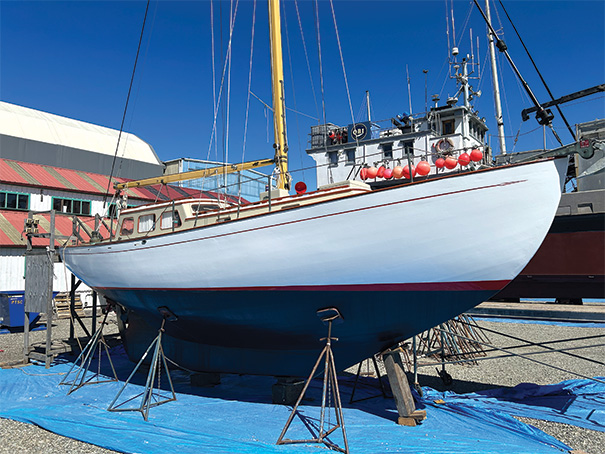
Lester Stone–designed 33′ sloop, LITTLE PACKET
• Tim Lee, one of the owner-shipwrights, had his Lester Stone–designed 33′ sloop, LITTLE PACKET, built in 1958 at Stone Boat Yard in California, on standby for relaunch. He has been working on the boat and making upgrades over the five years he has owned her—this year, he refinished the mast and overhauled the standing rigging. Earlier, “We pulled the old Universal Atomic Four out of it and put a Yanmar 3YM30 in there,” he said. Part of that project involved sistering frames that had degraded under the engine. He gave the boat new fuel tanks at the same time and installed a galvanic isolator, a lithium house battery, an absorbed-glass-mat starter battery, and a new battery charger. He also isolated the propeller shaft by mounting the stuffing box to a 5⁄8″-thick plate of G-10, counterboring the bolt heads, then mounting the plate to the shaft log on hanger bolts. This year, he wooded and refinished the topsides. “Over the years, I’ve probably put five or six planks on—I just always identify the next bad plank and take if off in the next haulout. Every year we take on a little more.”
• Inside the main building shed, the Concordia yawl No. 15, LOTUS, built in 1953 by Abeking & Rasmussen in Germany, was being reconditioned to get her ready for sale. Her sheerstrakes, toerails, and covering boards needed attention after water ingress caused rot problems, especially at the starboard mizzen chainplates. “Then it’s a huge refinishing job,” Tim said, to include the spars. Relaunching was expected by early summer.
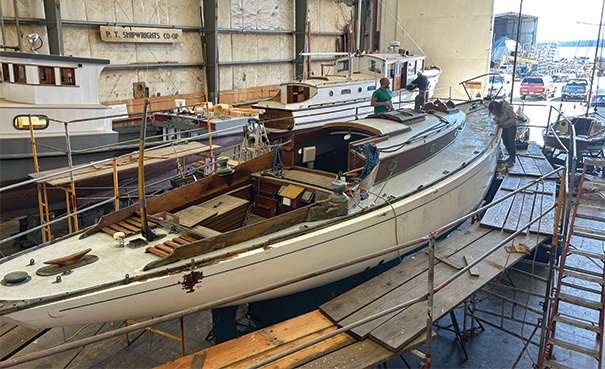
ISSWAT, 34′×10′×4′, is undergoing a multi-year restoration by co-op member Jeff Galey for his own use.
Alongside the Concordia, ISSWAT, 34′×10′×4′, is undergoing a multi-year restoration by co-op member Jeff Galey for his own use. The boat was built in Ketchikan, Alaska, in 1948 and had a varied career as a troller, log-pond tender, tug, and pleasure boat. Jeff, who has owned her since 2018, has sistered a number of frames and replaced numerous planks. He has refastened and recaulked the hull, completed extensive deck work, and replaced the wooden lifts making up the curved bulwark aft. “This year is the big one: repowering,” he said. He plans to install a new Perkins diesel engine. “My goal, my hope, my dream, maybe, if I can do it, is to get it to where I can go fishing with it again,” which will involve adding hydraulics, a mast, and poles for commercial hand-trolling.
Also inside the main shed, RIPTIDE, a 48′x11′ by 4′5″ bridge-deck cruiser, a regular annual customer, was having some refinishing and interior work done. Built by Schertzer Brothers on Lake Union in Seattle in 1927 to an Ed Monk design, she has been owned since 2015 by Pete Leenhouts, formerly the executive director of the Northwest School of Wooden Boat Building, where he had earlier been a student of Tim’s after a career as a naval officer. The boat has had much work done at the co-op over the past decade, including having frames sistered, topsides replanked, and a new Cummins 6PT engine installed. This year largely involved interior work, including the installation of an Airhead composting toilet and making the living space more comfortable for cruising. “The co-op’s done all the work, except the staving on the inside of the cabin, which was done by another shipwright,” Leenhouts said. “But the work here is so high-quality that there just really isn’t any comparison, as far as I’m concerned. I just come here every year,” and he works alongside the shipwrights.
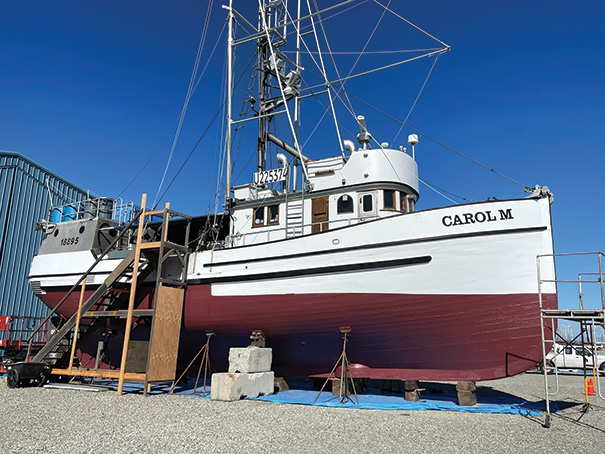
CAROL M is having her annual routine work done.
• Outside, Diana and Mike Clausen’s ocean troller CAROL M was having her annual routine work done. Diana, who works in the co-op office, said the boat, 56′6″ LOA, was launched in 1926 for halibut fishing. “We bought it in December of 2008,” Mike said, “mainly for albacore,” venturing as far as 200 miles off the coasts of Oregon and Washington. The boat has annual work done at the co-op, which this year involved installing forward trolling poles and some rigging and systems work. “They did a pile of work to it back in the late ’80s,” Mike said, including installing aluminum bulwarks, an aft shed, and raising the decks.
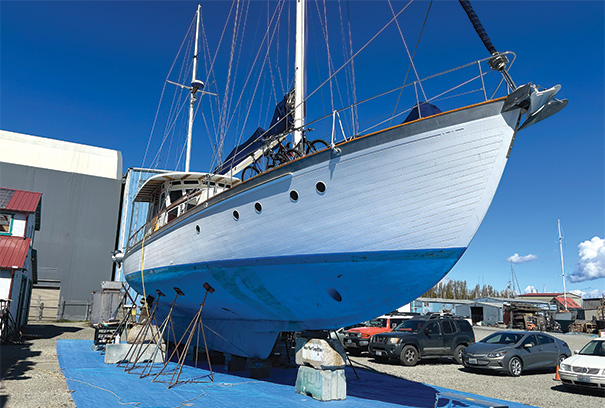
Manuel Campos–designed ketch LUNA.
• Also outside, the Manuel Campos–designed ketch LUNA, 73′ LOA, which has been having its work done at the co-op for about 15 years, was having final details completed to prepare for a season of chartering. The boat was built in 1941 in Argentina, Campos’s native land. She has had her sheerstrakes, plus one lower strake, replaced, and following Tim’s recommendation, aluminum bulwarks were installed—a common solution to commercial boats such as CAROL M—to eliminate covering board leakage issues. The owner, Scott Ashworth, said the boat was originally planked with lapacho, a type of ipe, almost all of which was intact.
• Also, the sailmakers of Carol Hasse’s former Port Townsend Sailmakers have moved to the co-op, which bought the business upon Hasse’s retirement. Six sailmakers work in a loft about equal in size to their former space in historic buildings at the opposite end of town.
Port Townsend Shipwrights Co-op, 919 Haines Place, Port Townsend, WA 98368; 360–385–6138; www.ptshipwrights.com.
◼︎ Haven Boatworks, just across the way from the Shipwrights Co-Op, also had a full house that week:
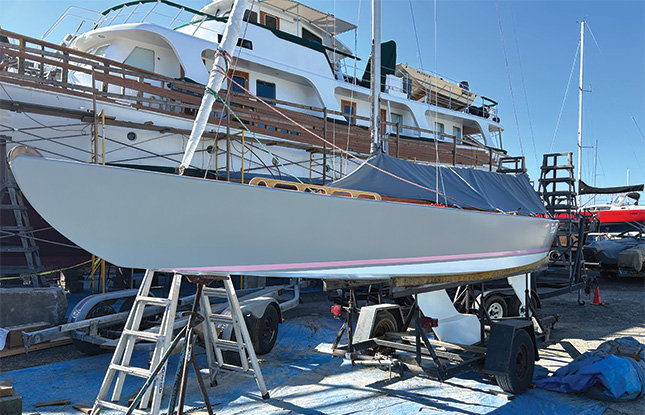
MONTEGO, a 93′ LOA power cruiser built in Croatia in 1967.
• MONTEGO, a 93′ LOA power cruiser built in Croatia in 1967, was having significant work done to her topsides. “We’ve been working with the owners of this boat for decades off and on,” yard owner Blaise Holly said. “She’s wanted work on the bulwarks for a while, and eventually the time really came.” They were being rebuilt entirely, and at the same time through-deck fittings were being renewed, simplified, and made watertight. “We had the chance to actually build up the foundation so that it’s pretty clean,” Blaise said. She is unusual, at least in these parts, for being planked entirely in oak.
Just off MONTEGO’s port bow was a Ray Hunt–designed International 210 that Blaise is reconditioning for his own use. He has replaced its standing rigging with fiber, led belowdeck thorough fairleads. The jib has a belowdeck roller-furler. He is also experimenting with Hempel fouling release paint instead of antifouling: “Time will tell how it does. I plan to scrub it before every race.”
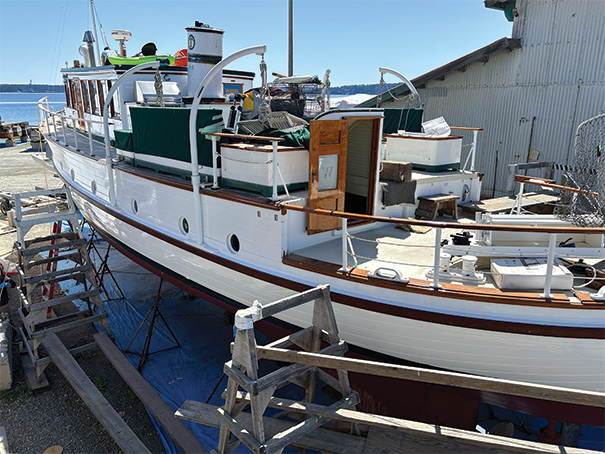
WYRILL, a 62′× 15′× 7′ power cruiser.
• WYRILL, a 62′×15′×7′ power cruiser built by the Boeing Company in North Vancouver, British Columbia, in 1931, was hauled out to repair storm damage she suffered in Whittier, Alaska. The damage was minimal, and Blaise said she needed only minor repairs to the deck and sheerstrakes, and “a winter’s worth of refinishing.”
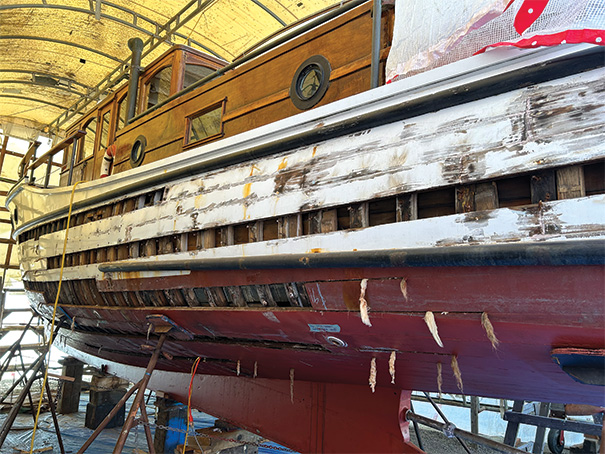
• A second North Vancouver yacht, YONDER, built in 1928 at the Hoffar-Beeching Shipyard, which was later merged with the Boeing Company, was having some sister frames installed and planks replaced. “I was really proud of the gang,” Blaise said. “They got seven sisters in right the way up to the sheer, shooting them in from the far side of the boat. When I see fits like that, it just makes me feel like we’ve done a good thing for a boat.” The in-place planking was supported by jackstands and braces to hold her shape while the kerfed frames were bent in. Blaise thinks the boat was used to test various engines: “There’s a lot of old plumbing that would relate to a variety of engines having been put in, and the engine beds are really chewed up,” he said. “And then there is the bizarrely large propeller aperture. When we did the horn timber and the shaftlog last year, we took the opportunity to kind of clean up the running gear.”
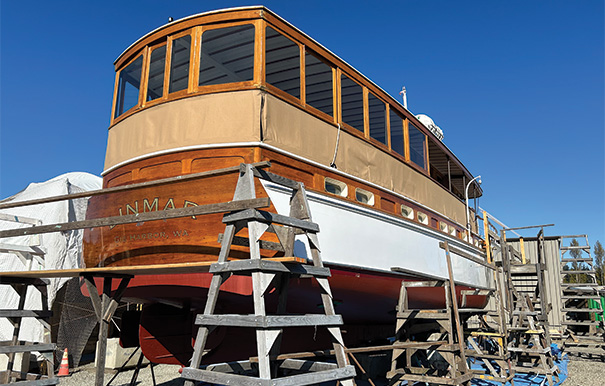
LINMAR, a 78′ power cruiser.
• Another yacht having shaft work done was LINMAR, a 78′ power cruiser that was hauled out mainly for cosmetic work ahead of the season. She was launched in 1932 at New York Launch & Engine Company; her home port is now Gig Harbor, Washington (see www.linmaryacht.com). In previous years, Haven Boatworks did an extensive deck refit using 2¼″-thick laid teak, neatly nibbed into the coved sill timbers of the deck structure and the covering boards. The yard has done extensive interior and topsides work as well, including reinforcing the boat deck over the aft saloon. This year, the most significant work involved the drive train. Having a climate-controlled machine shop, which is new since the yard moved to a new site a few years ago, has made that possible: “We’ve been turning our own bearings down, and we’ve been using Thordon water-lubricated material quite a lot,” he said. “Thordon plastic is so temperature-sensitive that even though it’s going to be underwater and relatively stable, you’ve got to machine it for that interference fit at a known temperature. This new shop’s proved terrific for us.”
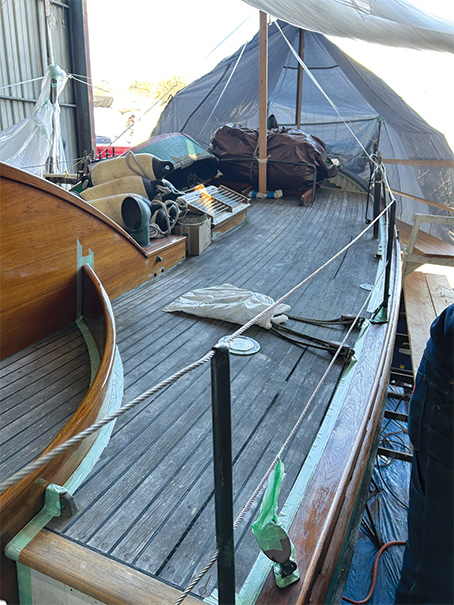
JOHANNA, a 41′ LOA gaff cutter built by Peter Christiansen of Shaw Island, Washington to a design by John G. Alden,
• JOHANNA, a 41′ LOA gaff cutter built by Peter Christiansen of Shaw Island, Washington (see WB No. 205) to a design by John G. Alden, was hauled out mainly for cosmetic work to renew the brightwork, give the deck a good scrubbing, renew the running rigging, and upgrade the blocks. “I can’t say enough about the way that Peter put this boat together,” Blaise said. “I mean, frankly, it’s humbling to see just the dead fit after dead fit, the way the centerline timbers, the hollow garboards are fit up, the scarfs in the covering board—I mean, it’s just about the highest level of craft I’ve seen in wooden boatbuilding in my career.” And that’s saying something.
Haven Boatworks, LLC; P.O. Box 1430, Port Townsend, WA 98368; 360–385–5727; www.havenboatworks.com.
◼︎ “On a chilly February morning in Manhattan,” Mai La Thai writes from New York City, “I was set to catch up with Lorne Swarthout, a retired history teacher and ‘unofficial official’ boatbuilding supervisor, and newly elected treasurer, at the Village Community Boathouse at Pier 40 in Hudson River Park. A plumber engaged to fix the heating system hadn’t shown up, so Lorne busied himself with work on a new boat built to the plans of AMERICAN STAR, a 27′4″ Whitehall-style gig built in 1824 in Brooklyn and presented to Revolutionary War hero General Lafayette, who was given a hero’s welcome when he returned to the United States from France in 1825 for a celebratory tour of the country whose cause he had aided.
“The original boat’s lines were taken in France by the American maritime historian John Gardner, who built a replica of the boat in 1975, in time for the bicentennial of the country’s founding in 1776. Gardner named the new boat GENERAL LAFAYETTE, and it remains in the collections at Mystic Seaport Museum, Connecticut, where he built it.
“Walking past stacked gigs and rows of boats, I found Lorne fitting the ash quarter knees. ‘I wake up worrying about it,’ he said, because this boat isn’t just another addition to the boathouse’s fleet; it carries the weight of history. One purpose of the reconstruction is to garner interest in a hoped-for race between BRONX STAR and HUDSON STAR, as the new boat is named, possibly during the organization’s November youth races at Pier 40. The race would commemorate the 200th anniversary of AMERICAN STAR’s win over the British gig DART, taking the $1,000 challenge purse put up by the captain of a visiting British frigate.
“Over the years, the boathouse’s crew of volunteers, young and old, have built a variety of boats, including dories, canoes, and plenty of Whitehalls. With a history of successful projects, Lorne now leads the VCB’s inaugural AMERICAN STAR project, actively participating alongside volunteers and ensuring smooth progress, and it’s his labor of love.
“‘What’s different is how we built it,” he said. The original was built with very light ¼″-thick cedar lapstrake planking, and although this new boat’s planking is also ¼″ thick, it is strip-planked and the resulting smooth hull is sheathed in fiberglass cloth set in epoxy.
“Compared to a normal gig of the Whitehall type, it’s longer at 27′4″; it’s a bit narrower, 4′ rather than a more typical 5′; and its freeboard is comparatively low. ‘This was built as a racing boat,’ Lorne said. ‘It’s built to be light. It’s built to go fast.’
“Lorne said this would be the fifth reconstruction of the boat in the United States: in addition to GENERAL LAFAYETTE at Mystic Seaport, there is one in the Bronx and two in the Puget Sound area. The original AMERICAN STAR remains in France.”
Village Community Boathouse, 353 West St., New York, NY 10014; www.villagecommunityboathouse.org.
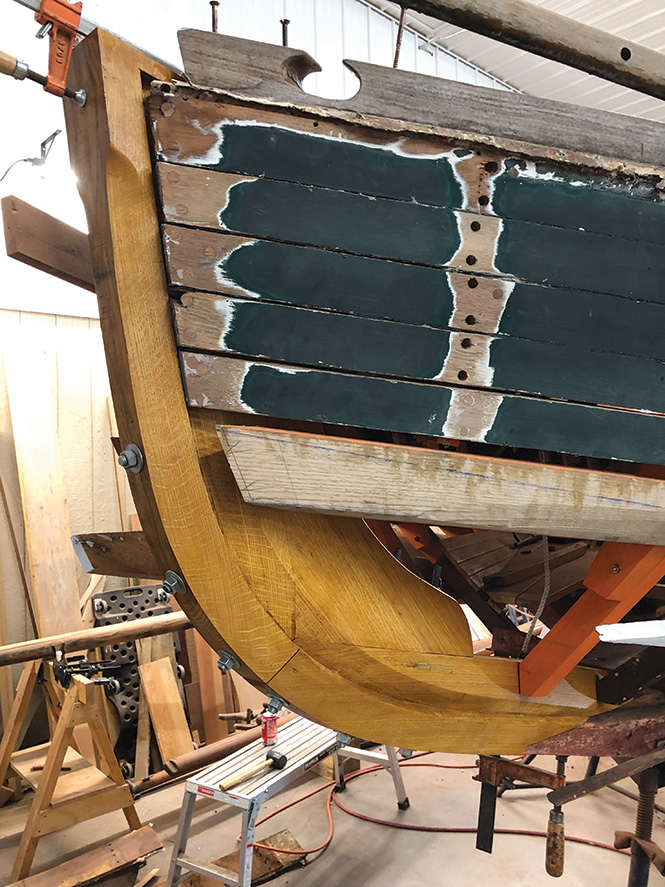 Padanaram Boatworks
In Portsmouth, Rhode Island, Padanaram Boatworks is restoring a Sea Bird yawl built in the 1930s.
◼︎ Keith Brown writes from Padanaram Boatworks in Portsmouth, Rhode Island, about a restoration currently underway: “The spirit of Thomas Fleming Day is alive and well here. The shop is currently working on a 1930s Sea Bird Yawl, a 26′ hard-chined boat designed by Day when he was the editor of The Rudder. Day’s design combined relative ease of construction with bluewater capabilities. As such, these boats have developed a bit of a cult following. The work list for the sturdy yawl has included removing as much of the remaining (now deteriorated) steel or iron as possible, along with the resulting iron-sick wood. The chines have been replaced, and the boat will also receive a new stem, rudder, deadwood, and a new lead ballast keel to replace the cast-iron one. A new mast is planned as well. Day famously sailed his centerboard version across the Atlantic. While this early example may not venture as far when finished, it will be capable of doing so if required. A relaunching in spring 2025 is expected.”
Padanaram Boatworks, 2451 East Main Rd., Unit 7, Portsmouth, RI 02871; 401–251–4280; www.padanaramboatworks.com.
Offcuts
◼︎ “For the 10-part FX/Hulu miniseries ‘Sh¯ogun,’ which streamed this spring, much attention was paid to the detail of the sets, costumes, weapons, and even the historic version of Japanese spoken by the actors,” Douglas Brooks writes from Vergennes, Vermont. “But ships and boats played a prominent role as well, and in 2021, because of my background in traditional Japanese boats [see www.douglasbrooksboatbuilding], I was hired by Disney as a consultant for the series.
“The story, based on a 1975 novel by James Clavell, is set in about 1600, and most of my input was in regard to small boats. Most prominent are the ‘samurai boats,’ for which I relied on research by Tokyo University documenting SENZANMARU, the oldest plank-built boat in existence in Japan. Preserved in a museum in Tokushima, the boat was built in 1857 and is based on a type, known as a whale-chaser, which greatly influenced military dispatch and troop transport boats of the time. Scroll paintings from the era of the ‘Sh¯ogun’ story show very similar watercraft. For example, look closely at the famous Hokusai wood-block print ‘Great Wave off Kanagawa’ of 1831, and you can see three similar boats, in this case fishing barges known for their speed. Most Japanese sea boats have a keel plank with two planks per side. The steeply raked stem creates a hull with a very fine entry, which gives it speed. Six to eight sculling oars are typical (see WB No. 192).
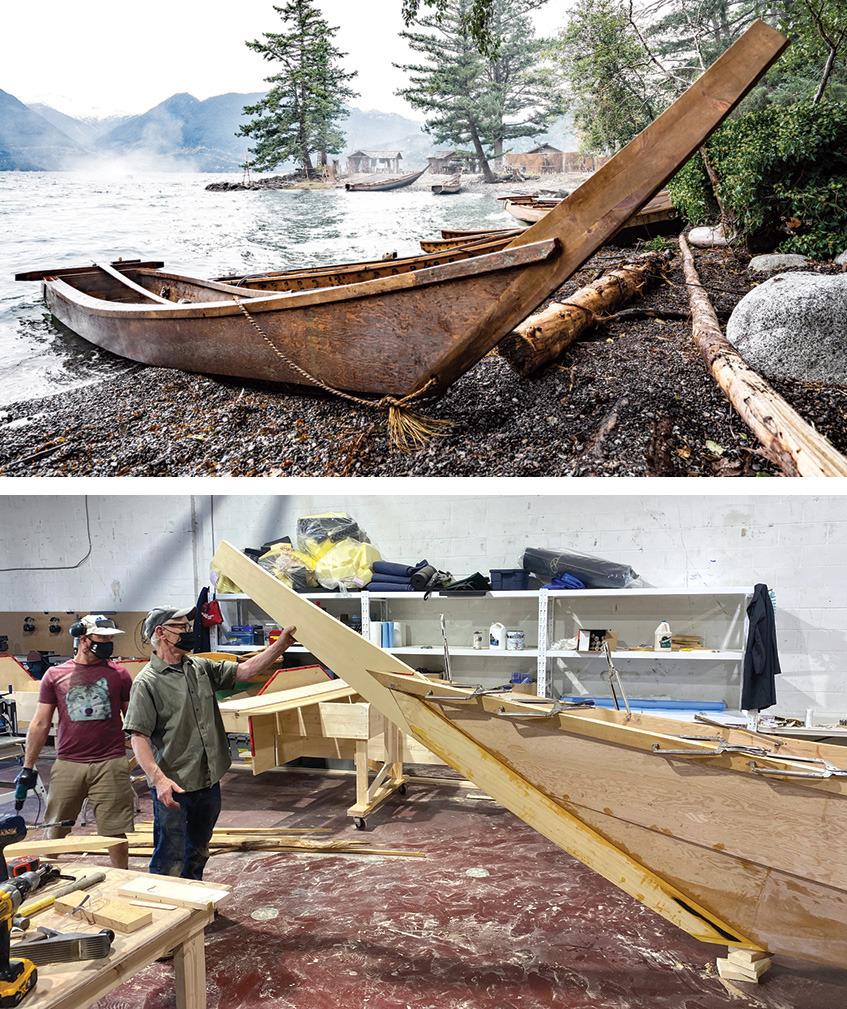 Jay Kent, Set Decorator; Quill Goldman, Barefoot Wooden Boats
For the spring miniseries “Sh¯ogun” that streamed on Hulu in early 2024, Douglas Brooks consulted on boats, producing a design representing Japanese types from about 1600; he also coached boat handlers on sculling techniques. Bottom—Quill Goldman of Barefoot Wooden Boats built several boats to Douglas’s design in British Columbia, where the series was filmed.
“‘Sh¯ogun’ was shot on two different sets and a sound stage in British Columbia, and Disney turned to their set builders to make several samurai boats to the design I provided, led by shipwright Quill Goldman of Barefoot Wooden Boats on Gabriola Island. In some scenes, viewers can see more than two dozen of these boats in action. Most are computer-generated, as are all the sailing scenes involving two Japanese warships that were built full-sized inside the sound stage. The hulls were made of plywood, then grain-painted. To provide a variety of watercraft, the set builders also bought fiberglass dragon boats and cut them in half to make two small boats from each. It was innovative, though not authentic. The studio also bought two Japanese boats my Bates College students built in 2019.
“Perhaps my most important contribution to the series was teaching 30 extras how to use the Japanese sculling oar. Originally, the producers assumed the boats would have to be towed on camera while the extras swung oars cut off at the water’s surface. When I heard this, I asked Disney to give me a chance to train them. A month before shooting began I flew to the set to work with them, following the boats in a small inflatable, shouting instructions and encouragement. Within a week they had the basics down and I had a promise they would keep training. It was a small detail in the scope of the series, but I am happy to have played a part in getting things right.”
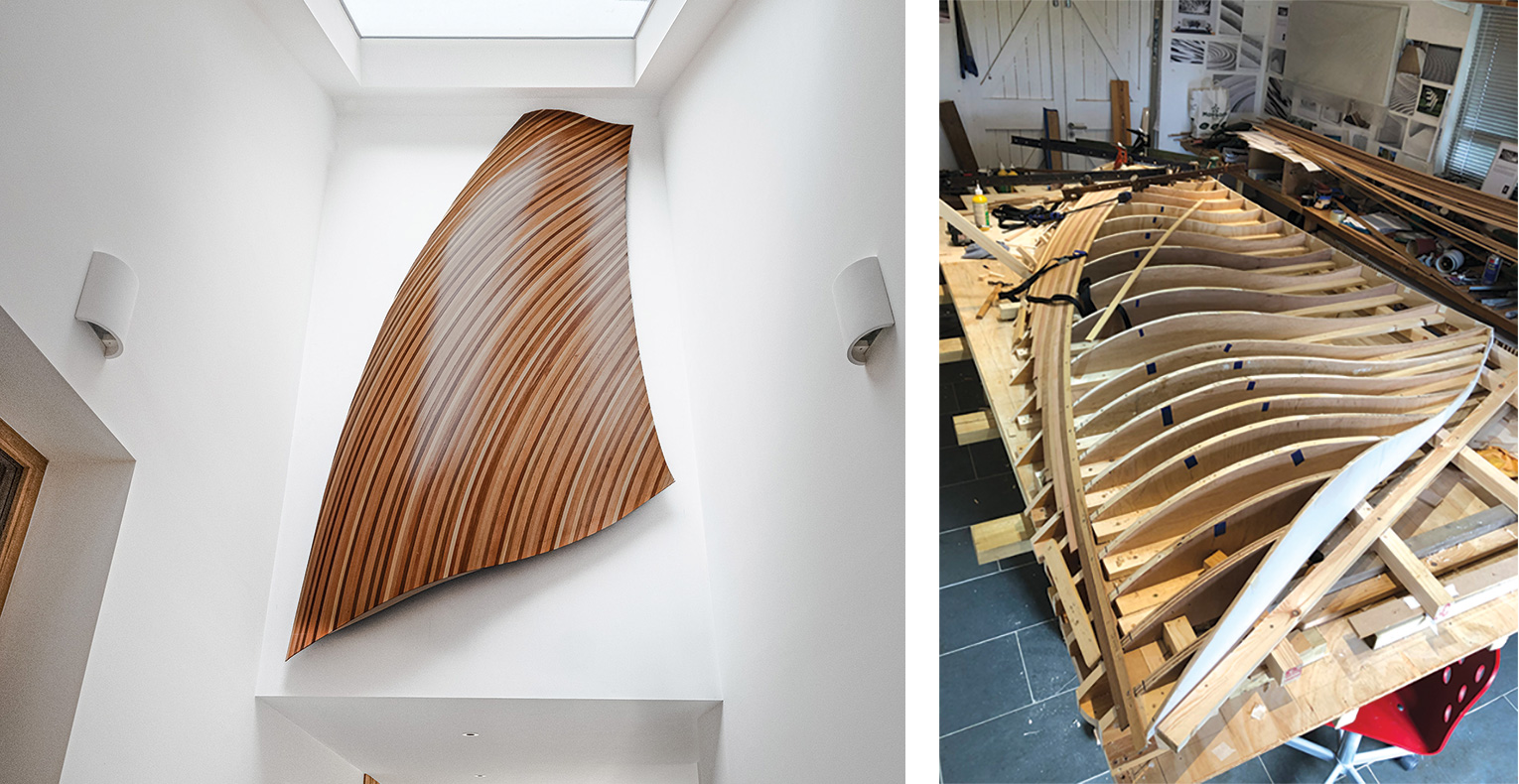 William Lasdun (both)
Left—William Lasdun of Devon, England, was inspired by strip-planked kayak construction to create a cedar-strip sculpture in the form of a sail for clients who are avid windsurfers. Right—Lasdun erected molds over which the cedar strips were glued.
◼︎ Some call boatbuilding an art, and we hear often enough from artists who think so. One of them, William Lasdun of Devon, England, writes to tell us of a sculpture he recently completed using inspiration from strip-planked boatbuilding techniques: “My clients, who live in Hampshire, approached me to make some kind of sculpture for a new atrium space in their hallway. After chatting at length with them and learning that they were passionate windsurfers, I proposed making a sculpture inspired by the form of a windsurfer sail. They loved this idea, and it proved to be a really great project to work on and resulted in some very happy clients. It’s built using the cedar strip-planking method commonly found in the construction of kayaks but reinterpreted as an art form.
“I’ve never built using this method before, or anything like it, but a few years ago I was visiting the Adirondack Mountains in the United States and spent an hour in a workshop for kayak builders, chatting about this technique and looking at the cedar-strip kayak under construction. It struck me that this would be a great technique for building the sort of curved sculptures I’m interested in [see www.williamlasdun.com]. I worked out the molds first in white card with cedar strips laid over them to see how much bend the wood would take. Then the molds were transposed onto plywood and the strips glued on. The finish is varnish, chosen for minimal effect on the color of the wood.”
Across the bar
◼︎ Howard E. Makela, 68, March 29, 2024, Fort Bragg, California. Mr. Makela was born into a salmon-fishing and boatbuilding family. His father, Fred, and uncle, Nick, descended from Finnish immigrants, started their boatyard at Noyo Harbor in Fort Bragg in 1947 (see WB No. 171). Mr. Makela bought and restored his first fishboat, PIRU, a Monterey clipper, at age 16. He continued to work in the boatyard in the off season. In 1983, at age 27, he bought and rebuilt the 49′ Makela-built SEA WOLF, which had been damaged in a fire. In 1994, he decided to turn to boatbuilding full time so he could spend more time with his family. Repair and maintenance work on the troller fleet continued to be the mainstay of the yard, but Makela also built new boats. An important mentor for him was veteran Fort Bragg boatbuilder Dean Stephens. He also built yachts, most notably IDORA, a William Atkin–designed Ingrid gaff sloop, 37′6″ (see WB No. 126), which was followed by LEGACY, a 42′ John G. Alden–designed Malabar II schooner. His daughter, Kiersten, and a nephew, Clinton Gibney, apprenticed under him. Mr. Makela died as a result of a fall from a boatyard ladder.
◼︎ Benjamin B. Baker, 84, January 9, 2024, South Dartmouth, Massachusetts. Mr. Baker first learned to sail as a youth at his family’s summer home at Wings Neck in Pocasset, Cape Cod, graduating from a Sailfish to a Herreshoff 12½ and then a Buzzards Bay 15. Herreshoff yachts became a lifelong passion: under his ownership, two of them—the Newport 29 TEASER of 1926 and the 46′ power cruiser ARIEL II of 1931—were restored at Ballentine’s Boat Yard in Cataumet, Massachusetts. He was a supporter of the Herreshoff Marine Museum in Bristol, Rhode Island, where he and his brother in 1984 donated TORCH, the 1930, 43′3″ Fishers Island Sloop that they had co-owned for 15 years. Among his other boats, also restored at Ballentine’s, was MERLOT, a 1952 Palmer Scott powerboat that had served as the chase boat for Buzzards Bay marine photographer Norman Fortier. Mr. Baker graduated from Harvard College in 1962 and earned a master’s in urban planning from the University of North Carolina, Chapel Hill; in 1970, he moved to New Bedford, Massachusetts, where he served as city planner. He and his wife, Deborah, were longtime supporters of the New Bedford Whaling Museum and the historic Zeiterion Performing Arts Center. He belonged to the New Bedford and Buzzards Bay yacht clubs and the Cruising Club of America; he was also a U.S. Coast Guard reservist, retiring in 1985 as a captain.
◼︎ Paul Stephen Bryant, 80, April 7, 2024, Damariscotta, Maine. Mr. Bryant, a lifelong resident of Newcastle, Maine, started building boats at Riverside Boat Co., which was founded in 1946 by his father, Creston Bryant. His father gave him his first sailing dinghy when he was just five years old. His boatbuilding career was interrupted only by six years in the U.S. Coast Guard reserve. He built boats that he or his father designed, including five for his own use, all named HOOT MON. He was an avid racing sailor. He succeeded his father as the yard’s proprietor, and worked on many classic yachts. He harvested wood from his own woodlot, cut it on his own sawmill, and earned a reputation for finding clever solutions on the fly. He also served 50 years as Newcastle’s harbormaster.
◼︎ Susan F. Funk, 67, December 10, 2023, Mystic, Connecticut. A native of Marblehead, Massachusetts, Ms. Funk learned to sail as a youth. In 1977, while a senior at Bates College in Lewiston, Maine, she became the first enrollee at the new maritime history program by Mystic Seaport Museum and Williams College, during which she helped shipwright Willits Ansel build a dory. After graduating Bates, she joined the demonstration squad at Mystic Seaport. She worked for the institution in a wide variety of roles for 40 years, ultimately being named in 1994 as executive vice president and chief operating officer, from which she retired in 2020. Projects with which she was involved included the schooner AMISTAD construction, the CHARLES W. MORGAN’s “38th Voyage” program, and the reconfiguration of the museum’s north entrance. A Children’s Museum on the ground was renamed in her honor upon her retirement; earlier, she had started weaving demonstrations there.
◼︎ Rick Nash, 77, March 21, 2024, Haliburton, Ontario. Originally from Monson, Massachusetts, Mr. Nash worked as a photographer in New York City but found his life’s work in the early 1970s while working with birchbark-canoe builder Henri Vaillancourt of New Hampshire. In 1978, Mr. Nash moved to Ontario, where he became a curator and resident canoe builder at Kanawa Canoe Museum, a precursor to the Canadian Canoe Museum in Peterborough. In 1983, Mr. Nash started his own workshop in Dorset, near Haliburton. He not only built birchbark and wood-and-canvas canoes but also crafted meticulously researched scale models documenting canoe types. When the Canadian History Hall opened in 2017 in the Canadian Museum of History in Gatineau, Québec, the display included a full-sized Nash-built replica 10m (32′10″) birchbark canot du maître, an iconic type used by the early fur-trading voyageurs. In the book The Canoe: A Living Tradition (Firefly Books, 2005), Mr. Nash contributed the chapter about birchbark canoes.
◼︎ Ken Warby, 84, February 20, 2023, Cincinnati, Ohio. Word came to us late that Mr. Warby died last year. He was the subject of a feature article (WB No. 145) about his October 8, 1978, Unlimited Water Speed Record, which he achieved in his home-built, wooden-hulled SPIRIT OF AUSTRALIA, a jet-powered 27′ boat of his own design that took him to an official speed of 317.6 mph at Blowering Dam Reservoir in New South Wales in his native Australia. The record still stands. He moved to Cincinnati in 1993 but continued to develop speedboats with his son, David, who continues the effort. 
Tom Jackson is WoodenBoat’s senior editor.