
by Nigel Pert
 Nigel Pert
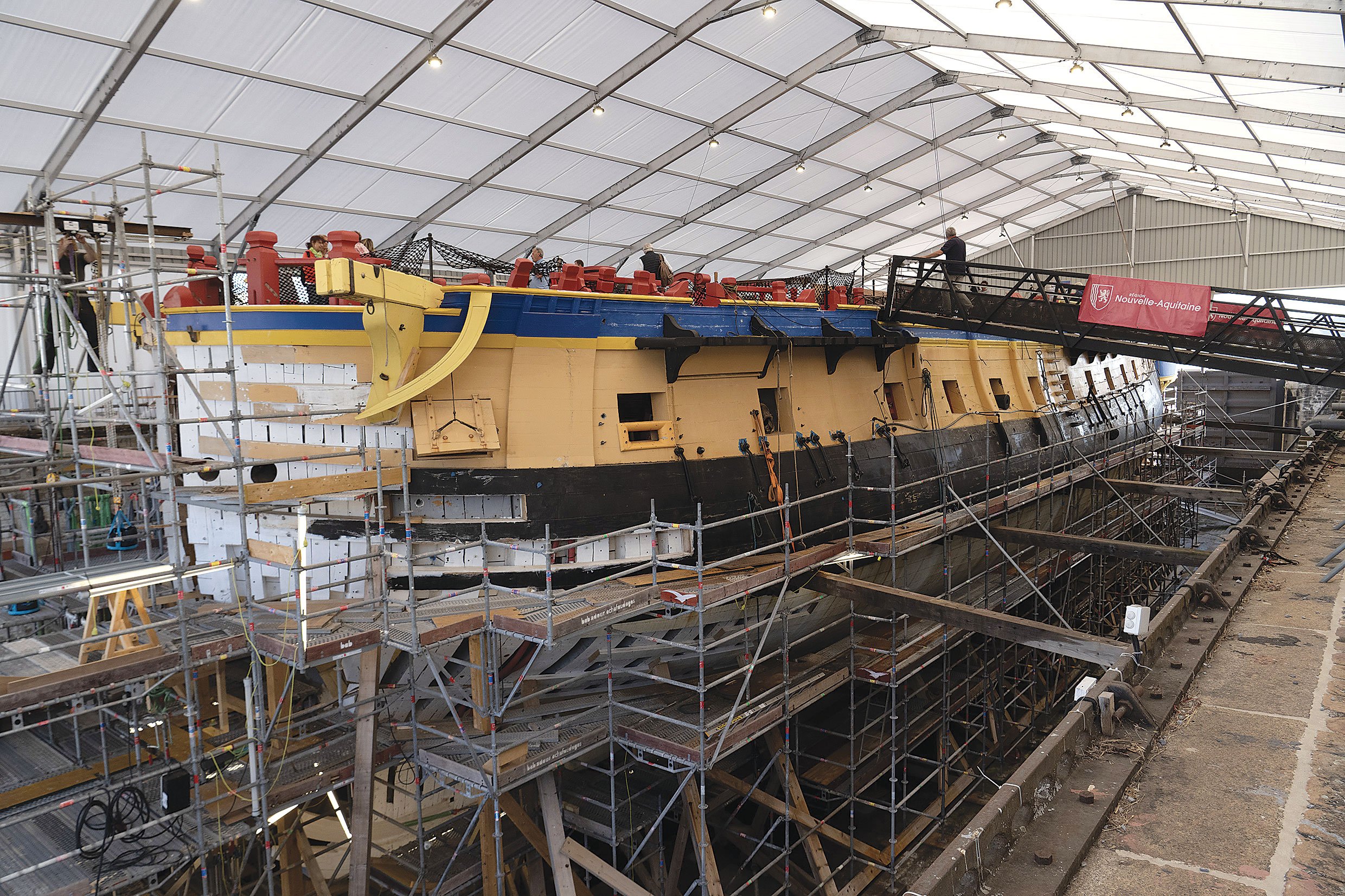
L’HERMIONE, a replica frigate built in Rochefort, France, put to sea for the first time in 2014, but only seven years later she is in dry-dock for major hull repairs.
L’HERMIONE, the replica of a French frigate of 1780 (see WB No. 244), spent 15 years under construction in a dry-dock in Rochefort, France, and after launching in 2012 spent two more years afloat in the tidal zone of the Charente River before being ready for sea. She had been sailing for just seven years when a routine maintenance haulout in May 2021 revealed that her oak hull timbers were badly damaged by fungi. The repairwork is ongoing but should be finished—finances permitting—in early 2025. In addition to the repair, shipwrights are investigating causes, solutions, and lessons to be learned for the benefit of other vessels.
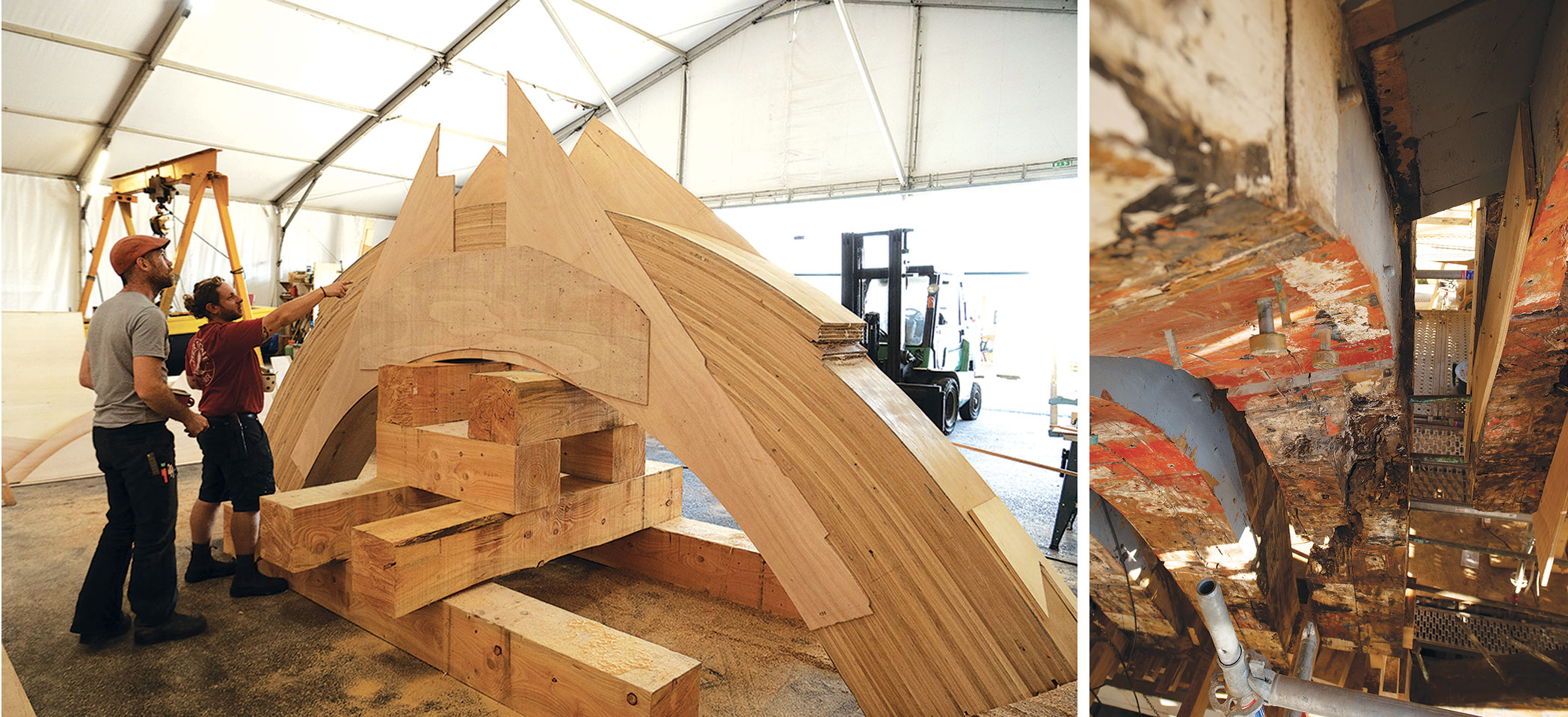
The destructive organisms are the xylophage fungi called oak mazegill (Daedalea quercina) and white rot (Donkioporia expansa), both of which attack oak and thrive in damp conditions. An initial warning was sounded in 2019, when 1⁄16″-long beetles were found on the lid of a drum of hydraulic fluid in the engineroom. Analyses in various laboratories were inconclusive, and since no areas of rot were seen, their presence was attributed to the proximity of a trash can. Later, however, the laboratory of the Museum of Natural History in Paris identified specimens as a xylophage beetle with a penchant for oak that is rotting because of fungal action. In the 2021 haulout, a shipwright probing a tiny area of damaged paintwork below the waterline aft on the port quarter was alarmed when his knife simply disappeared into the plank. When sections of two planks were removed to investigate, the underlying frames were found to be deteriorated, too.
The Association HERMIONE La Fayette, which owns the ship, called for a thorough inspection. The ship spent the summer tourist season in Rochefort and then went to a dry-dock in Bayonne in southwestern France. The Asselin company, one of her original builders, was hired to investigate and then restore the structure aft, under the project management of Yachting Concept. In September 2022, Chantier du Guip, a renowned boatyard in Brest, started work at the bow, which was less affected than the stern. Although Guip shipwrights were initially engaged to replank the hull after the structural work by Asselin, they ended up having to first disassemble the whole bow, figurehead and all, for structural repairs.
It got worse. Initial investigations aft revealed severe rot to the keelson, lower frame futtocks, seven cant-frame pairs, the sternpost, and the sternpost knee. Portions of the deadwood and the after half of the keelson had to be removed. Forward, the damage was confined to the area around the lower stem, extending to about the forward end of the keel and up to adjoining structures such as the lower cant frames and hawse pieces. Access involved total disassembly of the beakhead.
There are various theories as to causes. During the initial construction, sources of large-sectioned, well-seasoned oak were very rare; consequently, much of the timber delivered was relatively fresh-cut and apparently not always adequately stickered for ventilation. Some was refused because signs of fungal infection were already present. Use of inadequately seasoned wood also led to shrinkage after installation. By the time the vessel was floated out of its covered construction workshop, joints had opened, allowing rainwater to reach the structure. It has also been suggested that L’HERMIONE’s long time in the low-salinity, brackish waters of the Charente also favored fungal growth. Scaffolding and temporary supporting pine timbers were possible sources of fungal spores. Precise information on surface treatments during the hull construction is difficult to verify, but it seems that red lead was used initially, followed by zinc-based treatments after red lead was outlawed. Historically, vessels such as the original L’HERMIONE suffered from the same kind of fungal problems; active service for contemporary warships was rarely longer than 10 to 15 years. The areas affected are ideal for fungal growth: dark, relatively warm, and with wood moisture content of 20 to 80 percent.
 Nigel Pert
Left—With large-dimensioned timber rare, epoxy-laminated structural timbers are being used for replacements. Right—Two species of fungus caused serious deterioration in the oak used in the ship’s hull framing.
For the current repairs, the same problem of finding good, seasoned oak in large dimensions persists. Consequently, replacement structural timbers are being made of 1⁄2″-thick layers epoxy-laminated to the needed dimensions. The wood being used is well-seasoned, being naturally dried and then finished off by kiln-drying to a moisture content of 12 to 15 percent. Such epoxy-lamination techniques were also used during the replica’s construction where curved compass timbers—unavailable in modern times—would have been used in the 18th century. In the current work, those pieces were found to have suffered much less fungal damage than dimensioned-timber structures in the same area, so the hope is that laminations will greatly reduce the likelihood of a recurrence of fungal attack. All parts are being remade exactly as to the original drawings; the only difference is in the stock from which they are cut. Furthermore, new timbers, and as many existing ones as possible, are being treated with antifungal compounds such as a borate solution called Boracol and also Sylix gel and Xylix 2000, which use polyphenolic plant extracts that have low environmental impacts while retaining a high fungicidal efficiency, according to the manufacturer’s website.
The costs are high—as is invariably the case in wooden ship repair, much higher than anticipated. The Association L’HERMIONE La Fayette, which has managed the whole project since its inception, is constantly raising money. The major source during the construction was shipyard visitation and merchandise sales, which remain an important element during repairs. Recently, the French government made a direct contribution of about $1 million and recognized the association as a nonprofit organization eligible to receive tax-deductible donations. About $6 million more is needed to finish the project. The ship has a strong historical connection to the United States; the original L’HERMIONE was the flagship for the Marquis de Lafayette when he arrived in America in 1780 to support Gen. George Washington in the war of independence. Therefore, a campaign to raise tax-deductible donations in the United States has been launched through Friends of Fondation de France, USA (www.friendsoffdf.org/will-lhermione-the-frigate-of-freedom-be-able-to-set-sail-again-in-2025).
Ever faithful, many of the 600 trained crew members help to raise money and volunteer to continue routine maintenance, which doesn’t stop during repairs. Various ideas are in the air for future sailing programs after she is refloated, hopefully in 2025. A return trip to the United States is a high priority, probably with many young Americans among the crew. Between voyages, L’HERMIONE will probably spend most summer months in her home port of Rochefort and then winter over in a saltwater port. In addition to direct antifungal treatments, the current work aims to improve ventilation and lighten the structure to enhance air circulation below. Additional technical solutions may include installing monitors to detect spore levels in the atmosphere and a radar system of a type used in buildings as a noninvasive control for mold.
This long period of repair and the additional precautions are intended to ensure L’HERMIONE a further long life at sea, enriching many hundreds more young lives.
Nigel Pert has photographed L’HERMIONE since the start of construction in 1997 and has sailed aboard many times. His photos have illustrated articles and books on the subject published worldwide. Although always a photographer, specializing in the maritime world since 1992, he has also had a variety of other jobs, including boatbuilding. He divides his time between France and England.
Around the yards
 Favourite Boatworks
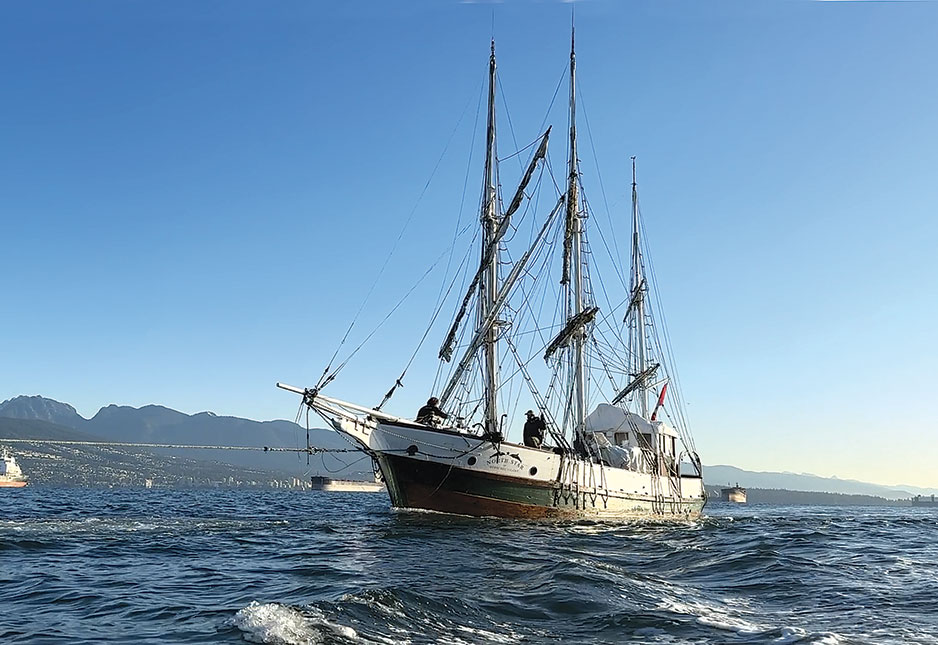
NORTH STAR OF HERSCHEL ISLAND, built in 1936 as an Arctic seal-hunting vessel, was towed from Vancouver, British Columbia, to Richmond for a complete reconstruction at a new boatyard, Favourite Boatworks.
◼︎ A new boatyard in Richmond, British Columbia, has taken on several historic boat restorations in the past couple of years, including NORTH STAR OF HERSCHEL ISLAND, which for years has been a fixture at the heritage harbor at the Vancouver Maritime Museum.
“Favourite Boatworks was funded by Lyle Franklin in 2022 at Shelter Island in Richmond,” Johannes Fast writes from the yard. “The first year, Lyle was working together with an apprentice on various projects, from an East Coast lobsterboat to laying new decks and full interior renovation on a 50′ Chris-Craft. This year, Favourite Boatworks was awarded the contract to restore and refit the NORTH STAR OF HERSCHEL ISLAND, built for Arctic seal hunting in 1936. The vessel had just changed owners and ended up in the care of June Harrison, who lives just up the street from the heritage harbor in a house she’d finished restoring a couple of years ago.
“With that contract, Favourite Boatworks had to expand fast in preparation for the tow and subsequent haulout. It was still only Lyle and one apprentice, but within a few weeks the company had grown to over 10 employees. Today, roughly four months later, we’re closing in on 20 employees.
“It was not a small task getting such an old and deteriorated vessel safely to the marina at Shelter Island, which is located up the Fraser River delta, one of the busiest rivers in the region. Fast-flowing river water, log barges, and shipping traffic added additional layers of risk to an already risky tow, but on a calm and sunny day she made it up the river.
“Once she was on land, the crew got to work emptying and indexing all the loose items in the interior, and artifacts collected over 88 years were meticulously removed, photographed, and stored away. Once the ship was emptied, the crew got to work cleaning. There was mildew and mold as far as the eye could see.
“For the past two months, the crew has been working on carefully taking her apart without losing her hull shape or structural integrity. Lots of issues have come to light, and we’re at a point where it’s looking as though very little of the original wood will be left after she’s been rebuilt. Rotten-through deckbeams, a cracked and rotten beam shelf, and deteriorated planking are just a few of the issues that have come to light at this stage. We’re looking at the potential of only saving parts of the keel and keelson.
“For the past few weeks, the crew has been working on making the first new frames, starting from the bow and stern simultaneously and slowly working toward the midship region. The shape of her stern and the difficulty in sourcing large-enough timber has the crew working with multiple techniques to make the frames. Some are sawn and some are laminated.”
The boat, 57′ on deck, was built at Kneass Shipyards in San Francisco, California, for seal hunting, and later fur trading and Arctic trading, by Inuvialuit people living on Herschel Island, Yukon, near the McKenzie River delta. In the 1980s, a subsequent owner converted her from a sloop to a full-rigged ship. In 1996, she was purchased by R. Bruce Macdonald, who owned her for 28 years; he wrote a history of the boat published in 2012 and has started a website devoted to her (the website is no longer live as of this posting). The site has links to the yard’s series of YouTube videos about the project.
 Favourite Boatworks
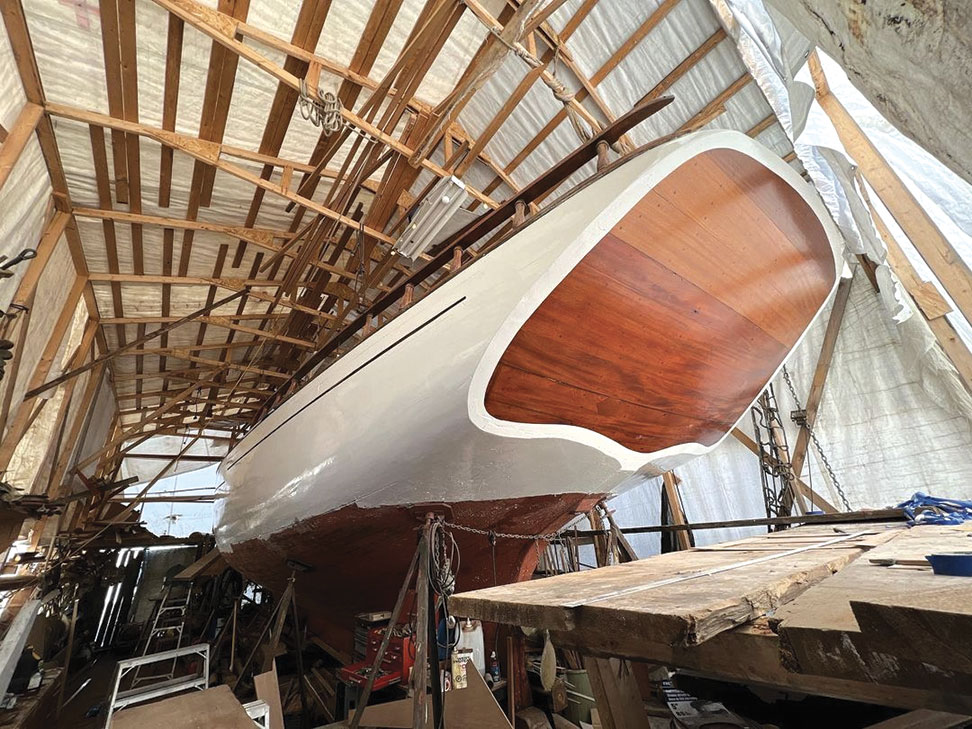
FAVOURITE, a 1910 sealing schooner 48′ LOA, is also being rebuilt at the yard.
The yard is also continuing work on FAVOURITE, Lyle Franklin’s 48‘ sealing schooner of 1910. “She is in the finishing stages of a full refit and rebuild from the waterline up,” Fast wrote. Another project is AILSA CRAIG, Fast’s own 38‘, 1949 power cruiser, one of Ed Monk Sr.’s last designs, which has had some work done to her hull, including replacing a few planks in the stern. The yard also is consulting and advising the owners of LILLIAN BELLE, a 58′, 1946 purse seiner, and MIRTH OF MUSIC, a 70′ Frank Fredette–designed sealing schooner. “We also just relaunched WESTERN YEW, a 43′, 1946 power cruiser used as a forestry boat, after some hull maintenance,” Fast wrote.
Favourite Boatworks Inc., 6911 Graybar Rd., Richmond, British Columbia, V6W 1H3, Canada; 604–800–9627.
◼︎ “The total restoration of U.S. Coast Guard surf rescue boat No. 24667, built in 1944 by the Curtis Bay Boat Yard of Baltimore, Maryland, for service in Chatham, Massachusetts, is well under way at the Cape Cod Maritime Museum in Hyannis,” Peter Cross writes from the Cape.
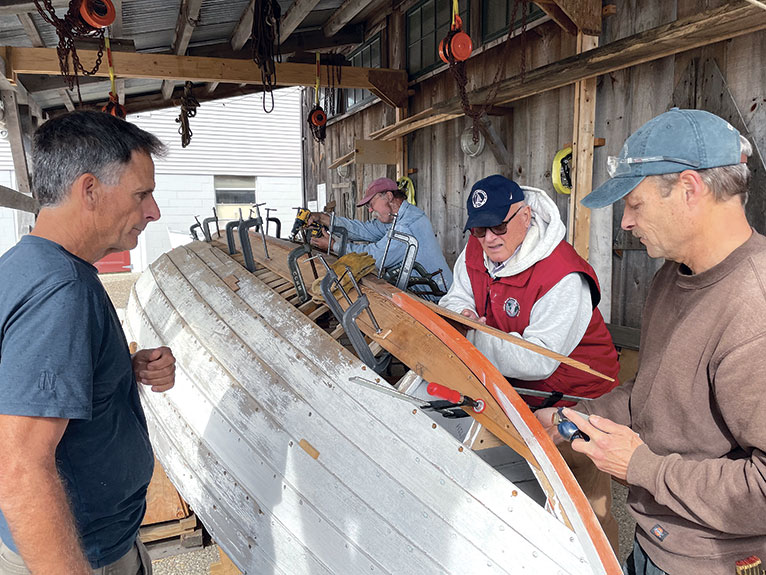
“Since the winter of 2019, a small group of experienced volunteer boatbuilders led by Tony Davis, owner of the Arey’s Pond Boat Yard in Orleans, has been working on the project. The boat is a double-ender, built to be launched from a beach with a crew of five oarsmen and one steersman. She is 26‘ 6“ LOA with a beam of 6′ 2″ and weighed 1,200 lbs fully loaded.
 Don Stucke
At the Cape Cod Maritime Museum in Hyannis, Massachusetts, volunteers are restoring a 1944 U.S. Coast Guard surf rescue boat, 26′ 6″ LOA. Tony Davis (at left) of Arey’s Pond Boat Yard in Orleans is guiding the work.
“Lofting the hull from the original plans allowed the group to use CNC-cut exterior station molds set right-side up on a raised strongback to guide the boat’s restoration to an accurate, as-built shape. After setting up the boat, we determined that both stems and the keel needed to be replaced. We steam-bent 2″-thick white-oak stems to lofted shapes and used Douglas-fir for the new keel. All steam-bent frames were replaced with 1″-thick oak ones screwed to the keel and riveted to the planks that were not in need of replacement. The boat has like-sized steam-bent floor timbers midway between the frames, extending to just below the turn of the bilge on each side. Our home-made steambox is an 8′-long heavy-duty piece of high-density plastic pipe with a removable cap on one end. An induction port fed steam through an automotive radiator hose leading from a 10-gallon can heated by a propane burner. We also installed a pressure-relief valve and a sliding cradle inside the steambox to make the steamed pieces easier to remove.
“Having two retired engineers on the team has been great. For example, pieces that could not be steam-bent directly into the boat were bent around bending jigs designed and built by one of the engineers to the specifications of the original plans. After these pieces cooled, they could be fitted into the boat.
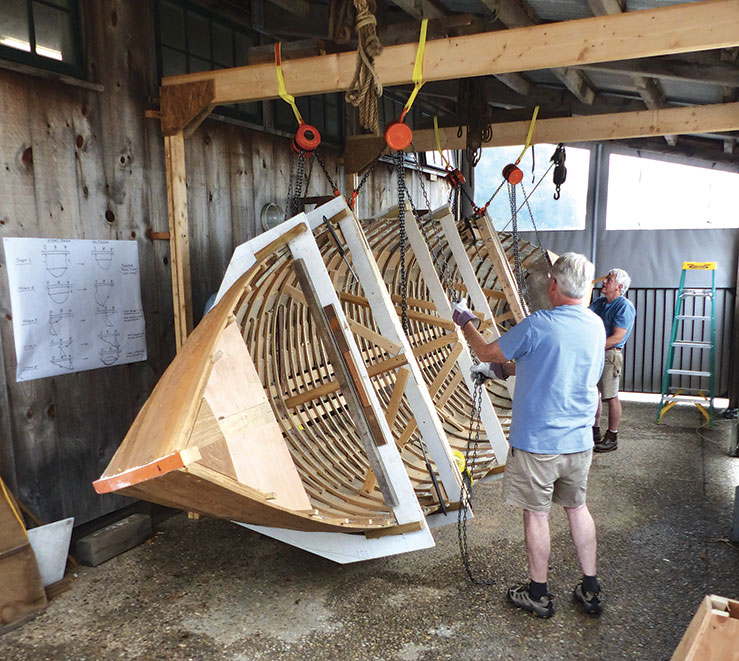
“With the stems, keel, frames, and floor timbers secured, we turned our attention to the planking. To turn the boat over for this purpose, we built an overhead support system to a design by one of our resident engineers. With interior hull reinforcement in place, it took just 60 minutes for the engineer to direct four guys at the chain falls to safely flip the hull over and lower it onto a custom-made support system.
 Don Stucke
After the boat’s centerline timbers, frames, and floor timbers were replaced, the hull was turned upside-down for planking work.
“A local contractor and museum director came up with two century-old pieces of cypress, 1″ × 20″ × 24′, from a building his company was working on. After we scraped off paint, Tony took it to his yard to have it dimensioned on his planer. The boat was originally planked in cypress, so the two long pieces were just what we needed for new garboards and broadstrakes, which we fastened using 2″ copper rivets.
“Our work space is under a shed roof extending from the side of the boatshed at the museum, which is open daily. It has drop-down side curtains with clear panels to let in plenty of light and allow the public to see the work. They can be rolled up in fair weather. We recently enclosed one side with heavy-duty vinyl with a door on a wood frame to keep the winter wind out.
“The surfboat project is a fine example of good-old Yankee ingenuity, with traditional skills and tools being used to save a great boat from the bonfire. We don’t have a launch date, and it may be a year or more away. But we are all enjoying the project and working together. The many museum guests love seeing a working project with hands-on boatbuilders willing to describe the project.”
Cape Cod Maritime Museum, 135 South St., Hyannis, MA 02601.
◼︎ “For most builders of custom wooden boats—and Ben Harris of Gweek, Cornwall, is among them—the only thing better than getting a commission for a new boat is getting a new commission for a boat they’ve already built,” Nic Compton writes from England. “So much time is spent lofting a new design, making patterns, and generally figuring out every little bit of timber and piece of hardware that it’s hard, if not impossible, to make a profit on a one-off boat. On the rare occasions a customer orders a new boat to an old design, much of the head-scratching has already been done, and the builder can massively improve his or her efficiency.
 Nic Compton
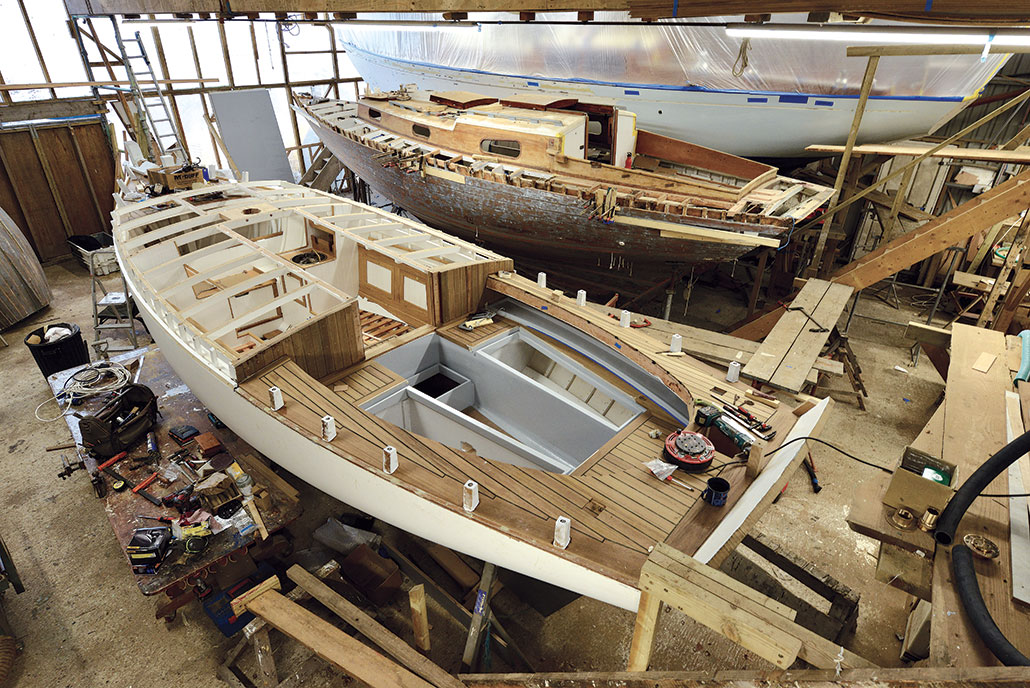
A new 23′ boat (left) being built to Ed Burnett’s Frolic design is taking shape under Ben Harris’s hands in Cornwall, England. Also at the yard are the restoration of a 26-footer designed by Kim Holman (center) and a 37′ Alan Buchanan–designed cruiser (right) being spruced up for the season.
“This was the case when a customer spotted a boat that Ben had built previously and asked for one just like it—with a few tweaks. Regular readers will remember that in 2018 Ben built the 23′ sloop PANACEA to a design by Ed Burnett (WB No. 268), who died in 2015. The result was a pretty little dayboat, with no aspirations to sail around the world but intended simply ‘for a sail around the bay, perhaps do a little fishing or just chug up the river on a quiet evening to spend the night,’ as Ed described his Frolic design.
“PANACEA was shipped to Australia the following year, but the climate there wasn’t to her liking and so she was shipped backed to Falmouth, where she was soon snapped up by a sailor based in nearby St. Just. The owner of the new boat, who lives a mile or so away in St. Mawes, saw PANACEA on her mooring, immediately fell in love with her, and contacted Ben through the builder’s plate on her transom. ‘It’s been great to have the opportunity to build a second boat to the same design,’ Ben said when I visited him at his workshop in Gweek, which is near Falmouth. ‘It means we had all the molds and patterns cut from the previous boat and the recollection of building it. Having the first one in the workshop for maintenance and winter storage means that if any questions come to mind, we can check the other boat for reference. We’ve also learned about the things we’d like to differently on this boat. So, it’s been a nice process.’
“The main difference with the new boat is the hull materials. Whereas PANACEA was planked in larch on oak frames, Ben has used Alaska yellow cedar planking on GALATEA, as the new boat is called, no doubt mindful of recent horror stories about larch planking going rotten. The rig has also been designed to be as easy as possible to handle, with halyards feeding back to the cockpit and roller-furling fitted on both foresails, as the owners hope to sail the boat throughout their retirement. GALATEA is expected to be launched in April.
“Elsewhere in Ben’s workshop, he and his team were restoring a 26′ Kim Holman design similar to a Twister, as well as ‘titivating’ the 37′ Alan Buchanan–designed bluewater cruiser BLUE SALUKI. And there was a pretty 30′ Luke Brothers sloop being readied to go back in the water. With vessels dating from the 1930s, 1960s and 2010s, they represented a fascinating cross-section of wooden-boat history, past and present.”
◼︎ Three graduates of the Boat Building Academy and Furniture School in England, which plays prominently in an article starting on page 80 of this issue, have joined forces to start a boatbuilding company called Blue Tree Boat Builders. They met while taking the school’s 40-week boatbuilding course in Lyme Regis, and their company is in the same town, not far from the school where they met. Their firm’s first project is a 16′ 5″ river launch, built with an ethic of sustainability that they intend to make a central purpose of their company. For all of them, a purposeful change in career path brought them to the school: Obioma Oji, 44, had been an interior designer at IKEA; Luke O’Connell, 33, served in the British army for six years; and Otto Marples, 51, founded a creative agency with two other people and sold it after 28 years in business. Oji and Marples were building a Paul Gartside–designed Maisie Belle; O’Connell commissioned and built an 18′ strip-planked gaff-rigged sloop. “Our common goal is to build exceptionally crafted boats in a way that leaves as little mark on the planet as possible,” Marples said in a press release. “So, our hulls use both traditional and modern techniques, with cold-molding being our preferred construction method. Wooden boats, he said, have “aesthetic and tactile appeal which aligns perfectly with Blue Tree’s vision of creating harmony between boatbuilding and the natural world.”
Blue Tree Boat Builders, The Yard, Lyme Regis, DT7 3UB, U.K.
Offcuts
◼︎ Douglas Brooks writes about a new program in Japan meant to continue a tradition of building boats used by cormorant fishermen, a type he documented after serving an apprenticeship.
“In 2017, I apprenticed with Seiichi Nasu, one of the last builders of cormorant boats, which are 42′ long and extremely lightly built. Cormorant fishing, in which trained birds are used to catch river fish, has a 1,300-year history in Gifu City, and its traditions are sacred: the costumes of the fishermen, the gear, and the boats have remained unchanged for centuries. But Nasu’s retirement created a crisis: there is no longer a reliable source for these boats.
 Douglas Brooks (left) and Randall Henson (right)
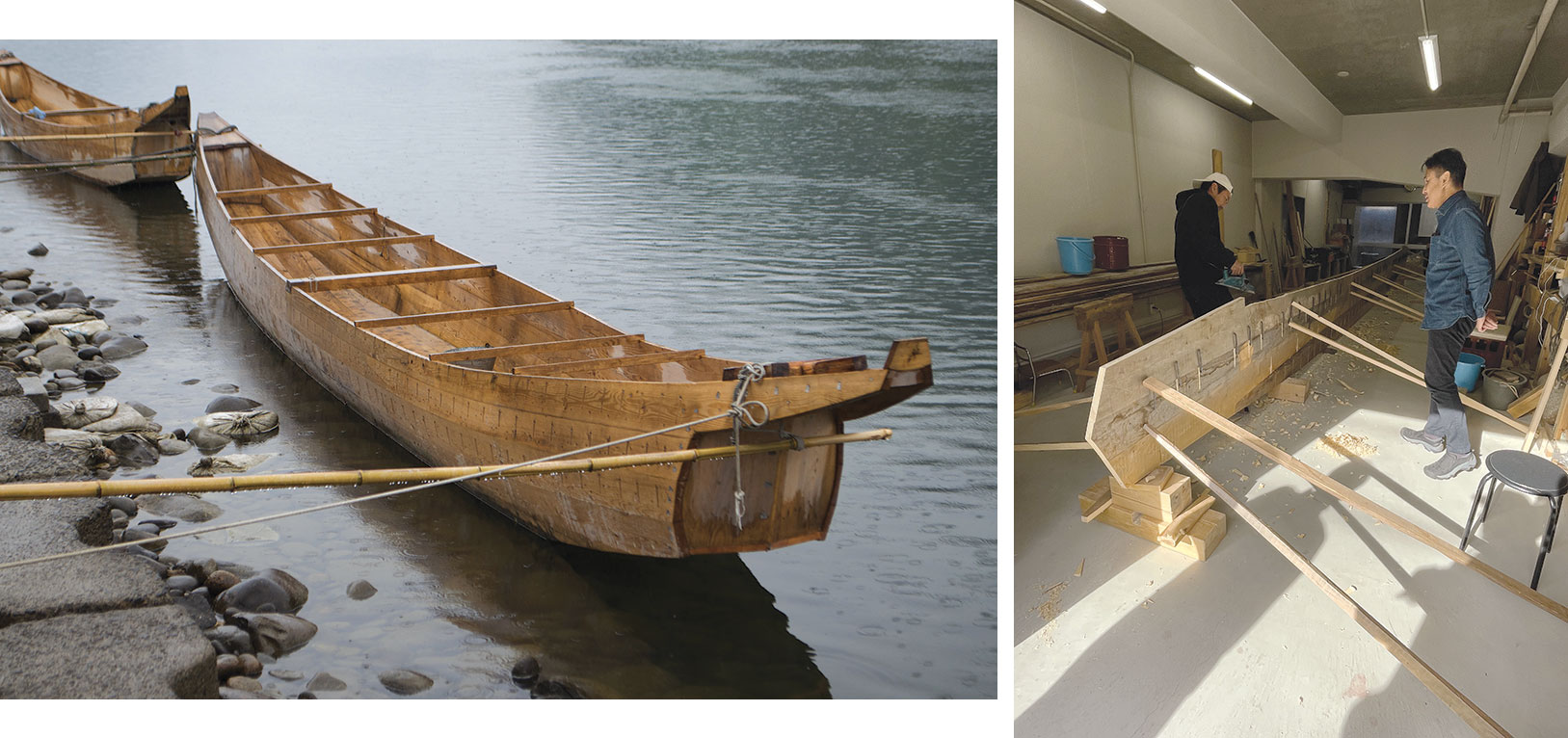
Left—Fishing using trained cormorants has a 1,300-year tradition in Gifu City, Japan, using lightly built boats. They have only one permanent beam; the others shown here are removed during fishing. Right—A new cultural program will train boatbuilding apprentices so that the fishing tradition continues.
“All the fishing today is done as a demonstration for tourists. The fishermen go out every night for six months of the year, and up to 100,000 people come to Gifu to watch. There are six hereditary fishermen in Gifu, and each boat lasts about 10 years. Light construction is crucial—they have just a single beam for framing—because the crew of three needs to be able to push their boat over shallows. The fishermen also demand an open hull so they can move freely when setting out and retrieving their birds.
“In order to ensure a future source of boats, a government grant was secured to fund a six-year training project to teach the six boatmen who assist the fishermen. Working under the direction of Hiroshi Tajiri, who apprenticed with Nasu over 40 years ago, they will be building one cormorant fishing boat every year during the off-season. Over the course of six years, this will provide a new boat to every Gifu fisherman, with six boatmen trained in their construction.”
Brooks’s most recent book about Japan’s boatbuilding traditions is about the cormorant fishing boats and was published in Japan in 2019. “Tajiri and the boatmen are using this book in their training,” he wrote. An English version followed in 2022.
For more information, see www.douglasbrooksboatbuilding.com.
◼︎ In WB No. 296, I wrote in Currents about the plan for the Friend Memorial Library in Brooklin, Maine, to receive the 6,700-volume library from WoodenBoat founder Jon Wilson. Now comes word that Benjamin Mendlowitz, whose photography first appeared in the magazine’s pages in about 1977 and has been a regular presence ever since, has also signed a letter of intent to convey his slides—155,000 images taken before 2005, when he switched to digital format—to what will be known as the Maritime Research Collection. (The digital collections could follow in later years.)
“I’m looking to the future of what’s going to happen with my images, and I guess I was inspired by Jon’s gift,” said Ben, who is now 76. “I thought it’d be awful nice to have this stay in town, and I think it would be a nice supplement to the book and paper collection to have images.” He and Ed DePasqual, the library board’s president, have signed a letter of intent to that effect, just as Jon has done.
Ben has been shooting photographs on freelance assignment to WoodenBoat since the late 1970s. He founded the company Noah Publications, which has published his own Calendar of Wooden Boats since 1983 and numerous books, and he and the company moved to Brooklin in 1985. The company’s office is closing this year, but the calendar will continue, with WoodenBoat editor Matthew P. Murphy taking over caption-writing from Maynard Bray, who has been the magazine’s technical editor since early in its existence. WoodenBoat Publications will now publish and distribute the calendar.
About 1,000 of Ben’s slides have already been digitized, and others are likely to follow. All were taken with archival Kodachrome film and stored in 20-slide archival sleeves. The collection, stored in six fireproof five-drawer file cabinets, is expected to fit easily in an already-planned library expansion, now the target of fundraising. (The contact is Robert Baird, robert@rabassoc.com.)
Those digitized images are among about 10,000 of the slides that are considered “selects,” and the hope is to digitize all of those, with volunteer help. But complete sets including outtakes may prove useful—for example, for anyone considering a full restoration of a boat and needing detailed images.
Ben had done some work for Sail magazine while living in Boston, Massachusetts, but the then-new WoodenBoat quickly attracted his attention. “It’s not like I came in as a fully formed boat photographer,” he said. “I knew how to handle a camera, and I knew I had a good feeling for light, certainly, and composition.” Working collaboratively in the early days with Maynard and also Sherry Streeter, then WoodenBoat’s art director and later the calendar’s graphic designer, had an influence on all of them. “I think the three of us, and Jon, standing at the light table and looking over stuff, and seeing what they liked and what worked for what they were trying to do, definitely influenced how I shot going forward. In terms of how to photograph a boat to show its lines, I think Maynard, especially, had a big influence. He was often driving the chase boat or going around boatyards with me.”
◼︎ Bruce Stannard, who wrote from Australia about Tom Robinson’s solo cross-Pacific rowing attempt in Currents (WB No. 296), has a follow-up: “Tom has now signaled an end to his epic voyage, in which he hoped to become the youngest person to row from Peru to Australia. Although the voyage ended with his miraculous rescue at sea, the fate of his abandoned skiff, MAIWAR, left open the remote possibility that he might be able to recover her and carry on. That hope flickered into life when MAIWAR eventually washed ashore on Panawina Island at the far southeastern tip of Papua New Guinea. Tom caught a flight to the capital, Port Moresby, and narrowly missed being caught up in a week of bloody riots in which 15 people died. He hitched a ride on an island trading boat and, together with a native shipwright, headed east toward Panawina. There he found MAIWAR with her bow stove-in and her half-cabin ground to a pulp as she washed over coral reefs. All her fittings had long since been taken as souvenirs by curious locals. The grim discovery ended any hopes of continuing that Robinson may have entertained. He was reluctantly forced to conclude that his heroic voyage was well and truly finished. He left MAIWAR on the beach where she came ashore, hoping that her remains might be useful to the islanders. Tom was able to recover some of the boat’s equipment, including a watermaker and, incredibly, his mobile phone, which was undamaged and still contained all its data, including hundreds of photographs documenting the voyage through the islands of the Pacific. So, all was not entirely lost; he is now writing a book about his exploits.”
◼︎ Speaking of updates: An item in Currents (WB No. 291) informed readers of the retirement of Marla and George Surgent, who were at the helm of Seaworthy Small Ships for more than 30 years and were hoping someone else would take over. Well, someone has: Alice Sampson of Colorado tells us that she has partnered with Julius Spradley of Denver Custom Boatworks to continue the company’s creation of kits for sailing model boats, with kids especially in mind. Alice is a retired science teacher and has both sailing and woodworking in her background. She is on the board of directors for the Rocky Mountain Wooden Boat School, where Julius is also a board member; he is a graduate of The Apprenticeshop in Rockland, Maine, and the company he founded specializes in runabouts and sailboats of the Colorado lakes. We are reliably informed that the model kits will continue to be available through The WoodenBoat Store.
For more information, see the Seaworthy Small Ships website and www.woodenboatstore.com.
Across the bar
◼︎ Iain Oughtred, 84, February 21, 2024, Portree, Isle of Skye, Scotland. Mr. Oughtred grew up sailing in Sydney, Australia, where early in his life he was a competitive dinghy racer with a nascent interest in building and designing boats. During his period of extensive wandering in Europe and the United States in the 1960s and ’70s, he was influenced by a variety of traditional boats, and they became a constant thread of his life. He was especially taken with the double-ended small craft of Scandinavia that he had seen in the early 1970s. In the early 1980s, by then living in England, he started focusing on small-craft designs, among them dories, Whitehall derivatives, and finally the double-enders inspired by Scandinavian and Shetland Islands types, for which he arguably became best-known, particularly with the 19′ 6″ Caledonia Yawl (see WB Nos. 183–185 and 213). He also adopted glued-lapstrake plywood construction. He had a sojourn for several months in Maine in 1986 by invitation of WoodenBoat, then returned to England with the completed Gray Seal design, a 22′ pocket cruiser. In 1989 he moved to Scotland, living in various places before finally settling in Portree in 2000. He completed over a hundred boat designs of a wide variety and published two books, Wooden Boatbuilding in Britain—A Guide to Designers, Builders & Suppliers in 1986 and Clinker Plywood Boatbuilding Manual in 1998. The English writer Nic Compton’s 2008 biography, Iain Oughtred: A Life in Wooden Boats (WoodenBoat Publications, 2009) listed 107 designs; for Compton’s tribute to the designer, see page 40.
◼︎ Paul C. Haley, 77, February 5, 2024, West Hyannisport, Massachusetts. Mr. Haley grew up in Marblehead, Massachusetts, where his father founded Marblehead Marine Center. The family lived upstairs in the business’s building on the waterfront; “The harbor was my front yard and playground,” he wrote, and he learned to sail on the family’s Friendship sloop, TERN. A marine career seemed inevitable. He started off by working for his father; later, as a student at Columbia University and the University of Miami, he went to sea on research ships. After returning to Marblehead in 1976, he worked first at Graves Yacht Yards and later at Ted Hood’s Little Harbor Boat Yard. He also started working as a marine surveyor; in 1985 he joined another longtime Marblehead marine professional, “Giffy” Full, in G.W. Full & Associates Marine Surveyors. They worked together for years. As Full dialed back his involvement (and eventually retired; he is now 97), Mr. Haley succeeded him as the pre-eminent New England surveyor of wooden yachts and historic ships of all kinds. The firm’s work was not exclusive to wooden vessels, but it was a specialty for which they and the firm were specifically recognized by Lloyd’s Register of Shipping. Among Mr. Haley’s survey projects were prominent historic ships such as USS CONSTITUTION, MAYFLOWER II, and the presidential yacht SEQUOIA; many schooners, among them ERNESTINA-MORRISSEY; and many yachts. He published articles occasionally in WoodenBoat and periodically taught one-week courses in surveying wooden boats at WoodenBoat School in Brooklin, Maine.