
 Tom Jackson
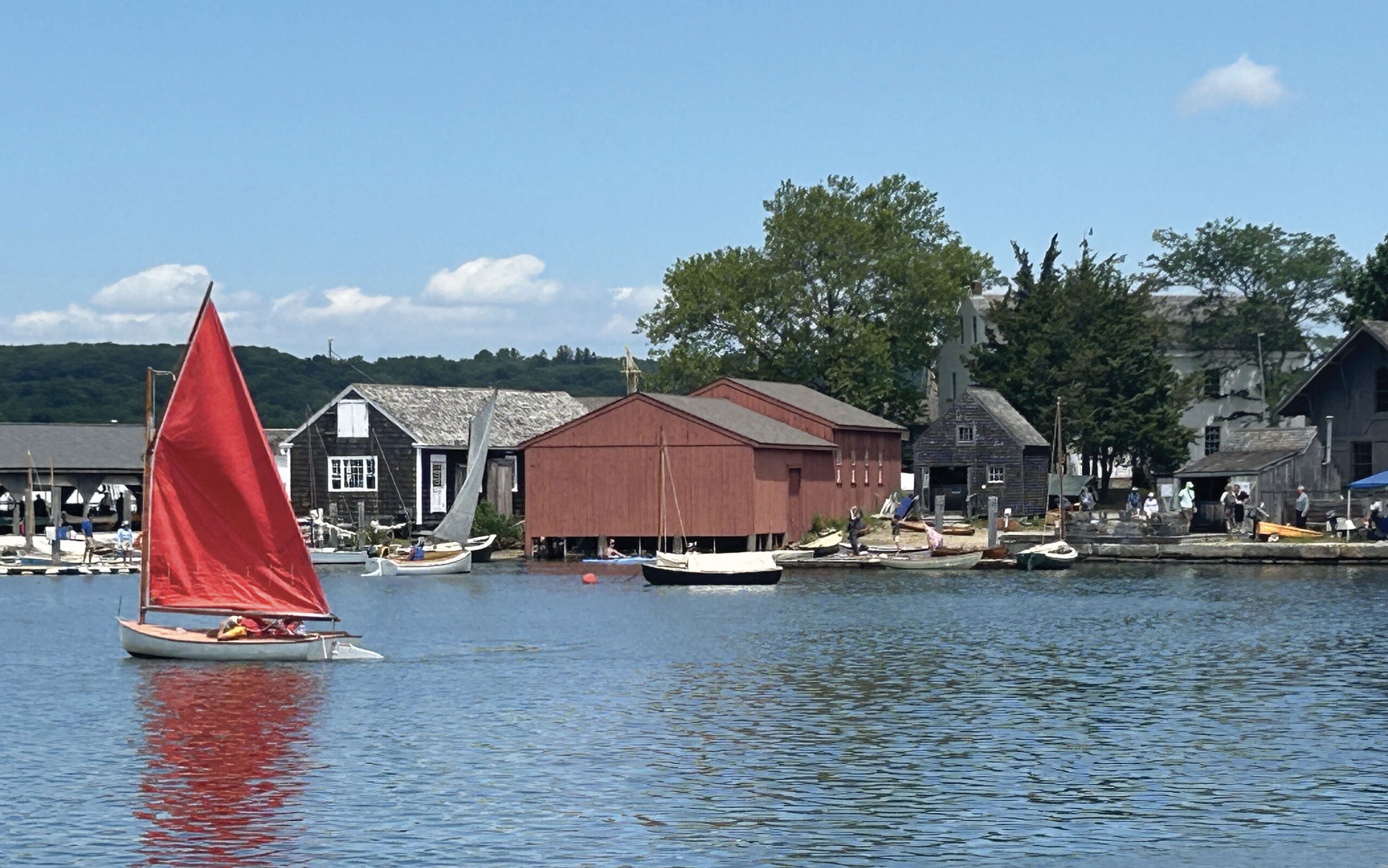
The John Gardner Small Craft Workshop, held in conjunction with The WoodenBoat Show, encourages use of boats from both the Mystic Seaport Museum livery and those exhibited by TSCA members.
It is sometimes said that achievements come by standing on the shoulders of giants who came before. It’s a nice image, a poetic one, and it rings true—but it can be misinterpreted. It doesn’t mean standing still.
A case in point is the Traditional Small Craft Association (TSCA), which was founded 50 years ago as an outgrowth of the Small Craft Workshop founded in 1970 by the small-craft historian John Gardner, then a curator at Mystic Seaport Museum. He was appalled that U.S. Coast Guard regulations then being considered would render illegal many of the small boats he loved—all of them well proven for eons. The effort worked. The proposed laws were reevaluated, then amended.
For anyone interested in small craft at that time or long after, Gardner was the north star. His role, and his books, were vital and remain so. But Ben Fuller, who was a curator at Mystic Seaport during Gardner’s day, said that Gardner could see changes coming. “Something that he definitely recognized was, ‘What’s amateur boatbuilding going to look like?’ And the piece that interested John was to figure out, ‘What kind of materials are available?’ It is a serious, serious problem.” He knew that those long, wide boards of clear, air-dried cedar and pine visible in the boats he studied were becoming rare. “He did a number of designs for pure plywood stuff,” Ben said. “The piece that is really keeping things going, I think, is the ability to figure out how to take the traditional designs and interpret them, if you will, in materials that mere mortals can find.” Even tremendous traditional boatbuilding skills don’t guarantee the ability to find what you need.
Meanwhile, the gold-standard vision of having a lovely traditional boat on a mooring in full view of home was becoming more of a hallucination. Waterfront property required wealth, often vast wealth, which drove boat owners to adapt. Traditional boats are best kept in the water, so some found marina space. Others sought mooring fields, but they were not alone: waiting lists are approaching 12 to 15 years in some harbors. Many people, like Ben, reached a conclusion: “I don’t want any boat I can’t haul behind my pickup truck,” whenever I’m tempted by a larger project boat. It’s a mantra I often repeat to myself.
“My little rowing sailing boat that sits out there,” said David Wyman, a naval architect of Castine, Maine, referring to the boat in the back of his pickup, “it’ll go at 65 miles an hour and get me to some interesting cruising grounds pretty quickly.” David and Ben have both been involved in the TSCA leadership, and all three of us were part of an all-for-one, one-for-all team of volunteers that ran Maine’s Small Reach Regatta (SRR) for 15 years. I had come back from Raid Sweden (see WB No. 187) in 2005 brimming with enthusiasm to get something similar going on the coast of Maine, and a simple group email got it started. The SRR grew steadily—to something like 85 boats at the end in 2021—but we all reached a day when the choice was either to grow it more or let it go. We decided to end it on a high note.
The SRR and many other events show that the nature of small-craft gatherings has changed since 1975. A generation of ever-more-aggressive small-boat events and races emerged, among them the Everglades Challenge in Florida, the Texas 200, the Seventy48 in Puget Sound, and others. They arguably all traced their origins to Charles Henri le Moing’s innovative small-boat “raids” in Europe, of which Raid Sweden was one. They varied with local conditions and opportunities.
 Michael Percy
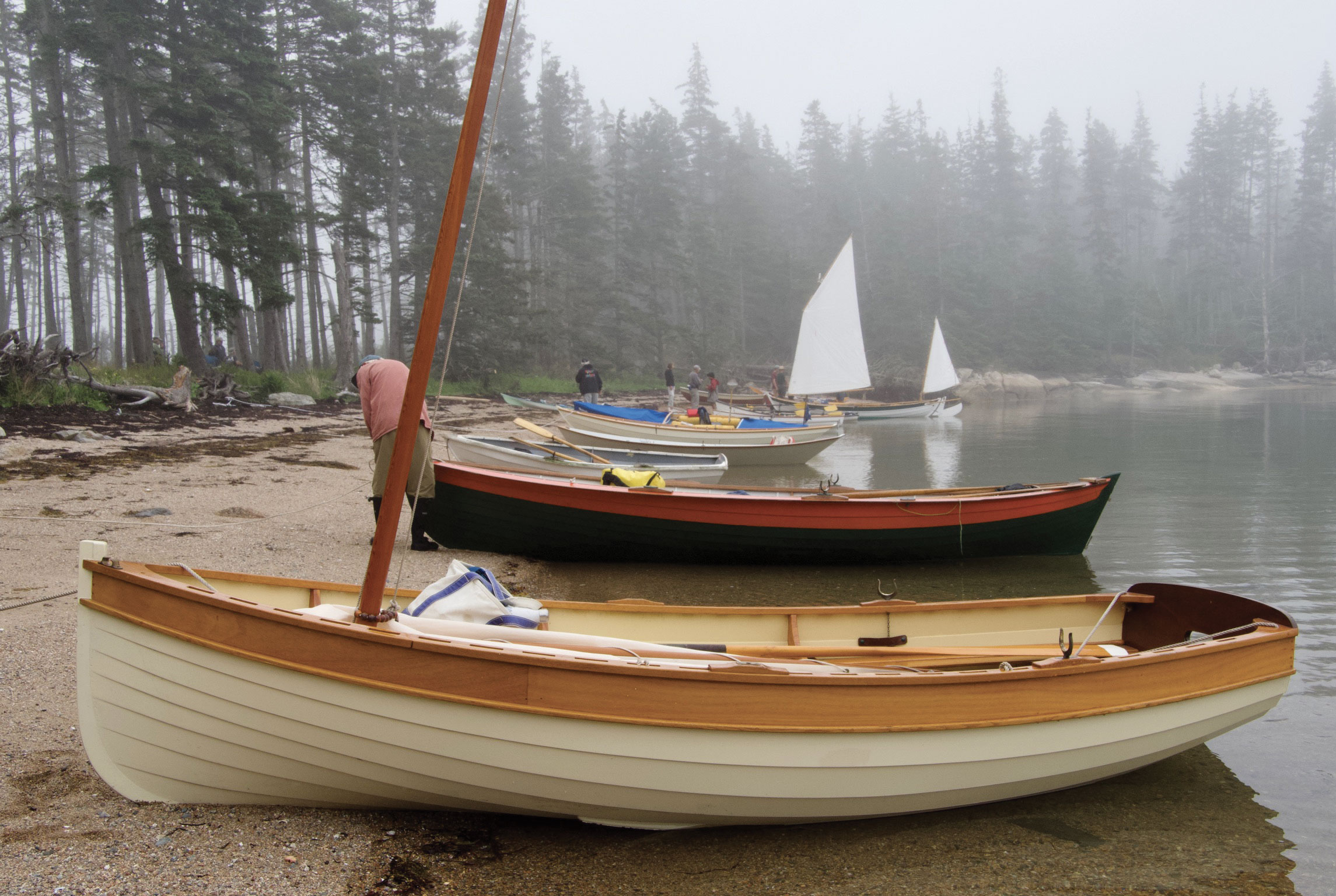
The Downeast Chapter of the Traditional Small Craft Association, one of 36 such chapters nationwide, often has about 15 boats for outings like this one in July 2025.
Challenging events bring experienced, like-minded people together for the adventures they’re ready for. (Even events such as the SRR, which was never a spectator event, still have reason for TSCA affiliation: the SRR quickly came under the Downeast TSCA Chapter partly because it could then fall under the national organization’s event insurance.) And yet, relatively staid “messabout” events still play the viable role of introducing the simplicity of traditional small craft to the uninitiated. The John Gardner Small Craft Workshop, as it was renamed long ago, is now run by the John Gardner Chapter of the TSCA in conjunction with The WoodenBoat Show, and it hews to an earlier example of giving people a chance to experience traditional boats in person, often by using them.
“I think there are a lot more events and a lot more gatherings that bring people together to share the joy and the camaraderie of boats and the TSCA,” said Pete Peters, the current national president. “There’s not a stereotypical chapter. They’re all quite different.”
Meanwhile, boatbuilding has changed a great deal. Andy Wolfe, who first joined TSCA in 1992 and served as its president before becoming the editor of its glossy magazine, Ash Breeze, in 2012, points out that “the biggest surge in membership we ever had was when Chesapeake Light Craft [CLC] put a notice in their digital newsletter.” Wolfe has shifted Ash Breeze’s content to emphasize practical tips, what members are doing, and voyages (issues since 2012 are all available online at www.tsca.net). When Wolfe started as editor, there were 27 TSCA chapters nationally; today there are 36, plus two more forming. Andy recalled that in 2012 national membership was about 700; today, it’s about 1,200.
Companies such as CLC and Chase Small Craft, whose proprietor, Clint Chase, was a regular SRR participant before starting his company, ease the entry into the world of small boats. Their CNC-cut plywood kits show a staggering variety, but they are almost always rooted in traditional types that Gardner would recognize. “My first boat took me a year to build,” Andy said; “my second boat took about two months.” A kit made the difference.
“I think CLC and Chase, these boatbuilders have really been able to reach out to the public and get people excited about building boats,” Pete said. “So there are many more boats on the water. And if I build a boat, I’m looking for a place to use it. TSCA is trying to make ourselves more recognizable as a place to go and do that.”
Technology wrought other changes, too. “The way it was in the old days,” Andy said, “the council met once a year at the annual meeting,” at the small-craft workshop. “It was in March, and it was always freezing cold. Total communication was about five hours in the course of a year.” It took a change in the bylaws even to enable communication by email. “The next step up from that,” Andy said, “came from Dave Wyman.” Recognizing the value of Covid-19-era Zoom meetings for a widespread organization with no chance to meet annually at all during that pandemic, David called for regular monthly meetings on the app. “I consider that probably the most important thing I’ve done for the TSCA,” David said. “The organization is doing more coordinating.”
Sharing information about events, keeping up with laws or limitations that small boats face, and above all getting boats used are all right in line with Gardner’s goals. The organization also directly supports work by researchers through the annual John Gardner Grant program, something that Ben initiated when he was on the board. He recalls that as his primary personal contribution to the group; much later, the SRR gave $5,000 to the program (and the same amount to the Maine Island Trail Association and the Penobscot Marine Museum) while closing down.
Instead of standing on the shoulders of others, the TSCA seems more like a relay team, passing the baton so the race will go on. “What John was really interested in,” Ben said, “was getting off your butt and doing stuff.”
Not standing still, in other words. 
Tom Jackson is WoodenBoat’s senior editor.