
 Daniel Caparrós Torres
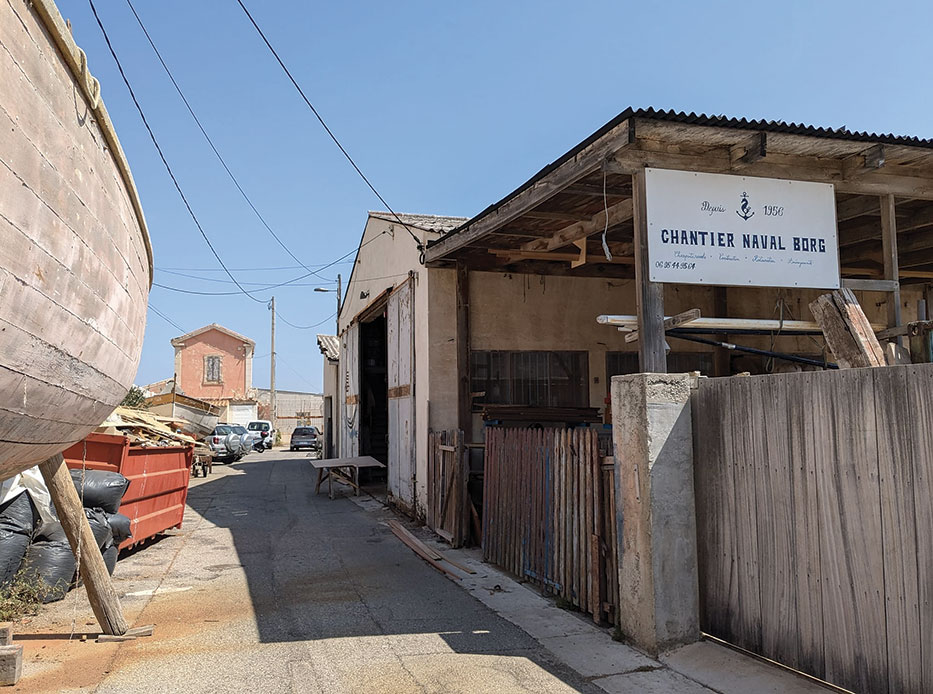
The yard at Chantier Naval Borg was originally opened in 1956 by a family from Tunisia.
“Approaching Marseille by sea, a sailor first passes the Frioul Islands—low, rocky outcrops that once guarded the city’s approach toward the old port,” Daniel Caparrós Torres writes from the south of France. “After passing the Pharo, a bluff marking the narrow mouth of a harbor that for centuries has sheltered ships of all kinds, a forest of masts comes into view in the Vieux Port, one of the Mediterranean’s most iconic nautical hubs and a recent candidate for UNESCO recognition. But just before that postcard scene lies a lesser-known inlet: l’Anse du Pharo. Oriented toward the open sea, shielded from the wind, and nearly invisible from the city, it’s home to one of France’s historic boatyards: Chantier Naval Borg.
“The yard occupies two picturesque, mid-sized sheds nestled between the rocks and the sea. Michel Athénour, the current owner, has a small office with a tiny window framing the intense blue of the water. ‘It was love at first sight,’ he says. ‘I fell for the place—and for the team, a group of very skilled carpenters.’
“The Borg family arrived from Sousse, Tunisia, in 1956. When Denis Borg, the third-generation owner, decided to step back, Michel, who had worked in the tech industry, took the leap. He describes it as a ‘life-changing decision,’ one that pulled him out of computer screens and into sawdust. ‘I’m much happier now,’ he says. Michel saw in Chantier Borg not just a personal turning point—he had recently completed his carpentry training when we spoke—but also a chance to breathe new life into a shipyard that was on the verge of closure. He envisions preserving traditional wooden boatbuilding while steering the yard toward a future of decarbonizing recreational boating.
 Daniel Caparrós Torres
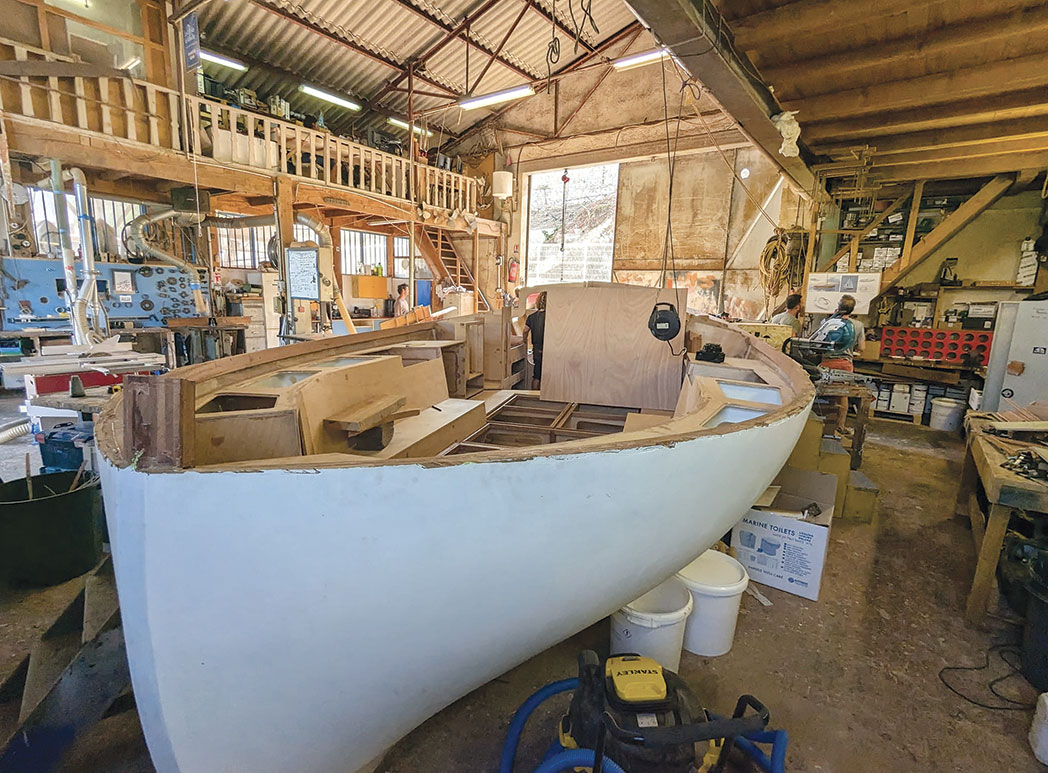
At Chantier Naval Borg in Marseille, France, proprietor Michel Athénour is building the first strip-built hull of a 9m (29′ 10″) hybrid sail-and-engine powered yacht.
“Inside, the workshop is calm and focused. Six shipwrights move in the quiet choreography of manual work: cutting, sanding, planing, clamping. Sunlight filters through high windows, catching racks of western red cedar, oak, Mediterranean pine, and the occasional exotic wood. The yard remains closely tied to the restoration of double-ended, round-sterned barquettes Marseillaises long used for fishing and leisure along the Provençal coast, many of them now listed as heritage craft. But Michel has broader ambitions: Beyond taking on large projects, such as the current restoration of the pilot cutter ELEANOR MARY, his plan is to revive custom construction, something the yard hadn’t done in years. ‘The goal is to show clients that wood still has a place in the future of sailing,’ he says. ‘Fiberglass pollutes, it ages poorly, and it’s hard to recycle. Most of it ends up in a landfill. With wood, if something breaks, we can replace it. And we’re preserving a craft that is rare, with its own complexity and dignity.’
“In the center of the yard, resting on chocks, sits the clearest expression of that ambition: the nearly completed hull of a 9m [29′ 6″] hybrid dayboat, a type Michel calls a ‘Fifty,’ recognizing its ‘50-50’ reliance on sail and power. The boat was designed in-house and built to sail with a sloop rig or motor with twin electric propulsion units integrated into the hull. The hull is strip-planked with western red cedar. The lines recall a scaled-up traditional barquette, but with such contemporary touches as a fold-down platform aft making it easy to slip into the sea for a swim, a retractable central table, and an exterior galley. The first of the boats is set to launch by the end of 2025.
“It’s a fresh chapter for one of southern France’s most storied boatyards. In this region, barely half a dozen historic yards still operate between Marseille and the Spanish border. The survival and reinvention of Chantier Borg, which now brings in roughly €500,000 [about $586,000] a year, feels almost improbable. Yet here it stands. As the Mediterranean boating world begins to reckon with questions of sustainability and heritage, this small cove in Marseille offers a quietly radical answer—one plank at a time.”
Chantier Naval Borg, 25 Anse du Pharo, 13007 Marseille, France.
Above image: The yard at Chantier Naval Borg was originally opened in 1956 by a family from Tunisia. Courtesy: Daniel Caparrós Torres