
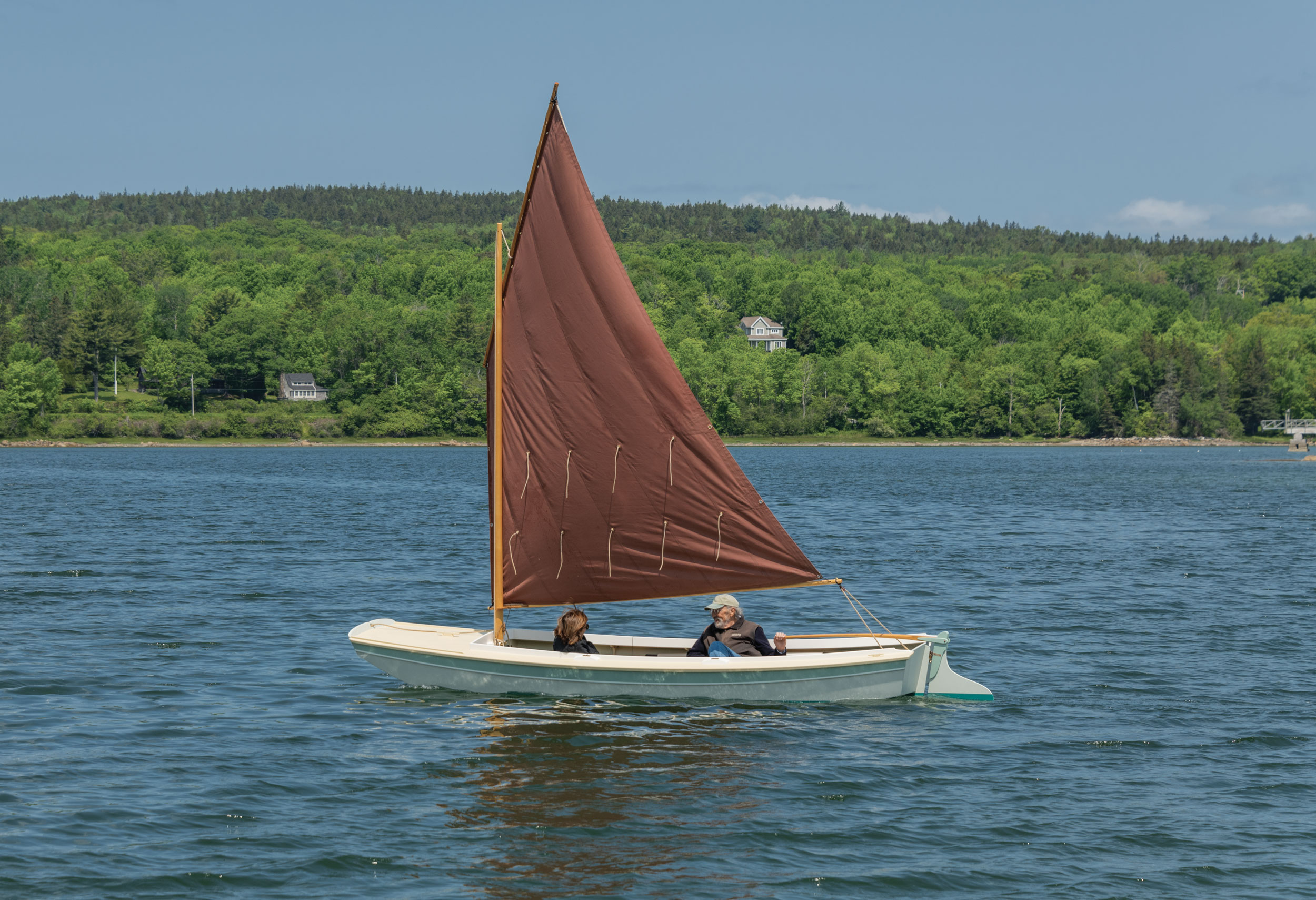
 Benjamin Mendlowitz
The Swan Point Garvey is the culmination of Russ Manheimer’s years of dreaming about the perfect boat for day excursions in the coastal marshes of New Jersey. Doug Hylan designed the boat, and his shop, Hylan & Brown Boatbuilders of Brooklin, Maine, built it in time for an early June launching.
The daydream goes like this: It’s a beautiful but chilly fall day on upper Barnegat Bay in New Jersey. After being out all day in a dying, dry northeaster in our double-ended, lapstrake-planked 22′ kosterboat SJOGIN (see WB No. 247) my wife, Julia, and I anchor off Reedy Creek, a mile from where she began her outing at David Beaton and Sons Boat Yard. After the stove has been banked in anticipation of a warm return, the tender is brought alongside. There’s an hour before sunset and just enough breeze for a quiet sail. As the breeze dies, the tender is rowed back to SJOGIN. The rig is put away and the tender drops aft. After a glance alow and aloft, the hatch is slid open and the warm cabin awaits.
I’ve had this recurring daydream for many years. All of our sailing in SJOGIN consists of daysails. Once in a while, however, the thought of anchoring out and having a small boat to go ashore or mess about in our remaining creeks and marshes has seemed appealing. I have spent many a watch below, thinking of a suitable tender.
Since my introduction to small sail-and-oar craft through John Gardner in National Fisherman in the 1970s, I’ve been attracted to traditional boats. My first was the conversion of an elderly 15′ Charles Hankins Sea Bright beach skiff to a sprit-rigged sloop in the mid 1970s. After a few years with a hard-chined tabloid sloop, I’ve been lucky enough to be the steward of SJOGIN for the past 38 years. Though she is certainly traditional, her tradition lies about 3,800 miles to the east-northeast, in the Koster Islands on the North Sea coast of Sweden.
Therefore, my first thoughts went to an appropriate Scandinavian pram that would look good alongside SJOGIN, but upon reflection I thought them a bit tender for those of advanced years. Perhaps, I thought, a tender with a flat bottom would help with stability. But then the boat would have to be a longer than the usual tender to justify that comfortable, wide-enough flat bottom. Apart from being a useful tender, the new boat would have to row and sail well. The world of flatiron skiffs then beckoned. After a while down that rabbit hole and then semi-dories and such, I started thinking about local, traditional flat-bottomed boats. Around here there’s no flatter boat bottom than that of the traditional New Jersey garvey. That’s how I settled on this humble, simple, small boat for SJOGIN’s tender.
 Benjamin Mendlowitz
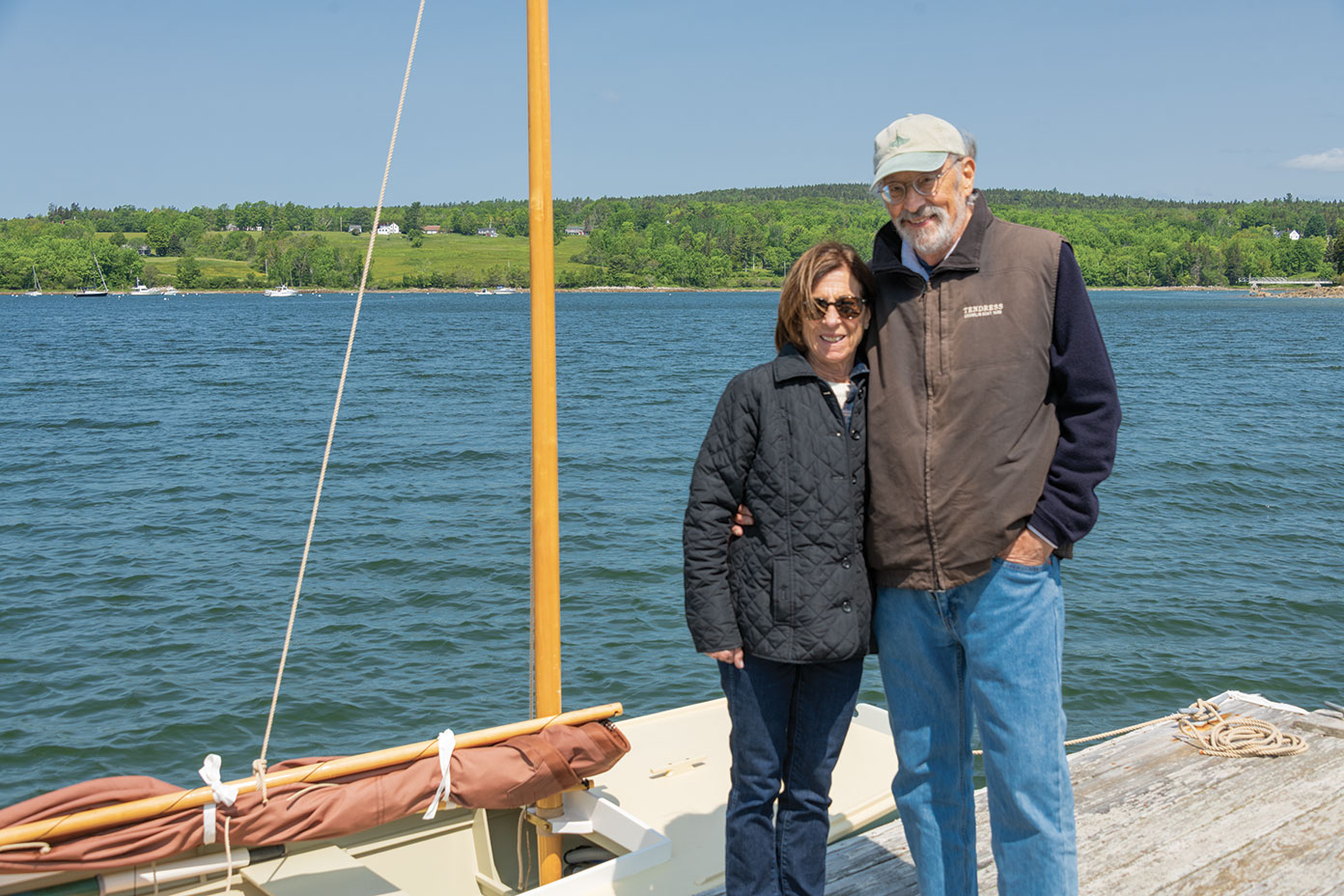
Russ and his wife, Julia, before their first sail in the new boat.
I realize that, at 15′, the Swan Point Garvey is about two thirds of the length of SJOGIN and larger than normal for a tender, but I wanted a boat large enough to allow sailors of advancing years to step aboard and use comfortably. I also wanted a boat large enough to have a good turn of speed while rowing or sailing, with as little draft as practical.
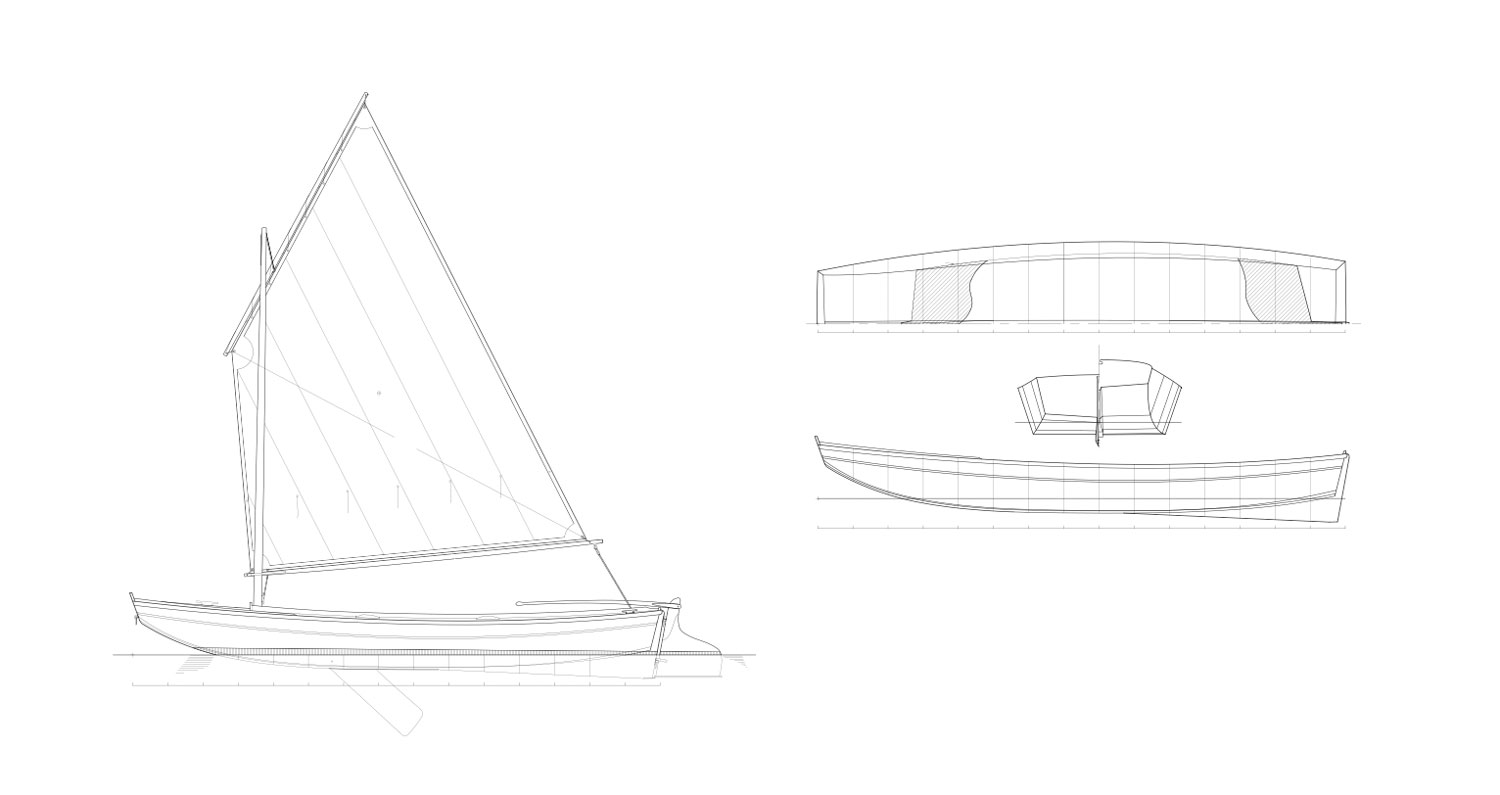 Doug Hylan
Traditional garveys were sprit-rigged, but Russ chose lug rig for its ease of handling and quick striking. The dismantled rig fits easily inside the boat. The scow shape of the garvey hull carries nearly its full beam all the way forward and aft, creating more stability and space than a conventional hull. The slight V sections forward and aft ease the quarters to improve sailing performance.
One of the early influencers in my search for the right garvey was Kent Mountford, a dear friend and estuarine ecologist and environmental historian. In his book Closed Sea, a comprehensive history of Barnegat Bay, he discusses the boatbuilding that went on there in the early 18th century. The basic garvey type has been around since the English settler Gervas Pharo built the first one in the early 1720s (see “Gervas Pharo and the history of the garvey” below). From Kent’s book, I went to my well-worn copy of American Small Sailing Craft, by Howard Chapelle, and read his section about garveys. Along with Kent’s illustration, the Chapelle book showed the way to a garvey design that would serve as a tender to SJOGIN and for my adventures on Barnegat Bay. After ordering and reviewing four of the Chapelle plans from the Smithsonian Institution, it was clear a smaller version of the boats shown in the Chapelle drawings would work out just fine.
 Tyler Fields
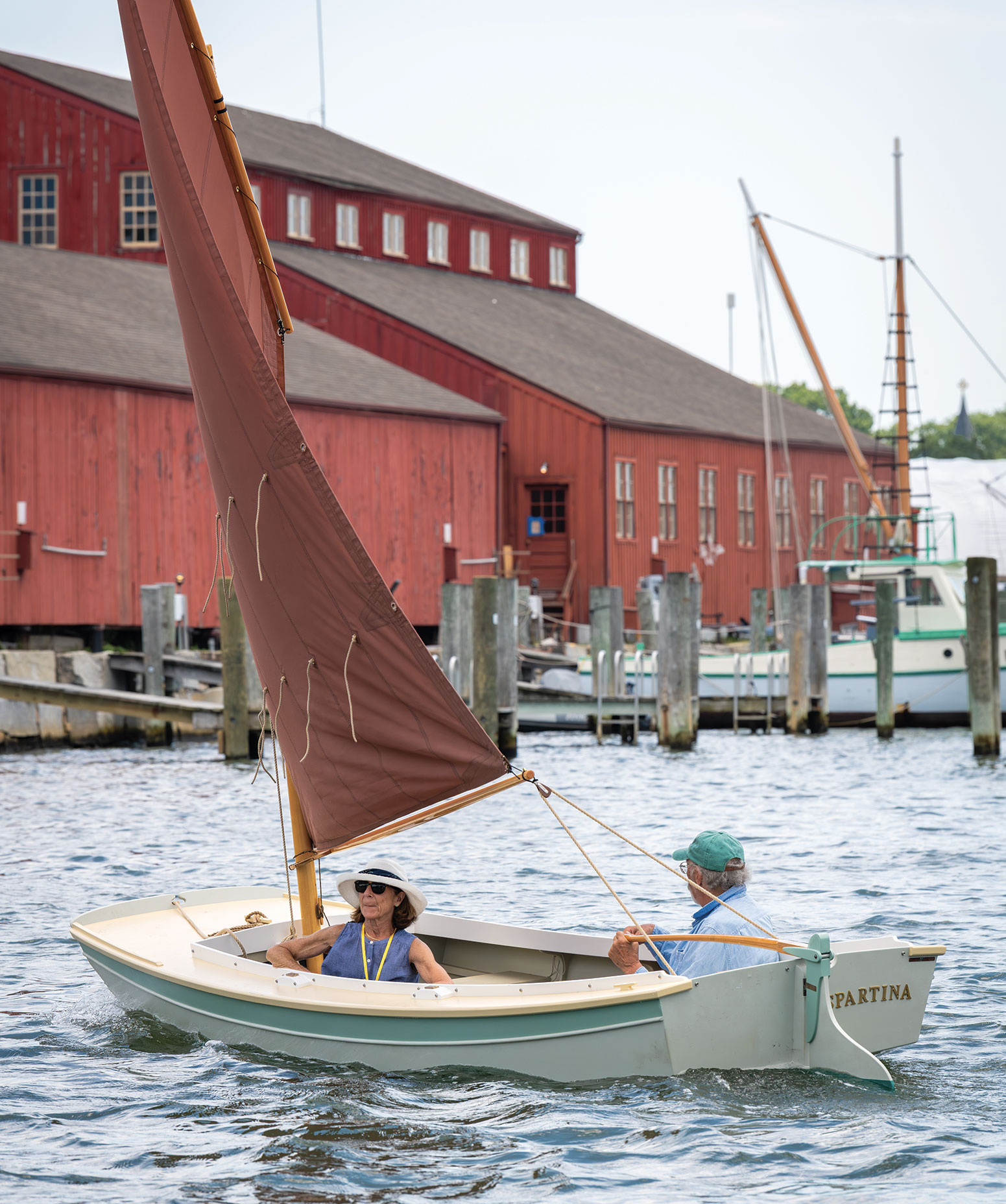
SPARTINA, as the first boat of the Swan Point Garvey design is called, sails at Mystic Seaport during the 2025 WoodenBoat Show.
Even simple workboats such as the garveys can have a touch of grace. Early builders of these boats began construction with a pair of transoms, one aft as usual and another, usually smaller, forward, and a few rough molds. After fitting cedar planks to the sides and transoms, then turning the boat over and nailing on a cross-planked bottom, they had a simple, robust boat. Up until that day when a bone-tired bay-man had the bright idea to fit an old Model T engine in his garvey, they were all rowed, sculled, poled, or sailed with a moderate spritsail when the summer sea breeze served. The garvey sailing rigs shown in American Small Sailing Craft are of considerable size and would have moved these simple boats quite well.
The distinctive square, scow-like bow of the garvey, and its flat bottom rising up to the deck in a graceful curve, sets it apart from other traditional small boats with stems forward. Think of garveys as a certain type of double-ender, a variation that shows up in traditional boats all around the world. The Louisiana flatboat, the English punt, the New Hampshire gundalow, and such have all evolved with the practical solution of having a square bow. What such boats may sacrifice in moving through a nasty chop they gain in having greater stability spread out forward. Anyone who has stood right in the bow of a small traditional boat knows what that lack of stability feels like. And per foot of length, there’s more usable space on a square-bowed, flat-bottomed boat.
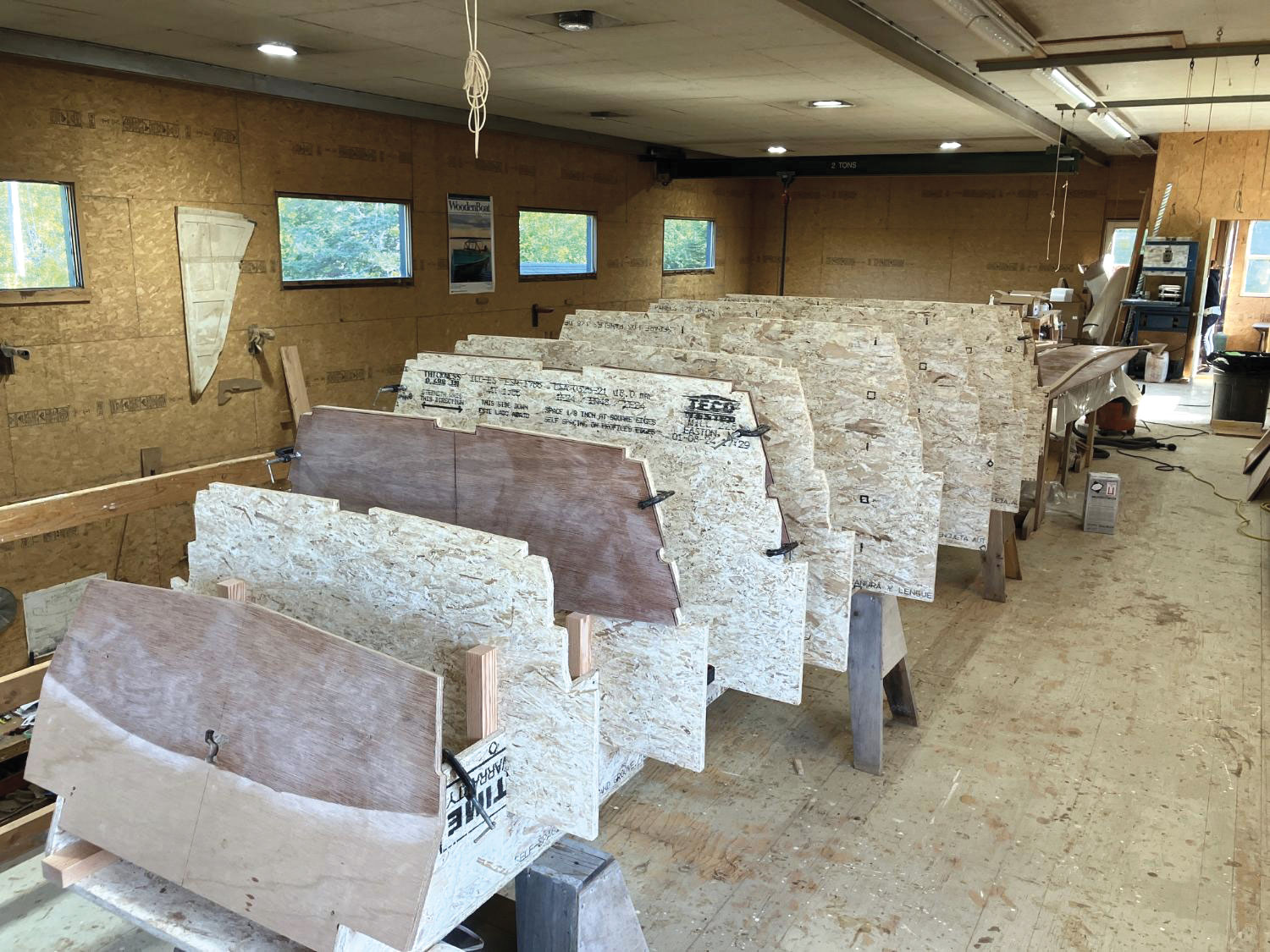 Hylan & Brown
Construction began with a set of CNC-cut molds, the two transoms, and two bulkheads.
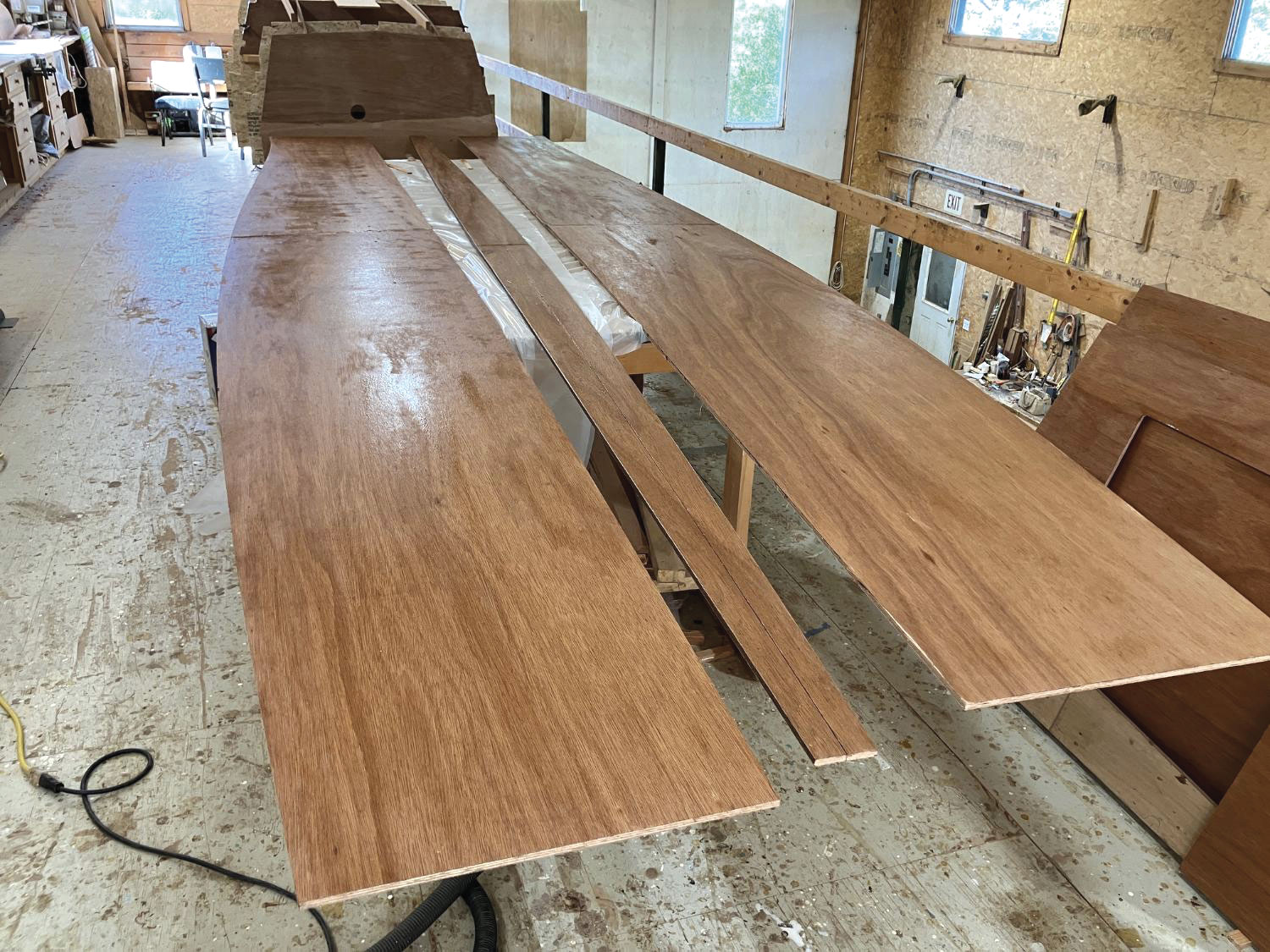 Hylan & Brown
Plywood panels were epoxy-coated before being hung.
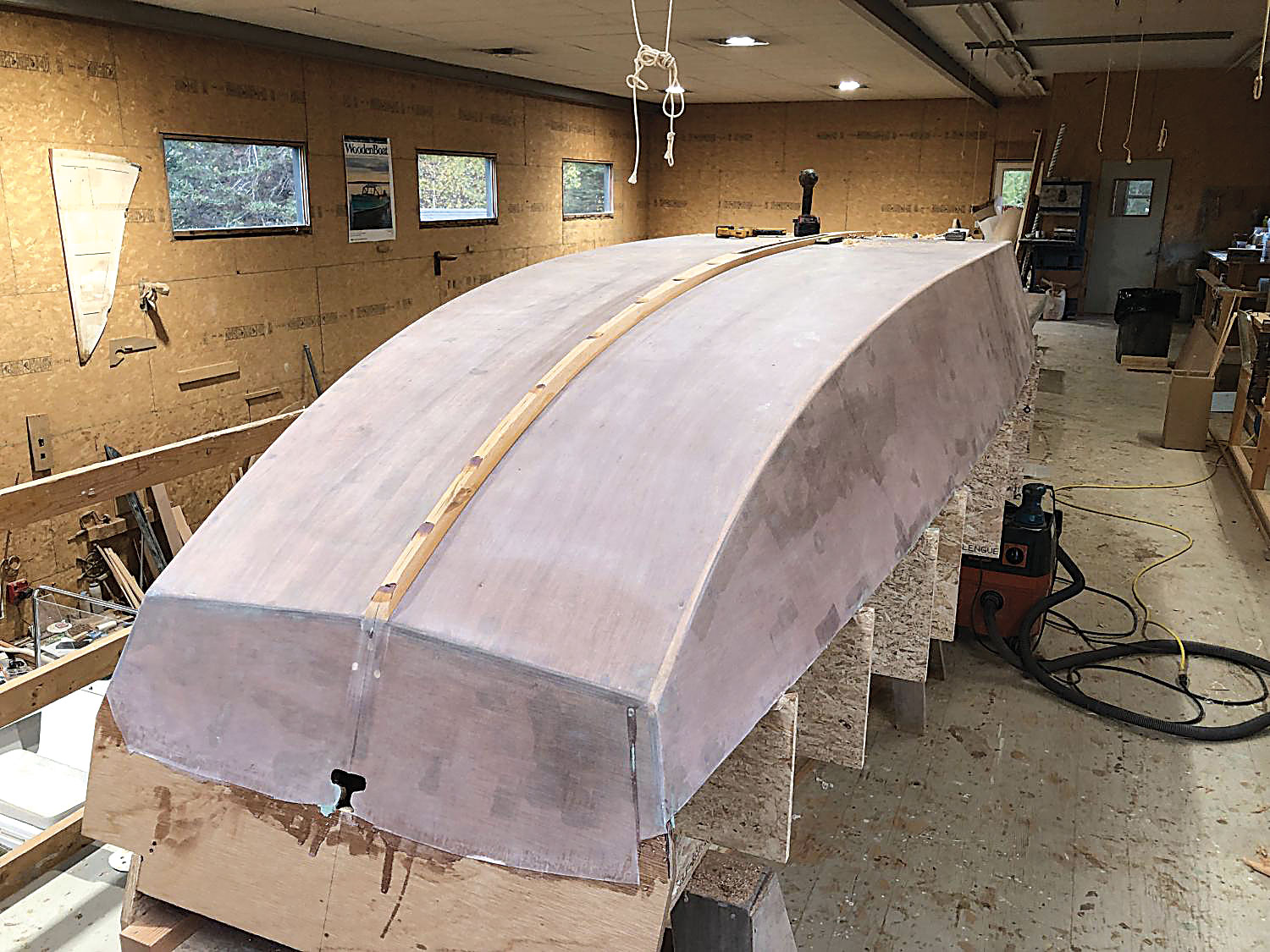 Hylan & Brown
The meranti hull panels were glued in place with epoxy and fastened with bronze screws where needed.
After reviewing the Chapelle plans and other sources, I assembled a design brief that set forth the metrics, background, and building method I imagined would match my long-running daydream. This brief, which I submitted in turn to several noted small-craft designers and kit builders, asked them to develop a 14′ to 15′ sailing garvey of moderate weight with a beam of about 4′6″ and an appropriate rig. The boat would employ glued-plywood construction. Here are the first two paragraphs of the brief:
Even not-so-pretty boats such as our humble New Jersey garvey deserve consideration for a new design for home builders using modern glued-ply methods. Garveys have served folks on Barnegat Bay for over 300 years with their simple, easy-to-build shape.
A moderate weight 14- to 15-footer; four and a half foot or so beam with appropriate traditional rig would work well along the quiet waters and creeks still to be found on Barnegat Bay and elsewhere. Think of a picnic punt with a bit of weatherliness. And one that would look right in American Small Sailing Craft and in small-boat gatherings. One part of my dream is sailing her around the Mystic River during the WoodenBoat Show.
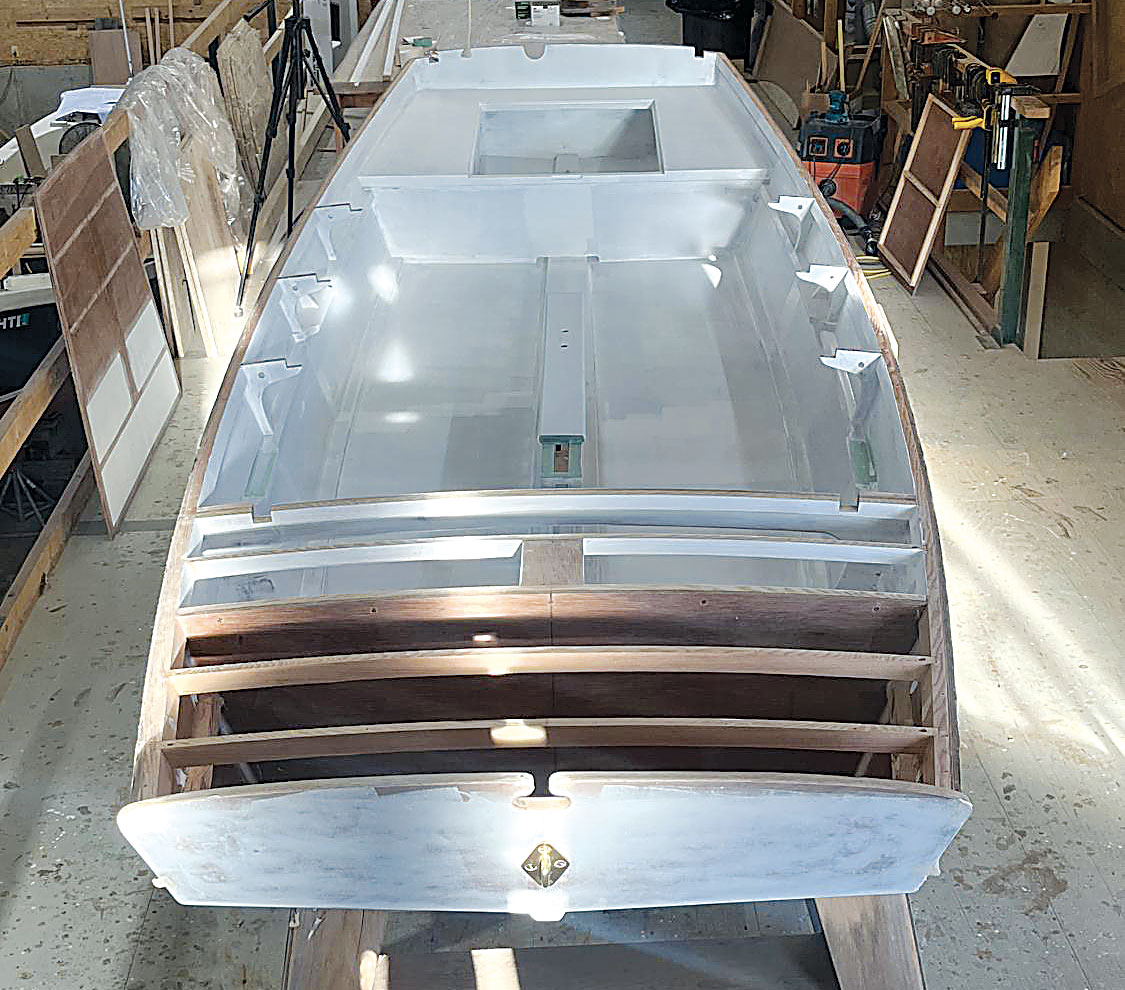 Hylan & Brown
Self-rescuing was of paramount concern in Russ’s design brief. The forward and after bulkheads create flotation chambers.
I found a sympathetic designer and builder in Doug Hylan, whose shop, Hylan & Brown Boatbuilders, sits on the edge of the Benjamin River in Brooklin, Maine. Doug is well familiar with garveys, having designed a range of powered ones as well as a veritable fleet of other small recreational boats inspired by traditional types.
In Doug’s first email to me in July 2022, he raised several points that he thought would result in a better boat. Thus began our correspondence over the past two years, with Doug carefully managing my daydream expectations. The first rendering he sent was a thrill; it showed the boat of my doodles and imaginings made almost real.
After digesting Doug’s initial efforts, the first question I raised was the use of slight V-sections forward and aft. Doug explained that he thought they would improve the boat’s looks and ease the quarters a bit when the boat heeled under sail. I had expected and anticipated the traditional flat garvey bottom and bow, but Doug’s logic was inescapable. I signed up for the V-shapes.
 Hylan & Brown
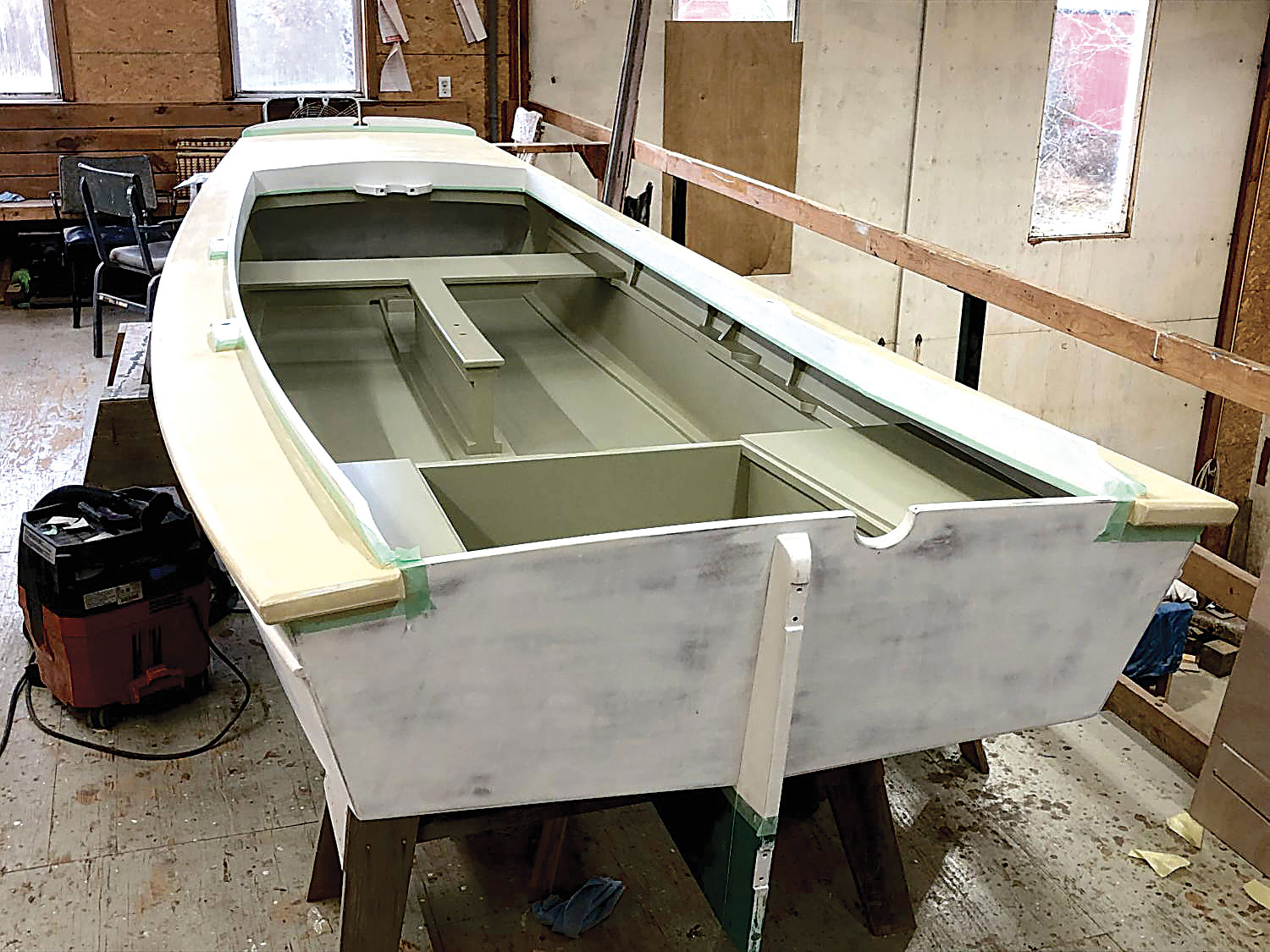
All of the boat’s surfaces, save for the tiller and spars, are painted in a traditional low-gloss scheme. Visible here, too, are the hull’s dimensional Douglas-fir chines, clamps, and framing.
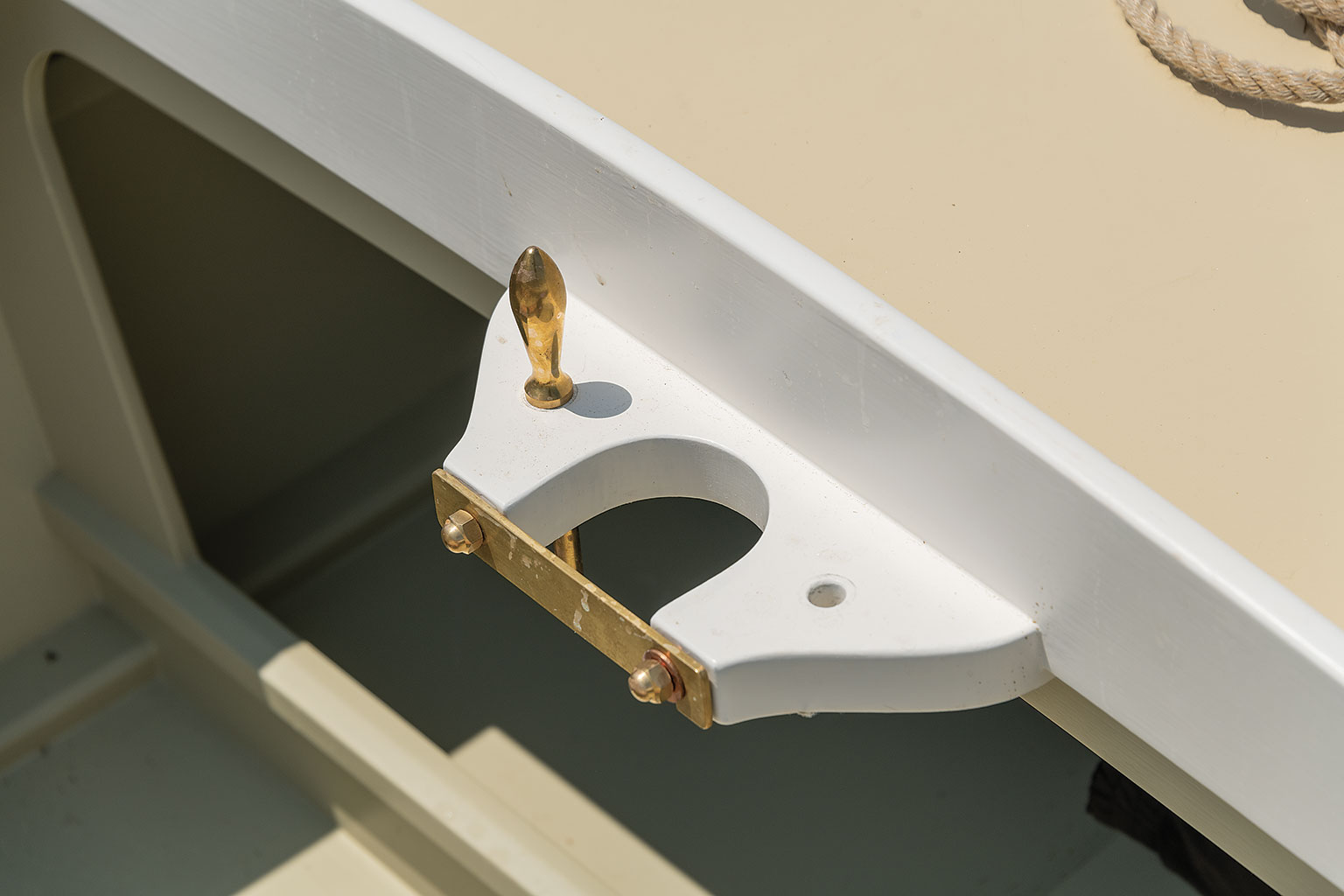
Our second point concerned the mast placement. All of the Chapelle drawings show the mast going through the foredeck, as is customary, and Doug initially had the mast placed there. I thought it would be easier for aging sailors to raise and lower the mast if there were a gate for it on the forward coaming. Doug figured this out by lengthening the cockpit a bit and moving the mast aft some. The mast placement now looks perfect.
One other detail concerned the after thwart. Doug designed it to be removable to allow a nice bit of sprawling space and room for camp-cruising. I questioned whether it could be moved aft to the next deck frame to allow old sailors more comfort. Doug, however, has a strong opinion that boats such as this one should be sailed while sitting on the bottom. The second, farther-aft position for the thwart allows both options.
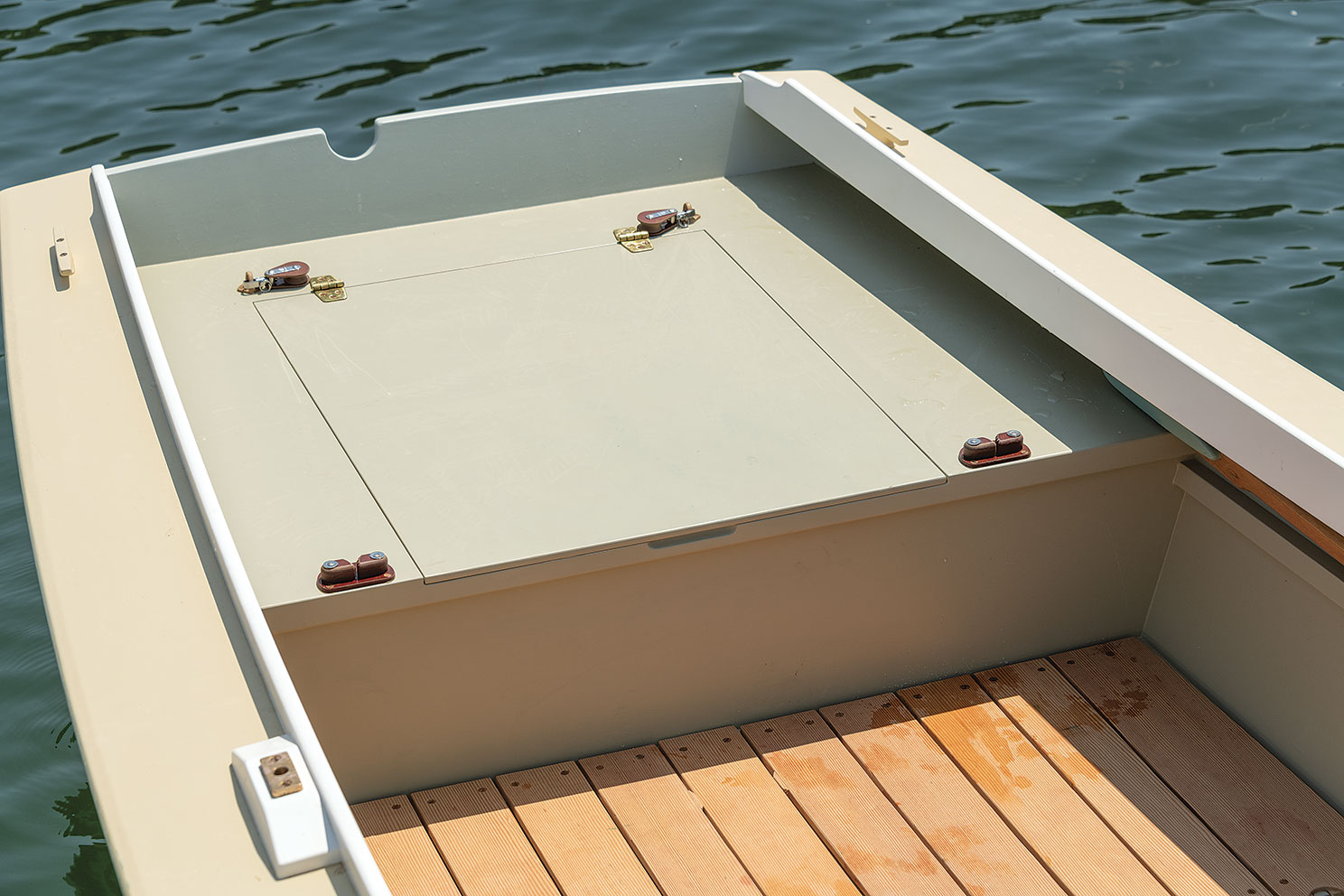
The final design calls for a blend of boatbuilding techniques. These include the use of traditional, dimensional Douglas-fir chines, clamps, and framing. Meranti plywood hull panels are fastened mostly with epoxy, supplemented by bronze screws where appropriate. The bulkheads and deck-beams are made of meranti plywood joined with epoxy fillets. There are buoyancy chambers forward and aft providing sufficient flotation. The afterdeck, which functions as a seat, has an ample locker amidships between flotation chambers. There is also storage under the foredeck. Most important, the spars all fit comfortably within the boat.
 Benjamin Mendlowitz
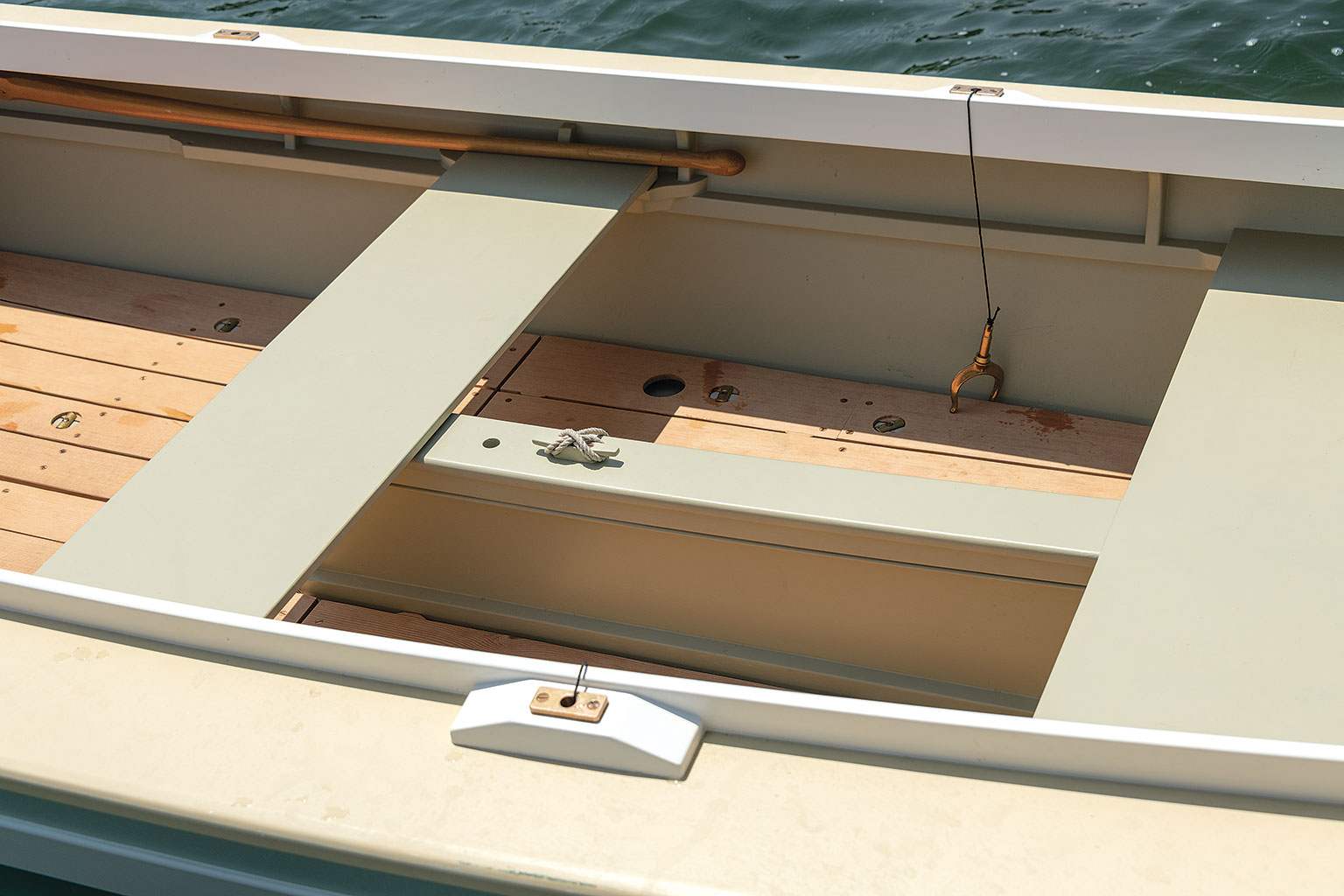
Two rowing stations allow for ample oar power when the wind dies.
 Benjamin Mendlowitz
A mast gate allows the rig to be easily stepped at the launching ramp.
 Benjamin Mendlowitz
The afterdeck functions as a seat and has locker space between flotation chambers.
The standing-lug rig, is a departure from the traditional spritsail. At first I was in favor of a sprit rig, with the addition of a sprit boom, but the thought of being able to easily strike the lugsail won over.
On the Hylan & Brown website, Doug wrote about the genesis of this new garvey: “This is one of my favorite kinds of project—taking a traditional small working craft and adapting it for modern materials and usage. It used to be that even the poorest fisherman had a good eye for a nice-looking boat and demanded a level of aesthetic detail that has vanished from much of modern living.” His passion for this project shows how a simple workboat with just a few lines to work with can result in something sublime.
 Benjamin Mendlowitz
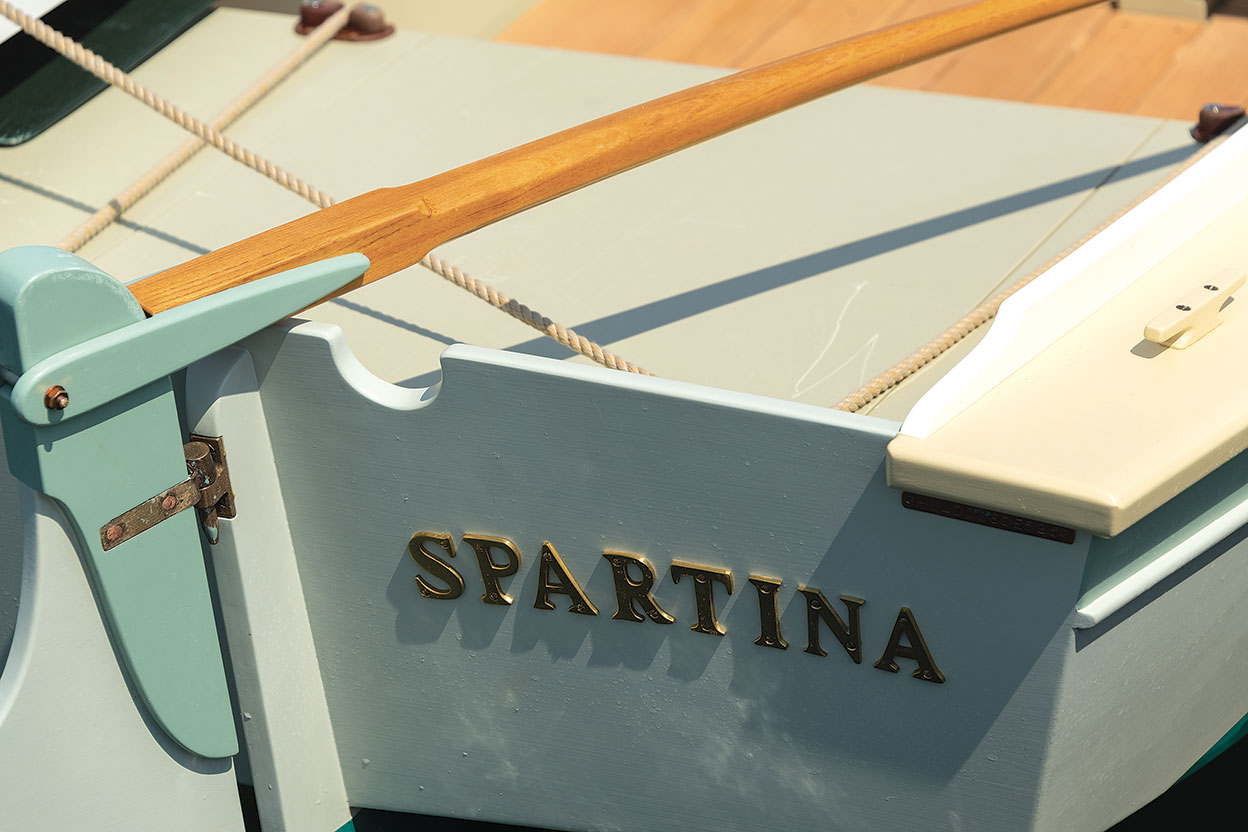
The boat’s shallow-draft rudder; options for sculling, rowing, and poling; and great form stability all suggest an ideal craft for marsh exploration.
Hylan & Brown built the first of what became known as the Swan Point Garvey for Julia and me. Named SPARTINA, she was launched on a sunny morning in early June into the Benjamin River in Brooklin. As I ran my hand and eyes over the boat, I was very impressed with the yard’s level of care, craftsmanship, attention to detail, and the simple painted finishes. SPARTINA was built by Kit Machi with the rest of the shop’s crew helping out.
Julia and I drove to Brooklin for the launching, staying for a few days to conduct sea trials. We stopped in Boothbay to collect SPARTINA’s new lugsail, which was built there by Mike Bartels of M&H Bartels, Sailmakers. Mike had been able to track down a supply of moderate-weight Duradon tanbark-colored cloth, which is relatively hard to find. The sail set well in a range of conditions during the sea trials. With narrow vertical panels and two sets of reef points, it looks very traditional.
The first outing was as enjoyable as the one in my daydreams. For two days after our arrival in Brooklin, the conditions were too breezy for our tastes. Doug eventually couldn’t wait, so he and a mutual friend, Howard Sharp, made the first Swan Point Garvey sea trial. It was incredibly gratifying to see my vision of this new old design sail off in full control. The following day was gusty again, but we had a nice row to windward, then a slow broadside drift downwind after the centerboard was lowered. I was impressed with her stability. I could step off a dock onto the foredeck and walk aft without a dunking.
As hoped for and forecast, the northwesterly breeze laid down at the end of the week. Julia and I set off. As Doug had firmly stated, the best seat in the house was sitting to leeward on the bare fir floorboards with one’s back against the after bulkhead, one arm draped over the coaming and the other lightly holding the long tiller against a proper weather helm. I smiled for the whole sail. She tracked as if on rails and responded smartly when tacking and jibing.
SPARTINA is exactly what I had imagined over the years. Watching Doug Hylan and crew turn those dreams and doodles into a remarkable design and finished boat was one of the thrills of my life. We now have our perfect small boat to mess about in our creeks and marshes. In Chapelle’s concluding lines in the garvey section in American Small Sailing Craft, he writes that in 1951, “Except for gunning, there appear to be no sailing garveys alive in New Jersey.” Since then, there have been a few large sailing garveys built and maintained by local museums. My hope in pursuing this project is to reintroduce this handy sail-and-oar boat to a wider audience. As of this writing in June 2025, there was a second Swan Point Garvey under construction in Cape May, New Jersey. Doug has already sold a half dozen or so plans and full-sized mold drawings. With SPARTINA in commission and others on the way, it seems, at long last, that Chapelle has been proven wrong about sailing garveys being no longer alive in New Jersey.
Gervas Pharo and the history of the garvey
It is unusual that a well-known local boat type that was developed more than 300 years ago on a creek running into the New Jersey Pine Barrens would have, on record, a single creator. That distinction seems to belong to Gervas Pharo, an English Quaker from the Fens of Lincolnshire, England. He settled with his family as a three-year-old in Burlington, West Jersey, in 1678. By 1705, Gervas was a successful, married settler and a leader in the local community. His farm and grist mill on Westcunk Creek off Great Bay behind Long Beach Island became the center of a growing area.
As commerce among the settlers grew, and with the seemingly endless bounty of fish, oysters, clams and birds at their doorsteps, Gervas, known to his friends as Gervey, had likely become frustrated with the use of the local Native Amerian dugouts for moving about the shallow waters of Barnegat Bay. The other boats used by the early settlers were the traditional English ship’s boats and whaleboats of cedar construction with long keels. I can imagine that poling or dragging these boats up shallow tidal creeks became old, fast. Gervas recognized the need for a boat with a very shallow draft, simple construction, and the ability to row, scull, pole, and sail well. He likely remembered his family talking about the simple punts native to the Fens but knew those boats wouldn’t be suitable for conditions found outside his door.
Those conditions can be quite challenging. Even in summer, the afternoon sea breeze can blow 25 knots or more with short, breaking waves. Winter northeasters keep everyone off the water. In the morning, there’s usually a calm or slight land breeze requiring a long row out the creeks to the bounty of Barnegat Bay. In between the extremes are reliable breezes for traveling up and down the back bays.
The first garvey was probably small, because it was something Gervas dreamed up and he wouldn’t likely have invested too much time and capital in an experiment. Some of the world’s best boatbuilding lumber—Jersey white cedar and white oak—was at his doorstep, so he probably started out like all small-boat builders, with the setup of a few molds and the bow and stern transoms. After seeing that the shape was what he had in mind, he would have added an oak chine and clamp and then planked the sides with wide cedar. Once the hull was turned over, the easiest way to finish the bottom was using cross-planking of cedar. Then, forward, after, and side decks with coamings were added.
As a crowd of curious onlookers watched, Gervas Pharo launched the first garvey into the waters at his mill on Westcunk Creek off Little Egg Harbor. Some historians say the year was 1723. Fitted with a simple spritsail, daggerboard, and steering oar, Gervas’s creation was so successful that, eventually, his first name morphed into the word garvey as the design spread up and down the back bays of New Jersey and beyond. I know of no other traditional boat that, after 300 years, still carries the name of the original builder. The garvey should be New Jersey’s state boat.
 Benjamin Mendlowitz
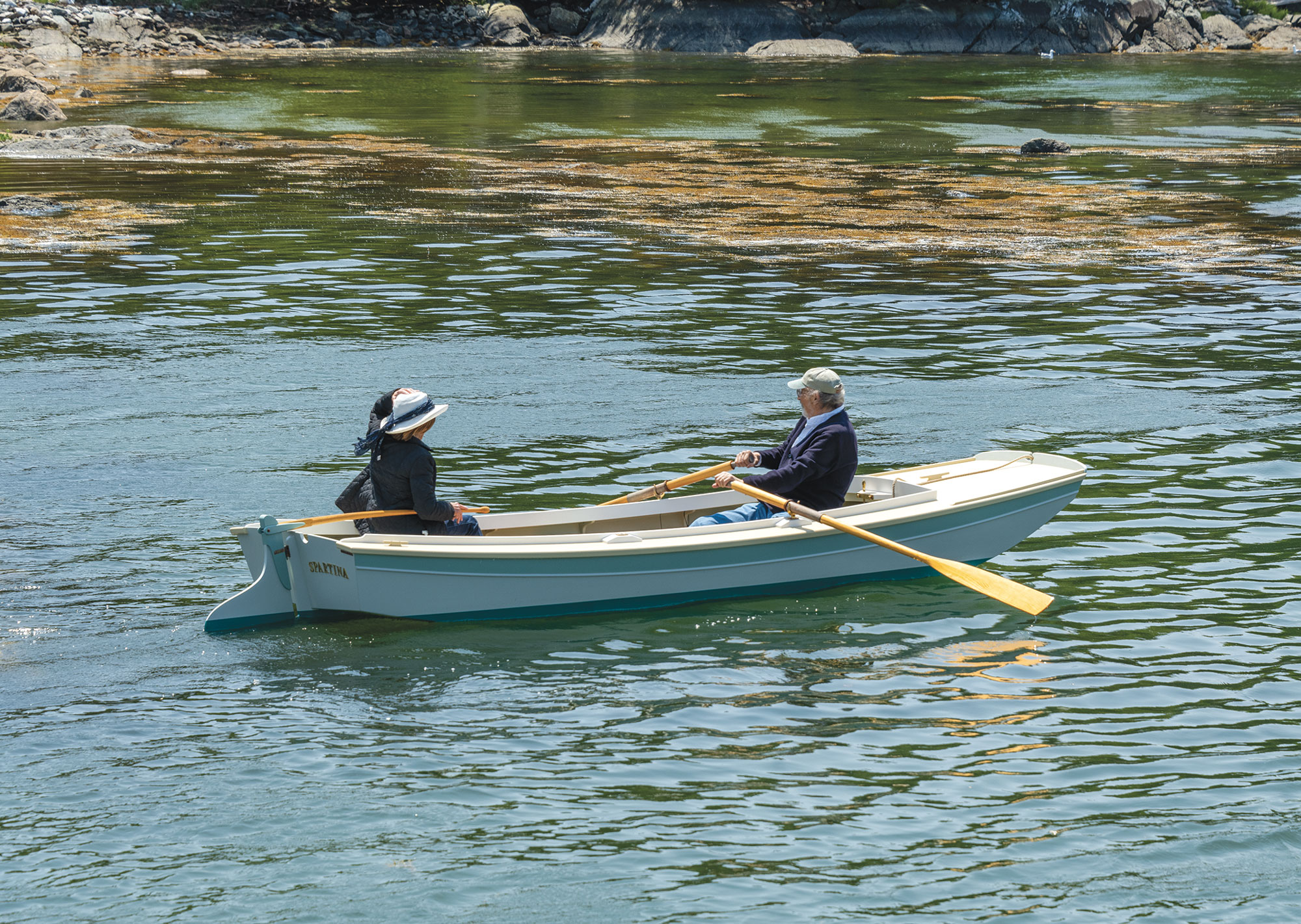
Whether under oars or sail, the Swan Point Garvey can fill a variety of purposes. Since her launching, SPARTINA, the first boat of the design, has also been fitted with an ePropulsion 500W, 1.5-hp electric outboard motor.
The various uses for the Swan Point Garvey
While I was daydreaming about the creation of the Swan Point Garvey, I thought of the various ways a simple small boat based on the New Jersey garvey and powered by oar, sail, and electric motor, could be put to use. I realize that there are many small traditional boats that could be used for the considerations below but think our bluff-bowed boats fit well along our thin waters. I have a very faint hope of luring local kids out of Optimist prams and into a traditional, very local boat. Think Swallows and Amazons on Barnegat Bay. Here are a few uses to consider for such a handy small craft:
Beach cruising. With the after thwart removed there’s plenty of space for two people to set up a comfortable camp. With a boom crutch supporting one end of the mast, the lugsail could be draped over the angled mast to provide some basic shelter.
Salt-hay harvesting. Have local parents and kids in Swan Point Garveys support a boutique non-profit fundraising business of harvesting and providing zero-carbon-footprint bales of totally organic Spartina alterniflora, otherwise known as common, traditional salt hay, for use as a mulch in proper seaside gardens. Back in the sailing days on the Jersey back bays, there used to be an industry of scow sloops and schooners that helped harvest and transport the valuable salt hay.
Traditional duck-hunting. Imagine piles of marsh grass lashed to the decks along with a mess of decoys, while ghosting along under sail past Sloop Point in a light fog. Then rowing around with the spars and sail stowed while setting up the decoys. The dog quivering in anticipation. Why not? And what a great dog boat in general for landing on a beach or marsh for a run ashore.
Messing about. Consider a group of a dozen kids, four in three boats, a couple of parents in a fourth, out for a day or weekend of messing about in the marshes, doing environmental monitoring, having pirate races, camp-cruising and just being kids on the water in useful boats.
A picnic or sunset cocktail punt. She would have low, comfortable seats with backrests for four, a full canvas sunshade with the center thwart serving as a cocktail table. A small electric motor provides silent motion with the boat being steered with simple continuous line to the tiller.
A lesson in building and sailing. Consider having a yacht or boat club build a pair of Swan Point Garveys as a learning experience. They could be built from scratch or from kit. Then the organizations can use them to teach environmental stewardship. It would be wonderful to see one filled with kids learning how to sail slowly and close to nature.
A small sailing garvey is ideally suited to the quiet waters and creeks of Barnegat Bay, or anywhere. The Swan Point Garvey is designed for light to moderate conditions, although with the right sailor and conditions she will be quite sporty. There’s the option of a racing rig, one large enough to provide thrills but manageable enough to be tamed by an experienced sailor. All in all, it’s quite a useful small boat.
Russ Manheimer lives and sails on upper Barnegat Bay, New Jersey, with his wife, Julia. He maintains the blog Hove to Off Swan Point, which mostly discusses his experiences aboard his 22′ Swedish Kosterboat, SJOGIN, which he wrote about in WB No. 247. 