
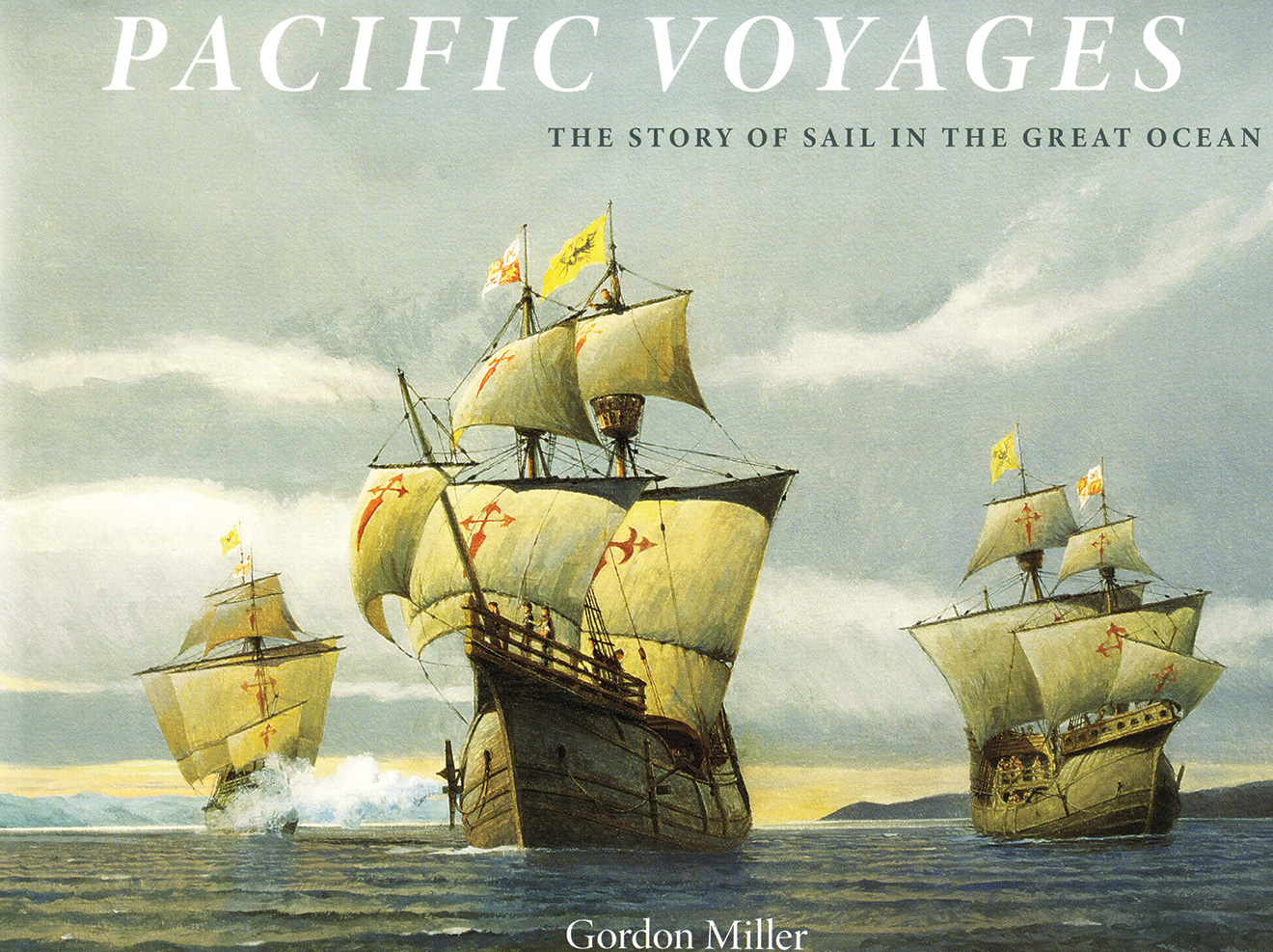
Pacific Voyages: The Story of Sail in the Great Ocean, by Gordon Miller. Douglas & McIntyre, www.douglas-mcintyre.com, 2023. Hardcover, 264 pp. $49.95 (CDN $59.95).
Too often, North Americans look east, to the Atlantic Ocean, as the body of water that saw history’s most important maritime discoveries. The outward sprawl from the Mediterranean by the Phoenicians, the Vikings in Newfoundland, Columbus arriving in the Caribbean Islands, and others are well studied and understood. The Atlantic, the geo-center of western commerce for nearly a millennium, is the cultural shore westerners stand on.
The Pacific receives far less attention, even though it is the biggest geographical feature on the planet and the history of its exploration is no less fascinating than that of the Atlantic. Gordon Miller, a Canadian writer, goes a long way to redress the situation with his new book Pacific Voyages: The Story of Sail in the Great Ocean. Pacific Voyages ticks all the boxes for readers who want to understand the Pacific and humanity’s expansion in the region.
Beyond the mercantile class and empire-building governments, if people thought anything about the Pacific, it was as an intimidating body of water that needed to be avoided at all costs. They didn’t give much consideration to the Pacific’s initial cultural and trade development until the mid-19th century.
We now know, as Miller points out, that the earliest Pacific explorers traversed the ocean’s expanses. “When Europeans had as yet barely sailed beyond the sight of land, these oceanic wanderers had discovered and colonized an area of the ocean greater than North and South America combined.” It wasn’t until the copra trade and agricultural industry (think Hawaii and pineapples) that the vast number of islands in the Pacific basin received any recognition, and only the threat of loss to Japan in World War II drove us to study the region in greater depth.
Studying the Pacific’s precolonial period was hindered by the lack of written records until 400 years ago. The information existed, but western academics’ distrust of the oral tradition discounted it. Western anthropologists preferred to trust archaeology and awkwardly unprovable theories to account for the spread of Polynesians across the Pacific Basin.
In the first chapter, Miller acknowledges the common belief that the pre-eminent navigators in the Pacific were the Polynesians, and he points out that many current histories discount the Chinese, who were known to have made voyages to India and Africa and who have been purported—with much dispute—to have reached North America sometime around 1421. The book, however, ignores the coastal voyaging and trade accomplishments of First Nations peoples such as the Haida and Tlingit.
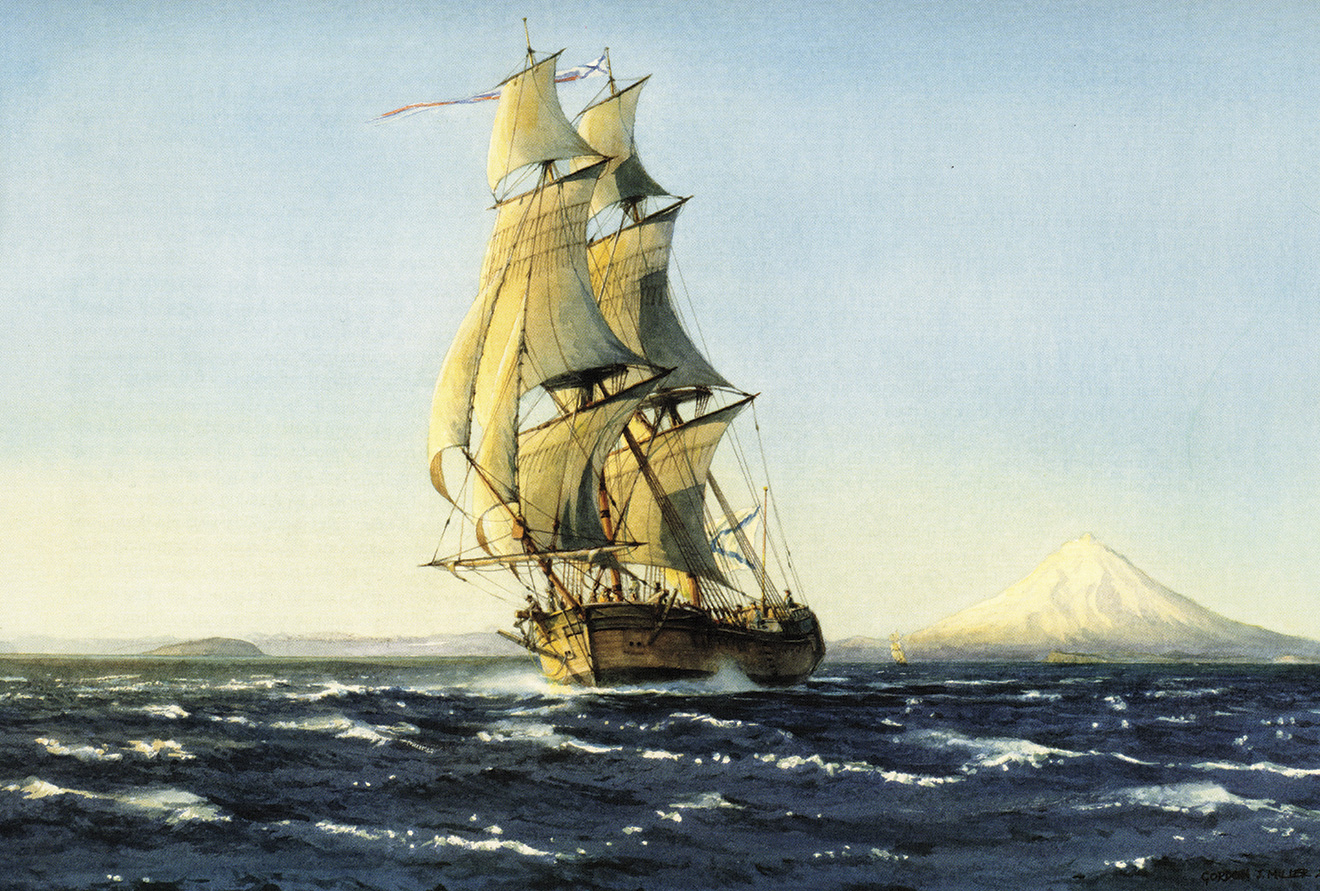
Departure From Avacha Bay. The Russian vessels ST. PETER and ST. PAUL depart for North America on June 4, 1741.
Miller deals with the early settlement by various indigenous groups as best as he can through oral tradition, but Pacific Voyages really takes off when he has paper documentation to work with. That documentation begins with Ferdinand Magellan’s circumnavigation in 1521. Of the five ships that left Spain in 1519, only one returned, under the command of Sebastian Elcano, the last of five fleet captains. But it wasn’t Elcano who reported on the journey. Elcano took over command of the expedition after Magellan was killed in the Philippines. But it was a young Italian nobleman who took part in the voyage, Antonio Pigafetta, who wrote a book upon the fleet’s return, giving us the first maritime adventure book.
The subsequent 20 chapters of Pacific Voyages cover all aspects and motives of Pacific exploration and include characters and nations such as Indigenous Peoples, Malay/Indonesians, Russians, and Chinese—people who don’t typically appear in western school texts. These chapters also cover the first western shipbuilding on the Pacific coasts.
Miller was born in Winnipeg, Manitoba, about as far away from the ocean as you can get in North America, and grew up sailing prams on the Red River. “When I graduated from high school at 16,” he writes, “I was sure of only two things: I wanted to be an artist, and I wanted to live where I could sail on the ocean.” He did both. He recounts having owned three boats—a wooden Bristol Bay gill-netter, a 12-ton foam-cored Stan Huntingford–designed ketch, and a 27‘ Ted Brewer–designed sloop. For 60 years, he cruised the waters between Puget Sound and Haida Gwaii (formerly the Queen Charlotte Islands) and “at 85, I realized I was no longer strong enough to handle the boat in a blow, and reluctantly swallowed the anchor.”
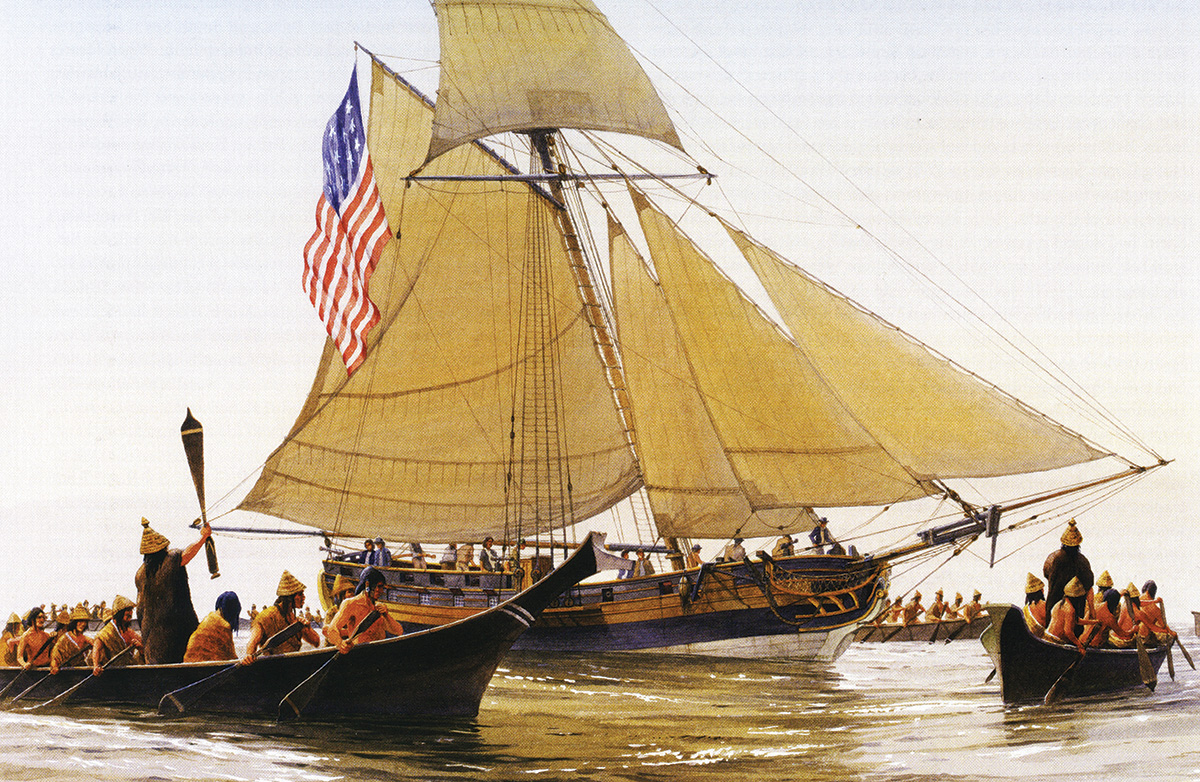
UNION Among the Nuu-Chah-Nulth. UNION was a small New England sloop of about 90 tons. Upon returning to Boston, Massachusetts, on July 8, 1796, she became the first American sloop to sail around the world.
Miller admits to having no interest in history in school. “It seemed to consist mainly of memorizing dates of kings and battles. In 1965 I joined a firm of professional designers contracted to create the first four galleries in the new Vancouver Museum being built for Canada’s centennial. I later became the museum’s chief designer, a position that included design responsibilities for the Vancouver Maritime Museum…. It was during these ten years, working with historians, anthropologists and archaeologists, that my interest in history was kindled. It also made me aware of how deficient my knowledge was of maritime history.”
His response was simple and creative. “When I couldn’t find a single, easy to understand, lineal narrative of ship development and world exploration, I wrote Voyages, to the New World and Beyond, and to fill the same gap in Pacific maritime history, I wrote Pacific Voyages, The Story of Sail in the Great Ocean.” His historical work was so good, he was named chair of Maritime History by the San Diego Maritime Museum in 2020.
Miller trained as a fine artist when he was a young man, and Pacific Voyages is more than just a regurgitation of familiar names and dates; it is a collector’s folio of his fine marine paintings. His training, sea experience, and observant eye give him an ability to render sea states and island landings sensitively and accurately. “My paintings,” he writes, “are all created to illustrate some event in history, and visual accuracy is my most important objective.”
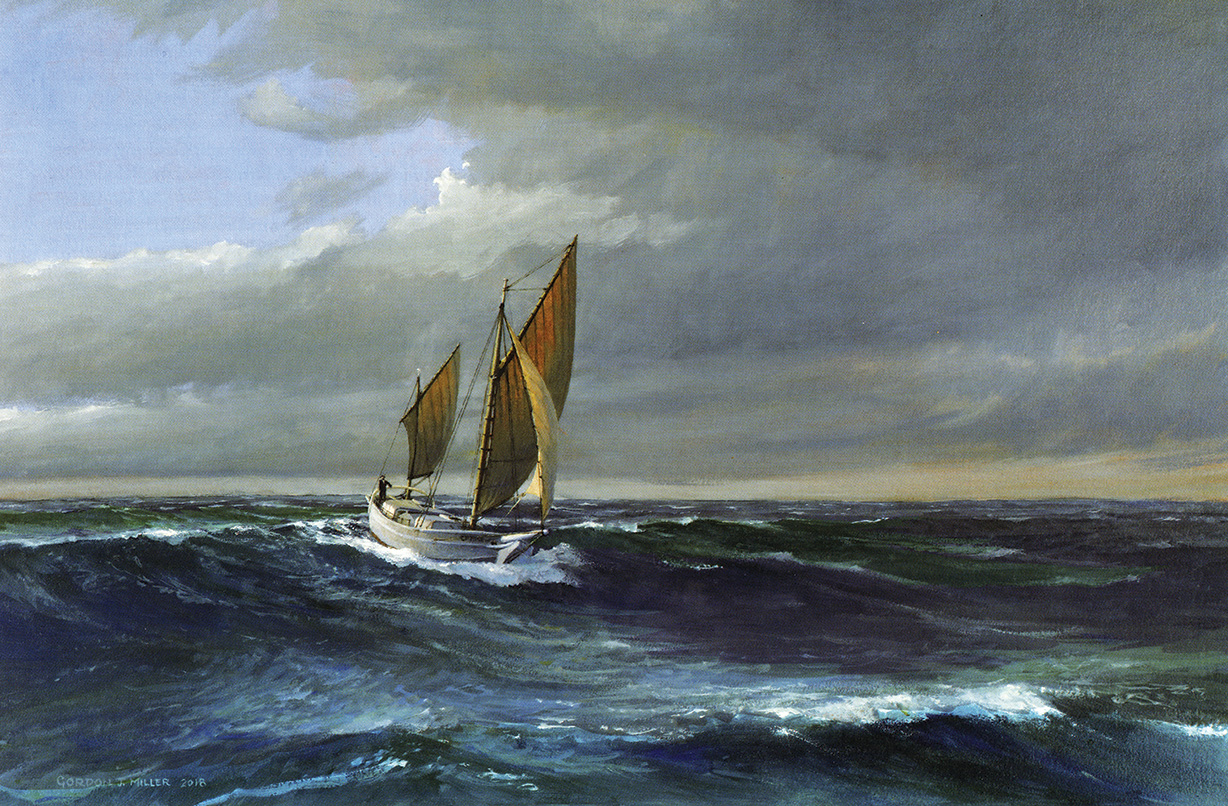
Slocum Alone and Westward Bound. Joshua Slocum sailed from Westport, Nova Scotia, in July 1895 in SPRAY, a once-derelict Delaware oysterboat he had rebuilt, to become the first westward-around-the-world solo circumnavigator.
Many WoodenBoat readers will fall in love with Pacific Voyages for its elegant production values. It’s a substantial, cloth-bound book printed on high-quality coated paper; the type is crisp and the illustrations “pop.”
The work of research was time-consuming, “but enough reference is available for most places to create a reasonable representation. And I recruited friends around the world to take photos of places I was never going to get to [such as the Cape of Good Hope].” He visited many of the sites on the North American west coast, giving him excellent firsthand background reference. “Best of all were places like Drake’s Bay [San Francisco]. Ray Aker, who was an expert on 16th-century sail, and Drake in particular, spent a day with us on the California coast, pointing out the careening site” believed to be where Sir Francis Drake paused during his 1577–80 circumnavigation, “and the beach where the Spanish galleon was wrecked.”
In the age of tablet computers, tiny phone screens, and the Internet, Pacific Voyages: The Story of Sail in the Great Ocean, is a real physical pleasure. It is a joy to hold and a “keeper” for any sailor’s bookshelf. 
Bruce Kemp is a regular contributor to WoodenBoat.