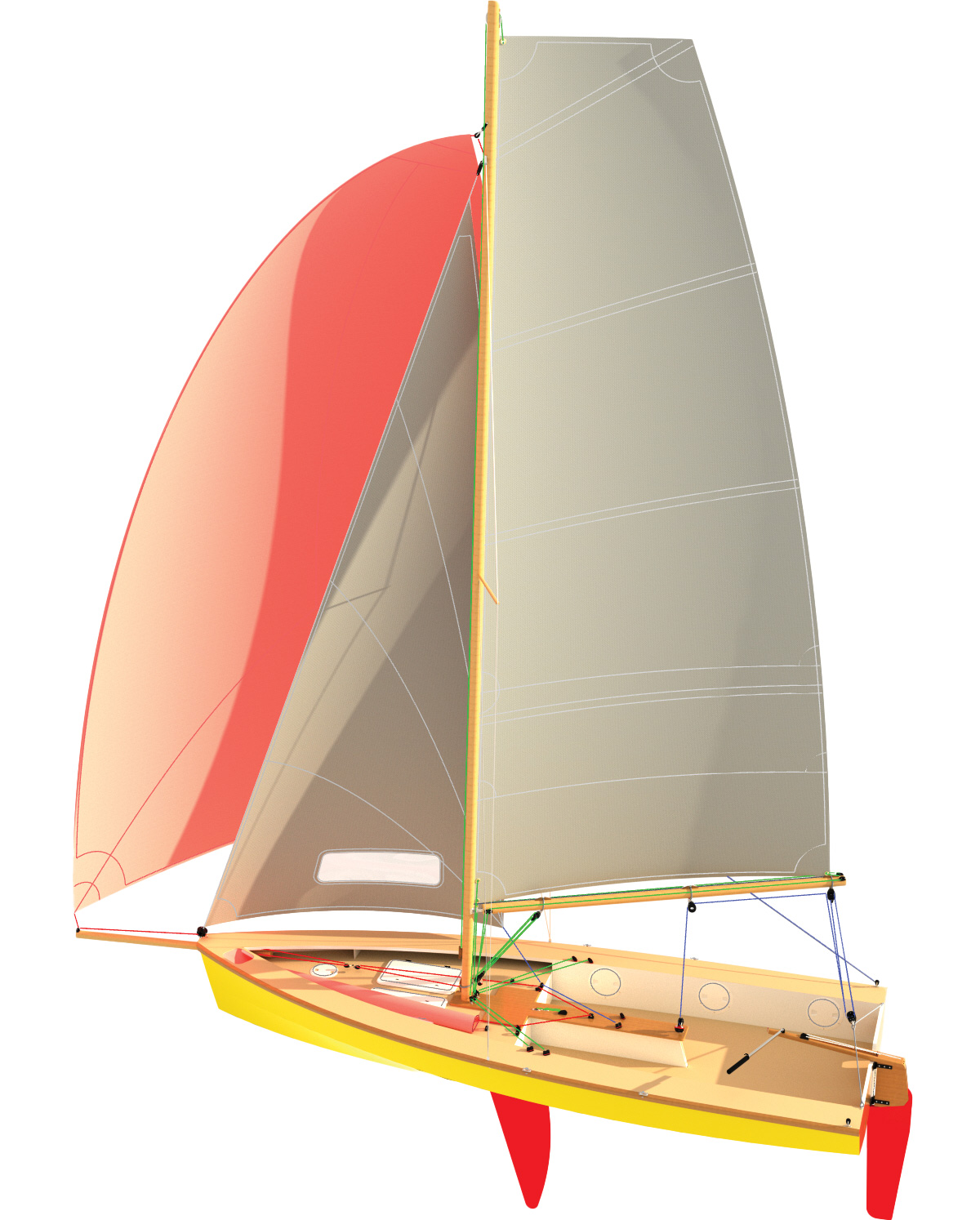
The Naskeag 16 is an easily transported high-performance daysailer.
Dear Dudley,
The Naskeag 16 is an easily transported high-performance daysailer.
WoodenBoat School Director Eric Stockinger and I were recently discussing how-to-build classes for our summer program. Many of the boats we’ve built over the years have been pretty to look at and comfortable and safe to sail, but we’d like to include one that’s a little more challenging and gratifying for experienced small-boat and dinghy sailors. I was advocating for the inclusion of an easily transportable, high-performance, plywood-epoxy sailboat that could be cut on a CNC router and built in a one- or two-week class.
Your Paper Jet (PJ) sailing dinghy, which focused on performance and affordability, came immediately to mind. I dug out the Design Brief article you wrote about it for Professional BoatBuilder magazine in 2008. Some aspects of that boat are transferable to the school’s priorities, particularly the lightweight hull built of 4mm plywood on interlocking transverse frames and stringers, and the multiple rigs that can be fitted to the hull to accommodate a range of experience or comfort levels. While reading I was reminded of seeing you sail the PJ and noting how physically demanding it was even for an experienced athletic sailor.
Eric and I agreed that a larger, slightly more forgiving platform that could comfortably carry at least two adults and gear would better fit readers’ and students’ needs. Limiting costs by applying as many simple materials and buildable elements as possible would be beneficial. The boat should look sharp but not blindly adhere to traditional aesthetics and styling. I know I hardly need say it to you, but it’s important that while construction should be within reach of amateur builders, affordability and accessibility should not come at the expense of performance under sail, especially for sailors who embrace the challenge of the most powerful rig. I’m hoping you can help us add a thrilling and versatile new ride to the fleet here in Brooklin.
Aaron Porter, Editor
Professional BoatBuilder magazine
Dear Aaron,
Thank you for proposing this design. It fits neatly into my philosophy of simple, fast, and fun, and your brief allows me broad scope for developing the idea—which is how my most popular designs have come to life.
Many current small-boat designs reference historical concepts that evolved to serve local conditions, which resulted in the wonderfully rich and diverse styles found along the East Coast of the United States. Those historical features, however, may have little bearing on a modern design, aside from aesthetics; modern boats are generally built and used in scattered locations and in varied conditions. For this design, I find myself referencing my own historical designs drawn over the past 45 years.
That is not necessarily a bad thing, because I grew up around and on boats. We lived on the banks of the largest sailing lake in the Cape Town area of South Africa, in the mostly windy conditions of the Cape of Good Hope—which is also named Cape of Storms, for good reason. My dad was a provincial champion in the Flying Dutchman class and participated in coastal racing on offshore yachts before the advent of lifelines. My memories of sailing with him are of fast, wild, and wet sailing; tending the centerboard; and the gurgling of home-made self-bailers. My sailing roots involved learning by doing.
I didn’t comprehend the nuances of centerboard adjustment for helm balance and boat speed at the time. Dad would tell me to lower the board, push the bailers down, or pull them up, and that is what I did. From this, I developed into a seat-of-the-pants sailor, always tweaking for more speed based on how the boat feels rather than from reading textbooks. The boat tells me what it wants. And so it is with my boat designs as well. I am a seat-of-the-pants designer, drawing what I feel is best for what the boat is intended to achieve rather than relying on the numbers used by others.
I’m calling this boat the Naskeag 16, in honor of the point of land near which WoodenBoat is located.
Hull Form

The Naskeag 16 has a flat bottom panel, multi-chine sections, and a flat sheer. It is based on several of the author’s proven designs.
Particulars:
- LOD: 4.92m (16′2″)
- LWL: 4.80m (15′9″)
- Beam: 1.85m (6′1″)
- Waterline Beam: 1.27m (4′2″)
- Draft:
Board up 0.14m (5.5″)
Board down 1.31m (4′3″) - Displacement (at DWL): 370kg (815 lbs)
- Weight (approx.): 135kg (300 lbs)
- Sail area:
Balance lug: 12.3 m2 (132 sq ft)
Fractional sloop: 16.93 m2 (182 sq ft)
Turbo rig: 18.93m2 (204 sq ft)
The basis for the Naskeag 16 goes back to my first complete design, the 32′ CW975, accomplished while I was a student of yacht design. She was a multichined plywood boat with a flat bottom panel, and she had strengths and weaknesses. She was okay, but not great, for around-the-cans racing and performed beautifully in strong downwind conditions, surfing at 18 knots and reaching at 14 knots on flat water under spinnaker. The Coquette 39 followed. It had the same basic shape in a slimmer hull, and proved to be an exceptionally fast cruiser.
But the overall concept of the Naskeag 16 harks back to my more recent Argie 15; it is modernized by 35 years with a flatter sheer, though the hull sections are similar to the boats described above. The Argie had an unexpected top-end performance for reaching, but the smallish rig limits that speed to stronger winds. The historian at Royal Cape Yacht Club told me that he sailed with a friend on an Argie in strong winds, keeping pace with a Fireball on a reach, and immediately bought one for himself. The layout is proportioned to allow two adults to sleep on the cockpit sole for camp-cruising, and there is voluminous stowage space for camping gear and food. Unlike the Argie, the Naskeag 16 has a closed sunken foredeck that can sleep two children; the raised cockpit sole is self-draining through ports in the transom, so it does not need floorboards to lift sleeping crew out of the bilge or arrangements to remove bilgewater from the cockpit.

The boat has a sunken foredeck and the raised cockpit sole is self-draining.
With a new design, it is normal to calculate and compare with other designs for prismatic coefficient (PC), longitudinal center of buoyancy (LCB), center of flotation (LCF) etc., along with displacement and other numbers. These particulars are calculated with flotation at the expected load level for normal sailing, with the boat floating level. For heavy boats, those values stay relatively stable in use because fore-and-aft trim doesn’t change much. For light boats, particularly with the unbalanced waterlines created by fine bows and broad sterns, the numbers can vary considerably by moving crew forward or aft. Moving crew forward at low speeds lowers PC and moves LCB and LCF forward, reducing drag for increased speed. Conversely, moving crew weight aft increases PC and moves LCB and LCF farther aft, increasing speed in strong conditions, particularly downwind. A light boat such as the Naskeag 16 benefits from sailing bow-down in light breeze and to windward, stern-down off-wind in strong wind.
I don’t think much about the so-called “design spiral”—the process of refining a broad initial concept by repeatedly revisiting and adjusting previous decisions—when I develop a new boat, but I do go through this process to get displacement, PC, LCB, and LCF where I want them. After I get those numbers settled, I very seldom venture back into the spiral. From there the design progresses naturally, with construction calculations and detailing running parallel. I worked through seven design evolutions before this hull shape was finalized.
Construction

The centerboard allows access to shallow water, and small adjustments to it can be used to fine-tune helm balance.
My 13′5″, 94-lb Paper Jet skiff, which you note in your brief, contributes structurally to the new design. The Paper Jet is built of 4mm okoume plywood, with cedar and poplar solid wood where needed. I have used the same basic scantlings for the Naskeag 16, except for increasing the backbone to 6mm and substantially increasing the transom structure to take an outboard motor.
Boats of this size can have thin decks as long as they are stiffened by suitably spaced stringers. A bit of flex that may be felt from a thin deck on land is not felt when on the water because the entire boat moves to absorb footfalls. My Mini-Transat-style sailboats are built for ocean crossings, designed to ABS racing yacht rules, and have 6mm okoume plywood for all skin panels, supported to rule requirements. The result is a deck that is light but feels solid underfoot. The Naskeag 16 structure is designed to the same principles.

The Naskeag 16 is built of 4mm and 6mm CNC-cut plywood pieces glued together with epoxy. It could be built in a one- or two-week boatbuilding class.
The hull stringers have two purposes. First, they support the thin hull skin. Second, they restrain the skin from naturally bulging outward in areas of twist if not persuaded to do otherwise. The Paper Jet bottom skin twists nearly 90 degrees bow to stern and is held in by the bottom stringers, forming a finer bow than it would have without stringers. This gives clean wave penetration and reduced pitching when sailing to windward in a chop as well as good speed on flat water on all headings. The result is a non-developable form from sheet plywood, which will soon relax into the constrained shape and relieve the stresses felt on initial bending.
Rigs

The boat has three rigs. The sloop (right) is the standard one, and it uses the same spars and jib as the turbo rig (left) but not the bowsprit, asymmetrical spinnaker, and flat-top mainsail. The freestanding balance-lug rig (middle) offers quick setup and leisurely sailing.
I have drawn three rigs. The turbo is the largest and is adapted from my Didi Sport 15 (DS15), a radius-chine plywood double-handed sailing dinghy with a large flat-top mainsail, fractional rig, and asymmetrical spinnaker on a retractable sprit. It is complicated but will be a lot of fun to sail in most conditions for experienced crew. The mainsail may be reefed in strong winds, with the first reef reducing the sail plan to a masthead sloop.
The halyard has a masthead lock and terminates at a horn cleat on the mast. Double-ended outhaul and Cunningham lines lead to cam cleats on both side decks for quick adjustment. I have replaced the self-tacking jib of the DS15 with separate sheets because a family sailboat should have control lines for the crew to tend; this also allows a jib with a small overlap. The forestay will be in a luff sleeve on the jib, and set on a small furler. The sprit deploys with the spinnaker halyard and retracts with the spinnaker retrieval line. The spinnaker chute is in the port side deck, with the spinnaker sock on the foredeck. This rig would work well with twin trapezes, for crew and helmsman. Strengths for club racing would be skiff-type courses that include reaching legs or point-to-point courses. The deck-stepped mast and other spars are wooden; they are hollow and built of staves using bird’s-mouth joinery. They can also be standard aluminum sections suitable for large dinghies.
The sloop is the standard rig, using the same spars and jib as the turbo rig but not the bowsprit and asymmetrical spinnaker. It also has a conventionally roached main. With a symmetrical spinnaker, this version would be a good club-racer for windward-leeward courses, which would not suit the turbo rig. A single trapeze would be appropriate.
For those who want leisurely sailing from a simple sail plan, the freestanding balance-lug rig has a solid wood mast that steps in a tube in the foredeck. I have always liked lines to tweak but, now at 75 years old, I would be happy with the lug rig.
The most common options requested by Argie 15 builders have been a lug rig and pivoting centerboard, and both features are designed into the Naskeag 16. The centerboard gives easy access to shallow water, and adjusting it can be used to fine-tune helm balance with the center of lateral resistance moving aft with the board partially raised for reaching headings and fully down for beating. The board’s elliptical shape maintains efficient flow in almost any position rather than the increasing drag from a squared-off bottom end when partly raised.
The centerboard dictates a long trunk, which I have covered with a broad hardwood board to serve as an aft rowing seat; the “seat board” is widened at the aft end of the foredeck to create a comfortable forward rowing position, as well. The jibsheet cleats are on top of the centerboard trunk to be reached by crew or from the tiller position when singlehanded. The mainsheet block is on the aft end of the trunk, convenient to the helm. The top is screwed to support framing on both sides of the trunk so it can be removed for centerboard extraction either on the water or on a trailer, without lifting the boat.
Aaron, I believe that the Naskeag 16 will provide great sailing experiences for crews of all levels, from families who use her for fun adventuring as a daysailing picnic boat or camp-cruiser with the lug or sloop rig, to those who want to blast across the bay at high speed with the turbo rig, spray flying in the way that I experienced in my childhood years with my dad. ![]()
Dudley Dix designed his first boat, a 15′ beach catamaran, in 1973, and has been a professional designer since 1979. His work ranges from 8′ to over 70′. He moved to Virginia Beach, Virginia, from his native South Africa in 2004, and is an “unrehabilitated beach bum at heart” who surfs whenever he can. Learn more at dixdesign.com.
Please send concept proposals for Sketchbook to sketchbook@woodenboat.com.