
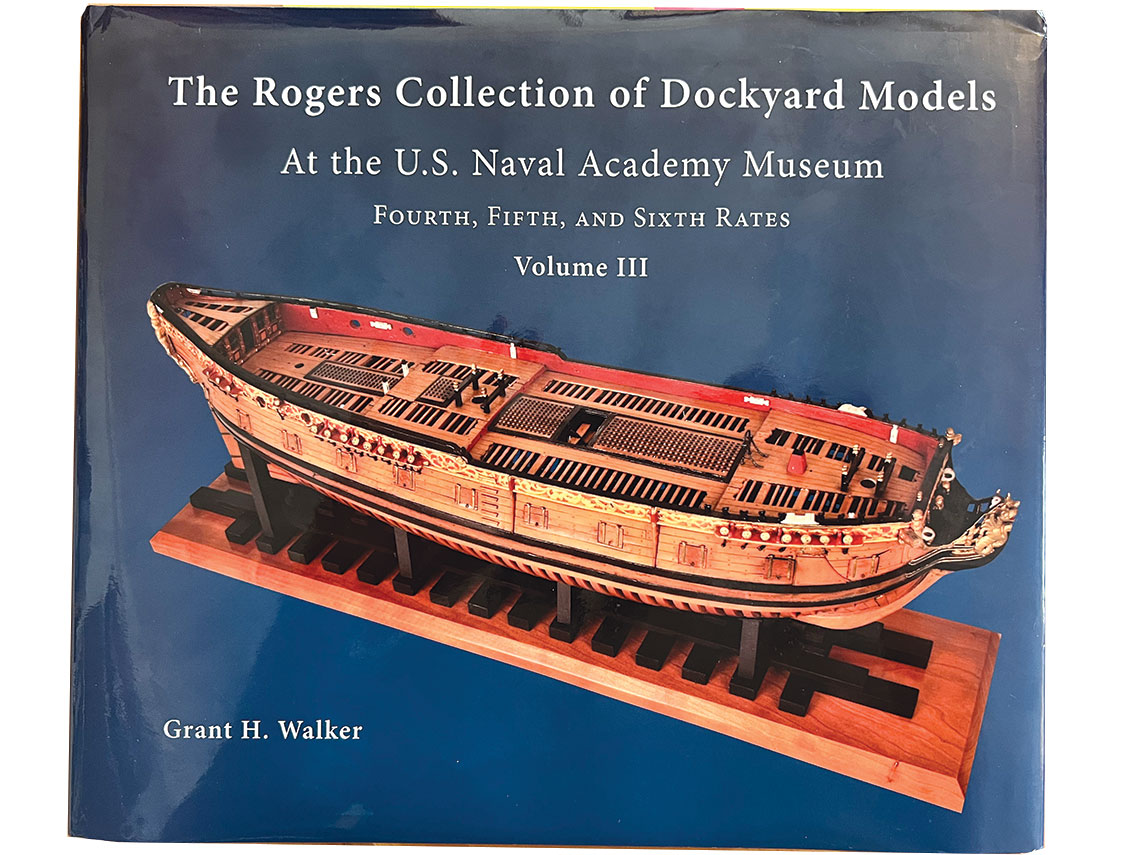
The Rogers Collection of Dockyard Models at the U.S. Naval Academy Museum, Volume III, by Grant H. Walker, Sea Watch Books, 2040 Millburn Ave., Suite 102 No. 109, Maplewood, New Jersey, 07040. 390 pp., hardcover, extensive photographs supplemented by historical artworks; six appendices, bibliography, index; 390 pp. $96.
Like much of the history of western civilization, the history of shipbuilding is largely told today through the study of warfare. This is somewhat unfortunate for the Age of Sail, because such a study skews knowledge away from everyday life and into the concerns primarily of state, and especially royal, powers, their fetishes, their whims, and their conflicts. With discoveries of merchant ships, nautical archaeology is rebalancing this study significantly, but the fact remains that seafaring in all ages and nations is first and foremost preoccupied with the machines of war.
Nevertheless, every person who is interested in history needs some kind of a “key” to inquiry. That key may be anything—architecture, migration, agriculture, textiles, the choices are infinite—but for many of us, the development of boats and seafaring ships, regardless of purpose or the founding culture, is the single most compelling thread of the human story.
So when fragile historical artifacts directly involved in that heritage improbably survive hundreds of years into our own times, they command serious attention. They are messengers from the past, and they deserve close and careful analysis. That is precisely what Grant H. Walker is providing for a staggering collection of British ship models built by shipwrights who were contemporaries of the ships themselves. The Rogers Collection of Dockyard Models, Volume III, published late in 2024, is the latest in what is promised to be a four-volume series focusing on all the models in the U.S. Naval Academy Museum in Annapolis, Maryland, where Walker has been a curator for many years.
Col. Henry Huddleston Rogers, a wealthy collector of British Admiralty models, donated the collection to the Academy in 1938. Walker, a West Point graduate, came to the Naval Academy in 1987 as a professor of history, and in the early 1990s, as he writes in this volume’s acknowledgments, he was introduced to the ship models by a fellow history professor, a conversation that “set me on the path that became my life’s work and passion.” He was staggered to learn of the models’ historical accuracy and the insights they could support. His close study of them even introduced new techniques of examination, including the use of endoscopes, X-ray photography, and CT scans.
The ships whose stories are told in these volumes are exclusively British. The fact that the Admiralty pioneered the practice of taking lines off all ships in its dockyards, including those captured or acquired from enemies, gives us one of the richest sources we have of shipbuilding history. The Admiralty also required builders to provide models, and the making of them became a high art; some documented built hulls, others served as proposals, and the grandest were probably gifts for shipyard patrons.
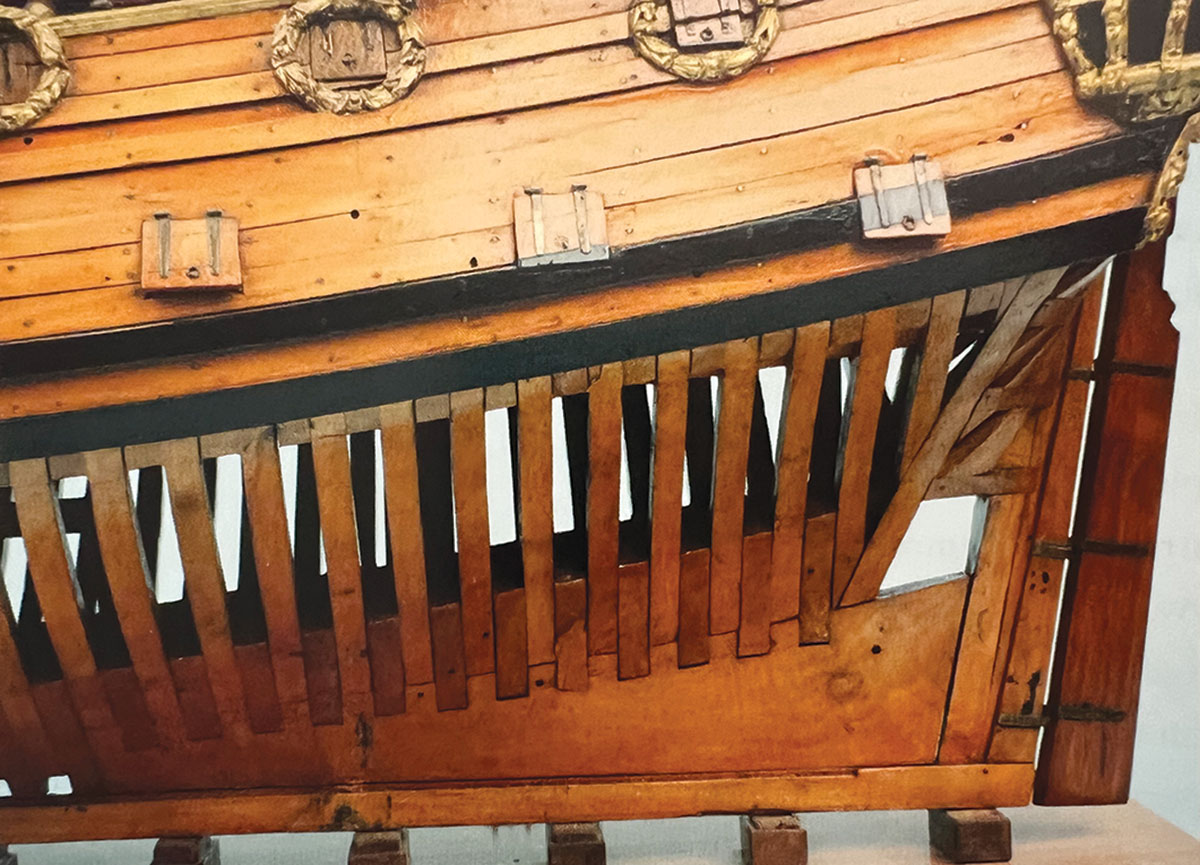
The framing of the 1693 ship PORTLAND, left exposed, shows especially fine work.
The Admiralty rated its ships based on how many guns they carried, and the first volume of Walker’s series (which I reviewed in WB No. 251) focused on the grandest and largest of them, the first- and second-raters. The second volume (which, regrettably, I have not seen) focused on the third- and fourth-rated ones, and this one’s topic is ships down to sixth rate, the smallest. I am very eager to hear what the fourth volume’s subject will be.
The most impressive fact of Walker’s work is the incredible detective story involved in each one of these models. That “key” I mentioned as an entry into history opens many doors: understanding baroque ship decorations of the 17th and 18th centuries, for example, calls for an understanding of the classical Greek mythology that was then popular, plus the history of art, since many of those decorations have their origins in popular paintings and sculptures. The ships open and personalize the dense subject of British royal succession, aristocracy, Admiralty leadership, and naval history. Original rigging rarely survives intact, so a thorough understanding of changes and innovations in sail handling is necessary for spotting errors and anachronisms introduced in repairs—and in this and other regards the great British historian R.C. Anderson’s scholarship holds up particularly well, and so does the work of Rogers’s favorite modelmaker, Henry Culver, and the modelmaker and author Charles G. Davis. It’s a small cast of characters that Walker has come to know well.
Walker never accepts appearances at face value; he works the problems, sorting through facts with the painstaking care for detail that the best of the modelers themselves exhibited. He is clear about what he cannot know and where the trail went cold, and in many cases he points out possible paths that future scholars might follow. This work is undoubtedly easier than it was during the 1920s, when Rogers’s collecting was at its height. With today’s technology and rapid international communication, the promise of future additions to this scholarship is ripe.
One of my favorite models in this volume is MINERVA, a fifth-rate 38-gun frigate of 1780. “It is made of the highest quality materials and demonstrates the hand of one or more master craftsmen, not only of woodwork and carving at a miniature scale, but of painting and metalwork as well,” Walker writes. It is presented in detail in the book, including lines plans and numerous photos of her incredible carvings. The hull, instead of the sawn framing common earlier, is built of bread-and-butter “lifts” up to the waterline and plank-on-frame above that. (I built a model just this way when I was in high school.) This ship was an early example of a hull’s copper sheathing, which is portrayed in exquisite accuracy on the model. The sheets are set in a staggered pattern, like brickwork, and fastened with what Walker estimates at nearly 45,000 individual copper tacks.
Another of my favorites is a fifth-rate “demi-batterie” ship of 1689. This was an influential attempt to solve the problem of auxiliary propulsion by oars on armed ships. The solution was to have a low deck devoted mostly to rowing and above it a gun deck—the idea being to keep the oars, nine per side, at an advantageous height for rowing without obstructions and at the same time put the gun ports, 14 per side, high enough to be clear of the water in all weather. This innovation plays out in several other models described in this volume, and Walker traces the development through its variations.
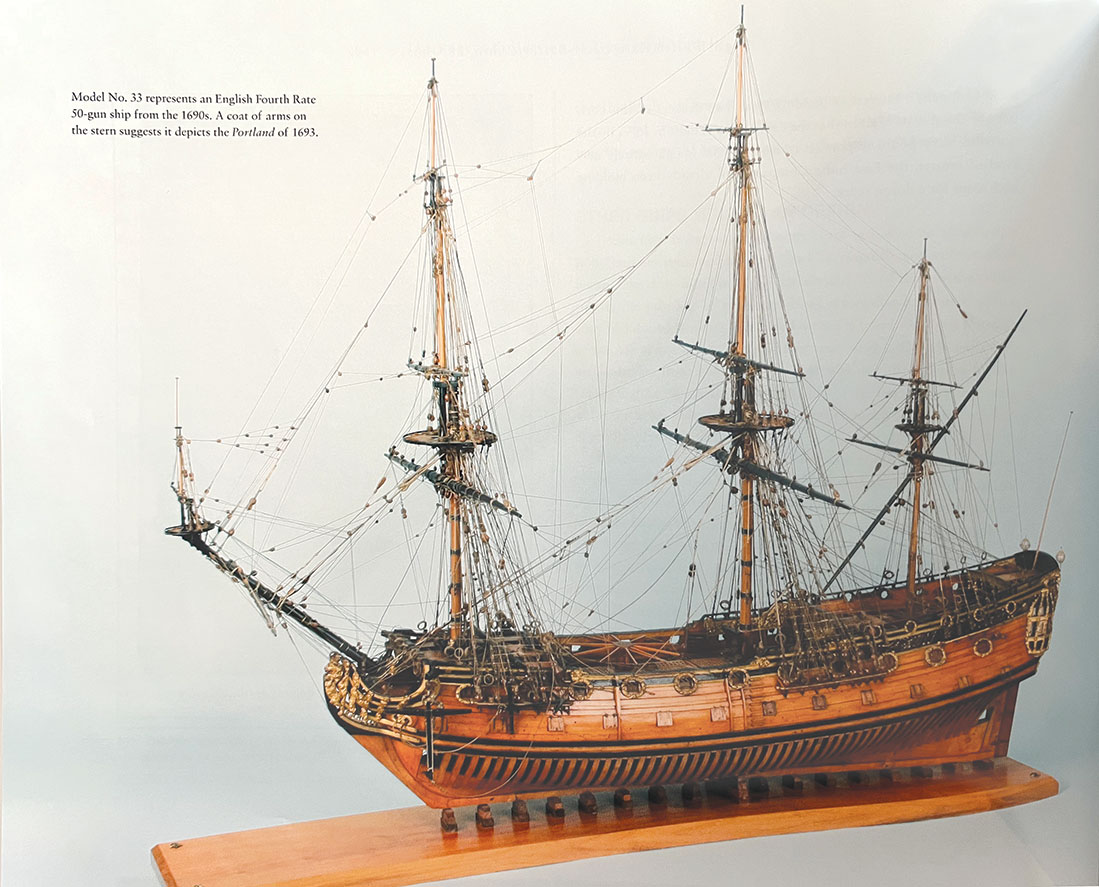
PORTLAND’s rigging is modern, beautifully reconstructed in 1925 by Henry Culver, who worked for the collector Col. Henry Huddleston Rogers.
The demi-batterie is a framed model, which is arguably the most illustrative for those interested in hull construction. The book includes 18 models, 10 of which are framed, all with the lower planking left off for the appreciation of the hull’s construction. One particularly fine one is PORTLAND, a 50-gun fourth-rate ship of 1693. Another is the model the author chose for his cover photo, an unusual ship full of design innovations, including a narrow “pinked” stern. For this model, Walker includes an X-ray image revealing its extensive metal hull fastenings.
There are some surprises. The endoscope allowed the discovery of two shipyard apprentices’ names written in a 20-gun ship of 1727. A CT scan of one very unusual hull showed that it was built with a combination of horizontal, vertical, and diagonal “lifts” to represent waterlines, buttock lines, and even diagonals. In one ship, the name PERSEVERANCE was painted on the transom; it was a late addition and proved to be wrong; a slip of paper found tacked to the keel identified her as INCONSTANT, and the model’s builder identified himself as George Stockwell Jr., with additional scribbles that the builder noted to have been made by his 14-month-old son.
In every case, Walker presents an analysis of the model as it stands, a review of everything known about it, its provenance, and its historical context. If identified as a specific ship, that ship’s history is told clearly. In one notable case, he was able to correct a misconception: a 38-gun frigate model long identified as SHANNON was misidentified. That British ship defeated CHESAPEAKE during the war of 1812, and during the encounter the American captain, James Lawrence, famously cried, “Don’t give up the ship!” just before dying of his wounds. Walker writes persuasively that the ship is not SHANNON, but despite all his detective work, he can’t prove what it was, or whether it was ever anything more than a proposal.
There is abundant terminology in the volume that would have argued in favor of a glossary, which this book does not have—but on the other hand, an argument can be made for not weighting it down with things readily found in other references, since anyone looking at a book such as this is likely to have them already. As with British officialdom, it’s best to keep a reference at hand. There is some usage, however, that would benefit from footnoted definition. For example: for several models, three keel lengths are noted, called “touch,” “tread,” and “calculated” measures. I’ve never seen these in naval architecture, and I’m unaware of them among modelers. I’m still unclear what they mean.
For serious modelmakers, writers of historical fiction, and naval tacticians, these models present important evidence and inspiration. If only all museum collections had publications with this level of detailed object examination. But I think that what Walker gives us above all is a deeper appreciation for these objects as works of art. These volumes, and no doubt the fourth, will stand as reference works for a very long time. 
Tom Jackson is WoodenBoat’s senior editor.