
 Nic Compton
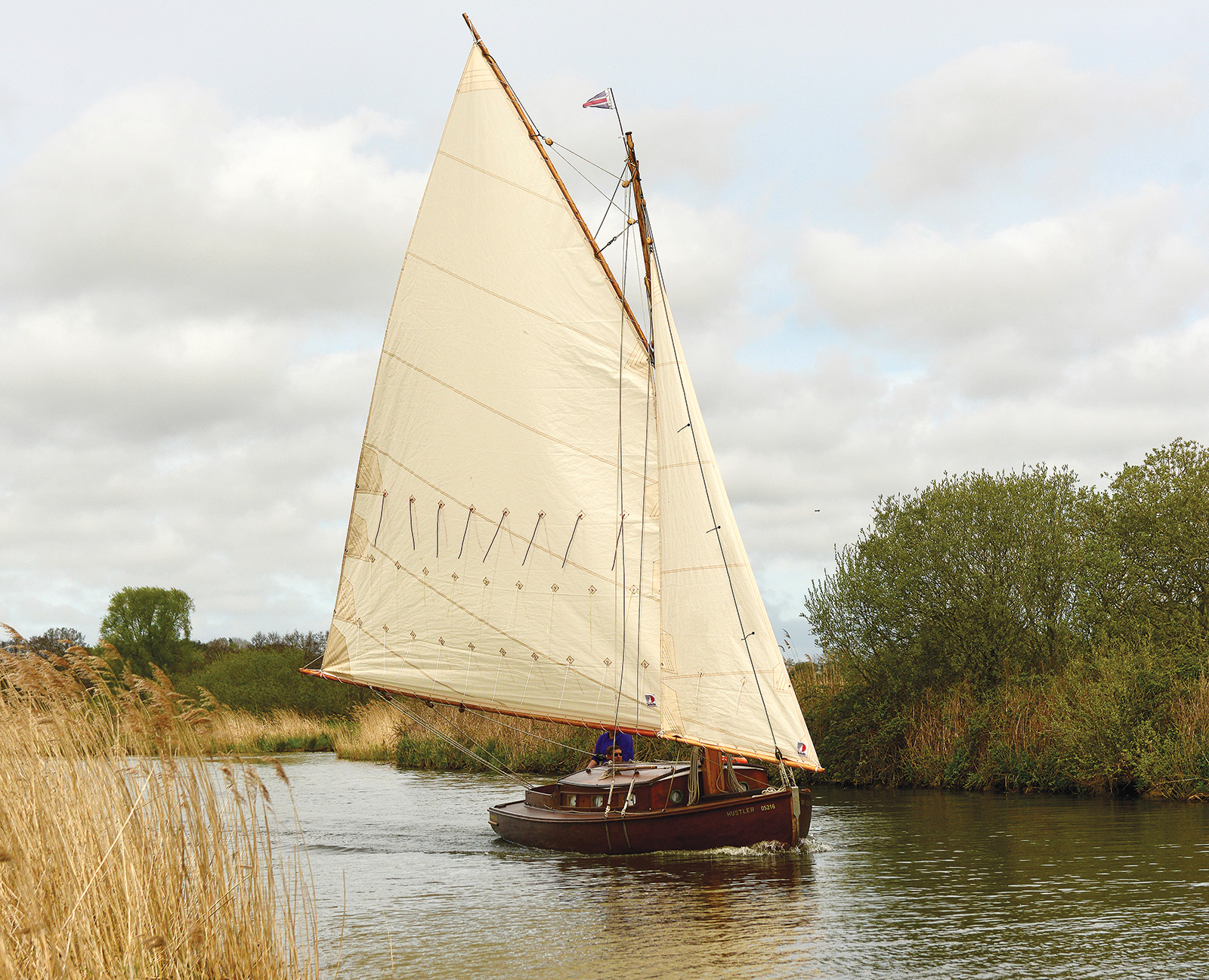
HUSTLER, a two-berth, 24′4″ LOA yacht built by Percy Hunter in 1936, sails out of the channel leading from Hunter’s Yard to the River Thurne on the Norfolk Broads, England. The extensive network of conserved waterways has been a destination for generations of sailors.
“Stop! Don’t go! Please don’t leave us! I do not have a clue what I’m doing!”
Those were my thoughts as the Rev. Neville Khambatta stepped off our boat onto a dory driven by his wife, Val, and headed back to shore, abandoning us to our fate. We had barely had 10 minutes’ training when I suddenly found myself in charge of a 29′ 2″ wooden boat with a huge gaff mainsail, navigating a narrow river while dodging a steady stream of traffic. The wind was blowing Force 4–5 (11 to 21 knots), a perfect sailor’s breeze if you know what you’re doing but downright terrifying if you’re new to a boat and sailing in a confined setting. For the first time in ages, I felt truly like a fish out of water.
It was the Easter holidays, and my wife, Anna, and I had decided to head to Norfolk on the East Coast of England, on the other side of the country from our home in Devon, for a change of scenery. Nearby was the vast network of marshes, reed beds (see sidebar, page 30), and inland waterways known as the Norfolk Broads. It’s been a popular sailing area since the early 1800s and holds a special place in the British sailing psyche: a place where families and Sea Scouts can charter small- to medium-sized boats for sailing or motoring without fear of meeting any big waves. It’s also famous for its big skies, bucolic scenery, and abundant wildlife.
On the spur of the moment, I contacted Hunter’s Yard, which since 1932 has been running a fleet of rental boats—hire boats, as the British call them—in the town of Ludham, on the Broads to see if they had a boat available for the weekend. In no time at all, we were aboard LUCENT, a beautifully built wooden replica of a type of craft that has been prevalent on the Broads for more than 100 years. Shallow-drafted, with a long, low-aspect fin keel and a spade rudder, a large gaff main and small jib, low headroom belowdecks, and a pop-up coach roof, the Broads yacht is an institution in itself.
 Nic Compton
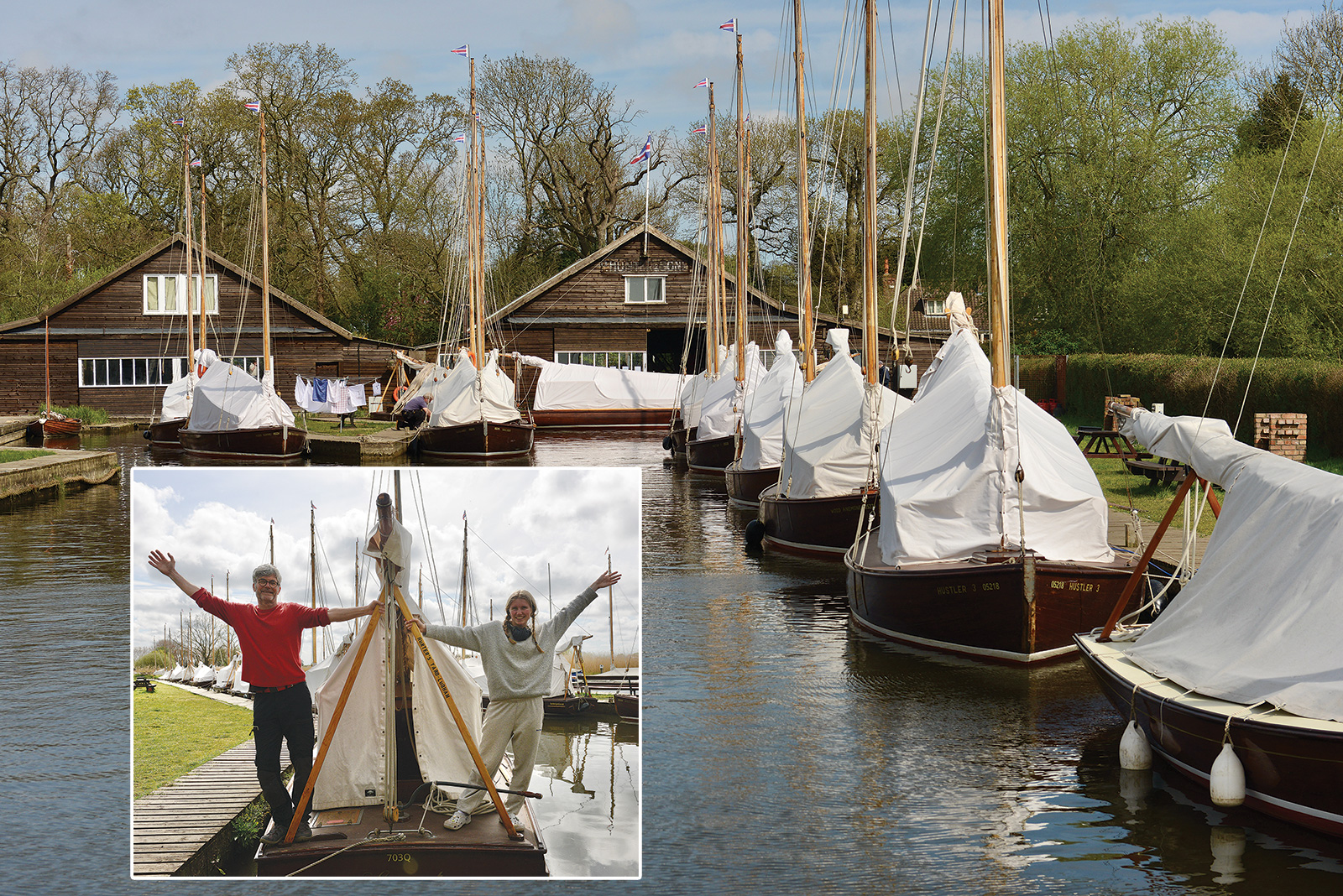
The Hunter’s Yard fleet of wooden boats includes 14 Broads yachts, a shallow-draft type developed specifically for the area, ranging from 24′ to 29′ LOA. Inset—The author and his daughter, Betty, take command of LUCENT, launched in 2006 as the newest addition to the fleet.
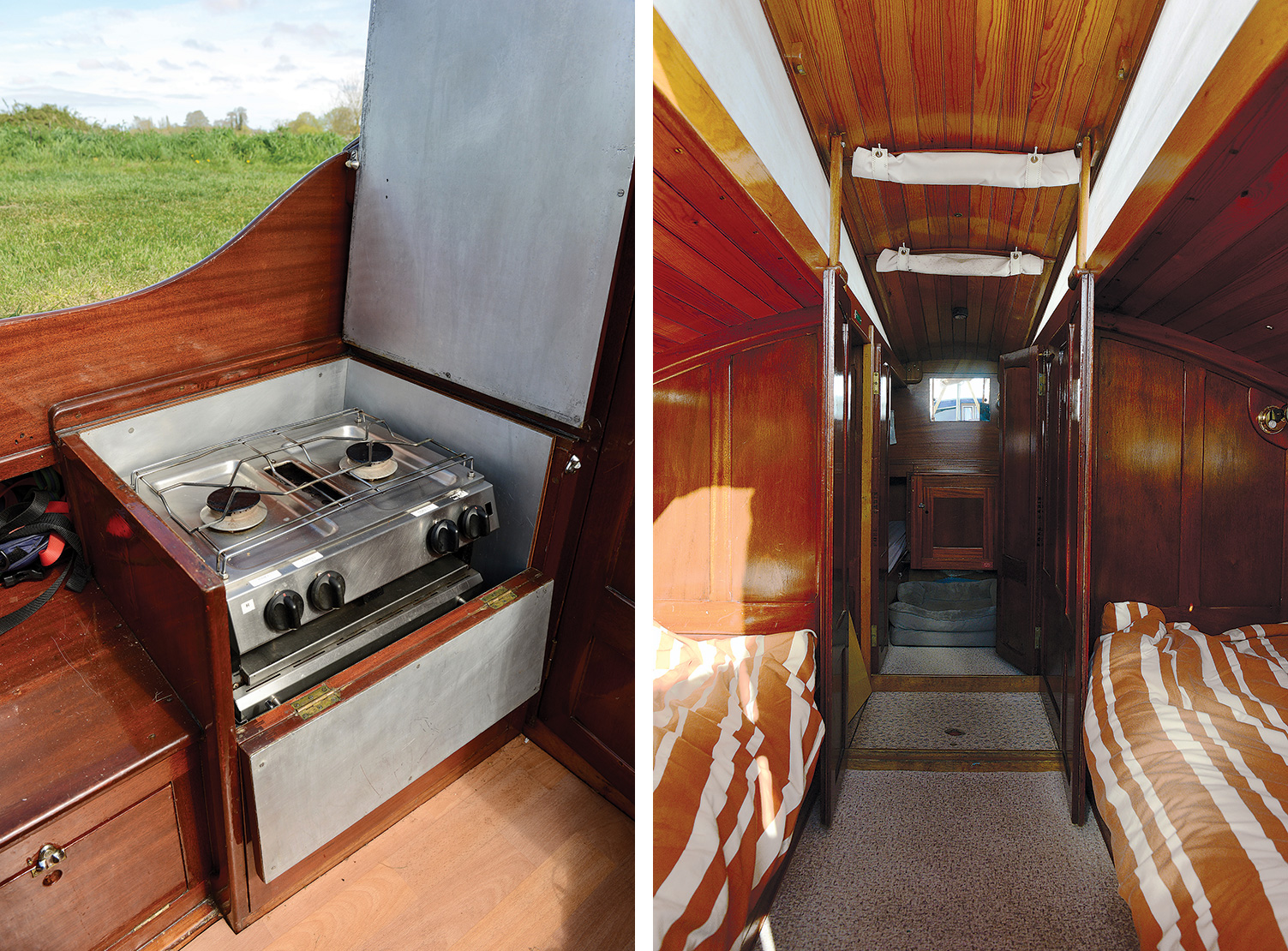
If my family was expecting something fancy when I told them we were going sailing on a Broads yacht, then they would have been disappointed by the little time capsule we found waiting for us at Hunter’s Yard. LUCENT was the biggest boat in the fleet, and her accommodation was closer to camping (or “glamping”) than “yachting.” There were four bunks in two cabins, with a small crawl-in head between them and a pop-up central walkway to provide standing headroom down the middle. Instead of a saloon, a canvas awning stretched over the cockpit, giving some extra shelter from the rain. Instead of a galley, there was a cooker under a lid in the cockpit, with crockery and cooking utensils in the drawers. It was all beautifully made, well thought-out, and redolent of an era before modern comforts were so easily and so cheaply available. “Discomfort in style,” is how one of my crew described it, and they had a point.
“It’s not luxury sailing,” agreed Neville, chair of the Norfolk Heritage Fleet Trust, the charity that owns and runs Hunter’s Yard. “You’re sailing a pure sailing boat that evolved for sailing these waters. But there’s everything you need.”
 Nic Compton
Left—The galley consists of a gas stovetop in a cockpit locker, with utensils stored in drawers below. Right—The cabin has only sitting headroom, but the coach roof’s amidships section is hinged to swing up, providing limited standing headroom when the boat is moored.
Local Knowledge Is Key
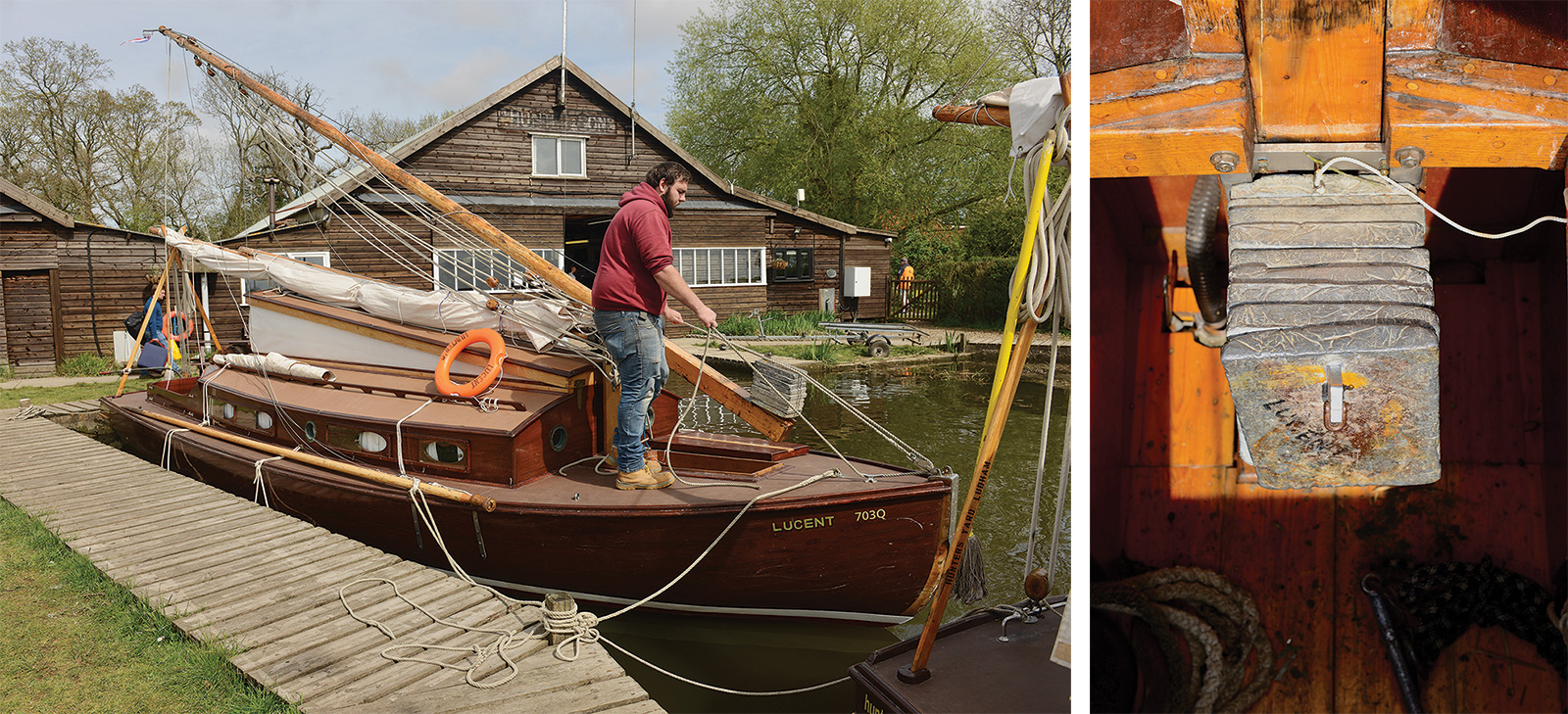
Before casting off, we were shown around LUCENT by chief instructor Ezra Bailey. He started off by introducing us to one of the distinctive features of all Broads yachts: the mast-lowering mechanism that allows you to “shoot” bridges with impunity. The mast is set in a wooden tabernacle and hinged about 3′ above deck level, to make sure it clears the coach roof when it’s down. Heavy weights are attached to the bottom of the mast to counterbalance the weight of the upper section—which, in the case of LUCENT, took the form of nine lead plates hung off a hook. To lower the mast, you simply open the mast gate, give the mast a nudge, and let it come down under its own weight, controlling its progress with a block-and-tackle attached to the end of the forestay. Raising the mast is simply a matter of lifting the mast from the coach roof, then hauling it up with the forestay until the heel passes down through the hatch hole in the foredeck and sits snug against the tabernacle. It’s not quite child’s play, but certainly a couple of smart teens (or small adults) could do it.
 Nic Compton
Left—Ezra Bailey of Hunter’s Yard demonstrates the technique for lowering the mast. (Under way, the pop-up coach roof would be lowered and the boom removed.) Right—Lead plates counterbalance the heel of the mast, easing the task of striking the rig to clear, or “shoot,” bridges.
One of the advantages of the gaff rig is that when the mast is lowered, the mast top sticks out over the stern by only a few feet—unlike boats with Bermudan rigs, which have much longer masts.
There then followed a lesson in “quanting.” Nowadays, most of the bigger Hunter’s Yard boats (including LUCENT) are fitted with electric motors, but until recently the only means of keeping going when the wind died was to quant. The quant is a 16′- to 17‘-long pole with a shoe at one end, to keep it from getting stuck in the mud, and a “bott,” or knob, at the other end to make it more comfortable to handle. The act of quanting goes something like this: walk the quant to the bow of the boat on the leeward side, thrust the shoe end down into the water, with the bott angled slightly forward so you can then push the quant along, walking along the boat as you do so, and remembering to stop when you reach the stern. Pull the quant out of the mud and repeat. “If you haven’t got the quant out of the mud, then let go of it,” Ezra said helpfully, “because otherwise you’ll be going for a swim.”
So much for the theory. It was time to put it all into practice, and it was at this point that Rev Nev (his preferred moniker) came along to show us how to sail the boat. Now, I’m generally a pretty confident sailor, having sailed thousands of miles in all kinds of yachts in many different countries—but most of that was done on the open sea, where there is plenty of room to maneuver and you might not even tack for several hours. It was quite a different experience sailing a heavy wooden gaffer within the confines of a narrow waterway with very little room to maneuver and no warning when inexpertly driven motorboats appeared around a bend in the river. Suddenly, I felt like a complete beginner.
It turns out I’m not the only one, and I was relieved to later read on the Hunter’s Yard website (buried in the list of frequently asked questions): “Good dinghy helmsmen have no difficulty sailing our boats, but experienced seas-sailors can find Broads sailing a bit different at first.” A bit different. I couldn’t have put it better myself.
A Fleet’s Astonishing Legacy
Luckily, before leaving us to fend for ourselves, Rev Nev had shown us how to sail the boat into the reeds on the windward bank of the river (not the leeward bank, for obvious reasons) and lower the jib to stop the boat temporarily. This gave us a few moments to gather our thoughts and also provided some reassurance that, if things really got hairy, we could always “pause for thought” by burying the bow in the nearest clump of reeds. Sort of like an emergency brake.
But, of course, we couldn’t stay in the reeds forever so, once Rev Nev was safely out of sight, we hoisted the jib and backed the boat onto the river proper. With the wind blowing from the north, we decided to head south toward the sea and were soon sailing on a broad reach at surprising speed. These boats may look quaint and old fashioned, but, with their shallow bottoms and big mainsails, they are unexpectedly fast off the wind.
Once we were under way, with the familiar feel of a tiller in my hands, I relaxed into the moment and remembered this was supposed to be fun. Even though we weren’t sailing out to sea or headed out on some great ocean adventure, I experienced that same sensation I feel every time I set off on a boat, when your worldly troubles fall away and you can focus fully on the job at hand. Sailing a beautiful wooden boat with a fresh breeze across unknown waters is a panacea for the soul, whether on the Norfolk Broads or the Caribbean.
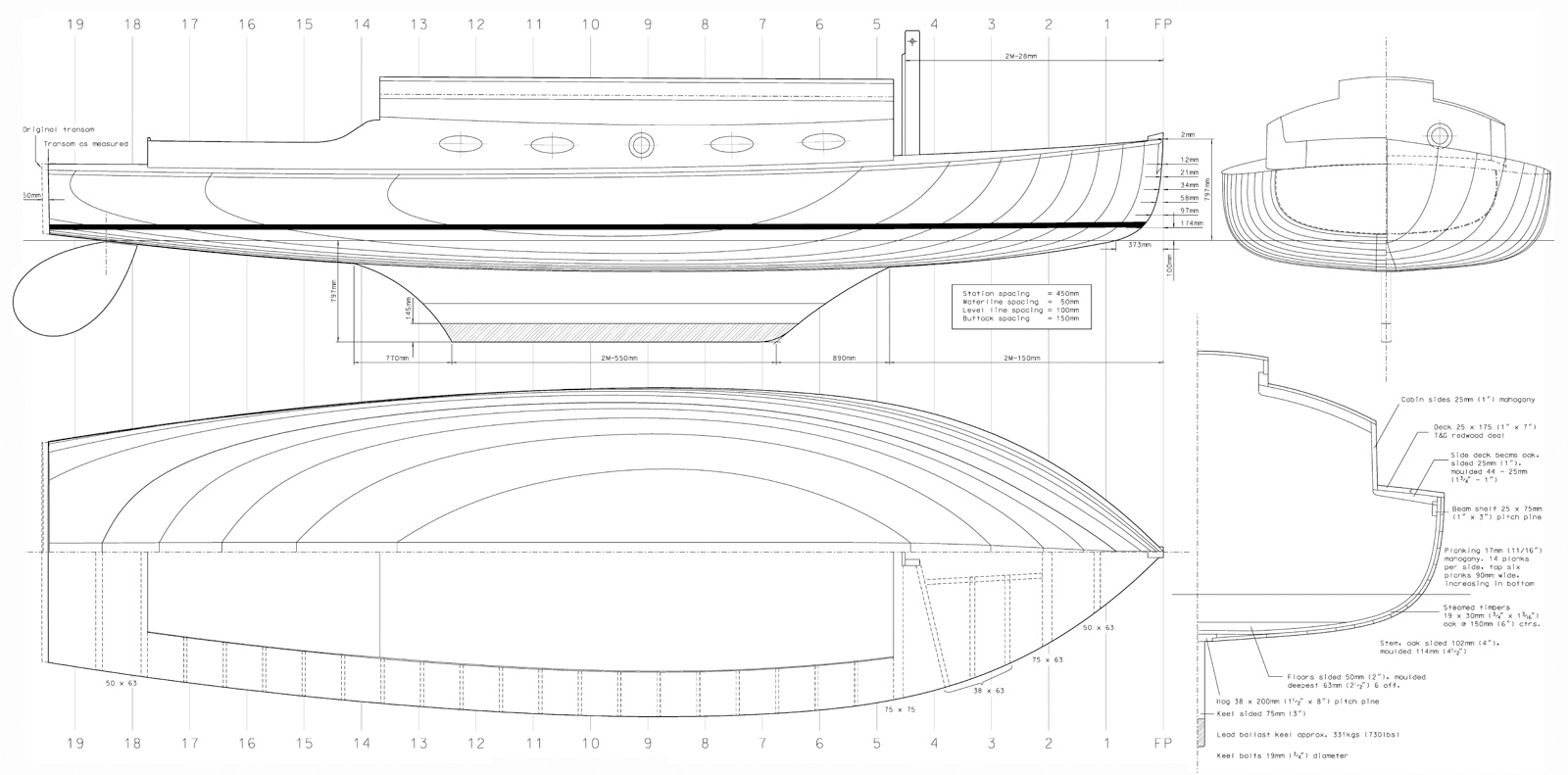 Andrew Wolstenholme
LUCENT, built to the lines of the 1933 Hunter-built LUNA as interpreted by the naval architect Andrew Wolstenholme, was launched in 2006 after six years in construction. The low-aspect fin keel and large pear-shaped rudder make the boat easy to maneuver.
LUCENT is the latest addition to a fleet of wooden boats based at Hunter’s Yard, nearly all of which were built in the 1930s and ’40s by Percy Hunter and his sons, Cyril and Stanley. Percy was a visionary boatbuilder who went to extraordinary lengths to build his own fleet of charter boats during a boom in holidaymaking on the Norfolk Broads—before the great British public had been lured abroad by the promise of sun, sea, and souvlaki. The family dug their own dike by hand to connect their boatbuilding shed to the neighboring river. And when they had too many boats to fit into one shed, they built another one next to it—both of which are still standing.
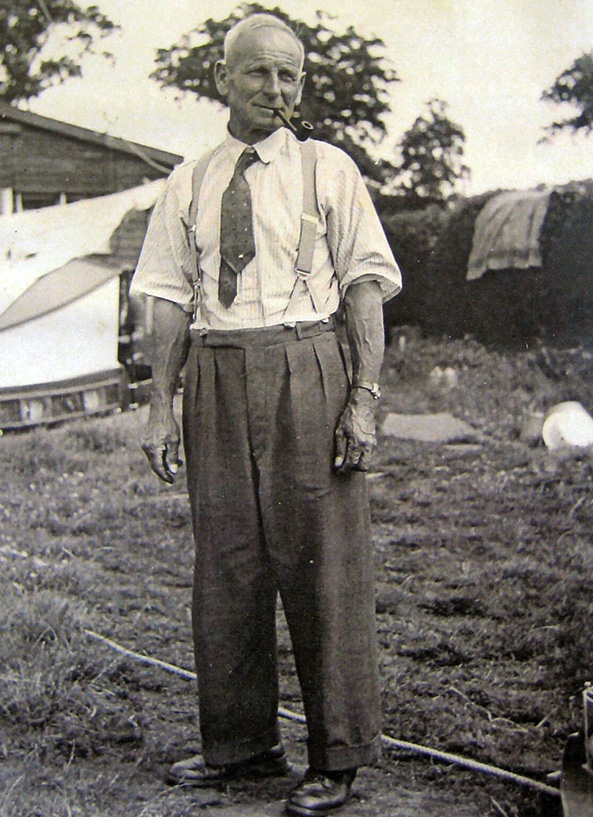 Hunter’s Yard
Percy Hunter was the visionary boatbuilder who founded Hunter’s Yard on the Norfolk Broads in 1932.
Percy died in 1964, by which time increasing numbers of people were choosing to vacation abroad. The sons put the business up for sale and, thanks to Chief Education Officer Dr. Lincoln Ralphs (motto: “The purpose of education is to turn ‘I cannot’ into ‘I can’”), it was bought by Norfolk County Council in 1968. The council ran the yard as an educational facility until 1995, when it was put up for sale to save money. A massive fundraising effort by local people succeeded in raising £100,000 (about $155,000 at that time), with £200,000 more (about $310,000) coming from the National Lottery Heritage Fund. As a result, the Norfolk Heritage Fleet Trust was formed in 1996 and has run the yard ever since, working alongside youth organizations as well as hiring the boats out to the public.
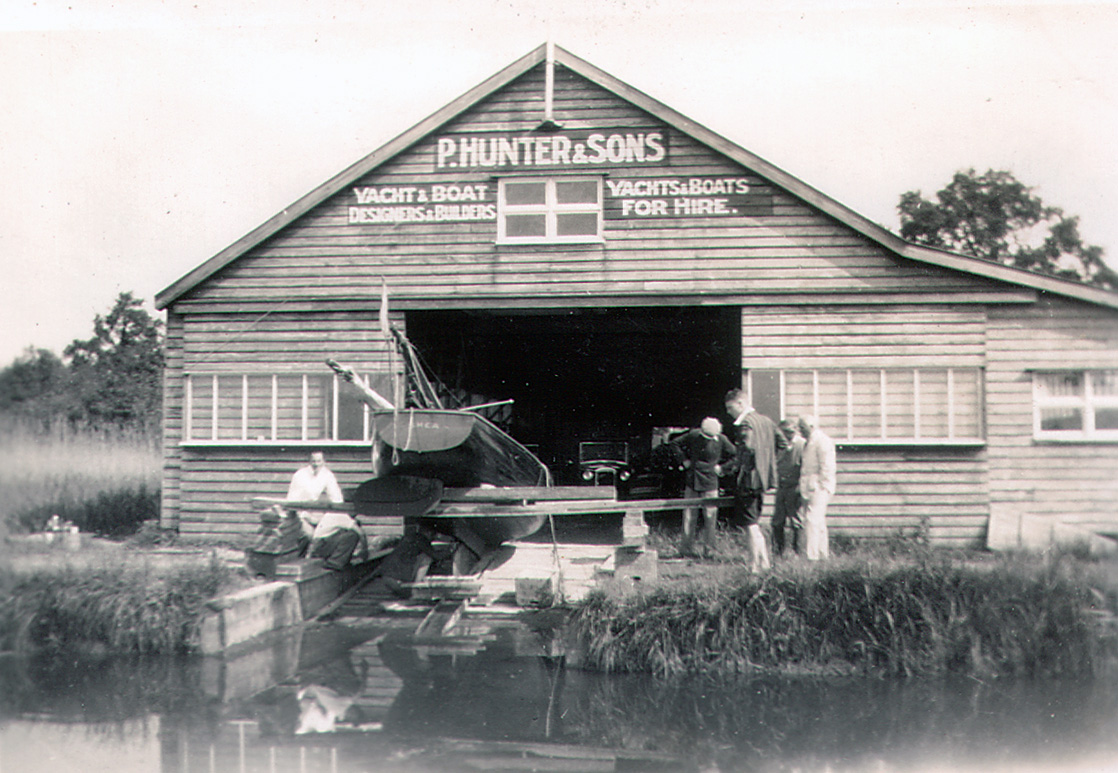 Hunter’s Yard
The original Hunter’s Yard shed was built in 1933.
Originally conceived as a millennium project, LUCENT was the first new Broads yacht to be built at Hunter’s Yard since WOOD ANEMONE in 1949. Her lines were taken off the 1933 LUNA, slightly stretched from 28′ 6″ to 29′ 2″. Local boatbuilder Graham Cooper started construction in 2001, first in the main shed, then in the “building berth” where most of the other Hunter boats were built in the 1930s and ’40s. Controversially, he chose to use the same materials as his predecessors—mahogany planking on oak frames—despite objections from some in the Association of Friends of Hunter’s Yard about the environmental impact of using mahogany. The then chairman, Richard Sargant, resigned over the issue. Construction took six years, in between maintaining the rest of the fleet, and LUCENT was finally launched in October 2006.
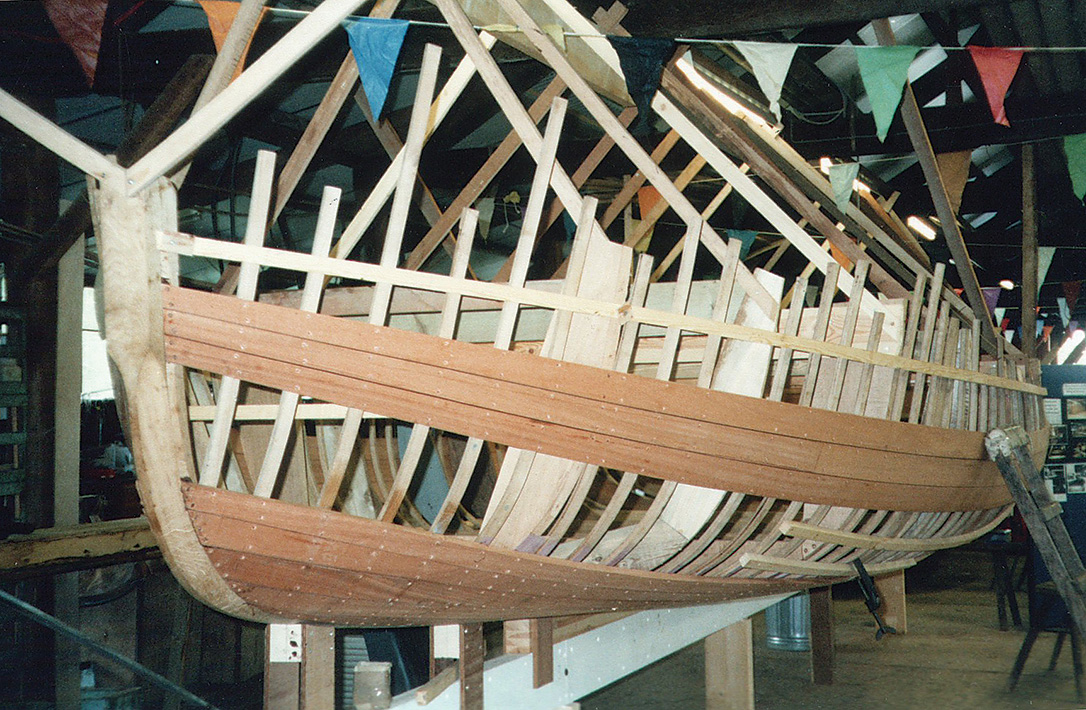 Hunter’s Yard
The shed still stands, and LUCENT was built there, matching original materials, as a commemorative project.
The arrival of LUCENT brought the total tally of boats based at Hunter’s Yard to 25. That includes 14 Broads yachts in three different sizes: five 24′ 4″
Hustler-class yachts with two berths; five 24′ 5″ Wood-class yachts with three berths; and four 28′ 8″ / 29′ 2″ Lullaby-class yachts with four berths. The yard also
runs eight 20’–22′ half-deckers for daysailing and “camping under the stars.” The author Arthur Ransome famously sailed the Broads, so the yard looks after several Ransome–related dinghies, including the boats that played the starring roles in the 1974 movie adaptation of his book Swallows and Amazons. They also have TITMOUSE, the dinghy featured in the 1984 BBC adaptations of Coot Club and The Big Six, as well as TEASEL, which is actually the original LULLABY.
That’s 25 traditional wooden boats, all available to hire by anyone with the necessary sailing skills. No qualifications are needed even to skipper a boat, though some previous experience is recommended—and, if my experience is anything to go by, highly necessary.
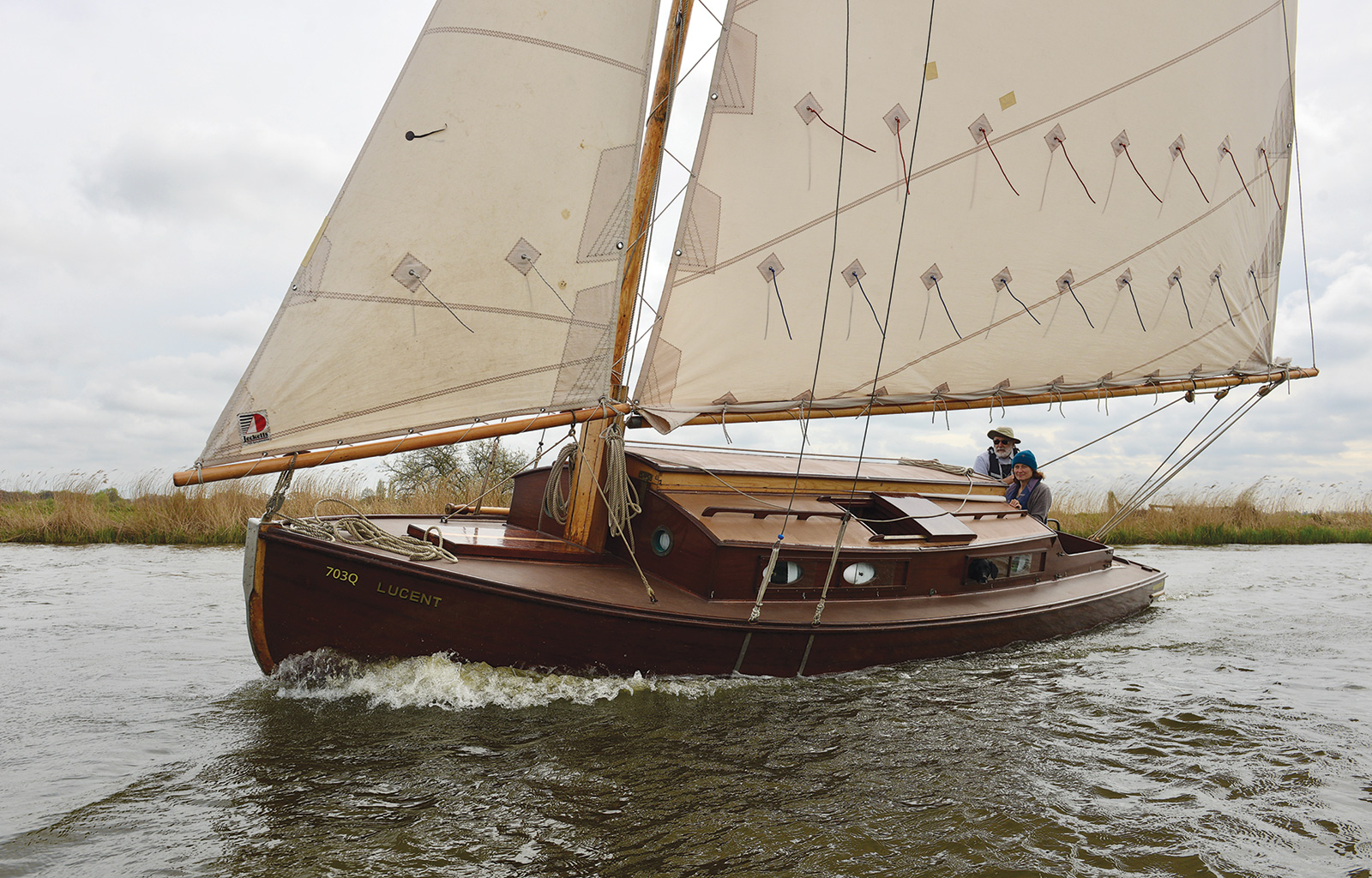 Nic Compton
The Rev. Neville Khambatta, who goes by “Rev Nev,” takes the author’s wife, Anna, through the boat’s paces on a blustery morning. (Winnie, the family’s dog, visible at one of the after portlights, is a keen sailor, too.)
Local Conditions, Local Solutions
Back aboard LUCENT, I was beginning to get the hang of this Broads sailing lark, though the wind was still messing with my head. The countryside here is famously flat, more like Holland than my native Devon, which is all hills and valleys. That means the wind here follows its own rules or, as Rev Nev put it: “You do have a prevailing wind, but the wind also follows the rivers. So you’ll be tacking along, thinking two more bends and you’ll get a lovely beam reach. But you won’t; the wind will follow the river round. And the other thing is when the wind comes across the fields and the reed beds. As it comes onto the river, it takes the path of least resistance and turns. You can pick that up and sail halfway around the bend while other people are still tacking. We call it ‘creeping corners.’”
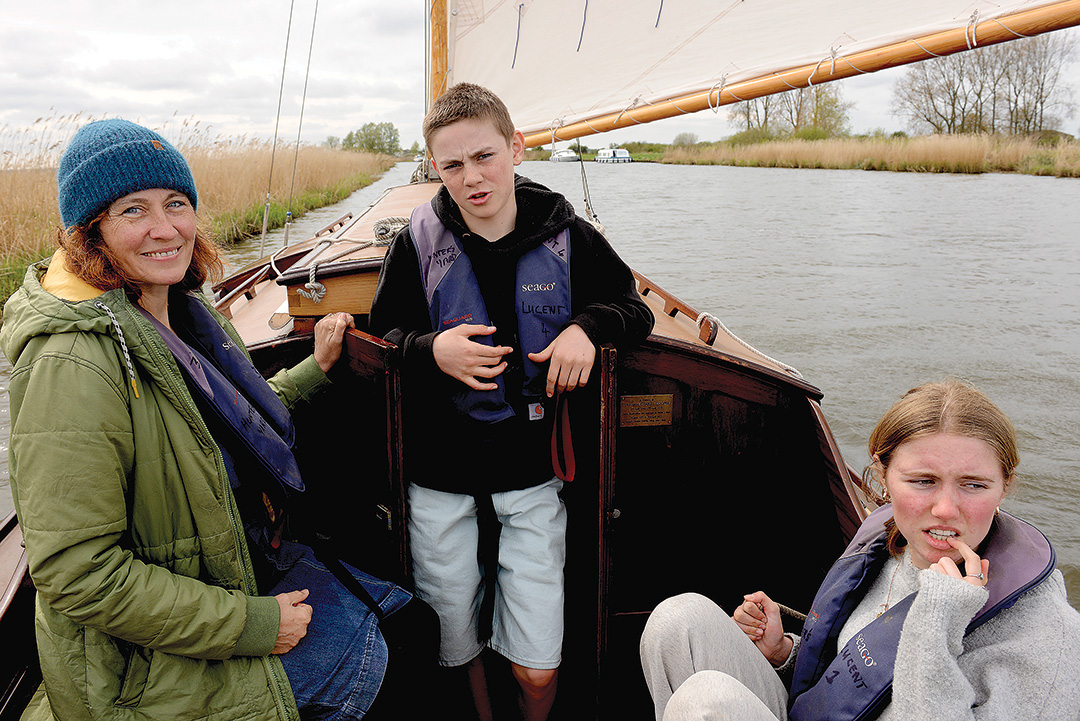 Nic Compton
The author and his wife, Anna; son, Sol; and daughter, Betty, discovered the ethic of “discomfort in style” as they sailed on the Norfolk Broads in their boat’s rudimentary accommodations.
What this means in practice is that you can’t relax for a minute, especially if there’s a strong breeze. As Rev Nev puts it: “Forget the burgee at the top of the mast; watch the luff of the sail.” Wind awareness is everything when you are sailing on the Broads, which is no doubt why it’s such a good place to learn to sail and why even experienced sailors come back here, year after year, to take up the challenge.
After a short while, we came to the junction with the River Bure and turned west to go up the river to the ruins of St. Benet’s Abbey, where we stopped for lunch. In retrospect, we should have carried on up the Bure and found a quiet place to spend the night, but we had been told there was a pub at Bridgecraft where we could have a good dinner. So after lunch we duly headed back down the river and experienced the joys of tacking a big boat in narrow waters.
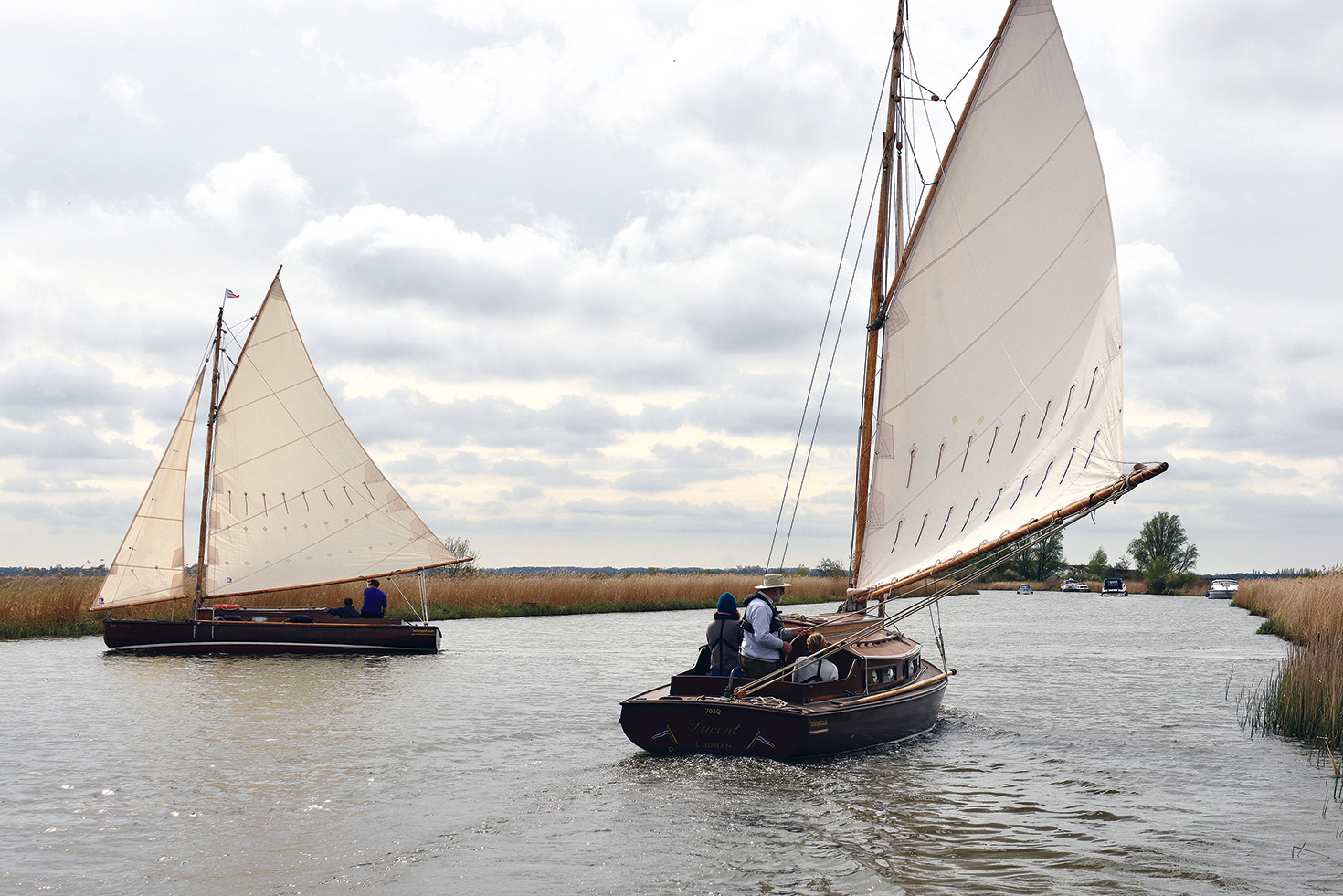 Nic Compton
LUCENT, right, and HUSTLER, left, crossed tacks while sailing the River Thurne at the outset of the family’s vacation.
All the usual gaff rig sailing rules seemed to apply, which is to say: build up momentum before you tack to prevent the boat from going into irons; ease the jib before tacking to allow the main to drive the boat around; don’t pull the main in too tight or you’ll stall the boat. Other things were more particular to a Broads yacht, particularly the helming. Before he abandoned us, Rev Nev had said: “Don’t push the tiller past the coamings, or it will stop being effective. The sweet spot is about a foot past the center on either side.” It took a while for me to get used to this idea and not push the helm hard over when tacking, but eventually I did and found that the boat turned much more quickly with less helm.
As for all those pesky motor cruisers driven by innocent but uninformed landlubbers, I eventually realized they weren’t a problem either. With a towering cloud of sail driving us toward them at great speed, they were far more scared of us than we were of them, and they would usually meekly pull over to the opposite bank and wait for us to pass. When that didn’t happen, I again followed Rev Nev’s example and indicated by forceful hand signals what our intentions were and where they needed to go.
Anna and I took turns steering the boat and holding the mainsail sheet, although thanks to the self-tacking jib the boat could easily be sailed singlehanded. The kids, meanwhile, were busy ticking off the wildlife on the sheets provided, including multiple heron sightings, as well as lapwings and redshanks, plus countless dragonflies. The otters remained aloof.
The pub at Bridgecraft was a disappointment (frozen meals defrosted by teenagers), but we nevertheless spent a cozy night on LUCENT, tied to the dock just upriver of a bridge, which, to save time, we had decided not to shoot.
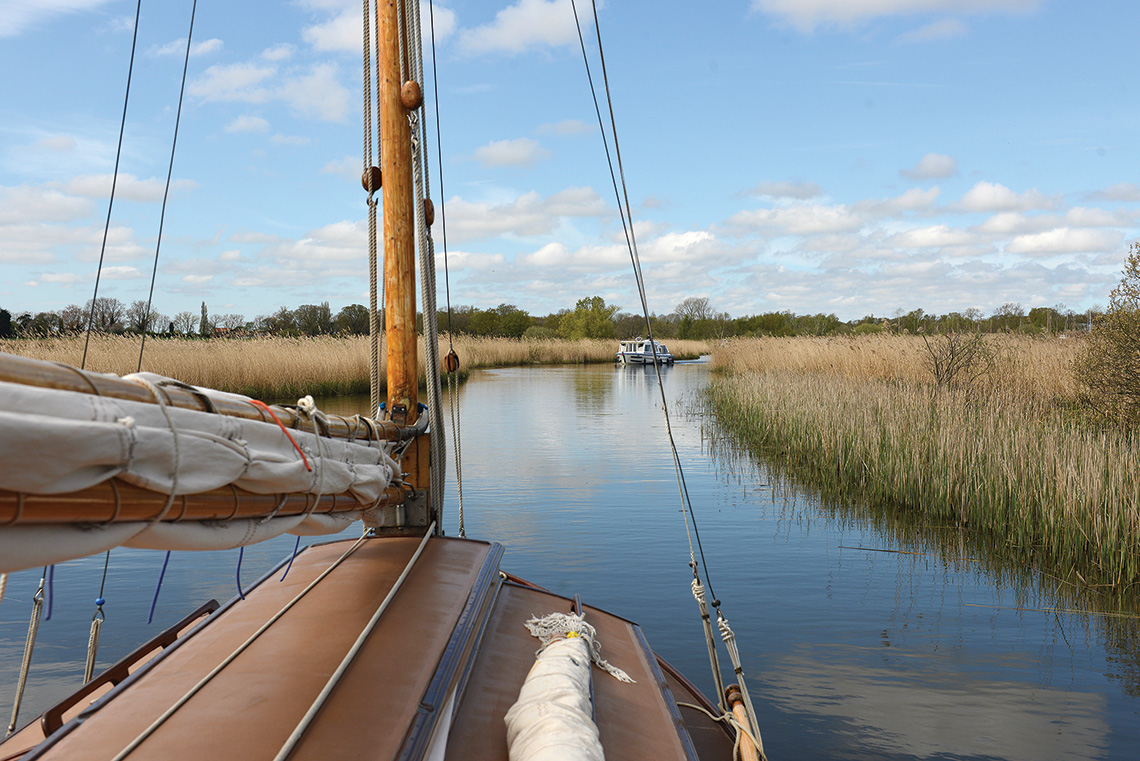 Nic Compton
Nearing the end of the vacation, LUCENT motored along the narrow channel leading from the River Thurne back to Hunter’s Yard in Ludham.
Basking in Tradition
With the forecast showing gentle easterlies the next day, we set off under full canvas hoping to sail back up the Bure. Those fickle Broads winds had other ideas, however, and we made slow progress against what turned out to be a headwind. Following Rev Nev’s advice, we nudged LUCENT’s bow into the reeds and, with the engine on tick-over to keep the boat in position, calmly set about lowering the sail. Chastened, we set off a few minutes later under electric motor, stopping at picturesque Thurne for lunch.
It was nearly time to go home, but we had time for one more blast up the River Thurne to Hunter’s Yard, the wind having finally veered to the east. The sun was out and all was well with the world as we headed back to the dock, just one more family enjoying a weekend sailing on the Broads, like thousands of families before us.
Back at Hunter’s Yard, it was easy to dawdle. The yard itself feels like a giant time vault, with rows of varnished spars and cream-colored sails waiting to be rigged, and what looked like a chandlery full of fenders, lifejackets, and a serious workshop. Up above our heads were the molds used to build some of these boats nearly 100 years ago. It made me almost dizzy just thinking about it. More than just a fleet of boats, Hunter’s Yard is a remarkable collection of artifacts from the past—boats, sheds, tools—which has survived not just as a living museum but also as an active and highly relevant resource. It’s little wonder that when the National Lottery Heritage Fund people came to visit the yard in 1995, they didn’t just agree to fund the amount asked for but awarded nearly twice as much. This is an institution worth saving.
Yachting on the Broads
The unique landscape that now hosts such a wealth of wildlife and plants is, surprisingly, not a natural habitat at all but the result of human activity. Back in medieval times, the local monasteries took it upon themselves to dig up peat to sell as fuel to nearby towns such as Norwich and Great Yarmouth. Norwich Cathedral alone is said to have consumed up to 400,000 peat bricks a year. As sea levels rose, the peat quarries were flooded and, despite attempts to drain them with windmills and dikes, they eventually turned into the lakes now known as the broads.
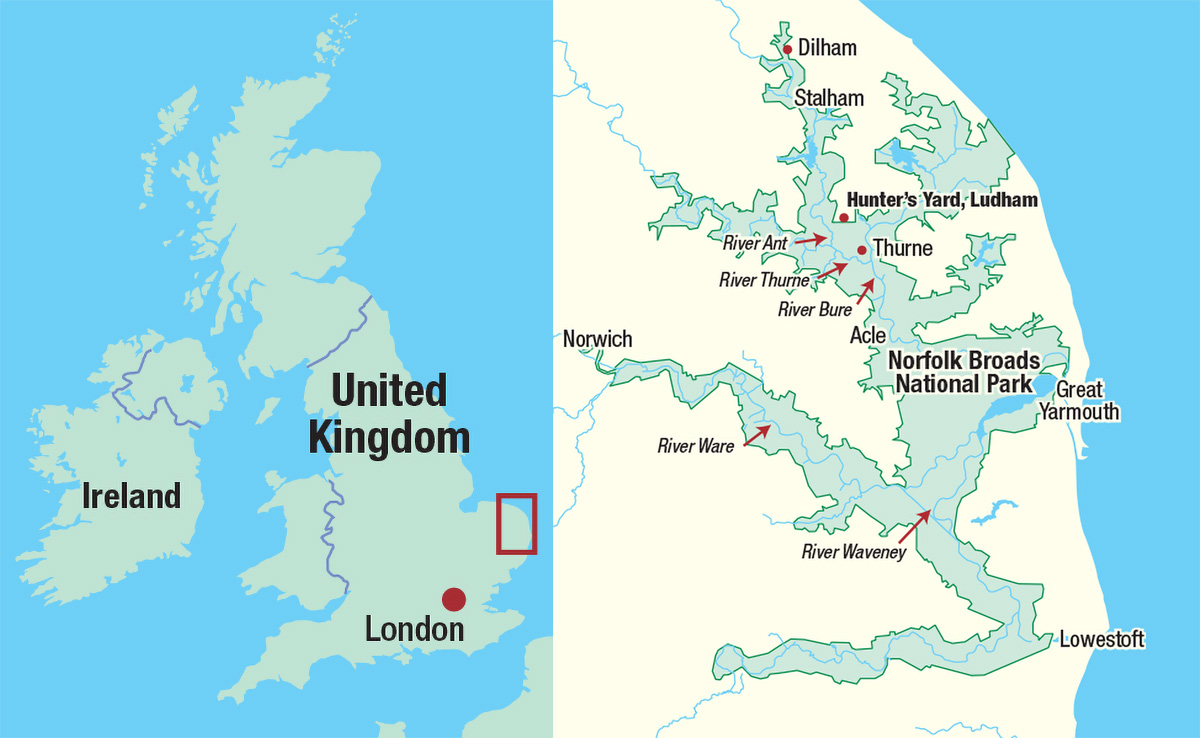
The result is a complex network of rivers and lakes stretching from Great Yarmouth in the east, inland as far as Norwich to the west and up to Dilham in the north. Over an area of 120 square miles, the Norfolk Broads contains 60 lakes, seven rivers, and—most important for boating folk—150 miles of navigable waterways. The waterways are split into two main networks: a tranquil northern section and a faster-flowing southern section. The two eventually converge at Great Yarmouth before flowing into the North Sea. You could easily spend several weeks exploring the many rivers and tributaries, and many people come back year after year to discover new nooks and crannies.
 Michelle Gawe
The Norfolk Broads is a labyrinthine network of rivers, creeks, and inlets with 150 miles of navigable waterways.
This extensive waterway has been used to carry cargo for centuries. The Norfolk wherry was the cargo-carrier of choice, and hundreds of these craft—with their shallow drafts, enormous barn-door rudders, and distinctive black sails—once worked throughout the Norfolk Broads. Nowadays, only eight remain.
Boating on the Broads for pleasure probably started in the 18th century, and by the 1820s there were already several “water frolics” with rowing and sailing races watched by large crowds ashore. An unusual type of boat evolved to compete in these events: the so-called “lateener” yachts. A rarity in Great Britain, these boats were fitted with lateen sails, presumably inspired by Mediterranean working boats. One of the most successful lateeners was the 3.4-ton MARIA, launched in 1827, which was so successful in her day that some boatowners refused to race against her. As built, she had a schooner rig with lateen sails on both masts, although that was eventually changed to a gaff mainsail and a lateen foresail. Astonishingly, this historic vessel was rediscovered in 1969 and is now on display at the Museum of the Broads in Stalham, at the northern end of the Broads.
The lateeners were eventually superseded by the Broads “cutter yachts,” which had a large gaff mainsail, a long bowsprit and, despite their name, a single foresail.
The popularity of the Broads as a tourist destination grew with the advent of the railways from 1844 onward. It was also one of the few areas in Britain where sailing wasn’t the province only of the wealthy. The first hire-boat fleet was created by a carpenter-turned-boatbuilder, John Loynes, who started hiring out his own boats to his friends in about 1878 and quickly discovered he had a viable business. Others soon followed, with hire fleets springing up in Wroxham, Oulton Broad, and Potter Heigham.
Although the railways were a boon for tourism, they spelled the end of cargo-carrying by boat. Gradually, most of the wherries were either abandoned or converted into charter yachts. Soon fully fledged wherry yachts were being built, complete with toilets, baths, and even small pianos.
Meanwhile, the hire-fleet boats developed into the Broads yachts of today. From about the 1930s onward, they were built with a fin keel and separate, metal-plate rudder—long before this arrangement became popular on seagoing yachts. The keels were built by stacking planks to the required depth, finishing with a slab of lead of the same thickness as the planks. The keel was made long enough to support the base of the mast, but short enough for the boat to turn easily.
The British naval architect Andrew Wolstenholme has designed several Broads yachts in traditional and modern variations and has made digital studies of all three of the bigger classes in the Hunter’s Yard fleet. He writes: “Their hulls are flat-floored with just a gentle fore-and-aft rocker and with a full and nicely rounded bow. The flat floor with firm turn of the bilge produces a hull with plenty of form stability, allowing keel weight and overall displacement to be kept to a minimum. Their ballast ratios of around 15 percent are significantly less than the 35 percent or more that would be expected on a seagoing yacht. The maximum beam of the hull is forward of midships, in common with some of the thinking of the time and is referred to as ‘cods head and mackerel tail’ form.”
Andrew points out that the large gaff rig common to the type provides just enough weather helm to act as a “safety valve” by rounding up into the wind should the boat become overpressed by a strong gust. The club-footed jib shifts the center of effort of the sail forward without needing a bowsprit and makes the rig easier to handle; extra-large rudders augment this by shifting the center of lateral resistance aft.
Nowadays, there are many yacht regattas on the Broads for the so-called Broads River Cruiser Class, including events at Wroxham, Horning, and Oulton Broad. But the most famous of them all is the Three Rivers Race, which takes place over 24 hours and covers 50 miles of inland waterways, including the Rivers Bure, Ant, and Thurne. The race is billed as the largest inland yacht race in Europe, with more than 100 boats taking part. 
Nic Compton is a regular contributor to WoodenBoat.
For further information, see Lines & Logs, published in 2021 by the Norfolk Heritage Trust, and the Hunter’s Yard website, www.huntersyard.co.uk.