
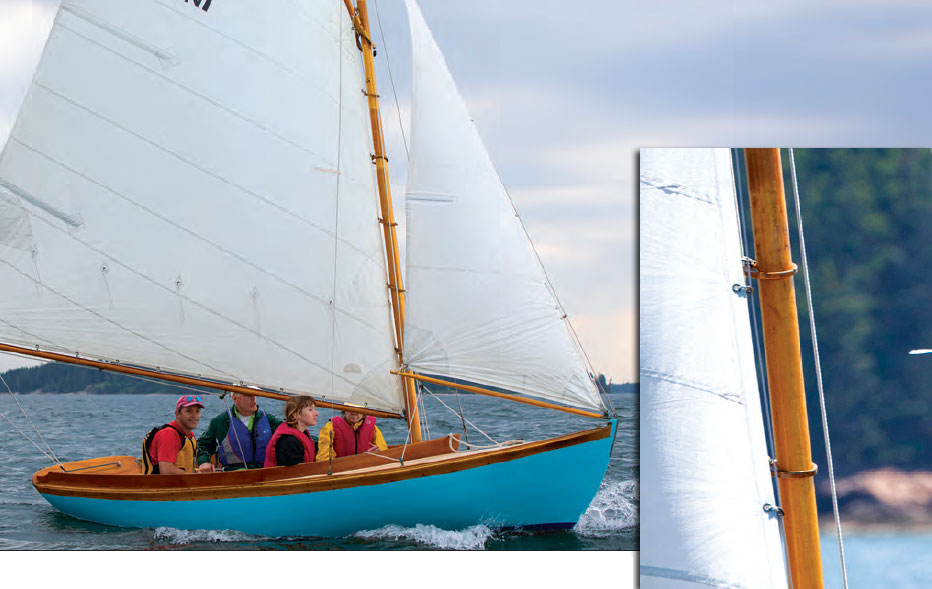
 Alison Langley (both)
Mast hoops are commonly used on gaff-rigged boats, such as the Haven 12 1/2 seen here. There are a few companies offering replacements, though owners with modest skill and equipment can make their own.
What Are Mast Hoops?
Mast hoops are commonly used on gaff-rigged boats to allow the sail to slide up and down the mast. Hoops are worth extra inspection and care, because replacements are hard to find and expensive to purchase when you do find them. Although they are small, they might seem intimidating to fashion. Bending frames into a small round-bottomed hull is daunting enough, but that tight bend of the circular hoop is enough to make the best builder blanch. How does one make these fittings?
There are, actually, similarities between bending hoops and bending frames. The first consideration for both is stock selection. White oak is a top choice, as are elm, ash, and hickory. Look for straight grain with no imperfections—that is, no sapwood, pin knots, or worm holes. The wood should be air-dried, and moisture content is critical; the greener the stock, the better. It should be as smooth as possible, with the corners relieved so they are not sharp.
Then, there is the device to heat the wood to soften it enough for bending. While this can be accomplished by boiling the pieces in a tank, the most convenient and efficient device used to plasticize wood is a simple steambox. The wood must be steamed for roughly an hour for each inch of thickness.
How do we get that fiendishly tight curve of the hoop? The secret to success is to use a flexible strap on the outside of the curve while bending the stock around a circular jig. The wood on the inside of a curve compresses, while the wood on the outside stretches; steamed wood can be compressed a considerable amount, but it will stretch less than 0.5 percent without failing. The strap keeps the wood on the outside of a bend from failing