
Table of Contents
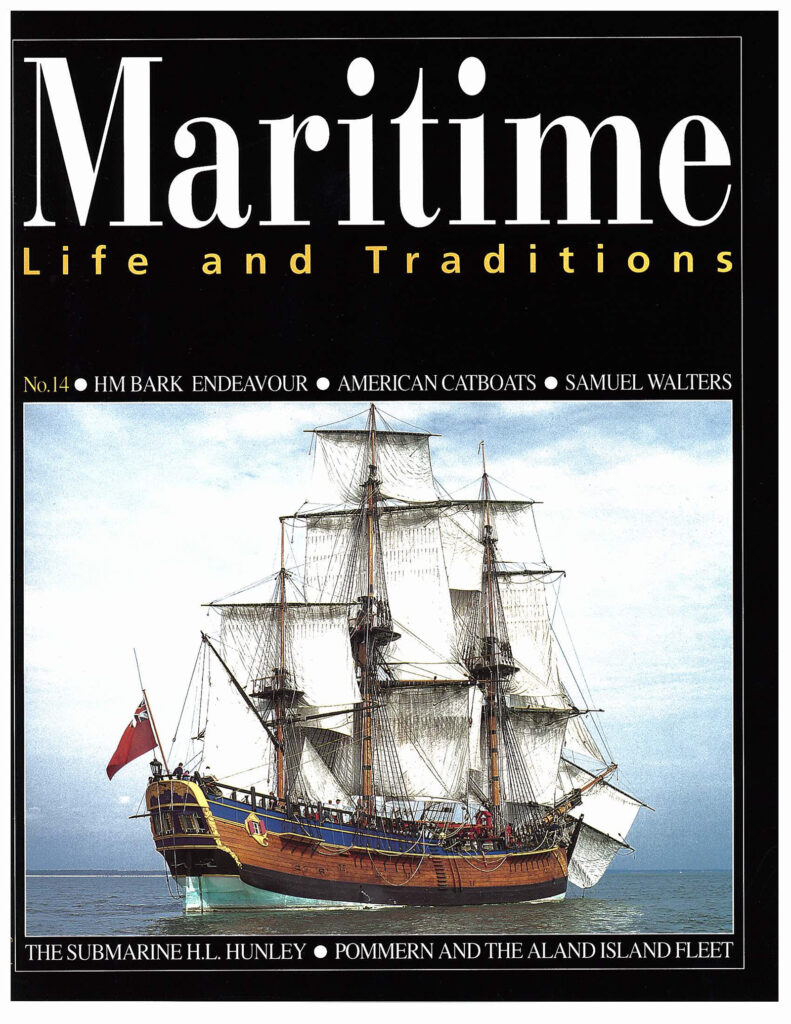
HM BARK ENDEAVOUR
By Jenny Bennett
In 1768 the Yorkshire-built bark, Endeavour, set sail from Plymouth, England, under the command of Lieutenant James Cook bound for Tahiti. The expedition would ultimately circumnavigate and chart New Zealand, chart the East Coast of Australia and return to England with a collection of some 30,000 plants and 10,000 animals. In 1993 HM Bark Endeavour was launched in Fremantle, Western Australia. Recognized as one of the world’s most accurate working replicas she now sails with professional and amateur crews offering a glimpse of eighteenth-century seafaring life. The author charts the history of the original ship, the building of her replica, and the experience of life on board.
POMMERN AND THE ALAND FLEET
By Basil Greenhill
Unique in maritime societies the people of land not only survived the transition from wooden sailing-ship fleets to steam shipping but they did so by staying in sail and capitalizing on falling prices, transforming their economy from meagre subsistence levels to unimagined wealth and prosperity. Today the Aland islands are still prospering through shipping and ship management. A captivating tale of beating the odds, in which some of the major players won fame and fortune all over the world, the name of Erikson has become particularly renowned — and typical of Erikson’s fleet was Pommern, today docked at Mariehamn as the world’s only four-masted barque preserved in authentic original condition.
THE SUBMARINE H.L. HUNLEY
By Brooks Townes
While experiments had been made with underwater craft for at least 200 years it was not until the American Civil War that an enemy ship was successfully sunk by a submarine. The price was high, however, and whilst the target was destroyed so, too, was the submarine. In the summer of 1995, more than a century after her sinking, her remains were discovered off Charleston, intact and undisturbed. The author tells a very human story of eccentric science, extraordinary courage, and unresolved history.
THE ALL-AMERICAN CATBOAT
By Peter Brewer
The catboat is one of the most distinctive of America’s small working boats. Once it was to be found all over the northeast shores of the country but, as with so many commercial sailers, when mechanical power was introduced the catboat faded into obscurity and some thought it had gone forever. Nevertheless, this humble workaday craft has proven itself to be a survivor and for the last fifty years has experienced a slow but steady increase in popularity among pleasure sailors all along the Eastern Seaboard and beyond.
SAMUEL WALTERS, MARITIME ARTIST
By A.S. Davidson
Maritime art is as popular as it has ever been, despite, or perhaps because of, the demise of many of the western world’s great ports. Today more and more eighteenth and nineteenth artists are gaining international, though posthumous, recognition. However, as the author reveals, Samuel Walters gained such acknowledgement within his own lifetime not merely by creating fine paintings but also by adopting the latest in printing technology and mass-producing many of his works as calling cards or affordable prints to be collected.