

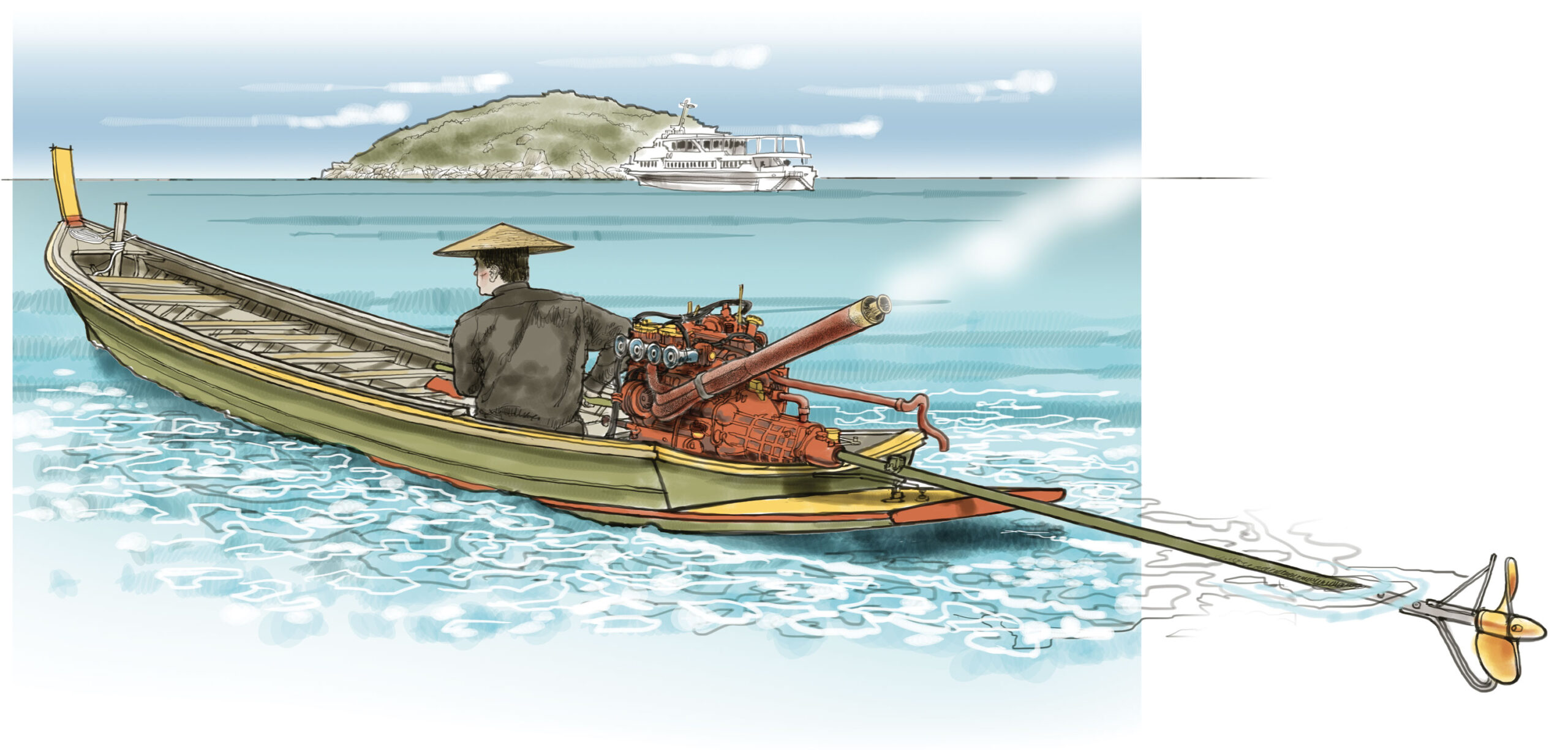
When boats began using internal combustion engines at the turn of the last century, we began to put holes in hulls. Today, an inboard-powered motorboat or a sailboat with an auxiliary engine must be engineered to keep a dry inner hull while sending power to the wet outside—right through the hull. Vibration, wear, torque, and corrosion conspire to break the best mechanical schemes that separate engine power from the water.
Your boat’s ability to project power from a dry motor to a wet outside depends on an interlocking set of systems that begins at the fuel filler cap and ends in the wake of your boat. Here, we’ll introduce the parts of the drivetrain—the system that begin where the engine ends— and we’ll also examine some important supporting systems (fuel, and the combined exhaust and cooling systems) that also require holes in the hull.