Bristol 27 Particulars

  • LOA 27′ 4″
  • LWL 26′ 7″
  • Beam 7′ 10″
  • Draft 2′ 4″
  • Displacement 5,800 lbs
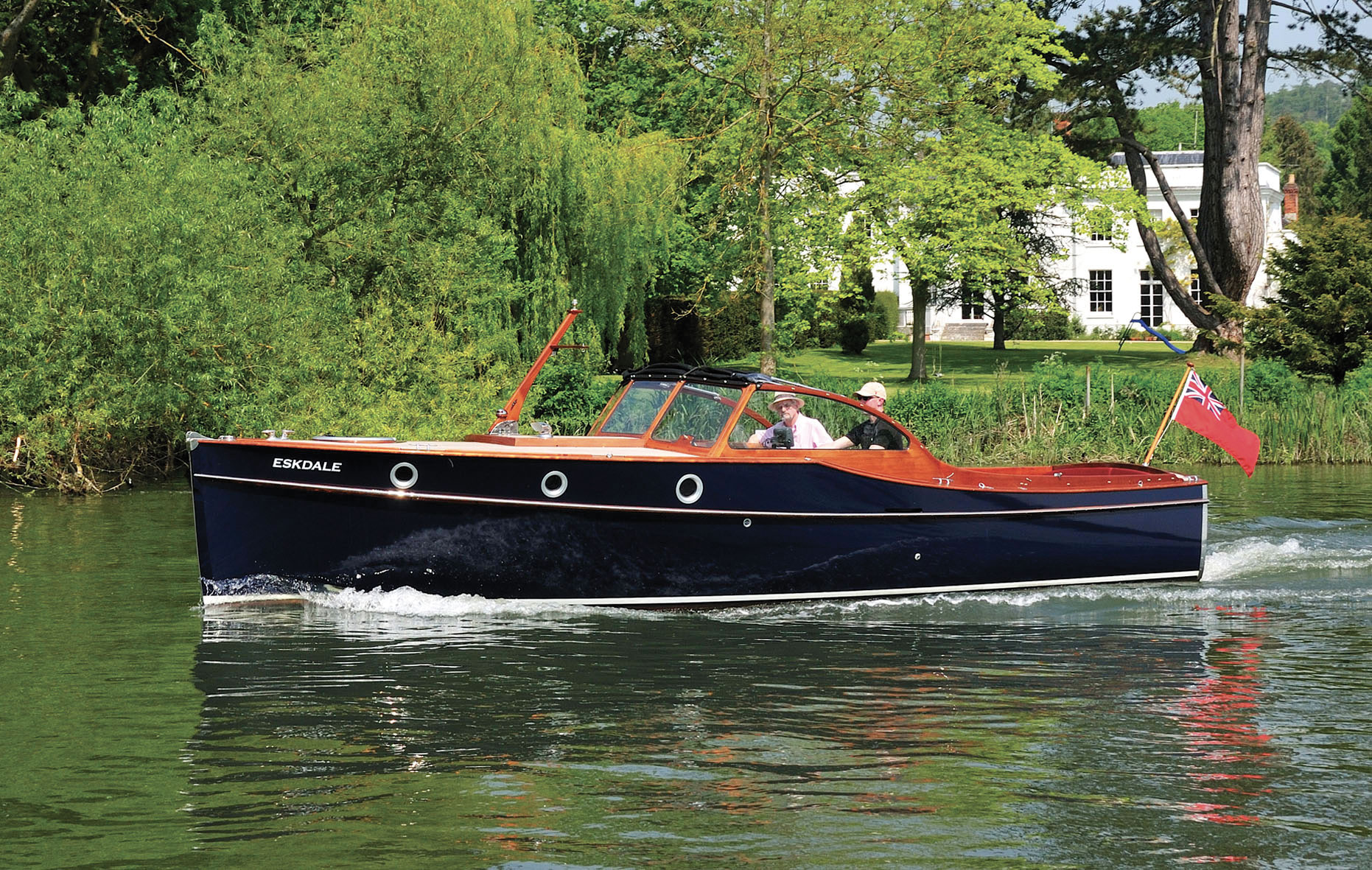
A Bristol 27 with shiny black topsides and a bright deck glides through the river.

The striking Bristol 27 combines traditional appearance with contemporary design elements. Its style would have been appreciated in the past century and likely will be admired in the future.

Emulating a traditional type while creating a thoroughly modern boat is no easy task, and Andrew Wolstenholme’s shaping of the Bristol 27 is so unforced that the boat could be at home in any decade of the past century. Clean and simple lines coupled with just the right amount of bright-finished mahogany reference traditional cruising yachts as well as open sportfishing boats. Built on the South Coast of England, her intended cruising waters are both the inland upper Thames River and the open salt water of The Solent. These diverse requirements make the boat suitable for day cruising or overnights in coastal waters anywhere.

The most prominent feature of this design is the raised foredeck with a break in the sheerline. While a smooth, unbroken sheer may be seen as more graceful, the higher foredeck and taller stem impart a strong character and add real seagoing ability. When drawing a sheerline, one rule is that longer lines are more graceful, so it follows that it’s best to position the sheer break either forward or aft, not midships. But with skill and artistry rules can be ignored, especially when the benefits are obvious. On the Bristol, the sheer break perfectly aligns with requirements for both inside and outside space.

While length is one major factor in how a boat performs, beam has the biggest effect on how it might be used. An easy update to older-style boats is to increase beam, which increases stability and internal volume. We can do this with impunity today because compact horsepower is readily available. Eighty or 100 years ago a 27′ motor launch would have a beam of 6′ 6″ and a 5-hp engine that provided a maximum speed of 6 knots. The hull had to be kept narrow and light to achieve a reasonable speed with the engines available. Today other constraints are more important; in the case of the Bristol 27, beam is limited to just under legal trailering limits.

The 16″ increase in beam over that 100-year-old design gives an increase in stability of about 70 percent, because we’ve increased beam, depth, and displacement. Couple greater stability with a few inches more freeboard, and seakeeping ability has increased substantially. For its size the Bristol will be a far more capable boat than was usual in the middle of the previous century.

This is a round-bottomed hull with the bilge turn that becomes progressively tighter in the after third. When a hull is intended to run with reasonable efficiency through a wide speed range, the choice of round bottom or hard chine needs careful consideration. The Bristol will be limited to under 5-knot speeds on the Thames, while the builder suggests speeds of up to 20 knots with 100 hp installed.

Line drawings of the hull shape of the Bristol 27

This round-bottomed hull runs efficiently with modest power. Pushed by a 52-hp engine, the prototype Bristol cruises comfortably at 9 knots and has a maximum speed of 12 knots. The builder suggests that 100 hp might increase top speed to 20 knots.

The first boat, with 52 hp, will have a maximum speed of 12 knots. This is a speed/length ratio of 2.3, which is very typical of semi-displacement hulls where the round bottom makes perfect sense. At 12 knots or less, the round bottom will be quiet and throw a small wake, which is always appreciated in harbors and rivers. The round bottom will roll a bit farther and longer than a hard-chined hull, but it won’t jerk and slap as a hard chine will. If most of your cruising is on inland waters, the round bottom is the first choice. If you require higher-speed runs in open water, the hard chine reduces wetted surface, offers better spray control, and far better dynamic stability.

The inboard profile shows a slight reverse curve in the rabbet line aft of the engine. This reduces draft at the propeller while maintaining hull volume aft to the transom. Immersed volume at the transom will deepen and flatten the wake, opposing the boat’s tendency to trim bow-up at speed.

The lines perspectives show just a hint of flare below the sheer forward. This will keep the deck dry in those occasional open-water runs, and the wider deck line increases interior volume. The designer has also included small bilge keels, which will aid in damping-out rolling with minimal additional drag.

A side view of the Bristol 27 as a black and white line drawing.

The Vetus four-cylinder diesel engine delivers its power through a V-drive. A relatively large keel improves directional stability, and a metal skeg protects the rudder and propeller.

I heartily approve of the big, full-length external keel on the Bristol. So often today we see keels trimmed away to nothing by designers hoping for just a bit more speed from the reduced wetted surface. This big keel means the boat will go where you point it, even with the engine in neutral, and it won’t be blown away in a crosswind. There’s a metal skeg protecting the propeller, and the rudder is oversized with some balance. These choices reflect the designer’s experience in producing boats with excellent and predictable control, and an understanding of how wrong things can go in shallow water.

Top down view of the Bristol 27's twin berths and small galley.

The Bristol’s arrangement seems well suited for day trips and weekending. Twin berths will prove comfortable for sitting or sleeping, and the tiny galley rests conveniently at the companionway.

Earlier I mentioned the engine and performance; let’s look at the specifics. The first boat built to this design has a 52-hp Vetus four-cylinder diesel installed with an integral V-drive. This positions the engine in the middle of the cockpit clear of the centerline cabin entrance, but the weight is a bit higher than it would be if the engine were farther forward with a straight shaft. In this case, again looking at mostly inland cruising, I think it’s a great choice. With the cover off, access for maintenance will be superb. The main objection to the V-drive is that the stuffing box is under the engine, making it awkward to access.

The Vetus offers a maximum speed of 12 knots at 3,000 rpm and comfortable cruising at 9 knots and 2,000 rpm with fuel consumption of about 1.5 U.S. gallons per hour. Fuel storage is 32 gallons in two tanks under the after seat; this provides a range of approximately 190 miles at 9 knots.

The Bristol hull is strip-planked of 3⁄4 Alaska yellow cedar sheathed with 12-oz fiberglass inside and 24-oz outside. The deck is 1⁄2plywood on traditional oak beams with a finish deck of 1⁄4-thick teak. Sheathing the hull planking both inside and out will reduce the framing requirement, which will also be commensurate with the intended speed. For a higher-speed boat, I would require lots of floor timbers forward, but for low-speed inland cruising this can be minimized.

A side view of the Bristol 27 as a black and white line drawing exemplifying her low freeboard.

Sweeping curves and low freeboard make for a striking profile drawing, and the Bristol 27 looks even better on the water.

The forward cabin arrangement makes sense to me: one big space with twin berths and a small galley area aft, and a closed-off forecastle for the head. Note that headroom is 4′ 8″; that’s a compromise that perfectly fits the primary function of day cruiser. Also, even one more inch of topside height would take away from the visual elegance of this boat. There is sitting headroom below and lots of space for two or three people to get out of the weather. There is the option of a full-headroom three-piece folding canvas enclosure for the cockpit; at the very least I would choose the forward section of this.

The Bristol 27 is a very attractive design that is even finer as built. The compromises necessary to achieve these good looks are easy for me to accept but will be impossible for some. Examining those compromises is what keeps boat design fascinating.

Article ends.


Tad Roberts designs boats on Gabriola Island in British Columbia, Canada.

Contact the Bristol 27’s designer at Wolstenholme Yacht Design, The Flint Barn, Westbourne Rd., Coltishall, Norfolk, NR12 7HT, England