
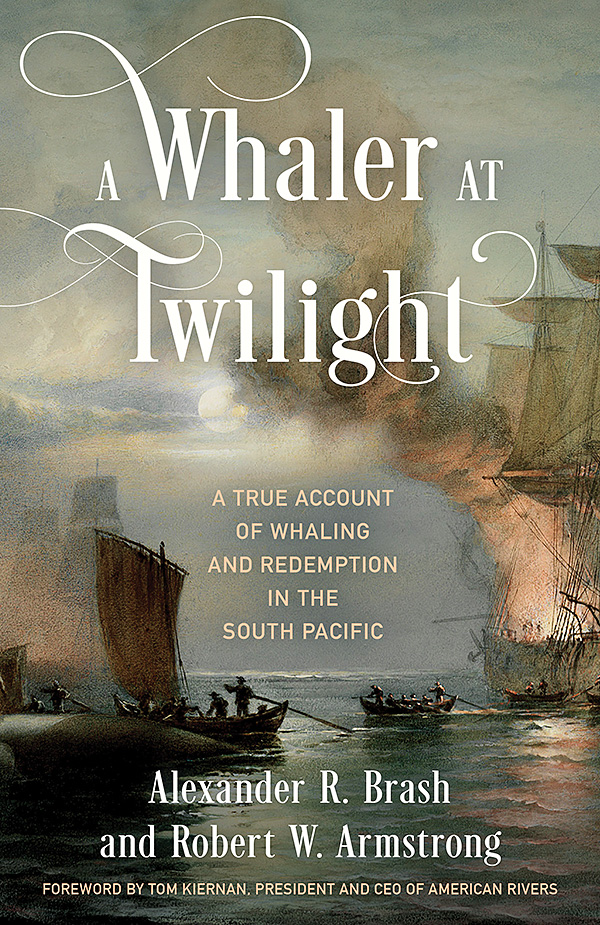
A Whaler at Twilight: A True Account of Whaling and Redemption in the South Pacific, by Alexander R. Brash and Robert W. Armstrong. Lyons Press, 4501 Forbes Blvd., Suite 200, Lanham, MD 20706. 320 pp., illus., hardcover. $34.95
Available from The WoodenBoat Store
(www.woodenboatstore.com)
For anyone who came of age in the 1970s, as I did, whaling is arguably the one chapter of maritime history, among many contenders, that is absolutely the hardest to stomach. Ample sources have long romanticized the industry—“Nantucket sleighrides,” and all that. But those stories always sprang from the long-gone era when whaling was conducted by ships under sail, lowering open boats to hunt their prey under oars. By the mid-20th century, factory ships, cannon-fired exploding harpoons, and widespread extinctions and near-extinctions had absolutely nothing of romance about them.
And then, Roger Payne’s 1970 album of haunting humpback whale songs changed everything. Eminent maritime museums began to retool to give “equal time” to the natural history of whales and the tragedy of the industry’s depredations. That earlier story still has some compelling facets: its racial and ethnic mixing probably has never been equaled by any industry before or since; the newness of bright, smokeless light forever changed night life in cities and homes; its profits propelled the rise of a capitalist class in New England; its abusive working conditions shocked a formerly agrarian society. There are still important questions and story lines to be teased out of this history. But a deeper understanding of whales brought a new urgency to the conservation of the natural world and raised a new kind of question: What have we done?
Alexander R. Brash, an ornithologist and prominent conservationist who grew up in New York City and now lives in Connecticut, had only a vague awareness that he had a whaleman as an ancestor. Robert W. Armstrong, his great-great-grandfather, was destined for a profession, having graduated from a Baltimore, Maryland, college that was the first devoted to dental medicine. Armstrong came from a family that valued high achievement, and still does. His promising start, however, was shredded by serious struggles with alcoholism. He was broke and had burned a lot of bridges by the time he signed aboard the whaler SMYRNA out of New Bedford, Massachusetts, in 1849. Much later in life, and by then sober, he drew on his logbooks to write a fascinating memoir about his experiences, not only on whaleships but also as a logger in New Zealand. His commitment, with religious overtones, for sobriety came during the homeward year-and-a-half voyage aboard the ISAAC HOWLAND. After landing in New Bedford, his “lay,” or share, minus expenses of $70, “most of it worse than wasted,” was 21 cents. The owners took pity and gave him an extra $5. When he left for Baltimore, he ended up walking the last 65 miles home.
Brash, who shares the author credit with his ancestor, has assembled this book in an interesting manner. It is in four sections, Part I being his own story (Yale School of the Environment, PhD studies at Rutgers University, a wide variety of roles with prominent public and nonprofit organizations) and his first tentative steps toward expanding on his ancestor’s story.
In Part II, he presents the complete text of Armstrong’s writing as it stood, with little alteration and, mercifully, no footnotes. I found this effective, allowing immersion in Armstrong’s world. This is an ordinary seaman’s viewpoint, since he came aboard as a “greenhand,” or newcomer, and he describes other ordinary people. My favorite was Seth Walker of New Hampshire, with shades of Herman Melville’s Billy Budd: “We were not long at sea before he became a general favorite. He was intelligent, with some considerable education, generous and unselfish, and faithful to his duty to a fault…. The stormy Cape Horn weather was too much for our shipmate, and one day he failed to ‘turn to’ when his watch was called on deck. He grew rapidly worse,” and he died shortly afterward. Armstrong also records the ship’s many desertions, with replacements by “beachcombers” who had deserted other whalers and also by outright kidnappings of native islanders. He and another crewman were the last of the original crew to desert; they went to try their hands as loggers near Auckland, New Zealand.
As so many others, Armstrong marveled at the Pacific islands: “I cannot find language to adequately express the wonderful beauty of these islands in the sea. Their luxurious tropical foliage rising gracefully from the very edge of the ocean and covering the slopes of the hills with a rich, deep green, they form a picture once seen never easily forgotten….”
On the whaling grounds, his account turns to work. “…We then lowered and after a short chase, each boat secured a whale, our captain in their larboard boat and our 2nd mate in his boat. Then I saw the most wonderful site I had ever beheld. After the first whale had been struck, the whales stopped on the surface, heads and tails together, and for a few minutes they appeared utterly disconcerted, not knowing which way to go. As far as the eye could see, whales lay all around us in every direction and in numerable multitude….”
In Part III, Brash provides detailed context of Armstrong’s voyages. Among the topics are the Galápagos Islands, where victualing whaleships were responsible for decimating tortoise populations; the harms native populations suffered throughout the islands, including kidnappings to replace deserters; and a noted violent mutiny. For one chapter, he traveled to New Zealand to find remnants of old-growth forest in the area where Armstrong worked with a logging crew. In Part IV, he ruminates on what it all means. His best writing in the book emerges in the descriptions of a bird-watching voyage he joined from Buenos Aires, Argentina, into Antarctic waters and ending in Santiago, Chile.
For a 21st-century reader, Armstrong’s religiosity sounds shrill, but Brash found a way to reconcile himself to it: “If you truly believe in god, then one should recognize that the same entity also produced the resplendent biodiversity that characterizes Earth. If a being created us, it also created the gorgeous mosaic of species that are the biotic foundation of our planet….” In the last pages, he returns to the theme: “While Rob prayed for his own salvation, I pray for ours. I pray that our species will collectively find a way to extend our ethical and spiritual benevolence to all creatures, great and small,” without which, as his final words say, species will “slip into the infinite abyss of extinction.” As our populace stands, some will hear his plea. Others will not. 
Tom Jackson is WoodenBoat’s senior editor.