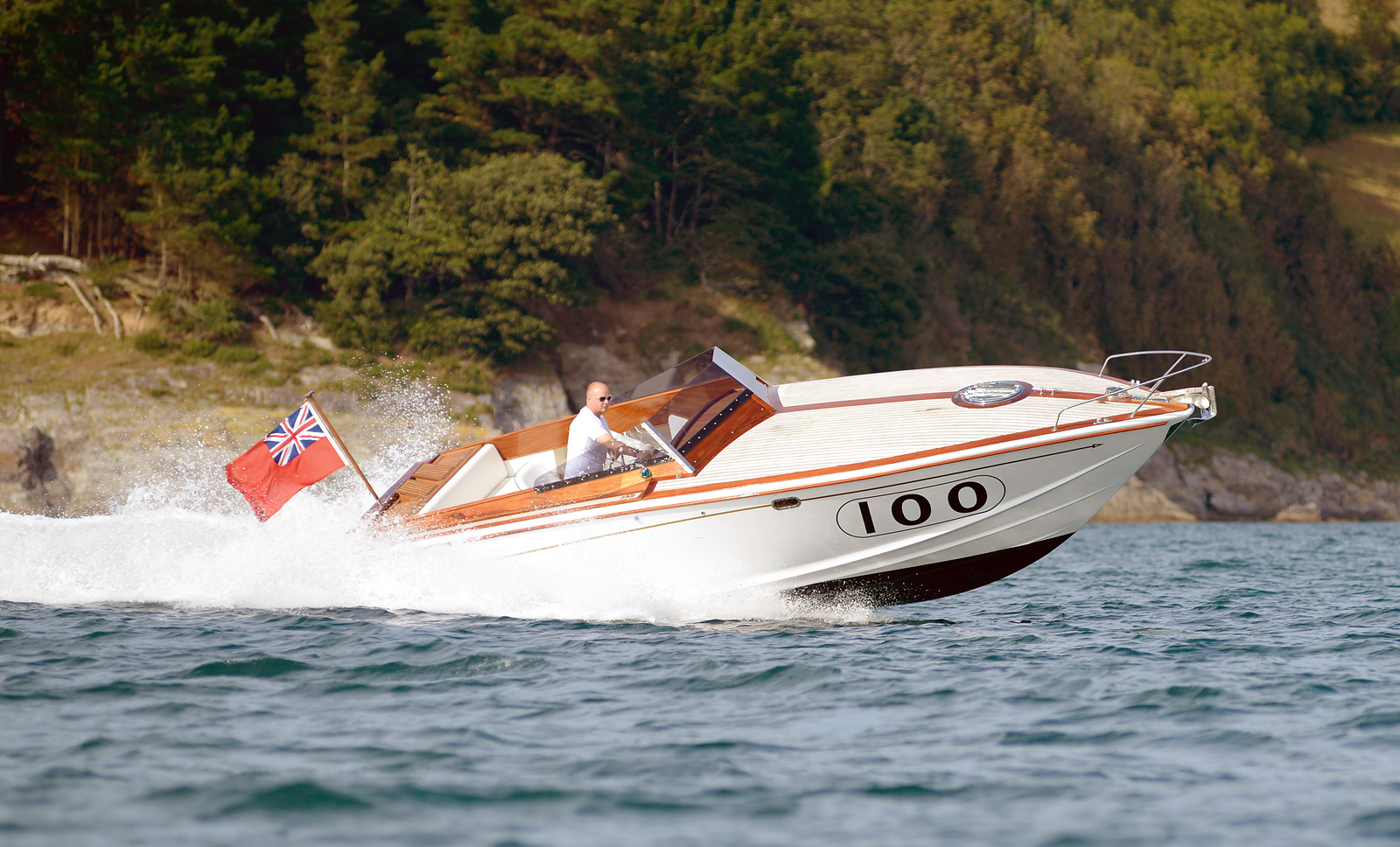
Raceboat on the water.Nic Compton

VIVA TRIDANTÉ! had been out of the water for about 30 years when Matthew and Ronnie Reed bought her in 2016. Although the 1964 raceboat has been refitted primarily for family outings, Matthew has pushed her to 36 knots on solo runs.

Matthew and Ronnie Reed were looking for a family boat to cruise the local waters near their home in Kingswear, Devon, England, when they spotted a rare—some might say collectible—boat for sale. VIVA TRIDANTÉ! was a 23′ speedboat, built to a design by Sonny Levi, that had raced several times in the Cowes-to-Torquay Race and won her class in the Torbay 100 Race in 1970, beating the likes of Sir Max Aitken in his famous (and much bigger) GYPSY GIRL. There’s even Pathé news footage of her holding her own among some of the top racing boats of the day, a plucky little pocket rocket battling against the elements and helping to cement the Levi legend.

Despite all this history, a 1960s offshore racing powerboat isn’t an obvious choice for a family with two young children. But then, the Reeds weren’t looking for anything obvious. Matthew grew up with boats on the River Dart, starting with a Mirror dinghy and moving on to a variety of open launches fitted with small engines. He joined the Royal Navy at 18 and by the time he was 28 he was captain of a 68′ patrol boat capable of speeds of over 25 knots. Since then, his boating has been almost entirely of the sailing variety, including competing in six Fastnet Races, several Cowes Weeks, and a Sydney-to-Hobart. His most recent campaign was racing the 1963 Maxi yacht KIALOA II in the 2023 Fastnet Race.

For their family boat, Matthew and Ronnie were looking for a comfortable motor cruiser, something they could anchor off the beach, sunbathe on, or use for pottering over to nearby Brixham for the weekend. Both have an interest in retro design. Ronnie owns a Renault 4 van, which she believes is one of only two original ones left in the U.K., making it rarer than a Ferrari. So a vintage boat appealed to both of them. They looked at classic British motor launches such as Fairey Huntresses and Fairey Huntsmen, but the boats they saw all needed too much work, and they could find “nothing exciting” in fiberglass boats.

Matthew was amazed when he spotted the old Cowes-to-Torquay Race veteran for sale up the coast in Poole. Even though it was a much racier boat than they had imagined, and the price was well beyond their budget, they decided to have a look at her anyway.

“It took my breath away when I saw it,” Matthew says. “The way it looks, the way the foredeck curves down. It’s a thing of beauty—like nothing else. Then there was the boat’s pedigree, its history. It’s the equivalent, in classic car terms, of a Jaguar E-Type that’s raced at Le Mans. If it was a car, it would be worth a fortune! After 10 minutes, Ronnie took me to one side, away from the broker’s earshot, and whispered, ‘We’ve got to buy this boat!’”

Boat launching on the Medina River.Bernard Olesinski/courtesy Of Charles Lawrence

VIVA TRIDANTÉ! was built in 1964 and launched on the Medina River in Cowes. Here, Wally Clark, the builder, checks the side windscreen’s fit on launching day.

The origins of VIVA TRIDANTÉ! stem from a chance encounter at the 1961 Earls Court Boat Show in London, an encounter that would change the direction of Sonny Levi’s life and influence the future of powerboat racing around the world. Levi had by then moved from his father’s boatyard in Bombay, India, to become an in-house designer at the Cantiere Navaltechnica, known informally as Canav, in Anzio, Italy. While he was visiting the Earls Court show, a friend handed him a flyer for the first Daily Express Offshore Powerboat Race (aka the Cowes-to-Torquay Race) and suggested he “have a crack” at it.

The effect was like dropping a lighted match into a bowl of gasoline. “The idea captured my imagination at once,” Levi later wrote. “Here was a challenge I could not resist, the chance to see if I could produce a boat capable of winning what promised to be a very exciting event.”

The result was the 30′ ’A SPERANZIELLA, the first deep-V boat to be built in Italy, according to Levi’s memoirs. Canav built the boat in three-and-a-half months. The intention was to compete in the inaugural Cowes-to-Torquay Race in August 1961 and also use her as a prototype for a new line of cabin cruisers fitted with smaller engines. Although the boat suffered technical problems on the last leg of the race and finished in sixth place, her performance was impressive enough to establish Levi as a vital new force in the powerboat world.

Levi was back the following year, this time with five designs to his name. One of those was the 23′ TRIDENT, commissioned by Don Shead, a British maverick who went on to become a hugely successful powerboat designer, including creating the Sunseeker range. Shead settled on 23′ LOA because he considered that to be the smallest practical size for a “lunch in Cherbourg” boat—one able to make the three-and-a-half-hour crossing of the English Channel to France and back in a day.

VIVA TRIDANTÉ racing.Powerboat Archive

VIVA TRIDANTÉ!’s best result was first in her class and fourth overall in the 1970 Torbay 100 Race.

Like ’A SPERANZIELLA before her, TRIDENT had the distinctive snub nose; convex, or reverse, sheer; and lack of hull flare that were already Levi trademarks. And, like nearly all of Levi’s prototypes, TRIDENT was built of cold-molded wood, with three layers of 3⁄16″ mahogany for the hull, two layers of 1⁄4 plywood for the deck, and spruce and afzelia for the stringers and beam. Unusually, she was fitted with three Volvo 110-hp sterndrive engines (hence her name), giving her a top speed of 35 mph.

TRIDENT’s first race was not a great success. The boat’s hull construction was either too light, as Levi himself conceded, or she struck an object at sea. Either way, she was holed in the early part of the race and was forced to withdraw with water rising in the bilge. She was immediately taken back to her builders, R&W Clark in Cowes, to have the hull strengthened. Later, her third engine was removed, which was found to make almost no difference in her performance: She returned for her second Cowes-to-Torquay in 1963 and won her class with only two engines. Overall, she finished seventh; ’A SPERANZIELLA was first.

“I was particularly pleased with TRIDENT as a boat, for she appeared to me to be the ideal small, nippy craft for fast cruising,” Levi wrote. “Don in fact on many occasions popped across the Channel in her for lunch in France. I think that it is also true to say that she influenced quite a few designers, since many boats resembling her general configuration were produced both in Europe and in the United States of America.”

In fact, a stretched version of the design with a raised cabintop was soon being built in fiberglass in England, first as the Poseidon and then the Triana 25. Both versions came out at 3 tons, compared to the 2.2 tons of the more stripped-back, wooden original, but several went on to race both in the Cowes-to-Torquay Race and the Round Britain Race, with modest success. A small handful of almost identical boats—cold-molded in wood and fitted with two engines rather than three—were also built by R&W Clark: JUPITER OF THE ISLES, which finished 16th in the 1963 Cowes-to-Torquay; MISTER SMITH II, which had withdrawn from the 1964 Cowes-to-Torquay but finished 16th in 1965; and VIVA TRIDANTÉ! in 1964.

Interior of boat showing hull construction.Nic Compton

VIVA TRIDANTÉ!’s strip-planked hull construction is clearly visible from her somewhat spartan interior. The planking has survived largely unscathed for 60 years.

VIVA TRIDANTÉ! was built for Derek “Don” Smith, “one of the Isle of Wight’s more colourful characters,” according to a later owner. She was built of the same materials used in TRIDENT and fitted with two 110-hp Volvo sterndrive engines, the same type used in the earlier boat. She didn’t enter her first Cowes-to-Torquay race until 1967, three years after her launching, and had to withdrew due to mechanical problems. The same thing happened in 1968, by which time the race had been extended from 156 to 228 nautical miles by the addition of a return leg to Cowes.

She had better luck in 1969, moving up steadily from 31st out of 52 boats at the first mark to 24th at Torquay and 19th over the finish line back in Cowes—not bad for one of the smaller Class II boats. Her performance earned her a mention in Yachts & Yachting magazine as one of the top four boats in Class II, as well as a few seconds in the official film of the race, in which she was described as “hopping on home” as she jumped from wave to wave. The overall winner of that race was American powerboat legend Don Aronow, who set a new course record with an average speed of 66.5 mph on his 32′ THE CIGARETTE—quite another league from the Class II boats.

VIVA TRIDANTÉ! withdrew from the Cowes-to-Torquay race again in 1970 and 1971, though in 1970 she did compete in the Torbay 100, a 100-mile race based off Torquay in Devon. This time, she not only placed first in her class, beating 13 other boats, but also finished 4th overall, two places ahead of Sir Max Aitken and his GYPSY GIRL, a 40′ giant propelled by 1,000 hp. It was probably the best result of her career.

Wooden powerboat.Nic Compton

An original wooden Sonny Levi powerboat such as VIVA TRIDANTÉ! is a rare find, though his Corsair design is now being built in fiberglass by Levi Boats in Italy.

After owning her for nearly a decade, Smith sold VIVA TRIDANTÉ! in 1973 to a prominent powerboat couple, Richard and Sue Griffith, who promptly put her on a trailer and headed south to the Mediterranean coast of Spain. The only race result she recorded was in the 1973 Marbella Week, where she seems to have been a nonstarter.

Her racing days were over. In 1976, VIVA TRIDANTÉ! was sold to Ray Jones, an Isle of Man businessman, who took her to the island to be used for day trips. When Jones and his family moved to Somerset in southwest England in 1980, they took the boat with them and eventually sold her to a family friend who used her for waterskiing around Exmouth, on the south coast of Devon. According to future owner David Sewell, a journalist: “It appears [their] comments on VIVA TRIDANTÉ!’s performance compares with that of the Griffiths’ inasmuch as she was very quick, particularly in rough water, but guzzled fuel at an alarming rate.”

By the 1990s, she was in a forlorn state in a boat graveyard in Southampton, along with several other outdated offshore racers. There, she was spotted by the powerboat superstar Simon Wood Power, who embarked on the first of several restoration attempts the boat would be subjected to in the coming years. David Sewell came next, announcing proudly in the 2002 edition of World of Powerboats that he was planning to “transform VIVA TRIDANTÉ! to its former glory and return the little 23-footer to Cowes, the home of its birth.”

Finally, she was bought by a retired insurance broker, Ian Wright, who did the sensible thing and entrusted the boat to the Woodford Marine boatyard in Poole, Dorset, which embarked on a complete restoration, gutting the interior and removing the decks. New deckbeams were fitted and a new double-diagonal deck was laid, topped with teak planking. The boat’s hull was in remarkably good condition, needing only to be prepped and painted with Awlgrip. The old Volvos were removed and a single 5-liter MerCruiser fitted in their place. Don Shead’s triple-engined racing machine had been tamed and subdued—and, reportedly, performed all the better for it.

Restoration included a teak deck.Nic Compton

A new deck was laid by the previous owner, using teak planking over a double-diagonal subdeck. The Reeds’ continued restoration included the installation of a new helm station.

By the time Matthew and Ronnie spotted VIVA TRIDANTÉ! for sale in 2016, she had been out of the water for nearly 30 years. Both of them fell in love with the boat at first sight, but they kept their cool and were eventually able to buy her at less than half the original asking price. Over the next two years, they further improved on the restoration work while enjoying some family time aboard during summers. The boat was completely rewired by a local boatbuilder, “because I’m very aware that I’m driving a wooden boat with a petrol engine with my family on board,” as Matthew puts it. The enormous fuel tanks required to feed the original two engines were reduced to improve locker space in the cockpit, though the boat still carries around 400 liters, or about 106 gallons, which is enough for up to four hours of cruising. The interior and the steering station were also restyled to be more in keeping for a boat of her era, and the air intake for the engine was improved. Last but not least, the name lettering was transcribed from an old photo and replicated exactly, including the eccentric exclamation mark, as a decal for the transom.

MerCruiser engine.Nic Compton

A single 5-liter MerCruiser now takes the place of the original twin Volvo engines.

VIVA TRIDANTÉ! came ashore again during the Covid-19 pandemic, and she remained out of commission for a couple of years afterward as Matthew focused on getting a new business off the ground. For a while, cash was scarce, and they couldn’t afford to launch the boat, at which point their daughter, Marigold, put her hand on Matthew’s knee and told him she would donate her pocket money if it would help get the boat back on the water. Her brother, Jarvis, agreed. In summer 2024, she was relaunched, and the family could once again use her as they intended—not to smash any records but just to get out on the idyllic waters of South Devon.

So, how does a 60-year-old offshore racing boat perform as a family boat? “It works really well,” Matthew says. “We have a fridge on board, and the kids use her as a camper van. Marigold and Jarvis love her. She’s not the easiest boat to drive slowly, because she’s designed to go on plane. And it can be quite tricky going alongside, because there’s a lot of windage. When you’re going at speed, it’s important to get the trim tabs right. But once you’re in the groove, it’s just like flying an airplane.”

The foredeck hatch.Nic Compton

The foredeck hatch is a lovely period detail, though the footing on the reverse-sheered foredeck takes a bit of getting used to.

On solo outings, Matthew’s current top speed is 36 knots, but he says the boat is more comfortable, and more fuel-efficient and family-friendly, at 23 to 24 knots. She cruises along remarkably quietly at 6 knots. Dartmouth is 85 miles from Cherbourg, and at 24 knots it would take three-and-a-half hours to cross the Channel, so Shead’s original concept of “lunch in Cherbourg” is still possible. But I don’t see a cross-Channel trip happening any time soon. “Lunch in Brixham,” eight miles away, is a lot more appealing for a family, and a lot less fuel-guzzling. VIVA TRIDANTÉ!’s racing days might well and truly be over, but she is still much appreciated by her clearly besotted owners.

“It’s an iconic design,” Matthew says. “Once you know what a Sonny Levi design looks like, you can spot them a mile off. Owning a boat like this gives you complete pride of ownership. It’s like owning a Riva, only a lot rarer!”


Sonny Levi: The great innovator

Renato Levi was born in 1926 to Italian parents in Karachi at a time when it was part of India instead of modern Pakistan. He acquired his nickname because his nanny couldn’t pronounce the “r” in his real name and called him “Sonny” instead. Karachi was part of the British Empire at the time, which meant that Levi was entitled to a British passport. After going to school in France and Darjeeling, he duly joined the British Royal Air Force in 1940 and subsequently studied aeronautical engineering in London.

30 foot racing boat.Beken Of Cowes

Sonny Levi burst onto the powerboat scene at the 1961 Cowes-to-Torquay Race with ’A SPERANZIELLA, a 30-footer powered by twin 325-hp Crusader engines.

He returned to his father’s furniture-making factory, AFCO, in Bombay in 1950. The company had by then diversified into boatbuilding, and Levi spent the next decade designing hundreds of utilitarian workboats for the Indian military, honing his design skills in the process. During this time, he patented his PlyGlass method of construction, using plywood panels held together with fiberglass joints, foreshadowing the stitch-and-glue system. He used the method to build stackable, frameless dinghies that the military used for crossing rivers.

Another notable commission in 1958 was for a 24′ low-cost fishing boat designed to be surf-launched. This beach boat had an 18-degree constant deadrise, similar to the deep-V hull shapes that would dominate powerboat racing, leading some to suggest that Levi invented the concept before, or at least coincidentally, with C. Raymond Hunt of Marblehead, Massachusetts.

In 1960, Levi moved to Italy to work as in-house designer for the Cantiere Navaltechnicha boatyard in Anzio, near Rome. The following year, he created his first racing boat design for the 1961 Cowes-to-Torquay powerboat race: the 30′ ’A SPERANZIELLA. Although due to fuel problems it finished only in sixth place, ’A SPERANZIELLA made a big impression, and commissions for more racing boats soon followed. Levi came back two years later, winning the race with the same boat.

By 1965, Levi was already established as one of the top designers of the day when he created his most revolutionary design. The 36′ SURFURY was the first of his Delta concepts, so-called because the widest beam was at the transom, creating a triangle effect. Long and lean, she was fitted with trim tabs and water-ballast tanks, and she weighed half as much as her predecessors. She won the Cowes-to-Torquay Race at her third attempt in 1967.

Raceboat in the Cowes-to-Torquay Race.Beken Of Cowes

Arguably Levi’s most famous design, the 36′ SURFURY was built by the Souters yard in Cowes in 1965. Fitted with tandem 525-hp Daytona engines, she won the 1967 Cowes-to-Torquay Race.

The success of SURFURY led to a string of designs based on the Delta principle, including MERRY-GO-ROUND, built in 1966 for Max Aitken, who took the boat to a new world diesel speed record of 60.21 mph on Southampton Water that year. In 1968, Levi adapted the concept to produce one of his most striking designs: the 37 “fast commuter” G-CINQUANTA, built for Gianni Agnelli, chief executive of the Fiat motor company. Fitted with four 320-hp BPM Vulcano engines, G-CINQUANTA easily beat the minimum 50-knot speed target set by her owner.

Sonny Levi at the helm of a racing powerboat.Courtesy Of Charles Lawrence/sonny Levi Estate (both)

Sonny Levi made his mark with racing powerboats. He is shown above left at the helm of G-CINQUANTA, also shown above right. She was a 37′ “fast commuter” built in 1968 for Gianni Agnelli, chief executive of the Fiat company, and was powered by four 320-hp BPM Volcano engines.

Levi continued to innovate throughout his career, most often building prototypes in wood. The spectacular 42′ 8″ DRAGO of 1972, which used revolutionary “surface propellers,” was built of laminated plywood to keep its weight down. It reached 55 knots, making it the fastest production cabin cruiser in the world at that time. Likewise, Levi’s bizarre Y-shaped “inverted tricycle” racer ARCIDIAVOLO II—half catamaran, half monohull—was built in plywood in 1975. The following year, the boat set a new Class II record of 67.964 knots.

Although best known for his motorboat designs, Levi designed many sailboats and some light aircraft. He moved to Cowes, on the Isle of Wight, in the early 1970s, and in 1987 he was appointed a Royal Designer for Industry, the highest accolade in his field. He died on the Isle of Wight in 2016. 

Nic Compton is a regular contributor to WoodenBoat.