A wood-species identification mystery solved.Michelle Gawe

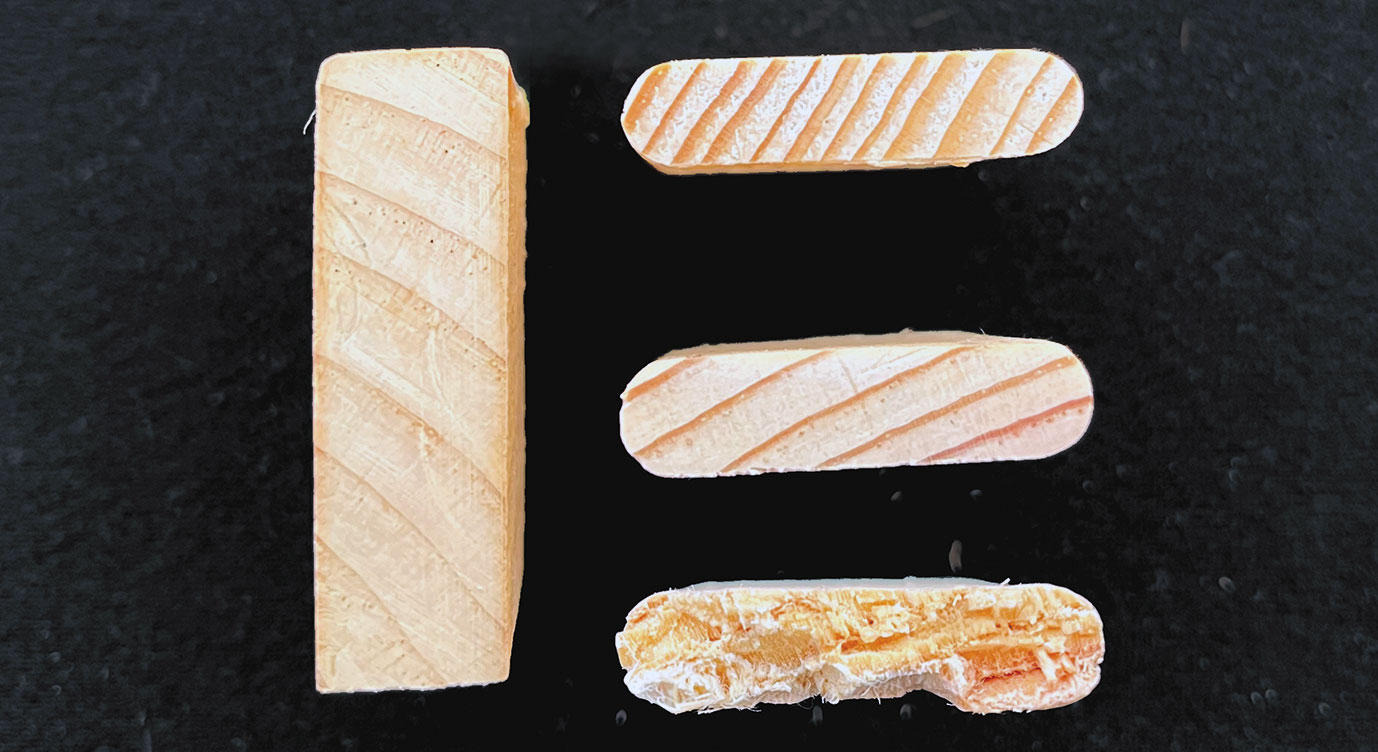
A wood-species identification mystery solved: The author’s known eastern white pine sample (left) appeared quite different from samples sent by reader Jack Nettleton from a South American species marketed loosely as “white pine.” At top right, a segment from one canoe rib that was steam-bent successfully shows differences from the one at middle right, which shows the wide growth rings and narrow latewood bands of juvenile wood—which failed in bending, exacerbated by its grain orientation relative to the bend. The “brash” break, abrupt and across the grain, is typical of bending failure in juvenile wood.

An email from Jack Nettleton, who lives near Rochester, New York, challenged my wood-sleuthing skills and had me putting on my Sherlock Holmes cap to solve a mystery: “This past winter,” Jack wrote, “a group of us built four skin-on-frame canoes to the designs of Hilary Russell. We tried using a variety of woods, experimenting to see how light we could make the frame. For the third boat, we used ⁵⁄₄ clear pine from a local lumberyard. We selected the straightest grain we could and reserved the best rips for ribs. The ribs finished at ⁵⁄₁₆″ × 1⅛″. We soaked the ribs overnight and put them in a heated water bath at lunchtime. After lunch, we bent the ribs into the ribbands on the form, and the pine bent like spaghetti. For the fourth boat, we used the same procedure but used pine from a different board. These ribs felt stiffer, and every one of them snapped. Some failed along grain lines, but others snapped almost straight across. The only difference we could see between the batches of stock was that the successful bends were in ribs from a slow-growth tree with narrow grain and the broken ones were from a faster-growth tree with larger grain. Is there something else going on or is the difference solely between slow- and fast-growth timber?”

I responded to Jack, asking him what species of pine he used and whether he might send some photos. He responded, saying, “All ribs were made of ⁵⁄₄ clear 14′ white-pine boards purchased from a local lumberyard. We were able to pick through the stacks and selected the boards we wanted. The ribs were finished ⁵⁄₁₆″ × 1″ with rounded edges. They were soaked overnight before bending. Since the majority failed, we made new ribs from ash we had in the shop. They bent just fine. We expected that we would lose a few ribs in the process anyway, so we always made extra. But every one of the ribs we tried to bend from the second pine board broke. Since we had ribs from both pine boards in the same tank, the process was the same. So, we decided it must be that the wood itself was the difference.”

Jack included some photos showing the end-grain of the pine ribs. Although they were somewhat blurry, I was not convinced that this was white pine. After further correspondence, Jack went to his kindling box and sent me rescued wood samples from the ends of strong and weak ribs.

He also contacted the lumberyard to determine the source of the “white” pine. But as the weeks dragged on without an answer and my column deadline approached, I decided to see whether I could identify the wood species based on anatomical features.

Microscopic Identification

Eastern white pine (Pinus strobus) is one of three U.S. pine species classified as a “soft” pine; the other two are western white pine and sugar pine. All three lack a well-defined latewood zone, as seen on a smoothed end view. In the accompanying photograph, the sample on the left is eastern white pine from my own collection. Only a few dense cells define the end of each growth ring. The two rib samples sent to me by Jack (top and middle right in the photograph) have well-defined, denser latewood zones. I examined thin sections of the ribs microscopically and confirmed that they were neither white nor sugar pine; and I was also able to eliminate red pine (Pinus resinosa) and Monterey pine (Pinus radiata) based on microscopic features. I ruled out contemporary southern yellow pines based on ring width, which is wider than in white pines, and on the transition between earlywood and latewood, which is more abrupt in southern pines.

This left ponderosa pine, lodgepole pine, Jeffrey pine, and jack pine among U.S. species. I initially assumed that the lumberyard near Rochester, New York, had sourced the wood locally. Lodgepole, ponderosa, and Jeffrey pines are western U.S. species. Jack pine (Pinus banksiana) is native to Canada and the northern tier of states from the Great Lakes region to New England. It is found in various locations in New York state.

While jack pine is classified as a “hard” pine, it shares some characteristics with white pine. In wood density and strength properties, it is intermediate between red pine and white pine. Among these three forest cohorts, jack pine is the slowest growing, often found on the poorest sites. It never achieves much size, only reaching heights of 30′ to 65′, and it is generally less than 16″ in diameter. Because the tree retains branches almost down to the ground level, it produces very knotty wood; trees with crooked stems are common. Consequently, until recently, most jack pine logs were sent to the pulp mill to be turned into paper products, while wood of better quality was turned into knotty-pine paneling.

As The Wood Handbook notes, “Jack pine lumber is sometimes not separated from other pines with which it grows, including red pine and eastern white pine.” While this supported the idea that Jack’s lumberyard was simply calling all locally sourced pines “white pine,” including jack pine, the fact that the boards Jack’s crew selected for ribs were 14′ long with knot-free straight grain was bothersome. Perhaps the lumberyard was getting a western wood like ponderosa pine (Pinus ponderosa). I often see western softwoods at big-box stores in Maine. The true identity of this rib wood was still a real puzzle.

Just as I was about to put the final touches on this column, I received an email from Jack. He wrote, “When [we] talked to the lumberyard all he could say was that it was a plantation-grown pine from South America. He uses multiple suppliers and could not pinpoint the specific source of the wood.”

The mystery was suddenly solved. Three very similar pines are native to South and Central America: Caribbean pine (Pinus caribbaea var. caribbaea), Honduran pine (Pinus caribbaea var. hondurensis), and Ocote pine (Pinus oocarpa). All are found in natural forests as well as plantations from Mexico to tropical South America and on the Caribbean Islands. The anatomical features of the three species are not distinguishable, and they are classified with the ponderosa-pine grouping. They all tend to be marketed as Caribbean pine.

Questions about wood properties, which are common, often arise because of modern wood-marketing strategies. Common names no longer have any meaning. I have written in the past about the marketing strategy of combining several species into one name. “Western whitewoods” can be the designation for western white pine, Douglas-fir, mountain hemlock, and, sometimes, white fir. “Western woods” is a category that includes ponderosa pine, sugar pine, and Idaho white pine, along with mountain hemlock and alpine fir. The justification is that “these species share similar design values.” Of course, this is not a totally new marketing deception. Woods derived from several genera of the Southeast Asian tree family, the Dipterocarpaceae, have long borne the name of Philippine mahogany and sometimes just mahogany. It is not, therefore, surprising that the name white pine is now a “brand” for any species of pine a marketer may choose.

Bending Properties

While the properties of Caribbean pine are definitely superior to jack pine, I was still surprised that the crew was able to bend canoe ribs from this or any pine. In general, coniferous tree species (softwoods) are poor choices for steam-bending. The reason is not clear but may be related to the different chemical nature of the lignin in softwoods versus hardwoods. A few more pliable species of softwoods are exceptions to the rule: Pacific yew (Taxus brevifolia) and Alaska yellow cedar (Chamaecyparis nootkatensis) respond well to steam-bending.

Among softwoods, juvenile wood, or that found close to the center of the tree, often fails under bending stress with an abrupt shear across the grain—a brash break. In the photograph, this is seen in the broken rib at the bottom right, which was part of the rib shown directly above it in the middle example. The wood sample at the top right of the photograph is part of a rib that was steam-bent successfully.

Why did the top rib not fail the way the bottom one did? Two reasons: It has narrower growth rings with a greater proportion of denser latewood in each ring. This is evidence that the wood is stronger and is from the mature wood zone of the tree. The rib that failed has wider growth rings and very narrow latewood zones—an indicator of juvenile wood. The second reason relates to the orientation of the growth rings relative to the bending plane. The successfully bent rib was curved in the radial direction, which has a higher level of success in steam-bending compared to bending in the tangential direction. This is true regardless of wood species. The failed rib is intermediate in grain orientation but much closer to tangential than radial orientation.

Right Choices

Not surprising to me was the consistent success reported when the crew switched to ash wood for their ribs. Ring-porous hardwoods such as oaks, elms, hickories, and ashes are prime candidates for steam-bending. Other hardwoods that perform well are beech, maple, walnut, sweetgum, and mahogany.

But not all hardwoods are good candidates for steam-bending. Weaker woods such as Paulownia (Paulownia spp.), which is often used in the construction of lightweight boats, is a very poor candidate. My advice would be to stick to the known, dense hardwoods for severe bends. Limit the use of low-density woods such as pines and cedars to the moderate curvatures needed for stringers or planking. These are the places to reduce weight in small-boat construction.  Article ends.

Dr. Richard Jagels is an emeritus professor of forest biology at the University of Maine, Orono. Please send correspondence to Dr. Jagels by mail to the care of WoodenBoat, or via e-mail to Senior Editor Tom Jackson, tom@woodenboat.com.