
 Richard Jagels
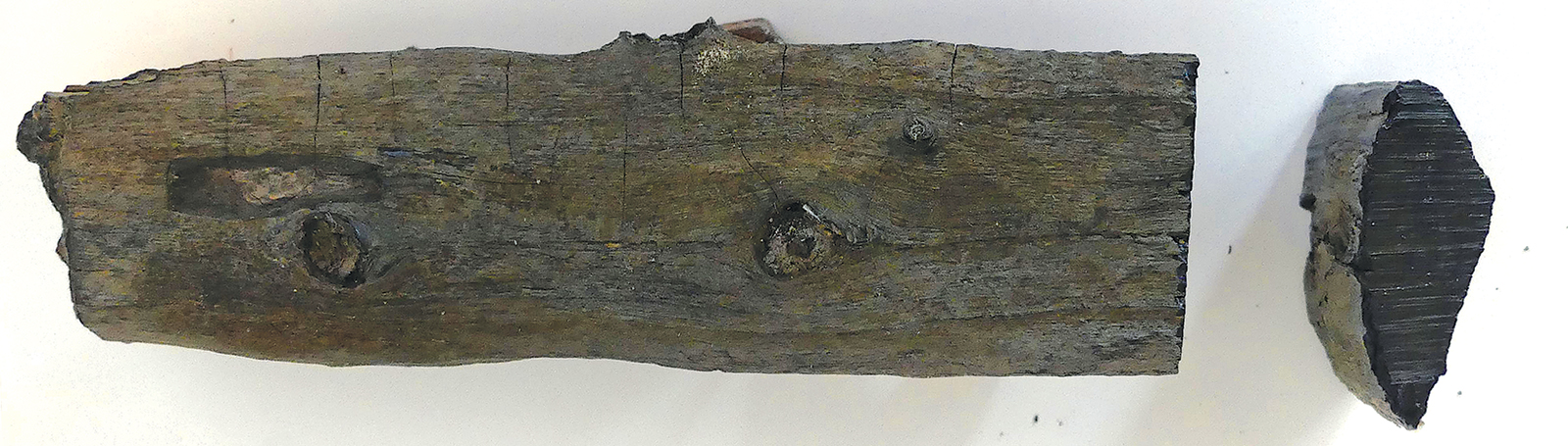
This naturally occurring flattened and “densified” dawn redwood (Metasequoia) fossil was collected by the author from an Eocene-era site on Axel Heiberg Island at 50 degrees north latitude in Nunavut, Canada.
After World War II, the world was inundated with an explosion of new technologies that had been developed as part of the war effort. New materials such as fiberglass-reinforced, petroleum-derived plastics began to compete with natural products, including wood. In response, the U.S. Department of Agriculture’s Forest Products Laboratory (FPL) in Madison, Wisconsin, experimented with methods to modify wood in ways to compete with the new synthetic materials.
In March 1956, FPL chemists R.M. Seborg, M.A. Millett, and A.J. Stamm published report No. 1580, titled, “Heat-Stabilized Compressed Wood (Staypak).” While Staypak was never commercially produced, other compressed, densified wood products made from chips, shavings, or fibers soon appeared—among them particleboard, medium-density fiberboard (MDF), and high-density fiberboard (HDF), and all are now ubiquitous in the market. Even earlier, in the 1930s, German engineers produced a compressed-wood product called Lignostone. Patterning on that model, the FPL crew produced Compreg, which was intended for structural products such as aircraft propellers, connector plates, concrete forms, and other applications requiring high strength. Compreg is produced by cross-layering veneers slathered with phenol-formaldehyde resin and subjecting the panels to heat and high pressure. Think of it as compressed plywood.