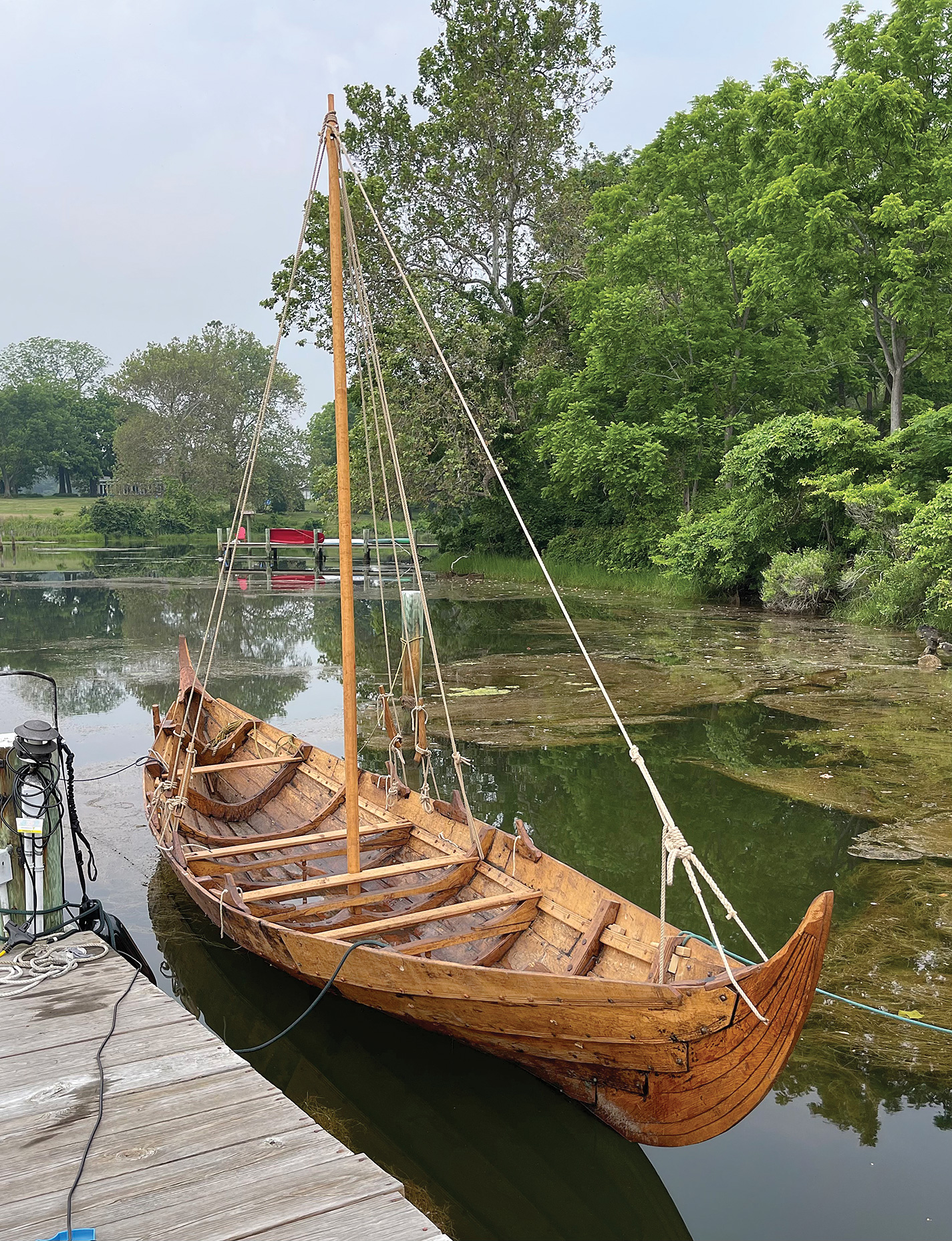
Matthew BarnesThe author led the Leetes Island Boatworks crew in re-creating a 900-year-old boat found and documented by archaeologists at the Viking Ship Museum in Roskilde, Denmark.
In 2017, when I was working as a shipwright at Mystic Seaport Museum in Connecticut, Søren Nielsen visited from the Viking Ship Museum in Roskilde, Denmark, where he is the boatshop director. I had come to deeply admire boatbuilders such as Søren who had not only a high level of skill but also a sense of purpose. In my work, I had been focusing especially on adze and axe work, learning much from my colleagues. My interest had become an obsession by the time of Søren’s visit, and during our conversations he ended up inviting me to join a boat-construction project at his museum that summer. A fellowship grant from Mystic Seaport made it possible; I was soon on a plane for Copenhagen.
During that summer, I spent 16 weeks as an apprentice working on the museum’s third reconstruction of a type of boat that had become known as the Gislinge boat, the 12th-century original of which was documented by archaeologists after it was unearthed in a municipality by that name. Its construction was right in line with the Viking tradition, but it was relatively small at 25′. That meant its construction could be accomplished in a reasonable time, giving me a full experience in Viking Age clinker boatbuilding, or what we would call lapstrake construction. I fully immersed myself, trying to learn everything I could, from cleaving oak logs, to making the resulting 16′×12″ pieces perfectly flat using only an axe, to using open fire to bend them into planks. While I was there, I took some time to travel around Scandinavia and northern Europe, following the path of the Norse peoples’ westward expansion to study how it affected boatbuilding in the region and how it survives today.
After returning home in September, I found myself with my hands on a computer more and more and on the axe less and less. In 2019, I decided to leave the museum to get back to hands-on boatbuilding, and I partnered with Tucker Yaro to start Leetes Island Boatworks in Guilford, Connecticut. The dream of doing a project such as the Gislinge seemed to be falling farther and farther out of reach. One day, however, a friend at the museum called to say someone had asked about having such a boat built; the museum declined it, but my friend referred the query to me.
Little did I know that this phone call would lead to some of the darkest and most stressful times I’ve experienced. The project took two-and-a-half years and almost bankrupted our young company. Ultimately, however, for Tucker and me it was one of the most rewarding accomplishments of our lives.
The Build
When the client first called me, I thought this guy was crazy. I’m sure lots of people would love to have a Gislinge boat, but who actually pulls the trigger, and why, was a mystery to me. As beautiful as it is, it’s not really a boat you tie up to a slip and take out for a day sail every now and again. Such a boat lives and breathes. It’s like owning a horse: she wants to run in an open field with the wind in her face, eat the finest hay, then be groomed and put to stable only to do it all again the next day. I was a little apprehensive, but after talking awhile and hearing the client’s story and mission, I really wanted to help him achieve his dream, and, to be totally honest, mine.
Matthew BarnesAfter splitting, or “cleaving,” wedge-shaped boards out of white-oak logs, the author and his business partner, Tucker Yaro, used axes to work the slabs down to rough dimension, which required extraordinary labor.
Our first major hurdle at the boatyard was finding materials. The boat is primarily made of white oak, and finding logs 3′ or more in diameter and 16′ to 20′ long was a challenge; they scarcely exist in New England anymore. Luckily, one of our suppliers ended up finding 12 beautiful logs in Connecticut and Massachusetts, enough to make up most of the planking and the backbone pieces. For all the structural members, we used grown live-oak crooks, offcuts from large restoration projects at Mystic Seaport that I had acquired and had been saving. For trunnels (aka “treenails”) we used locust. The mast was spruce and the oars ash. With most of the material in hand, we began to shape the keel in August 2021, using one 20′-long log that we shaped primarily with heavy Gransfors Bruks broadaxes made in Sweden.
One afternoon, alone and tired from hewing for most of the day, but still pushing, I made one wrong move and drove the blade into my right leg just below and to the inside of my calf. As blood filled my boot, I had the first of many moments of reflection: “What was I doing?” and, “That was f—ing stupid.” Those words played in my head for what felt like an hour, but after a few seconds I got myself together, made a call, and ended up in the emergency room for 18 stitches in my leg. It was a serious reality check. The trail of blood from the shop floor to the medical kit was a good reminder to quit while we were ahead.
As we shaped and laid the keel, Tucker and I quickly realized what we were getting into and what this was going to take physically, mentally, and most of all financially. Our optimism and naiveté were quickly tempered by reality as we realized that we would have to take on other projects if we wanted to remain committed to our goal of building this boat as authentically as possible. Our original delivery date was April 2022, but we wouldn’t even have the backbone completed until February of that year. This would prompt the first of many email exchanges to push back the deadline. I found it harder and harder to send these emails as month after month our deadline receded. Regardless, we continued to push and stay the course.
Matthew BarnesNext, the slabs were further worked down to their final finished thickness. Each strake consisted of several planks, so 30 of these were needed; the crew made 40, knowing that some would prove unsatisfactory.
With the backbone laid and the summer quickly approaching, we started cleaving out planking stock in earnest, using oak wedges driven into each log’s end and then down its length. We split each log first in halves and then in quarters, eighths, and finally sixteenths. For the boat’s five strakes per side, each composed of two to three planks, we needed about 30 good cleaves, so we planned to have at least 40, knowing that some would not work out. This was a momentous amount of work even before beginning to hew the boards to final thickness. It took us until February 2023 to finish the planking.
Matthew BarnesThe planks were given their final fairing and smoothing using only axes.
As we worked out the cleaves, we then moved to scoring and hewing, taking each cleaved piece down to a thickness of about ¾″ using a heavy Gransfurs felling axe and a lighter Danish broadaxe. We worked each pie-shaped piece into a perfectly quarter-sawn, wide, flat board. Despite the seemingly permanent holes that had developed on my left-hand knuckles, this produced some of the most beautiful oak planking stock I had ever seen. The process of cleaving uses the wood’s grain to advantage, making for a very flexible but strong piece of wood.
After a plank had been made, we soaked it overnight in a pond at our main shop and then brought it back to the yard in the morning. We built a long, narrow, and very hot fire in our pit. While the fire was heating up, we placed a large water-filled pot, the type used for boiling lobsters, in the fire and brought it to a boil. When the fire was down to embers, we lowered the plank over them, resting it on a chain that spanned across the pit. As the plank heated up, we periodically mopped boiling water from the pot onto the piece, which we flipped over every minute or so. As the plank got hotter and time went on, the pace increased. After about 20 minutes, the plank was flexible and ready to hang.
Tom JacksonThe Leetes Island Boatworks crew set up the boat as a skills demonstration for all three days of the WoodenBoat Show at Mystic Seaport Museum in 2022. With the carved forward and after stems set up on the keel, planking proceeds.
Using a series of tick-sticks and station marks, we bent the hot plank into place directly on the boat. After the wood had cooled enough to hold its new curve, we could then start to shape the plank for the final fit. This method of using fire to bend wood is effective but seems counterintuitive; if left too long, the plank could catch fire, making it useless.
We decided to use copper rivets instead of the traditional wrought-iron fastenings. This was one of our few changes from the original specifications and one we made mainly for the sake of the boat’s longevity. Using ⁵⁄₁₆″ square stock for the rivets and ⅛″×¾″flat stock for the roves, we forged about 600 of each by hand on our little gas forge and anvil.
Tom JacksonThe 1130 A.D. Gislinge boat, like Viking craft from hundreds of years earlier, had one-piece stems hollowed into V-sections to receive the plank hood ends, a technique faithfully followed in the new boat.
As the planking proceeded through the summer and into the fall, tensions were getting high. It was harder and harder to keep the bills paid, having exceeded any estimated hours and long since exhausted any funds dedicated to the boat. The pressure to make money fell mainly on Tucker. We had applied the “divide and conquer” method: I was down in the boatyard working on the Gislinge boat full-time while Tucker jumped back and forth to our other shop, taking on the additional projects that came in for our woodworking company, Håndlavet. He was also managing almost all the responsibilities of owning not one but two companies. Adding to this stress was the fact that we hadn’t paid ourselves in months, which was taking a toll not only on our work relationships but also our personal ones. Both of us were working more than 60 hours a week, with no real money coming in and no end in sight. We had to make some hard choices, forcing us to let go the only help we had, and then we had to try to figure out how we were going to make it all work with just the two of us.
On top of this, one morning in late September I was downrigging a boat when a cleat broke, and in the resulting mayhem I fractured three fingers and dislocated the pinky in my right hand, which put me out of commission for three months. At this point, my anxiety and pain manifested in pretty severe depression. Coping with the inability to use my hand was surprisingly difficult. We eventually made the very difficult decision to put the boat on hold, lick our wounds, and focus primarily on other work.
By spring 2023, my hand had healed and the company was back on its feet, so we restarted work on the Gislinge project. We set a launch date of early June; the pressure was still on, but we were feeling strong and confident.
Matthew BarnesHewn frames, joggled to fit the inside faces of the lapped planks, were installed after the planking was finished.
Finishing the planking, laying in the live-oak floor timbers, which were joggled to fit the lapped planking, and installing the rest of the structure went well. By mid-May, we were in a mad dash. Building the rig, making the eight ash oars, and getting out on the marine railway seemed to happen in a flash. By the first of June, we were ready to launch. More than a hundred friends and people from the community that had supported us came to watch as we christened the boat and sent her down the ways. It was one of the best and most surreal days of my life. As the boat hit the water, the emotion of the past three years, mixed with the shots of Jameson, came over us like a bow wave splitting apart and then crashing into one beautiful moment. All the hard work and pain and doubt and suffering washed away into silent motion.
Matthew BarnesThe author served a 16-week fellowship at the Viking Ship Museum in Roskilde, during which he helped build the 2017 Gislinge boat LANGÖE, so using traditional methods was important and rewarding to him. It was also a serious challenge.
Our client never told us to build this boat the same way the Roskilde builders do. He’d simply said he’d love a boat similar to the Gislinge type. I decided to build the boat in the traditional manner—and I take responsibility for the consequences. I’m not sure whether it was narcissism or masochism, but this project was personal for me. I wanted to prove that it could be done and that I could do it—and not just in a museum setting. It took blood, sweat, tears, and skill. I found purpose in the suffering. To me, the skills learned and used on this project are sacred and meaningful. ![]()
Matthew Barnes is a boatbuilder and woodworker based on the central coast of Connecticut, where he and Tucker Yaro co-founded Leetes Island Boatworks (www.leetesislandboatworks.com) to build, restore, and maintain classic wooden boats. He is a graduate of the International Yacht Restoration School in Newport, Rhode Island, and a former shipwright at Mystic Seaport Museum.