
 Harry Bryan
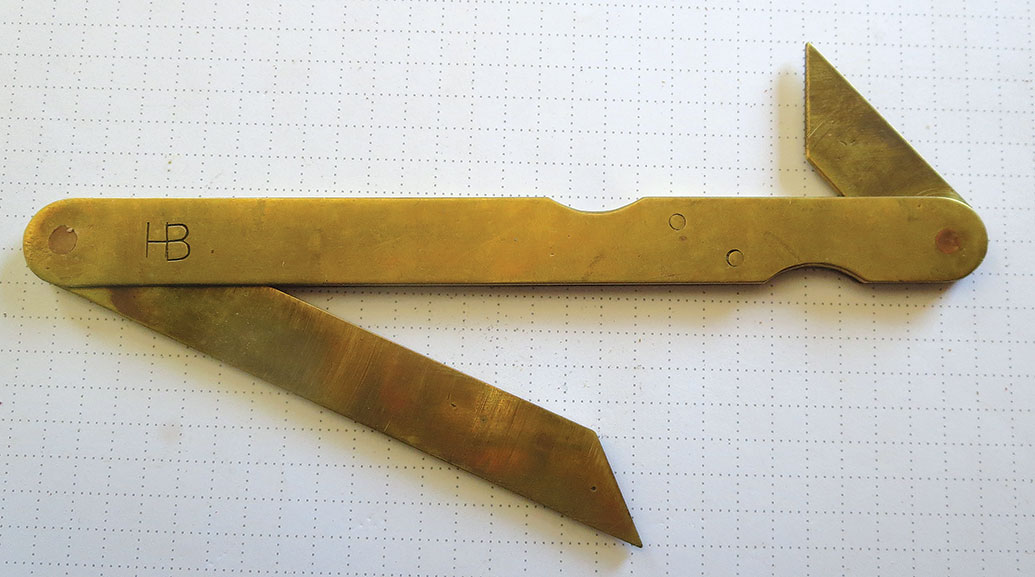
Author Harry Bryan has been inspired on numerous occasions, by tools he encountered in Dictionary of Woodworking Tools, to build reproductions such as this brass bevel gauge.
Dictionary of Woodworking Tools, by R.A. Salaman. Astragal Press, 1997; distributed by Simon & Schuster, www.simonandschuster.com. 546 pp., $39.95.
There are certain choices that we have designed into our lives that reveal a great deal about our personalities. One is the books that we read—not the current novel that entertains us briefly and then is put aside, but those books that have been on the shelf for years and, no matter how many times they are read, still hold the promise of a new discovery. Perhaps their appeal is in knowing that they always put us in a positive state of mind.
If I am not currently caught up in a novel, my routine before sleep often finds me sitting on the edge of the bed running my eyes back and forth along my shelves of books, waiting for one of them to say, “Pick me up, I am the one for tonight.” One night it might be L.F. Herreshoff’s The Compleat Cruiser, or Henry Plummer’s The Boy Me and the Cat. Another time I may choose Clifford Ashley’s The Yankee Whaler or, in a more philosophical turn of mind, I might pick up John Stilgoe’s Alongshore.
Many times, however, my wife comes into the bedroom to find me propped up on the pillow with my copy of R.A. Salaman’s Dictionary of Woodworking Tools. It is an odd thing to her that I should want to read such a dry, technical-sounding tome before sleep. However, there is no violence within its pages, no lurid sex scenes, just 500 pages and more than 740 illustrations on the subject that has brought much fulfillment to my life.
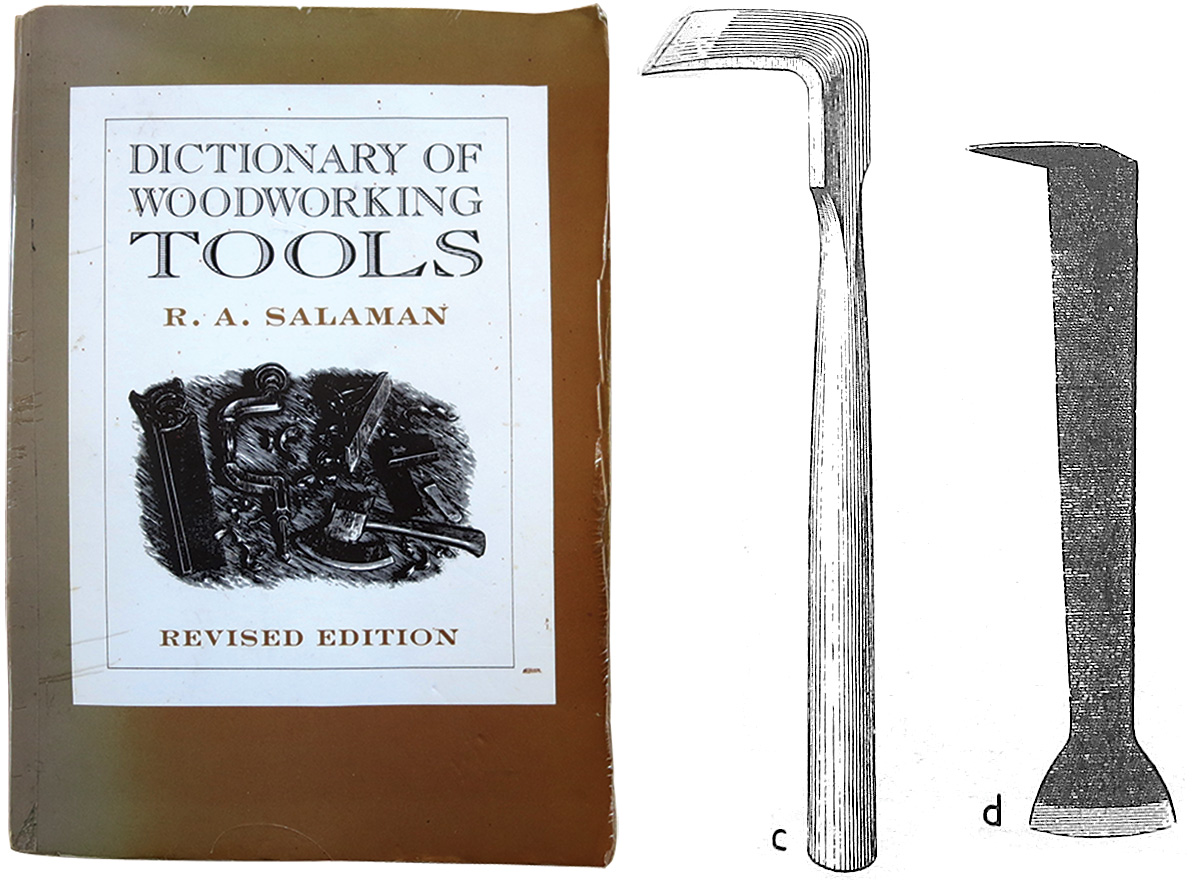
Without the drawings and reproductions of plates from tool catalogs, this would be a dry read. But as it is, the book draws me into the history of disappearing trades, and I have several times been inspired to construct a long-discontinued tool because I felt it may have relevance to the resurgence of wooden boat building. There are nearly 40 entries devoted to shipbuilding, which will certainly be of interest to many readers of this magazine.
The thoroughness with which the more common tools are covered may help to give an idea of the scope of this book. Take axes, for instance. There are more than 20 pages and 94 illustrations on the subject, including a cricket-bat maker’s axe. Planes receive 79 pages and more than 400 illustrations.
In the introduction, Salaman writes, “My aim when compiling material for this Dictionary has been to describe every tool used in the woodworking trades from about 1700 to the present time, and to explain its purpose; to give the reader some idea of the graceful shapes imparted to the tools by the men who designed and made them; and to record some of the methods and sayings of the tradesmen who used them.”
I have a great reverence for the past and believe that small local businesses using tools and technologies that are appropriate to a human scale will promote a more satisfying life than a rush to embrace every new technology just because it is new. Salaman’s introduction echoes this sentiment when he writes, “Anyone whose boyhood began before the First World War will remember that at that time, whether one lived in town or country, one could watch men working at a dozen different trades within a mile of one’s doorstep. Their disappearance is one of the harsher changes of recent years: it has removed a source of social intercourse without which life, particularly for young people, is less interesting and certainly more lonely.”
Dictionary of Woodworking Tools, published by the Astragal Press, shines light on this lonely place. The book is still in print, and used copies may be purchased from online booksellers. 
Harry Bryan designs and builds boats in New Brunswick, and is a contributing editor for WoodenBoat.