
 Paul Atkins
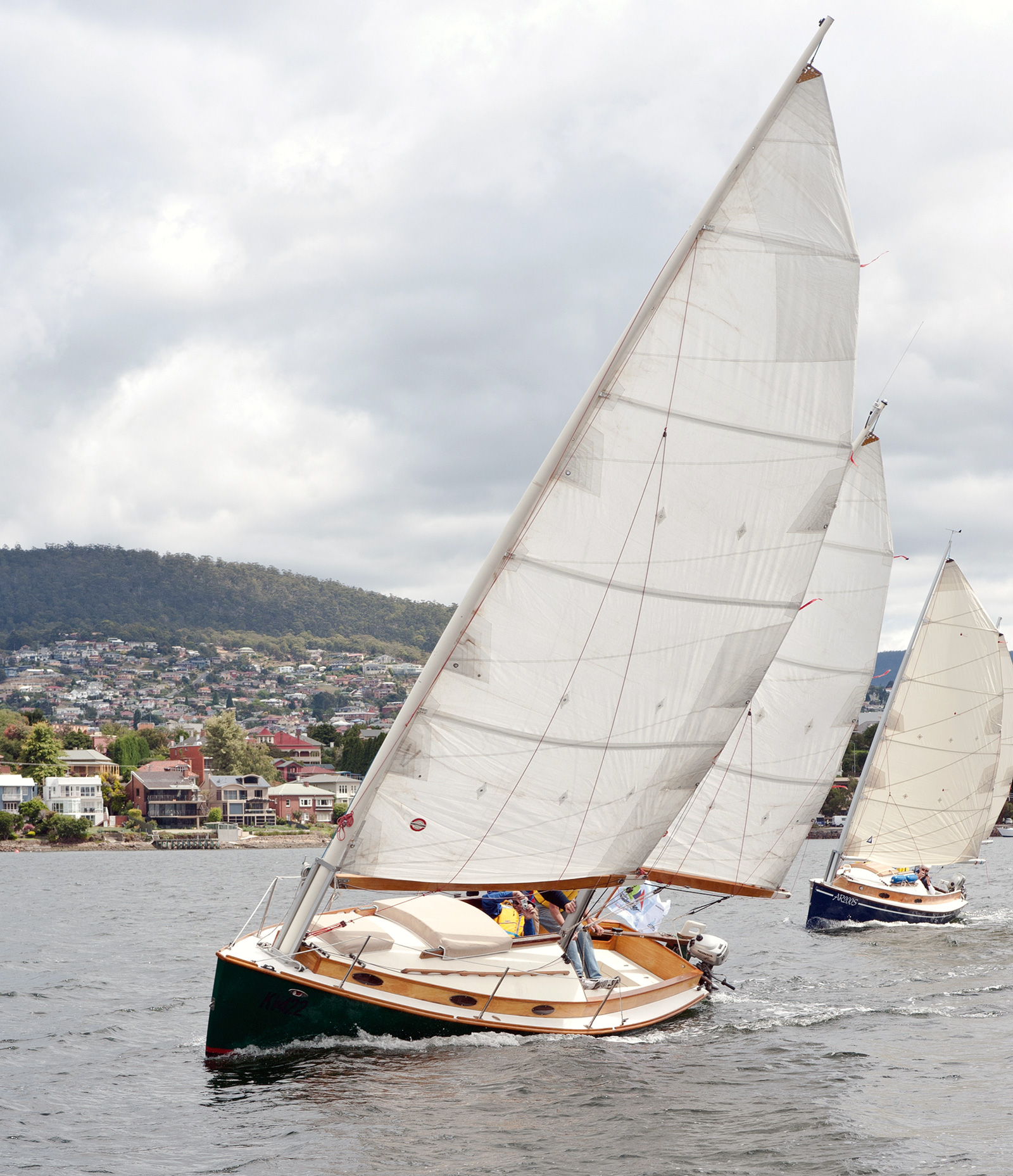
On the Derwent River near Hobart, Tasmania, Geoff Heriot’s Norwalk Islands Sharpie (NIS) 23, SCHERZO, leads Rob Ballard’s NIS 23, ROUTE 66. Bruce Kirby designed the original NIS fleet, in lengths of 18′, 23′, 26′, 29′, 31′ and 43′, inspired by the Connecticut River oyster fishing sharpies of the late 19th century.
My son Jacob will tell you he was more than skeptical about the little plywood boat. He was pretty sure his older brother, Noah, and I were in the midst of another nautical impulse buy—flurries of infatuation that have not always turned out well for us.
The Norwalk Islands Sharpie 23 that Noah and I found on Craigslist was in New Orleans, where Jacob, 25, is a professional saxophonist. With both Noah and me far away in New England, we encouraged Jacob to “just go have a look.” This boat could be a gem. The Norwalk Islands Sharpies have a reputation for being extremely fast and able boats.
 Paul Atkins
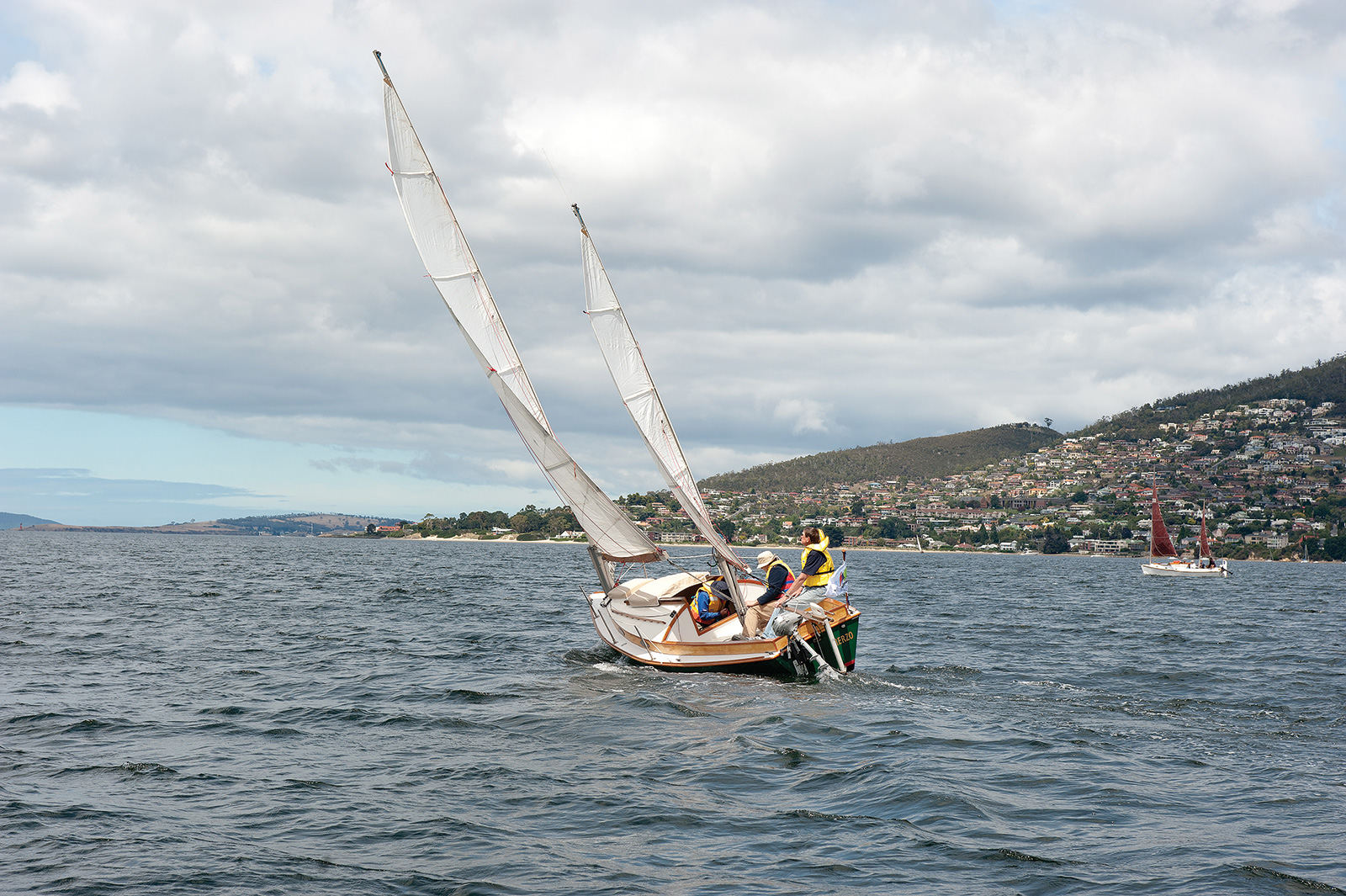
SCHERZO, a NIS 23, demonstrates the unstayed rig’s abilities in close-hauled sailing on the Derwent River near Hobart.
When Jacob saw POULE D’EAU, his skepticism began melting away. He liked the sleek, hard-chined hull and the raked, unstayed, cat-ketch rig. What truly blew him away, however, was his first sail with her seller, Dr. Peter Sawyer. “It was fast as all hell,” he gushed. Sawyer had written two articles for Small Boats Magazine about adventure cruising in the sharpie along the Gulf Coast and into the bayous. His enthusiasm was catching.
The rest, as they say, is history. After nearly a year of sailing POULE D’EAU, Jacob has become a zealous sharpie skipper. He sails five days a week and has become an active member of the Norwalk Islands Sharpies Facebook group. Like so many sharpie owners before him, Jacob has sailed “down the rabbit hole,” or more accurately, “over the rainbow.” He is far from alone.
While Norwalk Islands Sharpies have gained a global following, they are especially popular in Australia. There are more than a few sailors there who claim that what they call “NIS boats” are as addicting as the taste of a Vegemite sandwich. The Aussies say that for many seafarers and dreamers, it takes only one sail (as it did for Jacob) in these largely home-built “little busters” to make you want to join a throng of Norwalk Islands Sharpie “mates.”
 Randall Peffer
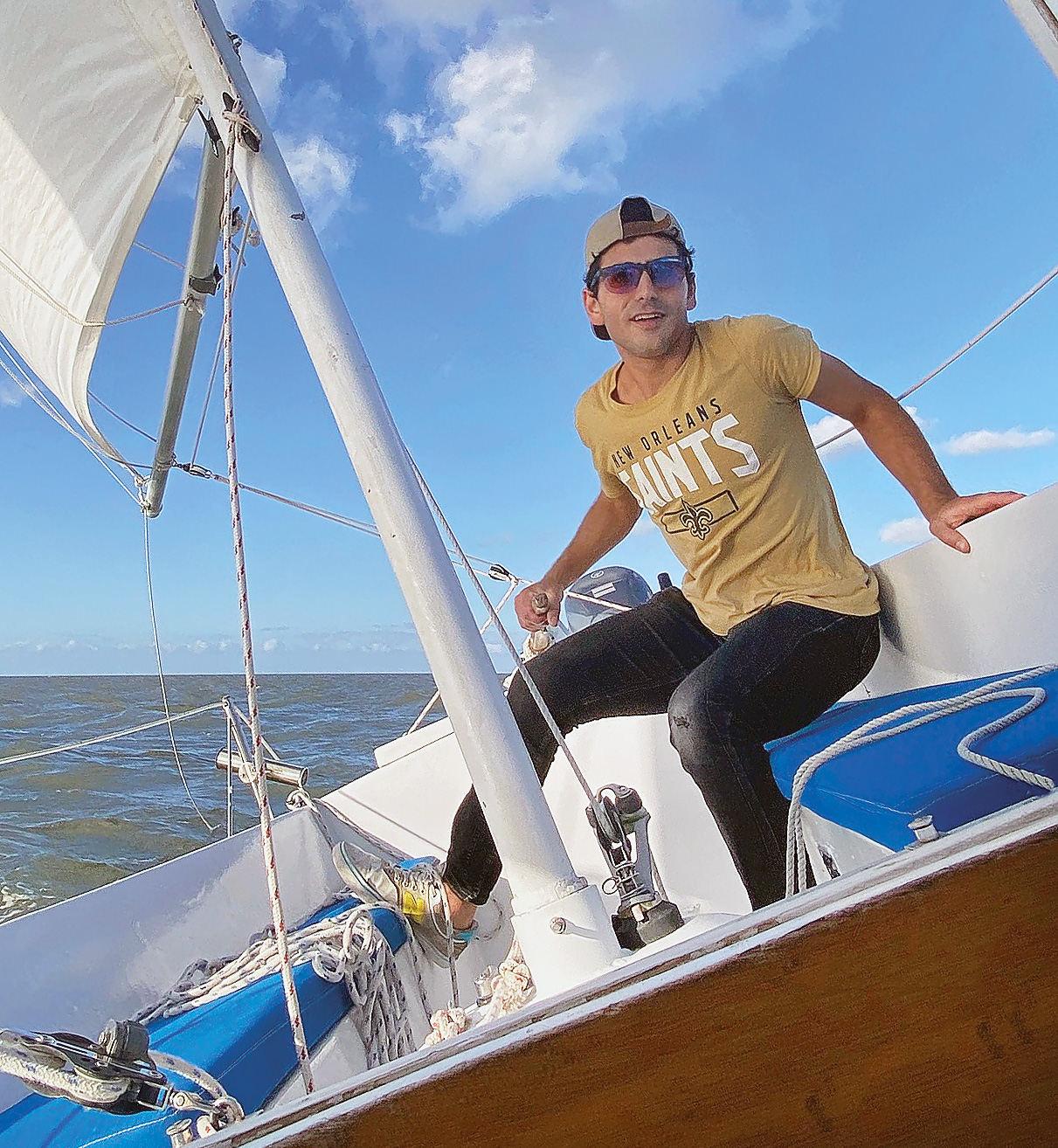
Jacob Peffer, shown at the helm of his NIS 23, POULE D’EAU, shared his early impression of the boat: “It was fast as hell!”
A Rough and Ready Pedigree
In his book American Small Sailing Craft, the maritime historian Howard Chapelle noted there is evidence of sharpies from as early as 1835 in America, and other historians speculate that similar, small, box-built, flat-bottomed boats were working in Irish fisheries even earlier. Some say the type takes its name from its narrow hull with a “sharp” pointy bow and (sometimes) stern. But no one knows for sure.
The American sharpie became popular in the fisheries of New Haven, Connecticut, in the 1870s. Used primarily by a crew of one or two men for oyster tonging, the New Haven sharpies were generally 21′ to 28′ long, with a beam about 25 percent of the length. They had extremely shallow draft, a centerboard, and a cat or cat-ketch rig. The masts were unstayed with spritsail booms and, usually, triangular sails. Fishers could build sharpies in their backyards during an off-season.
Having proven themselves as economically built, simple, functionally elegant, fast, and sturdy oyster tongers on the roiling winter waters of Long Island Sound, the sharpie design migrated up and down the Atlantic Coast of the United States, even to the Gulf of Mexico and the Great Lakes. Sharpies eventually evolved into everything from racing yachts to cargo schooners.
These boats inspired the legendary yachtsman and designer Commodore Ralph Middleton Munroe. He was a New Yorker who moved to the shores of South Florida in the 1880s. Munroe is best known for the double-ended, 28′ sharpie, EGRET, which he designed and had built in 1886 for cruising with his family and friends. For decades, he used EGRET as a flagship for the Biscayne Bay Yacht Club, which he founded, to deliver mail and explore the waters of Florida from the Keys north to the Indian River and beyond. All the while, he was promoting the cruising lifestyle and entertaining the likes of luminaries such as Alexander Graham Bell and fellow yacht designer Nathanael Herreshoff. His elegant and instructive The Commodore’s Story, long out of print, is about to be re-released.
A Designer with Chops
The virtues and history of Connecticut’s traditional oyster sharpies were not lost on a native Canadian yacht designer who had migrated to Rowayton on the Connecticut shore of Long Island Sound. Bruce Kirby (1929–2021) had design credits that included the Laser, the Olympic Sonar class, and multiple Canadian challengers for the AMERICA’s Cup. But Kirby was not thinking about contemporary racing boats when the waters around Rowayton began to silt in and grow too shallow for his conventional keelboat. As he watched commercial oystermen in their shoal-draft boats navigating the shallow fringes of the Norwalk Islands a few miles offshore, he had an epiphany.
“For years I had admired the simple hull form of the Long island Sound sharpie fishing boats that had plied the water of the Connecticut coast,” he wrote in his autobiography The Bruce Kirby Story: From the River to the Sea. “Why not take this hull design, raise the freeboard, give it a deck and a cabin, and use modern materials to cut down on the hull weight so it could take a good lump of inside ballast and a generous sail plan?”
Kirby’s friend Tony Widmann shared the “admiration and curiosity about the sharpie,” and they decided to have a 26-footer built to Kirby’s design for the 1986 summer sailing season. “Knowing the boat would be used mostly for daysailing,” Kirby wrote, “I gave it an 11′ cockpit…. Down below there was enough headroom for two settee berths, a small galley, and a head.”
Informed by the deadly Fastnet Race of 1979, Kirby drew the coach roof of the cabin with a lot of camber, knowing that a strongly crowned cabin and deck would add buoyancy and inhibit the boat from becoming stable in an upside-down position if it were knocked down. For ballast he would use 1,400 lbs of lead in bars 2′ long, 3″ wide, and 1′ thick bolted and faired into the bottom. The masts would be free-standing, tapered aluminum extrusions. The boat would draw 11″ with the centerboard and rudder retracted. For auxiliary power, the sharpie would carry a small outboard in a transom well.
A Star Is Born
Kirby called his favorite wooden boat builder, Bent Jesperson, in British Columbia. Jesperson agreed to build Kirby’s sharpie out of okoume plywood. Almost all of it was ⅜″ thick, save for ½″ panels for the bottom planking, the transom, and two bulkheads.
“We named it EXIT 12 for the exit we used for getting off Interstate 95, reputed to be the busiest piece of highway in the U.S.,” Kirby says. “The name symbolized and celebrated getting the hell away from speeding 18-wheelers.”
Kirby tried his sharpie at racing and found that EXIT 12 had about the same level of performance as a J/24 on a windward-leeward course, but blasted by these boats when reaching. While the boat proved itself a star in dirty weather and on the racecourse, what Kirby and his wife, Margo, really enjoyed was hiking up the centerboard and rudder; ghosting into a shallow, tree-lined cove; and letting the sharpie ground out in the mud overnight.
As with Kirby’s 1970 creation of the Laser, which now has well over 200,000 sailing copies, the designer realized he had a winner in EXIT 12. He quickly began designing and marketing plans for 23′, 26′, and 29′ iterations of his prototype. He named them Norwalk Islands Sharpies, he says, “for the beautiful archipelago 2 miles to the east of the harbor we lived on.”
Over the past 28 years, the 23-footer has become the most popular design of the series. In 1987, the design’s first year on the market, Kirby sold over 200 sets of plans for what he called the NIS 23. Today there are six designs in the NIS family, ranging from an 18-footer to 23′, 26′, 29′, 31′, 35′, and 43′ versions. The three smaller boats are easily trailerable.
Impressed by his sharpie’s stability, Kirby commissioned a marine consulting firm to analyze the righting moment of the 31-footer. The results indicated that the 31 could roll to 143 degrees and come back upright. A point of no return of 110 degrees is considered good for a small cruising boat, 143 degrees is exceptional. The same righting moment applies to the smaller boats, with the caveat that the smaller boats are more affected by crew placement.
Lasers for Adults
With their simple, hard-chined hull shapes and construction of marine plywood sheathed with fiberglass and sealed inside and out with marine-grade epoxy, Norwalk Islands Sharpies are ideal for careful amateur builders with an understanding of modern wood-epoxy construction.
As everyone from Bruce Kirby to my skeptical son Jacob has discovered during a first outing aboard a Norwalk islands Sharpie, the boats are simply thrilling under sail. Contrary to a longstanding criticism of sharpies, properly balanced and sailed, NIS boats do not pound going to windward. They slice through the chop.
“These boats move in the slightest breeze,” exclaimed yachting writer John D. Little in Small Boats Annual 2012.
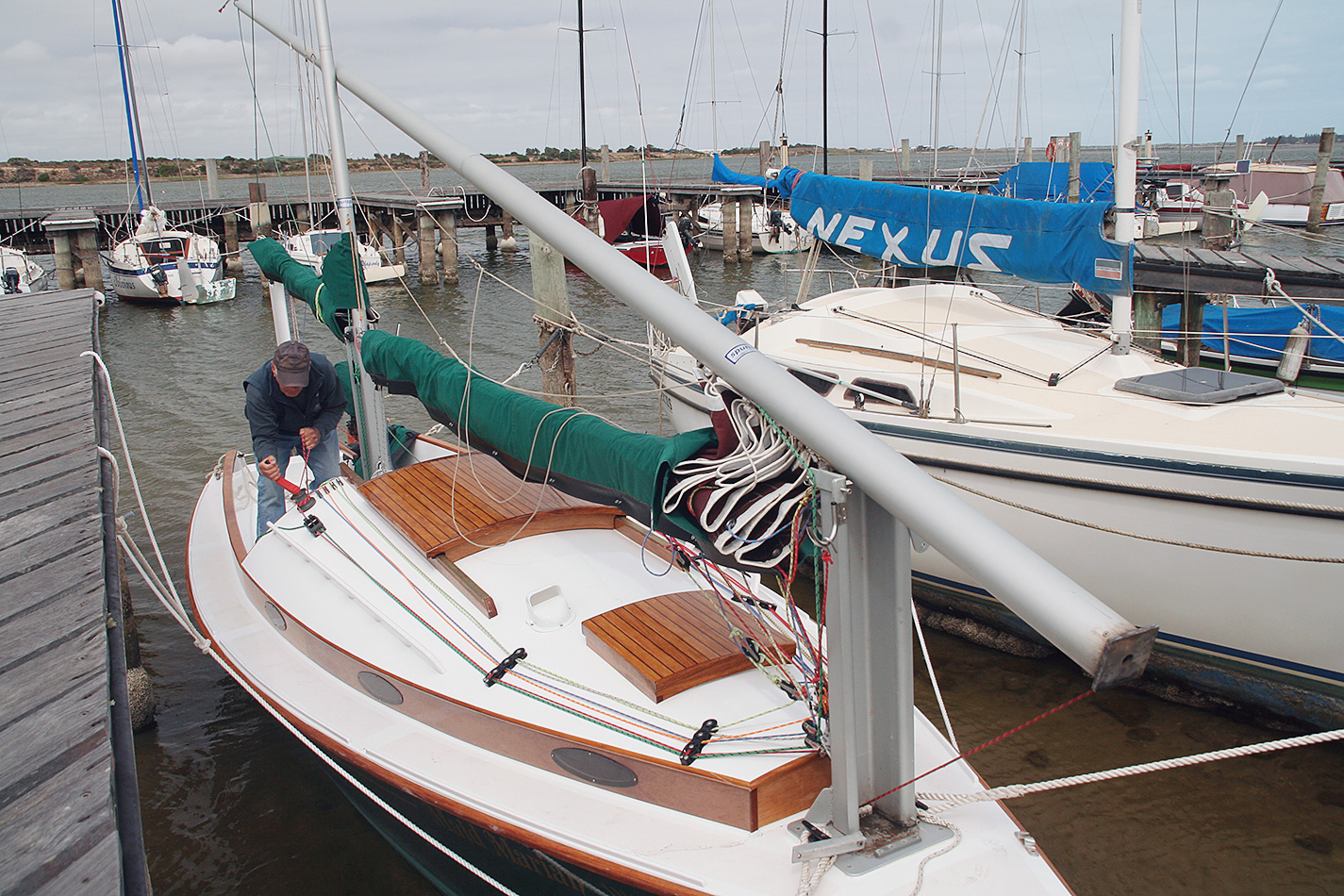
While the accommodations in the smaller NIS boats are basic, and headroom is limited, it’s better than it first seems. No sail bags get in the way because the sails live on the booms. The unstayed rig means that the booms can swing past 90 degrees so there is no need for spinnakers or spare headsails when running off the wind. Using mast tabernacles, one person can step the masts easily. When the boat is being trailered, the sails can be left furled on the booms with the running rigging in place, because the booms are attached to the tabernacles, not the masts. The lowered masts become full-length ridgepoles over which to drape a cover in the off season.
Although no hard numbers exist (particularly in the United States), Peter Ironmonger, who is an admitted “super fan” of NIS boats and the moderator of the Norwalk Islands Sharpies Facebook page, estimates that over 150 of them have been built, with no fewer than 70 in Australia and 40 in North America. Interest in the boats continues to grow. There are at least eight NIS boats under construction in Australia at the moment. Every week more people join the Facebook group. Membership now exceeds 320.
The Man from Oz
 Paul Atkins
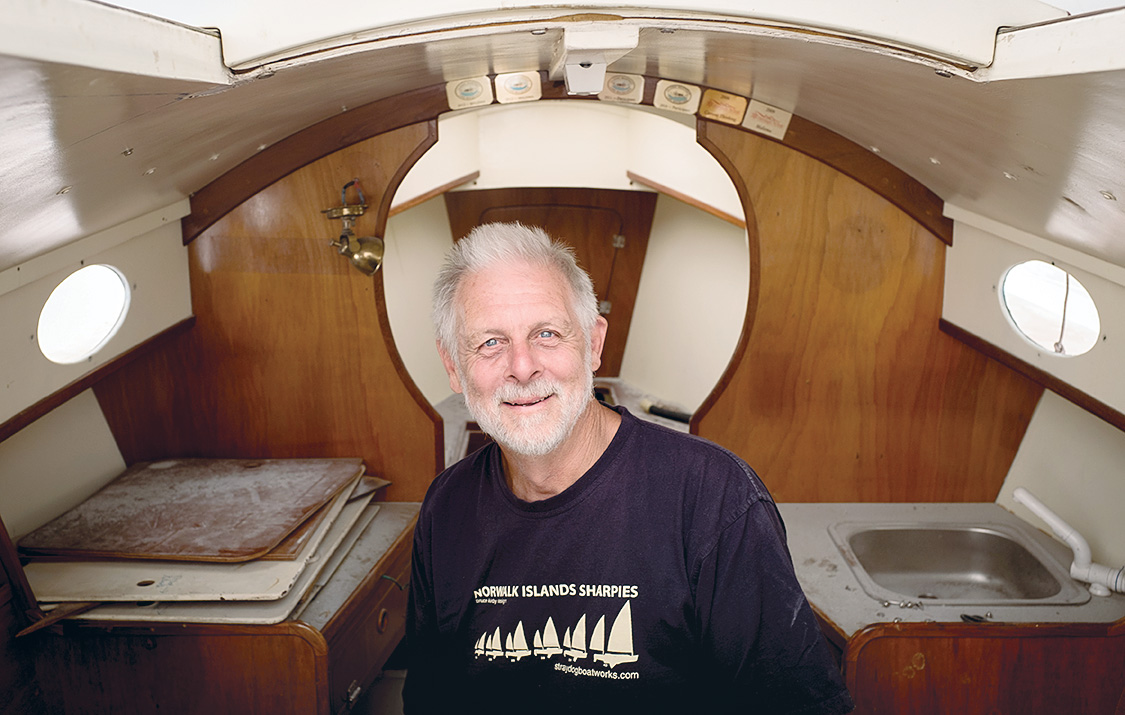
Robert Ayliffe of Straydog Boatworks in Mount Barker, Australia, became the Australian distributor for NIS boat kits and plans in 1987. He eventually became the worldwide distributor. He is pictured in the cabin of a friend’s NIS 26, contemplating damage.
Every popular, successful boat design needs a Pied Piper to help it flourish. For Norwalk Islands Sharpies, the boatbuilder, wool classer, abalone diver, teacher, shipwright, author, adventurer, and raconteur Robert Ayliffe is that bloke.
“A most notable fellow from Adelaide, Australia, appeared on our doorstep in May of 1987,” Kirby wrote. “Robert Ayliffe had read about Norwalk Islands Sharpies in [WoodenBoat magazine] and had sent for a set of plans for the 26′. He wanted to take a closer look. Not only that, but he insisted on going for a sail, even though EXIT 12 was still sitting on her trailer in the driveway. How could we refuse this engaging fellow with the thick Australian accent, mile-a-minute speech, and the determination of a charging bull? Of course we launched the boat.”
After his sail, Ayliffe “was sold” on the modern sharpie concept. When he left Kirby, he carried an armload of plans and a letter from the designer, saying Ayliffe was the official NIS representative Down Under with permission to sell brochures and plans as well as to build NIS boats.
Ayliffe left his original business creation, Duck Flat Wooden Boats, a pioneer in what the multihull designer John Marples called “liquid welding construction.” They built a variety of small craft, including James Wharram and Derek Kelsall multihulls and the glued-lapstrake plywood jewels designed by Iain Oughtred. And then came Bruce Kirby and the Norwalk Islands Sharpies. Ayliffe’s shop morphed into Straydog Boatworks. Narrowing his focus to represent Norwalk Islands Sharpies, Oughtred’s boats, the John Welsford–designed Scamp, and specialized componentry, Ayliffe dragged trailer loads of boats to various Australian boat shows and promoted them in sailing magazines as well as on line.
 Straydog Boatworks
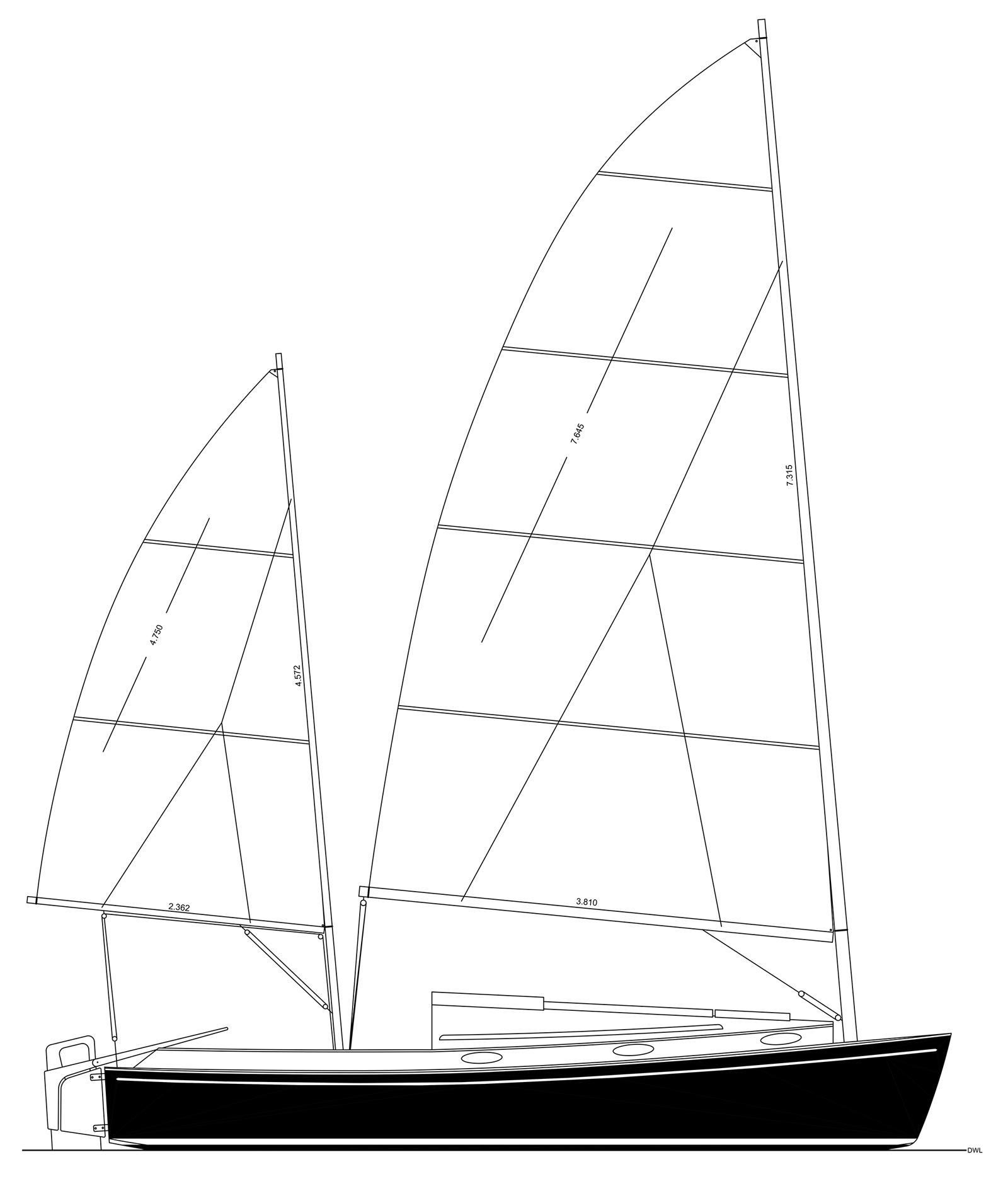
Like all of the boats in the series except for the NIS 18, the NIS 23 carries an unstayed cat-ketch rig. The 18-footer has options of cat, cat ketch, or cat yawl.
He has not worked alone. He is quick to acknowledge input from Michael Jansen, an engineer and draftsman; Paul Atkins, who is a communications guru and NIS 26 kit builder; Ken O’Brien, sailmaker for AUSTRALIA 2; Michael Storer, a past employee and successful designer in his own right; and Chris Dearden, a draftsman and builder of his own NIS 23, SARDINE CHOPPER. Ayliffe says some of his best ideas have come from his clients.
Impressed with Ayliffe’s hustle, charisma, and marketing success, as well as what he considered to be the “superb” quality of Ayliffe’s own NIS 23, CHARLIE FISHER, Kirby eventually handed over the exclusive, worldwide rights to Straydog Boatworks to sell NIS plans, kits, and accessories.
 Robert Ayliffe
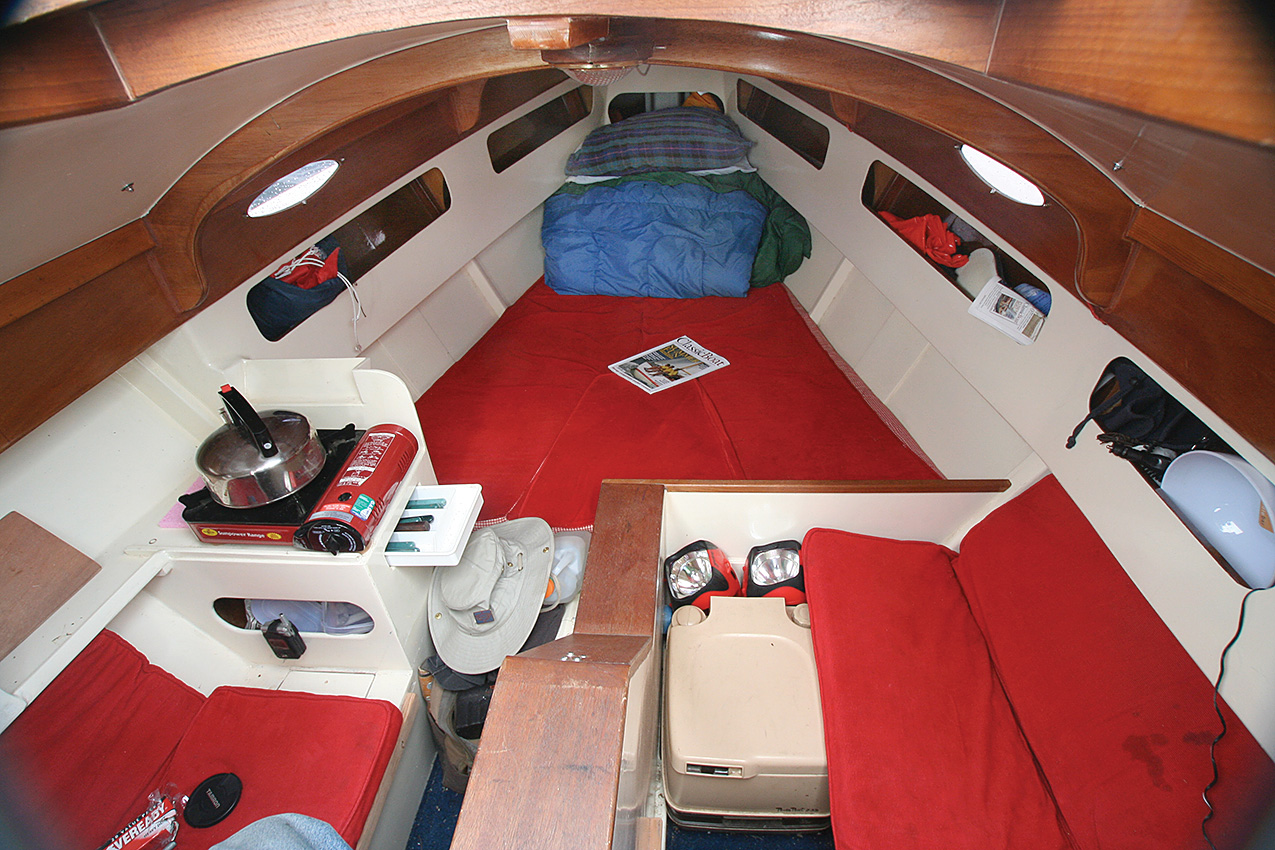
Settees flank the centerboard trunk in CHARLIE FISHER’s cabin, with a V-berth forward of the bulkhead.
“It was always more than a partnership,” Ayliffe says. “It was friendship and a conversation, often about boats that endured…for more than 30 years. I owe him so much and miss his encouragement.”
Plans and Kits
Constructed largely of marine-grade plywood, Norwalk Islands Sharpies are easy to build—especially in the kit versions. Ayliffe has made Straydog Boatworks one-stop shopping for past and aspiring NIS builders. The CNC router-cut plywood-and-epoxy kits yield fair, low-maintenance, durable, lightweight boats. The kits, now available in the United States and Europe as well as Australia, come with a building jig, designed by Ayliffe, that’s made from medium-density fiberboard (MDF) with slots for the bulkheads at exactly the right heights, angles, and spacing.
 Paul Atkins
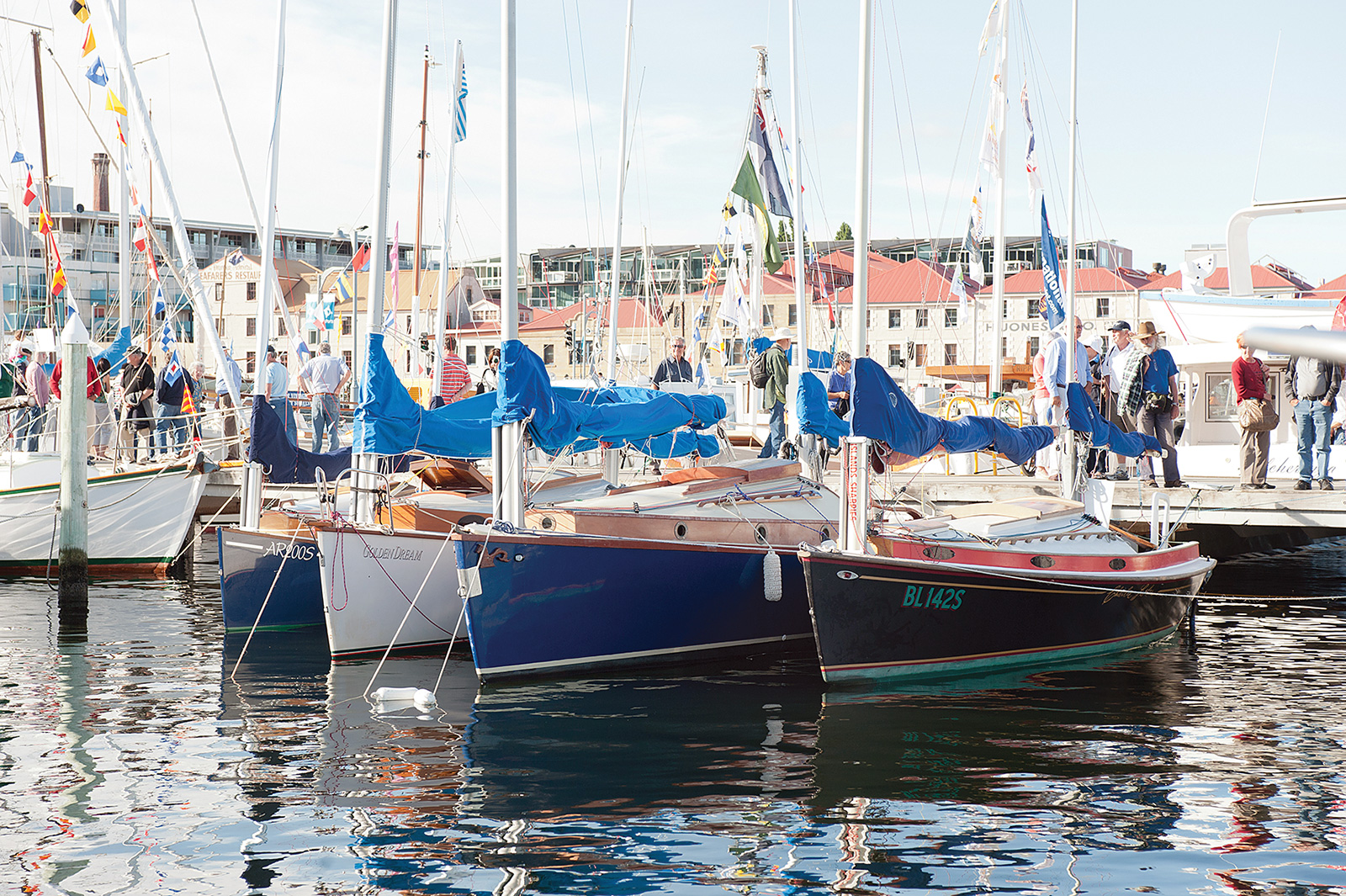
Four NIS boats were on display at the 2007 Australian Wooden Boat Festival in Hobart, Tasmania. They are (from left) NIS 23, ROUTE 66; NIS 26, GOLDEN DREAM; NIS 26, KELPIE; and NIS 23, CHARLIE FISHER.
Over the years, Ayliffe has made NIS modifications with Kirby’s knowledge and approval. Ayliffe has engineered carbon-fiber spars, an ingenious cassette rudder, and mast tabernacles. Influenced by an idea already preceded by Munroe’s PRESTO sharpie, Kirby’s early Lapwing Sharpie drawing, and the NIS 31 standard drawings, Ayliffe has designed radiused-chined bottoms for all the boats in the NIS family. Kirby was certain that the alteration would make the boats faster and, along with the faired outside ballast keel, would also make the boats stiffer.
Epic Voyages
When Ayliffe launched his CHARLIE FISHER in 1987, he had more than inland and coastwise sailing in mind. He is a man inspired by books such as John Steinbeck’s The Log from the Sea of Cortez and the works of Commodore Ralph Munroe and Thomas Gilpin. Ayliffe had been impressed by accounts of Munroe deliberately and successfully weathering hurricanes in EGRET, and thought that if Munroe’s sharpie could prevail in heavy weather, with only loose road bricks as ballast, then his NIS boat could, too.
Ayliffe made his first offshore passage in CHARLIE FISHER from the South Australian mainland to Kangaroo Island, across the rough waters of Backstairs Passage then into a big westerly for 80 miles of Investigator Strait. He and his stepson, Abe, and a friend broad-reached under reefed mainsail for eight hours in a gale that was recorded at more than 60 knots.
“It was a bit frightening,” Ayliffe recalls. “Very noisy. We took turns to be seasick. Abe claimed to have eaten the same peanut 10 times, but the boat sailed very well.”
When CHARLIE FISHER reached shelter, the crew nosed the shoal-draft boat up to a beach, as Munroe had done, to rest and dry out. Local yachtsmen couldn’t believe that CHARLIE FISHER and her crew had survived such weather. But Ayliffe was already beginning to imagine taking on a bigger challenge: the Bass Strait between mainland Australia and Tasmania.
 David Gill
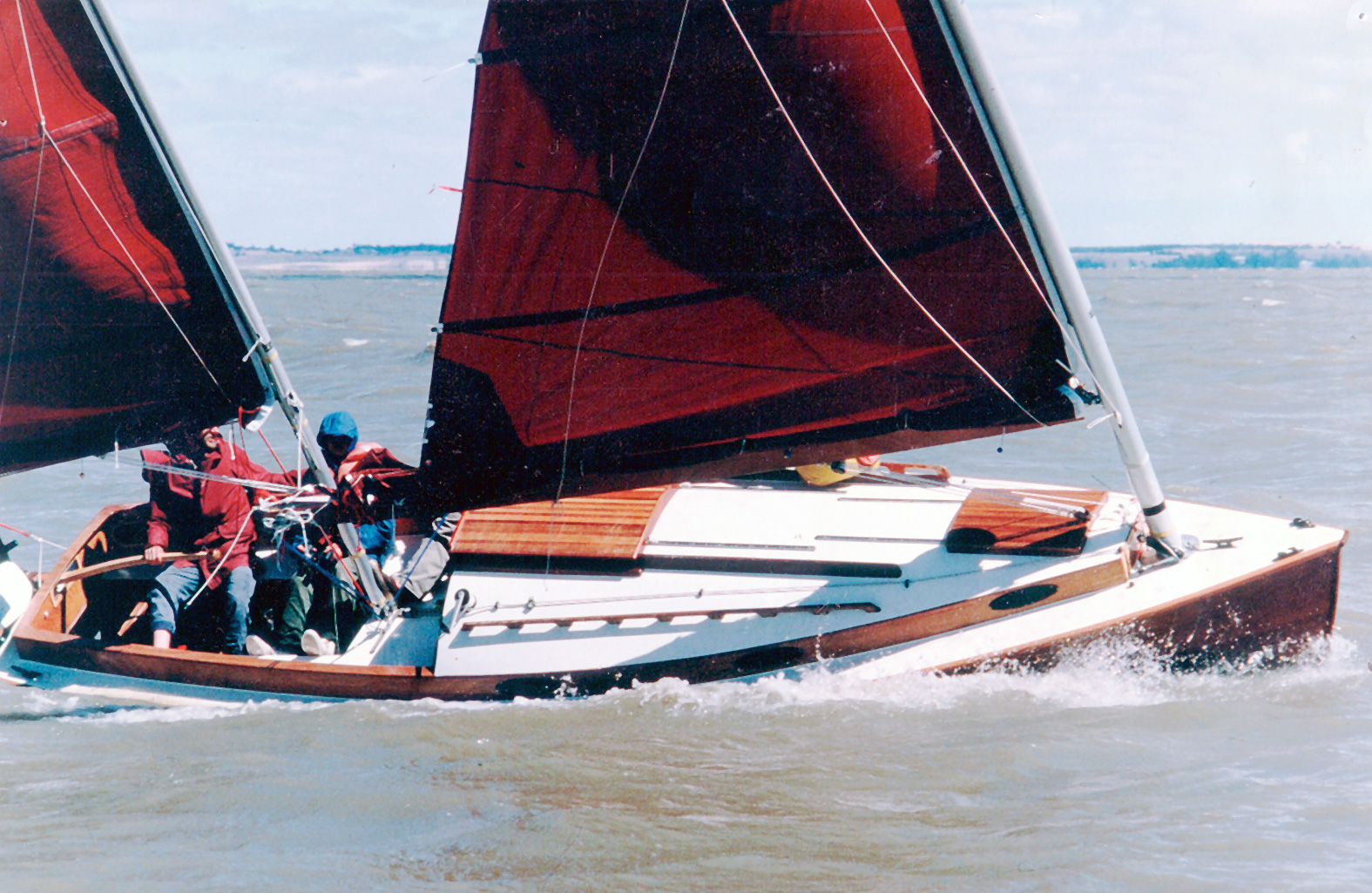
There are 12 people (some are below), plus camping gear, aboard this NIS 23.
It took him 18 more years to prepare himself mentally, and then he had to make CHARLIE FISHER ready for his voyage. In February 2007, Ayliffe and a friend, Ian Phillips, left Port Welshpool on the Victoria mainland, bound for the Australian Wooden Boat Festival in Hobart to display CHARLIE FISHER and to make a point. It would be a 400-mile trek through some of the most gnarly wind and sea conditions on Earth. A legion of naysayers on the dock forecast impending doom.
“As we cast off the lines,” Ayliffe remembers, “all the fear and worry just evaporated…. It was a dream run to Hogan Island, the boat broad-reaching and self-steering….”
Things grew spicy about halfway through the trip.
“We had just rounded Eddystone Light, leaving Bass Strait…ready for the run down the east coast to Hobart. The wind built quite strongly from the northeast and so did the sea,” Ayliffe has written in his narrative of the voyage. “I put two reefs in the main…. The boat drove at a cracking pace…. We saw 9 knots frequently. This was wonderful….”
Abeam of St. Helens, the breeze freshened. “Seas already large,” remembers Ayliffe. “Big swells coming in from New Zealand. A storm out there a few days ago. Steady 9 knots, 12. A big swell lifted us and we knew this was special. Fifteen, 15.5. Ian, monitoring the GPS: ‘Holy moley, 17.5 knots!’”
After an hour of worrying about what might break, Ayliffe and Phillips found themselves delirious with pleasure for the next seven hours, “realizing that (A), we were not going to die and (B), this really was a kind of heaven.”
They reached Hobart at midnight after three-and-a-half days at sea. When they woke up the next morning at the Royal Yacht Club of Tasmania, they heard an excited voice on the dock saying things like “They came from where, in that?”
The speaker at the festival was Tony Bullimore, famed for his disciplined survival in a bubble of air in his upturned single-handed maxi yacht for over a week in extremely icy water near Antarctica. He’d heard about this Norwalk Islands Sharpie “thing,” and wanted to see her for himself.
“He sat there holding the 4mm Dyneema reefing lines,” Ayliffe remembers. “Looking around, he remarked. ‘Everything is so effing light…and very effing competent!’”
To prove that CHARLIE FISHER’s successful passage was not a fluke or a miracle, when the festival ended, Ayliffe cast off his lines and repeated his voyage in the opposite direction.
The Boatbuilder as Savant
To say that the stories of CHARLIE FISHER’s voyages have been the talk of the Australian sailing community for years, as well an inspiration to a legion of trailer sailors, home-builders, and sharpie converts, is no exaggeration. The fame has been a boon to Straydog Boatworks’s business of selling plans and kits for Norwalk Islands Sharpies. Inevitably, the notoriety has drawn a steady stream of enthusiasts to Ayliffe’s doorstep in the Adelaide suburb of Mount Barker. Volumes of letters, emails, texts, and phone calls have come Ayliffe’s way, seeking counsel and affirmation for boatbuilding projects and fantasy voyages. To all of them, he offers a singular counsel drawn from his favorite passage by the German writer Johann Wolfgang von Goethe: “Whatever you do, or dream you can do, do it. Boldness has genius, power, and magic in it. Begin it now.”
An Infectious Passion
After Jacob’s year of sailing his sharpie, mentoring from former owner Peter Sawyer, devouring the narratives of Ayliffe’s seafaring adventures, and making Australian friends on the Norwalk Islands Sharpies Facebook page, Jacob booked a trip to Australia “to meet the gang.” Ayliffe, who had seen and heard Jacob on YouTube, strongly suggested he should bring his saxophone.
Shortly after landing in Australia, Jacob connected with Pete Ironmonger, who welcomed him into the fold. A world-traveled foreign-trade facilitator who lives in Sydney now, Ironmonger since 2010 has been the moderator of the Facebook page and its predecessor, a Yahoo forum. Harboring fond memories of building a boat with his dad, Ironmonger first read about NIS boats in articles written by Ayliffe in Australian Amateur Boat Builder magazine. A few years later he saw CHARLIE FISHER and was hooked.
He thought the sharpies were “just such a different-looking boat…with the mainmast up in the bow and then the mizzen like a smaller shadow of the main.”
Like many others, Ironmonger was drawn to the safety demonstrated by Ayliffe’s Bass Strait crossing and the rig’s ease of handling and practicality. He says there is a certain charm in knowing Norwalk Islands Sharpies have a pedigree stretching back to Commodore Munroe as well as the working boats of Long Island Sound and Ireland. In 2009, Ironmonger purchased a NIS 18 kit from Straydog and is taking his time to relish every step of its construction. Meanwhile, he has been surrounded by NIS camaraderie.
 Robert Ayliffe
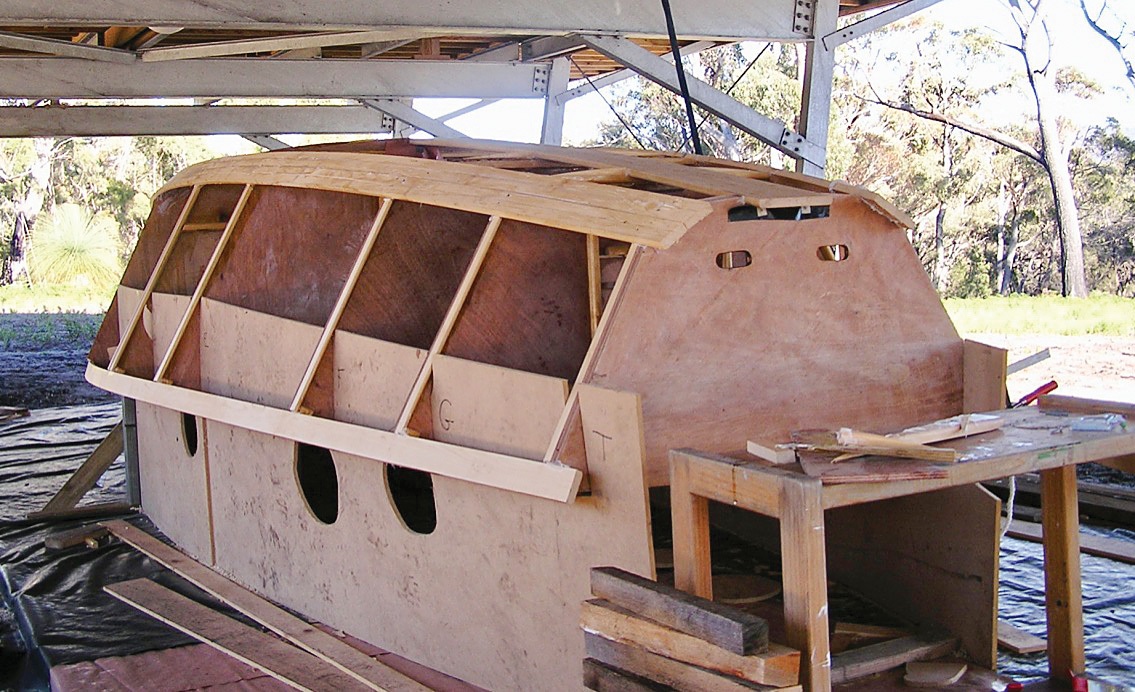
Mal Gahan’s NIS 23, ROSIE RED, is shown here under construction. Paired slotted strongback panels of sheet plywood align and position the bulkheads accurately.
“Those builders and sailors I read about and later met seemed to be very friendly, nice, easygoing, and interesting folks located in different parts of Australia as well as in other countries,” he says. Among the minions, Ironmonger has found “more than just middle-aged men suffering from a midlife crisis.”
Through the Facebook group he has connected with owners and builders across Australia. One of them, Libby Moodie, is a retired equine veterinarian with a NIS 23, sailing in the Whitsundays Islands. Then there is Ruth Mills, the longtime owner of a 23-footer named HOBGOBLIN and one of the first to have her boat retrofitted with the Ayliffe tabernacles. Jenny Drake has her NIS 29, WIRELESS, on Flinders Island in Bass Strait. Mal Gahan built and launched his boat, ROSIE RED, on the east coast of Tasmania and is the fleet’s current most dedicated buoy racer. Goolwa’s Peter Shipside preceded Gahan as an ardent racer with his scratch-built 23′, MAID MARION. Ben Tucker in Hobart, who owns a NIS 23 called OSPREY, operates amphibious vehicles that deliver supplies from ship to shore in Antarctica. Accounting executive Ian McDonald spent eight years of nights and weekends perfecting every detail of his 23′ jewel, RACHEL.
 Robert Ayliffe
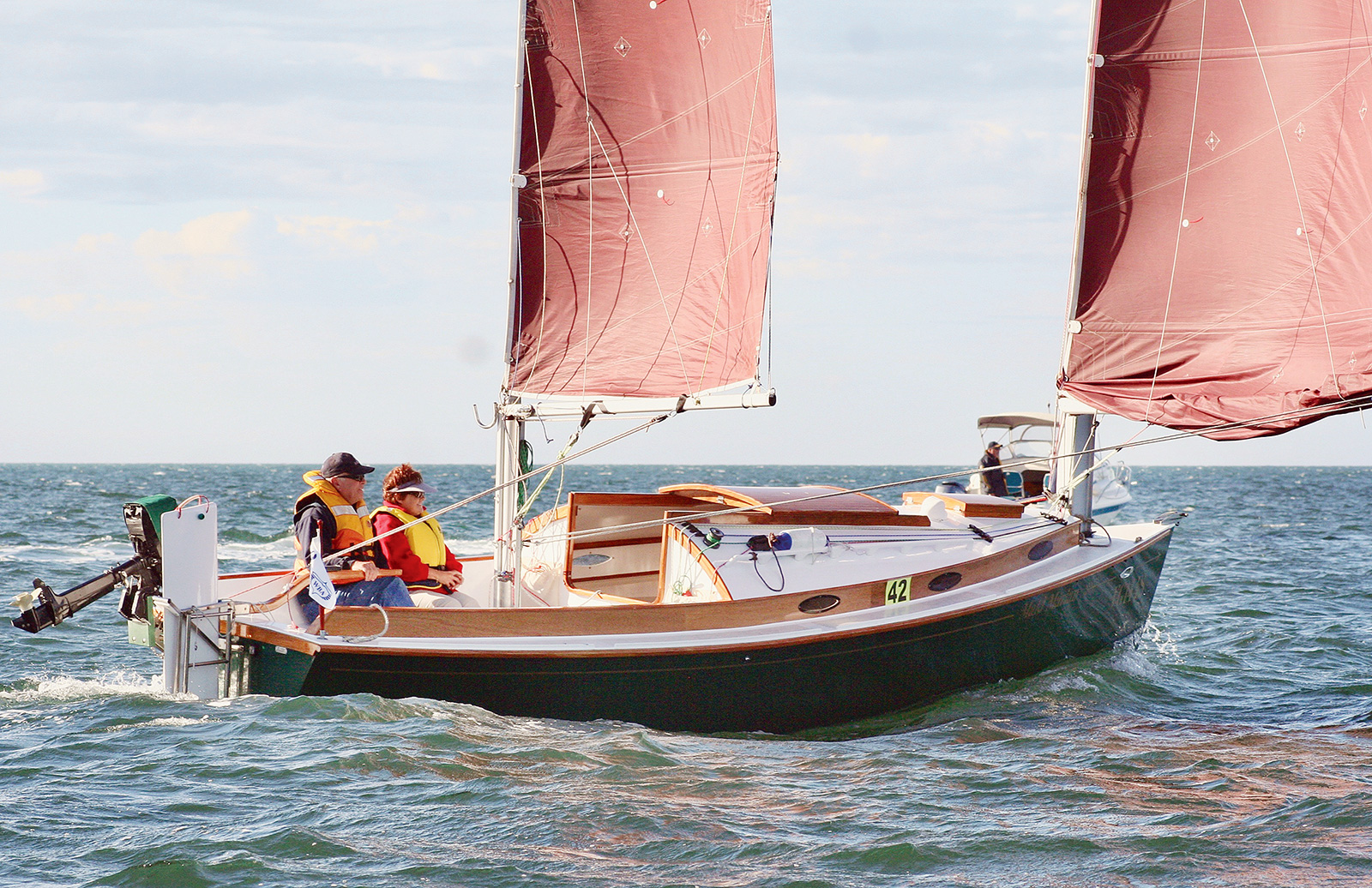
Peter and Vicky Shipside’s NIS 23, MAID MARION, which Peter built from scratch, has been raced frequently.
Farther afield, the NIS family includes a young surgeon in Los Angeles, California; a judge in Coeur d’Alene, Idaho, who now owns EXIT 12; a former submarine commander; and a retired Anglican minister in England. Then there is that young saxman in New Orleans.
In Sydney, Pete Ironmonger connected Jacob for a sharpie sail with a professional captain and ship-rigger named Graeme “Cookie” Cook. Like Pete, Cookie was drawn into the NIS family by Ayliffe’s articles in Australian Amateur Boat Builder, so when a NIS 26 appeared on Gumtree Sales, an Australian counterpart to Craigslist, Cookie thought “here is a chance to own one of the boats I dreamed about. Even though I already had a trailer-sailer in the shed.”
He has no regrets and talks fondly of the “very warm and friendly” support and advice he has gotten from Ayliffe—along with “a refurbished 26′ trailer at a very good price.”
 Robert Ayliffe
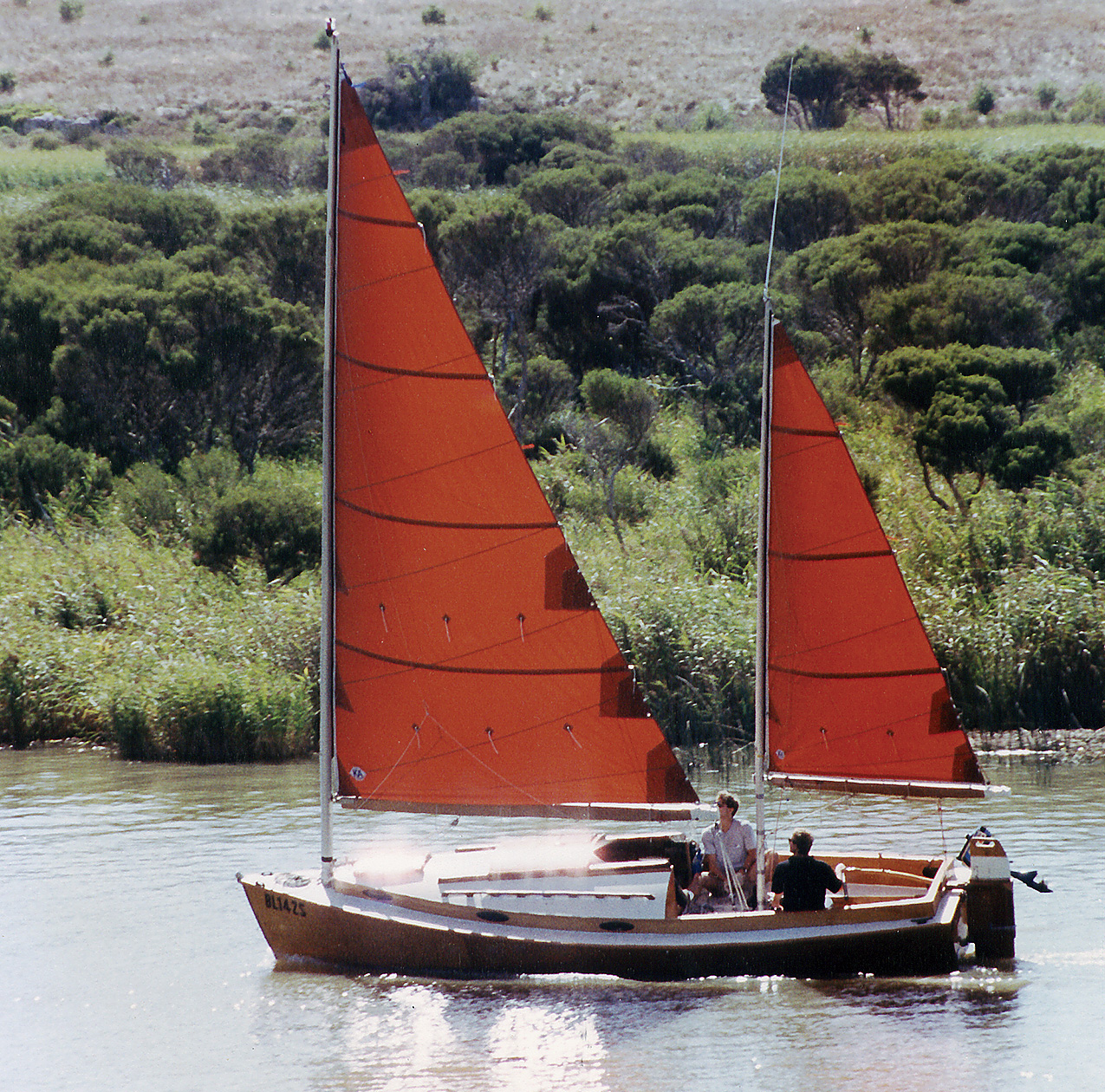
CHARLIE FISHER is equally at home racing in a shallow creek as she is crossing the treacherous Bass Strait.
Paul Atkins also raved to Jacob with affection about “the amazing Robert.” Paul, who runs a photo studio and gallery in Adelaide, is finishing his NIS 26 kit boat with the help of Troy Lawrence of Adelaide Timber Boatworks. Atkins and Ayliffe have been friends for decades, and for years Atkins borrowed CHARLIE FISHER from Ayliffe for family cruises with his wife and daughters around the River Murray delta near the port of Goolwa. “Robert’s a bit of a radical, and he has this amazing sense of community building,” Atkins says.
 Robert Ayliffe
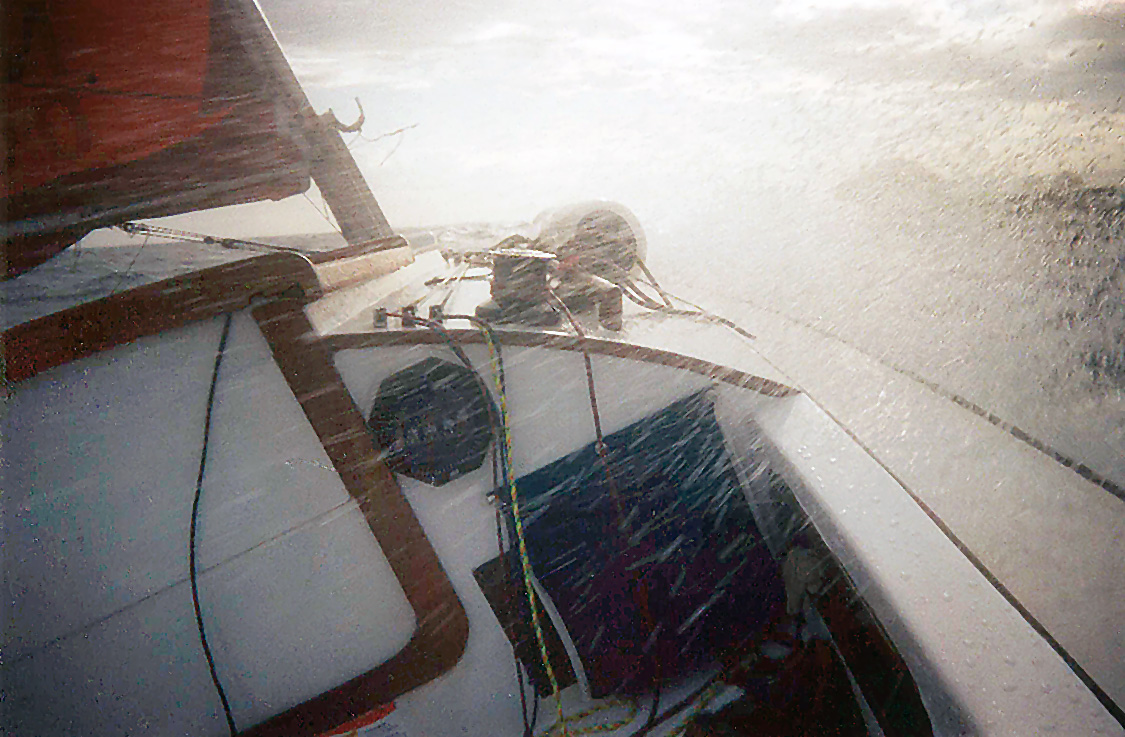
CHARLIE FISHER completed a crossing of the challenging Bass Strait to participate in the 2007 festival in Hobart. This is the view from her cockpit during that trip.
Jacob discovered the truth in those words within hours of meeting the Pied Piper of Norwalk Islands Sharpies face to face. After Ayliffe gave him a brief tour of a NIS 29 he is completing in an Adelaide boatyard, he suggested Jacob grab his saxophone: “Get in the Land Rover, mate. We have got you a gig!” he said.
 Angus Houstone
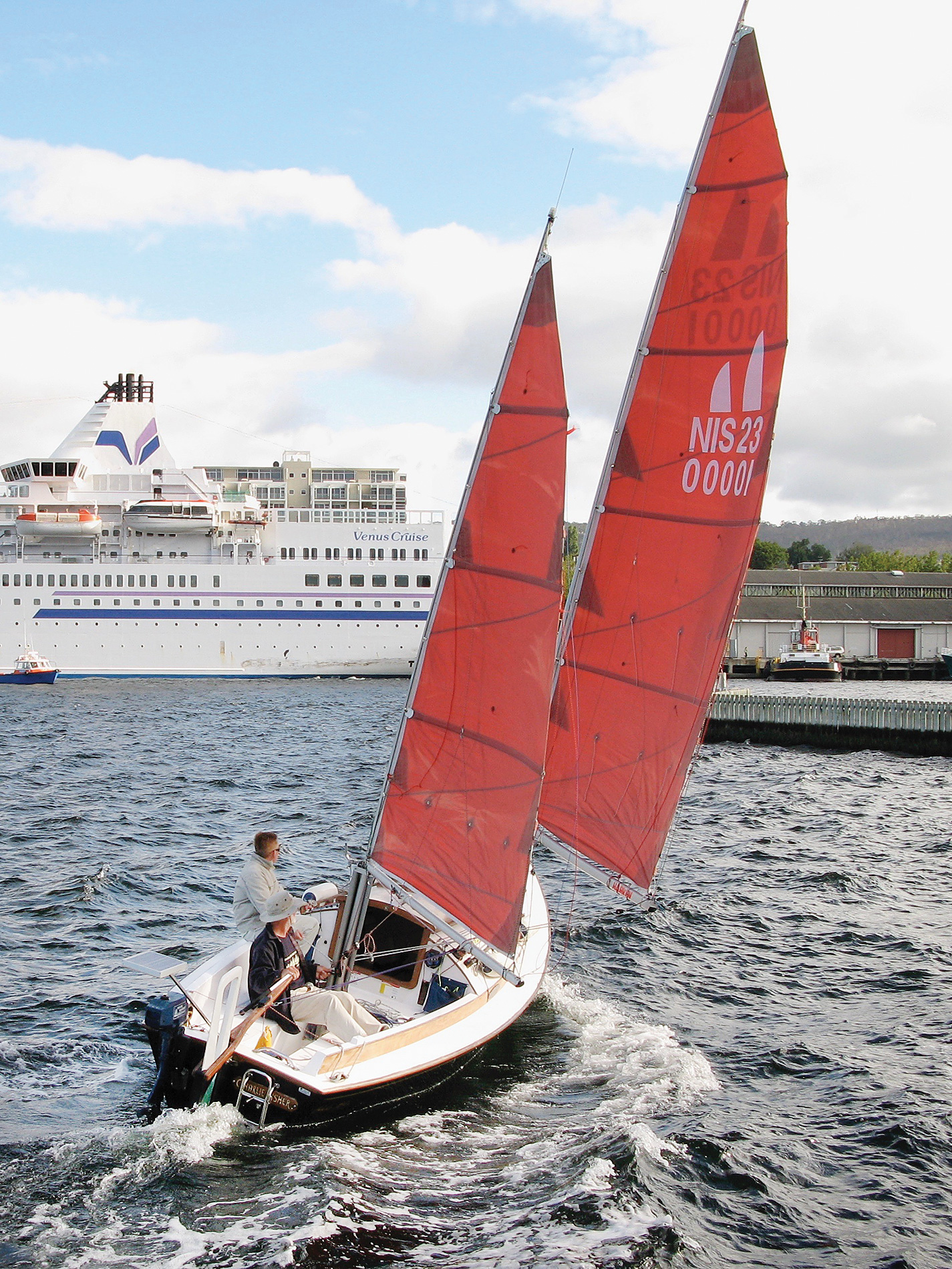
CHARLIE FISHER explores the Hobart waterfront.
 Robert Ayliffe
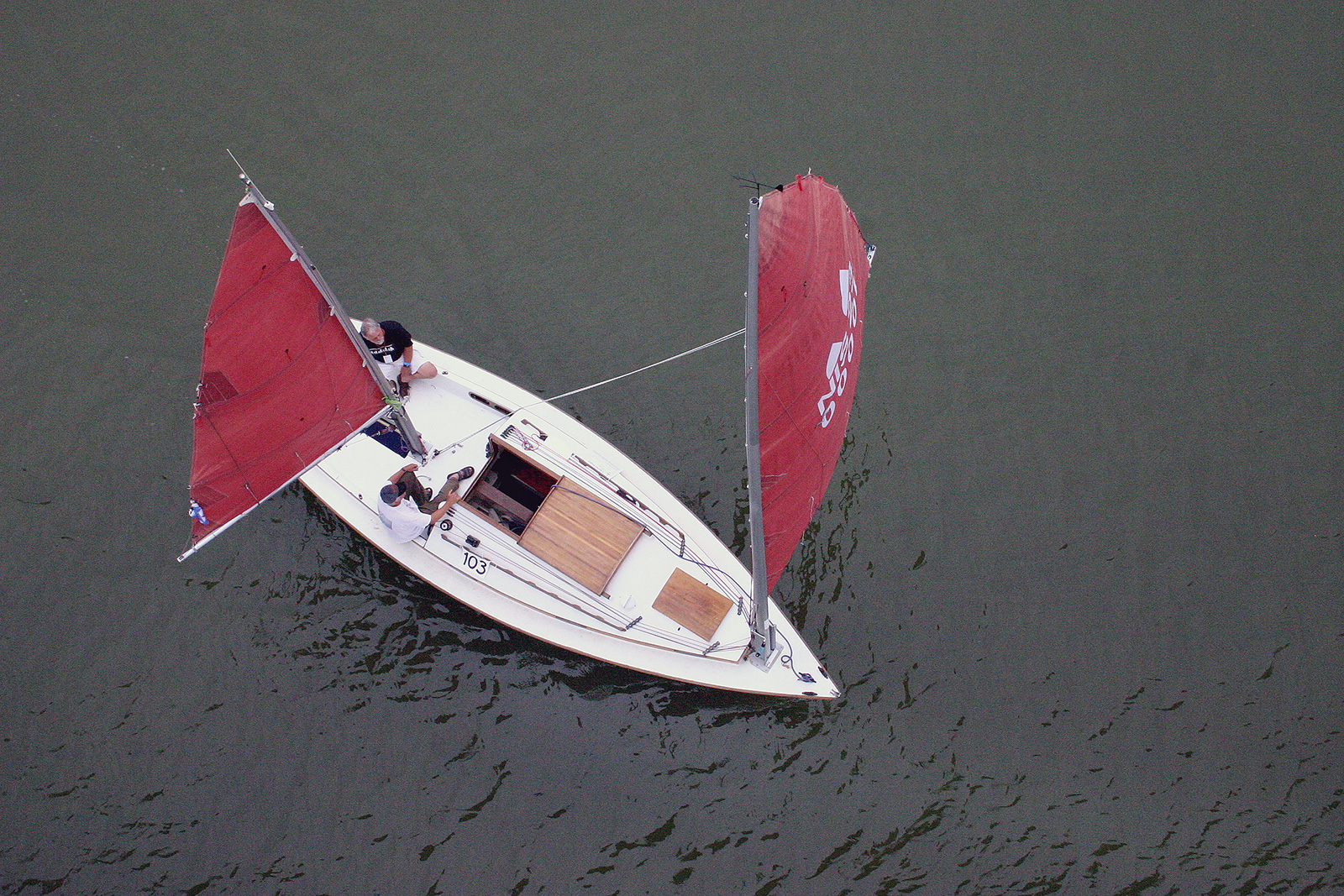
As demonstrated here on CHARLIE FISHER, sheet travelers and spinnakers are not required with NIS boats.
This visit was always going to be about more than sharpies. After Ayliffe had seen videos of Jacob playing blues, rock, and jazz in the clubs of New Orleans, he had decided to set Jacob up to “sit in” with some Adelaide musician friends. Before the reed of his alto saxophone was barely wet, Jacob was riffing over the melody of Bruce Springsteen’s “Hungry Heart” with a band on a live world-wide radio broadcast. When the show ended, Jacob’s new musician friends were urging him to “come back for next week’s show.”
 Robert Ayliffe
Even a lone sailor can easily raise the masts aboard a NIS 23.
But that wasn’t going to happen, because Ayliffe and his wife, Ali, were whisking Jacob off on an adventure to Kangaroo Island to meet the animal for which the island is named.
“Robert’s a bit of a kangaroo whisperer,” Ali told Jacob as the sun set over the island and the nocturnal wallabies and roos began to emerge from their dens to feed. It was not long before Jacob found himself in a field virtually filled with kangaroo joeys the size of deer fawns.
“Put you hand out, mate,” Ayliffe told Jacob. “They won’t bite you.”
Jacob opened his hand to a joey, and the wild kangaroo nuzzled him like a kitten.
“My soul feels clean,” said my son.
“Welcome to Oz, mate,” said the shaman of sharpies. He gave a devilish wink. Then he nodded in the direction of the Southern Ocean, as if to say, “Now, let’s go out there and sail a sharpie…maybe this time to New Zealand.” 
Randall Peffer is a regular contributor to WoodenBoat.