
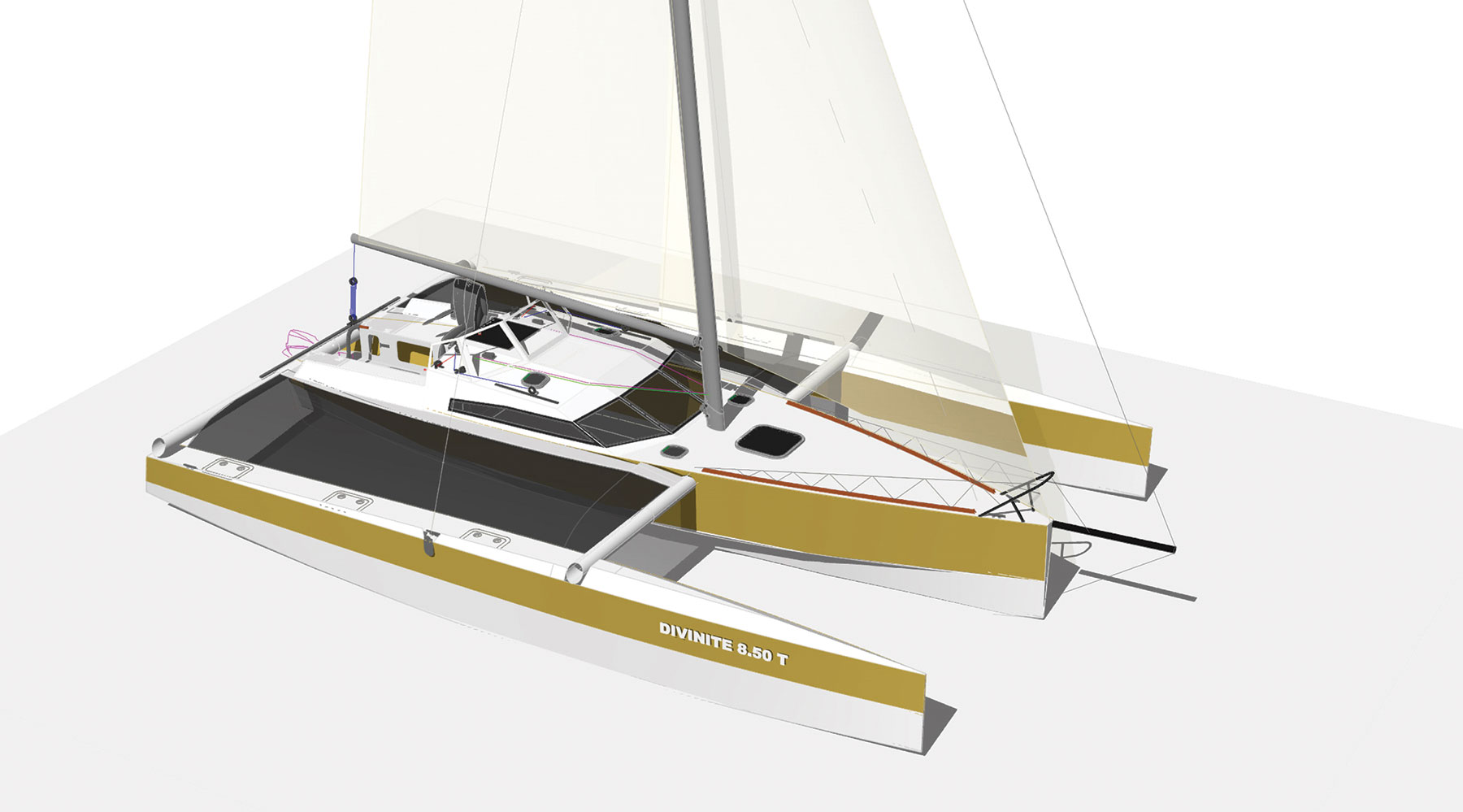
In the Divinite 8.50, designer Eric Henseval has created a simplified trimaran structure with modern good looks.
The multihull is a technical answer to the sailor’s quest for very high performance. Those who can either get past the seeming complexity of structure or see the beauty in its make-up will find easy cruising speeds far above those of typical ballasted monohulls. With his Divinite 8.5 trimaran, designer Eric Henseval has simplified this complex structure and created a good-looking modern trimaran that an amateur can build.
While a heavier catamaran of similar length might offer better accommodations, it would be at the cost of greater weight and less sailing power due to its narrower overall beam. A trimaran is generally more forgiving than a catamaran because its peak righting moment is reached at a greater angle of heel, making trimarans the winning choice for distance races such as the Race to Alaska, the so-called “R2AK” that covers the 750 miles from Port Townsend, Washington, to Ketchikan, Alaska.
Somewhat reserved, yet modern, good looks are typical of Henseval’s work; his lines are simple yet precisely sculpted into a cohesive whole that is just a tiny bit aggressive. We must look hard to find the very slight reverse in this boat’s sheerlines, countered by the more traditional sheer in the topside chines and paint lines. This opposition establishes a design tension that is very subtle and hard to do, but in this case is just right for a high-powered fast cruiser-racer.
The Divinite’s hulls, both the vaka (central hull) and the two amas (outboard floats), are long and slim with flat bottoms. The vaka has a lot of rocker to its bottom, mainly to gain displacement and a beam-to-length ratio at the waterline of 10:1. The amas’ center of buoyancy is farther forward than that of the vaka to add diagonal stability and cause the bows to lift as the boat heels. The ama decks are streamlined to reduce air drag when sailing to windward.
The Divinite’s hulls, both the vaka (central hull) and the two amas (outboard floats), are long and slim with flat bottoms.
The Divinite weighs 2,970 lbs including basic sails, rigging, and outboard motor—but without crew, liquids, or stores and personal gear. Displacement at full load is 4,400 lbs, giving the boat a maximum payload weight of 1,430 lbs. One rare feature is its ability to carry 200 liters (450 lbs) of water ballast in the amas. This is the same as having two or three people perched 9′ outboard from the centerline and adds considerably to the boat’s stability and sailing power. Saltwater would be used if you were sailing in the ocean, so that the tanks could be filled and emptied as needed, with no need to conserve potable water by pumping the freshwater ballast water across the boat. The water ballast allows slightly smaller and lighter amas because of the stability that’s added when the windward water tank is filled. The designer also notes that both water ballast tanks can be filled at anchor to stabilize the boat in stormy weather.
The wide, full-length sponson halfway up the topsides of the vaka is another major design feature of the Divinite. This additional horizontal surface adds livable interior while simplifying the construction of settees and bunk flats in the main and forward cabins. Such a flat surface might become stressed and noisy from waves striking it, but I think it’s far enough above the waterline to always present an angle to the waves when sailing.
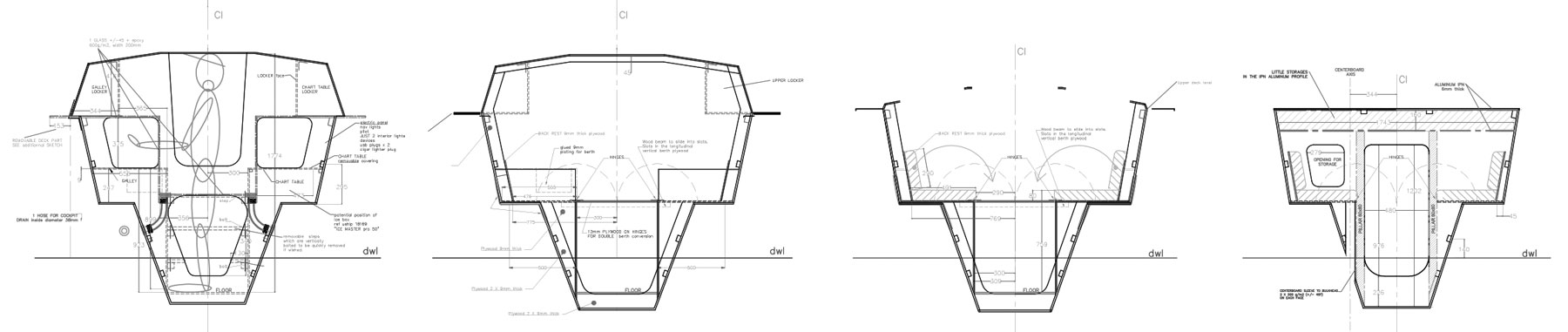
The wide, full-length sponsons halfway up the topsides of the vaka add horizontal surfaces that simplify the construction of settees and bunk flats.
Appendages consist of a kick-up rudder and a daggerboard. For the latter, Henseval has cleverly positioned the plywood-cored board and its trunk 13½″ to port of the centerline and in front of the forward crossbeam, or aka. This offset will have no effect on sailing performance but it gives access to the forward berth and allows the foredeck hatch to be on the centerline.
Additional appendages are the two small fixed fins on the amas for keeping the boat level when grounded out on a beach—a useful detail born of experience.
The main advantage of this “simplified box” type of plywood construction is that it goes together without any molds. The plywood is simply scarfed to length, cut to shape, and taped together; it’s all straight-ahead boatbuilding with no extra steps.
The bottoms and sides of all three hulls are of ½″ plywood with fillet-and-tape joints. Small longitudinal stringers of clear spruce reinforce the panels. The decks and trunk cabin are ⅜″ ply and the entire exterior is sheathed with 9-oz fiberglass set in epoxy. The two main bulkheads (located at the akas) are of 1″ plywood while the rest are of ½″ plywood. This structure is much heavier than a strict racing multihull, but the Divinite is intended as a long-lived rugged cruiser that races only occasionally.
The two akas are single lengths of 6″ aluminum pipe, which is not the lightest solution but is, again, simple, rugged, and easy to come by. All connections are made with large bolts, so disassembly is straightforward. The disassembled boat was designed to fit inside a standard 40′ shipping container. This keeps it out of the weather when not in commission, lengthening its life and opening up faraway sailing and racing destinations.
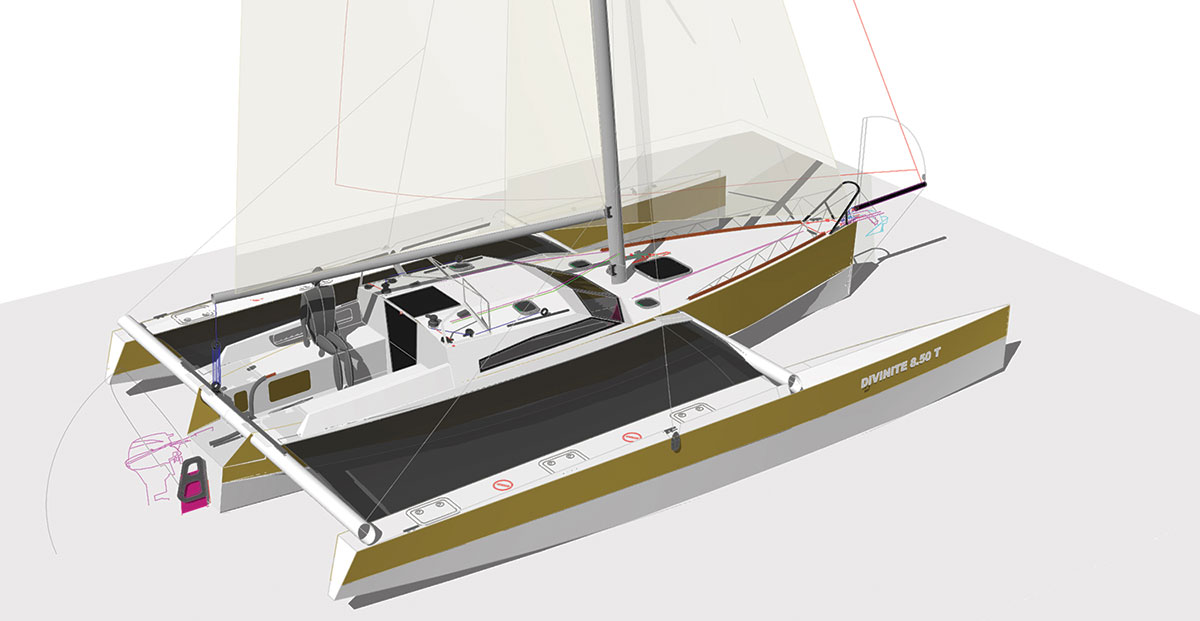
The two akas are single lengths of 6″ easily sourced aluminum pipe. Disassembled, the boat fits inside a 40′ shipping container.
The sail-area-to-displacement ratio for the half-load condition (3,685 lbs) under mainsail and solent jib is 34.2. While that is far higher than a typical cruising monohull, it’s lower than a racing multihull. Again, this fits the Divinite’s role as a performance cruiser. Sailing power could be increased with a rotating mast, and sail area is doubled downwind with an asymmetric spinnaker.
Note the absolutely flat foredeck—very simple to build and to fit a hatch to. There are narrow demountable solid side decks outboard of the cabin, which should help keep those who are perched there drier at speed. Large trampolines between the crossbeams and amas, a common feature of most multihulls, make a perfect napping spot while on a light-air reach. Steering is by a centerline tiller, and the 9.9-hp outboard will be transom-mounted on a lifting bracket.
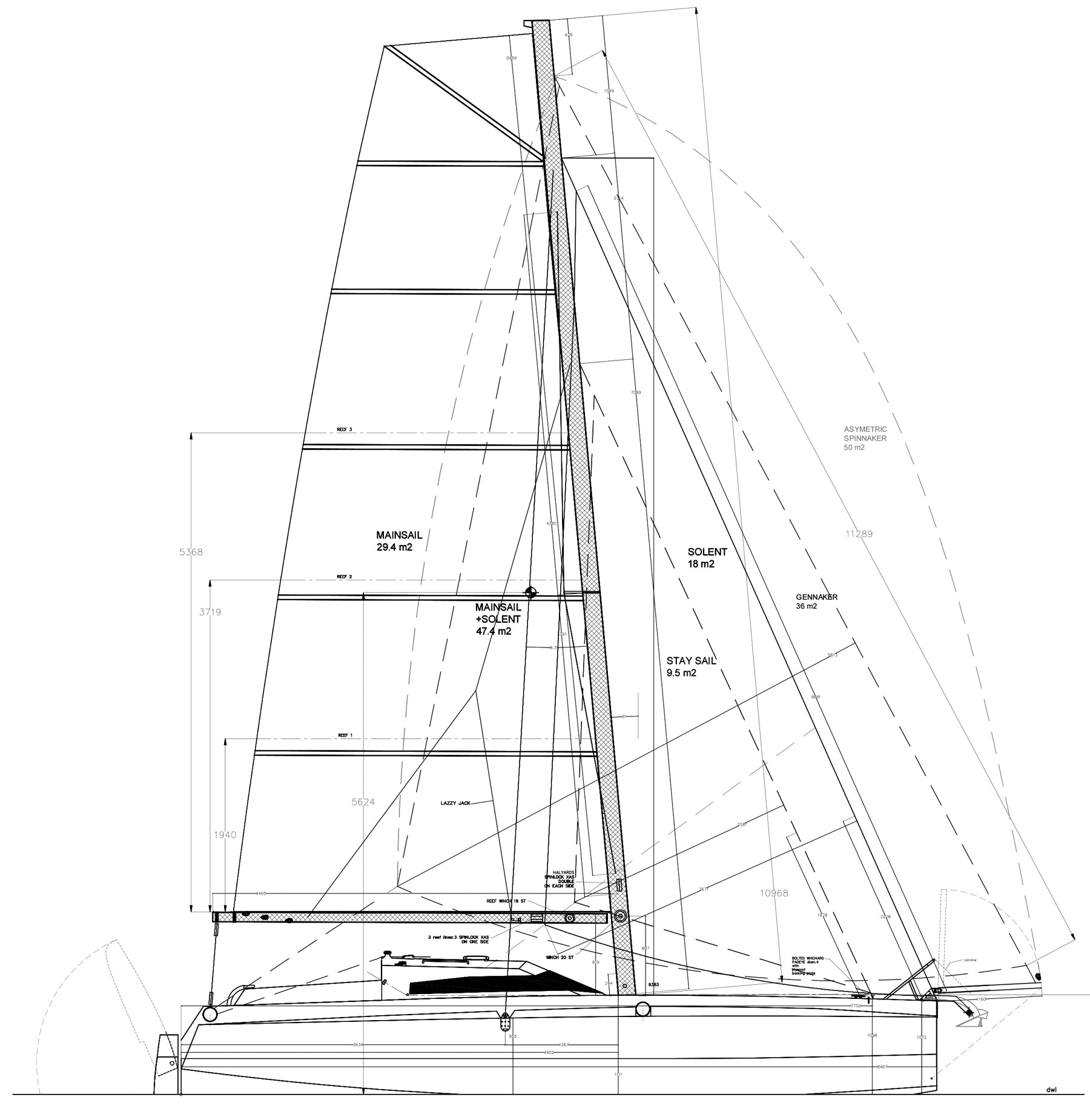
The Divinite’s sail-area-to-displacement ratio at half-load is 34.2, which is higher than that of a typical cruising monohull but lower than a racing multihull’s, illustrating the boat’s purpose of performance cruising.
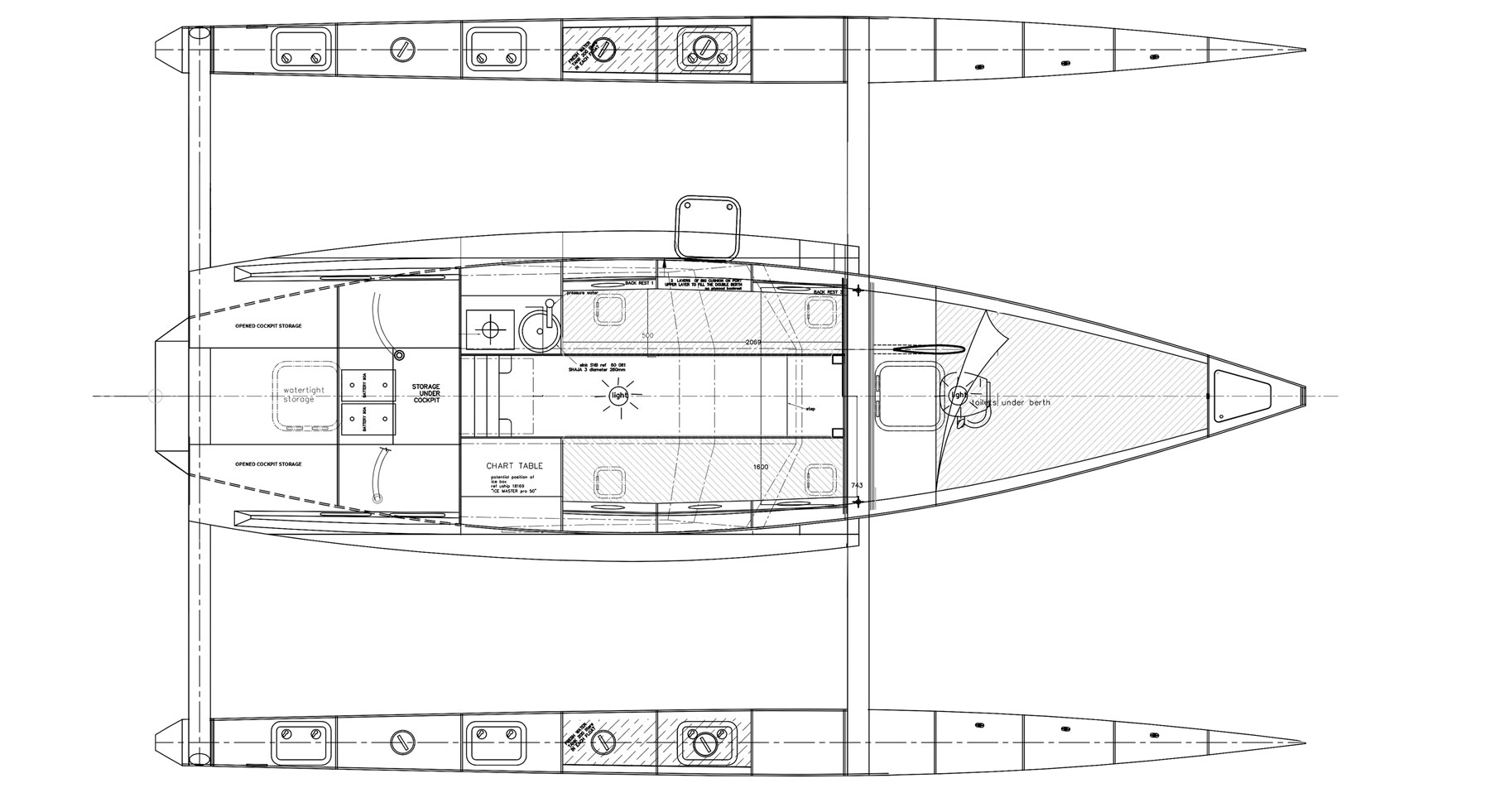
Interior accommodation is where trimarans come up short, appealing mostly to those who choose high-performance over camping arrangements below. The Divinite has a basic interior with sleeping for three or four adults and space for everything else that’s required. There is a small space at the foot of the forward berth for changing clothes or to ease the use of the head that’s under the berth’s after end. The large cabin windows surrounding half of the main cabin area will brighten and enlarge that space. And there’s space allocated for
navigation and cooking port and starboard of the main companionway. The fixed dodger windshield and soft top will go a long way toward expanding the accommodations by permitting cooking in the cockpit.
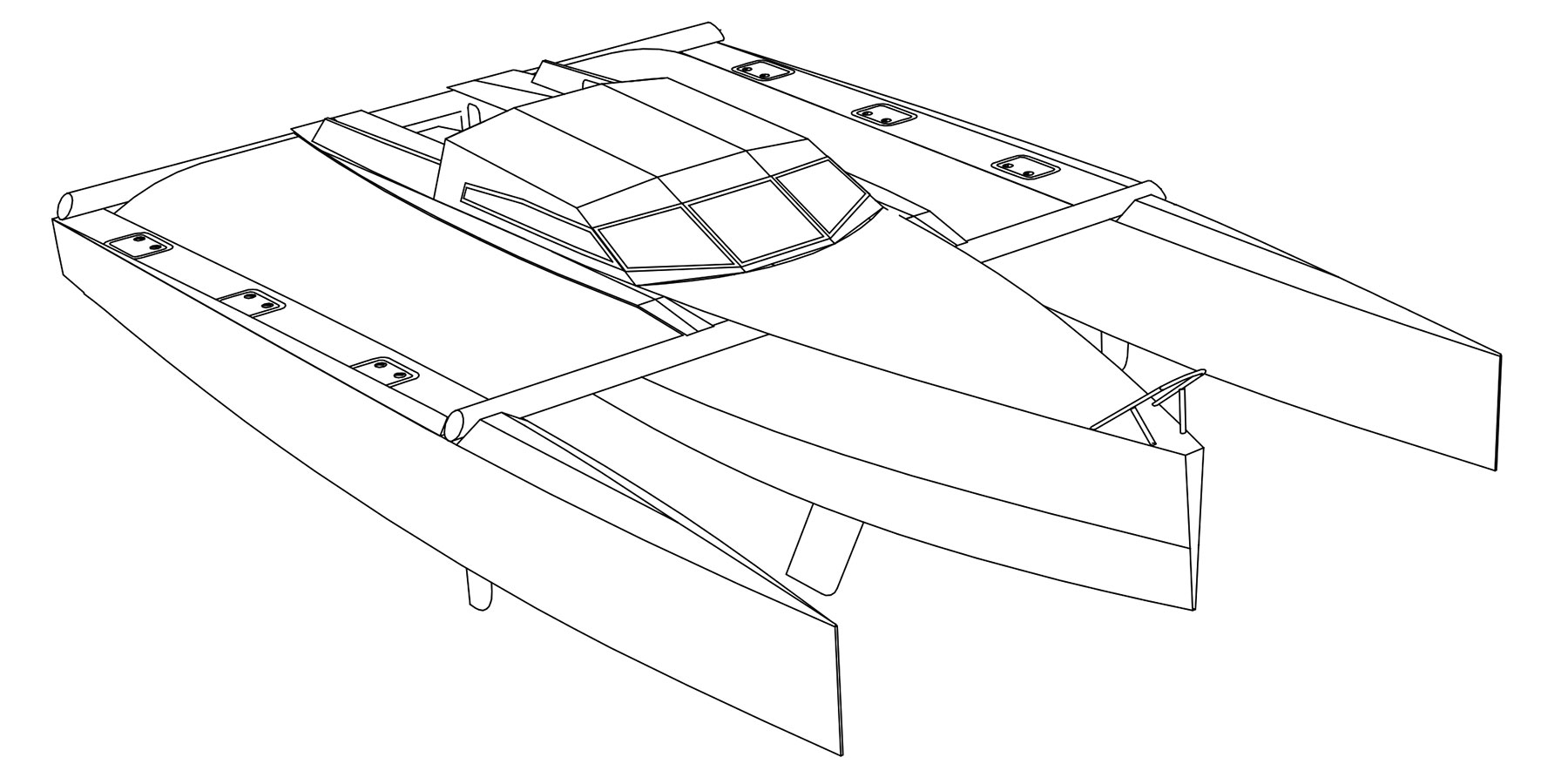
The flat foredeck is simple to build. Large trampolines fill the span between the amas and offer space for lounging.
For storage, the Divinite has numerous watertight compartments in the amas and the entire volume under the cockpit.
The Divinite 8.5 offers thrilling performance in a package far more straightforward to build than the usual foam-cored molded composite boat. Couple that with beaching and family camping, not to mention speed with minimal outboard power, and we have a sure winner! 
Tad Roberts designs boats on Gabriola Island in British Columbia, Canada.
Contact designer Eric Henseval at: 17 rue Marie Anne du Boccage, 44000 Nantes, France; eric.henseval@gmail.com; www.hensevalyachtdesign.jimdo.com.