
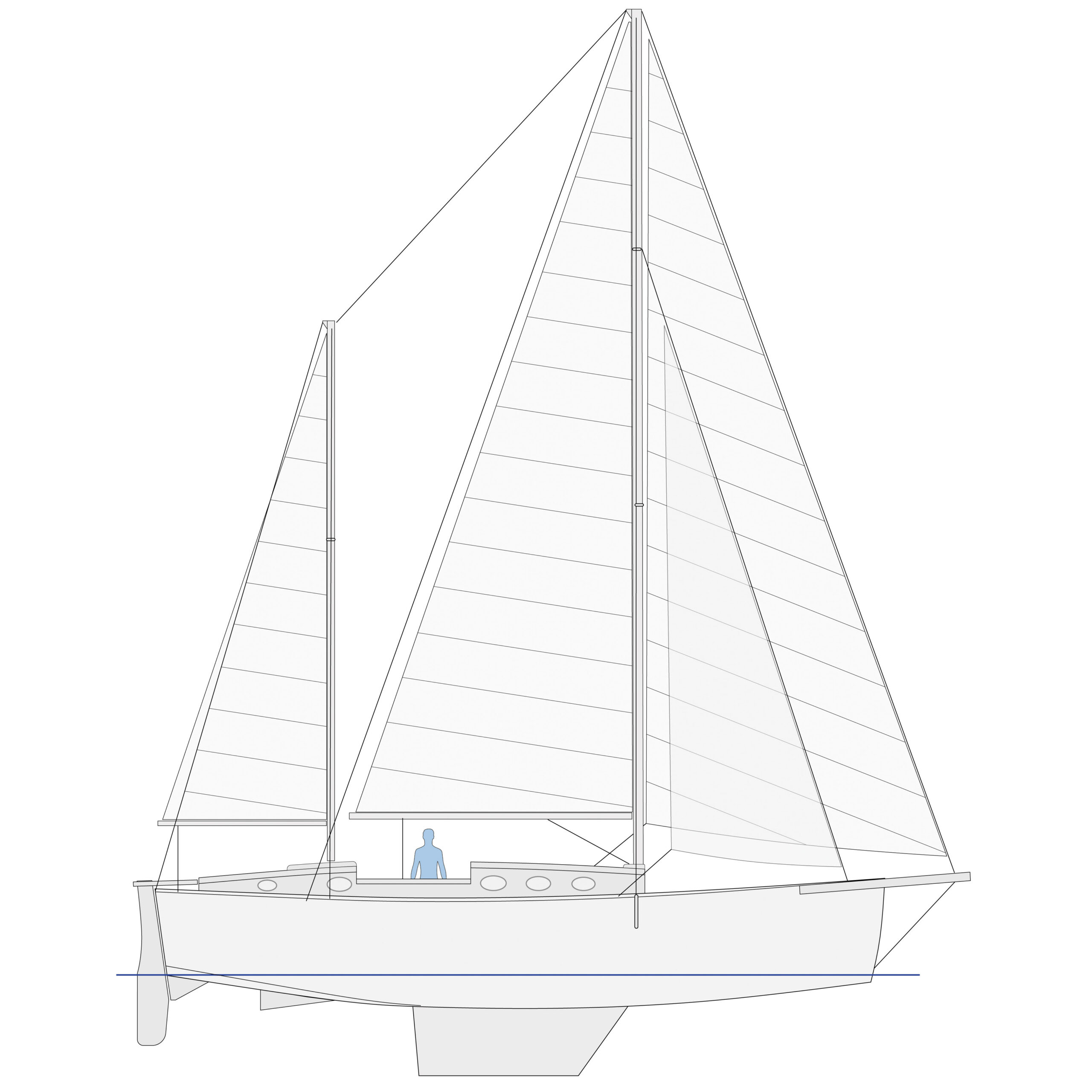
Eirikr 1195 is a budget-minded, no-nonsense cruiser with world-roaming capability.
Eirikr 1195’s Particulars
- LOA: 39’3″
- LWL: 37’11”
- Beam: 12’9″
- Draft: 5’5″
- Displacement: 23,360 lbs
- Cargo: 6,600 lbs
- Sail area: 776 sq ft
Creating a new hull suited to the rig and equipment salvaged from an existing (but tired) boat is a smart solution to the problem of high costs associated with building a new boat. We don’t see too many new wooden ocean cruisers in the 40′ range anymore, and the cost of rig and equipment is part of the reason. The owner-builder who commissioned this new design from Jerome Delaunay had access to a cold-molded ketch designed by Jean Knocker (designer of Bernard Moitessier’s JOSHUA) and built in 1968, but the boat’s hull and deck structures were seriously deteriorated and of dated design. Yet, because the boat was equipped with aluminum spars, recent sails, engine, and electronics, and had complete deck hardware, the opportunity to enlarge and modernize her rotting hull was an attractive prospect.
The Eirikr’s outboard appearance immediately brings to mind the Hillyard cruisers built by the dozens in England up until the 1970s. Somewhat high-sided, with short ends and a center cockpit, the Hillyards were designed and marketed as budget cruising yachts, as is the Eirikr, and their stark, attractive looks have been carried forward successfully. The Eirikr looks ready for an ocean voyage.
High topsides, short overhangs, and a flattish sheer give the boat a powerful appearance.
Usually people will cite the separation of living spaces and privacy as chief advantages of a center-cockpit arrangement. In this case, with owner’s quarters in the aft cabin and crew’s far forward in the forecastle, divided by both the center cockpit and the cargo space, the separation can’t get any better. The center cockpit offers a secure location for working the boat, with all sheets and halyards easily accessible. We don’t hear much anymore about cruising boats being pooped while running off in a big sea, but it is certainly a dangerous possibility, and the flush afterdeck and central cockpit minimize that concern. The roomy central space under the cockpit for tanks and machinery is the very best placement for major weights, and it offers ease of access to all the pieces that often require maintenance.
High topsides, short overhangs forward and aft, and a flattish but traditional sheer all work in harmony to give this boat a powerful appearance. Only at the transom do we catch a glimpse of her underwater secret, the hard-chined flat bottom. Looking at the body plan, we’re reminded of a Swampscott dory, the gently rounded topsides narrowing to a flat bottom amidships, which transitions to a radiused bottom section aft. This radius will reduce the tendency of flat sections to slap in waves.
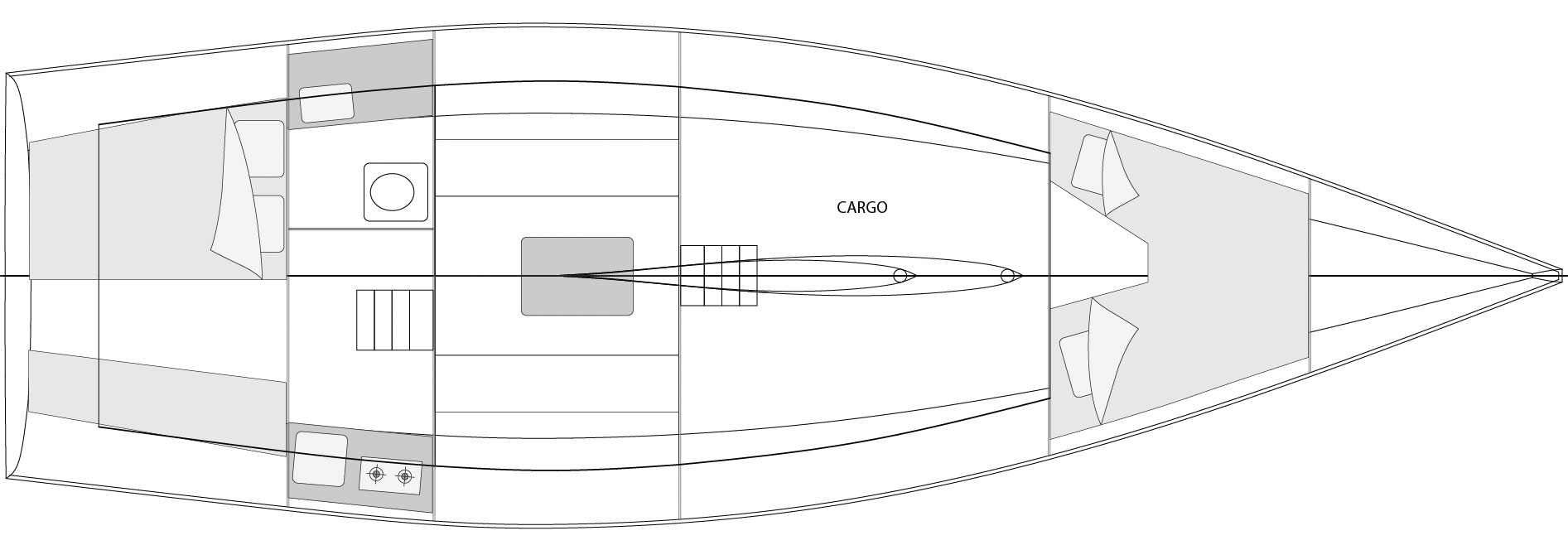
The owner’s quarters are in the aft cabin and the crew’s are far forward. These spaces are separated by the center cockpit and the generous cargo space beneath it.
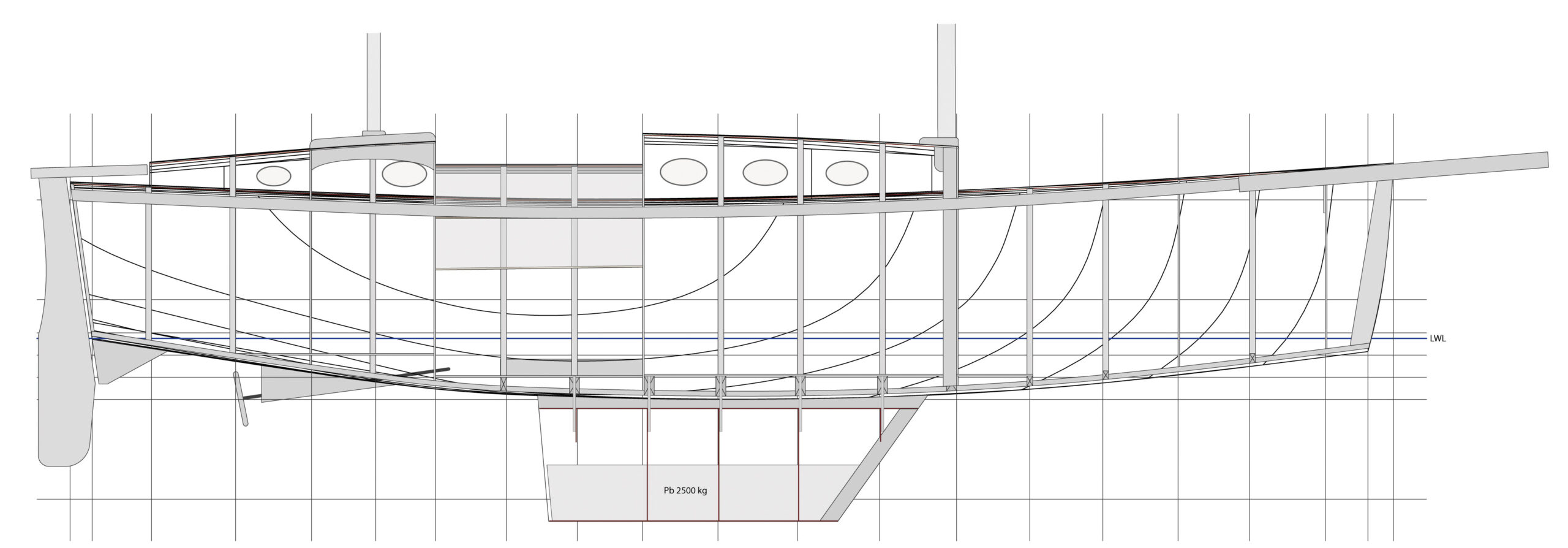
Those flat bottom sections will be the main concern for those contemplating an ocean voyage in this boat. Won’t they pound? Of course, any hull will pound given the right conditions, and sailors know that you either put up with it or change course. When strongly built, this hull form doesn’t show any huge disadvantage to my eye, and I do see several major advantages, including ease of construction and reduced labor. I would start construction by building the flat double-layer plywood bottom upside down with the keel stub, shaftlog, and rudder skeg all sheathed with fiberglass set in epoxy. Once the bottom is flipped over, the rest of the hull can be completed right-side up. And all the fussy joints associated with a full-length central keel and garboards are eliminated.
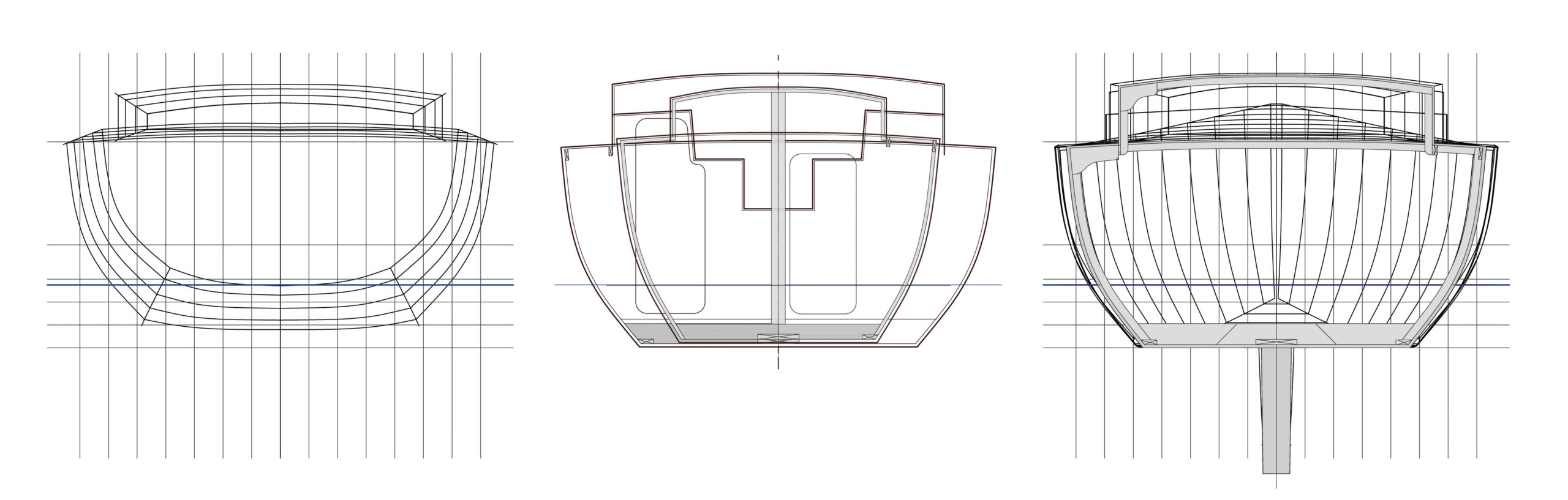
The tendency of flat bottom sections to pound in a seaway can be managed by prudent course alteration. The hull’s shape offers several advantages, including ease of construction.
In plan, the boat has a modern deck shape: fine forward with maximum beam aft of amidships and very little taper from there to the transom. This shape will be fast and powerful while working upwind in a big ocean swell. I would prefer slightly more beam right around the mainmast for better balance when reaching and running; this would also provide more deck width at the shrouds. But each designer has his or her own priorities, and we all have different experiences to inform these decisions. The Eirikr’s displacement-to-length ratio is 190 without cargo aboard, and 245 fully loaded. Even loaded, this is light displacement for an ocean-cruising boat, and I would not be surprised to see the sailing weight increase over time.
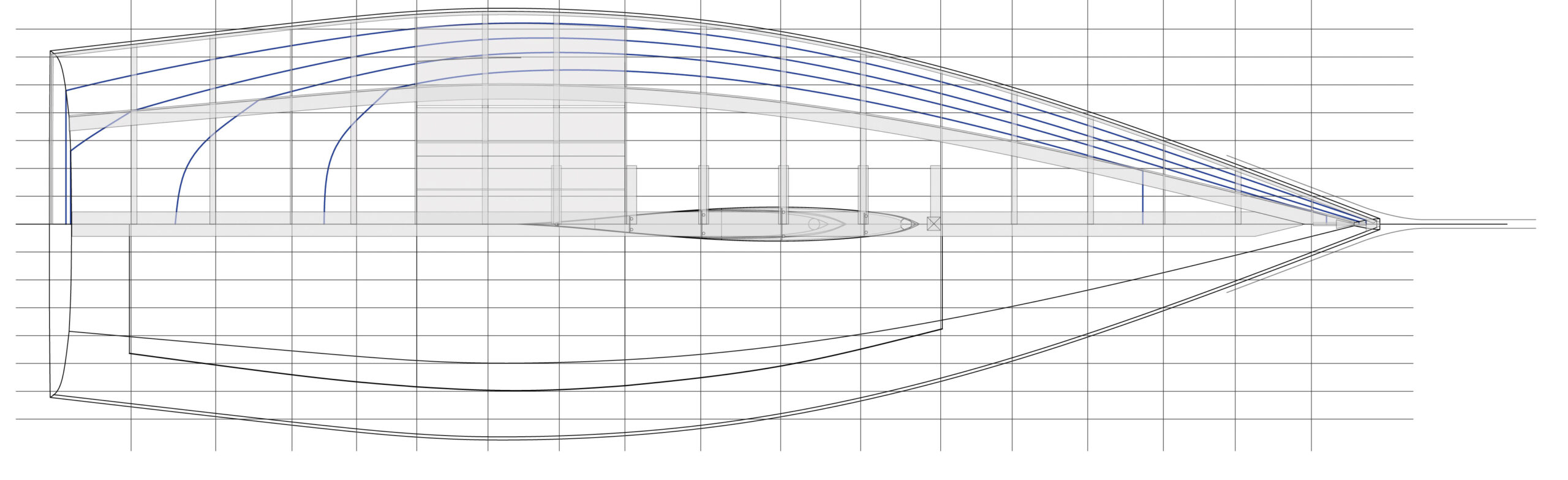
The boat’s shape—fine forward sections, maximum beam aft of amidships, and very little taper from there to the transom—portends speed and power.
The slightly long and shallow steel-box fin keel is a rugged, reliable, and simple solution to the challenges of directional stability, lift with minimum drag, and getting the required ballast down low without excessive draft. The rudder could be a bit larger and deeper for more control at low speed.
The bottom’s two layers are both of ½” plywood, and the sheathing is of 50-oz fiberglass to reinforce and protect it. The curved topsides are constructed of 1″-wide strips over widely spaced laminated frames and plywood bulkheads. This will be a light and stiff structure that goes together quickly, which is the real goal when modernizing any boat. The better-engineered and lighter the structure, the more ballast and sail area can be carried.
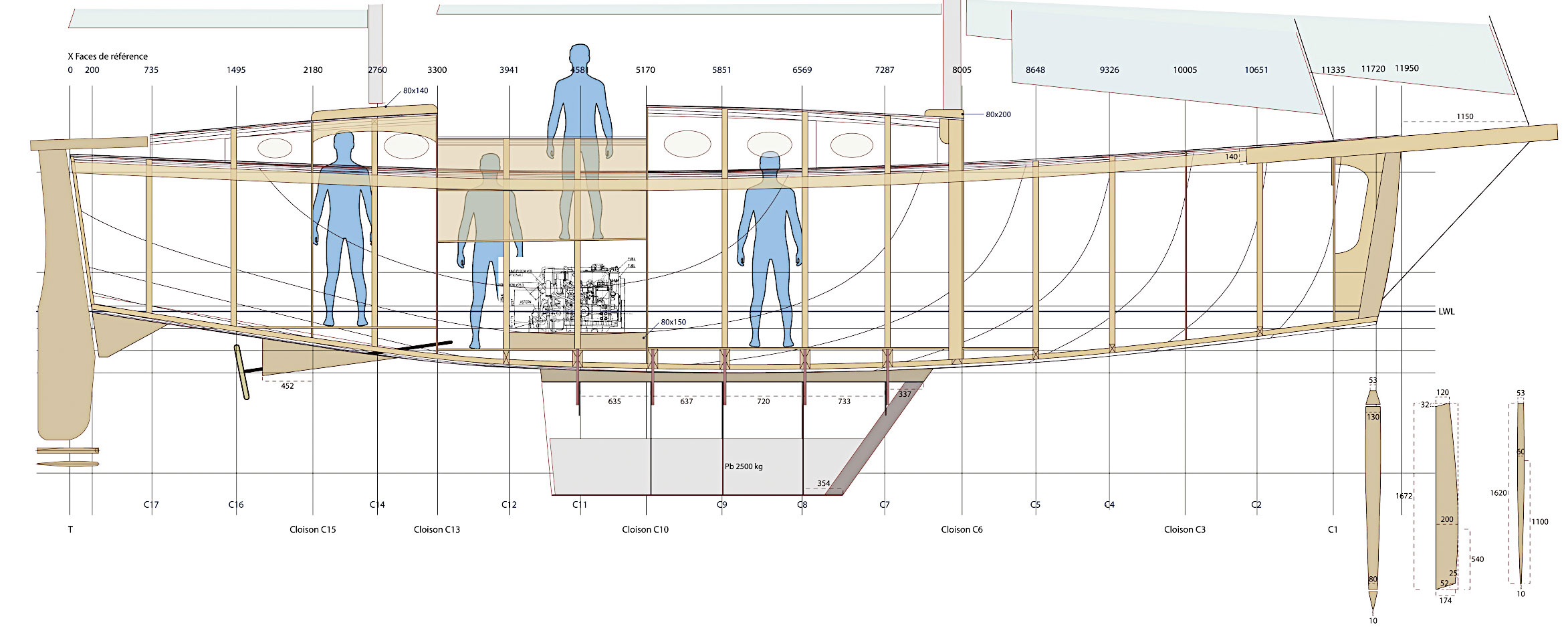
The center cockpit is a secure location for working the boat, while the generous space beneath it offers ideal placement of tanks, engine, and generator.
The designer has specified 6,600 lbs of cargo. The load will be placed into what would normally be the main cabin area, between the mainmast and cockpit and directly over the ballast keel. This is a relatively small load and will increase the draft less than 4″. The sail area-to-displacement ratio will go from 15 without cargo to 12.9 when fully loaded. Obviously, the boat will slow somewhat when loaded with cargo, but with her long waterline and ability to add sail area, the Eirikr will maintain a high average speed.
The ketch rig offers versatility in moving the center of effort forward or aft to balance the boat, and in adding sail area in the form of a big genoa and mizzen staysail, which could double the working sail area. Both the mizzen and main masts are deck-stepped, which can eliminate deck leaks at the partners. The big concern when repurposing such a rig is being sure it’s strong enough for the job. Since rigging loads are a function of the righting force developed by the hull, the designer must be careful to not specify too much stability. No problems here, given the shallow draft and moderate ballast weight of this design.
The accommodation is basic and simple, but because the interior is so voluminous, there’s an opportunity for many arrangement ideas. The basic design includes sleeping, galley, and head areas in the aft cabin. The engineroom is amidships with cargo hold forward and crew’s cabin in the bow. An alternative might consist of a workshop or studio of some sort in the cargo area, providing a way to earn a living while sailing.
I really like the outboard rudder with short tiller arm on the afterdeck. This is the super-simple steering system used by Moitessier on JOSHUA; steering ropes are led outboard from the tiller and along each side deck. A short shaft with a rope drum and steering wheel is mounted in the cockpit, and the steering ropes lead onto the rope drum. This is another easily built and maintained system that increases self-reliability and decreases dependence on some far-off corporation. A good dodger and bimini over the cockpit would be essential equipment for voyaging.
The Eirikr is a modern sailing home that can still earn its keep, in a package that is not too intimidating for the amateur builder. 

Tad Roberts designs boats on Gabriola Island in British Columbia, Canada.
Plans are available from designer Jerome Delaunay at Nautline, admainecrea@gmail.com.