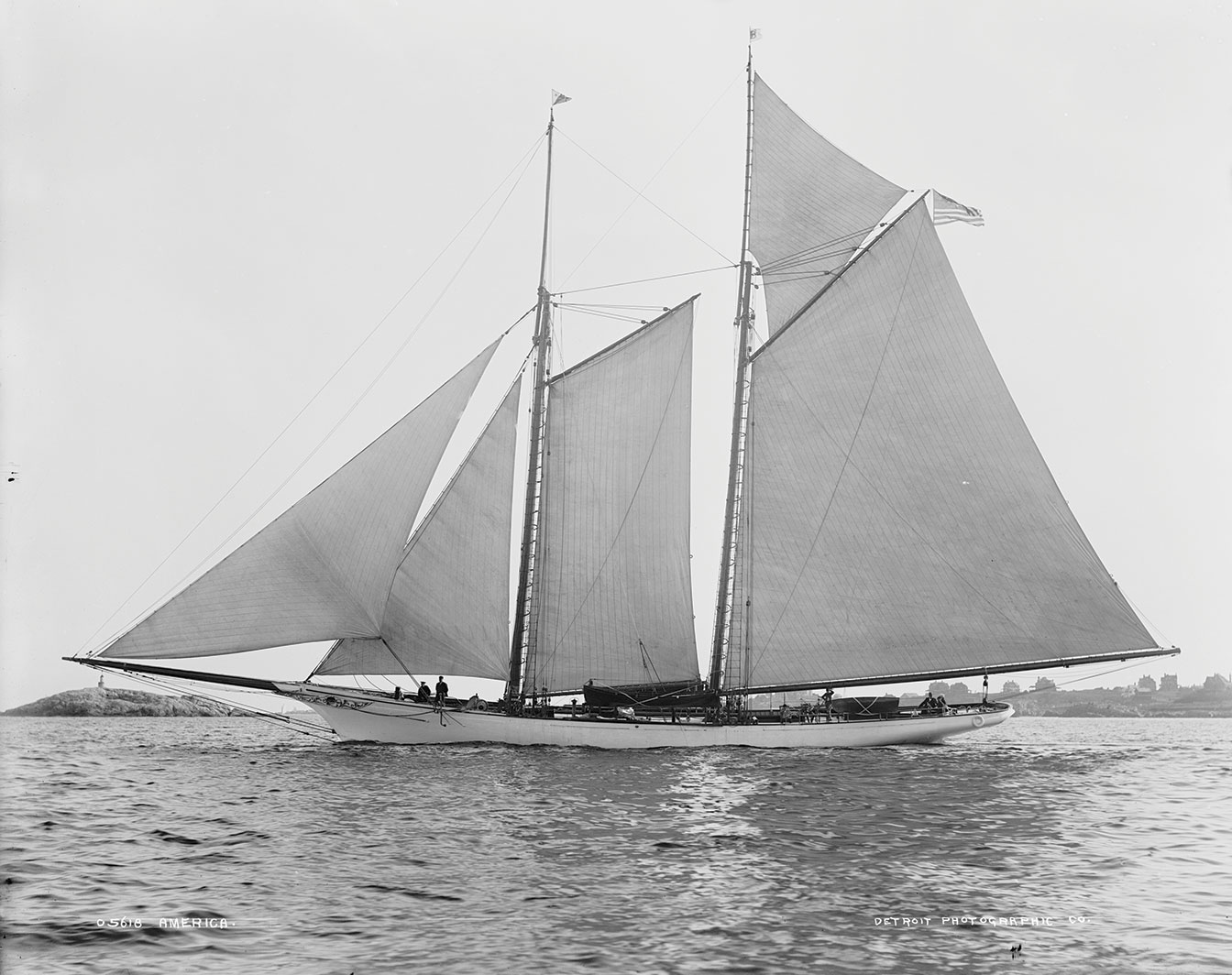
Schooner AMERICAThe Last Days of the Schooner AMERICA: A Lost Icon at the Annapolis Warship Factory, by David Gendell. Lyons Press, 4501 Forbes Blvd., Suite 2000, Lanham, MD 20706. 345 pp., hardcover, illus., index. $34.95.

The schooner AMERICA was without question one of the most successful and influential designs in the history of yachting. Although many devotees of sailing lore are familiar with the vessel’s early years and remarkable accomplishments, the closing chapters of her 91-year life are not nearly so well known. David Gendell, a veteran maritime author from Annapolis, Maryland, has now set out to recount the saga of that later period.

In 1850, Commodore John Cox Stevens and fellow members of the newly formed New York Yacht Club began to hear about elaborate plans for a World’s Fair to be held in London the following year. Although this gathering was grandly titled The Great Exhibition of the Works of Industry of All Nations, astute observers fully expected that the British would be at pains to assert their superiority in nearly all fields of endeavor. The affluent New York sportsmen, their competitive spirits aroused, decided that this would be an opportune time to demonstrate to the British a highly refined example of American ship design and construction. If such a vessel could prevail against the cream of the European yachting establishment, a distinctly aristocratic and notably self-satisfied cohort, it would make a powerful statement.

Having formed a syndicate, Stevens and several associates encouraged the creation of a schooner built expressly for this purpose, which would be constructed on speculation. If they approved of the outcome, they would purchase the vessel and sail to England in the early summer of 1851. For the design, they turned to the naval architect George Steers. Though he was still a relatively young man, Steers had enjoyed considerable success in designing pilot schooners for New York Harbor. These hard-working boats needed to travel swiftly and perform reliably year-round in all sorts of weather, including the very worst. The ideas that Steers had thus evolved were carried over directly into the designing of AMERICA, a yacht intended not only to compete against other thoroughbreds but also to cross oceans in comfort and safety. Carrying capacity was not a priority, and thus Steers was free to develop a hull that was unusually narrow and fine-lined, with low freeboard, hollow waterlines at the bow, and firm bilges aft. Maximum beam was located amidships, rather than farther forward, as was the general custom of the time. Stability was to be enhanced by 61 tons of iron ballast carried inside.

The Last Days of the Schooner AMERICA

AMERICA was built at the East River shipyard of the esteemed builder William Brown, and the 95′ vessel (with a beam of 23′) was launched on May 3, 1851. Sail area totaled 5,263 sq ft, carried on two steeply raked masts; initially there was no provision for topsails. It was apparent from the outset that the designer had achieved a remarkable result. The testimony of one contemporary underscores the extent to which this vessel was genuinely out of the ordinary: AMERICA, he remarked, “moves so quietly through the water and makes so little noise that it is difficult to realize her speed…she slipped through the water pretty much with the effect that drawing the blade of a knife through the sea would have.” Taking the helm of such a sophisticated craft must have been an exceptional experience, especially given her tiller steering, which was unconventional for a yacht of her size.

The NYYC syndicate accepted the schooner, and she departed for Europe on June 21. Notwithstanding five successive days of calm conditions, the passage was completed in just 19 days; the very fastest steam-powered ships of the time managed the crossing in 11 or 12 days. As one crew member later put it, “the way we have passed everything we have seen must be witnessed to be believed.” Shortly after AMERICA’s arrival in The Solent, she undertook an impromptu race against a British yacht of some stature, and she readily outsailed her competitor, excelling to windward in particular. The startled yachtsmen of Cowes then took several weeks to organize plans for a formal race, which took place on August 22. The course called for a 53-mile circumnavigation of the Isle of Wight, a route that would heavily favor those well familiar with the area’s numerous shoals and formidable tidal currents. Yet AMERICA prevailed—and by a stunningly wide margin—over 14 of the finest vessels of the day, most of them owned and sailed by members of the Royal Yacht Squadron. Her reputation of pre-eminence was made, and she was awarded the ornate sterling silver cup that would come to bear her name.

A mere 10 days after the race, Commodore Stevens and his syndicate pals concluded that they had made their point, emphatically, and had enjoyed sufficient sport: they proceeded to sell AMERICA to an English nobleman and headed home via steamship. From that point onward, and extending through the remainder of the 19th century, AMERICA led a highly colorful existence, in diverse chapters that at times brought surprising twists and turns. For a period during the Civil War, AMERICA was pressed into service as a Confederate blockade runner operating out of Jacksonville, Florida. Just before that port fell to the Union, she was towed many miles up the St. John’s River and scuttled in a remote tributary. Yet Union forces managed to locate and raise the schooner, and after she was refitted and equipped with three Dahlgren smooth-bore howitzers, AMERICA was assigned to picket duty off the coast of South Carolina.

In the years after the Civil War, the schooner once again passed into private hands. The high point of her existence during that era was a lengthy period under the ownership of Massachusetts squire Benjamin Butler. During his 20 years with the schooner (1873–93), Butler spent liberally in maintaining and upgrading the yacht, first hiring Donald McKay to supervise a refit and later engaging Edward Burgess to incorporate lead ballast and redesign her rig. Butler cruised the yacht widely along the Eastern seaboard and throughout the Caribbean and the Gulf of Mexico, ranging as far as Bermuda and Mexico. Yet his stewardship represented a zenith of sorts, and following AMERICA’s final outings under sail at the very start of the 20th century, the ensuing decades brought a lengthy and often melancholy period of steady decline.

After the schooner sat unused in Boston for nearly two decades, she was acquired in 1921 by a group of prominent local yachtsmen who followed through with their plan to donate AMERICA to the U.S. Naval Academy. She was towed to Annapolis, where she was accepted by the Navy but then languished for 19 more years, and although her masts were stepped she was by no means in sailing condition. Moored to a pier, AMERICA initially served as a floating display piece, deteriorating all the while. During the 1930s, semi-annual inspection reports repeatedly found the schooner to be in “generally poor condition,” and visitors were eventually no longer permitted. An overhaul was at last approved, and in December 1940, AMERICA was moved the short distance across Spa Creek to the Annapolis Yacht Yard, which had been selected to carry out the work.

Following a haulout, the first in 20 years, initial assessment of the vessel was highly discouraging. There was in fact little sound wood to be found: the frames and knees, topside planking, decking, transom, and spars were all judged to be thoroughly rotted and in need of complete replacement. Possibly at the behest of President Franklin Roosevelt, a plan for rebuilding was duly generated, though it was still unclear whether the vessel would in fact be restored for sailing or exhibition on land. Disassembly commenced during the summer of 1941, and a large shipment of white oak logs arrived at the yard. Work continued into autumn, with the schooner increasingly taking on the appearance of a mere shell. In due course a somewhat flimsy shed was erected over her; until that point she had been uncovered. Then came the Pearl Harbor attack. Once the United States entered World War II, thoughts of restoring AMERICA abruptly became ancillary to the national mission, and to the newly intensified pace of defense production at the Annapolis Yacht Yard. On March 29, 1942, Annapolis experienced a late-season storm that brought many inches of heavy wet snow. The shed’s roof gave way, and AMERICA was buried under debris and smashed beyond any hope of resurrection. All that remained was to decide how to distribute various broken bits as souvenirs. Eventually the Navy officially authorized the scrapping of the schooner, at the same time mandating the construction of a scale model to be made using wood salvaged from it.

In the initial section of his book, Gendell does a commendable job of summarizing AMERICA’s life. Yet the bulk of this monograph is centered around the final several years of the schooner’s existence—at which point the story largely transitions to a chronicle of the wartime activities of the Annapolis Yacht Yard. Many successive chapters offer abundant detail regarding the yard’s activities and its principal owners, as well as the sub-chasers and motor torpedo boats that were being built. Mentions of AMERICA are threaded through at intervals, in connection with the slow progress of decision-making as to possible restoration or reconstruction in the aftermath of the shed collapse. The tale leads ultimately to a lamentable denouement: AMERICA was stricken from the Navy’s list of ships on October 11, 1945, and soon thereafter most of her remnants were scooped up by a clamshell crane and trucked to the Annapolis city dump.

One must praise the thoroughness of Gendell’s research, including extensive archival work and numerous interviews. Fleshing out this particular era in the local history of Annapolis appears to have been a decade-long passion project. He has done a genuine service in setting forth a complete and granular overview of AMERICA’s entire life story, from brilliant beginning to unfortunate conclusion.  Article ends.