
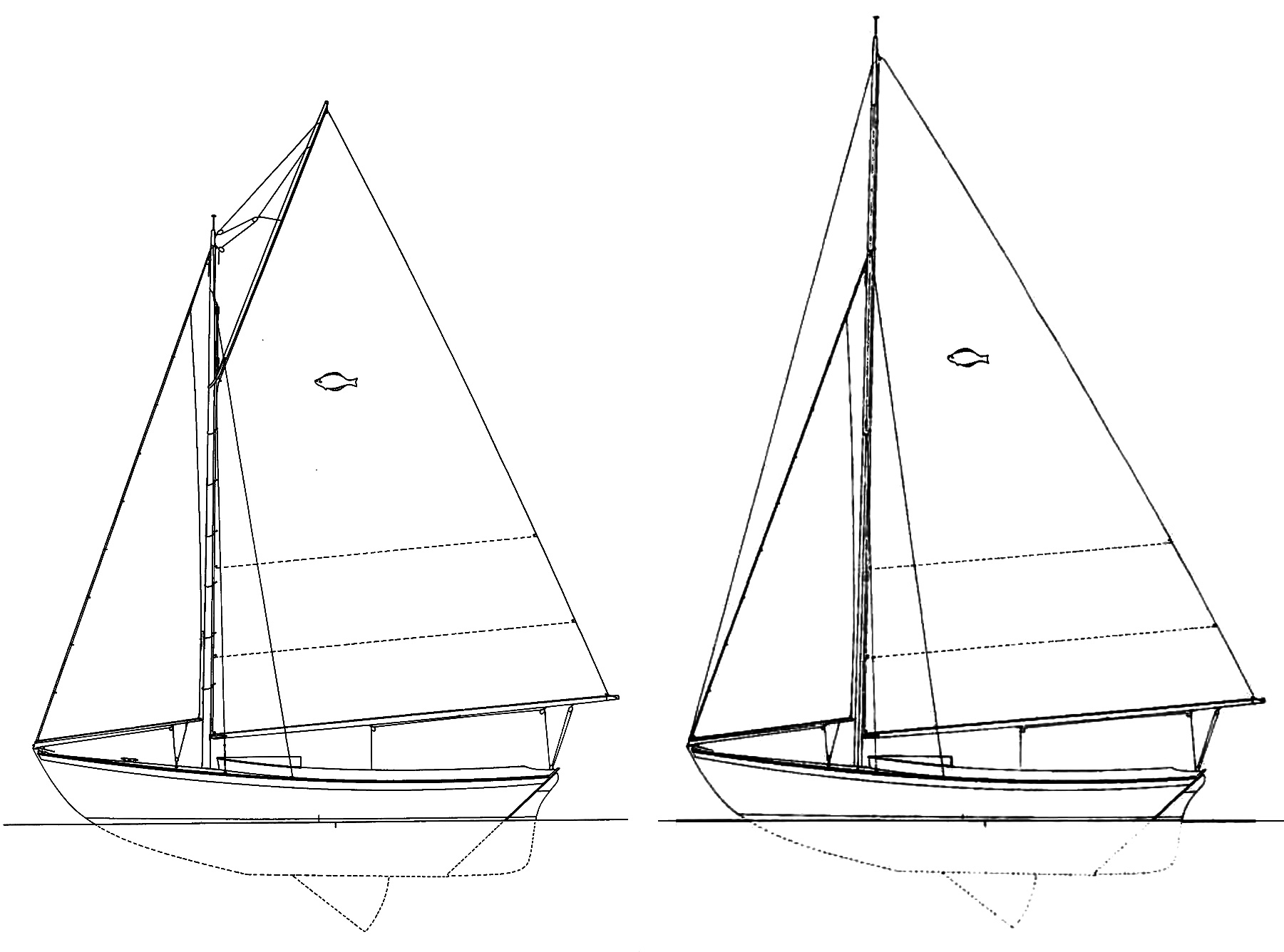
Joel White’s Flatfish design is a centerboard modification of the N.G. Herreshoff−designed Fish class, which is an enlargement of the legendary Herreshoff 12½. A builder may choose the gaff sail plan (left), or Bermudan (right).
The 20′3″ Flatfish sloop, created by Joel White, is a larger cousin to the boat that many folks consider the finest daysailer at the WoodenBoat School waterfront: the Herreshoff 12½ (see WB No. 300)—the timeless Nathanael Herreshoff design known in various iterations as the Buzzards Bay 12½-footer, Buzzards Bay Boys Boat, Doughdish, or Bullseye.
In WoodenBoat No. 57, Maynard Bray explains the genealogy that might have led to such admired characteristics. Herreshoff spent the winter of 1911–12 in Bermuda. While there, he would have observed the local fitted dinghies racing under clouds of unrestricted sail area. These dinghies were called “fitted” because the original boats were working craft fitted with racing gear for weekend sport. CONTEST, a dinghy designed and owned by Henry Masters, was a frequent winner.
The following winter, Herreshoff returned to Bermuda, bringing with him a new boat that seemed to show CONTEST’s influence: a striking bow with some hollow to the waterlines, well-proportioned sections, and a raked transom stern. ALERION, as the new boat was called, now rests at Mystic Seaport Museum in Connecticut. If you are fascinated by boat design, you might want to spend a rainy afternoon studying her hull from various angles. I did just that a long time ago, and the old boat taught me more about shape and flow than any textbook could. Go and stare. Never mind the curious gaze of casual visitors.
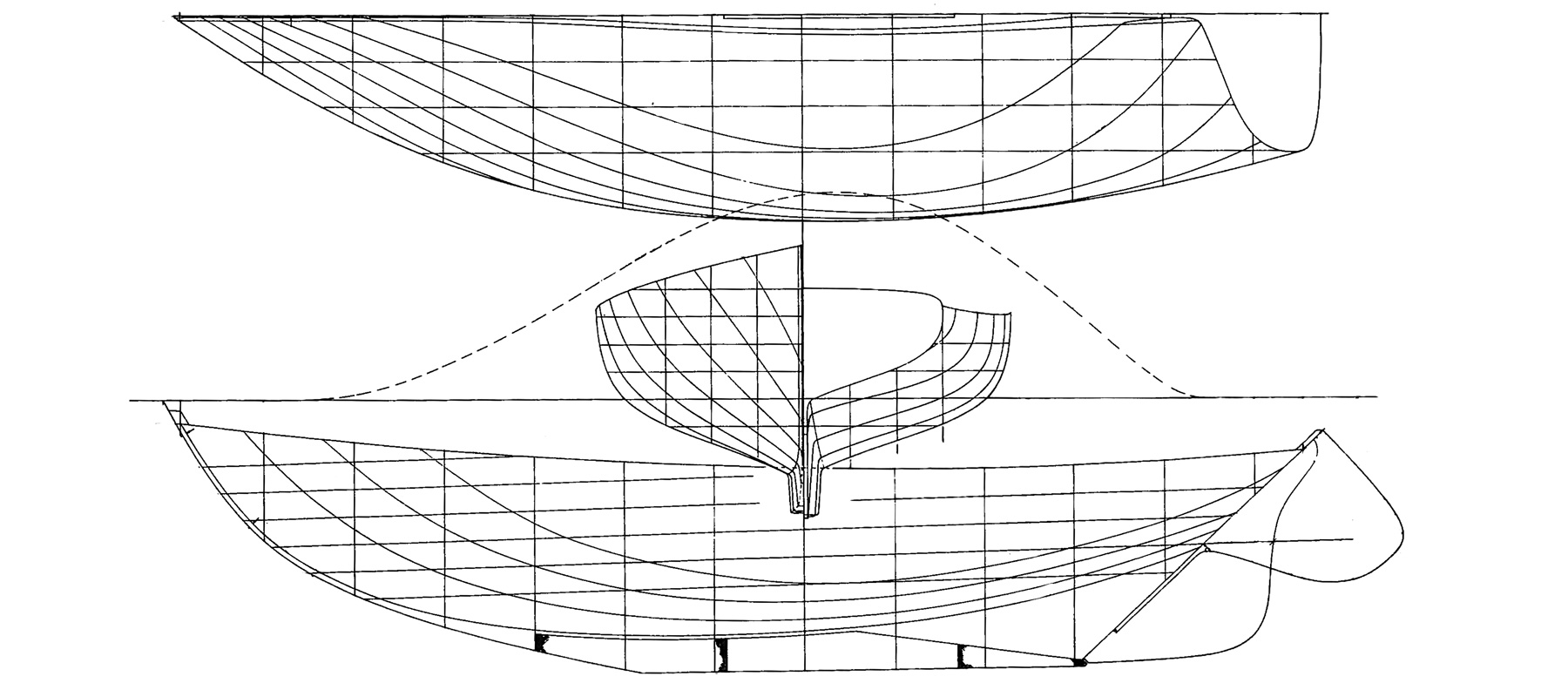
The Flatfish’s draft is shallower than that of the original Fish class, and the boat has more beam to offset this stability factor. White went to great lengths, however, to retain the character of the original boat.
In addition to the Herreshoff 12½ (15′10″ LOA, 12½′ LWL), other shape-related boats followed
ALERION: the Buzzards Bay 25 (32′6″ LOA), and the Newport 29 (35′6″ LOA) appeared in 1914. Then, in 1916, working to the model he’d used for the 12½, Herreshoff developed offsets and construction drawings for the 20′9″ LOA Fish-class sloops. By all reports, the new boat did just about everything as well as the highly regarded 12½. Of course the Fish class, with its longer waterline, often sailed faster and its small cabin offered real pocket-cruising potential.
Almost 80 years after the first Fish-class sloop hit the water, designer-builder Joel White decided to draw a shoal-draft keel-centerboard variant of that fine old boat. However, hull-lines drawings for the Herreshoff design were unavailable. Fortunately, an unrestored Fish named MERRY HELL was at Mystic Seaport, and so was Maynard Bray. He measured that boat and passed the results to White, who then drew a lines plan.
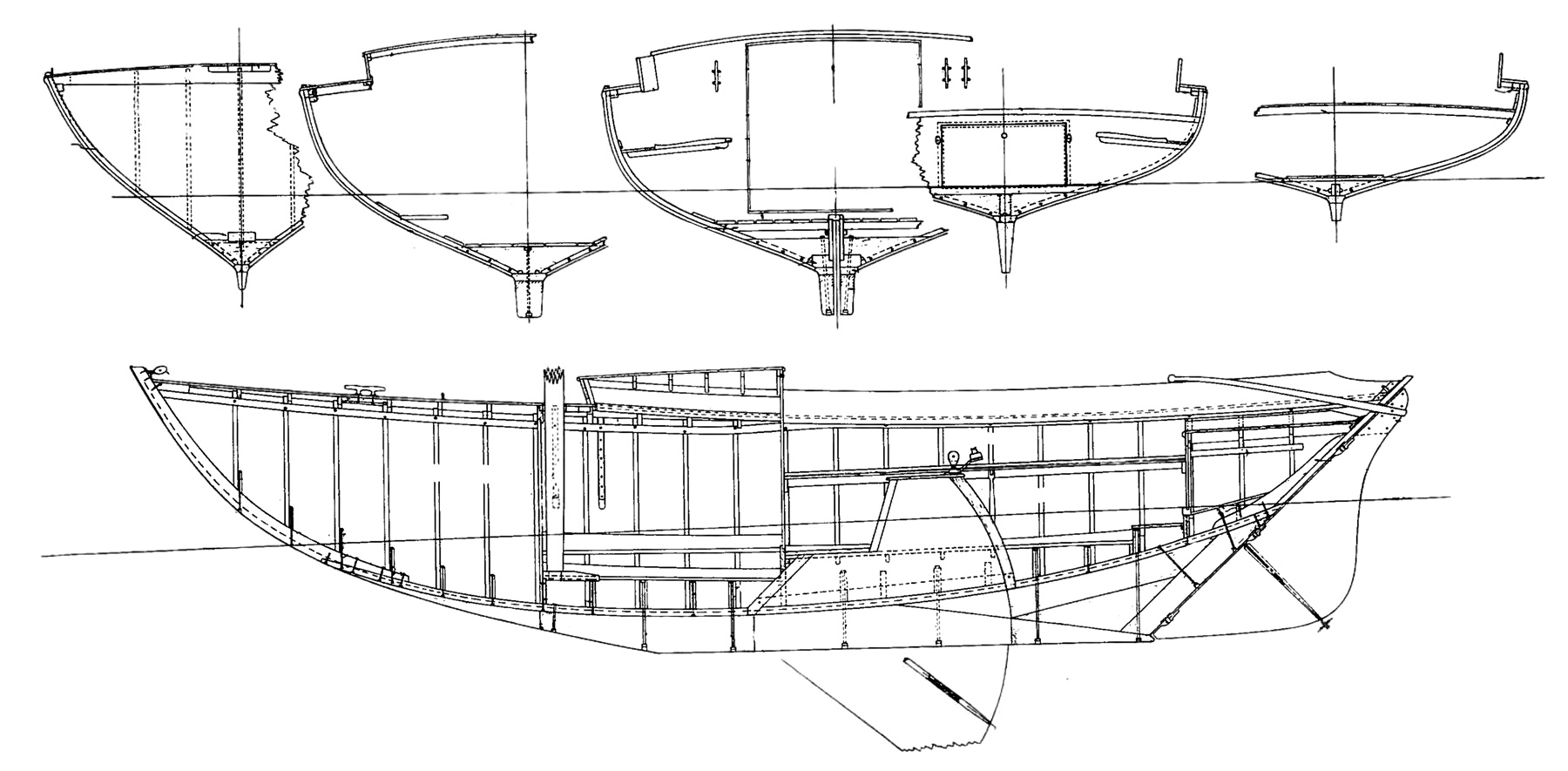
The boat is planked in ⅝″ cedar on ⅞″-square steam-bent oak frames. Cold molding is an option.
Beginning with this representation of the Herreshoff Fish-class hull, White created his Flatfish. He was determined to keep the following items unchanged: the profile above the waterline, the sail plan, stability, and displacement. To help achieve this in a hull of less draft, he increased the beam. Flatfish’s higher keel-rabbet line demanded less deadrise, but he made every effort to retain the “character” of the original sections.
The Flatfish drawings, printed on six large paper sheets, also retain the general character of the sloop’s predecessors, including the scantlings. Thus, we’re instructed to build the hull plank-on-frame, with ⅝″ cedar strakes over ⅞″ × ⅞″ steam-bent oak frames. White does stray from tradition slightly where updates make good sense. For example, the deck and cabintop will be of ⅜″ mahogany plywood sheathed with Dynel set in epoxy instead of canvas-covered cedar.

With it’s wider beam, the Flatfish’s cockpit is roomier than that of the Fish class.
Some years ago, White performed similar design surgery on the much-loved Herreshoff 12½ to create the keel-centerboard Haven 12½ class. Several examples of both types spend their summers at the WoodenBoat waterfront. They often sail in company, and they race in the same fleet. The difference in performance, if any, is so fine as to be masked by variations in the quality of sails and crews. Both classes sail so well and feel so good. To many of us they look equally beautiful.
The Haven’s cockpit is slightly roomier, and firmer bilges give it more initial stability than its older near-sister. For a detailed description and comparison of the Herreshoff and Haven 12½-footers, see “The Commencement Boats” in WoodenBoat No. 300.
Joel White’s 20′ Flatfish combines the happy traits of its smaller cousins with more speed, more space, and the chance for weekend cruising.
Flatfish Particulars
- LOA: 20′3″
- LWL: 16′1″
- Beam: 7′6″
- Draft (cb up): 2′2″
- Draft (cb down): 4′3″
- Displacement: 3,100 lbs
- Sail Area: 268 sq ft

Mike O’Brien is boat design editor for WoodenBoat.
Flatfish plans are available from The WoodenBoat Store, P.O. Box 78, Brooklin, ME 04616; 800−273−7447; www.woodenboatstore.com.