Still need introduction for Launchings from Matt…

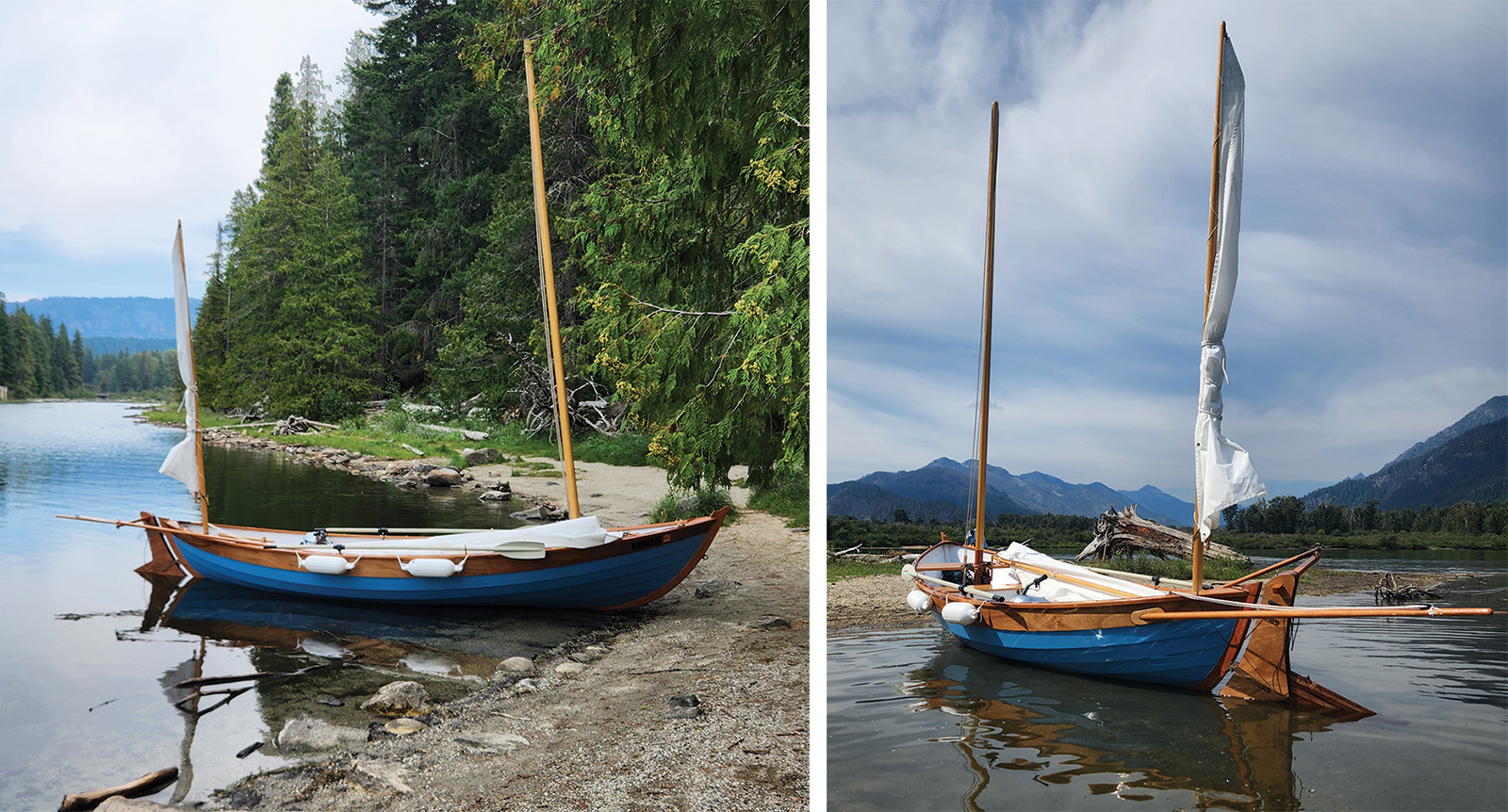
SUMMER WIND

SUMMER WIND

Photos by Jerry Ellefson

After 35 years as a commercial fisherman, Jerry Ellefson of Tacoma, Washington, retired and found himself boatless and missing the water. He decided to build a boat and after studying many designs, settled on Iain Oughtred’s Caledonia Yawl II, which has seven strakes rather than the four in the original version. The 19′6″ double ender carries a balance-lug main and a leg-o’-mutton mizzen. Jerry got a jump start on construction by ordering a kit from Hewes & Company of Blue Hill, Maine. It included CNC-cut planks, molds, centerboard, and parts for the kick-up rudder. Jerry made the mainmast from spruce in bird’s-mouth fashion; the resulting hollow spar is lighter and easier to step than a solid-wood one. He spent 18 months on the project and launched SUMMER WIND in June 2025. He sails her mainly on Puget Sound.
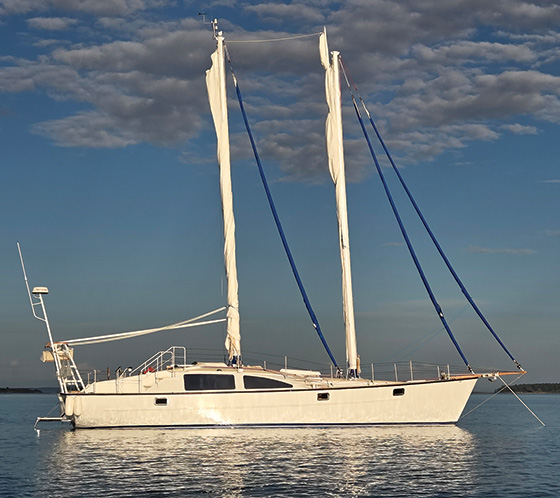

PERSEA

Photo by Risa Olekshy

Few people would have the patience and persistence to spend 18 years building a boat and then have to haul it 1,200 miles overland to get it afloat. PJ Marchyshyn and Risa Olekshy of Dauphin, Manitoba, Canada, did just that to launch PERSEA, their 49′×12′ sharpie schooner. PJ, who is 6′8″, couldn’t find plans for a boat that would fit him, so he designed one himself with accommodations that Risa, at 5′4″, would find “palatial.” PJ picked up woodworking skills from his carpenter father and had several other boats before PERSEA. He built her hull with strip-planked spruce sheathed with carbon fiber and fiberglass. Risa helped with the boat when she could and kept the household running. What they had envisaged in 2008 as a five-year endeavor concluded with the launching in Richmond, British Columbia, in the spring of 2026.


15′6″ flat-bottomed skiffs

Photo by Ron Dunlap

In early 2025, Coulson Bayne and his father, Mark, doing business as Sons of Bayne Boatworks in Mount Pleasant, South Carolina, were commissioned by a film production company to build two boats as props for a movie. The short film, titled Bateau, is a period piece set in the waters near Charleston in the 1870s. The 15′6″ flat-bottomed skiffs were not built to a documented type but are generic representations of the local bateaux that were built and used by the region’s subsistence fishermen. Rather than replicate traditional construction, the Baynes built the boats with okoume plywood, clench nailed. A dark mottled finish and thole pins give the boats the look of the 19th century. The film is to be released late in 2026; one of the boats will be exhibited in a maritime culture center at the University of South Carolina in Beaufort, and the other in a small museum in Charleston.


SECOND ONE

Photos by Blair Landry

Ken Morine, retired after a 36-year career as a mechanical designer, lives on the southwest end of Cape Breton Island in Nova Scotia, Canada. Some 15 or 20 years ago, with Eric Dow’s How to Build the Shellback Dinghy as a guide, Ken built his first Shellback in the workshop over his garage. The finished boat, FIRST ONE, spent many summers at Ken’s lakeside cottage on Gully Lake in central Nova Scotia before being sold. In 2022, he decided to get back into boatbuilding with a strip-built rowboat and not long afterward he decided to build another Shellback, like FIRST ONE, with mahogany and mahogany plywood, but lighter, with a ⅜″ instead of ½″ plywood bottom. Progress on the boat was delayed for a year by a surgery and recovery, but Ken finished the boat in the summer of 2025 and christened it SECOND ONE.


Ukaibune

Photo by Douglas Brooks

Douglas Brooks began building boats in 1980 as a college student enrolled in the Mystic-Williams Ocean and Coastal Studies Program at Mystic Seaport Museum in Connecticut. Ten years later, he moved to Japan, where he met several boatbuilders and in 1996 began a series of apprenticeships with master builders. Most recently, in February 2026, Douglas worked with Tenkyou Hirofumi, the last traditional-boat builder in Miyoshi in the Hiroshima prefecture, to build an ukaibune. The 30′ boat is made of cedar, carries a crew of three, and is propelled by paddle and pole. It is unique to the region and used for cormorant fishing. The ancient technique uses tethered cormorants to dive and catch fish. Cords tied around their necks keep the cormorants from swallowing large fish while allowing them to feed on the smallest. The ukaibune was launched on the Basen River in February 2026.


LOBSTAH

Photo by Tom Jackson

Although Sean Koomen was born in California and grew up on a farm in Minnesota, a visit to Maine was all it took for him to fall in love with lobsterboats. He moved to Maine and worked at Brooklin Boat Yard for a few years. He got to know lobsterboats well. Then, 10 years ago, inspired by Doug Hylan’s D’Anna, a blend of working lobsterboat style and amenities for comfortable cruising, Sean lofted his own take on a lobsterboat. But it wasn’t until he was coming to the end of a stint as an instructor at the Northwest School of Wooden Boatbuilding in Port Hadlock, Washington, that work on the boat began. The 30′× 8′6″ LOBSTAH was commissioned by Sean and his father and was built at the school, providing students with a wide array of skill-building projects. She was launched in April 2026 at the Point Hudson Marina in Port Townsend.


TOADFISH

Photo by Chris Morejohn

Nathan Shawl and Chris Morejohn bring a wealth of experience to boat design and construction. In 2016, Nathan suggested they join forces to design a seaworthy 38′ motor cruiser to carry two in comfort for months-long outings. Chris does his design work with pencil on vellum; Nathan’s expertise is in putting drawings into CAD files. They produced plans and CNC cutting files for the Anomura 20, borrowing the scientific name for hermit crabs. The boat, built of fir plywood, fir, and spruce, and sheathed with ’glass and polyester resin, is 20′ long, has a beam of 8′, and draws 12″. A 9.9-hp outboard pushes the boat at a top speed of 6.3 knots. She was christened TOADFISH at her December 2025 launching, and Nathan and Chris did winter sea trials on the Salish Sea. They then kept the boat near Chris’s house on Hornby Island, British Columbia. In April 2026, they embarked on a five-month cruise to the Great Bear Rainforest on British Columbia’s north coast.


JOYCE

Photos by Jack Wisnicki (left) and Chris Spring (right)

Chris Spring of Osgoode, Ontario, Canada, has always been fascinated by early 20th-century marine engines and among those he has collected is a 21/2-hp Kingfisher two-stroke. It hadn’t run in 50 years and was showing its age, but its copper jacket and brass name plate impressed Chris. The engine deserved not only a restoration but also to be put to use somewhere it could be seen and appreciated. It needed a boat. His research led him to plans for a 1905 12′ Lawley tender. Chris had long been fascinated by boats too, but he had never built one. As he began work in 2023, he had to teach himself to loft, spile, steam-bend, bevel carvel planks, and rivet. In June 2025, he finished the boat, trailered it to the Rideau Canal, and christened it JOYCE after his mother.


TUBBY

Photos by Alex Stone

Built in 1898, the gaff-rigged trading cutter KATE is among the oldest active sailing vessels in New Zealand. She has had a series of owners and most recently was purchased by the Waiheke Working Sail Charitable Trust, restored by naval architect Bernard Rhodes, and put back into service as a youth training vessel. She needed a new tender that could carry her full crew yet be light enough to carry on her cabin top. Bernard designed and, with a bit of help from two youngsters, built a 10′ lapstrake plywood skiff. Christened TUBBY, she was launched in December 2025 at Surfdale on Waiheke Island, just inshore from KATE at her mooring. Shortly after the launching, in 3′ of water with abundant supervision and life-jacket requirements suspended by local authorities, TUBBY underwent a load test to see how many young crew members she could carry.


CARIBE

Photo by Scott Tinney

In 1920, on Man O’ War Cay in the Bahamas, Maurice Albury began building sailing dinghies for sponge harvesters. During the 1900s he was just one of more than three dozen boatbuilders on the island who were, like him, descendants of Benjamin Albury, a sailor shipwrecked there in 1820. In 1952, Maurice’s sons Willard and Ben took over the business and established Albury Brothers Boats. In 1958, they built a 28′ powerboat originally named SEA BELL, then DOWNWIND, and now CARIBE and owned by Scott Tinney of Rocky Point, North Carolina. With the occasional help from skilled friends, Scott undertook a year-long overhaul and replaced many frames and all of the planking below the waterline. He would store boat on a trailer, so ’glass sheathing added to the bottom would prevent leaks caused by dried and contracted planking. The motor, a 240-hp Yanmar diesel, was pulled and reconditioned and all the wiring and electronics were replaced. CARIBE was relaunched in July 2025 on the Northeast Cape Fear River.


WASP

Photo by Nick Voulgaris III

WASP, a Herreshoff 12½, was built in 1941 and purchased by Nick Voulgaris III in 2004. He had grown up on the north coast of Long Island in Huntington, New York, and had often sailed on old boats, developing an appreciation for them, which later grew into an impulse to preserve them. While in college, Nick apprenticed at the Herreshoff Marine Museum, cementing his love of classic boats. He is the author of several books, including three about classic yachts and a cookbook featuring farm-to-table recipes from a Huntington-area farm that was founded the same year his 12½ was built. Nick sailed WASP for almost 20 years and kept her seaworthy by making repairs and upgrades as the need arose. During that time, he put in about 20 new steam-bent frames and replaced floor timbers, garboards, and the after deck. In 2023, WASP was in her 80s and due for a complete restoration. Nick commissioned the IYRS School of Technology and Trades in Newport, Rhode Island, to do the work, and she was relaunched in May 2025 as part of the school’s graduation celebration.


FORTNITE

Photo by John Leyde

In winter 2020, John Leyde of Arlington, Washington, and his two grandsons, then 11 and 9, built a Sam Devlin–designed Bella 12. The project was an educational experience for the boys and a rationale for John, a serial boatbuilder, to build another boat. They launched FORTNITE, named after a popular video game, in April 2020 on the lake near John’s home. After five years of being exposed to elements, the boat needed restoration. With a bit of help from his grandsons, John hauled her back into the shop and then, to get rid of the worst of the damage, cut about 2′ off the stern. He rearranged the interior, in effect converting the boat into a Devlin Bella 10. With the boat smaller and the boys bigger, they can’t row together as they once did, but John finds FORTNITE much handier for his own solo outings.


These pages, along with the Boat Launchings section of www.­woodenboat.com, are dedicated to sharing recently launched wooden boats built or restored by our readers. If you’ve launched a boat within the past year, please email us at launchings@woodenboat.com, or write us at Launchings, WoodenBoat, P.O. Box 78, Brooklin, ME 04616.

Please include the following information:

  1. The boat’s length and beam;
  2. The name of its design class or type;
  3. The names of the designer, builder, owner, and photographer;
  4. Your mailing address along with an email address or phone number;
  5. The port or place of intended use;
  6. Date of launching; and
  7. A few sentences describing the construction or restoration. Send no more than five photographs (jpg images at 300 dpi) and enclose a SASE if you want anything returned.

Hints for taking good photos of your boat

  1. Set your camera for high-resolution images. We prefer jpg format, at 300 dpi minimum.
  2. Stow fenders and extraneous gear out of the camera’s view. Ensure the deck is clean and uncluttered.
  3. Take your photographs in mid-angle sunlight for best results. Mid-morning or mid-afternoon usually work well.
  4. Keep the horizon level and the background simple and scenic so your boat stands out from its surroundings.
  5. Take some pictures of the boat underway and some at rest. Often a vertical format works well for sailboats. Shoot a lot of images, then send us your five favorites.

We enjoy learning of your work—it affirms the vitality of the wooden boat community. We receive so many submissions that there is not room in the magazine for all of them to be published. Launchings not printed in the magazine can be seen at www.woodenboat.com/boat-launchings. Article ends.