
 Ed Tupper
Shad boats, which are the Official State Historic Boat of North Carolina, were first conceived as small sailing vessels after the Civil War and shifted to power in the early 20th century. While their use has diminished, their broad utility as powerful open workboats—and cultural emblems—still attracts passionate watermen.
The North Carolina shad boat is emblematic of the post-Civil War–era South. It embodies innumerable aspects of this period of its region’s historical resource use and development patterns. The changes it has gone through in design, power, and function perfectly mirror a unique slice of Americana.
A shad boat is a utilitarian, carvel-planked workboat built on a carved “bottom piece” as opposed to a standard keel. Usually about 24′ long, they were adaptations of earlier dugouts called kunners. The original shad boats of the late 1870s were designed for sail, but later versions were adapted for inboard engines; combined with a shortage of materials such as naturally crooked knees, these powered shad boats began to take on the qualities of a “deadrise” hull type. This evolution has led to some controversy as to whether the later versions are, in fact, shad boats, deadrise shad boats, or round-chined deadrises. Most people on Roanoke Island tend to lean toward a broad definition and embrace all versions as the shad boats that have become an important part of their identity.
 Smithsonian Institution Archives
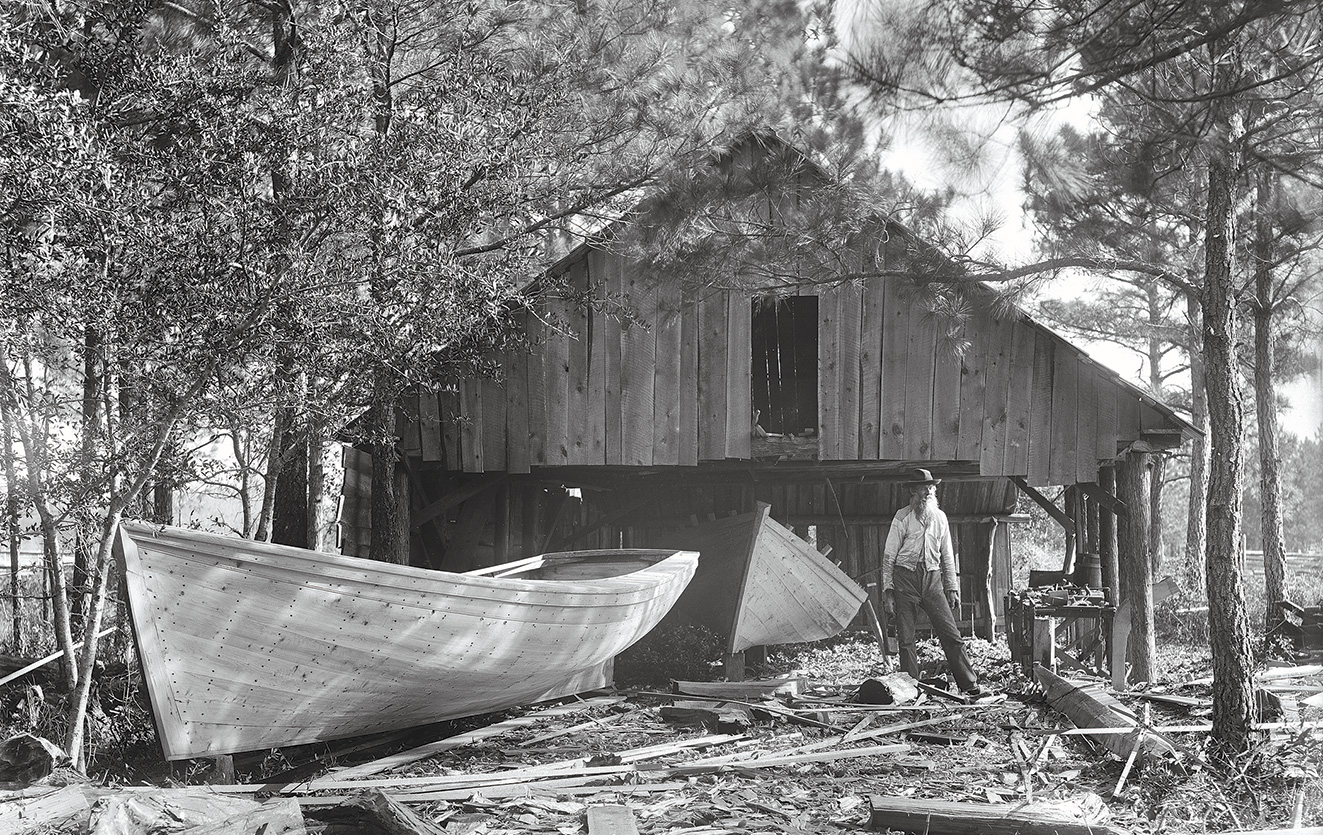
George Washington Creef likely designed and built the first shad boat in the late 1870s. He is shown here at his Wanchese, North Carolina, shop with two shad boats in progress.
George Washington Creef of Wanchese, North Carolina, is credited with designing and building the first shad boat in the late 1870s. Various builders around the tidewaters of Dare County continued to build shad boats and tweak the design for 50 years or more, marking the shift from the age of sail to that of the internal combustion engine, and in 1987 the state legislature designated it the Official State Historic Boat of North Carolina. While shad boats have been employed in many of the state’s tidewater fisheries, they are more than just utilitarian workhorses for artisanal fishermen. Ingrained in their sweeping lines and seakindly forms are myriad influences that go back thousands of years to the Croatoan tribe of the Outer Banks.
Ben Brown of Wanchese has a passion for shad boats that goes back to his childhood, which wasn’t so long ago. “I have been studying them since I was little boy,” says the 23-year-old fisherman and boat carpenter. “I don’t know what it is; something about them.”
Brown recalls his father buying him an old skiff when he was 12 years old, and he credits that boat with teaching him most of what he knows about boat carpentry. “It was one disaster after another. One time I was digging rot out of the side, and I dug out so much I didn’t know how I could fix it, and I fell down on the floor and I was crying and my dad grabbed me and said, ‘You got this. You’ll figure it out.’ And I did. I learned a lot from that boat. I learned there’s always a way to fix something.”
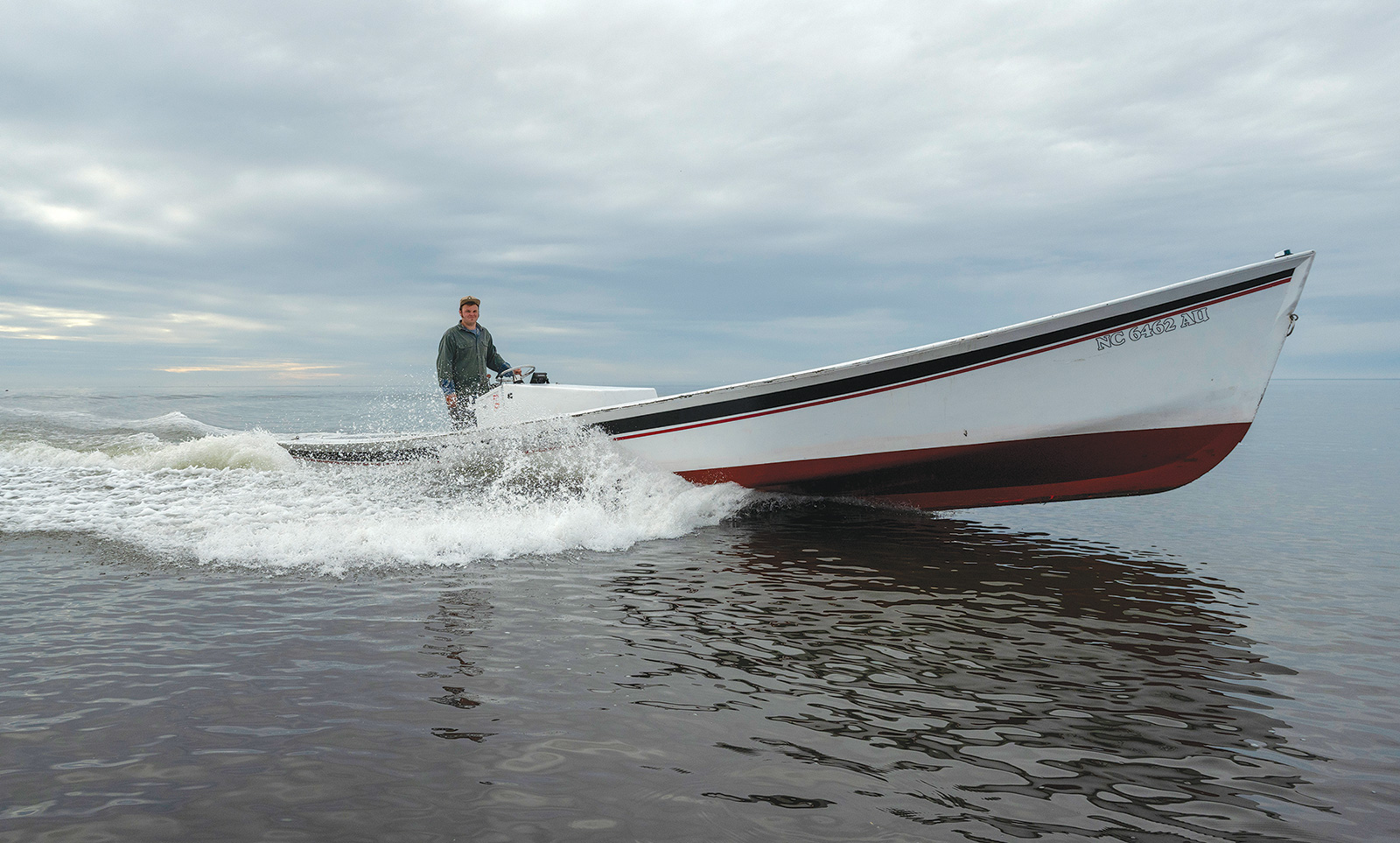
When he heard his uncle was selling a shad boat built in 1980, Brown went over to the mainland to talk to him. “I told him I wanted to buy it. He had another one but hadn’t been using it. So, it was in bad shape. It had some rot in the false deck, and the engine box was all rotted. We made a deal, and I brought it home around June of 2020, and was hoping to have it ready by Fourth of July.” Brown spent a solid week scraping the layers of old paint off the 30′-long, 7′-wide boat. “I never want to see that baby-blue color again,” he says.
After replacing the rotten decking and building a new engine box using closed-cell foam, Brown had the boat in the water by late August. “I filled the seams with epoxy and fiberglassed the top of the washboards,” he says. “It looked like it had a coaming at one time, and I thought about putting that back on, but I changed my mind.” Brown painted the inside gray, the outside white, and the bottom red. He added a dark-blue stripe under the toerail. He named it the MISS MARSHA, after his grandmother. “I think the world of her,” he says. “She saw it in the water, but I never did get to give her a ride in it before she died.”
In 2023, ribbonfish showed up off the coast of North Carolina, and fishermen were getting more than $3 per pound for them. Brown took his shad boat out to catch what he could. “Every day I went out there, they’d be talking about my boat on the radio,” he says. As far as Brown knows, the boat came from Buxton. “That’s down near Cape Hatteras. Mike Scott built it,” he says. “I think of it more as a replica. But I’ve never actually talked to him about it.”
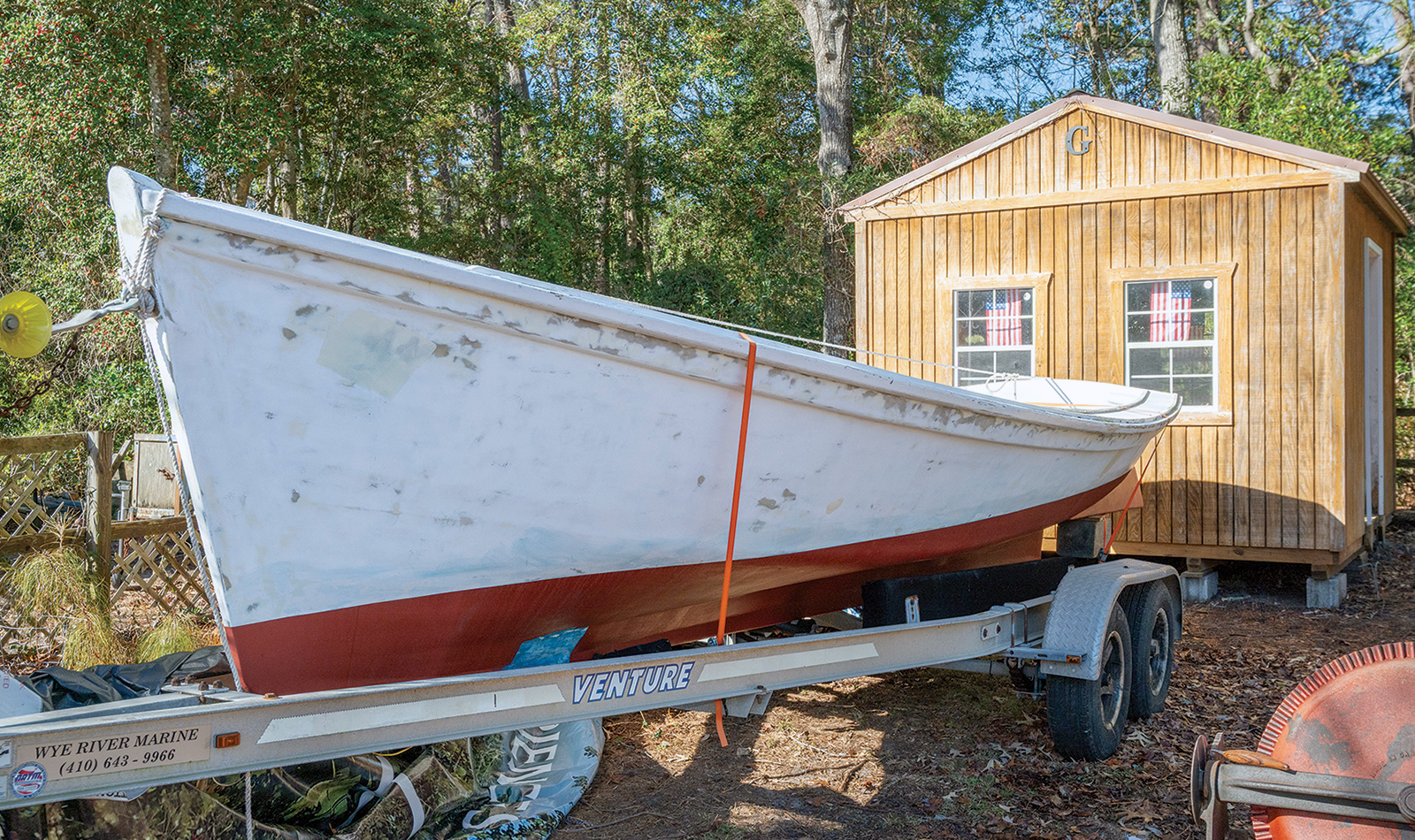
With the MISS MARSHA in the water, Brown bought a second shad boat, a 23-footer built in 1928. “An older woman told me that Belov Tillit built it. I think that’s how you spell his name.” Brown adds that he likes the lines a lot better. “It’s more of the classic shad-boat shape,” he says. “One side of the engine bed was rotten. Once I get that fixed I’m going to put a 350 marinized Chevy in her. I don’t mind having lots of power.”
Shad boats are built on a carved Y-shaped keel—the “bottom piece”—made of cypress. Builders fasten sawn frames, generally of white cedar—known locally as juniper—to the wings of the bottom piece, as the keel is called. The frames can be made of multiple overlapping pieces to maintain strength around the turn of the bilge, and the hulls are carvel-planked with juniper. Shad boats usually are fitted with wide washboards—or lookouts, as Brown calls them—supported by knees.
The classic shad boat is radically different from the types of workboats George Washington Creef had been building before the 1870s, but within its design and construction can be found traces of earlier tidewater boats, including the Croatoan dugouts. Archaeologists in the region have discovered dugouts from 2500 B.C. John White arrived on Roanoke Island in 1587 to re-establish Sir Walter Raleigh’s colony, which Governor Ralph Lane had abandoned a year earlier. White was something of an artist, and he drew pictures of Croatoans using dugouts to fish and tend their weirs. His drawings show them catching drum, hammerhead sharks, shad, pompano, and other species; chroniclers of the time state that Native fishermen could fill a basket with fish in less than an hour.
White’s drawings also show the Native boatbuilders using fire and stone adzes to shape dugout canoes from the massive cypress trees that once grew in the swamps around the sounds. These were the boats that the Colonial boatbuilders used as the basis for their adaptations. Two split cypress trees fastened to a central keel created a wider, deeper boat known as a periauger. Often fitted with two masts, periaugers served as the transport vessel of choice in Colonial times. Plantation owners used them to carry cotton and tobacco to coastal ports, and they were likely used in the emerging shad fishery.
Before building shad boats, Creef reportedly built kunners, which the historian David Bennett refers to as a smaller version of the periauger. A kunner on display at the North Carolina Maritime Museum in Beaufort offers an example of the method of fastening two carved split cypress logs to a center piece that served to widen the boat and sometimes formed a keel. The museum’s kunner has a shaft bored through the center log, indicating it was still being used when fishermen moved from sail to internal combustion in the early 20th century.
Up until August 2025, I had only seen photos of shad boats, but one hot day, as Hurricane Erin churned east across the Atlantic, I found myself aboard a broken-down fishing boat, the 46′ gillnetter LANDON BLAKE, lying on anchor a mile off Hatteras Island. The problem turned out to be a blocked fuel line, and after jury-rigging a fuel supply line to the engine, her owner, Tommy Danchise, got us back to Wanchese on Roanoke Island. “I hate being towed,” he said.
While waiting for a mechanic, Mr. Tommy, as the locals call him, invited me to jump into his truck. We drove down the road a couple of miles and pulled into the yard of Jay Hooper. Up on blocks sat a shad boat beyond repair, a couple of canvas straps were all that held it together. But all the pieces were there, more or less, including the carved cypress keel. “Calvin Paine and a man named Pierce built that in 1945. My father had it,” Hooper said.
 North Carolina Department of Natural and Cultural Resources
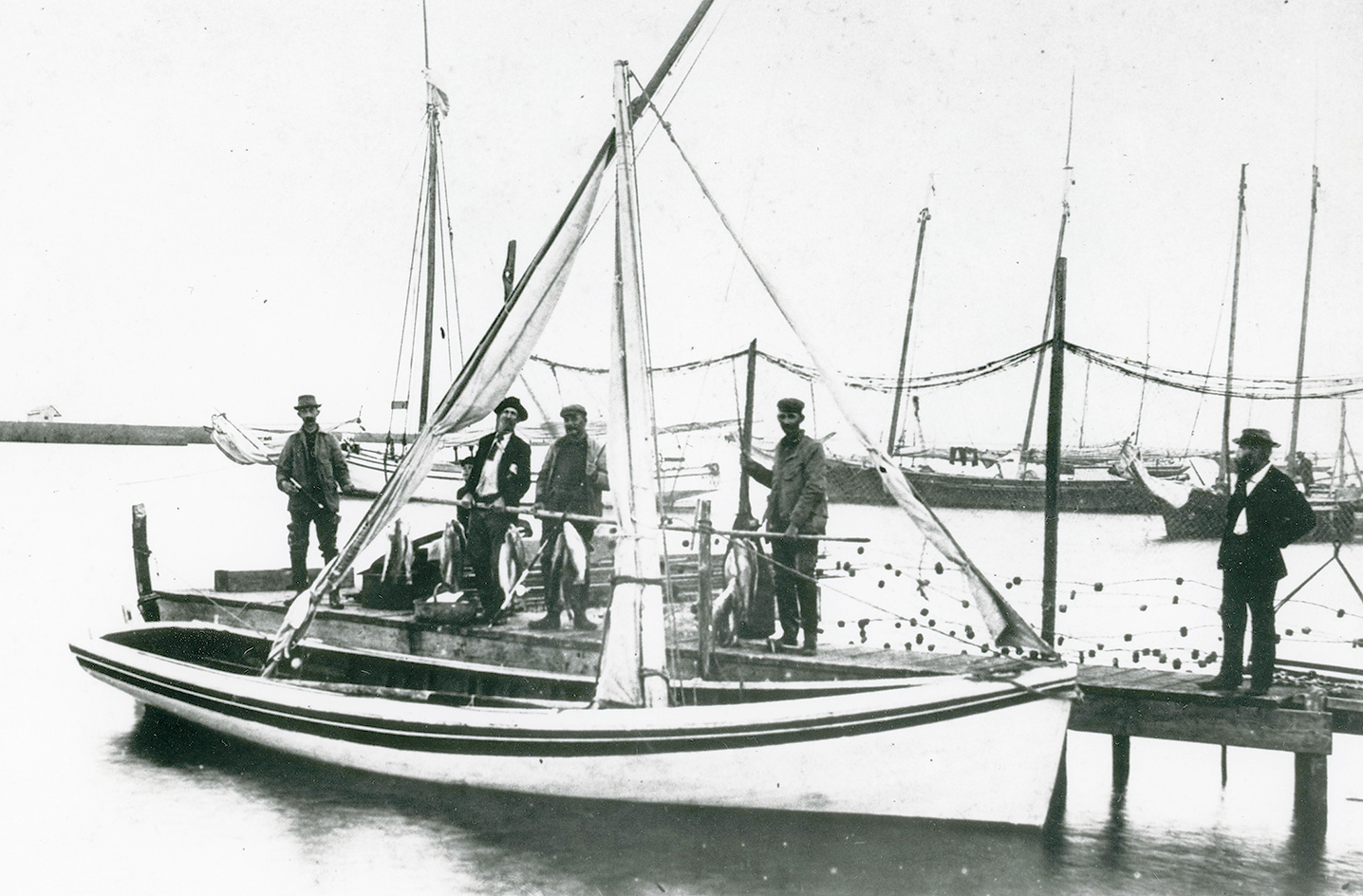
Shad boats at a dock at Manteo, North Carolina, around 1910.
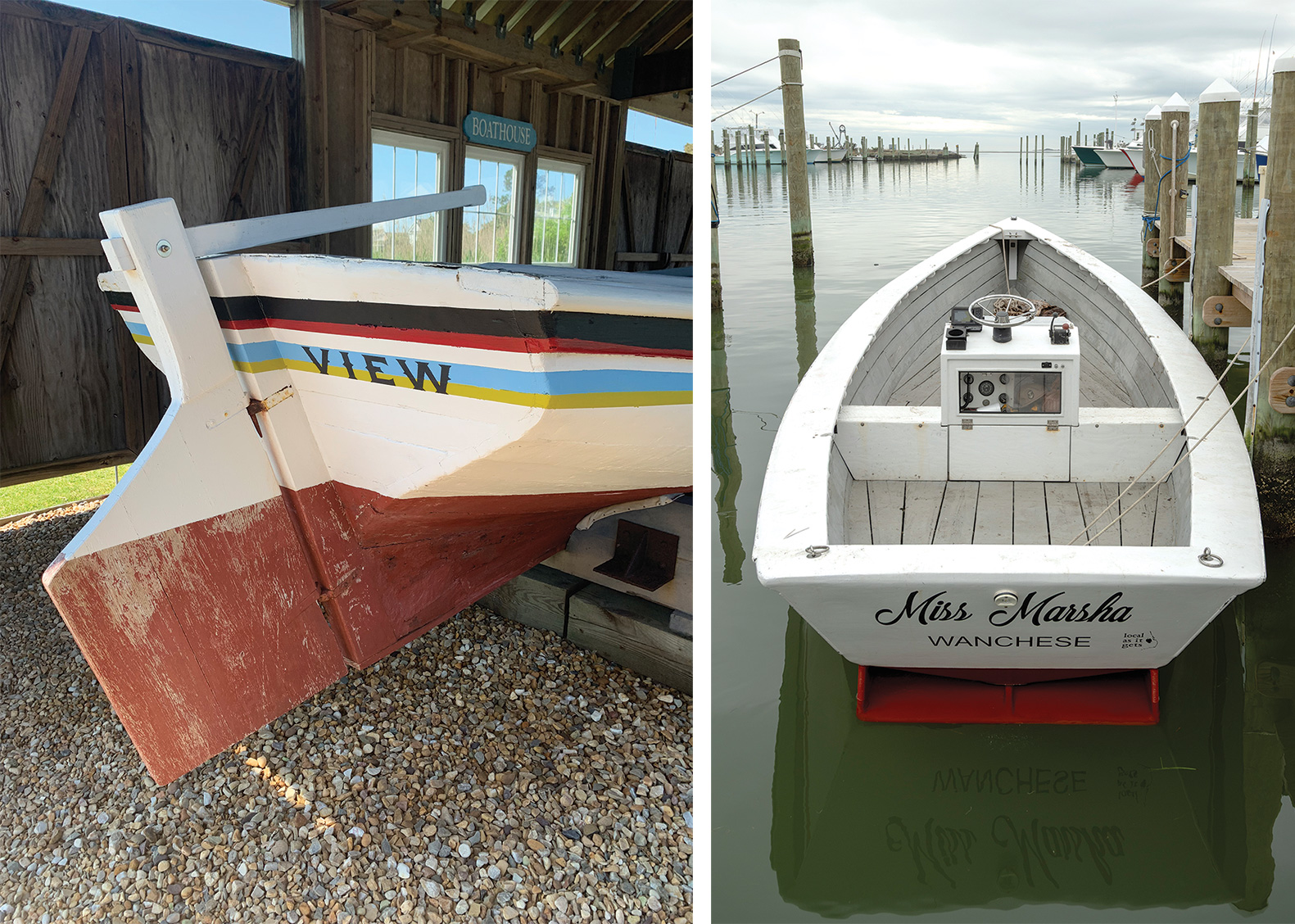
Next stop on Tommy’s shad-boat tour was the Roanoke Island Maritime Museum in Manteo for a look at the ELLA VIEW, a true classic shad boat, built in 1883 by G.W. Creef himself. The 24′ ELLA VIEW has a rounded hull with frames cut from juniper stumps where the roots turn out, capturing those natural curves. It has a centerboard trunk, and a large rudder hangs from a raked heart-shaped transom.
She has a lot of what Brown and others call “tuck,” where the bottom rises up to the transom, and the vessel is clearly built for sail. From the top, she looks like most of the shad boats that would be built after her, widest just forward of amidships, and with a wide washboard and a short coaming. There is a hole in the forward “thot” as the locals call the thwart, and a maststep on the cypress keel. Like most shad boats, the ELLA VIEW has a gentle sheer and a sharp stem raked to form a crisp obtuse angle where it meets the keel.
A photo exists of Creef in his yard, adze in hand, flanked by two finished shad boats and a cypress keel he is carving. The ELLA VIEW is one of “Wash” Creef’s earliest boats, and thus a model for the thousands of shad boats that came after her, although design changes occurred driven by availability of material, cost of construction, and the shift to inboard engines.
 Wikimedia Commons (left), Ed Tupper (right)
Left—The 24′ shad boat ELLA VIEW, which is now on display at Roanoke Island Maritime Museum in Manteo, was built in 1883 by George Washington Creef. As her heart-shaped stern and outboard rudder suggest, she was built to sail. Right—Contrast ELLA VIEW’s stern with that of MISS MARSHA, which is equipped with “hobbles,” or primitive trim tabs, to assist her in planing.
Like the ELLA VIEW, shad boats averaged about 24′, though some, like the MISS MARSHA, reached 28′ or 30′. They were the workboat of the common man and filled a need in the post–Civil War fisheries of eastern North Carolina.
Before what historian Charles Heath calls the War between the States, North Carolina’s shad fishery was a major enterprise. In his 1997 paper, A Cultural History of River Herring and Shad Fisheries in Eastern North Carolina, Heath documents the development of the fishery from small-scale to an industrial enterprise. “Commercial fisheries slowly developed in Colonial North Carolina,” he wrote. “By the end of the 1760s, however, commercial river-herring fisheries were well established in the Albemarle region, particularly in the Edenton area and on the Roanoke, Chowan, Neuse, and Meherrin Rivers.”
Heath, drawing from earlier research, told the story of large-plantation owners along the shores where shad passed, using hand-hauled seines as early as 1762. By the early 1800s, he noted, fishermen had started to use windlasses to haul the seines and started landing larger and larger quantities of shad. The plantation owners invested what today would be millions of dollars in their haul-seine fisheries.
In his paper, Heath cited the 1840 census, which records that haul-seine fisheries in the Albemarle Sound region produced 63,185 barrels of shad and river herring. He noted that chroniclers of the mid-19th century fishery all described large-scale river and sound fisheries that regularly landed 300,000 to 500,000 river herring in single hauls.
“In the 1850 Federal census, Bertie County alone claimed seven large-scale haul-seine fisheries with an annual production of approximately 11,000 barrels of fish, primarily shad and river herring,” Heath wrote. “By 1852 there were a total of 70 large-scale and small-scale haul seine operations on the Albemarle Sound and its tributary rivers. Twenty-eight haul-seine operations on the Albemarle Sound purportedly employed a seasonal work force in excess of 5,000 laborers.”
But fishing pressure and habitat loss took their toll on the fishery. By 1850, Heath noted, production had declined by 30 percent to 42,197 barrels, and by the 1860 census the numbers were way down, with only 13 fisheries around the sound producing just 7,513 barrels.
Then came the Civil War and the blockade of the South, known as the Anaconda Plan. In August 1861, a joint U.S. Navy and Army operation captured Fort Hatteras and Fort Clark, closing Hatteras Inlet. Then, in February 1862, another combined Army and Navy operation, the Burnside Expedition, took control of Albemarle Sound and Pamlico Sound. According to Heath, “Many fishing operations of the commercial variety were temporarily, but effectively, terminated.”
Heath noted that the occupation of eastern North Carolina by Union forces limited the Confederate army’s access to the fisheries there. Union forces reportedly destroyed much of the infrastructure, burning nets, boats, and shoreside buildings. But then, in 1863, the North Carolina government itself “prohibited haul-seining operations for the duration of hostilities,” Heath wrote. “The authorities feared that catches of river herring and shad would either be confiscated by Federal troops or openly sold to them by northern sympathizers, who resided in many areas along the coast.”
The trajectory of the shad fishery before the Civil War was not unusual. Overcapitalization by wealthy plantation owners led to overexploitation at the same time that dams were being built and habitat lost. Shad stocks were crashing hard in 1860, but the war led to a rebound in demand and a ban on haul-seines led to a need for more boats to meet it. This is when the door for the shad boat began to open.
 Ed Tupper
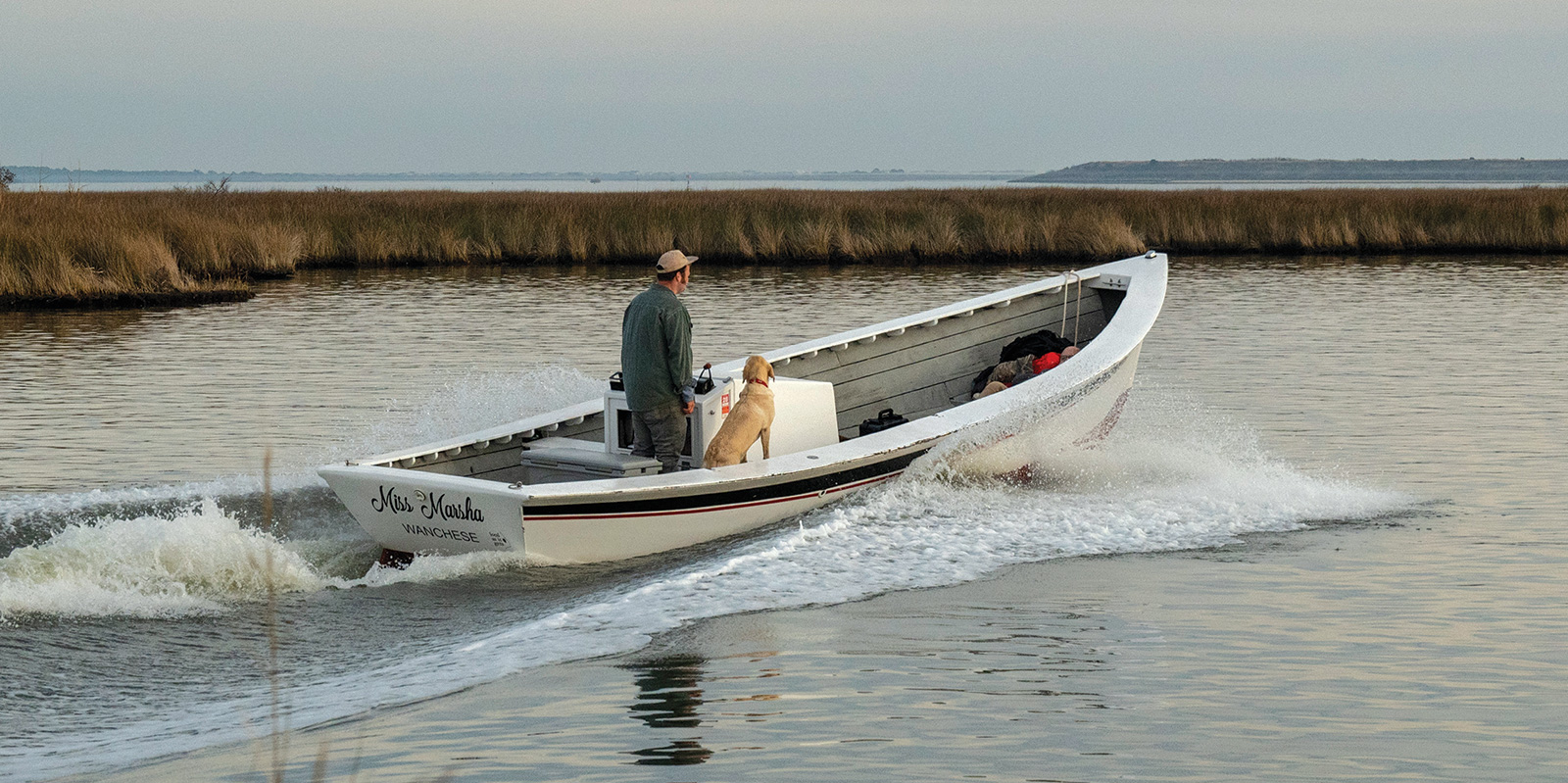
Ben Brown of Wanchese is a 23-year-old fisherman and carpenter with a passion for shad boats. He recently rehabilitated one, which he named MISS MARSHA, and is currently at work on another.
The haul-seine fishery continued but struggled due to a lack of labor in the postwar economy. Steam-powered windlasses came into use as the haul-seine fishery became industrialized. At the same time, John Pentrose Hettrick, along with his brother William, brought the pound-net fishery—by which fish are gathered into stationary nets—to North Carolina. In 1869 Hettrick, who had worked pound nets in the Great Lakes before the war, settled in Edenton, and started pound-netting near Sandy Point. The new gear he introduced provided small-scale fishermen with a means of landing large quantities of shad with a much smaller investment than needed for a haul-seine fishery. Pound nets started to account for a growing percentage of the annual shad and herring landings and as they took over the fishery, small-scale fishermen needed boats suited to the gear.
“In response to the growth and demands of the pound-net fisheries in the rough waters of Albemarle and Pamlico Sounds, North Carolina boatbuilders designed a unique work boat during the late 1870s,” Heath wrote. The specialized fishing boat came to be known as the “shad boat” or “Albemarle Sound boat.”
While George Washington Creef gets the credit for inventing the shad boat, the renowned shad-boat experts Mike Alford and Earl Willis believe he was just one of several builders working on a similar idea and sharing insights. In those post–Civil War days, the big cypress and juniper trees used for dugouts, periaugers, and kunners had become hard to find, and boatbuilders needed a design they could build with materials that were more readily available.
Alford and Willis interviewed the last of the shad-boat builders and are considered the best sources for information on the craft. “Wash Creef was building kunners,” Willis says. “But he couldn’t get the big juniper logs anymore. At the time he was doing some coastal trading down as far as the Bahamas and out to Bermuda, and we believe he saw boats like the Bahama dinghy and Bermuda sloop. He saw that plank-and-frame construction and realized that was what he needed, so he brought those ideas home.”
Willis observes that Wash Creef, as he is locally known, married the carvel plank-on-frame construction method to his long experience with kunners. “A lot of people think that fastening the frames to the bottom piece was a weakness in the design, but it turned out to be the strength of these boats,” Willis says.
 Ed Tupper
Brown’s current project is a sweet-lined 23-footer likely built by Belov Tillit in 1928.
“They used the natural-bend juniper root frames,” Willis says, noting that even some of those pieces were becoming scarce. He adds that sometimes shad-boat builders looked for days before finding juniper stumps that would produce knees with the right size and curvature for the boat they intended to build. “That was no easy task when, as was often the case, they had to trod through waist-deep water in search of the stumps. At most they could cut two root knees suitable for shad-boat frames from a juniper stump.”
According to Willis, the true shad boat is the original, rounded design that Creef developed. “The later boats are what we call the round-chine deadrise,” he says. Another shad boat expert, David Bennett, calls the later models “deadrise shad boats.”
“I think the round-chine deadrise is more accurate,” Willis says.
The scarcity of suitable materials and the shift from sail power to the internal combustion engine compelled builders to modify Creef’s design. “They had to take away the tuck,” Willis says, referring to the rise of the bottom to the raked, heart-shaped transom. “Once you lose that, it’s not a shad boat anymore,” he says. “When they went to motors, they needed to widen the transom, so it wouldn’t squat. And because they couldn’t find the juniper root knees, they had to piece the frames together. There’s a fellow named Scott Whitesides who built a real shad boat and launched it in 2003. I call it ROANOKE ISLAND, but the real name is the SPIRIT OF ROANOKE ISLAND. He glued pieces of wood together in the shape he wanted to make the frames.”
Whitesides inherited the project in spring 2002. “That’s when I came to work for the North Carolina Maritime Museum,” he says. “They had the funding to build it. At that point they had the keel laid and the frames set up with the transom and stem and ribbands holding the shape.”
Whitesides’ predecessors had laminated the frames, taking the shapes from the lofting. “They weren’t going to try and find the juniper or cypress buttresses to saw the frames from,” he says. “The same with the keel, they laminated several pieces of cypress together and then carved it out in the traditional way.”
Doing their best to hold to traditional shad-boat building practices, albeit using power tools, Whitesides sought to plank SPIRIT OF ROANOKE ISLAND the way the old-timers did it, working up from the bottom piece and down from the sheer to a point where they filled in the final gap with a shutter plank. “There’s no garboard. There’s no rabbet to fit the garboard into on the keel. With the bottom piece, the first plank just butts up against it like any plank, which does create some leak problems. You have to keep it caulked. We started there and worked up a few planks, but we put the shutter plank in the bottom, not in the middle like they used to. Putting it in the bottom made it a little easier to press it in, because there’s a reverse curve and you really have to bend it in.”
Over in Manns Harbor, Lee Craddock still fishes a few pound nets and builds boats. “I started fishing with my kin in the 1960s,” Craddock says. “I remember one time, my father and uncle came and got me out of school to help fish the pound nets. We filled one 24′ deadrise and half of another. It was about 3,000 lbs from two nets.” That’s the most shad Craddock ever saw from a fishery that had played a vital role in feeding people on the East Coast for thousands of years. “But that was nothing compared to what they said they got in the ’40s and ’50s.”
In Craddock’s yard sits a deadrise he built. “I built this one with the bottom stave planked,” he says pointing to the short planks running athwartships from the keelson to the chine. “That’s how they do it up on the Chesapeake.
“I had a shad boat that George Washington Creef built that I got from my great uncle, but it wasn’t big enough for my pound nets, so I sold it. Now I wish I hadn’t. But if you want to see a shad boat there’s one hauled out over on the bank I can show you.”
About a mile away, the late Cecil Midgette’s old shad boat rested on the grass in front of the little house now owned by his daughter, Becky Midgette Basnight. “It was built in 1936 or ’37 by Calvin Paine,” she says. “I just never could sell it.” Standing on the porch, Basnight shows us photos of her father, in his hip boots, working the boat in its prime. Midgette’s boat would not fit Willis’s definition of a true shad boat, but Craddock refers to a round-sided shad boat as a “real shad boat.” Midgette’s has the sawn frames overlapping to create something of a rounded hull. “Looks like he fastened it with copper rivets,” says Craddock, studying the details from a boatbuilder’s perspective.
While SPIRIT OF ROANOKE ISLAND is on display at the Roanoke Island Maritime Museum in Manteo, the thousands of shad boats and derivatives built over the decades have, in most cases, rotted away. Part of a shad boat keel was recovered during a dredging project on Shallowbag Bay off Manteo. Others, among them Jay Hooper’s and Becky Basnight’s, molder away in the dooryards of the children of their former owners.
On a little dirt road in Manteo, Ben Brown just can’t stop saving shad boats. He relaunched his 1980 deadrise shadboat—or round-sided deadrise, depending on if you want to use the terminology of Bennett or Willis—so now he is focusing on his 1928 boat. Willis, looking at a photo of the interior, remarks that it is neither a deadrise nor a shad boat, by his strict definition. “It’s something in between,” he says.
Fishermen of the late 19th century reported that they would leave for the pound nets at dawn, and if they had good wind, they would be home before dark; otherwise they would have to “use our wooden sails”—row, that is—and get home at 9 or 10 p.m.
 Ed Tupper (both)
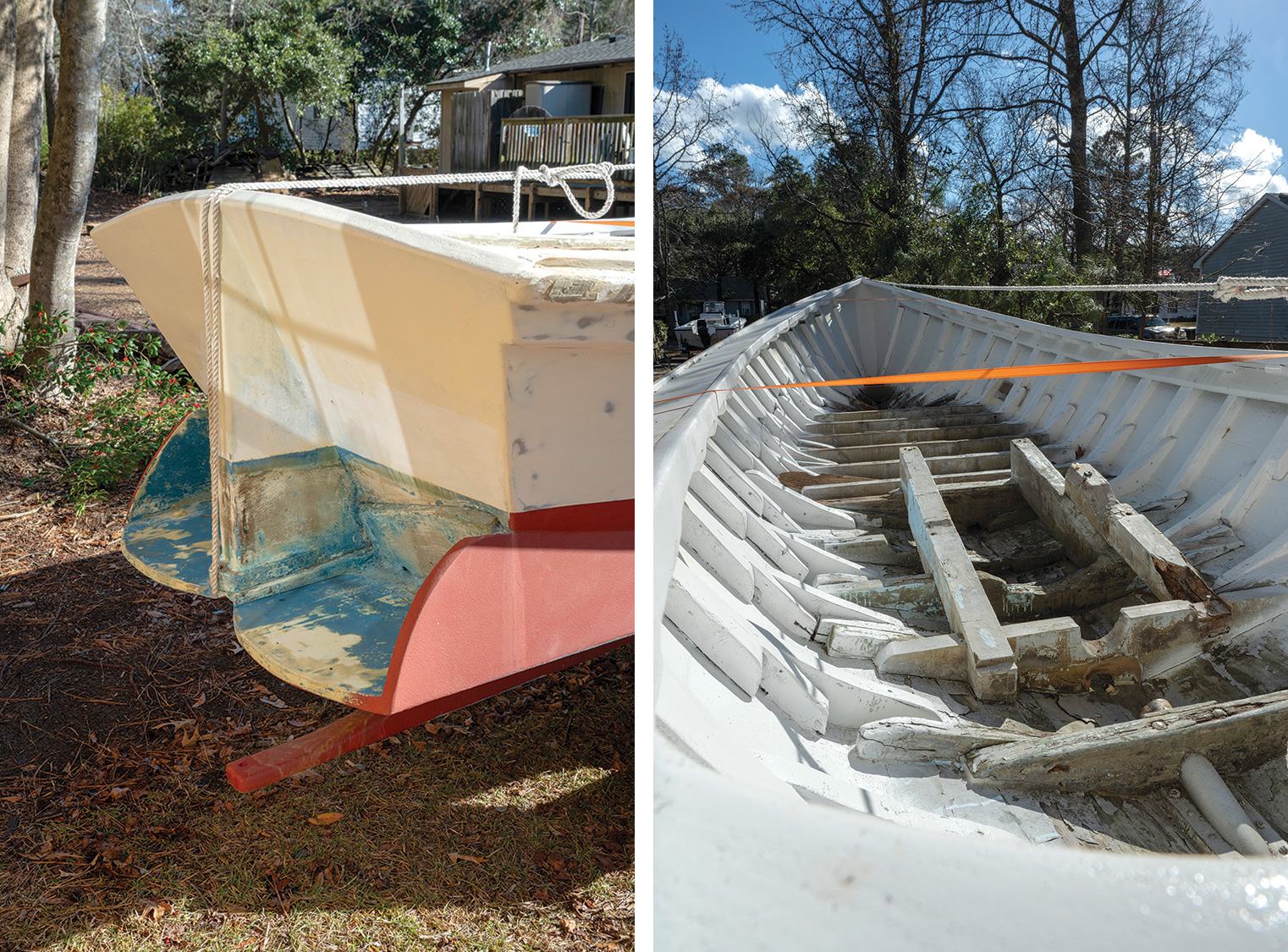
Left—Brown’s 23-footer has the characteristic hobbles of a powered shad boat, which will support the weight and force of the marinized 350 Chevy V-8 that he will eventually install. Right—Before the motor can be installed, Brown will have structural work to do, including the repair of a rotted engine bedlog.
By the time Brown’s boat was built in 1928, shad boats were firmly committed to engine power. Brown’s boat shows no signs of ever having a centerboard trunk, though in those years it may have had a maststep for a sprit rig to use in fair winds or an emergency. The 23′ boat was built with engine bedlogs and the keel bored for a shaft, but the hull shape still seems intended for sailing.
 Ed Tupper
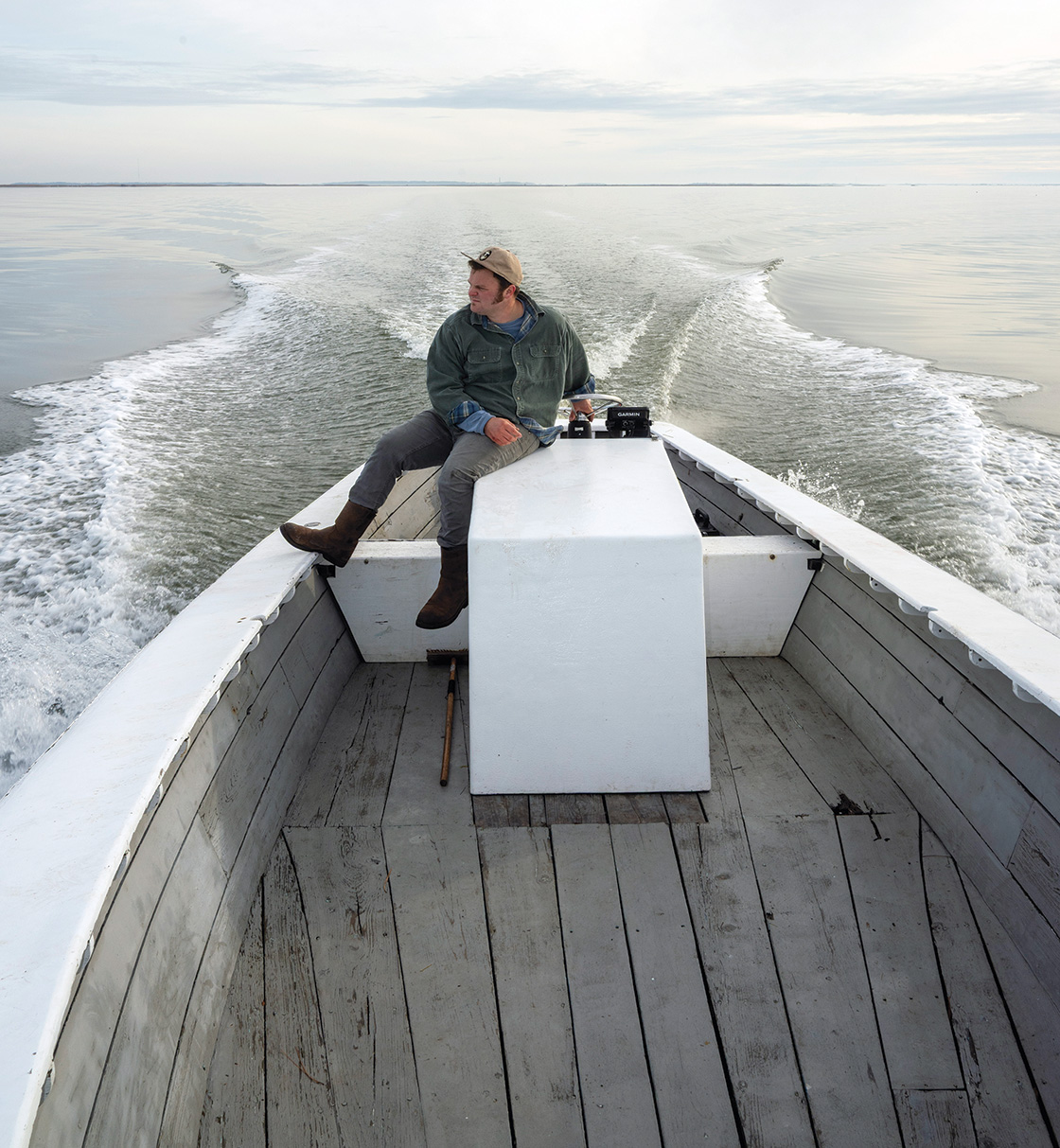
Ben Brown on an outing near Wanchese in December 2025.
“It still has a lot of tuck,” Brown says. “That’s why it has the hobbles.” The hobbles are like early trim tabs that kept sailboat hulls from squatting. “They have to have’m,” Brown says. “Once you get up to a certain speed, they set down and don’t plane right.”
According to Craddock, Brown’s boat originally had a rounded stern, but the previous owner had a local boatbuilder, Bug Tillit, change it to a square stern and add the hobbles. “Bug’s brother, Belov Tillit, also built shad boats and bigger boats,” he adds.
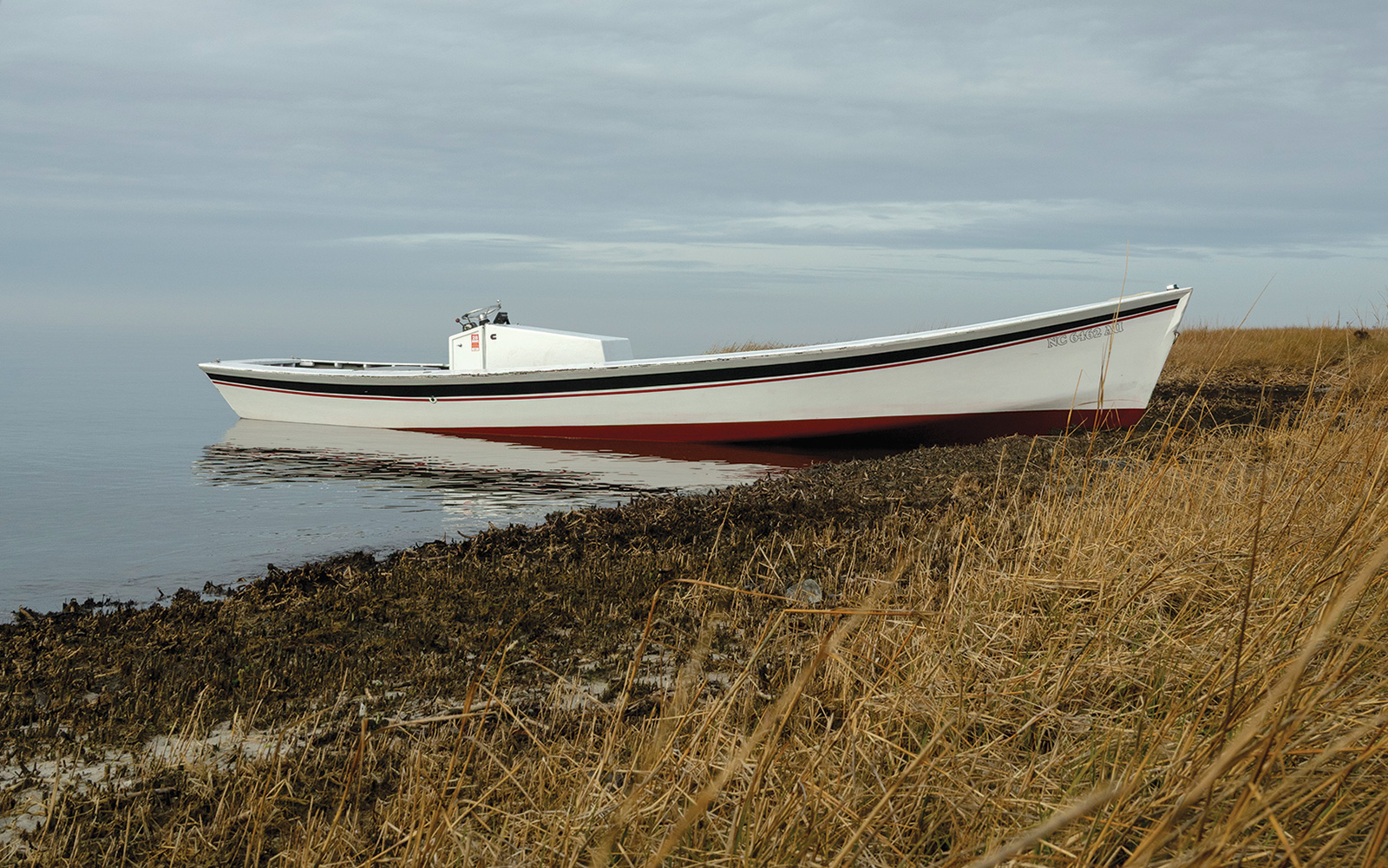 Ed Tupper
Shad boats have worked in many of North Carolina’s tidewater fisheries. Although their design was conceived in the mid to late 1800s, they have roots going back thousands of years to the Croatoan tribe of the Outer Banks.
While Brown’s boat has more of the round-sided shape of the Creef shad boat than later models, it is not built with the cypress or juniper root frames. Even by 1928, those had become rare. The frames on Brown’s boat appear to have been pieced together with as many as three short frames overlapping at their ends to form one frame, fastened in the shad-boat style to the bottom piece.
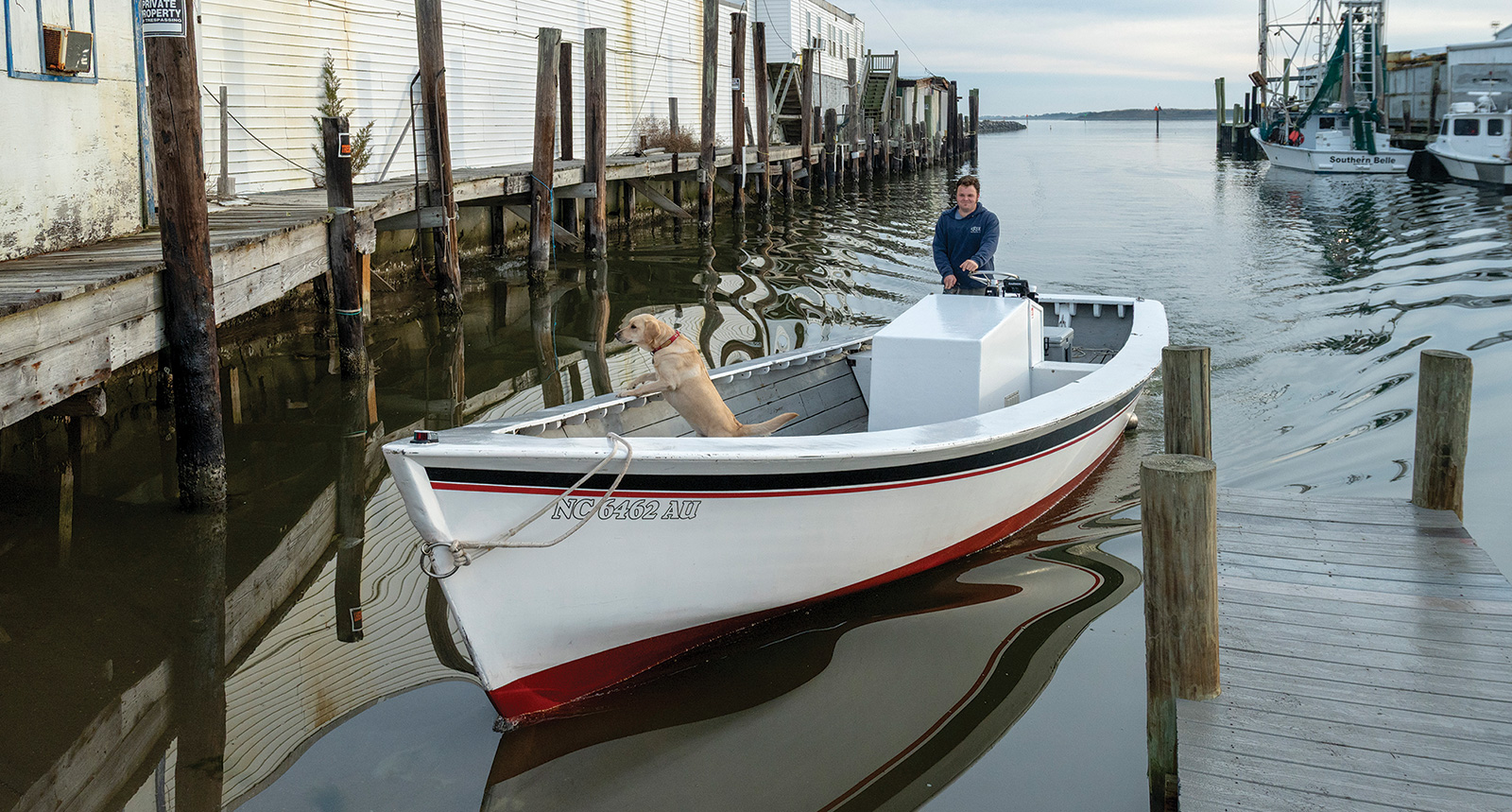 Ed Tupper
Shad boats might never again be the workhorses of North Carolina’s sounds, because the fish themselves have become rare. To conserve stocks, there is only a short fishing season in March each year.
“There’s a few I have to replace,” Brown says. “And some of the cross frames. You can see where I already took some out and those square nails are sticking up.” Several of the cross frames, or floor timbers, have noticeable rot. “I don’t know how deep it goes. I might be able to save some of the frame.”
Brown notes that these cross-pieces are difficult to remove because they are sometimes bolted down through the arms of the bottom piece. “And I need to replace one side of the engine bed,” he says. “I have a 350 marinized Chevy I’m going to put in there. It’s a lot for this size boat, but I like to have the power.”
Brown is largely self-taught and learning as he goes—confident that there is always a way to fix something. As he pieces together his project, he pieces together the history of these boats by talking to the old timers. While museums in North Carolina display shad boats from the past, their future is in the hands of people, such as Brown, who have a passion for shad boats as working craft.
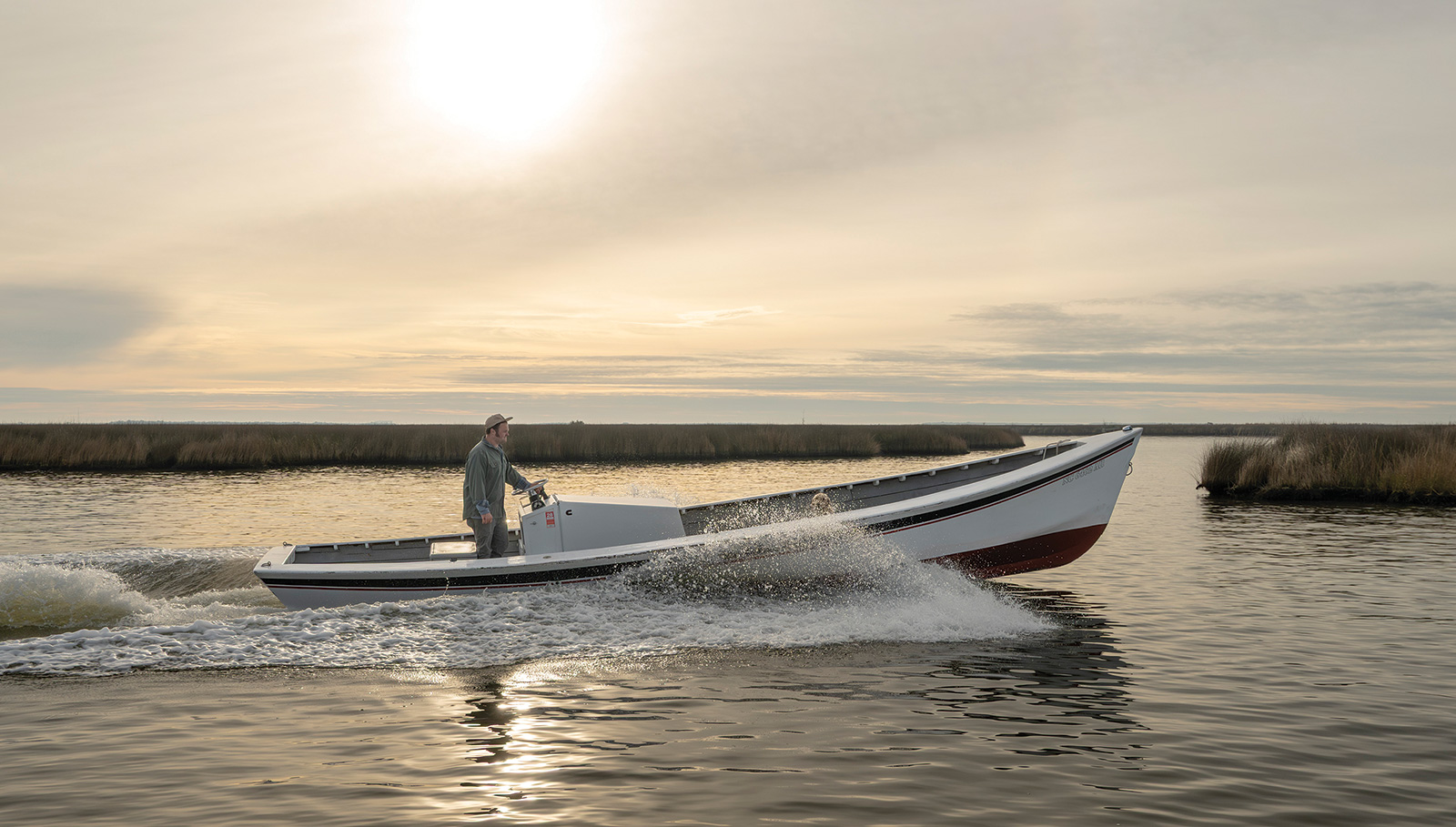 Ed Tupper
“Ben Brown,” writes author Paul Molyneaux, “just can’t stop saving shad boats.”
Not that shad boats will ever be the workhorses of the sounds again; like the boats, the shad have become rare. As in the 1860s, North Carolina’s shad stocks have shrunk to the point that there is only a short season in March when they can be taken. The Atlantic States Marine Fisheries Commission, which regulates shad, requires states to have an approved sustainable fishery management plan in place to try to restore the fishery, and North Carolina’s is very strict. But American shad in North Carolina are not bouncing back as fast as had been hoped. “You’d think with the restrictions we’ve had in place since 2014 in Albemarle Sound, that they would have come back stronger,” says Holly White, a biologist with the North Carolina Division of Marine Fisheries. “But we’re not seeing that here, yet. There have been improvements to passage through dam removals along the East Coast, but many impediments remain, preventing passage upstream.”
Even if the shad do come back, another problem is finding people who want to eat them. I recall that in the 1960s in Philadelphia, Pennsylvania, a neighbor called my father over to show him two skeins of shad roe in a sheet of butcher paper folded over in his hand, his eyes twinkling as if he were showing off diamonds. But he is long gone now, and those of us who grew up picking our way through these oily, bony fish are getting older. Times change; the shad, we shad eaters, and shad boats have become scarce, yet somehow we’re all still here. 
Paul Molyneaux is a regular contributor to WoodenBoat.