Intro coming from Matt some day.

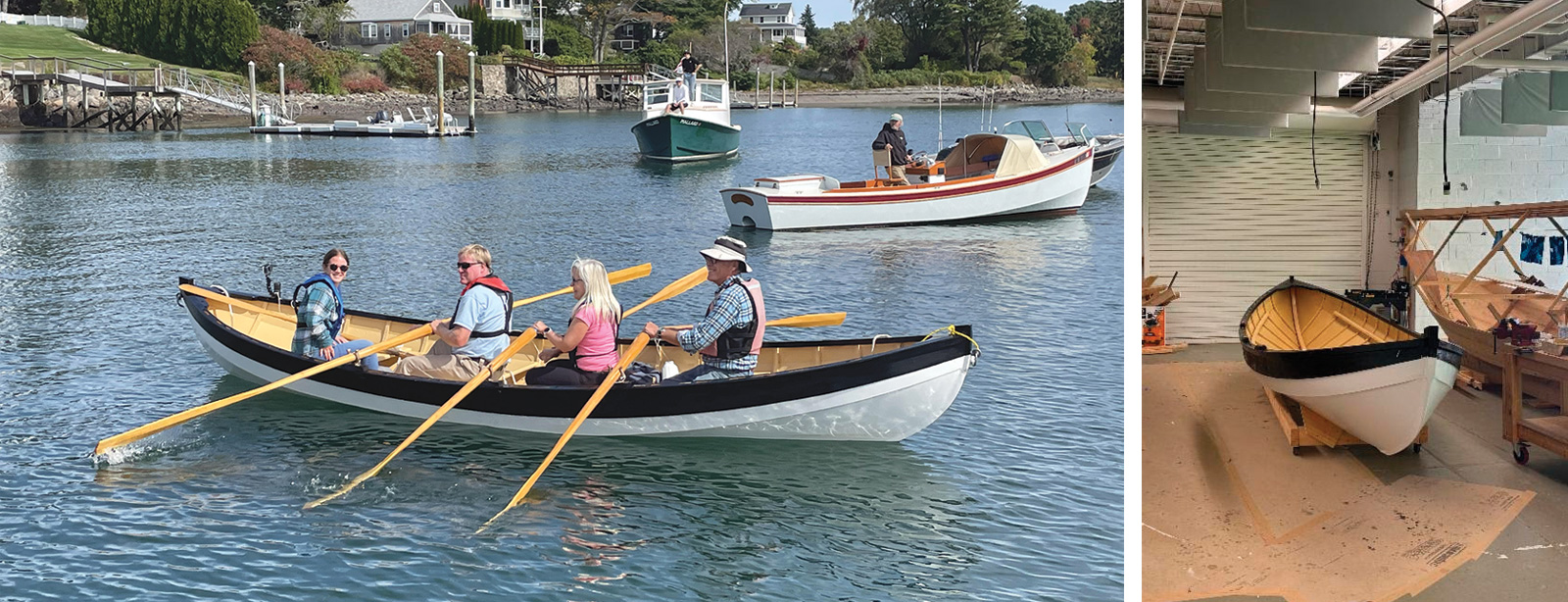
PERSEVERANCE, the first of the two USCG boats, was launched in 2022, and GRACE followed her in June 2023. 

PERSEVERANCE (left) and GRACE (right)

Photos by Wilssa

Since 2021, Traip Academy, the public high school in Kittery, Maine, has run a boatbuilding class conceived and funded by the Wood Island Life Saving Station Association (WILSSA), also in Kittery, Traip Academy, and Lowell’s Boat Shop of Amesbury, Massachusetts. Using original plans from the 1920s, 72 students have built two identical replicas of 19′-LOA, 5′2″-beam U.S. Coast Guard transportation boats. The six-oared boats are planked with marine plywood and pine on white-oak frames. The classes, led by Graham McKay of Lowell’s Boat Shop and Susan Johnson of Traip with help from Peter Stockless and Tony Lee, took students through all aspects of boatbuilding, from lofting to launching, working with both traditional hand tools and modern power tools. The class has since built a Banks Dory and is currently working on a CLC kit and a batteau.

PERSEVERANCE, the first of the two USCG boats, was launched in 2022, and GRACE followed her in June 2023.


J R BEALL is a Aroha Camp Cruiser.

J R BEALL

Photos by Andrew Pratt (top) and John Pratt (bottom)

John Pratt of Hayesville, North Carolina, began construction of J R BEALL, his Aroha Camp Cruiser designed by Peter Sewell in collaboration with Off Center Harbor, in September 2020. John worked with plans and a CNC-cut frame and strongback kit from Off Center Harbor. For the rest of the hull, he says, he used Douglas-fir, Honduras mahogany, meranti plywood, and “lots of epoxy.” J R BEALL is 29′10″ LOA by 7′ beam. She has an Electric Yacht 20-kW, air-cooled electric-motor system with eight lithium-ion batteries, which, John says, “easily pushes the J R BEALL through mountain lake water with a very modest wake.” J R BEALL (named after a lifelong friend) was launched in July 2023 on Lake Chatuge, North Carolina.


Ross Hills–designed Fleet, a 15′×4′ skiff.

Ross Hills–designed Fleet, a 15′x4′ skiff

Photos by Devin McCord (above), Michael Sklar (below)

Ryan McCord of Houston, Texas, was looking for a family boat that could be used for beach-launch fishing expeditions in La Jolla, California. He settled on the Ross Hills–designed Fleet, a 15′×4′ skiff that could handle small surf, was light enough to be carried down and up the beach on a dolly, and had a planing hull. Ryan built the skiff using okoume marine plywood, with white oak for the transom and pine for the rails and spacers. To create storage space, he cut hatches into the benches and, to maintain flotation, filled the unusable spaces with cut-up pool noodles. Before Ryan finished the skiff, it was used to help rescue people from their homes in Houston during Hurricane Harvey, but subsequently Ryan faired and painted it and then shipped it to La Jolla, where it now lives a few blocks from the beach.

Ross Hills–designed Fleet, a 15′×4′ skiff.


A 7′7″ sailing Nutshell pram.

A 7′7″ sailing Nutshell pram.

EXCUSE ME

Photos by Kent and Audrey Lewis

Guided by Maynard Bray, Kent and Audrey Lewis of Smithfield, Virginia, chose a 7′7″ sailing Nutshell pram for their granddaughter. They built the pram from plans, using okoume plywood on white-oak frames with sapele knees. Named EXCUSE ME, she was launched and successfully sea-trialed in Burwell Bay on the James River in late fall 2023. She will be homeported in the Tidewater region of Virginia.


A strip-planked Haven 12½.

Strip-planked Haven 12½

Photos by Peter Chesworth

Kevin Halcrow of Kendal, England, built this strip-planked Haven 12½ of western red cedar with epoxy-’glass sheathing inside and out. Kevin machined the strip planking and cast the lead keel in-house. The transom is solid teak and the interior fit-out is in utile mahogany. The decks are ’glass-sheathed 9mm marine plywood. The boat was started as a lock-down project during the Covid-19 pandemic and was launched on Ullswater in England’s Lake District in May 2023.

A strip-planked Haven 12½ sailing.


ARABELLA was launched in June 2023.

ARABELLA

Photo by David Lasnick

ARABELLA was launched in June 2023 at Shipyard Park in Mattapoisett, Massachusetts, and one week later won Best in Show at the WoodenBoat Show in Mystic, Connecticut. The double-ended 38′-LOD × 11′4″-beam gaff ketch designed by William Atkin was built by Stephen Denette of Granby, Massachusetts. Ninety percent of the wood—white oak and white pine—was harvested from Stephen’s family farm in Granby, Massachusetts; the spruce trees for the spars were planted by Stephen’s great-grandfather. ARABELLA is Stephen’s first build, and the seven-year project was documented in almost 300 videos made available on the YouTube channel Acorn to Arabella. Stephen is currently wintering aboard ARABELLA in the Cape Cod area and is planning some long-distance cruising, mostly in high latitudes, starting with a cruise to Newfoundland and on to Baffin Island, Nunavut, Canada.


NELLIE, a 12′10″, Joel White–designed Pooduck skiff built from plans.

NELLIE

Photos by Janet Wheeler

Will Wheeler of Coldwater, Ontario, has been building and restoring boats for about 10 years. His latest new-build is NELLIE, a 12′10″, Joel White–designed Pooduck skiff built from plans. She is of marine plywood with locally milled ash trim. She was launched in June 2023 and is homeported in Orillia, where she is thoroughly enjoyed by Will. The rescue dog, also called Nellie, is less sure but, Will says, she is “learning to like boating.”


Larry has built CODA, a New Yankee Tender.

CODA

Photos by Jerry Stanke (above), Larry Mariette (below)

In 1983, Terri Deming gave her partner, Larry Mariette of Little Falls, Minnesota, a set of plans for the 12′× 4′4″ New Yankee Tender. Forty years later, Larry has built CODA. Her hull is planked in western red cedar on white-oak frames; her transom, knees, and gunwales are mahogany; and the thwarts are white pine. CODA was launched in June 2023 in Superior, Wisconsin, and will be serving as tender to the sailboat that Larry and Terri sail on Lake Superior.

New Yankee Tender CODA.


Mike Bancroft of Anacortes, Washington, built this Chesapeake Light Craft Little Auk for his wife, Deb.

ARROW

Photo by Mike Bancroft

Mike Bancroft of Anacortes, Washington, built this Chesapeake Light Craft Little Auk for his wife, Deb. This is the fifth boat Mike has built but his first kayak and his first strip-planked project. He made a few modifications to the CLC kit: he made the hull fuller amidships to improve stability and also made an initial hull-to-deck joint with thickened epoxy before planing off any overhanging deck, after which he epoxied ’glass tape to the joint. ARROW was launched in spring 2023 and will be used to explore her home waters in the San Juan Islands.


An 18′ Bolger Clam Skiff built by seven Hull (Massachusetts) High School students.

EMILY M. CARROLL

Photos by Mike McGurl

Over the winter of 2022–23 a group of seven Hull (Massachusetts) High School students built an 18′ Bolger Clam Skiff. The project was the first of its kind for the school and was partly funded by a grant from USRowing. None of the students had ever built a boat from scratch, but they learned quickly under the direction of Mike McGurl, executive director of the Hull Lifesaving Museum, and the high school’s woodshop teacher, Derek Skapars. The boat is of ½″ marine plywood with mahogany frames and trim. Launched in August 2023, the EMILY M. CARROLL was named after, and dedicated to, Staff Sergeant Emily Carroll, a Hull resident who died in 2021.

Five Hull (Massachusetts) High School students.


Lighthouse Tender Peapod.

Lighthouse Tender Peapod from a Chesapeake Light Craft kit

Photos by Ralph J. Naranjo

Charlie Flanagan of Annapolis, Maryland, built this 13′5″ Lighthouse Tender Peapod from a Chesapeake Light Craft kit. He started in August 2021 and describes the process as “straightforward but lengthy as it involved many pieces and a lot of steps.” Charlie also took 10 months off to rebuild a 1973 Beetle Cat (see Launchings, WB No. 296). The peapod was built of okoume marine plywood, with mahogany rubrails, inwales, sheerstrakes, and breasthooks. Charlie reports that with the single lugsail the boat is fast and maneuvers well. Charlie finished and launched the peapod in June 2023 and uses it on the South River in Annapolis.

Lighthouse Tender Peapod from a Chesapeake Light Craft kit.


Relaunching of a 1923 triple-cockpit mahogany speedboat.

Relaunching of a 1923 triple-cockpit mahogany speedboat.

PENNSBURY

Photos by Pat Ahearn

In August 2023, after an extensive restoration, George Hulse of Moorestown, New Jersey, relaunched his 1923 28′ LOA × 7′ beam, triple-cockpit mahogany speedboat, built by the Morin Brothers of Greenwood Lake Launch Works in Sterling, New York. The boat is double planked on the bottom and single-planked on the sides, bronze riveted throughout. The restoration included a rebuild of the keelson and shaft log with ½″ white oak. All the original bottom frames were treated with epoxy and then sistered and re-fastened with stainless-steel bolts; the frames were also refastened to the stringers with stainless-steel braces. George fitted a new stainless-steel prop shaft, refurbished propeller, strut, and rudder; he rewired all the systems and rechromed all the fittings. A new aluminum fuel tank was installed, and the Stewart-Warner tachometer and gauge cluster were rebuilt and paired to a new 100-hp Mercruiser with 1:1.94 Velvet Drive reduction gear. The deck was stripped and recalked, the interior varnish work was refinished and the interior below the waterline was epoxy coated. The deck and hull were finished with 10 coats of high-gloss varnish.

George says that PENNSBURY will run comfortably at 24 mph at 2,500 rpm and, with a full complement of seven passengers, at 26 mph at 3,000 rpm. He believes she is one of only two Morin speedboats of this design currently operational.


LUNA, a Phil Bolger–designed Chebacco boat.

Luna

Photos by Kate Haas

LUNA, a Phil Bolger–designed Chebacco boat, was built by Jerome McIlvanie of Yakima, Washington, between 1996 and 2001. The boat is 19′6″ LOA with a beam of 7′9″. After being sailed just once—from the launching ramp to the marina for the 2001 Port Townsend Wooden Boat Festival—she was sold and stored under a tarp in a field. There she stayed for 19 years until she was rescued by Bruce Bateau of Portland, Oregon, and his wife, Kate, in 2020. When the tarp was removed, they found that the boat was in reasonable shape other than the cockpit, which Bruce describes as being like a bog complete with “water, leaves, mouse nests, and rot, a lot of rot.” The hull, Bruce says, was totally sound, thanks to the builder’s good work and his use of epoxy.

With the help of “highly skilled” friends Michael Bogoger, Doug Follet, Tim Lemon, and Andy Schmidt, Bruce removed the rot and rebuilt the cockpit. Then there was a lot of fitting out to be done, including sewing cushions and boom tents, rerigging, installing a new rudder, and replacing all the mast hoops, which, like the cockpit, had been destroyed by rot.

In July 2023, Bruce and Kate relaunched LUNA in Anacortes, Washington. She is now homeported on the Columbia River in Portland and sails to points north in the Salish Sea each summer.

Bruce and Kate relaunched LUNA in Anacortes, Washington.


These pages, along with the Boat Launchings section of www.­woodenboat.com, are dedicated to sharing recently launched wooden boats built or restored by our readers. If you’ve launched a boat within the past year, please email us at launchings@woodenboat.com, or write us at Launchings, WoodenBoat, P.O. Box 78, Brooklin, ME 04616.

Please include the following information:

  1. The boat’s length and beam;
  2. The name of its design class or type;
  3. The names of the designer, builder, owner, and photographer;
  4. Your mailing address along with an email address or phone number;
  5. The port or place of intended use;
  6. Date of launching; and
  7. A few sentences describing the construction or restoration. Send no more than five photographs (jpg images at 300 dpi) and enclose a SASE if you want anything returned.

Hints for taking good photos of your boat

  1. Set your camera for high-resolution images. We prefer jpg format, at 300 dpi minimum.
  2. Stow fenders and extraneous gear out of the camera’s view. Ensure the deck is clean and uncluttered.
  3. Take your photographs in mid-angle sunlight for best results. Mid-morning or mid-afternoon usually work well.
  4. Keep the horizon level and the background simple and scenic so your boat stands out from its surroundings.
  5. Take some pictures of the boat underway and some at rest. Often a vertical format works well for sailboats. Shoot a lot of images, then send us your five favorites.

We enjoy learning of your work—it affirms the vitality of the wooden boat community. We receive so many submissions that there is not room in the magazine for all of them to be published. Launchings not printed in the magazine can be seen at www.woodenboat.com/boat-launchings. Article ends.