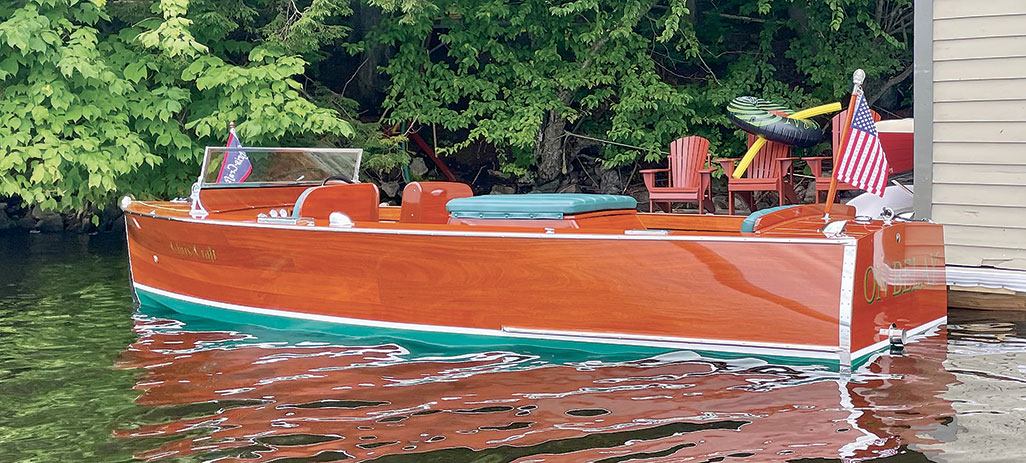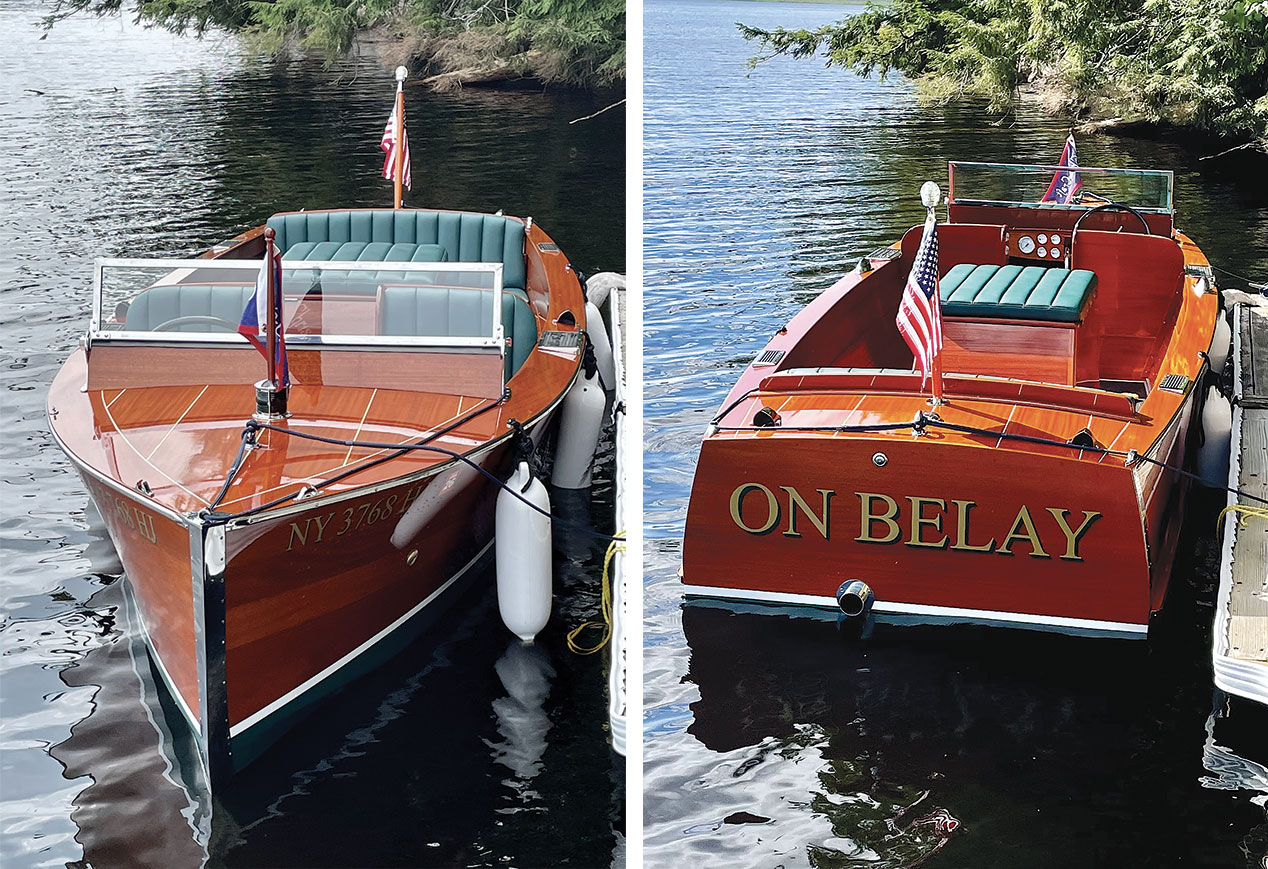
ON BELAY
Photos by Bill Widrig
ON BELAY, a 1935-designed 18′ Chris-Craft Deluxe Utility, was built by Bill Widrig of Ballston Spa, New York, over a 16-year period. Bill worked from original lines and offsets that he obtained from The Mariners’ Museum in Newport News, Virginia. The frame is white oak, and the planking is African mahogany. The bottom, topsides, and decks have an inner skin of ⅛” okoume plywood beneath an outer layer of ½”-thick mahogany planking.
Bill found a full description of the building technique in How to Restore Your Wooden Runabout by Don Danenberg. All the deck fittings are rechromed original Chris-Craft parts, and the engine is a 3.0L MerCruiser with a ZF Hurth 45A transmission. Bill launched ON BELAY in July 2023 and is using her on Upper Chateaugay Lake in Adirondack Park, New York.
MY WAY
Photo by Randy Mascharka
MY WAY was designed and built by John Greiner of Toledo, Ohio. The culmination of 23 months of work, she is the realization of a lifelong dream to design and build a small cruiser. MY WAY is 24′ LOA and has accommodations for four. John’s focus was on comfort and safety, so he designed MY WAY high-sided to get as much headroom as possible below, and fitted an outboard well to keep the motor in easy reach of the cockpit. MY WAY was launched in August 2022, six months after John’s 85th birthday. He and his wife, Judy, sail her on Lake Erie.
Wee Lassie
Photos by Louise Green
Over the winter of 2022–23, Andrew Green of Pewaukee, Wisconsin, built this Mac McCarthy–designed cedar-strip Wee Lassie. Andrew built the 10′ 6′ × 27″ canoe of ¼” × ¾” bead-and-cove western-red-cedar strips over laminated-ash stems. It is finished in an epoxy-coated 6-oz ’glass sheathing, with five coats of varnish. Andrew launched the Wee Lassie at Merton Pond, Wisconsin, in April 2023, and says she moves very smoothly with the Greenland-style paddle that he built of western red cedar and poplar.
WOODEN NICKEL and HIGH ANXIETY
Photos by John Schellinger
John Schellinger of Avon, Minnesota, launched this 10′ 6″ × 42″ Lawton tender, named WOODEN NICKEL (above left), in August 2022. She is of Atlantic white cedar on white oak with Honduras mahogany sheerstrakes and transom. The hull is copper- and bronze-fastened throughout, the thwarts are Douglas-fir, and the grown knees are tamarack. John worked from lines published in John Gardner’s More Building Classic Small Craft. In 2023, John followed WOODEN NICKEL with his second Lawton tender, a 12′ version he named HIGH ANXIETY (above right). She, too, is planked with white cedar on white-oak frames, but her knees are white oak, her sheerstrakes and transom are ash, and her thwarts and trim are mahogany. John rows the boats on lakes close to his home in central Minnesota.
MAUREEN and BRIGID
Photos by Delaney Family
MAUREEN and BRIGID are two flat-bottomed 17′ × 5′ 4″ Rosslare Cots built by Shay Delaney of Rosslare, County Wexford, Ireland. The Rosslare Cots were designed by local boatbuilder Bill Peare in the 1960s, and Shay worked from the original plans. With help from boatbuilder Billy Doyle and two boatbuilding apprentices, Eoin Gorman and Shane Gorman, Shay planked the boats with ⅜”-thick larch on oak frames; the bottoms are ¾”-thick Douglas-fir. MAUREEN and BRIGID were launched in July 2023 and will be used in the coastal waters of Rosslare.
Vanessa’s Paddleboard
Photos by “Grandma” Patty Crider
Vanessa Crider is the third granddaughter who has grown up enjoying the Wee Lassie her grandfather, Gary Crider of Pioneer, Ohio, built in 2006. The summers each of the two older girls turned 14, they spent two weeks with their grandfather building their own craft. First came Lauren, who built a Wee Lassie, and then Olivia, who built a paddleboard. When it came to Vanessa’s turn, her summer was all booked up, so the following spring she came on weekends before school got out and then for a week at the beginning of the summer vacation. In that time, she and her grandfather built another paddleboard, 11′ 6″ long, 30″ wide, and 4″ thick. All the lumber for the project came from the Criders’ own woods, and Vanessa worked more than 100 hours on every step of the construction, from design to launching. She also carved and shaped her own paddle. The best part, Gary says, “is that I get to spend all that time with a granddaughter, and we bond forever.” Vanessa launched her paddleboard in her grandparents’ pond in August 2023.
Great Laker Guide Canoe
Photos by Mary Harmon
After a 15-year project, in August 2022 Loren Harmon of Beddington, Maine, launched SOC, his traditional 20′ cedar-and-canvas Grand Laker guide canoe. The canoe was built on an original wooden jig that a friend had found in a barn in North Berwick, Maine. It was, Loren says, well-engineered, but the stern section was falling apart. He thinks it was probably built in the early 1930s of reclaimed barn lumber—it weighs more than 400 lbs.
Loren built the canoe of cedar on ash frames, and much of the lumber came from the woodlots of nearby friends. Loren has been building wooden boats since the late 1950s, when he and his father built two small boats from plans in Popular Science. He says that SOC (the name was his father’s nickname) was his most challenging project to date but also the most rewarding.
Chesapeake Light Craft Guider
Photos by Andy Friedell
Father and son, Andy and Will Friedell of Annapolis, Maryland, built this Chesapeake Light Craft (CLC) Guider as part of Will’s fellowship project during his senior year at Severn School, Severna Park, Maryland. They began in December 2022 and launched in July 2023 in Annapolis. Designed by John Harris of CLC, the Guider is 18′ 7″ LOA with a beam of 72″ and was built from a stitch-and-glue kit. After launching the boat, Will sailed on a 20-mile solo voyage along the Severn River. A few weeks later, he launched at his grandparents’ house in Stonington, Maine, and went on a 30-mile solo trip through the islands of Merchant Row, spending a night on Otter Island, and then returning to Stonington.
AQUINAS
Photo by David Wheeler
Thomas Reinecker of Dunkirk, Maryland, spent “three years and eight months” building AQUINAS. She’s a Doug Hylan–designed Bowler, with a slightly raised cabin to give more headroom. Thomas built AQUINAS in his garage after taking John Harris’s class in building a Tenderly Dinghy at WoodenBoat School. She is 26′ 6″ LOA × 8′ 6″ beam and is powered by a 60-hp Mercury outboard concealed in an engine compartment beneath the afterdeck. Thomas says he still has some work to do in the cabin, but AQUINAS was launched in August 2023 on the Patuxent River. She will be homeported on Chesapeake Bay, and Thomas hopes, one day, to take her down the Intracoastal Waterway.
Michael B. Strong’s Lawley Yacht Tender
Photo by Michael B. Strong
Michael B. Strong of L’Etete, New Brunswick, Canada, has built more than 30 boats ranging from a Parker 15 to a Swampscott sailing dory, as well as many strip-planked canoes, kayaks, and small punts. Over the winter of 2022–23, he built this Lawley yacht tender from plans in John Gardner’s Building Classic Small Craft Volume 2. She is planked in eastern white cedar harvested from Michael’s own woodlot. The copper-riveted planks were fastened to the white-ash frames with stainless-steel screws. The inner and outer stems, sheer clamps, and gunwales are steam-bent black locust. Michael says the boat was difficult to build because of “her intricate curves.” He launched the tender in August 2023 at L’Etete.
KIM MARIE
Photos by James Finley
It took James Finley of Lake Hopatcong, New Jersey, a little over a year to build his 15′ Whitehall, KIM MARIE. Working from plans published in John Gardner’s book Building Classic Small Craft, he carvel-planked her in cedar on white-oak laminated frames and stem. The keel, sternpost, and floor timbers are also white oak and the transom is hickory. For the thwarts, benches, and floorboards James used yellow pine. KIM MARIE was launched in Lake Hopatcong in summer 2023, and James reports that he has “greatly enjoyed rowing her with 8′ oars…she glides very nicely and carries her momentum through the water almost too well. With a steady stroke she will do 3.5 knots for miles.”
PHEATHER
Photos by Lorna Morris (above) and Matt Morris (below)
This 11′ 11″ × 30″ canoe, weighing only 20 lbs, was designed and built by Matt Morris of Waterloo, Ontario, Canada. He designed the boat, he says, for “local urban calm waterways,” and says that it has “zero sheer, almost no rocker, and enthusiastic tumblehome to make solo paddling comfortable.” The boat has ash frames, gunwales, and keel; maple stems; western-red-cedar stringers; and a 9-oz Dacron skin.
Matt christened the canoe PHEATHER and launched her near his home in September 2023. He will be using her on Victoria Park Lake in Kitchener and Silver Lake in Waterloo, bodies of water he describes as small urban lakes in downtown parks. He has shared her story at urbanboatproject.weebly.com/pheather-canoe.
NIMUE
Photo by Mary Dugas
NIMUE (pronounced “nim-oo-a” and named for the Lady of the Lake of Arthurian legend) was built by John Lee of Atlanta, Michigan, during the summer of 2022 and launched in June 2023. A Chesapeake Light Craft Chester Yawl based on a classic Whitehall hull, she is John’s first stitch-and-glue construction. Even though he has built other small boats, including a duckboat and two skin-on-frame kayaks, he describes the 15′ NIMUE as his most ambitious project. John uses NIMUE on Crooked Lake, south of his hometown.
GULL’S WAY
Photo by George Grimes
George Grimes of Rockport, Massachusetts, was taking a two-week class at WoodenBoat School when he learned that the peapod built in the previous class was for sale. The Doug Hylan–designed Beach Pea, 15′ LOA by 4′ 4″ beam, still needed fitting out, and George worked on it over the next two years in his backyard shed. He launched GULL’S WAY in Gloucester, Massachusetts, in the summer of 2023 and reports that she rows beautifully. This year, he will be trying out her new sailing rig on the waters off Gloucester and Rockport.
HERON
Photos by Matt Boulanger
Austen Boulanger, 12, of South Burlington, Vermont, built HERON as his “personal interest project” in his sixth-grade class at The Schoolhouse in South Burlington. She is a 7′ 8″ × 2′ 8″ One-Sheet Skiff designed by Herb McLeod. Austen took the full-sized paper templates into school to cut out the pieces with the help of his teachers, then built the boat at home with his father assisting with the tablesaw and acting as an extra pair of hands when needed. Austen built his own spars out of laminated western red cedar and made the oars out of construction lumber and lauan plywood. He cut the sail from a blue tarp. HERON was launched in June 2023.
These pages, along with the Boat Launchings section of www.woodenboat.com, are dedicated to sharing recently launched wooden boats built or restored by our readers. If you’ve launched a boat within the past year, please email us at launchings@woodenboat.com, or write us at Launchings, WoodenBoat, P.O. Box 78, Brooklin, ME 04616.
Please include the following information:
- The boat’s length and beam;
- The name of its design class or type;
- The names of the designer, builder, owner, and photographer;
- Your mailing address along with an email address or phone number;
- The port or place of intended use;
- Date of launching; and
- A few sentences describing the construction or restoration. Send no more than five photographs (jpg images at 300 dpi) and enclose a SASE if you want anything returned.
Hints for taking good photos of your boat
- Set your camera for high-resolution images. We prefer jpg format, at 300 dpi minimum.
- Stow fenders and extraneous gear out of the camera’s view. Ensure the deck is clean and uncluttered.
- Take your photographs in mid-angle sunlight for best results. Mid-morning or mid-afternoon usually work well.
- Keep the horizon level and the background simple and scenic so your boat stands out from its surroundings.
- Take some pictures of the boat underway and some at rest. Often a vertical format works well for sailboats. Shoot a lot of images, then send us your five favorites.
We enjoy learning of your work—it affirms the vitality of the wooden boat community. We receive so many submissions that there is not room in the magazine for all of them to be published. Launchings not printed in the magazine can be seen at www.woodenboat.com/boat-launchings. ![]()