New intro coming from Matt…
THELMA
Photos by Darrel Neaves
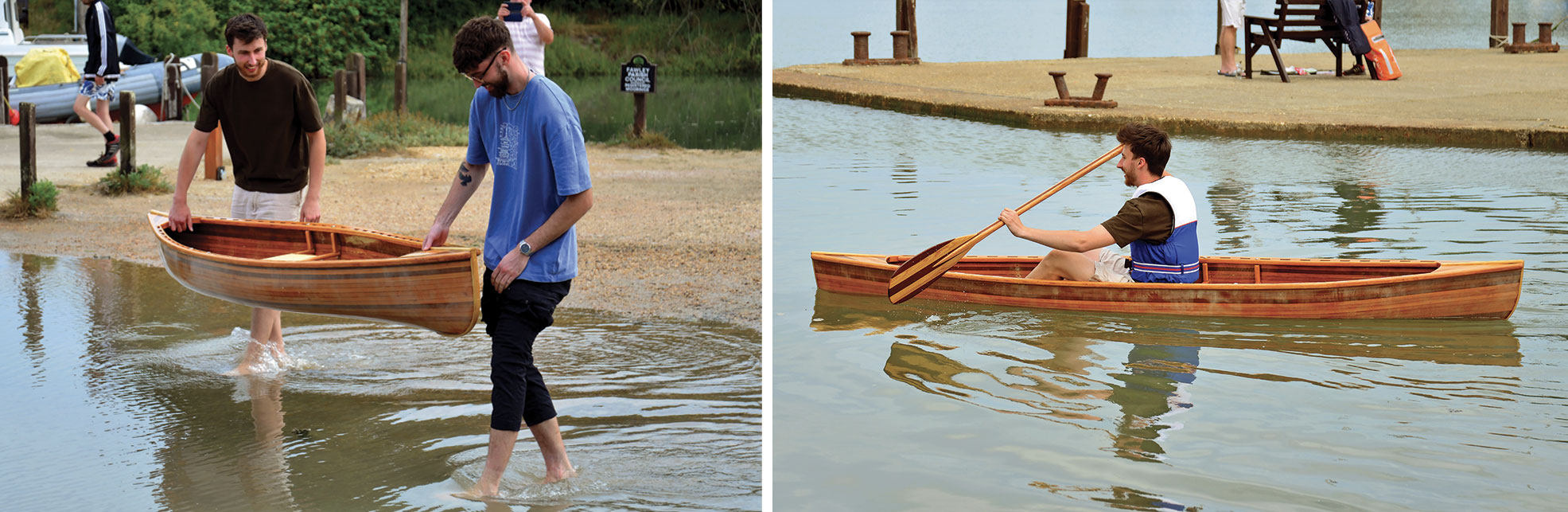
When cousins Tristan Brown and Tom South teamed up to build an 11′ 4″ Wee Lassie canoe, it was a first boatbuilding project for both of them. For a shop, they set up a tarpaulin shelter in the back yard of the Brown family home in Southampton, Hampshire, England. In 2020, they got off to a quick start, cutting the molds according to the plans by Mac McCarthy, but then they got sidetracked by other interests and didn’t start applying cedar strips until 2022. Tom was working and living in London at the time and returned to the shop once a month. He and Tristan enjoyed working together and didn’t mind the slow progress. In July 2025 they launched the canoe, named THELMA after their great-grandmother. Tristan is now pursuing a career in sailing and Tom has found work as a boatbuilder.
CHIONE and ALLISON P
Photo by Ted Dillard
Just north of Boston, in Lynn, Massachusetts, Kayak and Sail Lynn introduces local youths to building and using small boats. This year, guided by the crew at Small Dog Boatworks, two teams of four kids from Lynn English High School spent their February and April school vacations, as well as a few weekends, building two Six-Hour Canoes. Designed by Mike O’Brien, the 15′ 3″ plywood double-ender is usually built with simple, common tools, but to broaden the learning experience for the student builders, the instructors required them to learn how to use a CNC router to produce several of the interior fittings. At the launching of CHIONE (after the Greek goddess of cold and frost) and ALLISON P on June 21, 2025, the young builders were honored by their school’s junior ROTC color guard, Lynn military service members, veterans, state representatives, a district attorney, and a retired National Guard brigadier general.
ELIZABETH LEE
Photo by Bob Mooney
When Bob Mooney turned nine years old, he got an unusual gift for his birthday: a handsaw. At that young age, he had already grown fond of working with wood and had made tree forts and go-carts. Many years later, when he was in the Navy and visiting Capri off the west coast of Italy, he was smitten by the wooden boats moored there and thought to apply his woodworking skills to boatbuilding. In recent years, he has been building a series of boats, including this Sand Dollar designed by Arch Davis. The 11′ flat-bottomed skiff can be rowed, sailed, or outboard powered. To the ¼″ marine-plywood lapstrake planks, Bob added cedar veneers to provide a more attractive wood for finishing with varnish. Christened ELIZABETH LEE after his daughter, the skiff frequents the lakes of northern California, including Lake Tahoe.
FIRE
Photo by Neil MacAlpine
A boy can count himself lucky to have a grandfather like Neil MacAlpine. The retired engineer from Edmonton, Alberta, Canada, built stitch-and-glue kit kayaks for his two grandsons, Ben, now 10, and Aiden, 14. The first kayak, for Aiden, was 16′ BLUE, launched in July 2024 and featured in WoodenBoat #301 Launchings. The second kayak, seen here, is Ben’s FIRE, an Anuri 16, likewise built from a kit from Edmonton-based BoatCraft. FIRE was launched at Buck Lake in June 2025. Although both boys have taken quickly to the kayaks as boats to fish from, they were built, notes Neil, “for the days when they will be poor college students with a tent, a sleeping bag, and a junk truck to get to some remote spot in Canada’s wilderness. They’ll be the envy of their friends.”
STELLA ROSE
Left Photo by Tyler Ellis and Right Photo by Hunter Ellis
Tyler Ellis was introduced to boating at an early age by his father, kindling a lifelong love of the water. In May 2021, he graduated from Virginia Tech with a bachelor’s degree in ocean engineering and a minor in naval engineering. Just two months later, he landed a job as a naval architect. After focusing on work for a year, he decided to build a boat. To avoid the time it would take to hitch a trailer to his car or strap a boat on the roof racks of his compact Honda CR-V, he drew up a runabout that would fit in the back. Built of exterior-grade plywood and sheathed with fiberglass and epoxy, his STELLA ROSE is powered by an electric trolling motor that is concealed by the afterdeck. Tyler cruises her on the waters of Lake Audubon in Reston, Virginia, 9 miles northwest of downtown Washington, D.C.
ANDIAMO FAMIGLIA
Photo by Eli Sieplinga
In 1960, when Jerry DePersia of Grand Rapids, Michigan, was just 15 years old, he built his first boat, a plywood rowboat. Then, 25 years later, at the age of 40, he built a 21′ 6″ cedar-strip rowing shell to capitalize on his skills. When he turned 60, he built a 16′ cedar-strip canoe to the Redbird design by Ted Moores. At 70, he started his next boat, seen here, built to the Jessie design by Paul Gartside. Jerry had attended several classes at WoodenBoat School, and one of his favorites was Paul’s design class. For his Jessie, Jerry switched from the design’s double-diagonal ⅛″ cedar planking on steam-bent frames to glued-lapstrake plywood construction. He launched ANDIAMO FAMIGLIA— Italian for “Let’s Go Family!”—in June 2025 when he was 80 years old. He and his family now cruise the 15′ sloop on the coastal waters of Lake Michigan.
WANDERING TATTLER
Photo by David Doody
David Doody sails his 38′ sloop out of Port Washington, New York, and although he has enjoyed cruising north to the coast of New England, he dreams of sailing to the Bahamas or even making the crossing to Europe. For those adventures he decided a new tender would be in order. His Nutshell pram had served well but was too big to stow neatly on deck. He’d once had a 10′ RIB (rigid inflatable boat), but he didn’t like towing it or putting up with the heavy outboard and its smelly fuel tank. He was drawn to the Nesting PT 11, an 11′ plywood rowing and sailing skiff designed by Russell Brown which can be stowed aboard in only 6′ of deck space with the forward section tucked inside the after one. David built his PT 11, WANDERING TATTLER, from a kit produced by Chesapeake Light Craft. He launched her in June 2025 and declared it “a brilliant little boat”.
LIL’ BET
Photos by David Vangsness
When David Vangsness built a Fiddlehead for his wife, Elizabeth, he made a significant departure from Harry Bryan’s plans for the flat-bottomed, decked canoe. Instead of outfitting it to be powered by a double-bladed paddle, he installed a Hobie Mirage pedal drive. The conversion from arm power to leg power was perfectly suited to Elizabeth, an avid bicyclist. He built a rudder with a yoke and tiller lines that lead forward to wrap around a horizontal drum made of oak and mounted on the starboard side deck. The curved backrest is made from a French wine-barrel stave. David’s Fiddlehead was launched in April 2025 and goes by the name that Elizabeth’s father called her: LIL’ BET. David and Elizabeth have many lakes and rivers near their home in Roseburg, Oregon. While she pedals, he plans to motor alongside her in a 19′ runabout that he built in the early 2000s.
A Leadlight 14′ dory skiff
Photos by Wendy MacDermot
Gardiner and Wendy MacDermot spend their summers in Courtenay, British Columbia, Canada and winters in the Stann Creek District of Belize in Central America. They have easy access to rivers near both homes – the Puntledge River in B.C. and the Sittee River in Belize. Gardiner has been captivated by boats for most of his life, and the couple has cruised along canals in Ontario and the coastlines of British Columbia. To get afloat on the Sittee River near their home in Belize, Gardinder built a Leadlight 14′ dory skiff to plans from Clark Craft of Williamsville, New York. Gardiner rows several times a week, covering a few miles either upstream or downstream before heading home. Their unnamed boat is the only one rowed on the Sittee and they are often asked if they need a tow by locals passing by in outboard-powered pangas.
PAL-O-MINE
Photo by Karen Murray
PAL-O-MINE, a 27′ Friendship sloop, was built in 1947 by Warren Prescott “Scotty” Gannett, a highly regarded boatbuilder in Scituate, Massachusetts. In 1958, Doug Lane’s family acquired the boat and for 30 years sailed her out of Essex, Massachusetts. He undertook a restoration starting in 1988, and over the next four years gutted her interior, refastened her hull, and rebuilt her deckhouse. The boat then sat idle for 13 years before work resumed with a new rudder and refinishing. PAL-O-MINE was relaunched in 2007 but again sat idle until 2019, when she got new sheerstrakes to replace rotten ones. The restoration’s final phase began in 2021, when a 12kW electric auxiliary engine was installed. PAL-O-MINE went back in the water September 11, 2024, in Essex, to give her planks a chance to “take up,” after which, she was trailered to her new homeport, Edenton, North Carolina, where she was relaunched two weeks later.
ADVENTURESS
Photos by Truman Forbes
Jasmine Thomas grew up in Brooksville, Maine, and spent summers cruising with her family aboard their 32′ ketch and taking sailing lessons at local yacht clubs. Even before she graduated from the University of Maine in 2023, she had her captain’s license and had served as first mate on two windjammers. In January 2024, she joined WoodenBoat as editorial assistant. After moving to within spitting distance of Penobscot Bay, she knew she needed her own boat and acquired ADVENTURESS, a Sparkman & Stephens Gulfstream 30 built in 1959 by Norman Hodgdon in East Boothbay, Maine. The mahogany-on-oak sloop, which had been in a shed for 20 years, was sound but caked in dust and littered with cigarette butts and dead mice. Jasmine spent eight months reviving the boat: recaulking, refinishing, replacing missing parts, and rebuilding the diesel auxiliary. She relaunched ADVENTURESS in July 2025, with sailing lessons and charter cruises on her horizon.
ADVENTURESS and Jasmine Thomas are featured in an episode of our video series WoodenBoat Legends. Jasmine has also written a couple of articles on ADVENTURESS for WoodenBoat Magazine including Reviving ADVENTURESS.
BLACK ARROW
Photo by Nate Walton
BLACK ARROW was a 50′ John Alden Schooner built in Maine in 1920. From 1940 to 1953, she was owned by Nate Walton’s great-grandfather. Two other boats in his family were given the same name, and the latest BLACK ARROW is the Walton family’s Herreshoff 12½, originally named MUMMY CHUG and built in 1926 at Herreshoff Manufacturing Company in Bristol, Rhode Island. Nate acquired the boat in 2022 from the Herreshoff Marine Museum. A two-year restoration, which included the replacement of the garboards, afterdeck, bulkhead, sole, ceiling planks, and rigging, was carried out in Marblehead, Massachusetts, by Redd’s Pond Boatworks, led by Doug Park. In July 2025, the 12½ was relaunched and rechristened BLACK ARROW. Nate keeps her in Marblehead, where he sails with his wife and their two young children.
These pages, along with the Boat Launchings section of www.woodenboat.com, are dedicated to sharing recently launched wooden boats built or restored by our readers. If you’ve launched a boat within the past year, please email us at launchings@woodenboat.com, or write us at Launchings, WoodenBoat, P.O. Box 78, Brooklin, ME 04616.
Please include the following information:
- The boat’s length and beam;
- The name of its design class or type;
- The names of the designer, builder, owner, and photographer;
- Your mailing address along with an email address or phone number;
- The port or place of intended use;
- Date of launching; and
- A few sentences describing the construction or restoration. Send no more than five photographs (jpg images at 300 dpi) and enclose a SASE if you want anything returned.
Hints for taking good photos of your boat
- Set your camera for high-resolution images. We prefer jpg format, at 300 dpi minimum.
- Stow fenders and extraneous gear out of the camera’s view. Ensure the deck is clean and uncluttered.
- Take your photographs in mid-angle sunlight for best results. Mid-morning or mid-afternoon usually work well.
- Keep the horizon level and the background simple and scenic so your boat stands out from its surroundings.
- Take some pictures of the boat underway and some at rest. Often a vertical format works well for sailboats. Shoot a lot of images, then send us your five favorites.
We enjoy learning of your work—it affirms the vitality of the wooden boat community. We receive so many submissions that there is not room in the magazine for all of them to be published. Launchings not printed in the magazine can be seen at www.woodenboat.com/boat-launchings. ![]()
