
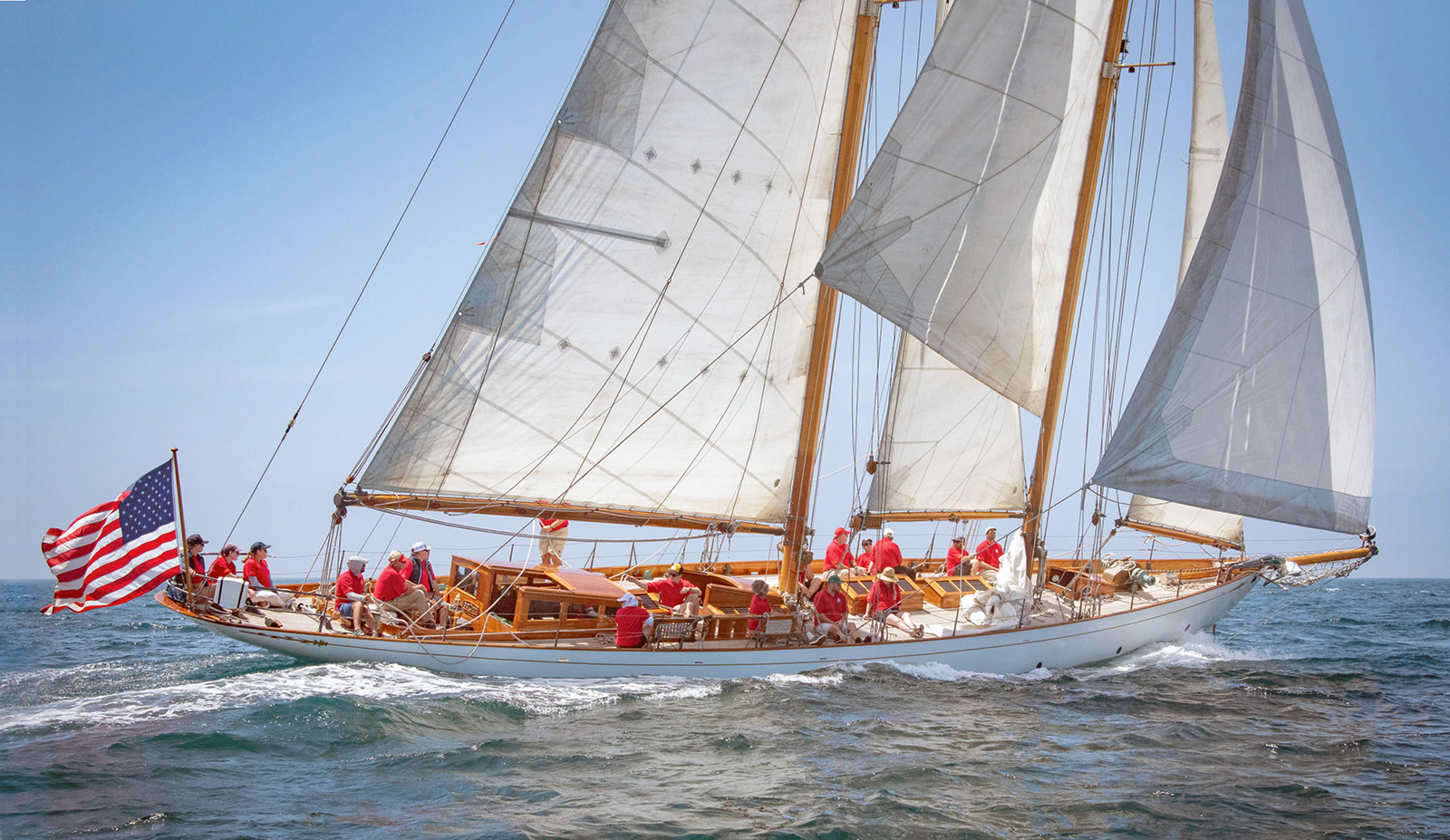
The 74′ LOD schooner ASTOR was built for a client and friend of William Fife III who took her to Sydney, Australia, soon after her launching in 1923. In 1987, Richard and Lani Straman bought her in San Diego, California, and have been stalwart caretakers ever since.
We have a joke in my family,” says Richard Straman, who has been the owner, skipper, and maintainer-in-chief of the 74′ LOD schooner ASTOR, designed and built by William Fife III in 1923: “When we bought the old girl in 1987, we had a 14-page to-do list. We are still on page 1.”
He’s exaggerating. ASTOR was far from a basket case when she joined the Straman family, and today she is a showpiece. But back in 1987 she was 64 years old, fairly original, and showing her age.
Richard and his wife, Lani, first went to see ASTOR at a fishboat dock in San Diego, California. Her owner had been getting by with oil lamps for interior lighting and running lights. “Her topsides looked like she was a steel boat that had been sanded with a 3″ grinder and painted with house paint,” Richard says. Belowdecks, the varnish on the raised-panel bulkheads in the saloon had darkened to the color of mocha. There was no refrigeration. She had almost no deck hardware, no travelers, and the running rigging had outlived its intended purpose. The surveyor had serious concerns about a patchwork of repairs to the teak deck.
“But she had a stunningly beautiful hull and rig, and they were sound,” Richard says. “So were the engine and drive train.”
Lani loved the feel of the boat down below. “You could see what she could be,” she says. “We made an offer on her within an hour of our visit.”
They had no clue how this big schooner was about to turn their lives upside down—in the very best way.
The “Unknown Fife”
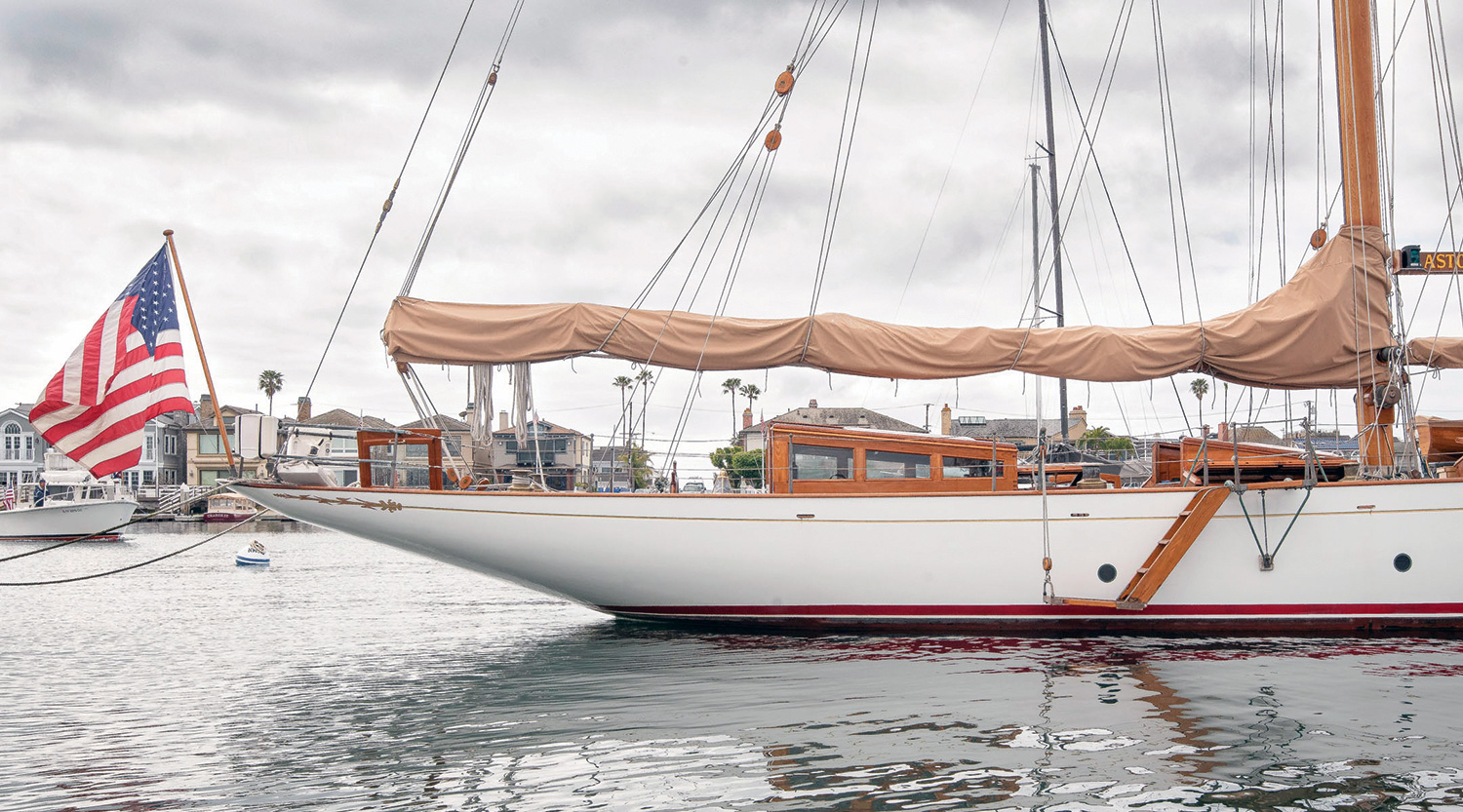
Not only the overall shape but also the details, particularly the cove-stripe finials, mark ASTOR as a Fife yacht—one that for many decades had been largely forgotten in North America.
In exploring ASTOR’s history, the Stramans went in search of books about Fife boats but found nothing. Then they stumbled upon an in-depth feature with superb photography of gorgeous Fife sailing yachts in Nautical Quarterly. It unpacked for them the story of three generations of Fifes, their yard in the port of Fairlie on the Firth of Clyde in Scotland, and their singularly “fast and bonnie” boats, as William Fife III described them.
It was a story well known among discriminating yachtsmen, not just because of the Fife reputation for speed and beauty but also because of the quality of their construction and their longevity. Today, approximately 100 of the 758 yachts built at Fife & Sons are still sailing, among them some of the most prominent racing craft of yachting history. ASTOR can count among her cousins a squadron of famous sailing yachts, but she is one of only five schooners that Fife built and one of only three that are still sailing today.
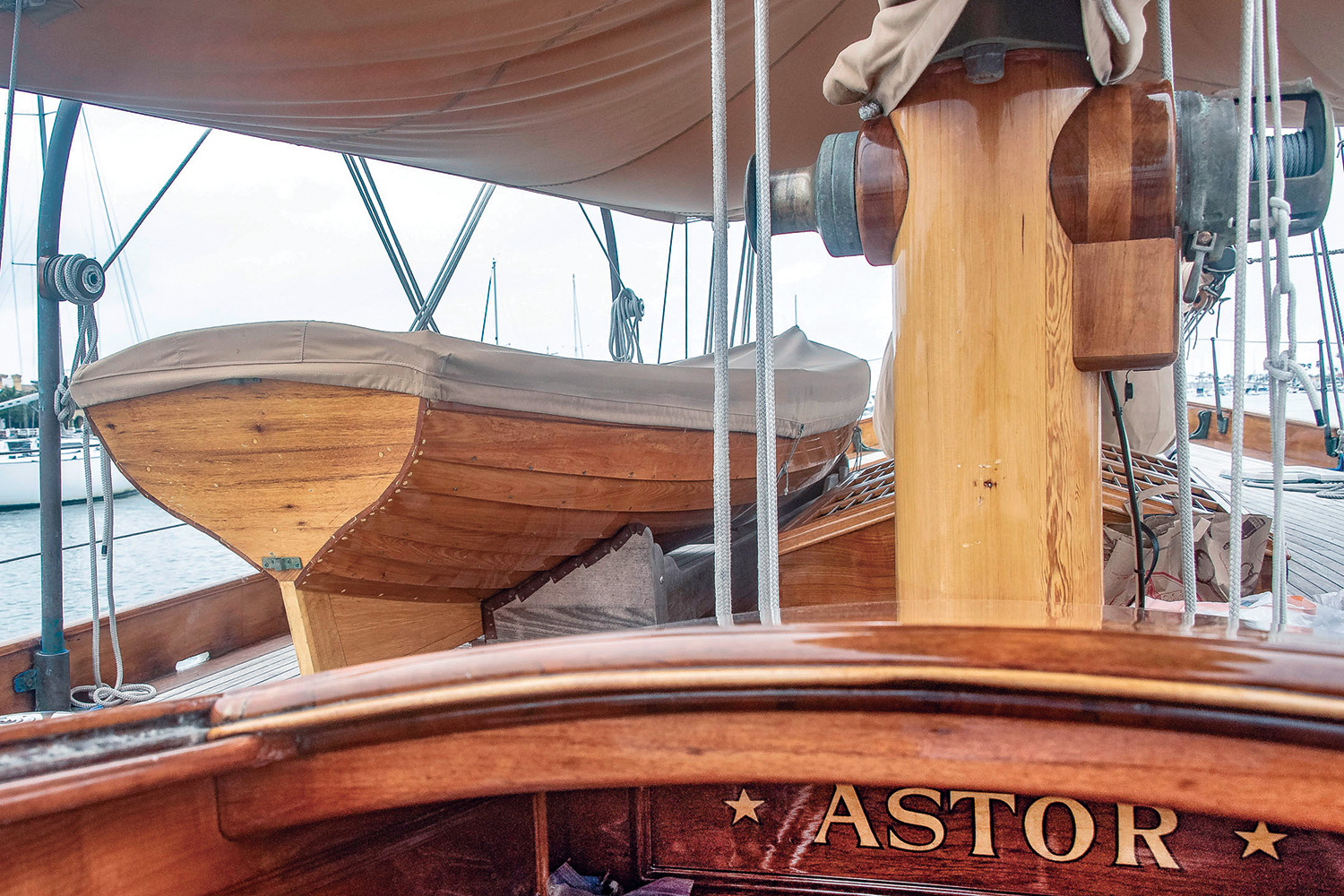
The schooner was launched as ADA, but in 1959 a Sydney businessman purchased her and renamed her ASTOR after his electronics business.
“At the time, ASTOR was the ‘unknown Fife’ in North America and the Caribbean,” Richard says. In the 2000s, he sailed to the Caribbean, where he entered his schooner in the Antigua Classic Yacht Regatta. As Richard recalls it, when he told the race official his entry was a Fife schooner, the reply was, “No it’s not—I know every Fife schooner.” Richard pointed to ASTOR riding at anchor in the harbor looking like a gleaming needle of a two-master. She had the distinctive Fife bow and counter stern, with the familiar dragon emblem at the forward end of the cove stripe. The race official found himself speechless, and he was far from the only one. This “unknown Fife” dazzled the crowd at Antigua, winning not only her class but also the concours d’élégance.
The reason ASTOR was unfamiliar to many classic-yacht aficionados in North America and the Caribbean was that for the first 40 years of her life, until 1963, she had been in Australia. William Fife III designed and built her in 1922–23 for a longtime friend, Sir Alex MacCormick, a surgeon in Sydney.
Built to Last
Particulars:
- LOD: 74′
- Sparred Length: 86′
- Beam: 15′6″
- Draft: 10′6″
- Registered tonnage: 60
- Ballast: 50,000-lb lead shoe
- Sail area: Working rig 2,400 sq ft
Total 7,000 sq ft - Engine: 150 hp turbocharged Deutz
The boat was a no-expense-spared effort, according to Richard. Fife demanded that the craftsmen at his Fairlie yard give her their very best work. When each man finished his piece of the work, he signed his name to it. MacCormick christened his schooner ADA, a name she carried until 1960, and he sailed her from Scotland to her home on Sydney Harbour. She was design No. 704; Fife & Sons would build 124 more boats before closing their doors in 1939, and among those were the two other schooners still sailing: ADVENTURESS, a 92-footer launched in 1924, and ALTAIR, 133′10″ LOA, launched in 1931.
ADA was framed with 4½″×9″ double-sawn English oak and planked with 2″-thick Burma teak fastened with bronze rivets. Her flush deck was of sprung teak and her spars of old-growth Douglas-fir. She measures 74′ on deck and has a sparred length of 86′. She is slender, with a beam of only 15′6″, and has a cutaway keel in the style of the 6-Meter and 8-Meter racing yachts that Fife also designed and built in the 1920s. She was originally gaff-rigged.
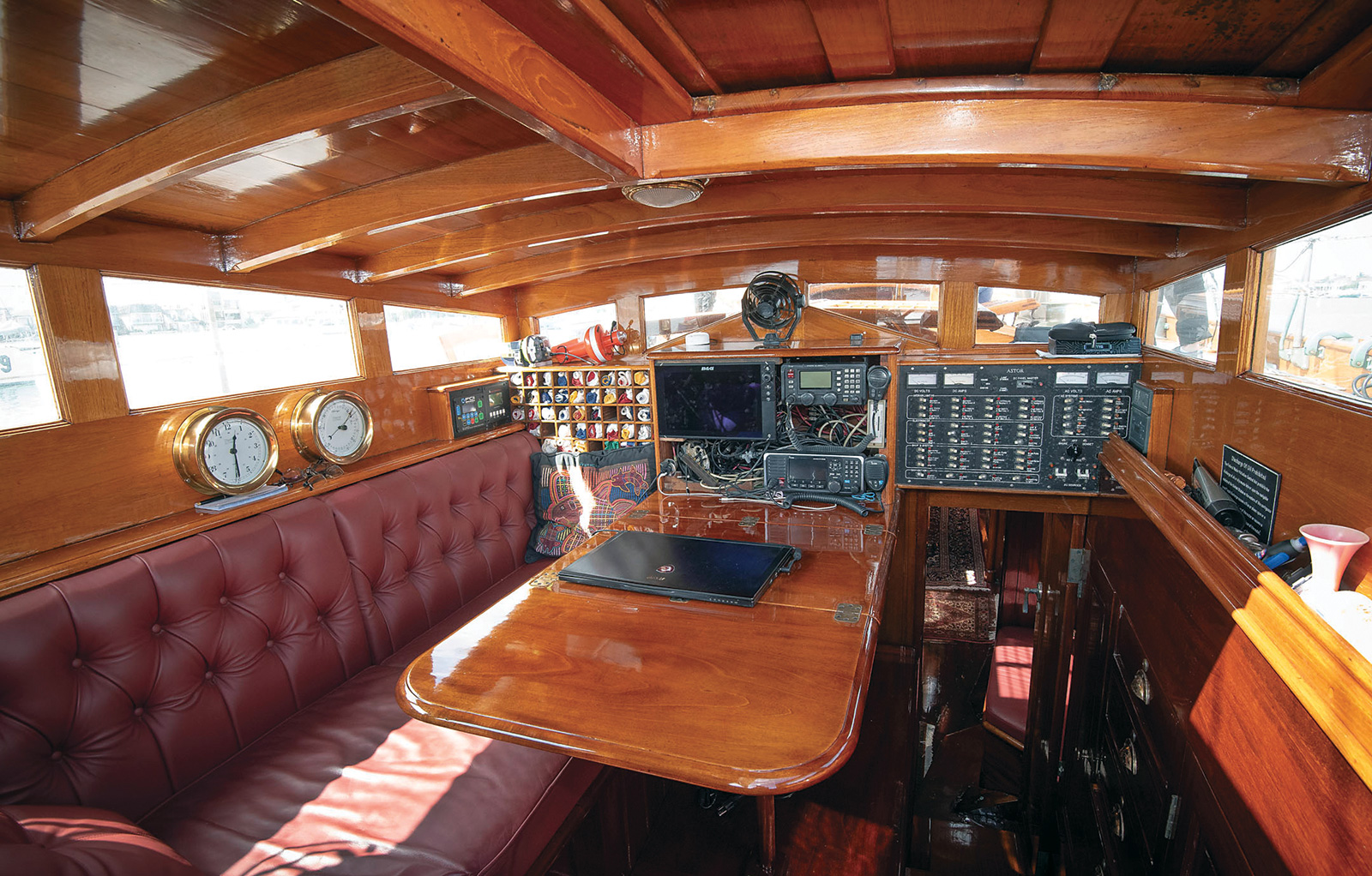
The Stramans’ restoration has included the installation of modern systems, including electronics and navigation in the pilothouse, to replace the original ones. At the time they found ASTOR, she was still using oil-lamp running lights.
ADA, the Queen of Sydney
MacCormick used his new schooner for daysailing and modest family cruising from his home on the south side of Sydney Harbour, where he had his own marine railway and boatshed. At one point, ADA was hauled out for a decade, but her seams never opened up due to the exceptional stability of her teak planking and the strength of her bronze rivets, which were installed hot and shrank as they cooled.
With the Japanese threatening to overrun Australia during World War II, MacCormick sold his house and his schooner. After the war, the new owner, William Stuart, had the yacht designer Uffa Fox draw a Bermuda staysail schooner rig for her. That rig, installed in 1953, is the one that she still carries today. Stuart began competing—and winning—with ADA in local races.
Peter Warner, another Sydney yachtsman, purchased ADA from Stuart in 1959 and renamed her ASTOR, after his electronics business. He proceeded to show off her abilities as an ocean racer. During the early 1960s, Warner and ASTOR took line honors three times in the Sydney Hobart Race, and in the 1962 race the yacht, then 30 years old, lost by only 57 seconds to “Huey” Long’s latest ONDINE maxi-racer.
In 1963, Warner sailed ASTOR out of Sydney Harbour bound for Los Angeles, California. His goal was to race in the Transpac, in which he finished fourth on corrected time.
California Girl
After the Transpac Race, the schooner stayed in California; in 1964, Dr. William Adolph of Marina del Rey bought her. He retired her from ocean racing, preferring to cruise with his four sons throughout California, Mexico, and Hawaii.
At that time, Richard Straman was studying design at the Illinois Institute of Technology in Chicago, his hometown. He had grown up around his father’s full-service automobile garage, where at age 14 he painted his first car, a ’56 Plymouth. “Anything I could do with my hands came easily,” he says, and it wasn’t long before he moved up to an XK140 Jaguar roadster. The experience launched his lifelong passion for exotic transportation and machinery.
After completing his studies, Richard opened an automobile customization and restoration shop. For fun, he started racing 15′ Albacore sailing dinghies on Lake Michigan. He loved watercraft as much as cars, but he vowed that he would never make a business of boats. It was the lure of year-round sailing, however, that drew him, and his car restoration talents, to Newport Beach, California, where he opened R. Straman Co. Automobile Restoration & Coachbuilding in 1970. When Detroit stopped making convertibles, Richard also started doing custom convertible conversions on a wide array of classic cars. He also built prototypes for General Motors, Honda, Mitsubishi, and other car manufacturers. Throughout all of this, he continued to sail as much as possible in fiberglass production boats.
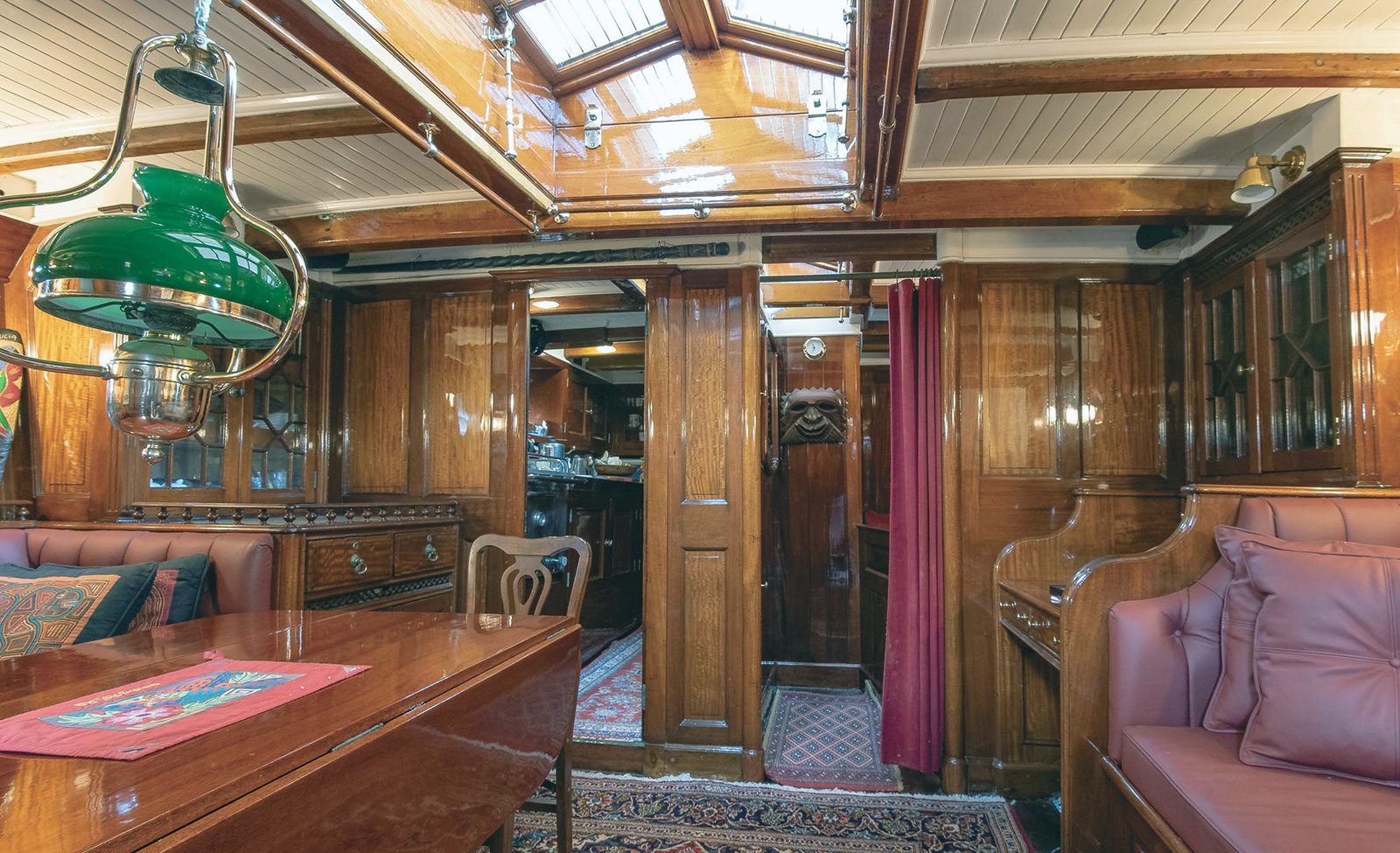
Belowdecks, ASTOR’s elegant, and largely original, main saloon and accommodations have been restored. Richard, a specialist in classic-car restorations and conversions, brought considerable experience and aesthetic sensibility to the schooner’s care. He and Lani have done much of the work themselves.
He met Lani in the early 1970s while restoring her 1938 Bentley. She was a California girl from San Bernardino, a nurse, and a self-described “car nut, like my dad.” She and Richard bonded over their love of speed, their sense of adventure, and the independence they found on the open road. Richard showed Lani that sailboats offered similar thrills, and boats would take them places a car could never go. They married in 1976, and their daughter, Mariah, was born in 1981.
In those days, Richard was searching out the perfect ride, both ashore and afloat. He wanted something that exuded speed and style. His quest afloat led him to his first wooden boat, a George Kettenburg–designed 32′ Pacific Class knockabout, and he discovered the spell a wooden boat can cast on her owner. It wasn’t long before Richard rescued the 56′ cutter BLUEWATER, designed by John Alden and built in 1930. He undertook a thorough rehabilitation of the yacht, utilizing his car shop and translating his auto restoration skills into boat carpentry.
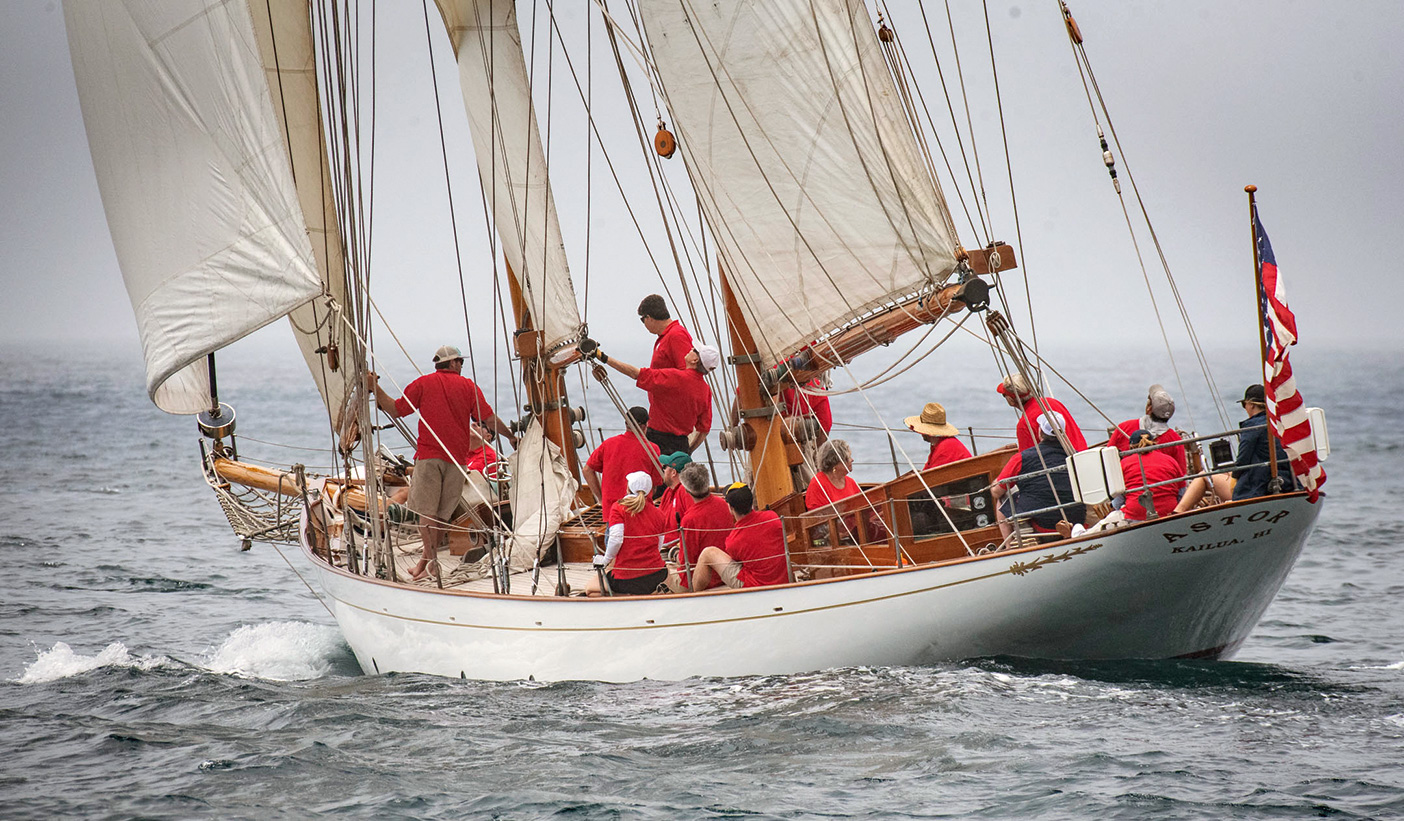
The Stramans have sailed ASTOR extensively since 1997, including a cruise starting in 2000 that took them and their daughter, Mariah, to Australia and New Zealand. Mariah left the voyage to attend college, but her parents continued, visiting more than 40 countries before returning to California in 2007. The have also sailed in many classic-yacht regattas.
“We didn’t have any money, so we had to do everything ourselves,” he says. “I learned a lot from that boat.”
“Richard was a fast study,” says C.F. Koehler of Koehler Kraft Co., a San Diego boatyard that has long specialized in wooden boats. “After all the things he has learned to do building cars, working with wood is easy. He’s that rare owner who can do it all.”
From the very beginning of Richard’s sailing days, his heart throbbed when he saw photos and drawings of schooners. There was something about boats built for fishing-schooner races, such as COLUMBIA and BLUENOSE, and schooner-yachts such as AMERICA, ATLANTIC, and ADVANCE that thrilled him. He thought the schooner rig represented the height of sailboat design, and he was particularly drawn to the big schooners that came off Alden’s drawing board in the 1920s and ’30s. “I told myself, ‘I’m going to own a big schooner someday,’” he says. “And then came that day in 1987, when I spotted a small ad in a local sailing rag listing ASTOR for sale. Lani and I had seen ASTOR a few years before when she visited Newport Harbor, and we knew that she was grand. She was the one.”
Restoration and Adventure
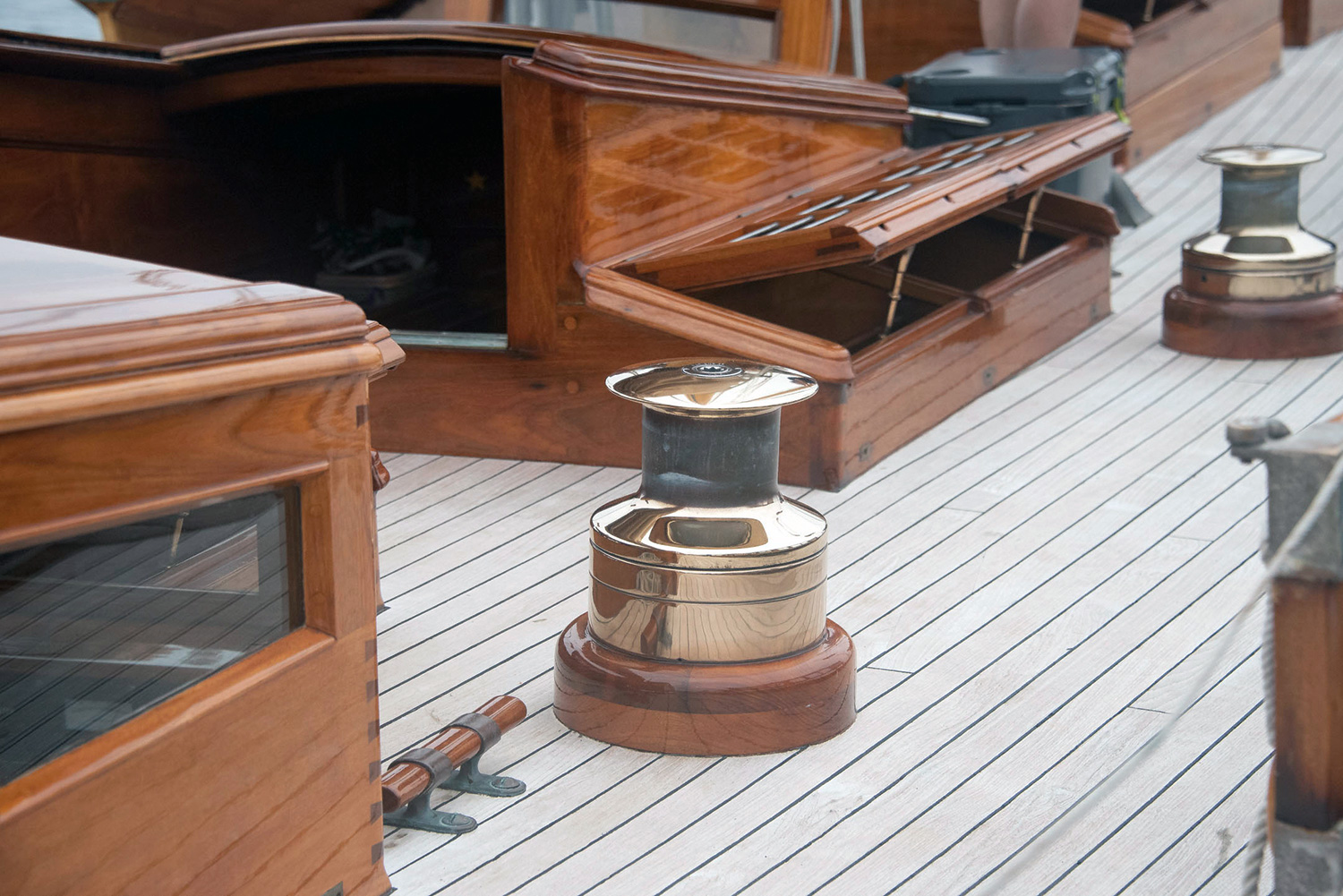
ASTOR, which didn’t have any winches when first launched, carries early bronze winches made by Barient Winch Company, founded in the San Francisco Bay Area in the 1960s.
So began the tenure of their ownership, which has been ASTOR’s longest. The Stramans’ life with ASTOR has unfolded as a rare model of commitment and family involvement with an owner-maintained, large, classic yacht. For Richard and Lani, ASTOR is more than a second career.
“She has become a lifestyle,” Richard says.
“I just love it!” Lani adds. She and Richard keep a pied-à-terre ashore at Richard’s shop in Newport Beach, but mostly the couple, now well into their 70s, live aboard ASTOR. They always have a new project going. When they are not sailing, they are usually both working on the boat.
Even before they sailed ASTOR away from that fishboat dock in San Diego to take her north to her new home in Newport Beach, the Stramans had projects. “The first thing we did was rip out all the purple carpet and ditch the red cushions,” Lani says.
Shortly after the sale, someone walked off with the boat’s traditional oil-lamp running lights, so Richard had to install enough of a new electrical system to power new wired ones, plus modern bilge pumps. Then the Stramans got spools of commercial cordage to replace enough of the running rigging to sail her home safely. There were no functional water tanks, so they lugged bottled water aboard. Then they set sail.
The passage from San Diego to Newport Beach was a 95-mile romp to windward in moderate winds. ASTOR heeled over to starboard, leaned into the Pacific swell, and took off like a thoroughbred. No creaking, no moaning, just the hiss of the bow wave trailing off to leeward as the schooner loped along with her four lowers drawing. She felt simultaneously immensely solid yet in flight. The dragon emblem at the bow seemed like more than artistry—more like an omen.
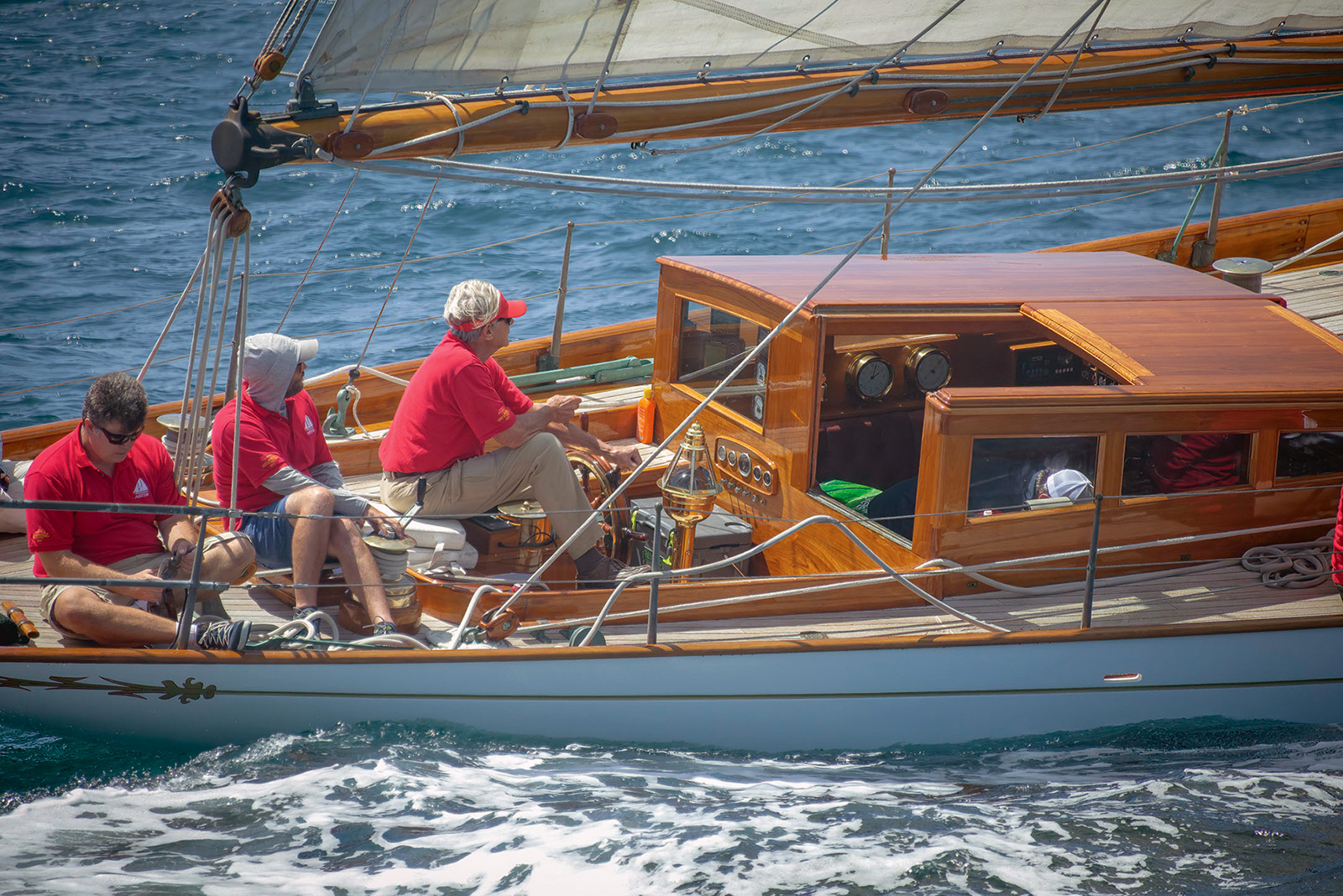
One significant change the Stramans made was to reconfigure the pilothouse. They felt the original was boxy, so Richard designed a new one that has a lower profile than the original yet reflects the styling of the other deck structures.
Over the next few years, with the boat home in Newport Beach, Richard, Lani, and Mariah, who was five years old when ASTOR joined the family, began what would be hundreds of weekend sails offshore to Santa Catalina Island. Richard’s auto restoration business was booming, but he squeezed in time to complete the electrical system, install new water tanks, install refrigeration in the galley, and add a generator. He fabricated bronze stanchions, travelers, and Highfield levers for the running backstays. He built boarding stairs and made butterfly hatches for the skylights. As time went by, the Stramans prepared ASTOR for a 21st-century future with new standing rigging, single-sideband and ham radios, and multiple GPS units. They added a depthsounder, a watermaker, a pressure washer, a water heater, a dishwasher, and a washing machine.
They never liked the schooner’s boxy pilothouse, so Richard designed a lower-profile one that echoed the lines of the companionway scuttles. After searching through stacks of mahogany for lumber with just the right grain, he built the new pilothouse in his shop and within just three weeks installed it on the boat. But it was no quick-and-dirty job: the Los Angeles–based boatbuilder Wayne Ettel (see WB No. 187) says that you can’t tell the pilothouse is not original construction from 1923.
Meanwhile, Lani was in the saloon stripping the old varnish off the raised-paneling and giving it 10 fresh coats. She was also keeping up with acres of varnish above decks.
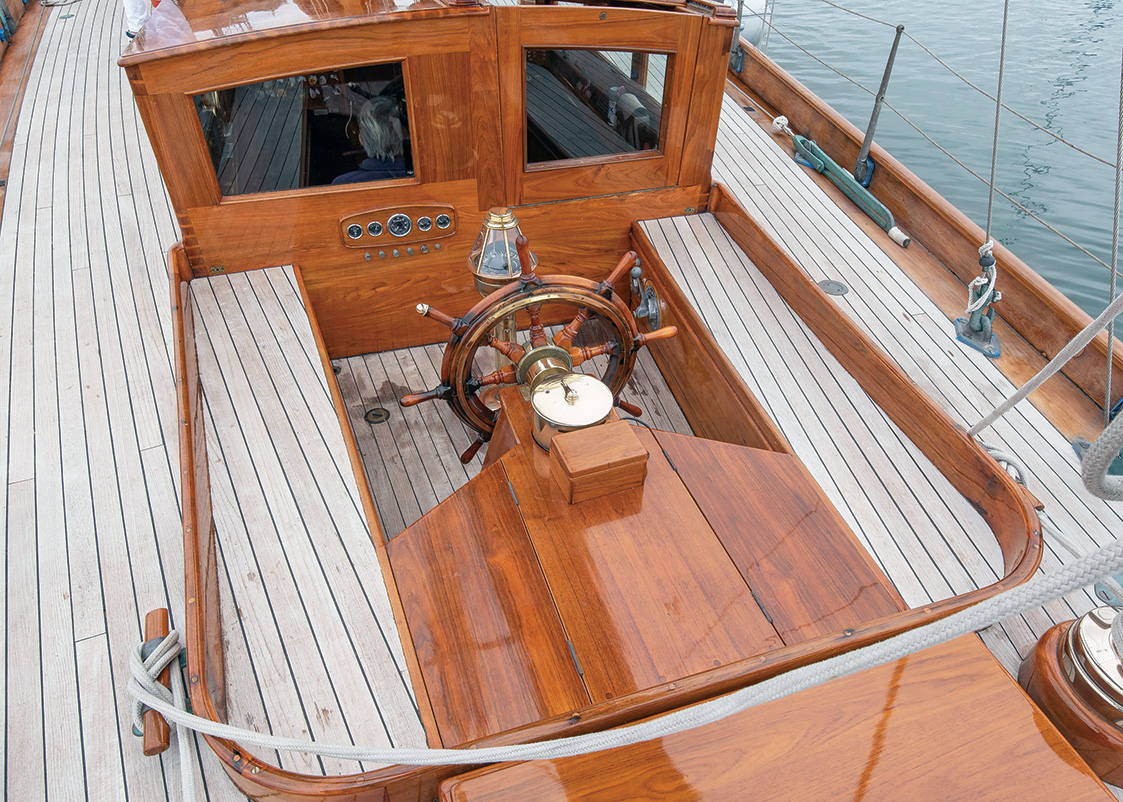
The new pilothouse seamlessly matches the cockpit, which Richard rebuilt in 2007.
Richard had spent a lot of time with orbital sanders and longboards getting layers of house paint off the hull’s topsides. But recoating a 60-ton schooner every two years with oil-based yacht paints was becoming a daunting chore, so during one haulout he took the topsides down to bare wood for a fresh approach. The seams above the waterline had been splined, but the glue holding them was failing. Richard removed the splines and glued in larger ones, using epoxy on one edge to leave a caulking bevel on the opposite edge to receive new caulking. With the hull tight and fair, he had a boatyard spray the topsides with linear polyurethane paint to give ASTOR a mirror finish that promises to last 10 years.
Then the Stramans tackled the worn and patched sprung-teak deck. “We spent seven months on our knees, removing the old wood and starting over,” Lani says, rolling her eyes. “It was quite the marathon.”
But life with ASTOR was far more than just project upon project. The Stramans enjoyed watching the looks on the faces of the crews on other boats when ASTOR sailed to anchor at Catalina with 10-year-old Mariah at the helm. The schooner got new sails made by Skip Elliott of Elliott/Pattison Custom Sailmakers in Newport Beach, and during the 1990s the Stramans started racing her. They got proficient at setting the spinnaker; the ADVANCE staysail, named for the pioneering staysail schooner ADVANCE designed by W. Starling Burgess; and the gollywobbler. Running before the wind, ASTOR can carry 7,000 sq ft of sail. In this configuration, she won the America’s Schooner Cup in San Diego five years in a row.
World Cruise
During the summer of 1997, demand for auto customization and restoration plummeted during the economic recession, so Richard’s business slowed down. The family decided to use the lull to advantage by taking the summer off and sailing ASTOR north to San Francisco Bay.
“That summer changed everything,” Lani says. “When it was over, none of us wanted to get off. We decided that when Mariah graduated from high school, we were going cruising. So far, we have sailed over 100,000 miles and visited well over 40 countries.”
In 2000, the Stramans closed the auto restoration business, sold their house, and started ASTOR on what Richard called a “lazy sail”: 3,450 miles in 17 days from Southern California to the Marquesas Islands. Cruising their way through Polynesia, they added another crew member in Papeete: Daniel Geissman, a young sailor who came off another yacht. By the time ASTOR reached Tasmania, Daniel and Mariah were in love. During the next two years, ASTOR explored Australia and New Zealand, after which the young couple jumped ship to go off to college together back in California.
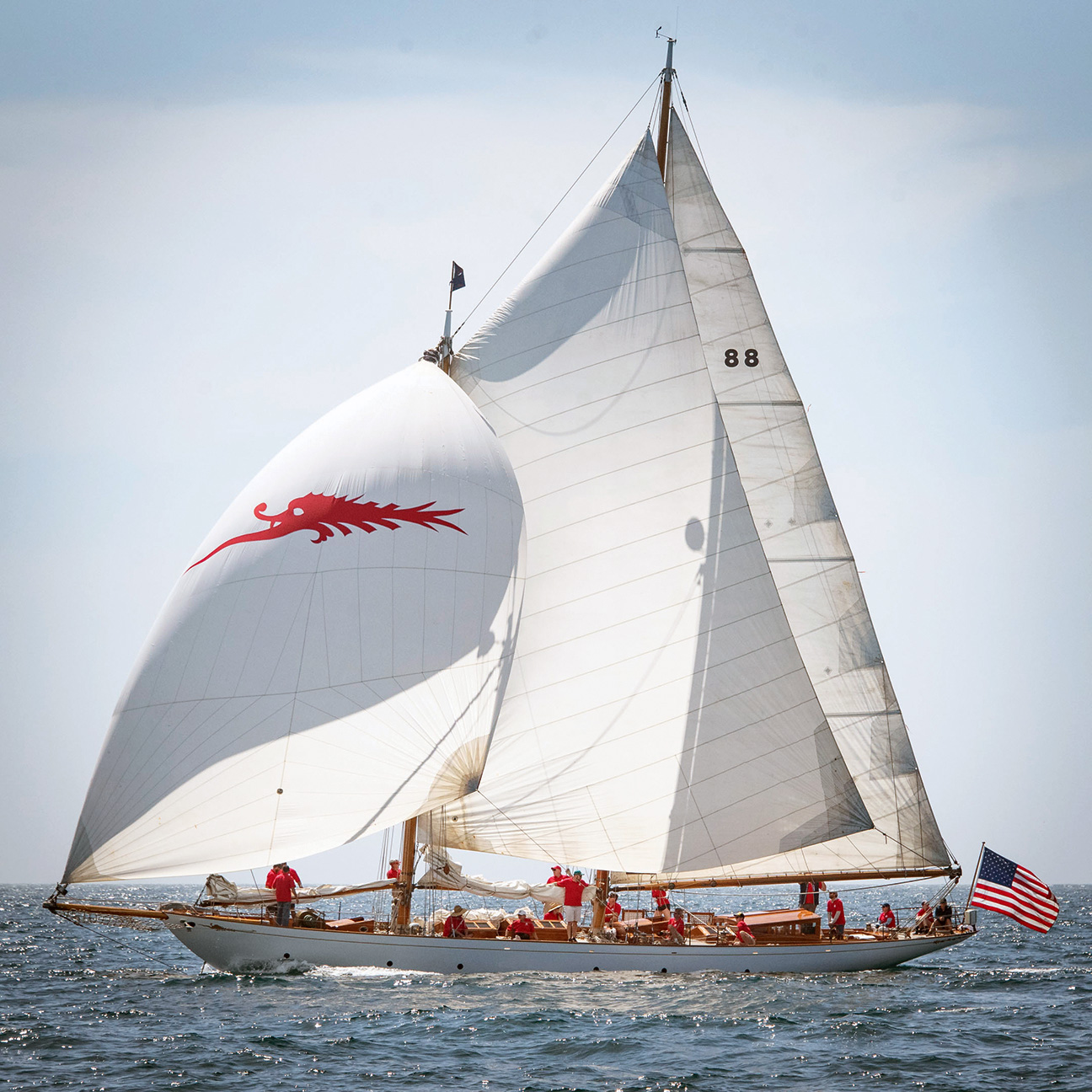
Originally gaff-rigged, ASTOR was reconceived as a staysail schooner in 1953 while in Sydney.
But Richard and Lani were just getting started. They lingered on the east coast of Australia, especially in the Whitsunday Islands, where ASTOR tied for first place in the classic division at Hamilton Island Race Week. Then they took off on a 9,000-mile windward beat to Hawaii. ASTOR seemed no worse for the effort, but Richard knew two things: first, “too strong never broke,” and second, he and Lani had more oceans they wanted to cross. So while they were in Hawaii, he augmented the schooner’s plank fastenings below the waterline with bronze screws, “just because.” The original bronze rivets showed no stretch or electrolysis, so Richard left them in place.
In 2007, the Stramans took ASTOR home to Southern California long enough to see Mariah and Daniel graduate from college and for Richard to replace ASTOR’s caprails, booms, and cockpit on the family schooner. He and Lani wanted to sail her next to her ancestral homeland, Scotland, in time for the 2008 Fife Regatta in Fairlie. But cruising got in the way of that dream.
They sailed south along the coasts of Mexico and Central America; through the Panama Canal; to Cartagena, Colombia; and on to the Caribbean islands. In 2009, they voyaged along the U.S. East Coast as far north as Maine until returning to the Caribbean for much of 2010. Next, they crossed the Atlantic to the Azores and the Mediterranean Sea. In Gibraltar, they paused to fly back to California for Mariah and Daniel’s wedding. After returning, Richard and Lani replaced ASTOR’s old Detroit Diesel with a new, 150-hp, turbocharged Deutz engine.
In 2013, they finally made it to Scotland, where ASTOR, looking regal at age 90, caused a stir with her return to Fairlie for the annual Fife Regatta. After that reunion of Fife-built yachts, the Stramans cruised the Irish Sea and then headed back to the Mediterranean for more adventures.
By 2015, the Stramans had made a westbound crossing of the Atlantic, homeward bound for Newport Beach. They arrived in 2016, after a 90,000-mile odyssey.
“I think we could have gone on forever,” Lani says, “but Mariah and Daniel were having a baby. We couldn’t stay away.”
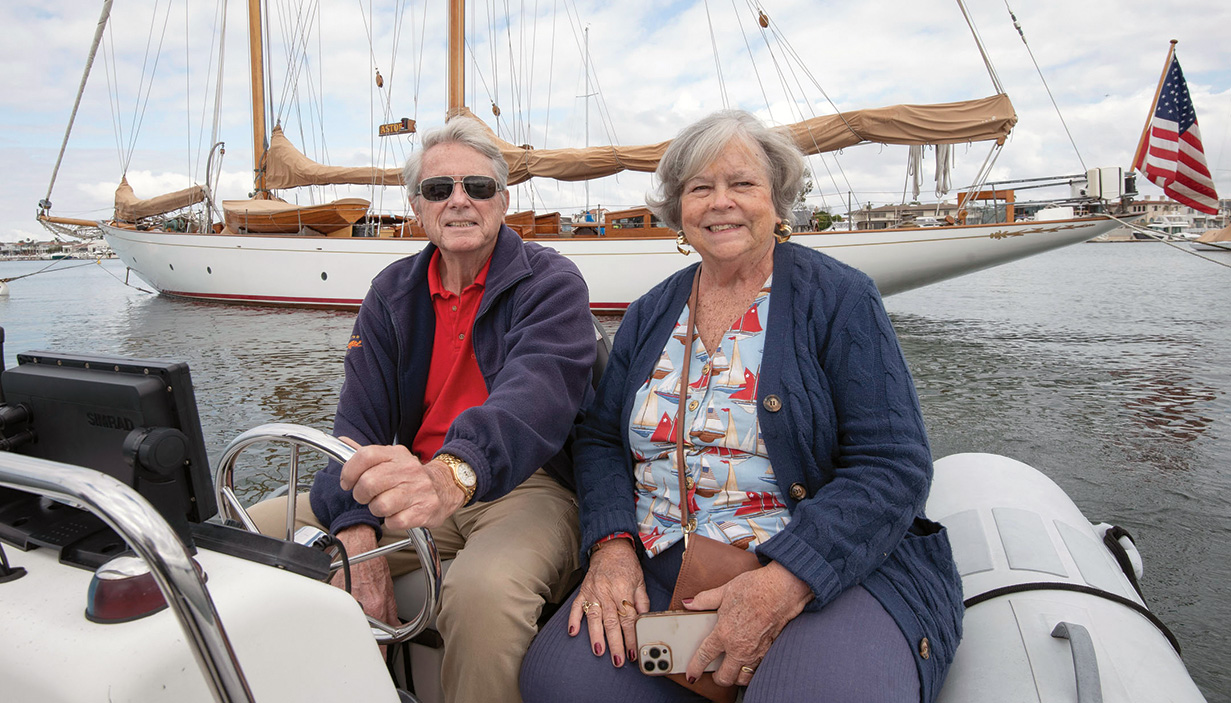
In 37 years of owning ASTOR, Richard and Lani have made many upgrades and learned a great deal about maintaining a large schooner.
Lessons Learned
The constant upgrades and renewal aboard ASTOR have not slowed during her time back in Newport Harbor. A few years ago, Richard teamed up with C.F. Koehler to fashion a new mainmast out of Douglas-fir, and he has replaced all the bronze chainplates with thicker ones. The Stramans are both handy with sewing machines, and just this year they completed a set of leather cushions for their saloon.
What does the future hold for the Stramans and ASTOR as they face the challenges of time and tides? “This story doesn’t end until they peel my cold, dead fingers from the wheel,” Richard says. Lani concurs: “She’s so much a part of our lives, and the grandchildren just love her. ASTOR’s their pirate ship. It’s all fun.”
Maintaining ASTOR
Despite the sailing and maintenance skills that Richard and Lani Straman brought to ASTOR back in 1987, their schooner has taught them quite a few lessons:
- Sailing a big schooner: “It is not as complicated as some people might think,” Richard says. If you can sail a small boat, you can sail ASTOR. She just has more sails, more halyards, more sheets. You start with the mainsail and trim going forward.” Having an electric winch or two really helps.
- Projects: “Prioritize the boat’s needs, and never, ever have more than one project at a time,” Lani says. “We’ve seen too many boats die and too many people get disillusioned when they go too deep into an old boat too fast.” As Richard says: “Stay focused and don’t let the project linger.”
- Have a maintenance schedule: “We prefer constant—constant—vigilance to a fixed schedule; the devil is in the details,” Richard says.
- Working with boatyards: “Don’t be a pain in the ass,” Richard says, “but be present and attentive when there is a job you cannot do yourself. Nobody knows your boat or cares about it like you do.”
- The daily work routine: At sea, everybody aboard ASTOR works on the boat until noon. At a mooring or at anchor, it’s ordinarily eight-hour workdays for the boat.
- Tools: “It helps to have a shop ashore,” Lani says, implying that the joys and romance of living on a classic schooner fade quickly if the boat becomes a job site. “You can never have enough tools,” Richard says, “but if you can only have one, I’d go with a hammer.”
- Varnish: “A minimum of 10 coats,” Richard says. “Twenty is better, to seal the grain.” He advises using a varnish with the highest ultraviolet light protection you can find. The Stramans sand and recoat their spars once a year. All other exterior varnish gets two coats every six months. “I sand with 220-grit before the first coat, 320-grit for the second,” Lani says, and she favors Corona Europa brushes.
- Metal: “Stick with bronze,” Richard says, favoring it by far over stainless steel. He uses Sharkhide Metal Protector to keep the bronze gleaming.
- Wood: The Stramans are always on the lookout for good teak, mahogany, Douglas-fir, and English oak, which they store in their shop to season. Richard has been known to pick through woodpiles for hours to find a few boards that meet his standards.
- Teak decks: “No oil,” Richard says. “It darkens the wood, absorbs sunlight, then dries out the fibers.”
- Washdowns: “I’m not a fan of fresh water on wooden boats,” Richard says. “We wipe the dew off every morning with microfiber cloths.”
- Spares: “Take everything you can think of,” Lani says, and Richard suggests including raw materials such as bronze rod and rolls of oakum.
- Expenses: The Stramans say they never skimp on the cost of materials or parts, but they avoid adding up their receipts for obvious reasons.
—RP

Randall Peffer is a regular contributor to WoodenBoat.