New Introduction coming from Matt….

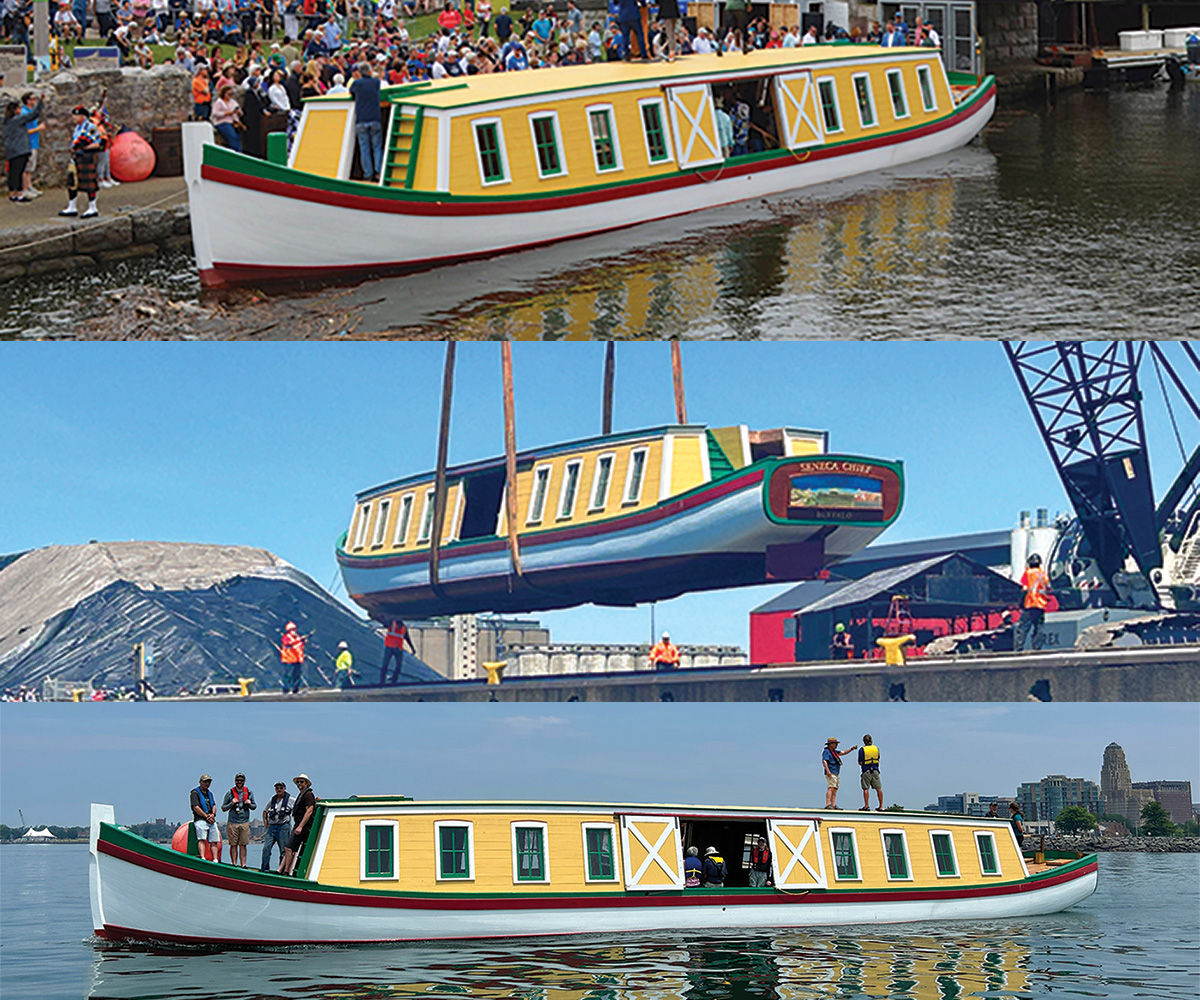
SENECA CHIEF

SENECA CHIEF

Photos by Stephanie Trzeciak (top) and Phil Bobzien Buffalo Maritime Center (bottom two)

In May 2024, the Buffalo (New York) Maritime Center launched a full-sized replica of Gov. DeWitt Clinton’s SENECA CHIEF, the boat that officially opened the Erie Canal in 1825. Built between 2019 and 2024 as a community project at the western terminus of the canal in downtown Buffalo, the replica will become a living museum to “educate and inspire the people of New York State in reimagining the Erie Canal.” Along with master boatbuilder Roger Allen and lead boatbuilder Greg Dudley, hundreds of volunteers worked on the project in roles ranging from historical research to hands-on boatbuilding.

The Erie Canal Boat SENECA CHIEF is 73′ LOA × 12′6″ beam. Her keel, frames, and other structural timbers are of white oak. The keelson was made from a single 60′-long piece of Douglas-fir, fashioned from a donated timber that was used in the early 1900s as a gin-pole crane. She is planked with two layers of 1″-thick cypress with a layer of Dynel cloth set in epoxy between the layers. The outer layer is traditionally caulked with cotton. The builders hope that the combination of traditional and modern boatbuilding techniques will help to maintain the boat’s watertightness despite the necessary winter haulouts. The 1820s-style cabin is fitted out in cabinet-grade hardwoods.

SENECA CHIEF will serve as the flagship of the Erie Canal Bicentennial Celebration, and in 2025, during the World Canals Conference, she will travel from Buffalo to New York City 200 years after her namesake made the same trip. Following the commemorative voyage, SENECA CHIEF will return to Buffalo but will continue to travel to communities along the canal to share stories, illustrate traditional boatbuilding techniques, and highlight the history and impact of the Erie Canal.


GOOBER

GOOBER

Photos by Craig Dean

Steve “Goober” Campbell of Alameda, California, has built a Glen-L hydroplane, restored a 1942, 17′ Chris-Craft, and has now designed and built this 7′11″×3′ outboard skiff for use on Stony Lake, Ontario. She is built of ¼″ marine plywood on white-pine frames milled from an old tree that came down on Monroe Island in Stony Lake. Her transom is 1″ marine plywood and the thwarts are white pine. GOOBER (the name has been Steve’s nickname since he was a child) was launched in October 2023.


CARMEN

CARMEN

Photo by Phil Bobzien

Working alone on weeknights and weekends, Phil Bobzien of Snohomish, Washington, completed this Sam Devlin–designed Candlefish 18 in about 1,800 hours. He began the project in 2015 and launched CARMEN—named for his grandmother—in August 2023 on Lake Stevens. CARMEN’s hull is built stitch-and-glue style of marine plywood with 6-oz ’glass cloth set in epoxy. The keel is purpleheart and the bright-finished gunwales are sapele. Phil says the only help he needed was to turn the hull over, and later, to hoist the 70-hp outboard motor onto the transom. Phil will be using CARMEN with his wife and friends for picnic cruises in the coastal waters of Puget Sound and nearby freshwater lakes.


SYNTAX
SYNTAX

SYNTAX

Photos by Matthew Murphy (top); Wes Wheeler, (bottom left and right)

The Wheeler 55 was inspired by the 1931 Wheeler Playmate catalog and a series of wooden boats built in that era by the Wheeler Shipbuilding Company that included Ernest Hemingway’s PILAR of 1934. Custom-designed and -built, she is 55′5″ LOA without swim platform, her beam is 16′9″, her draft is 4′8″, and she displaces 60,000 lbs light. The initial design and rendering were by Bill Prince Yacht Design of Port Washington, Wisconsin, and the detailed design and 3D shop drawings were by Brooklin (Maine) Boat Yard and their principal designer, Will Sturdy, with interior design by Martha Coolidge in conjunction with the Wheeler family. The yacht was built by Brooklin Boat Yard with Eric Blake, the yard’s vice president, serving as project manager. Structural members are laminated Douglas-fir, the hull is vacuum-bagged African-mahogany plywood, the topsides and interior are sipo mahogany, and the decks are laid southeast-Asia teak. There are two staterooms, a third cabin for crew, three full heads with showers, two fully equipped galleys, a spacious saloon, and a pilothouse with a 360-degree view. The yacht has two 1,000-hp MAN V8 diesel engines, and on sea trials cruised at 25 knots at 2,300 rpm with a range of 300 miles. The Wheeler 55 was launched in Brooklin in summer 2024.


RIVERHAWK

RIVER HAWK

Photos by Dave Feder and Steven Feder

Dave Feder of Lansdale, Pennsylvania, built RIVER HAWK, a Hans Friedel–designed Osprey supplied as a kit from Newfound Woodworks, as a gift for his brother, Steve. Dave says that the western red cedar strips from Newfound Woodworks had unique black streaks and he laid them out so the finished boat would have the appearance of “bird wings over the foredeck and down both sides.” He then added rice-paper graphics of a bird in full flight to the foredeck, stern hatch, and cockpit recess to complete the “River Hawk” theme. RIVER HAWK is 15′9″ LOA with a beam of 24⅜″. She was launched in April 2024 and joined the first boat that Dave built, LAZY LIGHTNING, which he relaunched the same day after a year in the shop to renew the ’glass sheathing and paint. The brothers will be paddling their kayaks in the mid-Atlantic region and England, where they are dreaming of a future trip down the Thames from Oxford to London.


SEVEN SEAS

SEVEN SEAS

Photos by Cade Simmons and Nate Ressling

In 2023, Miguel Prida of Galveston, Texas, attended Paul Gartside’s boat-design class at WoodenBoat School. Inspired by that class and the shop classes happening concurrently elsewhere at the school, he bought a set of plans for Iain Oughtred’s Acorn Tender and returned home to Texas to try his hand at building. SEVEN SEAS is 7′5″ LOA with a 4′ beam. She is built of mahogany marine plywood with varnished solid mahogany accents, and while Miguel says the construction was challenging, he also found it very rewarding. SEVEN SEAS was launched and christened in Galveston in February 2024.


SKEDADDLE

SKEDADDLE

Photo by Steve Frazier

When Connor Wallace of South Kingstown, Rhode Island, was in middle school, his father built a plywood skiff for him and his brother. A few years later, Connor built his own strip-planked kayak as a senior project in high school. Now, many years later, SKEDADDLE is the first build Connor has taken from start to finish on his own. He chose the Iain Oughtred–designed Caledonia Yawl because he liked its “traditional good looks,” and while it would be large enough to carry his whole family, it was small enough to build and store in his garage. Connor began building SKEDADDLE in 2021 and launched her in Point Judith Pond, Rhode Island, in May 2024. For the immediate future, Connor plans to sail her locally, but he is looking forward to summer camp-cruising with his family along the Maine Island Trail.


VIGILANT

VIGILANT

Photo by Tom Jackson

Peter Kass’s Johns Bay Boat Company in South Bristol, Maine, launched the 43′6″ lobsteryacht VIGILANT in June 2024. Powered by an 800-hp MAN diesel engine, the boat will cruise comfortably at more than 20 knots. She is the third Kass lobsteryacht built for Richard Armstrong, whose family members still own the previous two boats. The extended wheelhouse has a galley to starboard aft of the steering station, with a window that swings open for communication with the large aft cockpit. A settee and table are opposite, and forward of these is a bench seat opposite the helm. Below, she has a head with a full shower to starboard, two guest berths to port, and a comfortable stateroom forward. VIGILANT’s name is a nod to Armstrong’s earlier motoryacht, the Walter McInnis–designed 71′ sardine-carrier-styled LITTLE VIGILANT of 1950, which he restored and cruised widely before donating her to Mystic Seaport Museum. VIGILANT’s home port will be Friendship, Maine.


H

H

Photo by Jay Moody

Helga and Jay Moody of Danbury, Connecticut, spent 16 months building H, an 18′ center-console Marissa design by Graham Byrnes of B&B Yacht Design, which won the 2009 WoodenBoat Design competition (see WB No. 211). H is built from a kit with Douglas-fir for the frames and ⅜″ and ½″ okoume plywood for the hull panels. Helga and Jay say they also used about 24 gallons of epoxy. They personalized the boat’s look with a mahogany dashboard, and added strength with a triple-thickness transom. H was launched in May 2024 on Candlewood Lake in Danbury, and Helga and Jay report that with her 60-hp Suzuki outboard her top speed is 30 mph, she handles nicely, and “the ride is dry.”


NESSIE

NESSIE

Photo by Fredrik Eriksson

A father-and-son team, Mats and Akseli Vuorenjuuri of Porvoo, Finland, built this Iain Oughtred–designed Ness Yawl, named NESSIE, as a show and test boat for their boatbuilding shop, Nordic Craft. She is 19′2″ LOA with a 5′3″ beam and is built of okoume plywood with Douglas-fir keel, stems, trim, and spars. The floorboards and thwarts are of Finnish pine. Mats sees NESSIE as the perfect ambassador for their business, through which they promote “the pleasures and possibilities of small-boat cruising in Finland.” NESSIE was launched in Porvoo, east of Helsinki, in May 2024.


New Haven Oyster Sharpie

New Haven Oyster Sharpie

Photos by Mystic Seaport Museum

Mystic Seaport Museum’s 35′ New Haven Oyster Sharpie was donated to the museum in 1947. Believed to have been built in the 1890s, the boat was stored outside and fell into disrepair. She was rebuilt at the Connecticut museum in the 1960s by Elwood Bogue, who replaced the centerboard trunk, keelson, centerboard, some stern staving, sections of the after and forward bulkheads, and the maststep. At that time, the museum did not intend to return the sharpie to the water, and Bogue made no attempt to restore the hull’s original shape; she had lost 8″ of sheer over her 35′ length.

In 1973, Keith MacArthur undertook a second restoration during which he replaced three bottom planks, rigged and outfitted the boat, and relaunched her. The sharpie then had a 30-year-long career as a floating, and sailing, exhibit at the museum. In 1983, Arnold Crossman and Tom Janke completed an extensive rebuild of the keelson and centerboard trunk. By 2011, the sharpie had again suffered extensive deterioration. She was laid up ashore until 2019, when she was brought into the museum’s Henry B. duPont Preservation Shipyard main shop building.

Using the original sections, Walter Ansel, the shipyard’s director, created new CAD lines, with a sheerline inspired by the Lester Rose Sharpie documented by Howard Chapelle in 1928. Between 2019 and 2024, shipwrights Trevor Allen, Manny Portes, Lloyd Meads, and Scott Gifford restored the hull to her original shape, saving the keelson and rig. Large pine trees donated to the project by Boy Boyden of Foster, Rhode Island, were milled by Nathan Adams. The sharpie was relaunched at Mystic Seaport in May 2024.


ELLIOT WHITE
ELLIOT WHITE

ELLIOT WHITE

Photos by Paul Maselli (bottom left); Chuck Ulrich (bottom, right); Marcella Dolan-maselli (top)

The centerboard sloop ELLIOT WHITE was designed by Fenwick Williams (hull) and K. Aage Nielsen (sail plan) for the John G. Alden Design Company and was built in 1936 by the Mantoloking Boat & Engine Company of Barnegat Bay, New Jersey. She spent much of her life on the New Jersey coast and the south shore of Long Island, New York.

In 1997, she was found abandoned on the hard in Patchogue, New York, by Paul Maselli of Bay Shore, New York. Over the next 27 years, Paul and his wife, Suzanne, together with increasing help from growing sons Joe and Cooper (who made many of the bungs for the new planking out of the old centerboard planks), lovingly restored the sloop to her former glory. Shipwright Josh Herman helped to rebuild the hull—which included a total replacement of the backbone and 80 percent of the oak frames. Bill Mills of Stonington (Connecticut) Boatworks and Ben Philbrick of MP&G Partners of Mystic, Connecticut, worked on the deck and cabinhouse. The spars were built by Myles Thurlow Rigging of West Tisbury, Massachusetts, who, Paul says, “did a spectacular job to replicate the original spars so that all the original standing rigging would fit the new mast.”

ELLIOT WHITE was relaunched at the Frank M. Weeks Yacht Yard in Patchogue in June 2024 and Paul and Suzanne looked forward to a summer of “learning the nuances,” before venturing away from Long Island’s south shore to explore the U.S. Northeast coast in coming years.


These pages, along with the Boat Launchings section of www.­woodenboat.com, are dedicated to sharing recently launched wooden boats built or restored by our readers. If you’ve launched a boat within the past year, please email us at launchings@woodenboat.com, or write us at Launchings, WoodenBoat, P.O. Box 78, Brooklin, ME 04616.

Please include the following information:

  1. The boat’s length and beam;
  2. The name of its design class or type;
  3. The names of the designer, builder, owner, and photographer;
  4. Your mailing address along with an email address or phone number;
  5. The port or place of intended use;
  6. Date of launching; and
  7. A few sentences describing the construction or restoration. Send no more than five photographs (jpg images at 300 dpi) and enclose a SASE if you want anything returned.

Hints for taking good photos of your boat

  1. Set your camera for high-resolution images. We prefer jpg format, at 300 dpi minimum.
  2. Stow fenders and extraneous gear out of the camera’s view. Ensure the deck is clean and uncluttered.
  3. Take your photographs in mid-angle sunlight for best results. Mid-morning or mid-afternoon usually work well.
  4. Keep the horizon level and the background simple and scenic so your boat stands out from its surroundings.
  5. Take some pictures of the boat underway and some at rest. Often a vertical format works well for sailboats. Shoot a lot of images, then send us your five favorites.

We enjoy learning of your work—it affirms the vitality of the wooden boat community. We receive so many submissions that there is not room in the magazine for all of them to be published. Launchings not printed in the magazine can be seen at www.woodenboat.com/boat-launchings. Article ends.