
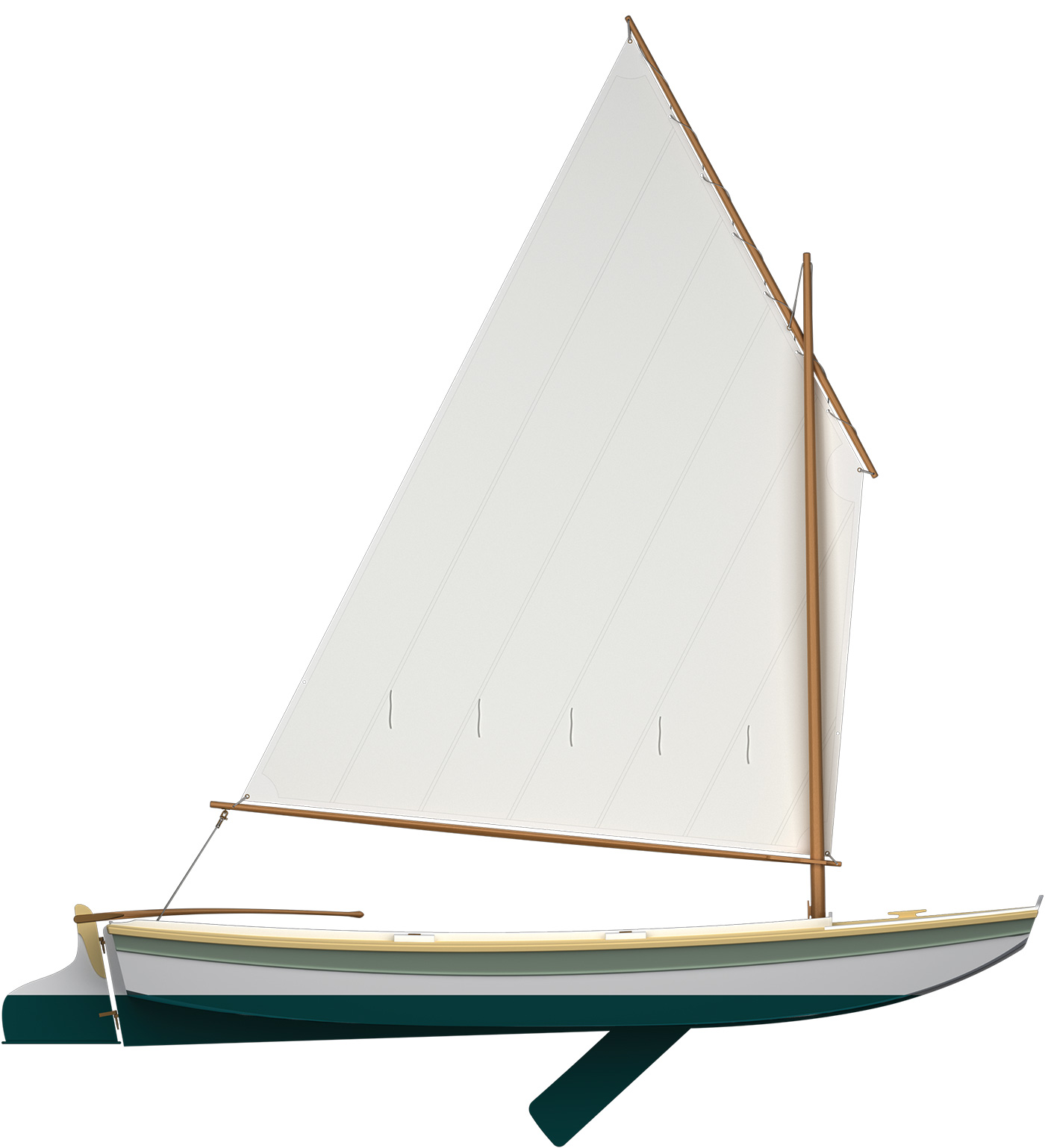
Doug Hylan designed the Swan Point Garvey for Russ Manheimer, a longtime Barnegat Bay sailor who wanted to return to this local traditional hull shape for recreational sailing.
On the paper-thin waters of New Jersey’s Barnegat Bay, garveys are part of the waterfront scene—so common as to be hardly noticed. These modified scows haul cargo, rake clams, hunt ducks, carry vacationers fishing, and accomplish most anything else that needs doing on shallow water.
Garveys appeared on the coastal lagoons of the southern New Jersey shore during the 19th century. Local history suggests that Jarvis (Gervas) Pharo created the first one in West Creek. The term “garvey” seems to have evolved as a corruption of his first name.

The bottom’s rocker, or longitudinal curvature, sweeps upward to the transom, allowing the hull to slip easily through the water.
According to Howard Chapelle in American Small Sailing Craft (W.W. Norton, 1951), the early garveys showed considerable shape and flare—rather handsome as scows go. Because they were rowed and sailed, their flat bottoms tucked up aft to clear their runs.
As internal-combustion propulsion became common during the 20th century, the grace of sailing garveys gave way to the straight runs and slab-sides of powered versions. Yet Russ Manheimer, a longtime Barnegat Bay sailor, wished for a return to the hull shape and silent running of traditional garveys.
He wrote to designer Doug Hylan: “Even not-so-pretty boats, such as our humble New Jersey garvey, deserve consideration for a new design for home builders using modern glued ply methods.” Hylan agreed: “This is one of my favorite kinds of project—taking a traditional small working craft and adapting it for modern materials and usage.” The result of their designer-client collaboration is the handsome Swan Point Garvey.
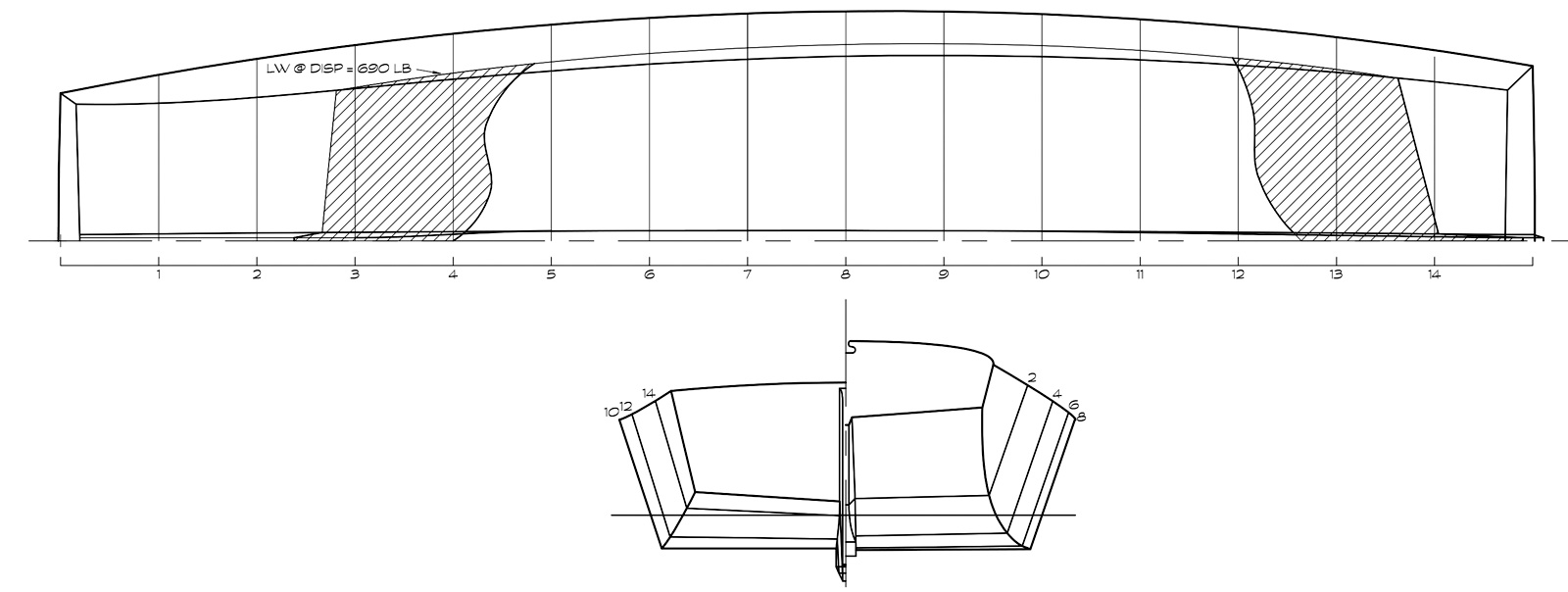
The sections show considerable flare in the topsides, lending stability as the garvey heels under sail.
Compared to many garveys, these hull lines show considerable rake (flare) to the sides. This looks fine to most of us, and it can result in a friendlier-than-otherwise stability curve as the Swan Point heels down under sail. The bottom’s rocker (longitudinal curvature) sweeps gently upward to the transom. At normal sailing speeds, this garvey will slip easily through the water and leave a clean wake.
A long skeg improves directional control and protects the rudder. In addition, this configuration won’t snag potwarp and weed. An end-plate at the rudder’s lower edge increases the blade’s efficiency. It causes more water to flow along the full length of the rudder, rather than slipping prematurely under its bottom edge.
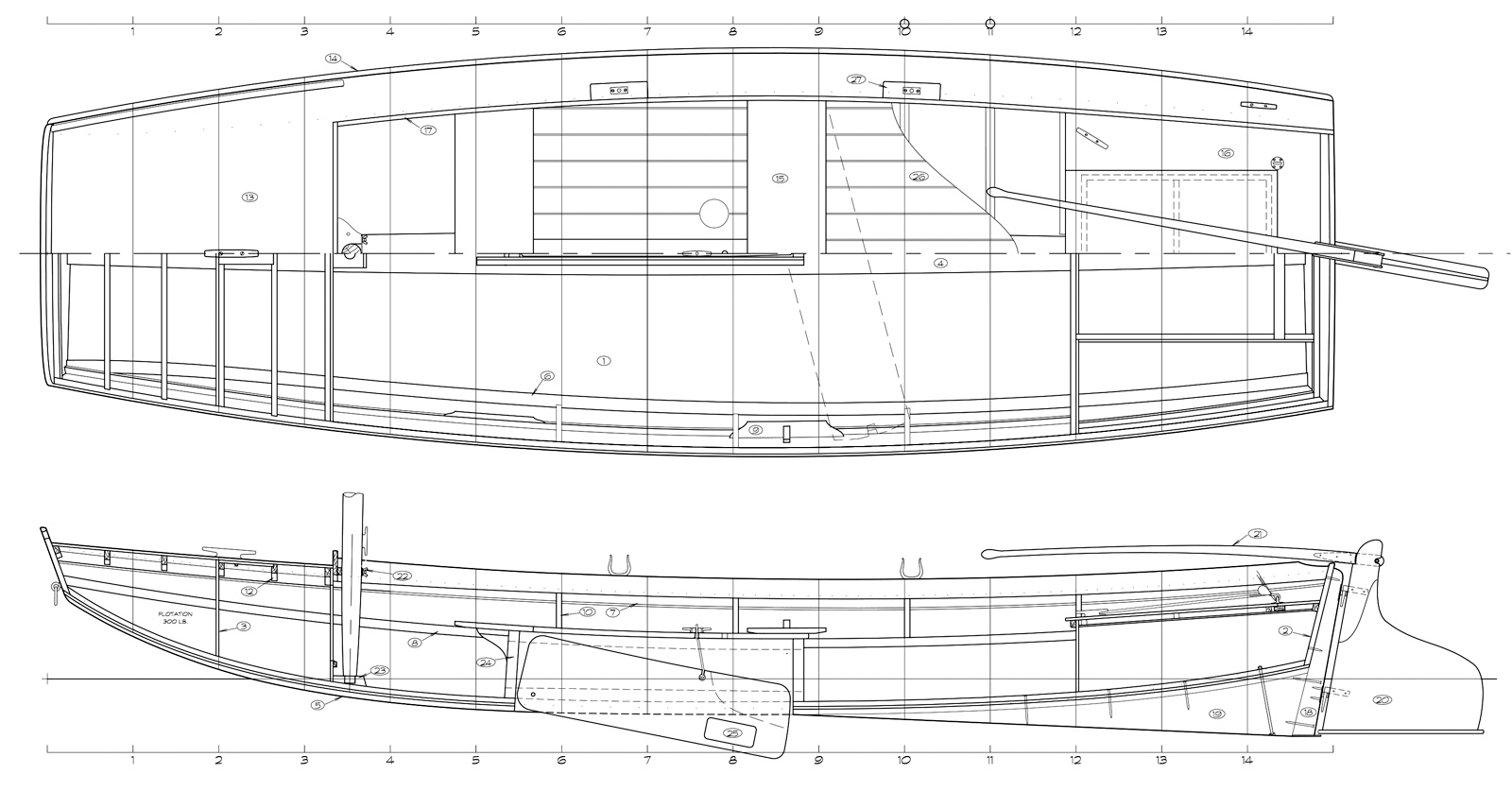
A long skeg improves directional control and protects the rudder in shallow water. Because this hull carries its width well forward, crew members will be able to work at the mast without the Swan Point feeling unstable.
Because this hull carries its width well forward, crew members of average weight will be able to work at the mast without the Swan Point feeling unstable. Still, we shouldn’t consider jumping aboard the foredeck from a high pier.
A 75-sq-ft lugsail will push along the Swan Point nicely. Most daysailers that came from my boatshop carried variations of the lug rig. After fussing with its details for a decade, I consider it among the best rigs for small boats. It is simple in the extreme, and can be set or struck in seconds. Precise changes to sail set can be made easily by adjusting the location of the halyard on the yard. The short spars stow in the boat for trailering or rowing.
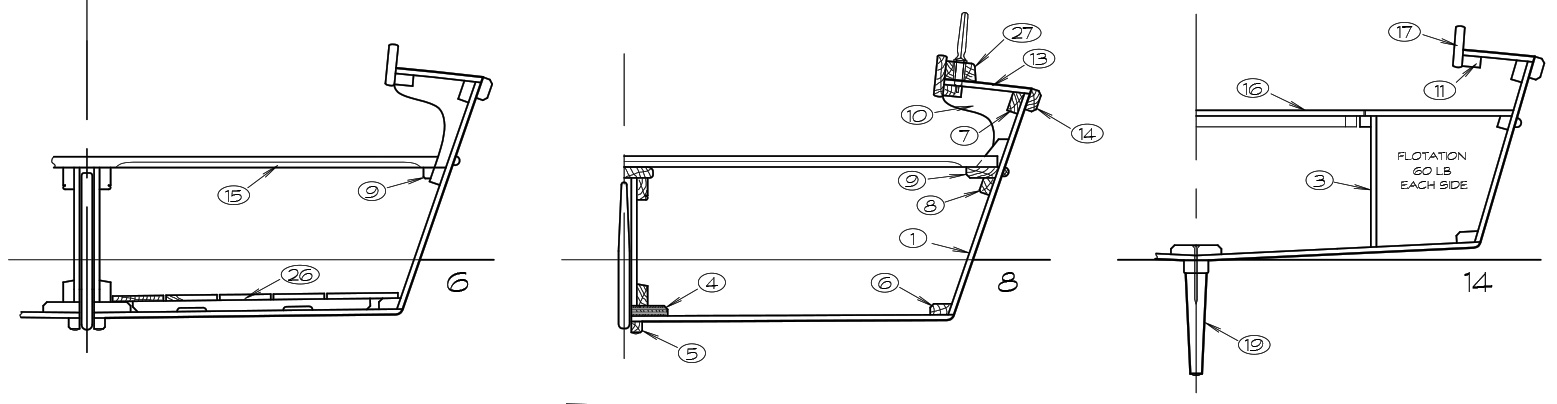
Though the boat is held together with epoxy, the Swan Point’s plywood bottom and topsides are joined with chine logs.
Through the years, we learned some lessons about making these four-edged sails: Work some heavy non-stretch cloth into the luff, and cut that luff dead straight. Cut the leech with a slight hollow (concave curvature), and forget about battens. Sew a fair amount of draft (“belly”) into the sail, and locate the point of maximum draft farther forward than is customary for contemporary mainsails.
For the Swan Point’s hull, Hylan specifies sheet plywood combined with epoxy. This will be “traditional” construction in the sense that it includes chine logs and all those good things. The process should prove quick for experienced hands and educational for neophytes. A substantial building jig ensures that each finished garvey will accurately reflect the designer’s drawings and the client’s wishes.
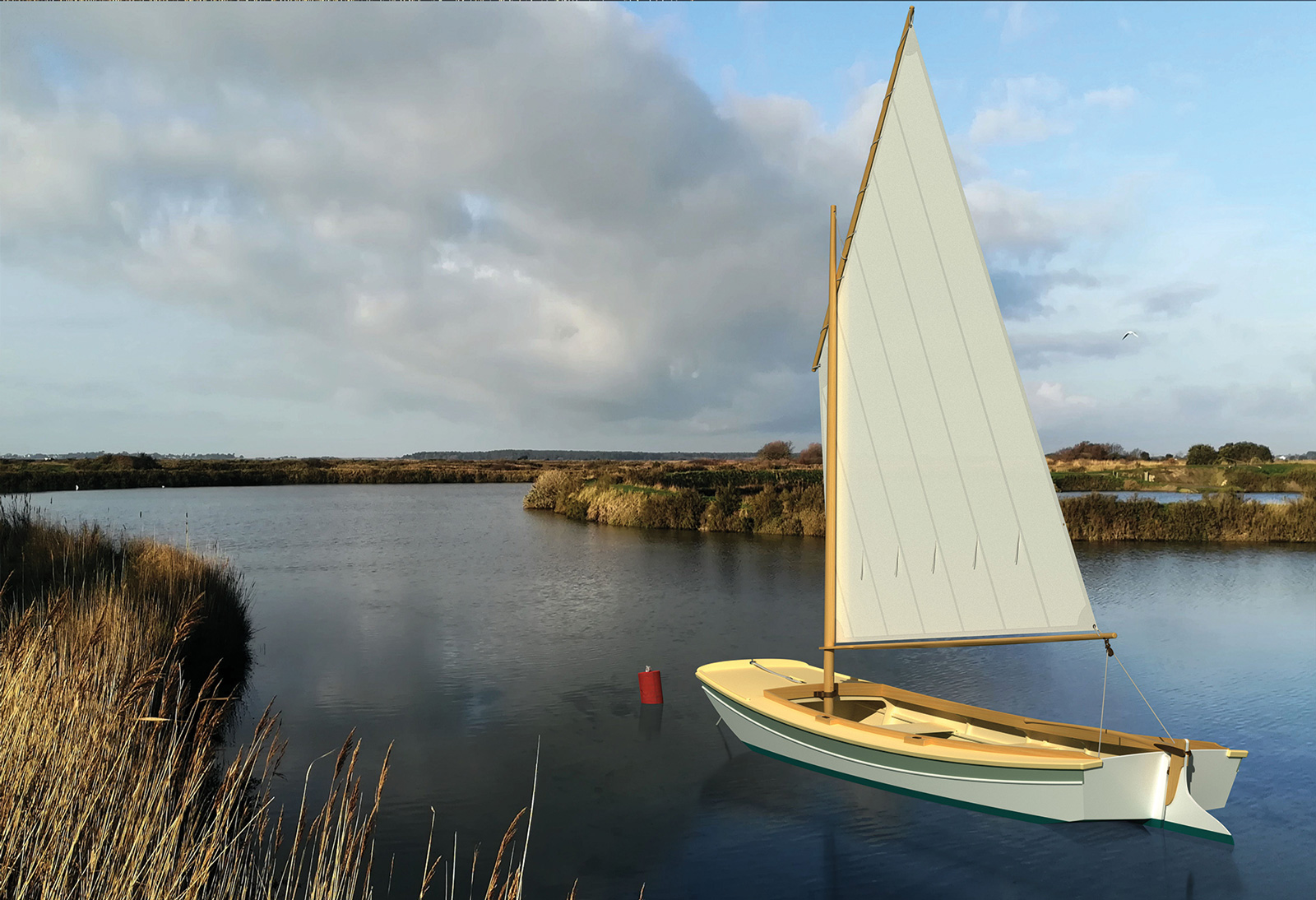
Garveys appeared on the coastal lagoons of the southern New Jersey shore during the 19th century. The Swan Point will be right at home on these waters.
This garvey is indeed a fine-looking small boat. It shows that happy results can occur when a knowledgeable sailor reaches out to an enthusiastic designer. Custom design need not be solely the domain of large yachts.
Russ Manheimer intends to have the first Swan Point built for his own use. He also suggests that this little garvey would make a fine candidate for community boatbuilding projects. Perhaps, in the near future, we’ll see a fleet of these good boats racing and daysailing across the shallow waters of Barnegat Bay.
Particulars:
- LOA: 15′0″
- Beam: 4′8″
- Draft: (centerboard up) not much
(centerboard down)2′6″ - Weight: 300 lbs
- Sail area: 75 sq ft

Mike O’Brien is WoodenBoat’s boat design editor.
Swan Point Garvey plans are available from Hylan & Brown Boatbuilders, 10 Frank Day Lane, Brooklin, ME 04616; 207–359–2244; doug@dhylanboats.com.
To learn more about Russ Manheimer’s life in boats, visit his blog at www.sjogin.com.