
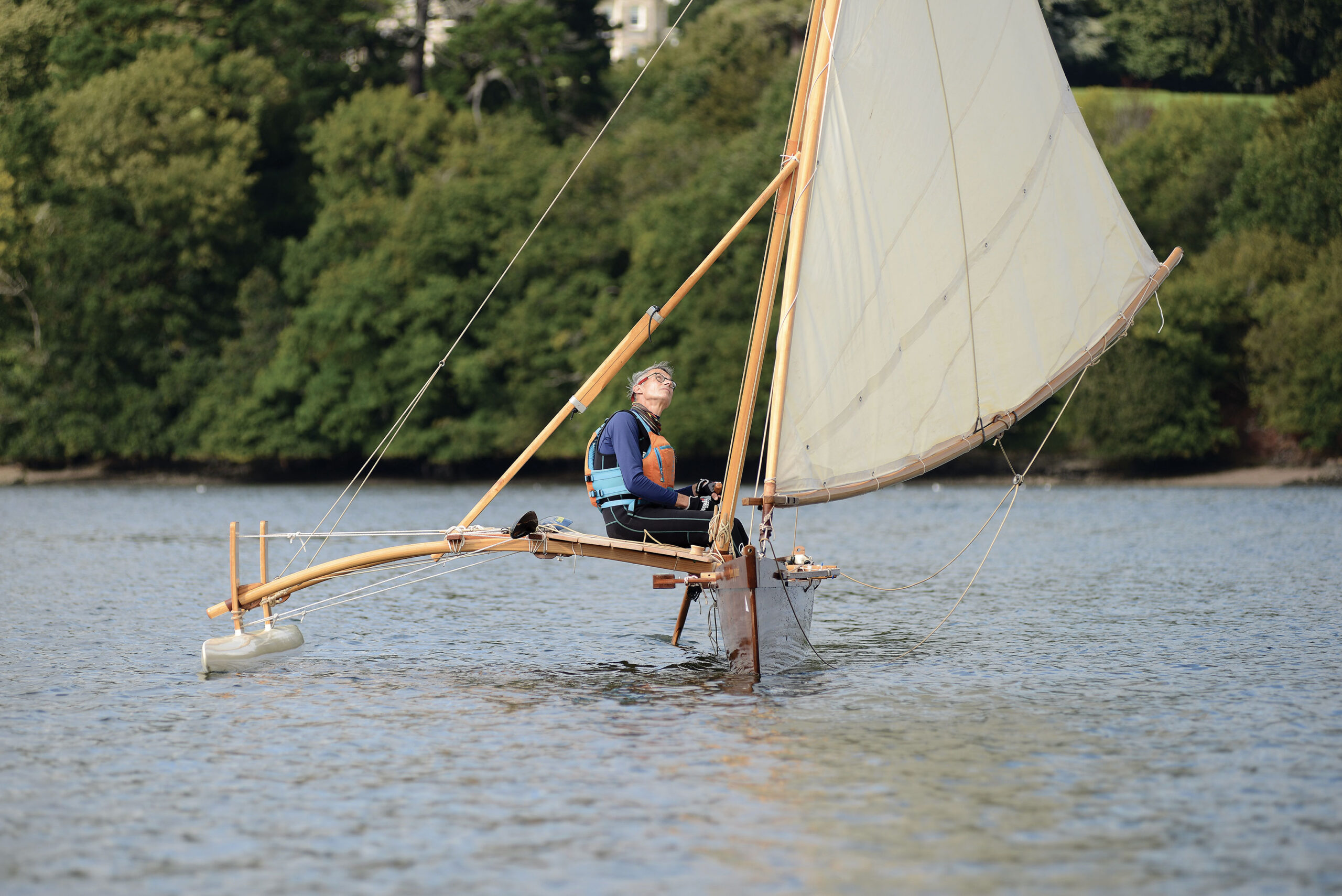
Gary Dierking’s T2 Pacific-proa design has a main hull, or vaka, that has a beam of just 1′4″. The outrigger, or ama, always remains on the windward side regardless of sailing direction.
It’s not every day you get invited to go sailing by the commodore of your local sailing club, so I was quite excited when the call came one sunny morning in September. The Stoke Gabriel Boating Association overlooks the River Dart in Devon, in southwestern England, so you might reasonably assume that its commodore would own a good, solid local boat like a Westcountry lugger, a Devon Yawl, or perhaps one of the Cornish Shrimpers so ubiquitous in these parts.
But that wasn’t what greeted me on the water that autumn day. Instead, what I saw was a moth-like craft with a low, brown body, an angular leg sticking out to one side, and a great cream-colored wing pointing jauntily up at the sky. It looked like a steampunk vision of a boat, both old-fashioned and yet strangely modern. However, once we got underway there was nothing imaginary about the way she took off and flew over the water when a gust came funneling down the river.
The boat was in fact a proa, a type of outrigger canoe whose antecedents came from the other side of the world, in the South Pacific. She had been interpreted and reimagined for modern construction by an American designer living in New Zealand and built by an English former expatriate newly returned to the United Kingdom from South Africa. And yet, despite its exotic provenance, the insect-like little boat didn’t look out of place among the rolling green hills of Devon. A beautiful boat is a beautiful boat wherever she’s sailing.
Proas have a unique place in yachting history. They’ve been both revered and ridiculed, yet not well understood. There’s something about their lack of athwartships symmetry that challenges European understanding of what a boat is. We expect boats to have a front and back and be the same shape side to side—even people who don’t understand terms such as “bow,” “stern,” and “hydrodynamic flow” know that much. But a “shunting” proa has none of these things. It has a single outrigger, the main hull, called the vaka, is curved on one side and flat on the other side, and it can sail in either direction without ever changing tack. That means the “bow” and the “stern” swap roles with every “shunt” leaving the outrigger, or ama, always on the same side. Confused? Read on.
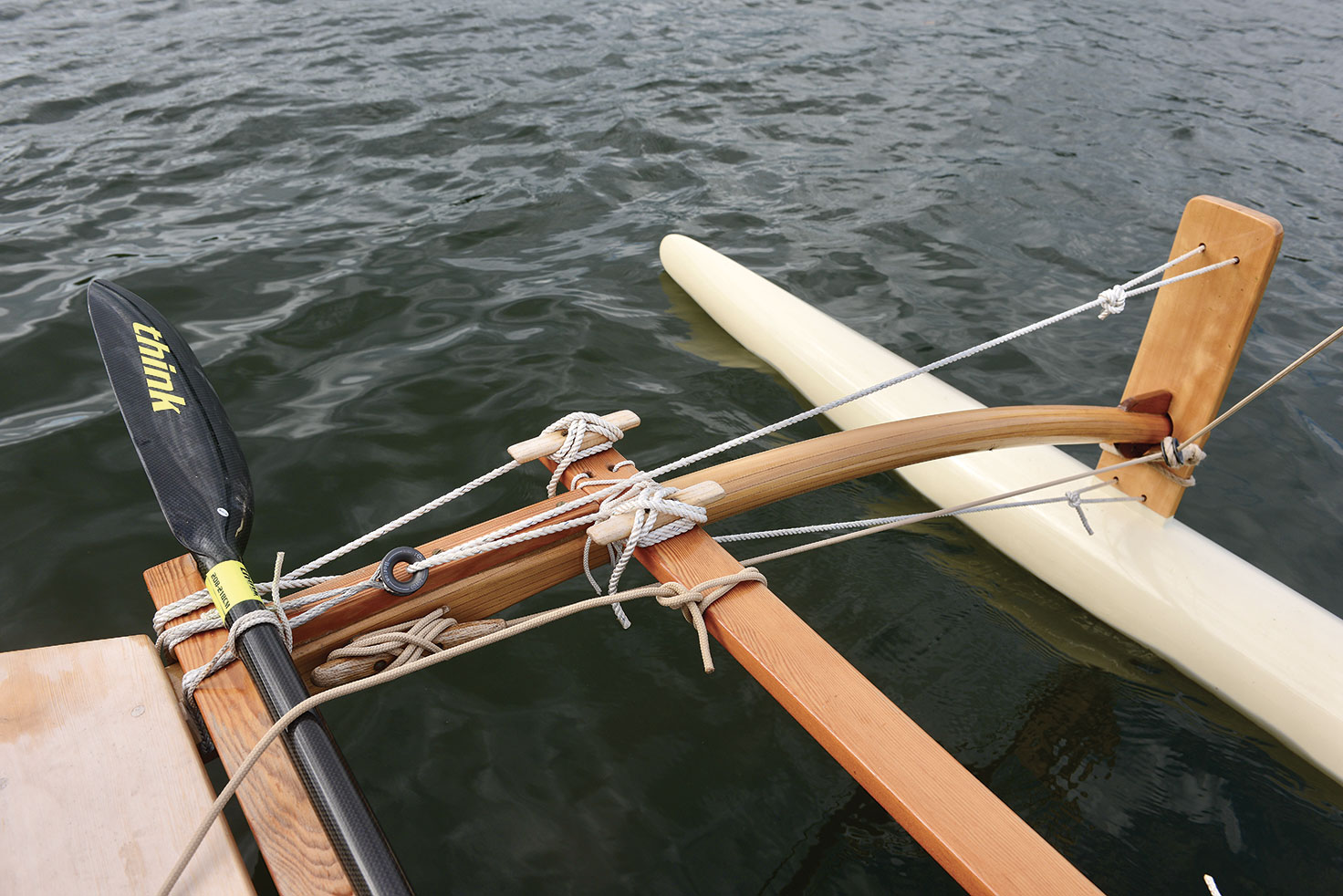
The ama is held in place by crossbeams known as akas. Lanyards hold the ama in place, which makes the boat easy to dismantle for trailering.
Proas have an ancient and well-proven track record, having been used for thousands of years in the Pacific for fishing and carrying light cargo around the islands, leaving the larger and more bulky catamarans to transport the heavy stuff. European explorers were amazed by the speed of these lightly built craft, which sailed rings around even their fastest boats. In the inventive era of the late-19th century, Commodore Ralph Munroe of Florida was one of the earliest westerners to study the type (while yacht designer Nathanael Herreshoff was off experimenting with catamarans in Bristol, Rhode Island). In 1898, Munroe designed and built the first of his several proas and found her capable of the then-unheard-of speed of 18 knots.
In the modern era, the proa cause was first taken up by multihull designer Dick Newick, who in 1967 designed CHEERS, a 36-footer he called the “Atlantic proa.” Unlike a traditional Pacific proa, which always keeps the ama on the windward side, the Atlantic proa has the outrigger on the leeward side. With Tom Follett at the helm, CHEERS won third place in the 1968 Observer Singlehanded Transatlantic Race (OSTAR), becoming the first American boat to complete the race.
The potential of the type was spotted by the British yachtsman and mustard millionaire Timothy Colman, who set a world sailing speed record of 26.3 knots with his 56′ proa CROSSBOW in 1972. He topped that three years later, clocking 31.2 knots, and went even faster in 1980 with his hybrid proa-catamaran, CROSSBOW II, this time bringing the record up to 36 knots. Since then, proas have consistently claimed world sailing speed records (when not challenged by windsurfers and kite surfers), the most recent being the carbon-fiber proa SAILROCKET 2, which Paul Larsen sailed to a record of 65.45 knots in 2012.
One of the biggest names in the proa world is Russell Brown of Port Townsend, Washington, the son of cruising-multihull pioneer Jim Brown of Virginia. The younger Brown built the 36′ JZERRO, which weighs just 3,200 lbs and is capable of 22 knots, and sailed her across the Pacific from San Francisco to New Zealand in 2000. More recently, JZERRO was acquired by Ryan Finn of New Orleans, who in 2022 sailed her singlehanded 13,500 miles from New York to San Francisco, making her the smallest craft to accomplish that feat.
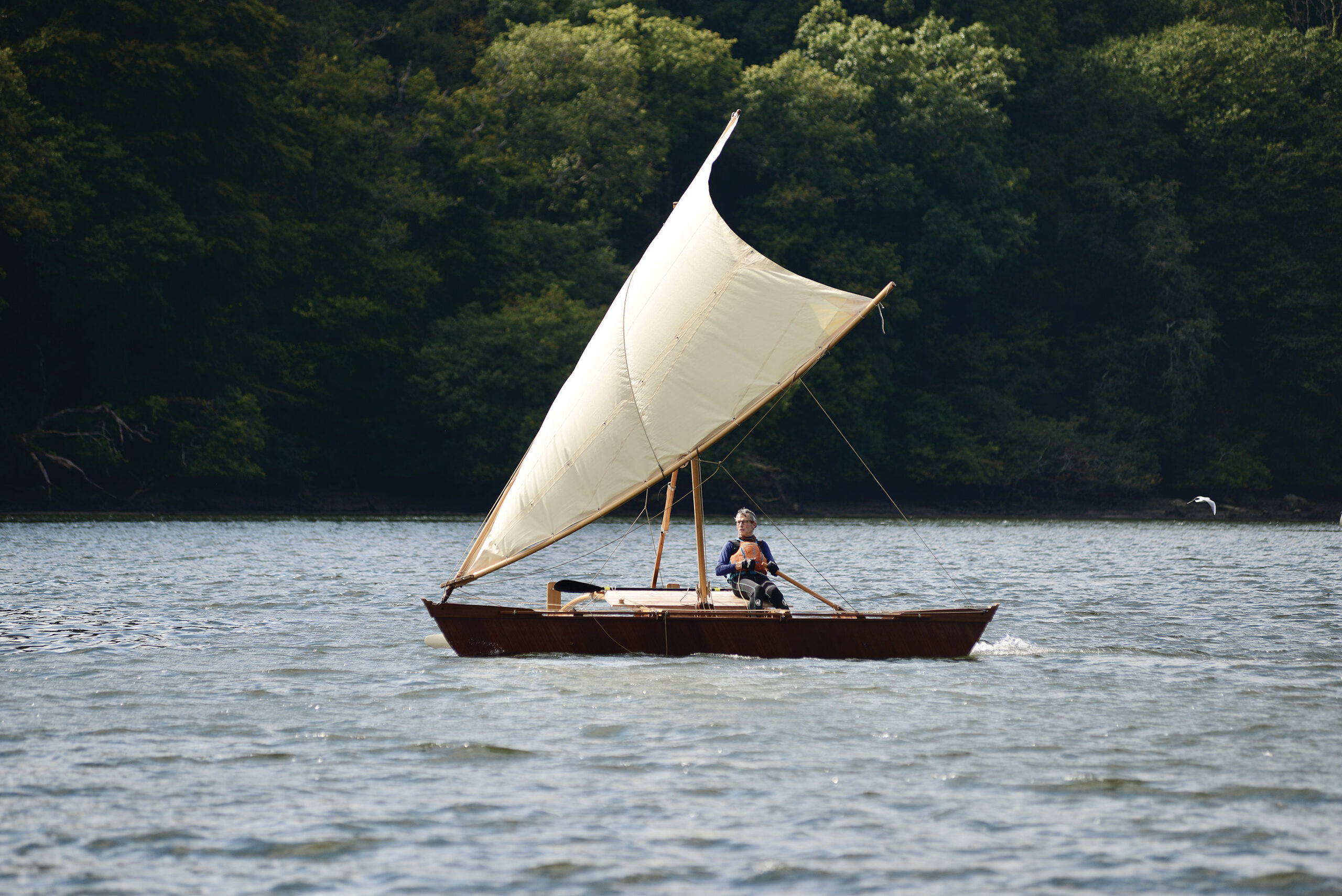
TINY GIANT takes a bit of wind to get her going but quickly reaches 9 knots in a decent breeze.
Despite these remarkable achievements, there is still a pervasive view that proas aren’t viable sailing boats. “It has been said that the multihull community is the lunatic fringe of the sailing community, and the proa community is the lunatic fringe of the multihull community,” according to proa enthusiast Simon Penny, a polymath theorist and teacher with a keen interest in Pacific cultures. Yet the most common reason quoted for building a proa is getting the most bang for the buck. There’s simply no other boat that will sail so fast at so little cost.
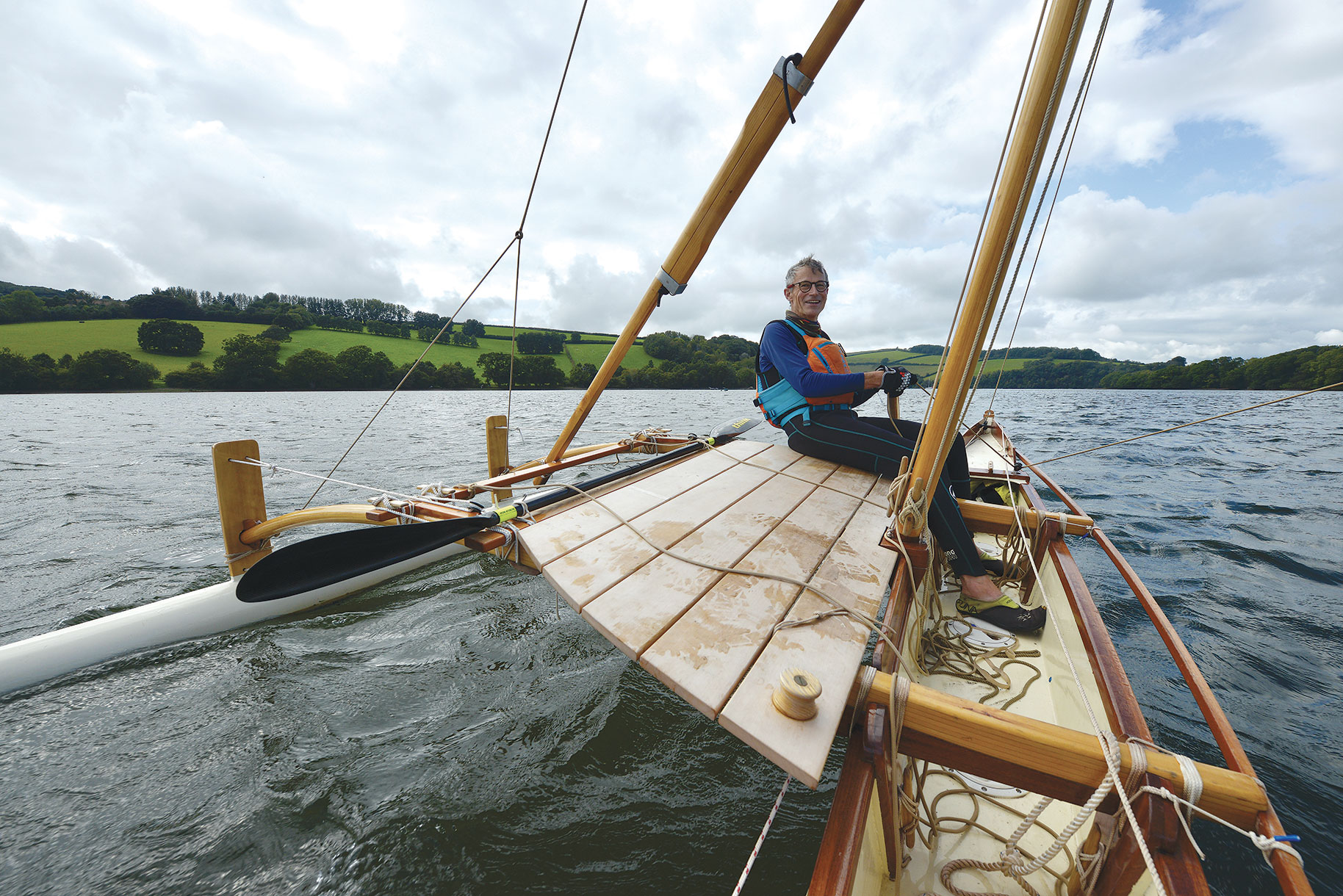
William Lewis, who uses TINY GIANT for coastal cruising, installed a “shunting rail” on the leeward side (at right in the photograph) to allow the yard’s lower end to run smoothly along the outside of the hull when changing tacks.
William Lewis, the sailor I joined that day in Devon, came to proas not via the Pacific, nor even through a fondness for mustard, but through a brief encounter at WoodenBoat School in Brooklin, Maine. Having spent much of his childhood and young adult years knocking around on the family’s old Folkboat, first on the Irish Sea and then on the west coast of Scotland, he had developed a lifelong affection for wooden boats. It was while working as a corporate lawyer in Johannesburg, South Africa, that he first signed up for one of the school’s sailing courses, and a few years later he returned for an open-boat sailing course. The fact that both of his children were studying at universities in the United States made it easy for him to combine visits to them with the pursuit of his interest.
William was lucky on both of his visits. His first class coincided with a visit by the late legendary boat designer Iain Oughtred (see page 40), an Australian who lived in Scotland for many years; Oughtred not only gave a talk about his work but sang a song, unaccompanied. For William, it was a memorable wee occasion. His next visit coincided with a talk by Jim Brown and his son Russell about their experiences with multihulls and proas, which made an impression. It was the first time William had seriously thought about proas, but it planted the seed of an idea in his mind.
After he returned to South Africa, he started building a small catamaran, the Hitia 17 designed by the English designer James Wharram, himself a prominent and proud member of the “lunatic fringe.” He was planning to use the boat for coastal cruising, but Covid-19 brought a pause to a great many plans, and William then decided to leave South Africa and return to the United Kingdom to reconsider his priorities. After 23 years working for the same company, 15 years of which were outside his native land, he decided it was time to take a sabbatical.
“I thought of all the sensible things I could do and didn’t do any of them,” he says. Instead, he signed up for a 40-week boatbuilding course at the Lyme Regis Boat Building Academy and Furniture School in Dorset on England’s south coast. “Which was a bit of a stupid thing to do, as I’m not very good with my hands and have no particular talent with tools, so I struggled for the first few weeks—as did quite a few of us.”
The way the course works is that students hone their woodworking skills for 22 weeks and then spend 18 weeks building boats. Up to six boats are built per course, usually covering boatbuilding in various styles: lapstrake (known as clinker construction in Europe), carvel, and modern. Individual students are expected to sponsor a boat, meaning they pay for materials but get to keep the boat at the end of the course.
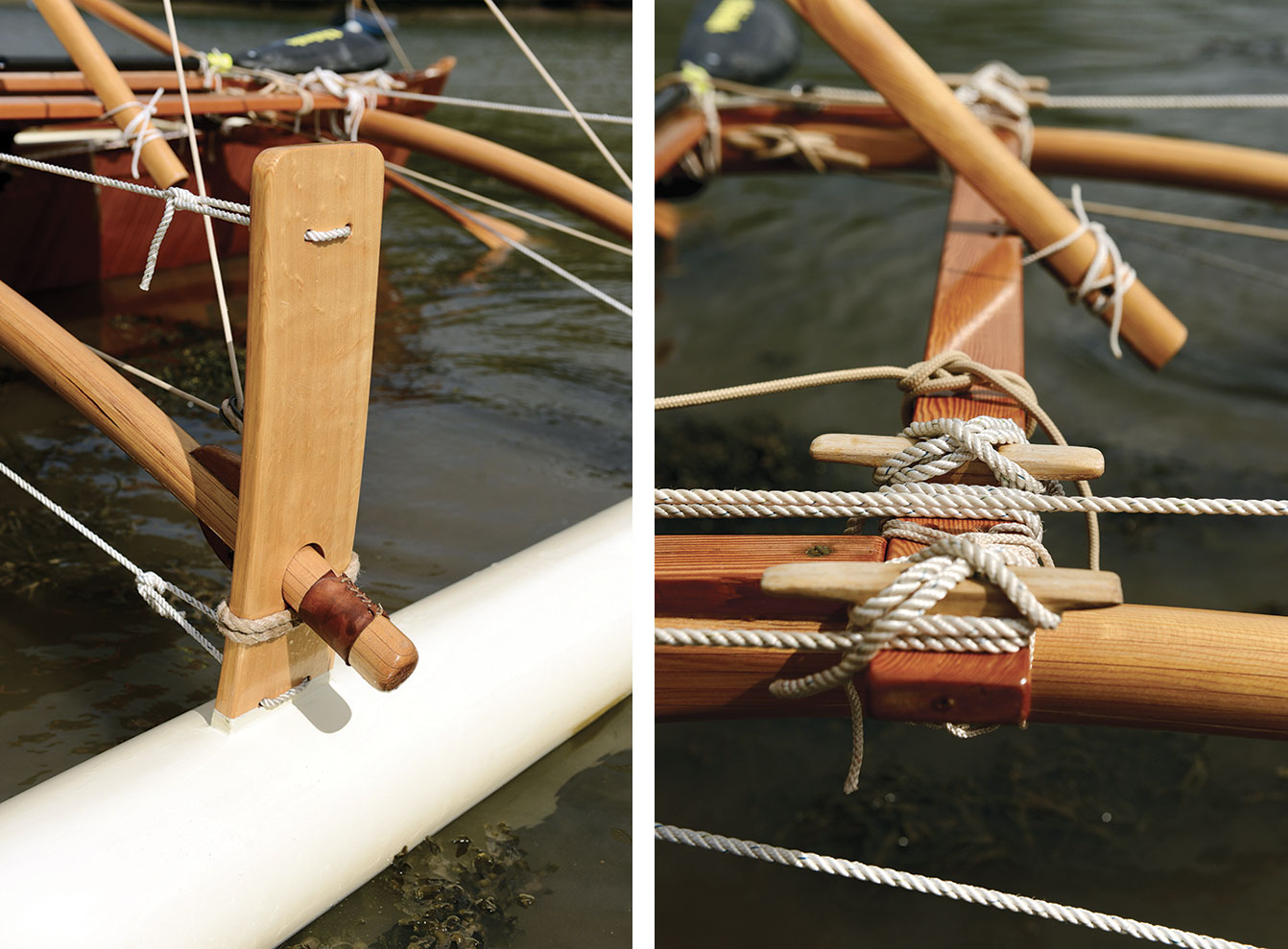
Left—The akas’ very simple lashing connection to the amas makes them fast to set up and allows slight adjustments. Right—The ama lashings are made off to cleats on the akas.
“I hadn’t planned on sponsoring a boat, as I already had a partly completed Hitia in the shed,” William says. “So, I kept quiet. But then everyone looked at me, because I was the oldest in the course, and they said, ‘Because you’re old, you must have lots of money’—which is entirely untrue.”
A pragmatist would have chosen a boat that could easily sell at the end of the course, and William did seriously consider sponsoring an Oughtred–designed Caledonia Yawl. But the sensible corporate lawyer had doubtless had enough of being sensible and decided instead to follow his whimsy and build that seemingly most impractical of craft: a shunting proa.
“The attraction of a proa, once you’ve made the intellectual shift, is that it’s got a lot of waterline, a lot of stability, and is very nice aesthetically,” William says. “In the right hands, this boat can reach 14 knots. But the value for me was as a potential cruising dinghy. Most cruising dinghies are a compromise of beam, weight, draft, and transportability. If it’s beamy, it’s too heavy; if it’s narrow, it’s too tender. With a proa, you can transport it easily and you can do fun things like sail on and off a beach without worrying about the centerboard or the rudder.”
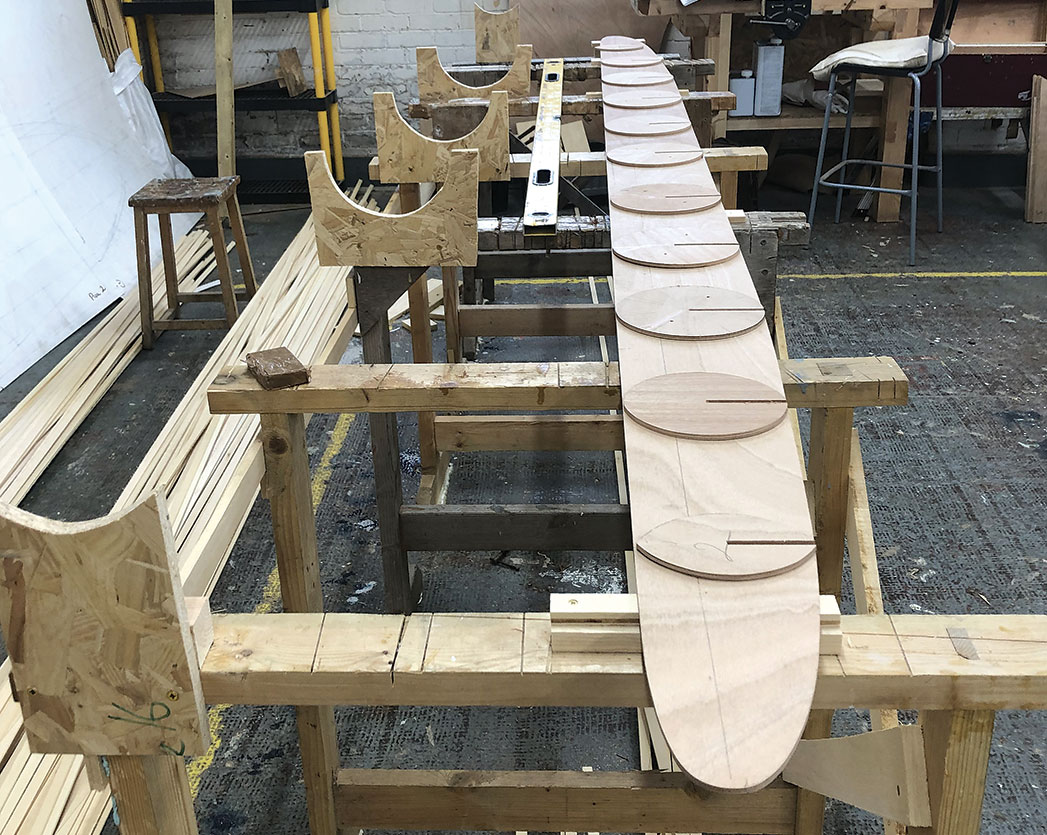 William Lewis
William’s proa was built at the Boat Building Academy and Furniture School in Lyme Regis, England. The ama was strip-planked over permanent bulkheads; the vertical timbers receiving the akas each straddle one bulkhead for strength.
The proa William chose was the T2 designed by Gary Dierking, an American living in New Zealand, who described the boat in his book Building Outrigger Sailing Canoes as a “sport canoe for one or two people.” Although the T2 is based on the traditional craft of the Marshall Islands in the central Pacific, it has been updated for modern construction. For a start, the vaka (or “waka” in Dierking’s terminology), is strip-planked with a sheathing of fiberglass cloth set in epoxy. It has sealed buoyancy tanks at each end and a self-draining cockpit with buoyancy underneath the sole, making it virtually unsinkable.
William used 6mm-thick (¼”) Alaska yellow cedar for the first layer of planking, which he and his fellow builders cut and molded into strips. To strengthen the hull, and in the process learn cold-molding technology, they added two layers of 2.5mm-thick (⁷⁄₃₂”) sapele planking, laid diagonally at 90 degrees to each other. To compensate for the extra weight of the sapele, they used lighter-weight fiberglass cloth in the sheathing than they might have, although the hull still ended up slightly heavier than designed, due to the slightly thicker planking. The stems were laminated from sapele, and William was persuaded to give the vaka inner and outer keels, which were also laminated from sapele.
The plans specified three gallons of epoxy resin for the T2, and as the team took turns planking up and laminating the hull William soon discovered an inconvenient truth: “Using epoxy, there’s two types of workmen: the one who’s paying and the one who’s not.”
Dierking’s design accommodates all types of builders. For example, his instructions for the ama suggest it can be built from two pieces of Styrofoam sheathed in fiberglass and epoxy, while the two crossbeams known as akas (or “iakos” in Dierking’s spelling) can be made of aluminum tubing. For William, the whole point of taking the boatbuilding course was to improve his skills for building wooden boats, so he chose instead to strip-plank the ama using cedar with a ’glass-epoxy sheathing and make the akas of laminated spruce. Determining the actual shape of the akas involved hours of research culminating in a further session of lofting—all part of the learning process.
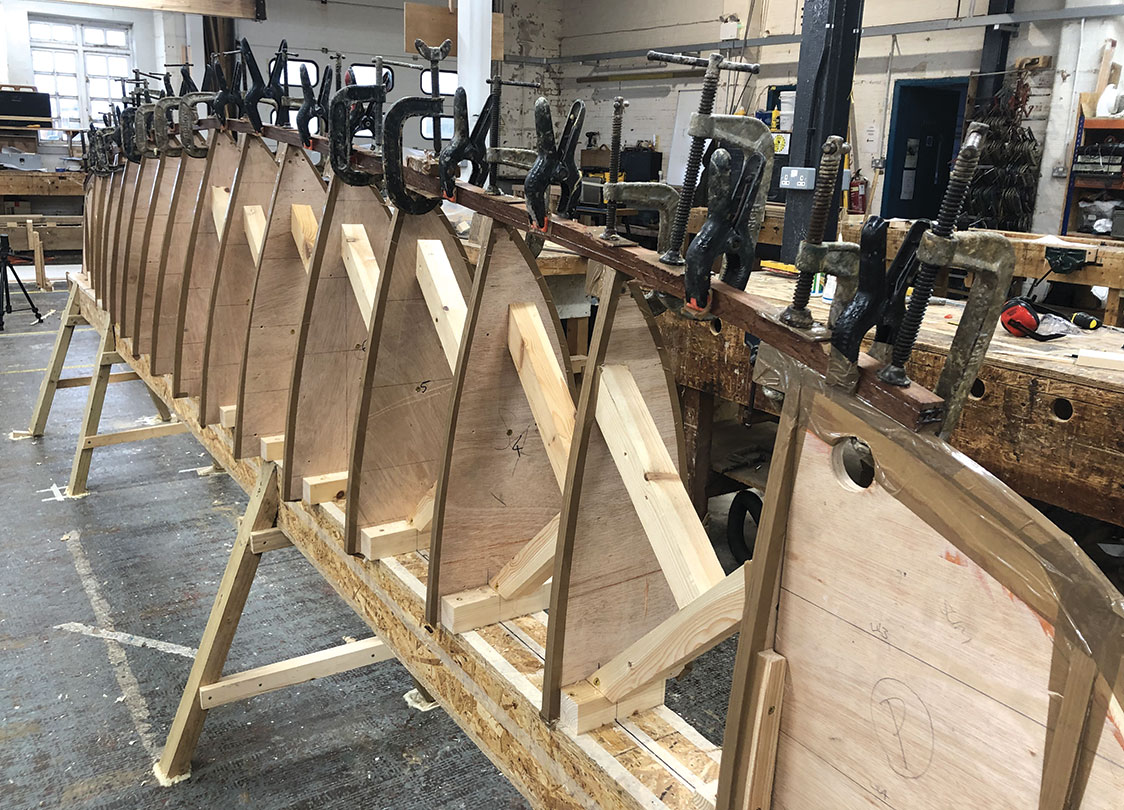 William Lewis
The asymmetrical vaka was first strip-planked with Alaska yellow cedar, after which two layers of sapele planking were cold-molded in place on opposite diagonals.
Dierking also presented two alternative sail plans. One of these he called an “Oceanic lateen rig,” also known as a crab-claw sail; the other was a variation on a modern windsurfer sail with a cut-off clew. William chose the traditional option, though he adapted it for modern methods and materials, including the use of a hollow spruce bird’s-mouth mast and yard and a solid laminated boom. The sail was made by the academy’s students as part of the course.
I first came across William and TINY GIANT, as he named his boat (partly after his wife, Priya, who he says is “tiny and hyperactive”), on the public slipway on the River Dart at the village of Stoke Gabriel. He was unloading the boat’s parts from a Hobie Cat trailer that he had modified and fitted with dedicated racks for the akas and the slatted seat. The easiest way to launch the boat, he explained, was to bring it down at low tide, assemble it on the beach, and then wait for the tide to come in and float it. He was still working out how to use the rig, he said, but would willingly take me out once he’d got the hang of it.
Several weeks later, the weather and our schedules synchronized, and I was able to join him for my first proa sail. First, I watched from the comfort of my dinghy while William demonstrated the fine art of shunting. Like all these things, the description sounds complicated, but the actual maneuver soon becomes intuitive. Dierking reckons a practiced crew can shunt in less than 10 seconds. He also recommends practicing ashore first, which he calls “lawn shunting.”
My first impression when I climbed aboard TINY GIANT was how stable she was athwartships thanks to that 9′ overall beam. My second impression was how tippy she was with weight shifts fore-and-aft, thanks to the slender vaka’s 1′ 4″ beam. The T2 has a length-to-beam ratio of 13:1, and Dierking advocates an even greater ratio for other boats, as much as 20:1. It is this combination of a narrow beam and a long waterline that makes the boat so fast, while the vaka’s deep-V hull shape allows the boat to grip the water without needing a centerboard.
William told me he had had the boat out in winds of 20 knots or more. “She’s not as fast as a planing dinghy but faster than a normal 30′ cruising yacht. She has quite a big wetted-surface area, so it takes a bit of wind to unstick her, but she comes alive with 10 knots and will get up to 9 knots quite easily.” Winds of over 20 knots brought serious problems: “The sail’s tack started thrashing around wildly and bashing the hull and me when I tried to sort it out. That’s why it’s important to have the halyard handy, so you can dump the sail in an emergency.”
In many ways, trimming the sail is like trimming a gaff-rigged one: you need to ease the sheets and can’t expect to sail too close to the wind. With the wind forward of the beam and the sail set to get the center of effort in just the right place, she should sail herself in a straight line, though William and I didn’t quite achieve that on our trial run. The sail trim can also be adjusted by raking the mast to leeward to produce a better sail shape in light airs or to windward in a strong blow, like a windsurfer sail. Getting even more fancy, the windward brailing line can be tightened to give the sail a fuller shape, like using the “tunnel effect” on a lateen rig (see WB No. 270), although William says he hasn’t reached that level of prowess yet.
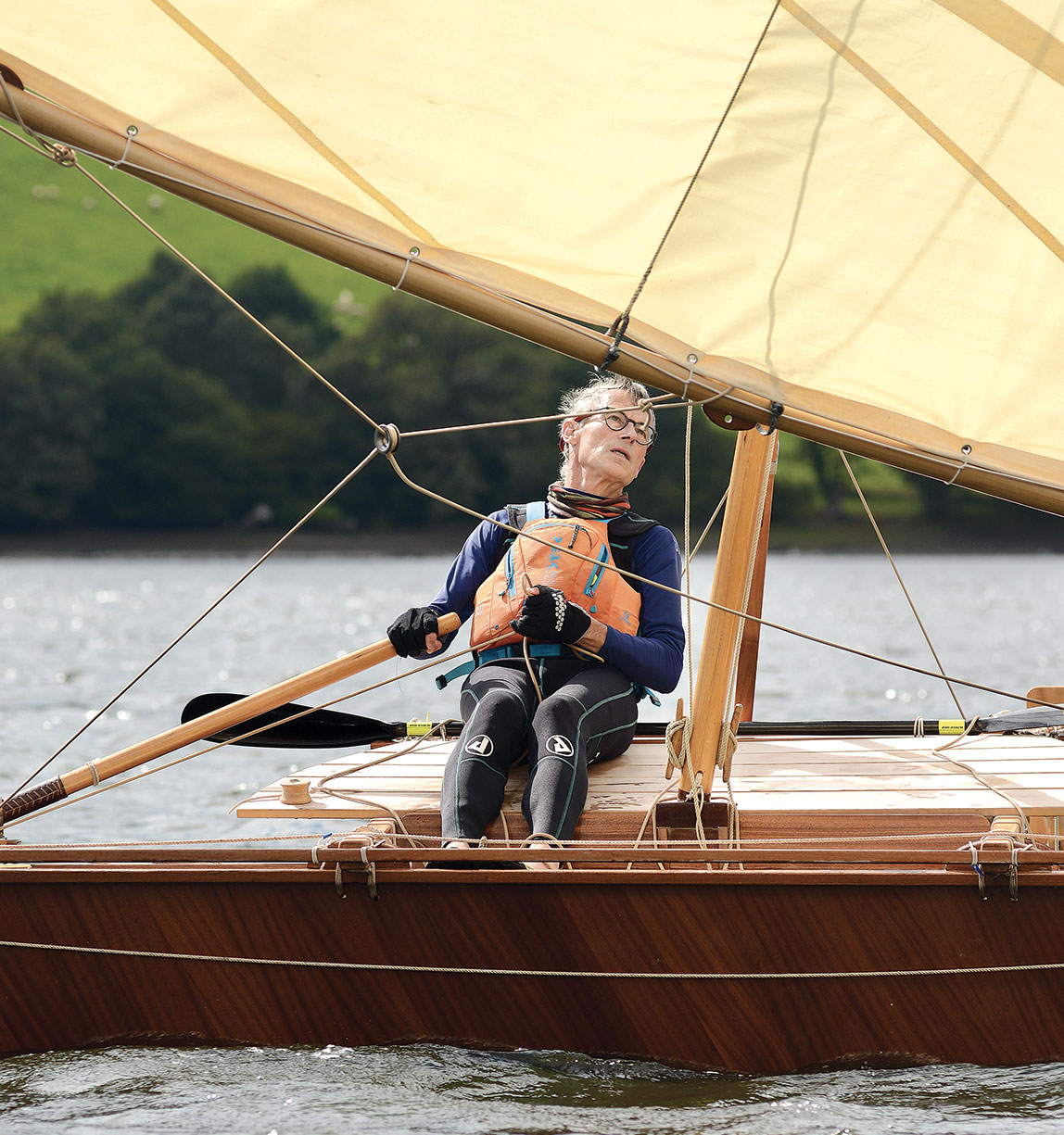
William wears a full wetsuit when sailing his proa, because the boat can be very wet in a seaway.
Steering with a paddle takes quite a bit of getting used to. William made it look easy, but I struggled with it, especially off the wind. As one sailor, Chris Grill, who sailed his extended T2 DESESPERADO from Mexico to Panama in 2011–12, wrote in his blog: “My dream is to steer with one foot whilst playing the fiddle and drinking gin-and-tonics, and steering oars are incompatible with that ideal.” Grill eventually fitted dual rudders, one at each end so one could be raised and the other lowered depending on the direction of the shunt.
One of the biggest challenges William has faced is getting the boat on and off its mooring. One thing you must avoid with a proa is allowing the sail to be taken aback, so heading into the wind to pick up a mooring simply isn’t an option. Instead, William usually drops the sail when he’s close enough to paddle the rest of the way if necessary, which is easier said than done when the river current is running at 4 knots, as it sometimes does in this section of the River Dart. Good sculling skills are an essential part of sailing a proa.
William was also planning to fit a stronger shunting rail, a strip of wood on the leeward side of the vaka that ensures the yard runs smoothly while shunting, to control the tack more effectively in strong winds. He is also going to fit a block-and-tackle to hold the aka more tightly into the ama and prevent it from coming loose. While some independent movement of the ama is desirable, too much play could damage the boat.
It’s been a steep learning curve for William and his exotic craft, and his dream of creating a light but fast boat for coastal cruising is still a work in progress. The next step is to take the boat out on the open water of Start Bay, just outside the River Dart’s mouth, to test it in a seaway. And then the real adventures will begin.
“The challenge is to travel very light,” William says. “The idea is to walk out of my front door with a rucksack, walk down to the water, get on the boat, pop the rucksack in the well, and off we go. That’s the type of dinghy cruising I want to do. I might fashion a bivouac for the boat so that I can stay on board for a night or two. Small-scale adventures are what it’s about.”
A proa’s shunt
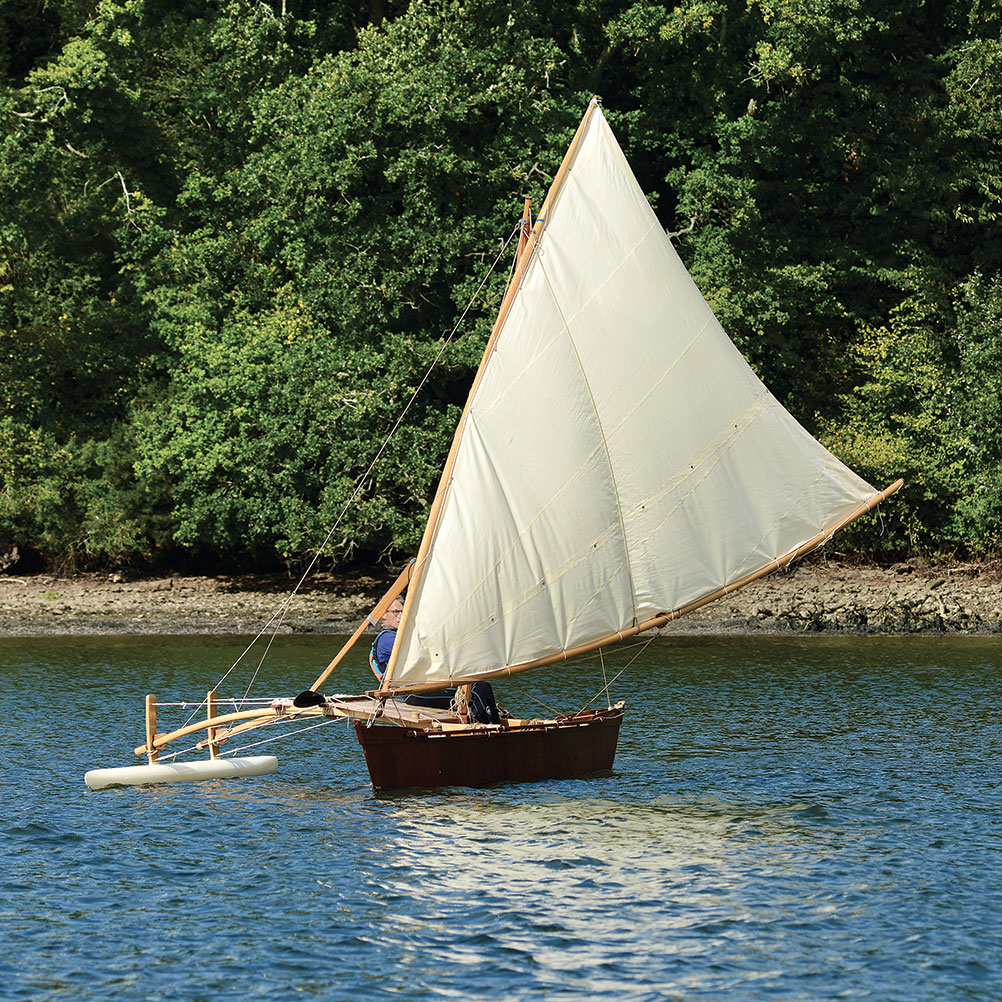
- The general idea in using a shunt to change direction in a proa is to get the boat on a beam reach, meaning the wind direction is perpendicular to the ama. You then release the sheet so the sail is luffing on the leeward side.
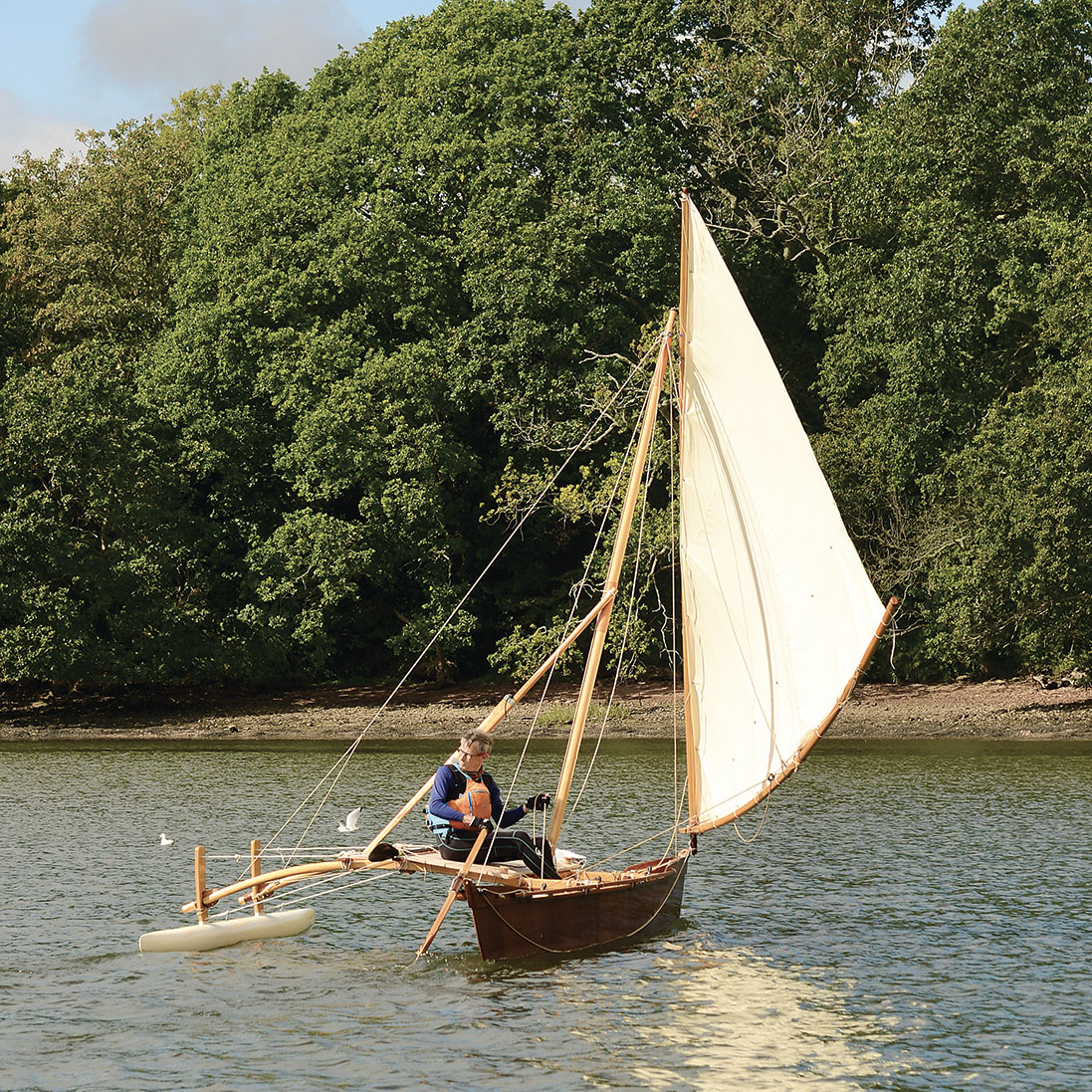
- Once the sheet is released, the tack is pulled along the bulwark to the other end of the boat (the new bow) where it is hauled tight. The mast follows of its own accord, the backstay locking once it has reached the correct rake.
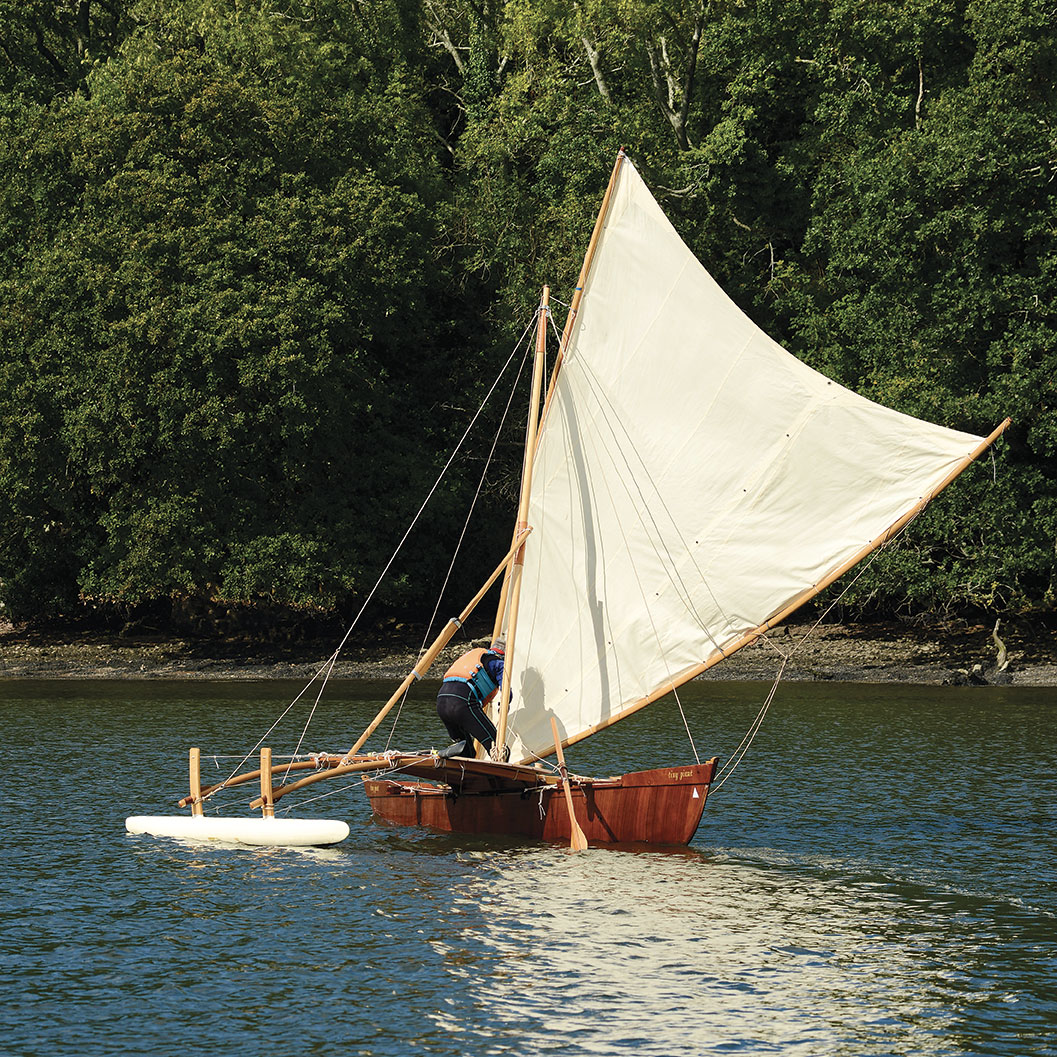
- Next, the tack of the sail is released, which allows the mast to stand upright. The mast is effectively hinged fore-and-aft, with a set of bungee cords keeping it upright until the tack of the sail is set at the other end of the boat (which becomes the new bow). A pair of running backstays pass through blocks at either end of the boat, with a stop on each backstay to lock it in place once the mast is at the correct rake. The backstays are deployed one at a time, and a bungee cord takes up any slack in the one that isn’t being used.
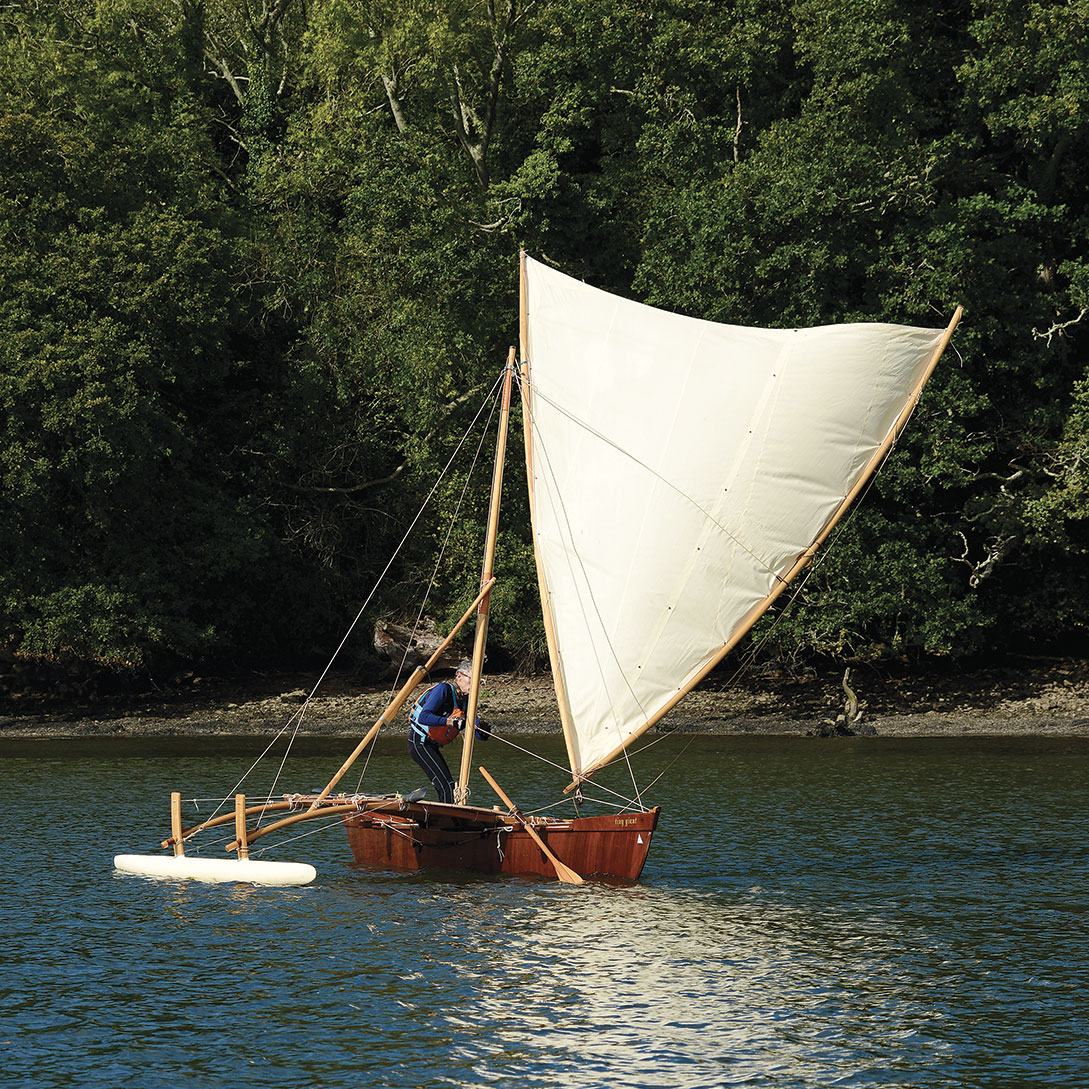
- Finally, the sheet is hauled in, and the sail will be set for the new tack. It is also important that the steering paddle is in the bracket at the new stern of the boat before setting off in the opposite direction.


Nic Compton is a sailor, writer, photographer, and frequent WoodenBoat contributor who lives by the River Dart in Devon, England. He is the author of nearly 20 nautical books.