
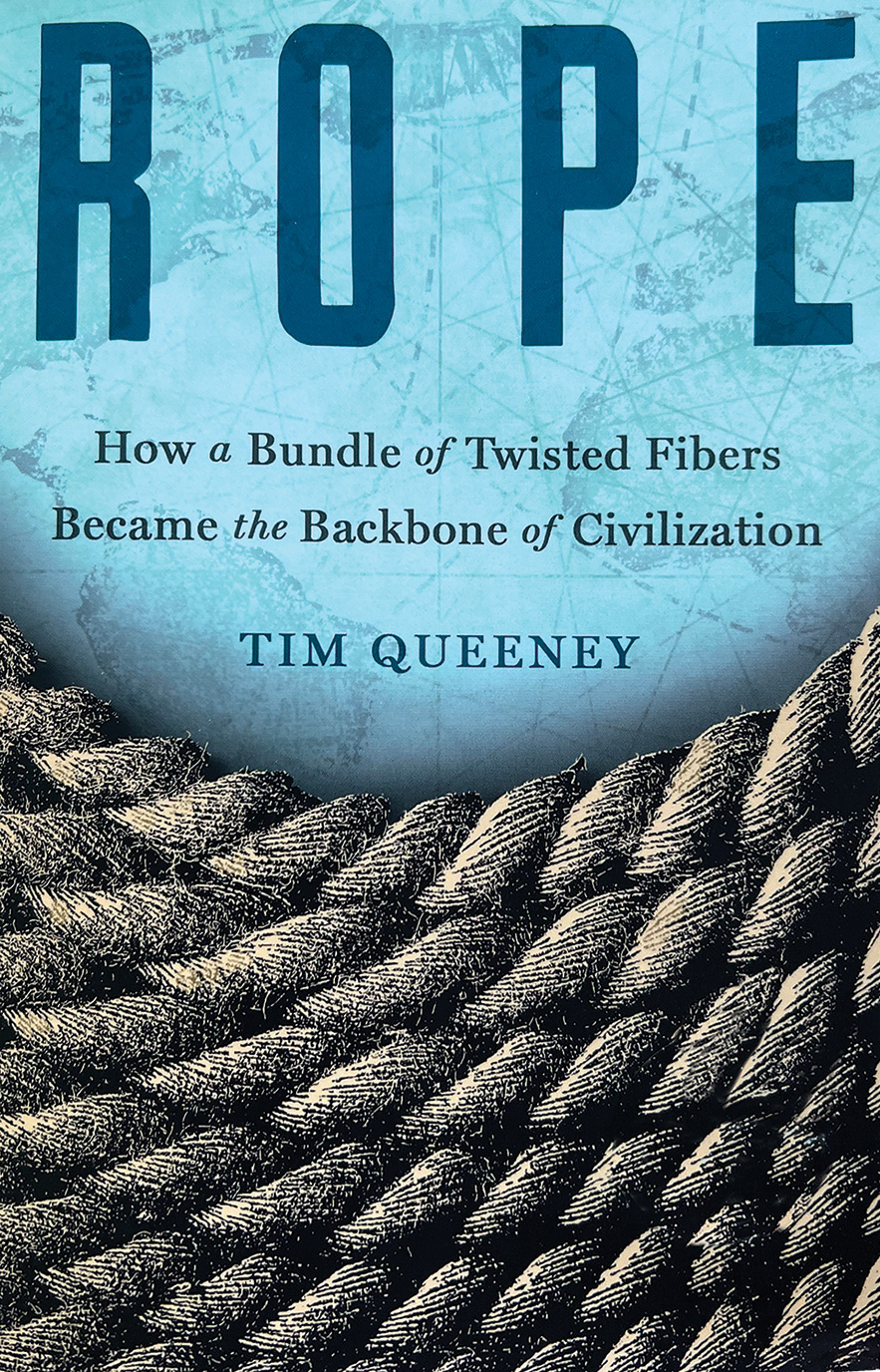
Rope, by Tim Queeney. St. Martin’s Press, New York
Hardcover, illus. 336 pp., $27.00
This book is also available at The WoodenBoat Store.
Imagine a story that begins with a caveman running across an Alpine meadow and ends with platforms floating in space, tethered to Earth by shimmering strands of graphite. This story would be Tim Queeney’s Rope, the latest in a genre of nonfiction that celebrates the material in our lives, a rich history just waiting to be told beneath some comfortingly unambiguous title: Color. Salt. Cod. Oranges. And now Rope, in which the author has unspooled the full scope of fiber-assisted triumphs in human progress.
Queeney starts at the beginning—showing us first the stick and stone, and then the axe, an innovation realized when the invention of cordage permitted early hominid engineers to bind one object to another. What you learn quickly is that the history of Homo sapiens is long and complex, and that rope is prominent throughout as both a material and a metaphor. Like all good books, there is something here for everyone: What, exactly, is the difference between sisal, hemp, and manila? Who exactly were the Phoenicians? How did the pyramids get built, and is it true that the word Viking was originally coined as a verb?
Rope is old. Given the ephemeral character of natural fibers, very little ancient rope remains for archaeologists to analyze, but they have found enough to agree that its origins are diverse rather than specific—more like the spear or loincloth than the mercury barometer. The Egyptians had rope, as did the Polynesians and the Chinese, all of whom found it useful as a binding agent for timbers in an age before nails or epoxy. The Norse longboats and Polynesian waka both used fiber lashings to join their planks into watertight hulls, strong and flexible enough to survive ocean passages. The great edifices of human antiquity—temples, cathedrals, pyramids, aqueducts, and border walls—owe their provenance as much to rope as to stone, as it was the former that eased the lifting of materials and permitted the lashing of poles into scaffolds for workers to climb.
For all its variants, the starting premise of rope is more or less the same in all cases: a bunch of primary fibers, twisted serially into yarns, then strands, and finally the rope itself, all cojoined in a way that the opposed torque of subparts thwarts an unraveling. From here grows a nearly limitless diversity of subtypes, each evolved in its own watershed. Stranded rope, plaited rope, and braided rope. Leather thongs. Handspun grass cord. Machine-made rope and synthetic fibers, both innovations offering a quantum advancement in the physical capacities of rope while promising more remnants left behind for future archaeologists.
Sailing ships and their prodigious demand for cordage were a main driver in the mechanized perfection of ropemaking. I’ve always been curious to learn more about ropewalks, and this book is the place to do that—with detailed descriptions of these overstretched sheds where hemp fibers were spun by whirling machinery into the halyards and cables of a global fleet. I’d never stopped to think about what would happen when such an apparatus caught fire, but that is explained here also, indicating that the modern scarcity of ropewalks is owed to more than simple obsolescence. The dawn of modern metallurgy in the 19th century allowed rope to become the stuff of infrastructure. Here Queeney’s narrative visits the Brooklyn Bridge under construction—its deck hung from steel-wire bundles 16″ in diameter and a mile long—and recounts the deployment of the first transatlantic cables, accomplished by Victorian ships at a space-age cost in time in materials. A century later, advances in chemistry made polymers possible, enabling hydrocarbon fibers to mimic silk in their strength and lightness. They were great for stockings but were soon co-opted for the stuff of war: fuel tanks, flak jackets, shoelaces, mosquito netting, parachutes, and the tow ropes for troop gliders. The first true synthetic was nylon, and soon afterward came the others now ubiquitous in our everyday lives: polyester, polypropylene, and Kevlar.
Queeney is catholic in his review of human endeavors, maritime and otherwise. We tour the fishing industry, with a run-through of modern lobster gear and an introduction (for any who need one) to Howard Blackburn, the Grand Banks doryman who rowed himself to Newfoundland after losing his schooner in a snow squall. There are detailed sections on ranching and rodeo (both new games to me) and a disquietingly long bit on rope’s place in the annals of human cruelty: lashing, lynching, bondage, torture, and the awful science of death by hanging. It turns out that rope, like most human inventions, does not occupy a purely benign role in our history—though it’s fair to say I’d be happy to never have learned about Albert Pierrepont, the British executioner credited with over 400 hangings in his oddly understated career.
Though the discovery of monoatomic carbon sheets called graphenes suggests an exotic potential for change in ropewalks of the future, ropemaking might for now be thought of as a mature technology, or nearly so. This has in no way paused the quest for applications. To wit, meet the man on page 268 who is building parachutes for space probes landing on Mars. In fact, people do so much with rope that it’s hard to know how Queeney decided what to put in his book and what to leave out. Why include the story of Philippe Petit walking a tightrope between the vanished towers of The World Trade Center, but nothing at all on surgery—a miraculous landscape of knots and sutures peopled by its own breed of wranglers, some of whom are robots? And what about the famous 10-mile length of Italian hemp that allowed the crew of HMS CHALLENGER to sound their eponymous deep? At some point one just needs to make fast, I suppose.
Rope is an interesting book stylistically, more a series of historical musings than a linear narrative, and with frequent interjections from the author in a sort of voice-over that manages transitions from one section to the next. Outside of these passages, the book is not heavily populated by live actors—though if you happen to be a tall-ship sailor, you may well recognize some of those that you meet. Readers familiar with rope in their own specialties may note that for all its ubiquity as a material, the word itself is not heavily used in everyday speech, and seeing it on every page feels a bit funny at times. Certainly to the mariner, “rope” becomes “line” at the instant it’s pulled off the spool and given a job to do.
Not unlike hunting for the bitter end in a long-stored coil, it took me a little while to feel like I had a good grip on Rope—though in the end there were just too many interesting things in its length to stop hauling. 
Elliot Rappaport is a faculty member at Maine Maritime Academy and has sailed as a captain since 1992 in sail-training ships and oceanographic research vessels. His first book, Reading the Glass: A Captain’s View of Weather, Water, and Life on Ships, was published in 2023.