
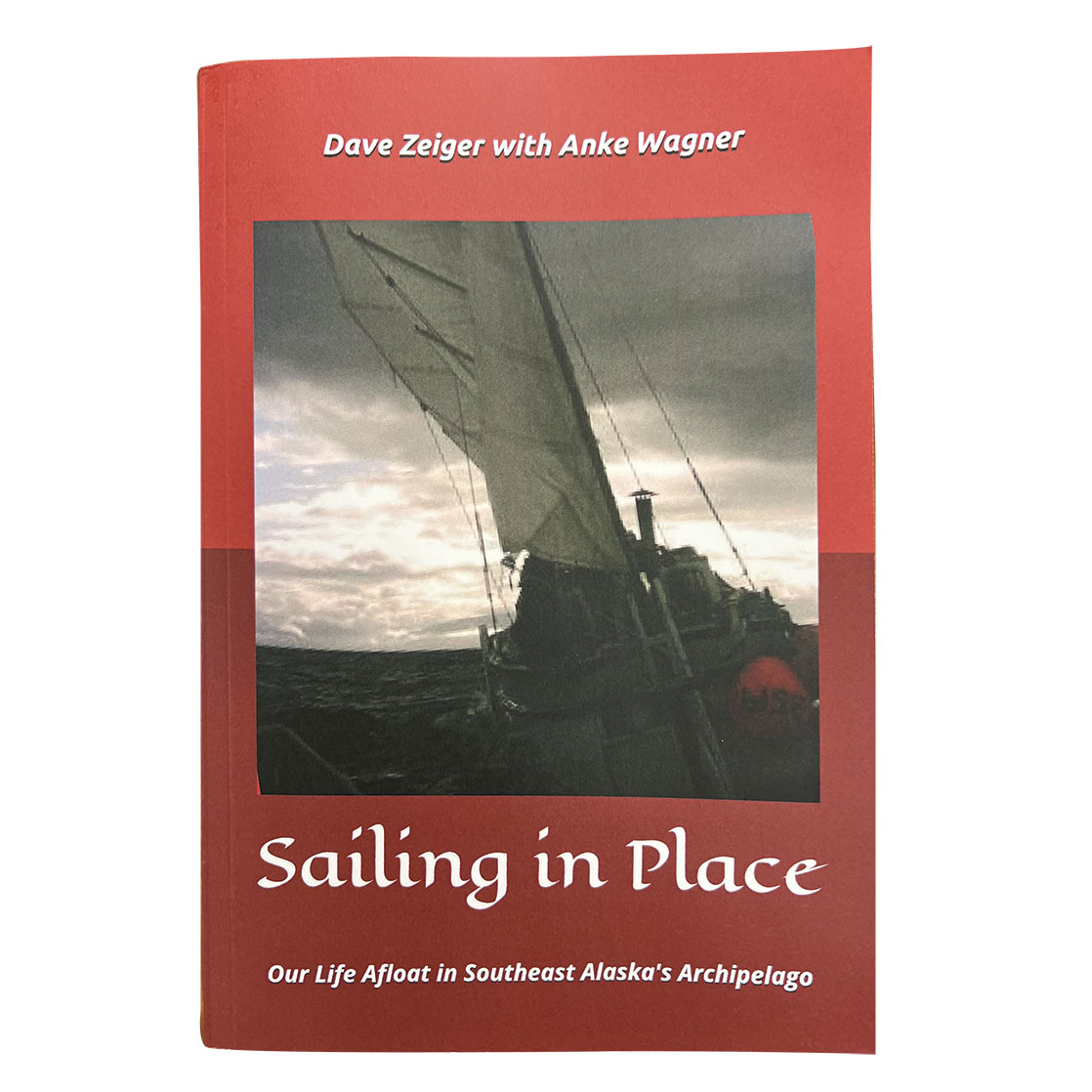
Sailing in Place, by Dave Zeiger with Anke Wagner, photographs and illustrations from multiple sources, Kindle Direct Publishing. 300 pp., $9.99 ebook or $24.99 paperback.
The world’s wooden-boat culture agreeably contains multitudes—dockside dreamers, kayak-kit builders, classic-yacht racers, bewildered muddlers, overweening perfectionists. And Dave Zeiger and Anke Wagner, are somewhere out in a skewed orbit, like Pluto, beyond all these others.
For 30 years now, Dave and Anke have lived and cruised aboard a succession of wooden boats from 19′ to 32′, making their home afloat in the archipelago of islands and inlets in Southeast Alaska. They built four of these boats themselves, three to their own designs. None of them are conventional, pretty, or sophisticated. None has an engine, electronics, or even a propane stove. “We set a low bar!” Dave writes, not apologetically. All are boxy and bargelike and have proven remarkably capable. Latest of the five boats, MUSTELID, a 24′ sailing scow launched in 2019, is the culmination of their experimenting. “We’d picked up quite a number of cockamamie notions over the years, and heaped them all into this design. Too much innovation at one go isn’t always advisable, but MUSTELID performed even better than we had (cautiously) hoped.”
Their experience is worth a closer look.
Dave provides a window, more philosophical than technical, with Sailing in Place, self-published through Amazon’s Kindle Direct Publishing platform. In it the couple relate the story of their boats and minimalist lifestyle, which springs from the voluntary simplicity movement of the 1990s, and from there back to Thoreau. The book, in fact, could be considered sort of a 21st-century Walden, minus Thoreau’s literary sheen and occasional cranky snark. It’s constructed of 60 short, essayish chapters in a carefree order describing everything from their preference for the cat-ketch junk rig (low center of effort, 10-second reefing, no stays or shrouds) to their philosophy of keeping their lives simple with ultra-low overhead so they are never chained to landlubbering jobs. Yes, they acknowledge, their way sounds loose and haphazard. Our world does not much appreciate nonconformists, especially those who adamantly avoid contributing to the GDP. Yet, there’s something to contemplate and admire here.
Those of us who reside along the mainstream arms of boat ownership understand that we are in a Doom Loop, or a couple of them intertwined, that works like this: Buy a conventional boat, pay moorage and insurance, work hard through the week to afford the luxury, and stir in weekend work on the boat to maintain it. Move up to a larger, more sophisticated boat to open up cruising possibilities while taking on more job responsibility to earn enough money to afford it, adding to the time and stress needed for work, plus more intricate boat maintenance, both subtracting time left to actually use the boat. And so on. No matter how you play it, life is a zero-sum game. At some point—preferably before it’s too late—it might be wise to step back and assess the tradeoffs. Do you want success and recognition? Or freedom?
Dave and Anke made their choice three decades ago while working in the DIY boatyard in Port Townsend, Washington, where they built their first boat, a Phil Bolger-designed 19′ 6″ cat-yawl sharpie. While working there, they were struck by the stupendous amounts of blood, sweat, tears, and life that others were pouring into their boats—with one foot nailed ashore. Some, Dave observes, eventually completed their investments and sailed off to enjoy them. But many others stalled out, lost loves or even lives, or traded the dream for something less overwhelming. Dave and Anke? They whipped out the boxy Bolger in one month, ferried it to Alaska, and moved aboard.
The “rules” they’ve since cultivated for their cruising and lifestyle might sound confining to others, but to Dave and Anke they constitute liberation. A sampling:
• No storage anywhere but on their boat. Renting a storage unit just encourages accumulating stuff you rarely use and don’t need.
• No engine. It imposes extra costs, tethers you to ports with fuel availability, subtracts from time cultivating sailing skills, and potentially tempts you to plunge into conditions that should be avoided through defensive sailing.
• Life is sufficiently rich with simple pastimes. A compact musical instrument. Pencil or charcoal drawing. Whittling and marlinspike arts. And, well, yes, a tablet computer, which stores a boatload of books and weeks of music and movies.
• Attitude, not an array of organizational hacks, is the secret to living together in a small space. Humor, tolerance, flexibility, ingenuity.
• Who’s in charge? Depends. At harbor or anchor, nobody. Dave and Anke call it a state of “Taoist anarchy”—from each according to mood, to each according to pleasure. No roles or rules. Underway, they trade off playing captain, who makes the decisions, mostly after consultation. In crisis mode, when the captain says jump, the crew jumps.
Considering 30 years of living and cruising in an unforgiving environment, the couple report few real crises. One, though, illuminates the virtue of having a small and simple boat. One pleasant autumn day, they were sculling LUNA, their 31′ junk-rigged cat-schooner, in a flat calm. Without warning, a williwaw screamed down from the mountains, snapping off the foremast just above its tabernacle hinge. When the wind subsided, they trimmed the jagged foot, transferred the hardware, rerigged the sail, and were on their way in a fair breeze, running wing and wing, in 90 minutes. Forgivably gloating, Dave writes: “Try that with a fancy, high-tech, marconi, witch-to-weather rig!”
Another incident illustrates their admirable integration into their Alaskan community. One day an injured sea lion pup began frantically banging against their dory tender, apparently trying to escape circling orcas, but it couldn’t heave itself over the gunnels. Dave and Anke pulled the dory alongside their boat, lifted up one side, and the pup scrambled aboard. There it camped overnight and through most of the next day before returning to the water. Yes, some nasty cleaning-up ensued. But Dave explains, “We ourselves have always depended on the kindness of strangers.” This was one opportunity to pay it forward.
Alongside the charming stories and philosophical excursions, there are some annoyances. Readers who are interested in boats will wish for more thorough descriptions and better pictures of the couple’s motley but intriguing fleet. And Dave’s style illustrates one of the hazards of self-publishing: the absence of a professional editor. One of the more useful functions of an editor is to save us writers from our most indulgent selves, and Dave indulges in quite a bit of folksy slang and purple prose. These distractions, though, do not fatally wound the book’s value. In compensation, it offers many memorable expressions of deep wisdom:
“As a rough, callous rule-of-thumb, I’d say that, if you have to ask someone, it ain’t seaworthy.”
“Too much obsession with perfection, and we stay anchored to shore. Too little, and we risk becoming a bottom feature. We seek a balance, the reasonable mean.”
Not many may feel tempted to follow Dave and Anke into self-sufficient nautical minimalism. But the ideas here are provocative enough to make us think about making sensible improvements in our boats and lives. Bigger, faster, and fancier ain’t necessarily better. 

Lawrence W. Cheek is a regular contributor to WoodenBoat.
Visit the Small Boats website for a 15-part video series about MUSTELID.