
 Emilie Waters Harris
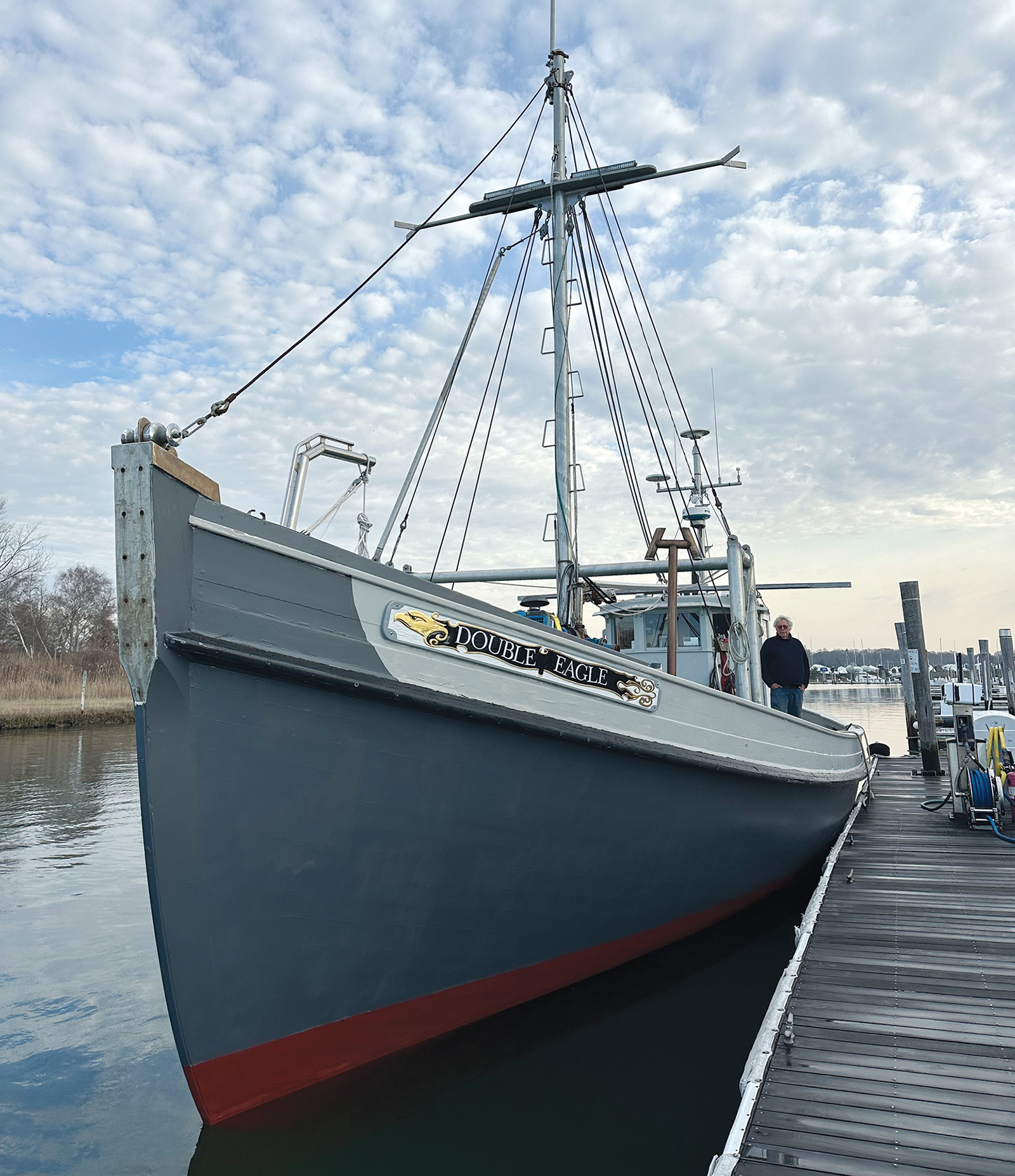
DOUBLE EAGLE was built in 1929 in East Machias, Maine, as a sardine carrier for the North Lubec Manufacturing & Canning Company. She is one of the last survivors of dozens of such boats, and a rare one to have another life in commercial fishing: Jonathan Waters bought her for his oystering operation out of Stony Creek, Connecticut.
It was one of those phone calls that you never forget. My wife and I were on a late-summer cruise in our schooner, SARAH ABBOT, anchored at Martha’s Vineyard, Massachusetts. I remember a day of soft sunshine and light wind, perfect for reading in the cockpit, when my phone chimed. The screen announced a call from a fellow workboat addict, the oysterman, artist, and boatbuilder Jonathan “Johnny” Waters. He was already laughing when I answered.
“This might be one of the craziest things I have ever done,” he chuckled. “I bought the damned thing.”
By “damned thing,” I knew he meant the last working Maine sardine carrier, DOUBLE EAGLE. His daughter, Emilie, had told me that her dad was on the Maine coast, helping to paint the bottom of a beast of a boat and “crushing hard on it.”
Johnny said he wanted to put DOUBLE EAGLE to work in his shell-fishing enterprise at Stony Creek, Connecticut (see WB No. 290). He just wasn’t sure how, yet….
“I’m going to need some help to get her home,” he said.
“Count me in,” I blurted.
 Benjamin Mendlowitz
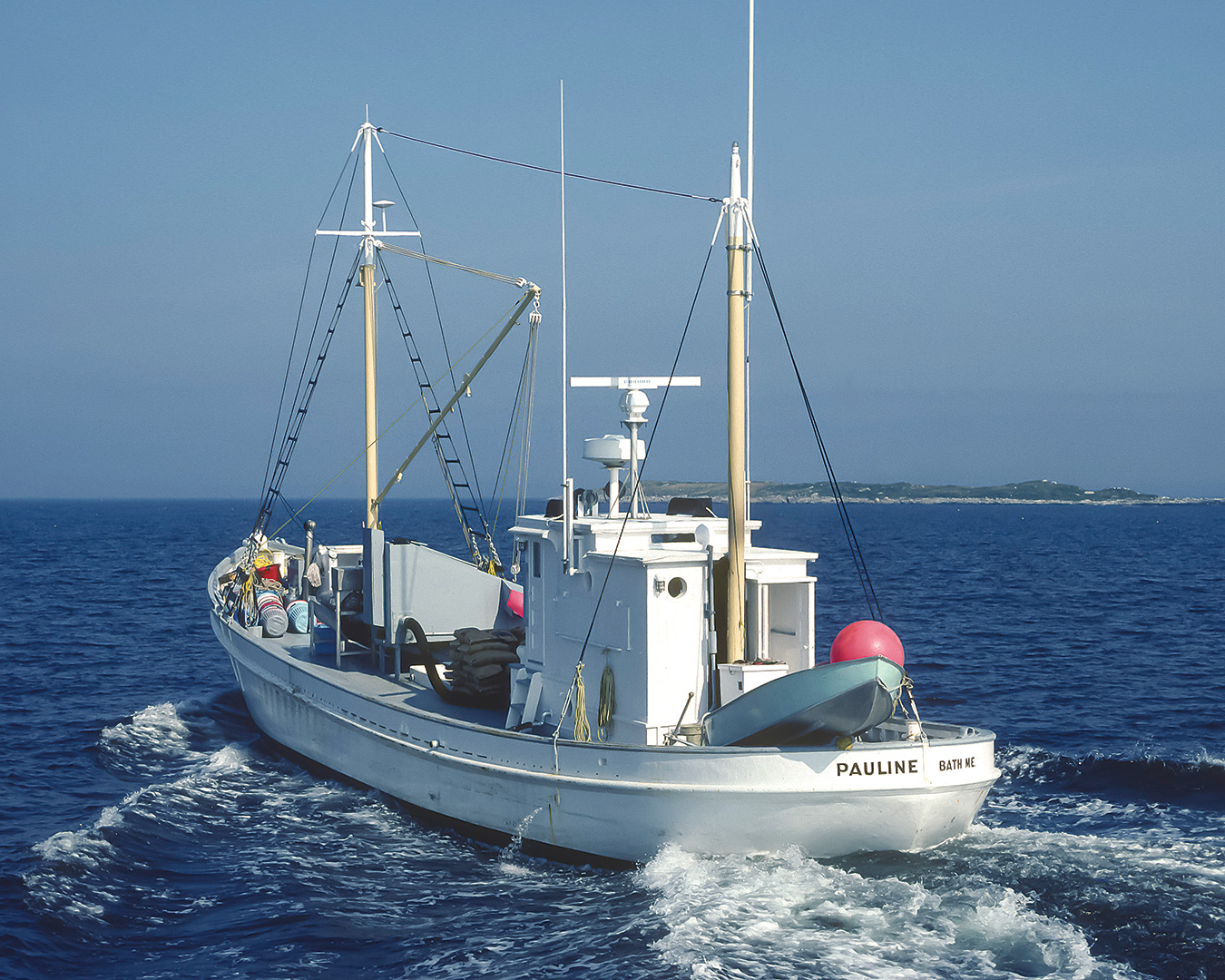
PAULINE was built as a sardine carrier in 1948. She was converted for passenger-carrying in 1988 and served in that trade until 2013; she is partway through a subsequent conversion, which seems to have stalled.
All my adult life I have drooled over the sweet lines and rugged look of these nautical dinosaurs, boats such as PAULINE and the JACOB PIKE, when I spotted photographs of them in Benjamin Mendlowitz’s Calendar of Wooden Boats or in person when they were deeply laden with a load of fish transiting the Fox Islands Thorofare in Penobscot Bay. I am a classic aircraft junkie, too, and a chance to crew a working sardine carrier on a 370-mile passage from Rockland, Maine, to Stony Creek, Connecticut, was right up there near the top of my bucket list with a flight I had recently made in the jump seat of a World War II–era B-17 bomber. “This is going to be an adventure,” I said, picturing myself at the helm of the 70′, 95-year-old DOUBLE EAGLE.
 Penobscot Marine Museum/Jim Moore Collection
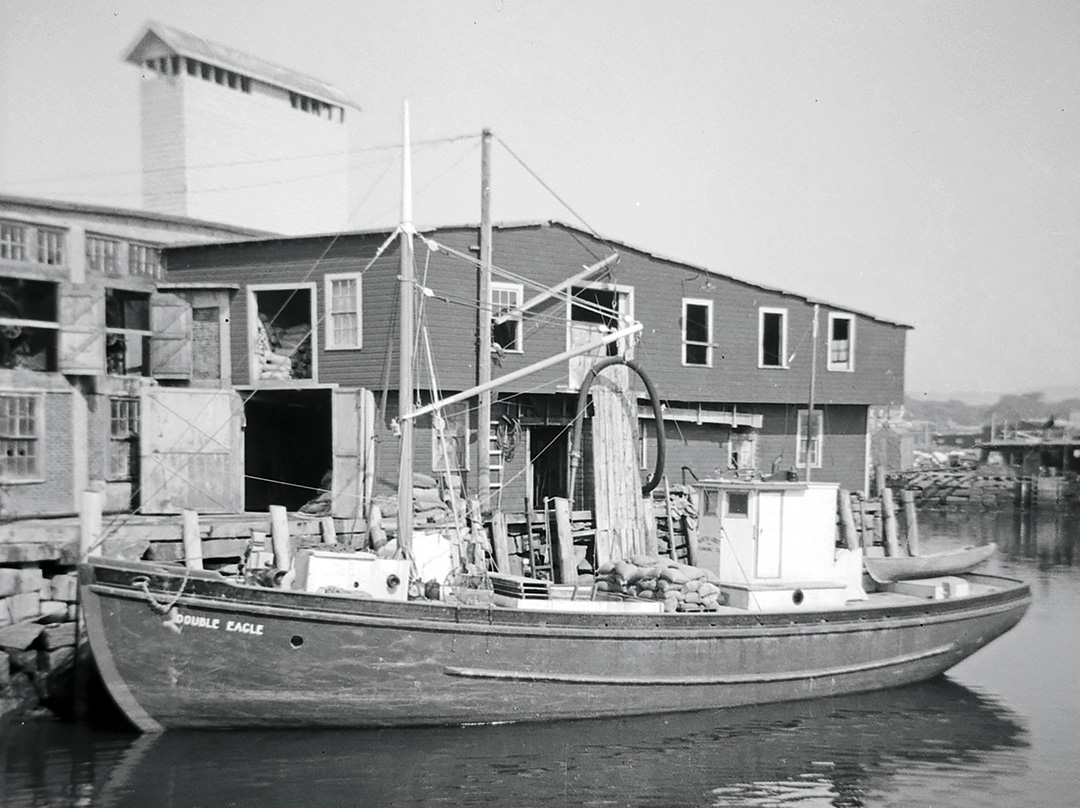
Boats such as DOUBLE EAGLE, shown in a 1948 photograph at the North Lubec Canning Company pier in Rockland, Maine, were developed to have fine and easily driven hulls. They were widely admired for their handling in nearshore waters, delivering the catch from Maine’s sardine fishery to canneries up and down the coast.
In my mind, I was already beginning to smell the pilothouse and its seductive blend of fish, white oak, cedar, musty bedding, diesel fuel, coffee, pipe tobacco, and ghosts. How different this passage would be from my recent delivery of a fiberglass-hulled Oyster 53 from Bermuda to Maine with a crew of six, a cook, ice cream, and more navigation hardware than a Boeing Triple Seven. Johnny said that for navigation electronics, DOUBLE EAGLE had a radar and an antique Dell laptop with a glitchy first-generation chartplotter program.
 Penobscot Marine Museum/Alden Stickney, Boothbay Fishing Collection
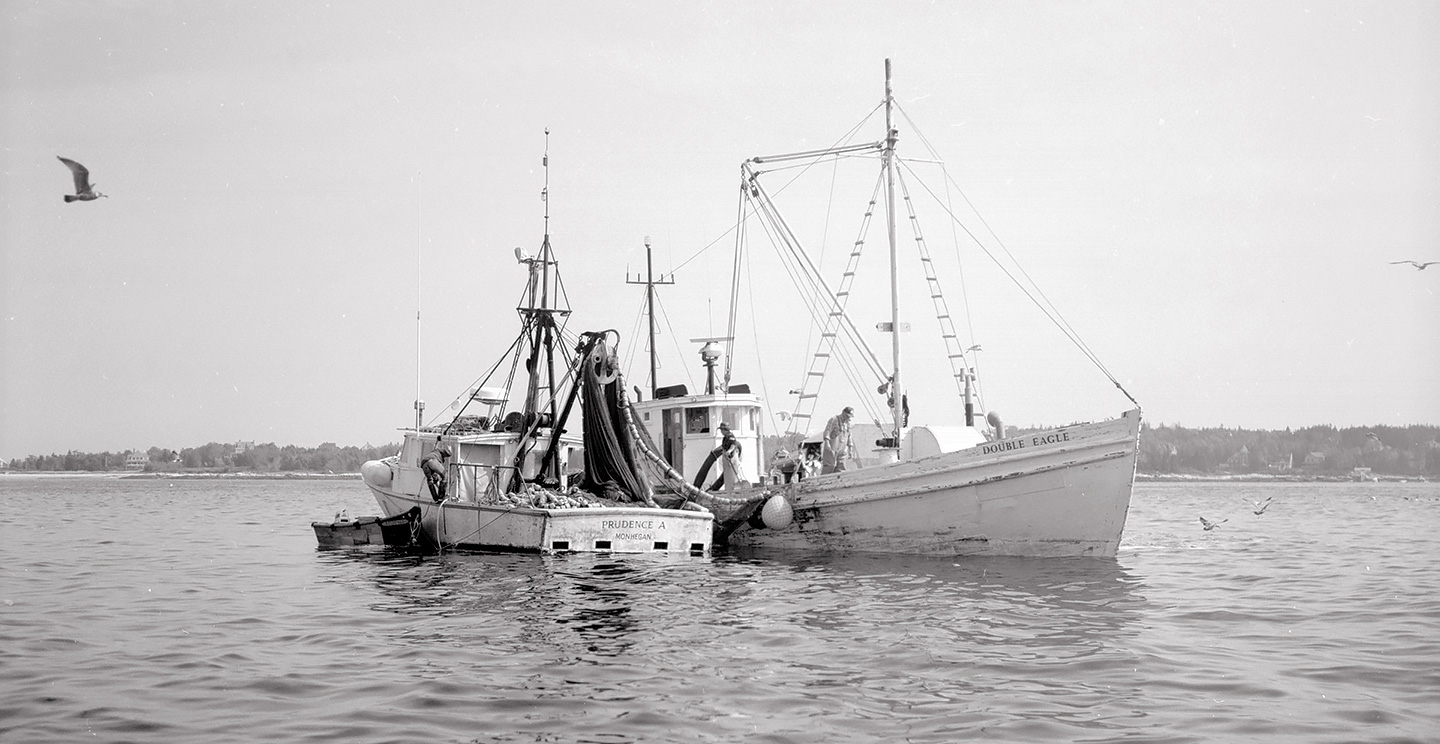
After the sardine fishery waned, carriers served boats such as the purse-seiner PRUDENCE A, shown in 1980, to deliver menhaden used as trap bait in the lucrative lobster fishery.
Good enough. I told the deliriously happy new owner that I had Navionics on my phone if we really got in a pinch.
“Don’t forget a charger,” Johnny said, still laughing.
He was sort of mocking modern technology. Like me, he was imagining this passage as something of a retreat from post-Covid America and a chance to commune with the souls of some all-but-forgotten seafarers, their vanished industry, and a classic American workboat of exceptional utility and beauty.
“How about I bring a jib off my schooner,” I added. “We can rig it as a steadying sail.”
“Perfect,” Johnny said.
The long, narrow sardine carriers had a reputation for rolling when running light, and we would be headed offshore into the Gulf of Maine, which is famous for its confused seas. How sensible that in addition to a Daewoo diesel engine, EAGLE, as she is known casually, still carried the vestiges of her original ketch rig, with a fully stayed mainmast, a setup that Johnny called “old school.”
Sardineland
Although DOUBLE EAGLE and her kind are generally called sardine carriers, the term is a bit of a misnomer. The word “sardines” is a generic term taken from Italian and used to describe a variety of small fish, including true sardines (found off Sardinia), herring, and sprat (among others) that are canned, cooked, and preserved in oil, seasoned sauce, or water. Boats such as EAGLE were built to transport herring caught in the coves and bays of Downeast Maine and Canada’s Bay of Fundy to dozens of canneries, some of them concentrated around Eastport and Lubec near the Canadian border but also extending along the Maine coast as far as Casco Bay, near Portland.
 Benjamin Mendlowitz
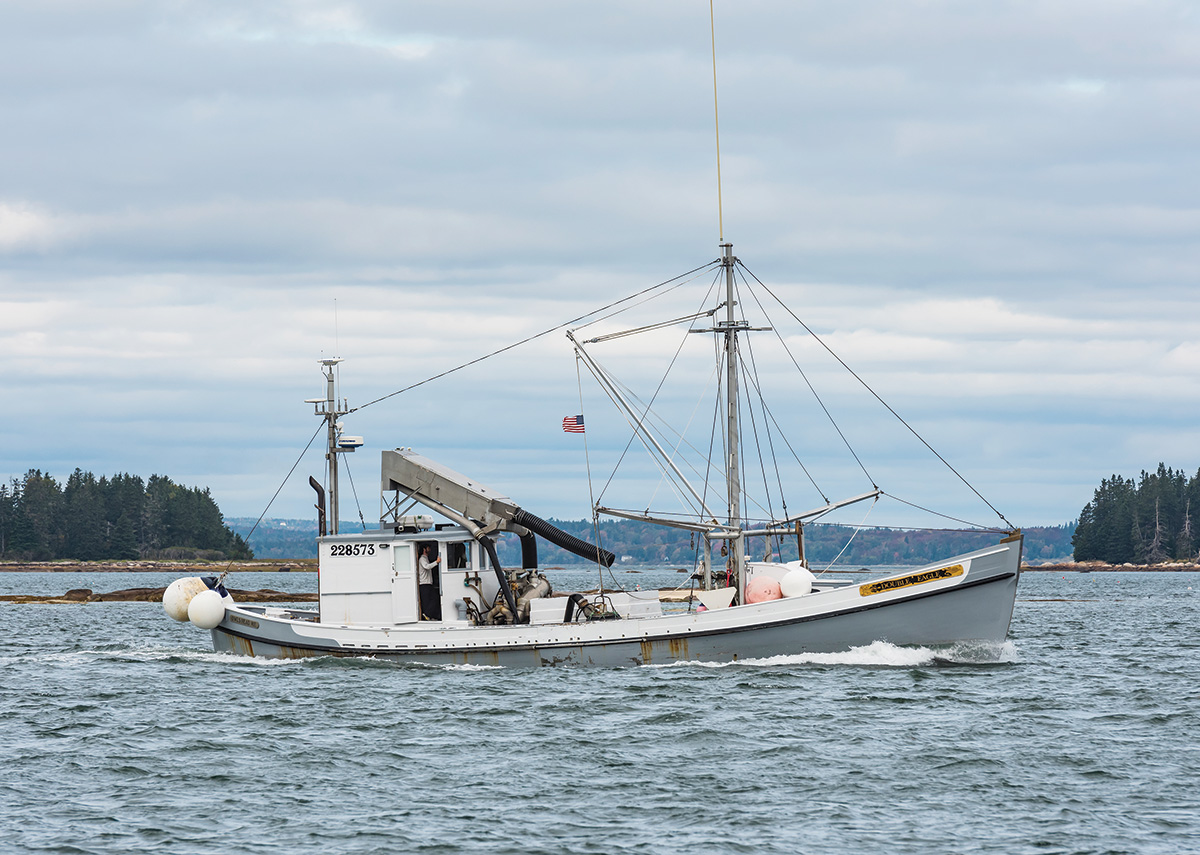
DOUBLE EAGLE continued supplying herring to lobstermen until 2023, far longer than any other boat of her type. This photograph was taken in 2018.
The sardine industry’s growth from a local herring fishery into an economic juggernaut started in 1867, when George Burnham returned to Maine from a visit to France, where he had witnessed a thriving sardine industry. He perceived that Maine’s abundance of herring could be caught and canned just like the French sardines. Herring gathered in immense and dense schools from June to October to spawn in Maine’s rocky coves, and the fish were easy to catch en masse with weirs, fish traps, and seine nets. Fishermen could work with dip nets to bring fish aboard their open boats and then the larger sardine carriers could use brails to transfer the fish to their holds for transport to the canneries for processing. In later years, the massive catch would be sucked out of the carriers’ holds by powerful pumps. Unsuitable fish, along with discarded heads and tails, were sold as lobster bait or converted into pet food or fertilizer, and fish scales went to the cosmetic industry.
The world market for “tinned” foods was propelled by the need to feed soldiers in the Franco-Prussian War (1870–71) and, later, by the demands to provision armies in World Wars I and II. Canned sardines were affordable, protein-rich staples for both armies and civilians. The peak of the sardine industry came in the early 1950s, when Maine fishermen landed as much as 90,000 metric tons of herring in a single year. In those heady days of the 1950s, more than 40 canneries operated along the Maine coast. These fish-packing factories employed 8,000 to 10,000 workers, most of them women. The fishery was so ubiquitous in the mid-20th century that people called the state of Maine “Sardineland.”
By the early 1970s, however, the domestic market for canned sardines was shrinking as tastes turned toward frozen fish and canned tuna. Meanwhile, improved fisheries technology such as purse-seining and mid-water trawling, along with huge, high-capacity fish pumps for vacuuming herring out of the nets into the carriers, devastated Maine’s herring stocks. Canneries began closing. The last of them, the Bumble Bee Foods factory at Prospect Harbor, held on as late as 2010, when it, too, shut down. A few of the remaining sardine carriers, among them DOUBLE EAGLE, continued to work offshore in partnership with purse seiners to catch herring used as bait for lobster traps. Many aging carriers were run up tidal creeks and left to molder away.
Finest Kind
“I don’t want to sell her, but it’s time,” the lifetime commercial fisherman Capt. Glenn Lawrence told me. It was he who sold DOUBLE EAGLE to Jonathan Waters. He said that DOUBLE EAGLE had been a good boat, but such a boat needs to work or she’ll die, and she had outlived her purpose in Maine. In recent years, federal and state commercial fishing regulations, responding to the depletion of herring stocks, had closed or significantly restricted the fishery in the Gulf of Maine. Carriers such as the EAGLE were banned from the remaining fishery.
I was the first to commit to Johnny for the passage to Connecticut, but my friend Paul Gingras, a machinist, mechanic, and seasoned caretaker of the offshore scallop fleet working out of New Bedford, Massachusetts, joined us as engineer. He was in his element in DOUBLE EAGLE’s cavernous engineroom as we came to the end of an hourlong walk-through of the boat and all of her systems with her longtime master and owner. Most of our time with Lawrence had been spent belowdecks going over the various pumps, hoses, valves, tanks, reservoirs, and wiring that kept the engine and drive train functioning, the lights on, and the bilges dry.
“Any questions, just give me a call,” Lawrence said after we had retreated to the pilothouse. This was his way of wishing us fair winds as we prepared to set out the next morning. He seemed eager to get off the EAGLE. He loved this boat, and leave-taking came with a rush of emotions for him. “Finest kind,” he said with a knowing smile. It is a common fisherman’s affirmation in New England. “Finest kind” is code for the rightness of a vessel or the current weather or fishing conditions and simultaneously an acknowledgement of brotherhood and the shared bonds of seafarers.
“She’s big and strong, but she’s simple,” Paul said after Lawrence stepped ashore. Paul was, no doubt, comparing her to the complexity of a modern steel scalloper or the Oyster 53 I had recently sailed back from Bermuda.
“The way a boat’s supposed to be,” Johnny said.
Amen, I thought.
A Product of Experience and Purpose
DOUBLE EAGLE has functional elegance of the first order, born of long experience of fishermen and boatbuilders on the Maine coast.
 Benjamin Mendlowitz
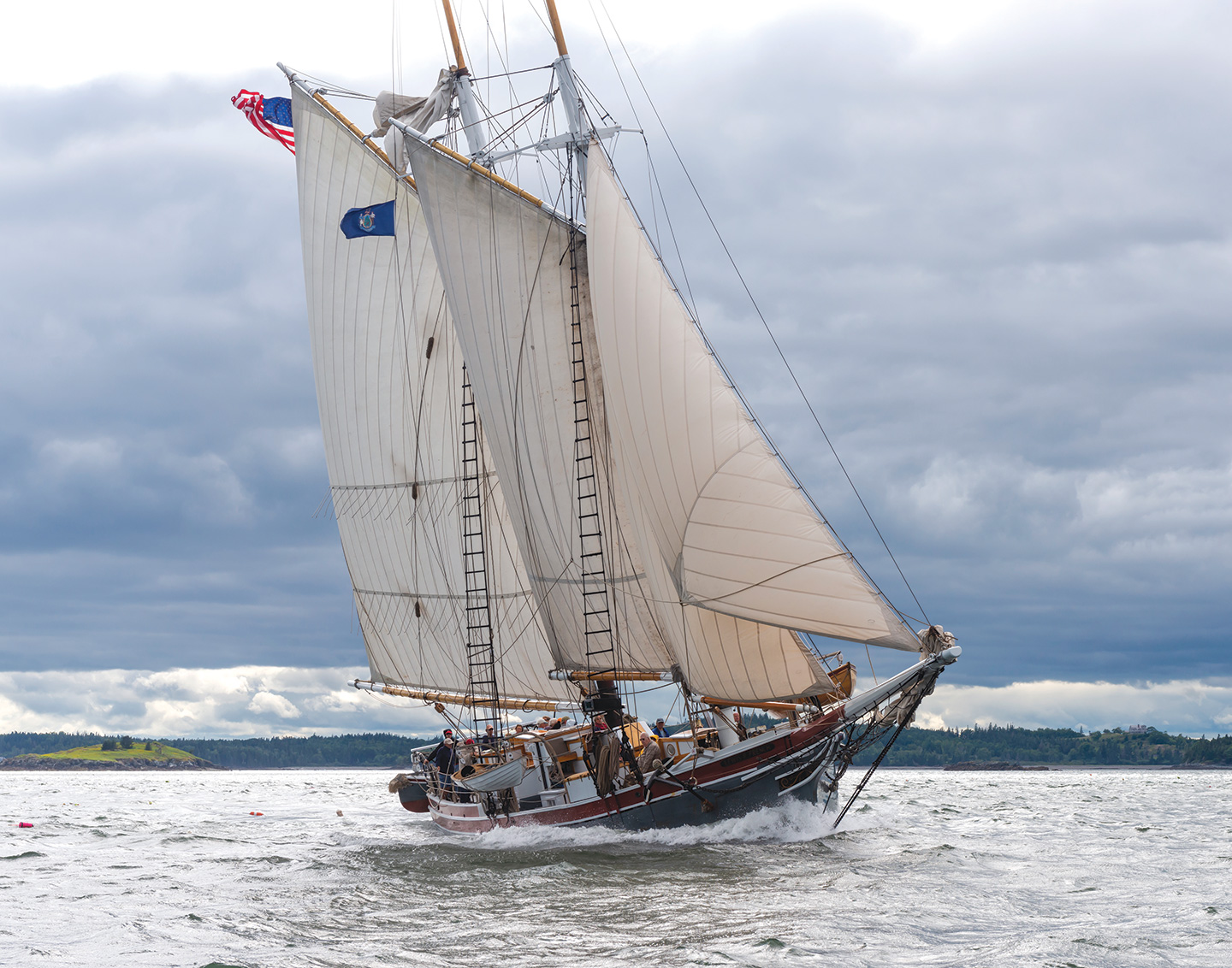
The LEWIS R. FRENCH of 1871, built for fishing and freighting, has been an admired veteran of the Maine Windjammers passenger-carrying schooner fleet since her conversion for the purpose in 1971.
During the final decades of the 19th century, small schooners were the preferred carriers because of their voluminous capacity, seakindliness, and ease of handling for a crew of two or three. The sole survivor of that era is the LEWIS R. FRENCH, built in South Bristol, Maine, in 1871 and today still serving as a Maine windjammer passenger schooner. Unlike the FRENCH, many of these schooners were pinkies and smacks that kept their catch alive in flooded holds to ensure freshness at the time of delivery. Their high, bluff bows protected the vessels and crews from boarding seas when running deeply laden, which was always the situation when homeward bound to the canneries. Their pronounced sheer and low freeboard amidships helped them to shed water rapidly through freeing ports. Crews believed their double-ended construction made them easier to handle than transom-sterned boats and safer in following seas.
As was the case in most American fisheries, seafarers began retrofitting engines to replace sails at the start of the 20th century. Herring fishermen experimented with gasoline, crude oil, and naphtha engines before discovering the safety and simplicity of diesel engines in about 1920. As the fishery boomed, fishermen and canneries were quickly outgrowing their pinkies, which often needed tugs to tow them back into port; the jury-rigged auxiliary schooners proved slow.
The first purpose-built modern carriers came from builders such as George Everett Richardson at the heart of the herring industry around Eastport in Maine and Deer Island in New Brunswick. The new carriers, adaptations of the double-ended pinkies and other small native schooners, were about 50′ LOA, generally with white-oak planking and fir decks spiked to massive double-sawn, white-oak frames and deckbeams. (Reported lengths can be problematic, because it often isn’t clear whether the length was considered “overall” or some other reference, for example the length between naval architecture’s perpendiculars. Some boats were lengthened later in their lives. The lengths shown here are from vessels’ certificates of documentation, reliable historical sources, or from Masts and Masters, noted in “further reading” below.)
 Benjamin Mendlowitz
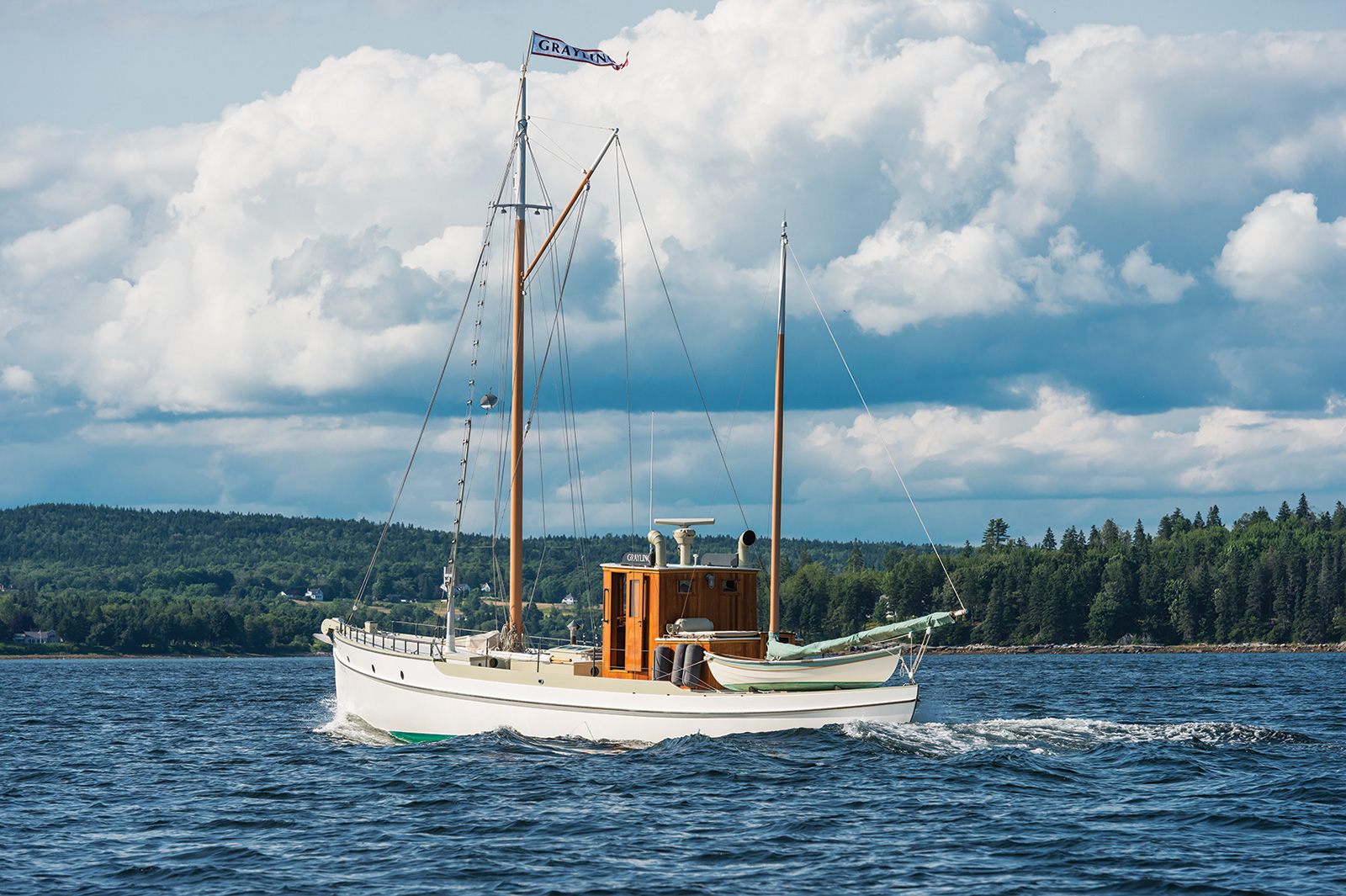
GRAYLING of 1915 is one of the success stories of a sardine carrier converted for pleasure use. She was rebuilt in the 1990s at the Brooklin, Maine, boatyard now known as Hylan & Brown Boatbuilders.
These were the prototypes for the following generations of sardine carriers. They eliminated the bowsprit and replaced the gaff-rigged schooner sail plan with a short ketch rig for carrying triangular steadying sails. The hulls evolved to be more slender and easily driven than the previous generation of schooners and “Eastern-rigged” draggers, possibly because the carriers were primarily working inshore during mild summer weather. A raised pilothouse aft was built over a large engineroom. Like the schooners, the new carriers had one or two cavernous fishholds amidships with a crew forecastle and galley forward. Many of the new carriers retained a sharp or rounded stern. Slow-turning, high-torque engines of 40 to 80 hp drove three-bladed propellers of 48″ in diameter or larger. Hold capacity was measured in “hogsheads,” rated at about 63 gallons or 1,240 lbs. GRAYLING, built in 1915 as a seiner and converted to use as a carrier, then to pleasure use in 1997, is a classic example of this type. The 83′ knockabout auxiliary schooner SYLVINA W. BEAL, originally built in 1911 as a seiner, became one of the largest examples of carriers from this era.
 Benjamin Mendlowitz
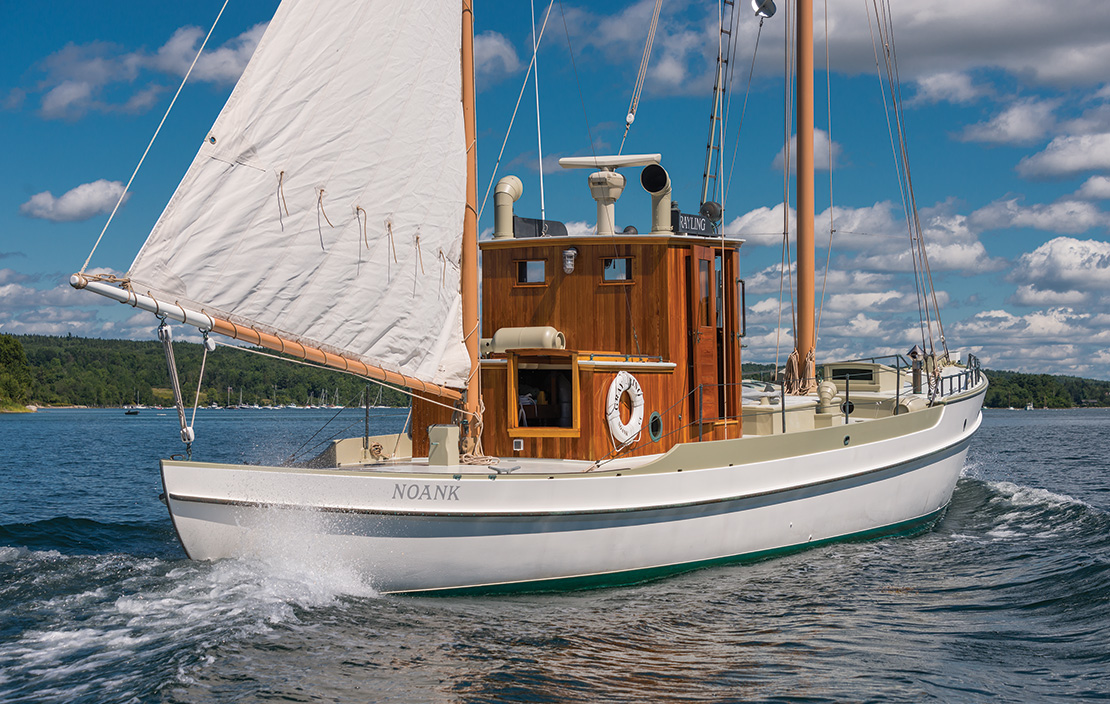
For almost 30 years, GRAYLING of 1915 has been celebrated as a respectful, and well-cared-for, adaptation of a sardine carrier.
During the Roaring 20s, the canneries wanted ever-bigger and -faster carriers. Diesel engines, especially from Fairbanks-Morse, became industry standards. Many canneries began building company fleets of their own. According to Jon Johansen, a Maine maritime historian and the publisher of the newspaper Maine Coastal News, at one point, the Canadian Sardine Company (which became the Booth Sardine Company of Maine) amassed a fleet of 13 company carriers all named CASARCO, numbered 1 to 14 because no superstitious fishermen wanted to go to sea with number 13.
 Tyler Fields
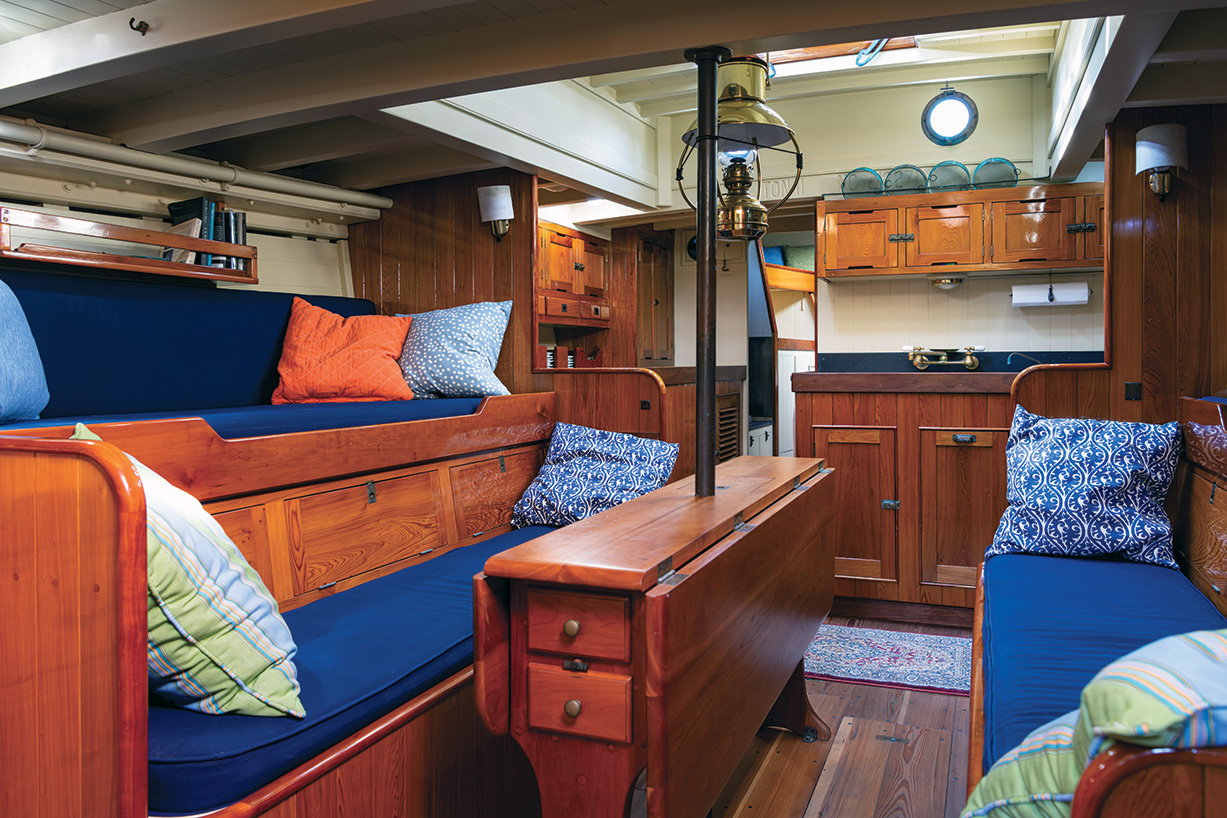
Fishholds the size of GRAYLING’s have ample potential for conversion to accommodations.
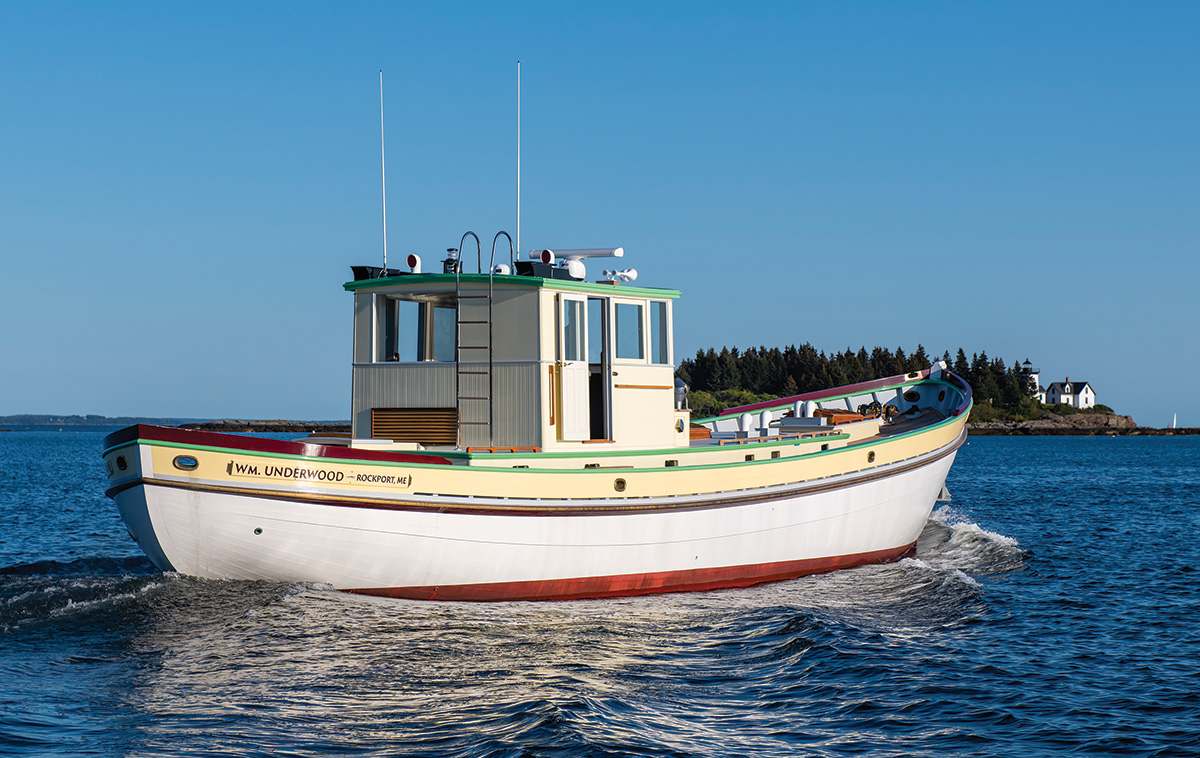
No longer the exclusive businesses under family names such as Lawrence, Peacock, Holmes, Stinson, Pike, and Underwood, the canneries began ordering carriers from noted Maine shipyards such as Hodgdon Brothers at East Boothbay, the Gamage Shipyard at South Bristol, and, especially, Newbert & Wallace at Thomaston. Some companies even reached out to prominent yacht designers such as Eldredge-McInnis and yacht builders such as George Lawley & Son in Massachusetts. The respected Simms Brothers yard in Dorchester, Massachusetts, built the WM. UNDERWOOD (see WB No. 272) in 1941 to help the canneries gear up for the heightened demands for fish from the U.S. military during World War II. At the same time, quite a few yachts were repurposed as carriers.
 Benjamin Mendlowitz
Taylor Allen at Rockport Marine in Maine rebuilt the WM. UNDERWOOD for his own use in a project that spanned more than a decade, culminating with a relaunching in 2019.
Before the 1920s, most of the builders carved half-hulls and measured them for lofting dimensions, but a newer generation of designers worked with pencil, paper, and planimeters to draw long, lean boats, some over 70′ LOA with beams of about 20′. Gross tonnage increased from around 25 to over 50. The hulls retained vestiges of their pinky ancestors, double-enders with full bilges, fine sterns, and moderately deep keels giving them drafts of about 8′. Built in 1929, DOUBLE EAGLE is classic example of a carrier from this era.
 Benjamin Mendlowitz
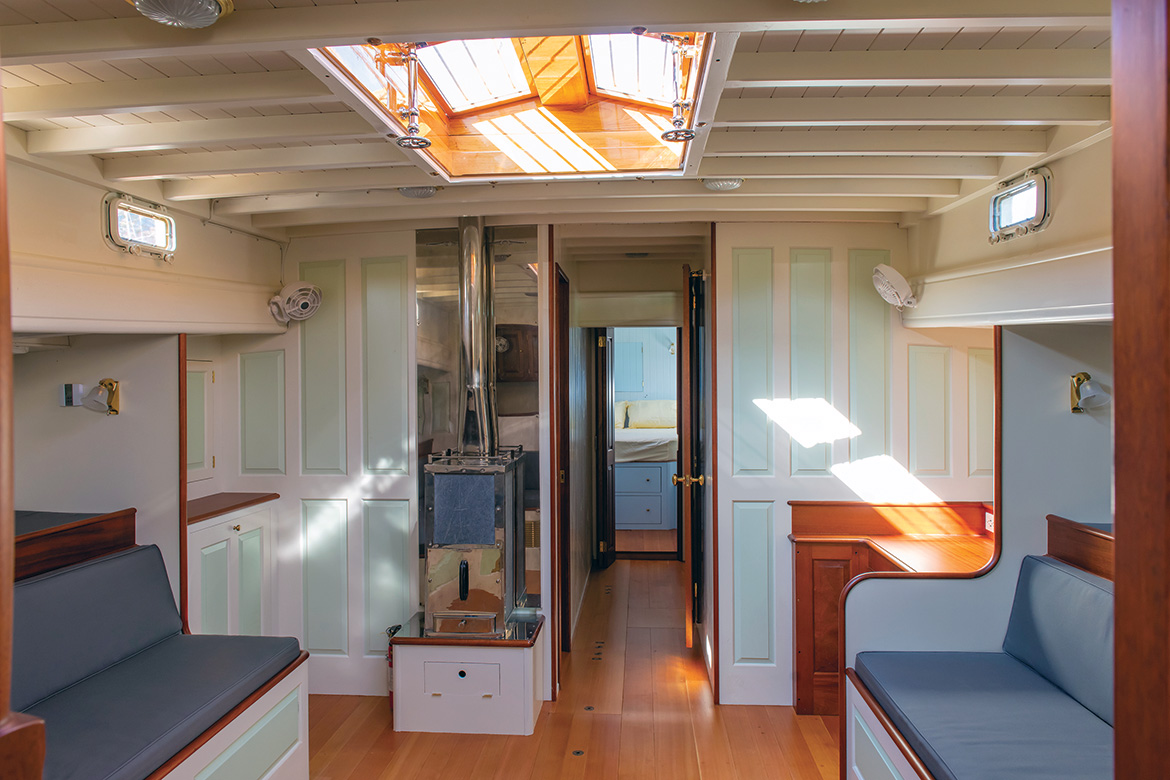
The WM. UNDERWOOD main saloon is commodious and comfortable.
The Great Depression of the 1930s hit the canneries, their fleets, and the carrier-builders hard, but with the onset of World War II, the military’s demand for long-lasting canned food revived the industry. By the time the war ended, the sardine fishery was booming again. The fishermen’s need to replace worn-out carriers fostered a final spurt of carrier construction in the postwar years, and some of the most admired boats of the type came from that era. PAULINE of 1948, MARY ANN of 1949, and JACOB PIKE of 1951 all came from the Newbert & Wallace yard and marked the end of an era.
 Benjamin Mendlowitz
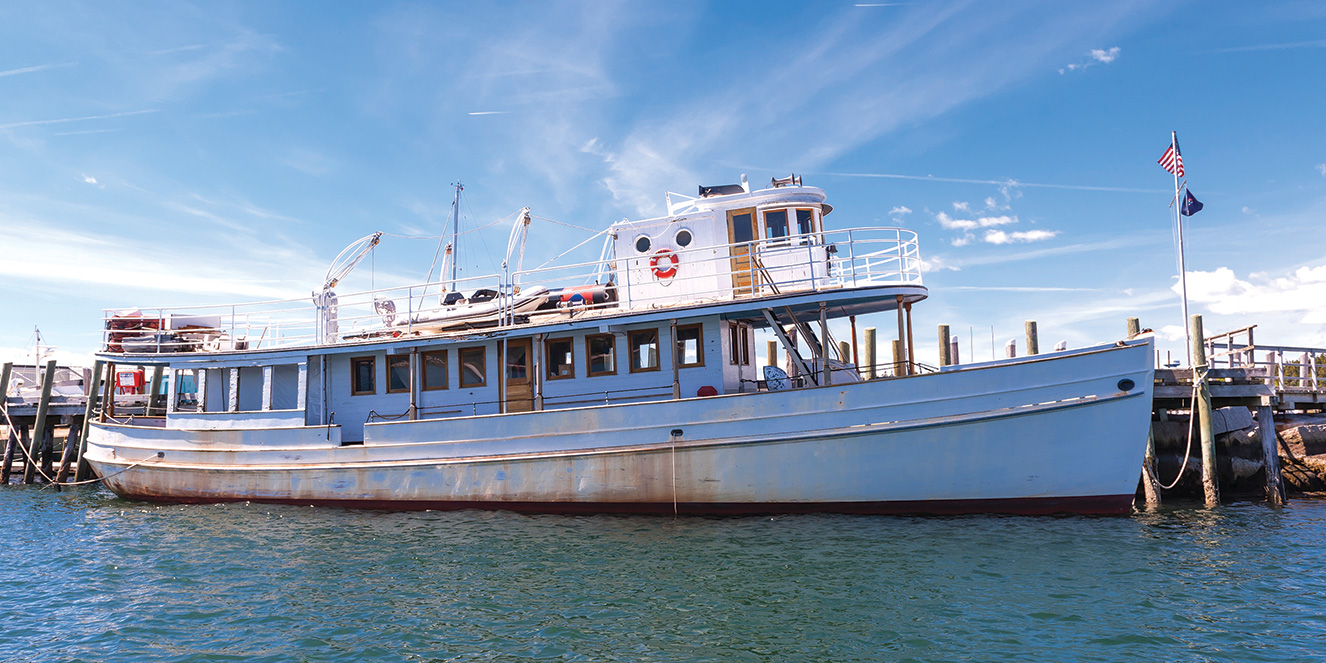
PAULINE was given a large deckhouse for passenger accommodations in the late 1980s. A 2020 refit for a sea education program has since been suspended, but the boat still survives in Stonington, Maine.
Outward Bound
After a breakfast of bacon, eggs, and toast, we made our final walkaround, engine survey, and electronics checks. Then we cast off DOUBLE EAGLE’s lines and took her to sea with steaming mugs of Typhoo tea in our fists and a satisfying rumble from the dry exhaust echoing through the pilothouse. As we left the town pier at Rockland astern, Johnny had the helm. Paul descended below to monitor the Daewoo. I went up to the foredeck to rig the jib.
Things rarely go as planned when seafaring, but this morning was proving the exception to that rule. We had hoped that the passage of a cold front overnight would drive persistent fog banks off the coast. Now, the tail end of the front had left us with 15 miles of visibility. We had a fair breeze to thread our way clear of the ledges and islands at the western entrance to Penobscot Bay and carry us the 370 miles to Stony Creek. Under ragged clouds and with a following sea, Johnny opened the throttle and EAGLE took to a long ocean swell, steaming at 8.5 knots. The schooner jib that I had brought along fit perfectly in the foretriangle, and when I sheeted it home, DOUBLE EAGLE found her footing. Her ponderous rolling all but vanished, and she began to glide.
“Finest kind,” Johnny said. He had one hand on the king spoke of the helm and smiled as if this pilothouse had been his home for years.
I understood that. Maybe EAGLE was a new boat to us, but we are men in our seventh decades, and we have been going out where the buses don’t run in all manner of traditional workboats for most of our years. As DOUBLE EAGLE spread her wings, I had an overwhelming sense of déjà vu. It was as if I were a young man again heading out for a morning of dredging oysters in the Chesapeake aboard the skipjack RUBY G. FORD with Capt. Bart Murphy and, simultaneously, steaming south of Martha’s Vineyard in search of summer flounder aboard an eastern-rigged dragger named RICHARD & ARNOLD with Capt. Dave Dutra. The men of those memories are gone now, long across the bar; but this morning, they seemed to be with me, sipping tea in the pilothouse of DOUBLE EAGLE with Johnny, his own ghosts, and four generations of Maine herring fishermen.
 Tyler Fields
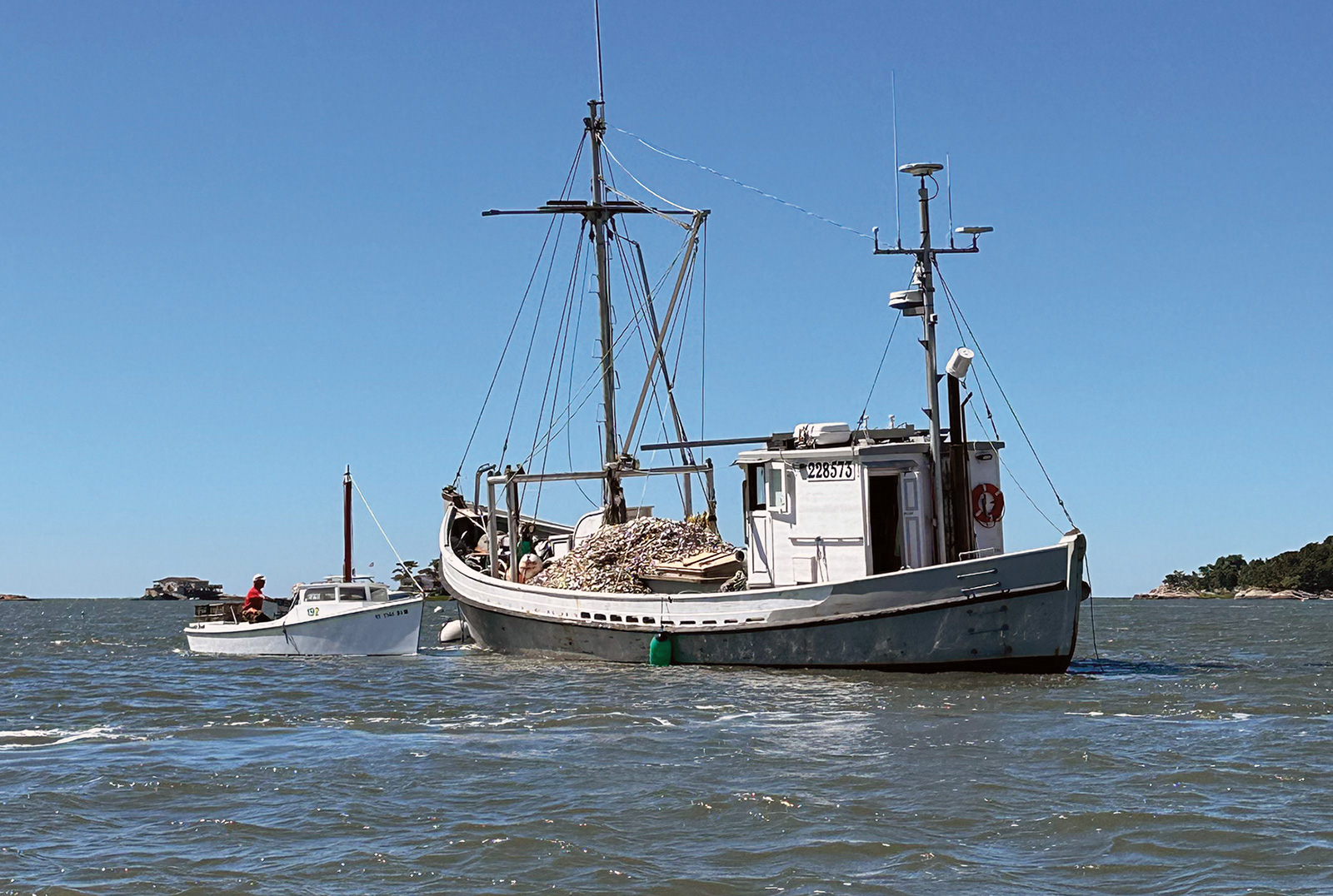
After arriving in Connecticut in 2024, DOUBLE EAGLE was refitted and given a new hull color for her latest task with Johnny Waters’s oystering operations.
DOUBLE EAGLE was built for the North Lubec Manufacturing & Canning Company in 1929 as a combination freighter and sardine carrier by Charles Ingalls of East Machias. The new boat was named after one of the company’s brands of canned sardines. As built, EAGLE measured 58′ LOA with an 18′2″ beam and 7′8″ draft. She was 41 gross tons, 20 net tons. Her original construction was probably white-oak planking and frames, but during 95 years of repairs and rebuilding, fir, cedar, and hackmatack have joined her mix of wood. Galvanized screws as well as the original spikes fasten her. The planking thickness is 1¾″. Double-sawn 4″× 6″ white-oak frames are spaced on 16″ centers (but closer in the bow and stern). The deck is fir.
“Best boat I ever had,” Lawrence told me recently. “I think I might have cried when I let her go.”
Ah, the stories she could tell.
After carrying freight and sardines for 20 years, DOUBLE EAGLE was rebuilt in 1949 and lengthened 12′ to increase her overall length to 70′. At the same time, her original transom stern was changed to the more traditional double-ender configuration. Over the years, she had many skippers but remained the property of the company that had her built until it closed all operations in the 1980s. Lawrence purchased her in 1989. Providentially, Lawrence shares the same name as, but is unrelated to, the entrepreneur behind the North Lubec Manufacturing & Canning Company who commissioned the construction of the DOUBLE EAGLE.
When Lawrence got DOUBLE EAGLE, she was beyond tired. He immediately gave his carrier a yearlong rebuild with shipwright Geno Scalzo at North End Shipyard in Rockland, Maine, repowering her with a GM 6-71 diesel, a 3.5 × 1 reduction gear, and a 40″× 32″ three-bladed prop. As time passed, Lawrence updated DOUBLE EAGLE with her current 400-hp Daewoo diesel, a new 30kW generator, and a four-bladed propeller. He also added a state-of-the-art Robertson autopilot and high-tech refrigeration.
“Ben Banow, my mate and second captain, and I were hauling herring to the canneries right up until the last one closed in 2010,” Lawrence told me. “There was a winter season for purse-seining herring down in Ipswich Bay north of Gloucester [Massachusetts], and we had some good years carrying fish for the seine boats.”
As currently configured, the EAGLE can carry 90 hogsheads, which translates to almost 100,000 lbs, of fish in her two holds. After the last canneries closed, Lawrence learned that when teamed up with a purse-seiner that was netting schools of herring, he could carry enough fish to supply more than 300 lobstermen with their daily bait needs. Over her final years with Lawrence, DOUBLE EAGLE transported herring for use as lobster bait to many coastal communities and islands of midcoast Maine. But now, with the herring fishery closed to carriers, the EAGLE was heading to Connecticut to find new ways to stay alive and earn her keep.
The trip was becoming a magic carpet ride.
Night Running
I was an hour or so into the mid-watch with the autopilot holding DOUBLE EAGLE on a steady course for the east end of the Cape Cod Canal, 25 miles ahead. The breeze had settled to just a few knots out of the northwest, and the ragged clouds had finally passed. There was no moon. The sky was a field of stars. Jupiter was so bright that it cast a beam of silver light across the water. Paul was curled in a sleeping bag on deck. Johnny was conked out in the day bed at the after end of the pilothouse. The Daewoo purred as we glided onward.
 Benjamin Mendlowitz
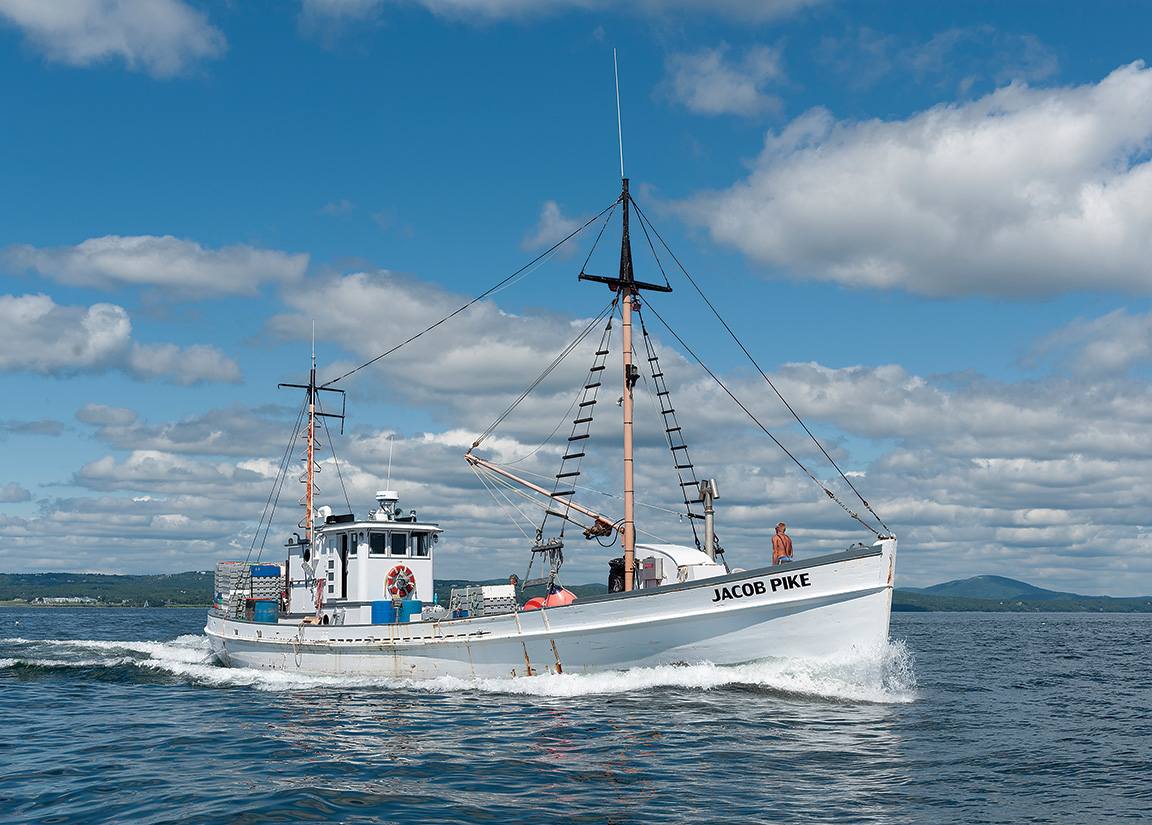
The JACOB PIKE, a 1951 carrier, had been targeted for preservation or conversion, but she sank in 2024 and was hauled ashore and broken up; hopes are alive to have a new version built.
I had made this passage from the North Atlantic into Cape Cod Bay, stood the mid-watch through these waters, well over a hundred times. Yet, each trip still feels somehow transcendent, as if for these few hours, alone and on watch, I am adrift in time. This night I let the EAGLE take me back to the glory days of the sardine industry.
Curious about sardine carriers, I had recently stumbled across a posting on the website of the Beals Historical Society (www.moosabec.org), a group “dedicated to exploring and preserving the history of the Moosabec area” of Downeast Maine. It was a list of more than 50 sardine carriers drawn from the memories of fisherman Arthur Woodward. The names of those old carriers surfaced in my mind unbidden: ROAMER, MOOSABEC, BETSY AND SALLY, BOFISCO, the SYLVINA W. BEAL, the ERNEST LOWELL, the HELEN McCOLL, WOLVERINE, GRAYLING, the WM. UNDERWOOD, PAULINE, the JACOB PIKE….
 Tyler Fields (both)
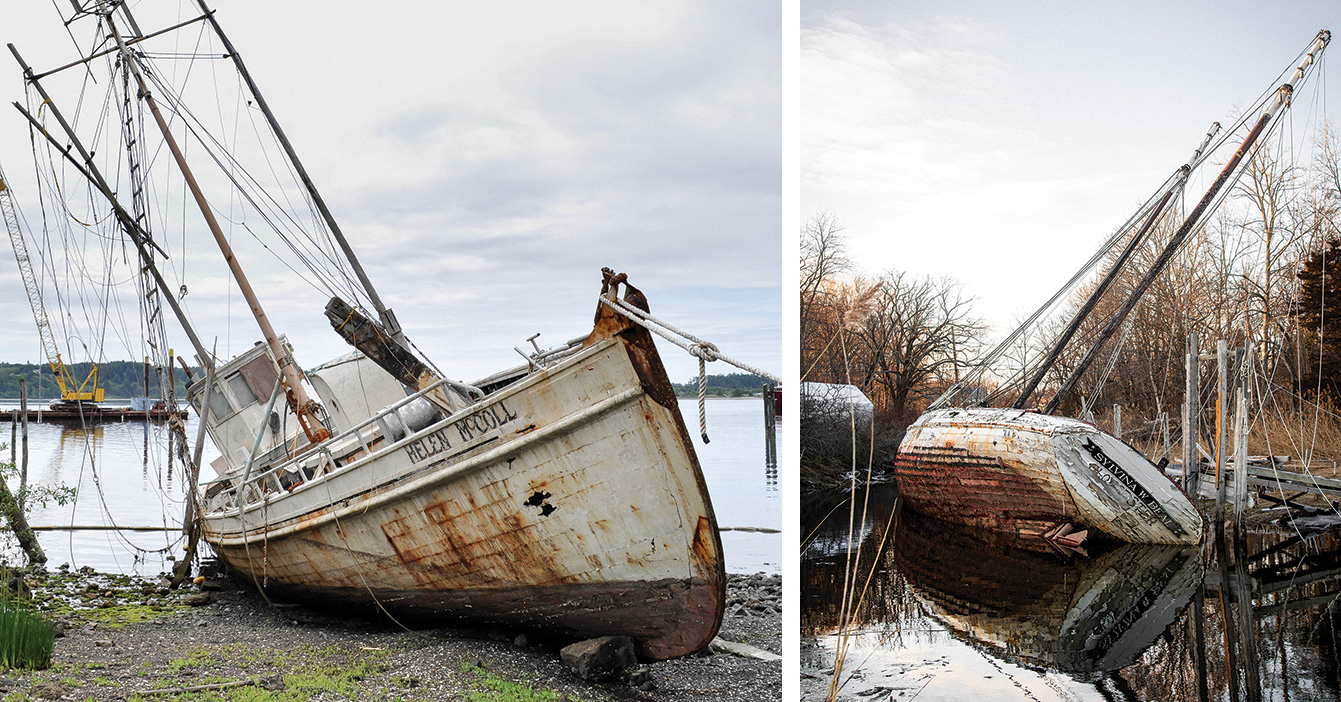
Above left—Boats beyond their profitable life often ended up abandoned. The HELEN McCOLL, built in 1911, ended up on the Oregon coast for salmon fishing, but sank and then was broken up in 2010, the same year the last sardine cannery in Maine closed. Right—The SYLVINA W. BEAL of 1911, a survivor of the sailing carriers, was converted to passenger carrying and may yet be reconstructed in Essex, Massachusetts.
I could picture these legends. The PIKE, 83′ LOA, which like DOUBLE EAGLE was banned from working in the remnants of the herring fishery by new regulations, had sunk at her mooring near Cundy’s Harbor in 2024. She was refloated, but despite appeals to restore her, the U.S. Coast Guard deemed her a hazard and broke her up. A nonprofit hopes to build a replica with gear salvaged from the wreck (see Currents, WB No. 303).
After a second career as a passenger-carrier on the Maine coast, PAULINE, 83′ LOA, has been hauled out at the Billings Diesel & Marine yard in Stonington, Maine, indefinitely (see Currents, WB No. 280). Reportedly, the carrier ANNE MARIE is on the hard at a farm in Norwich, Connecticut. After decades working as a windjammer schooner in Maine, the SYLVINA W. BEAL, 83′ LOA, was purchased by shipwright Harold Burnham in 2018 and sailed from Maine to Gloucester, Massachusetts. She is now aground in the tidal creek between the Essex Shipbuilding Museum and Burnham’s yard in Massachusetts. Burnham plans to rebuild her and put her back in the passenger trade.
“I have done a complete necropsy on her, and I have most of the wood and the bronze for the project,” he says. “She’s all lofted. I am just waiting for the right moment to start. I could have her sailing and carrying passengers by 2027.”
 Emilie Waters Harris
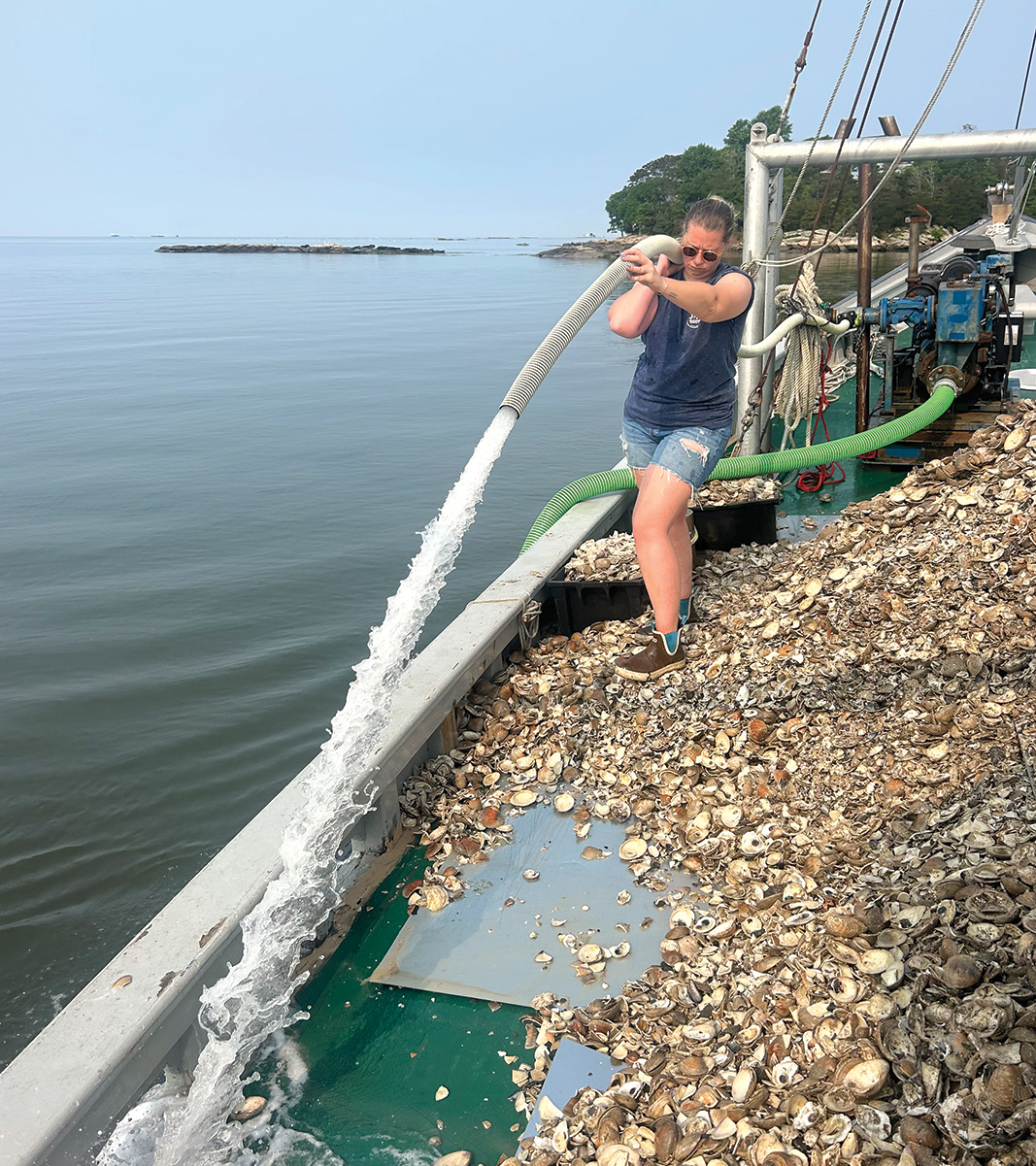
Among DOUBLE EAGLE’s tasks is to return shells to Long Island Sound as habitat for juvenile oysters.
As far as anyone can tell, DOUBLE EAGLE, the LEWIS R. FRENCH, GRAYLING, and the WM. UNDERWOOD are the last of Maine’s fleet of sardine carriers still afloat. A few others remain in Canada, especially at Blacks Harbour, New Brunswick. DOUBLE EAGLE, which served as a sardine carrier until 2023, was the last carrier to work in that trade.
Built by the French Brothers in South Bristol in 1871, the LEWIS R. FRENCH, 65′ LOD, fished and carried freight under sail and power until 1973, when Capt. John Foss rebuilt her as a passenger schooner for the Maine windjammer trade. It is a job she continues to do after more than 50 years.
GRAYLING, originally built as a seiner in 1915 by Frank Rice in Boothbay, was out of work and languishing in Lubec by the late 1980s before Steph Hart bought the 64′11″ LOA carrier and lived aboard her with his family for a few years. In the 1990s, Ted Okie acquired her and completely rebuilt her with Doug Hylan at Benjamin River Marine as the meticulous yacht that she remains today (see WB Nos. 141 and 142).
The WM. UNDERWOOD, 70′ LOA, is another showpiece. Built in 1941, she worked for decades hauling herring from seine nets to the William Underwood Company cannery in Jonesport until the industry collapsed. Taylor Allen of Rockport Marine rescued the carrier as an abandoned restoration project and spent many years slowly rebuilding her into an elegant yacht (see WB No. 272). In 2025, Richard Armstrong bought the UNDERWOOD and had her traditional ketch rig restored by Myles Thurlow and Gannon & Benjamin Marine Railway on Martha’s Vineyard,
Massachusetts. (LITTLE VIGILANT, a world-exploration vessel built in 1950 by Abeking & Rasmussen in Germany, is a sister to the UNDERWOOD built in steel to the same Eldredge-McInnis plans.)
A New Berth
It was nearly dawn when I spotted the lights on the Canal Generating Plant at the east entrance of the Cape Cod Canal. I was coming off watch soon, but I lingered at the helm and enjoyed the peacefulness of the moment. The final and inshore legs of DOUBLE EAGLE’s odyssey to Stony Creek lay ahead—the Cape Cod Canal, Buzzards Bay, Rhode Island Sound, Fishers Island Sound, and Long Island Sound. The sea state had mellowed. The boat was moving with purpose and grace. With the jib full and pulling, DOUBLE EAGLE promised a sweet ride westward. No doubt, we would make Stony Creek by late afternoon.
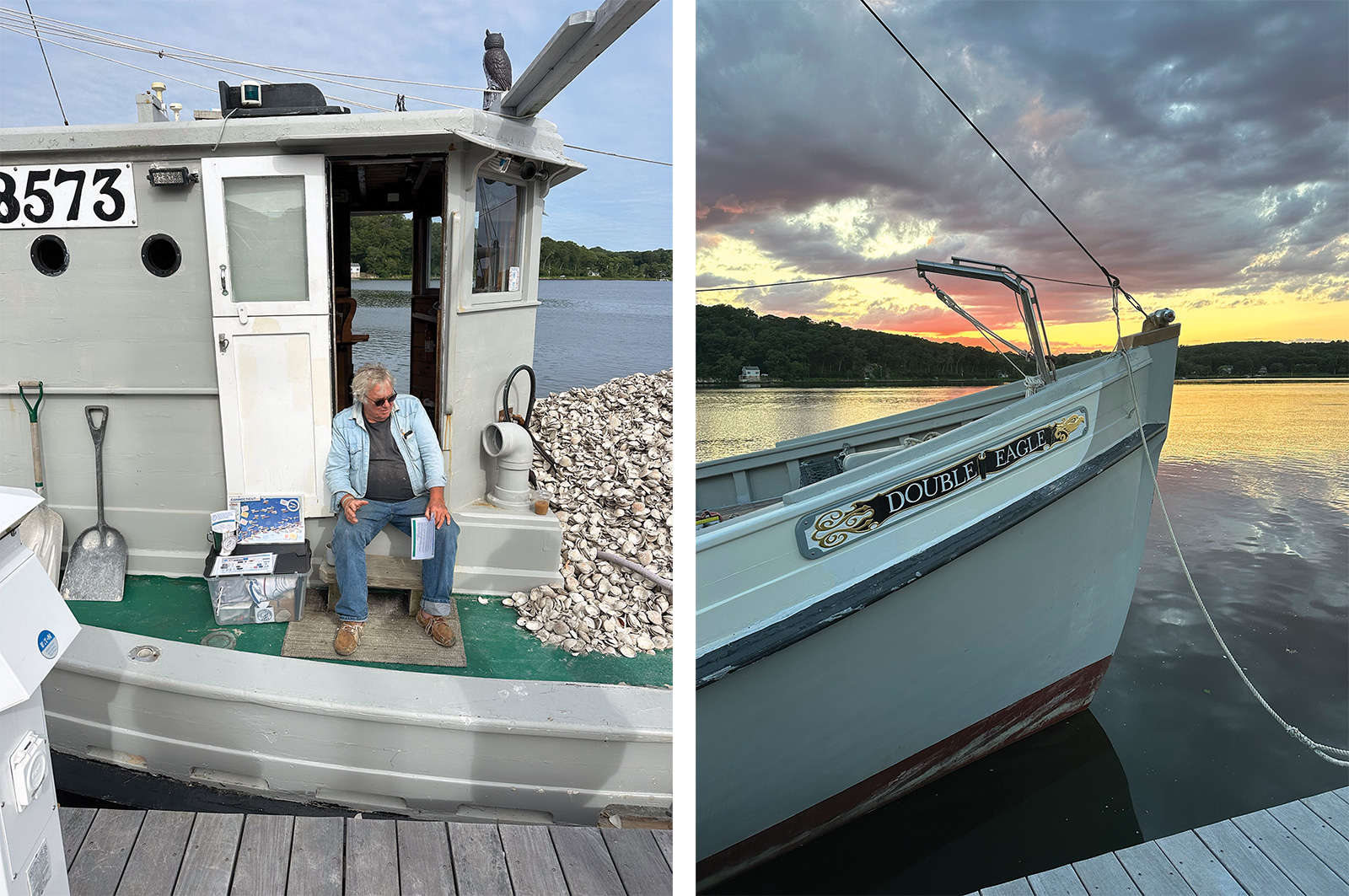 Emilie Waters Harris (both)
Above left—Jonathan Waters celebrated his new boat by bringing her—with a deckload of oyster shells—to the 2025 WoodenBoat Show at Mystic Seaport Museum. Right—Waters’s refit respected the sardine carrier’s details, even having her nameplates carefully restored.
I could hear Johnny snoring softly in the day berth. Sometimes he murmured words that I could not make out. He was dreaming, quite possibly of all the ways he intended to put DOUBLE EAGLE back to work. Maybe he was imagining using his new boat for his oystering operations, maybe some clamming. Maybe she would haul oyster shells and plant them on his leased commercial beds.
These boats stand as reminders that once upon a time a huge industry, a way of life, and countless communities in coastal Maine had been built around these boats. Knowing Johnny, his bona fides as an industrious waterman, and his love of no-frills vessels that earn their keep, it was no surprise that in 2025 he brought DOUBLE EAGLE to the WoodenBoat Show at Mystic Seaport Museum in Connecticut, her deck mounded with oysters. His oysterboat, MERLIN, has also been a regular exhibitor in recent years, along with GRAYLING and the WM. UNDERWOOD. I wouldn’t be surprised to see Johnny there again, and probably there will be mud streaks on her topsides…and on Johnny’s cheeks. 
Randall Peffer is a regular contributor to WoodenBoat. His most recent book, with Capt. Eric Takakjian and published in fall 2025, is Yarmouth Castle Burning, the narrative and analysis of a 1965 Miami–Nassau cruise-ship inferno. The captain was the first person off, and 90 people died.
Further Reading
- Masts and Masters: A Brief History of Sardine Carriers and Boatmen, 1995, privately published by the author, John D. Gilman. Lord’s Cove, Deer Island, New Brunswick, Canada. Gilman also wrote Canned: A History of the Sardine Industry.
- “Sardine Carriers,” Parts 1 and 2, by Michael Crowley, a writer and editor long associated with National Fisherman, in WoodenBoat Nos. 58 and 59, May/June and July/August, 1984.
- The Maine Sardine Fishery, by Frederick Clarence Weber (Classic Reprints, Forgotten Books, 2018, www.forgottenbooks.com). Originally the U.S. Department of Agriculture’s Bulletin 908 of 1921; also available online at www.biodiversitylibrary.org/item/191259#page/3/mode/1up.
- Maine Sardine Industry History: An Anthology, Maine Sardine Council, 1986. Author James L. Warren, compiled by R. Edward Earll.