
 Harvey Golden
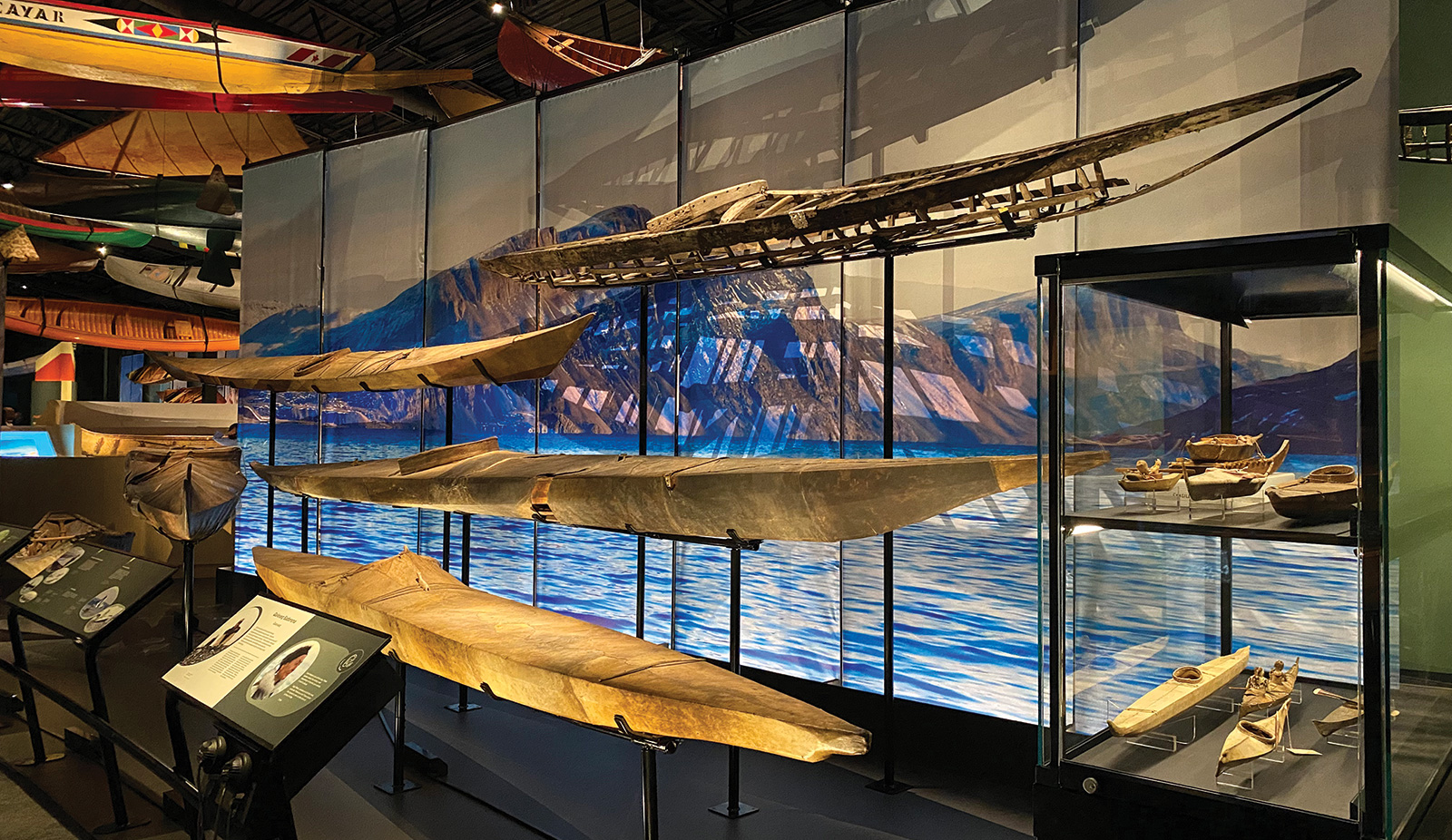
More than 200 boats are on exhibit at the Canadian Canoe Museum’s new building in Peterborough, Ontario, including a wide variety of kayaks.
When people see that you have an old canoe, there is some unwritten rule in the universe that dictates that someone will soon offer you another. For Kirk Wipper, this first old canoe was a commercially built dugout, carved from basswood in the late 1800s by Payne Bros. of Warsaw, Ontario. A friend of Wipper’s gave it to him in 1959, and he displayed it at Camp Kandalore, a boys’ wilderness and canoe camp that he operated from 1957 to 1978. While he could not have known it at the time, this was the beginning of what is now the world’s largest collection of paddled watercraft: the Canadian Canoe Museum.
By the mid-1970s, Wipper’s collection had surpassed 350 canoes and was quickly outgrowing the facilities at the wilderness camp. The museum aspect of Camp Kandalore came into its own in 1975, with the founding of The Kanawa International Museum of Canoes, Kayaks, and Rowing Craft, and three years later Wipper sold his interest in the wilderness camp.
 Justen Soule/Canadian Canoe Museum
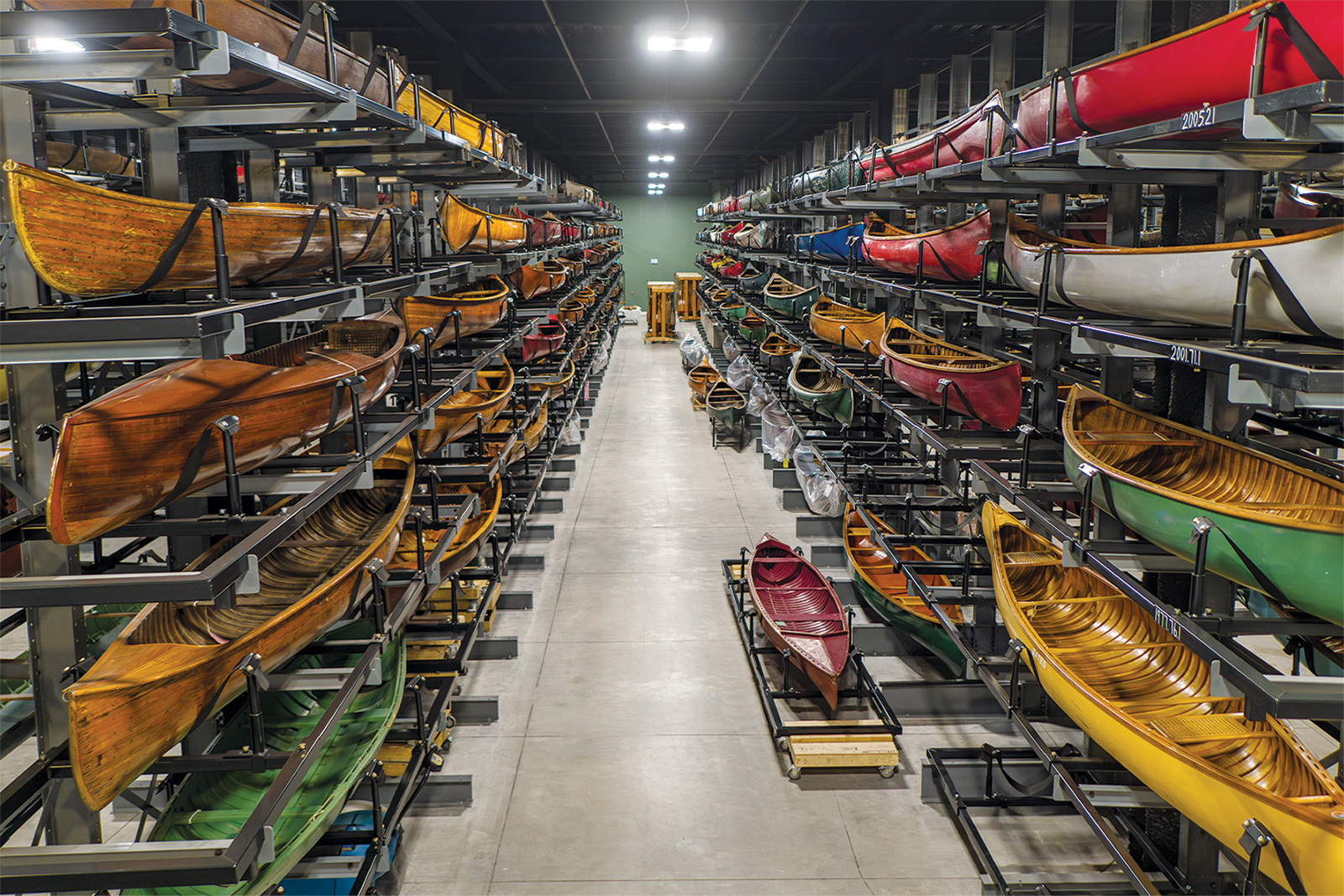
A 20,000-sq-ft Collection Hall, accessible via public tours, houses the hundreds of boats that are not on permanent exhibit.
Until now, the most significant and recurring impediments to this collection of more than 600 boats had been its locations and facilities. It had been improved over the decades, first with space being added at the wilderness camp, then with a big move to Peterborough, Ontario, where an old outboard-motor factory was sold to the organization in 1997 for $1. This brought the collection to an urban center long associated with canoe manufacturing, whereas the camp location had been in remote wilderness some 60 miles to the north. The old factory, as ideal as it must have seemed at the time, wasn’t quite the perfect home.
After 10 years of planning, fundraising, and challenging setbacks, the Canadian Canoe Museum (CCM) broke ground in 2021 on a site located on Little Lake, part of the Trent–Severn Waterway just a mile and a half from the building that served as the museum’s home for 26 years. Inflation being what is, the new facility cost more than the $1 of the previous one—by a factor of 43 million. By the time the new facility opened in May 2024, it had been fully funded, with grants coming from private, civic, provincial, and federal organizations: They recognized the importance of a world-class facility built to the highest standards for modern museums.
 Canadian Canoe Museum
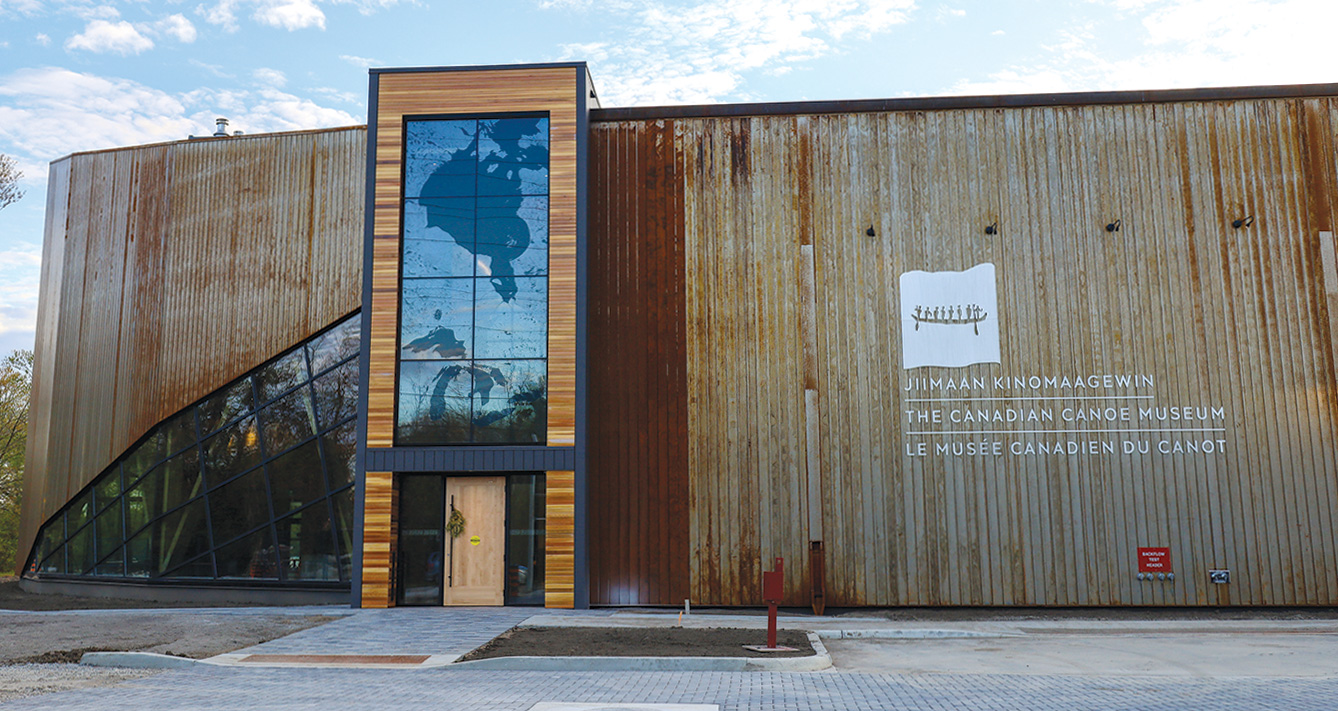
The modern museum building is in a lakefront setting, with docks, boardwalks, and a 2,500-sq-ft canoe house, with opportunities to get on the water.
This new location is in perfect harmony with what one might expect for watercraft so closely tied to the outdoor experience. The new building is not only beautifully situated on wooded shoreline bordered by parks and walking paths but also it has accessible docks for canoeists and an adjacent canoe-storage house. The museum will offer both canoe rentals and guided outings in large voyageur canoes.
The CCM’s new building is 65,000 sq ft, 20,000 of which are dedicated exhibit space, with over 200 canoes and kayaks on display. As with most museums, a large portion of the holdings are in storage, but the museum has ensured that the storage is visible, and accessible, with special tours offered for deep dives into the collections. This storage section is shockingly massive, with a 24′-high ceiling and five parallel passages walled on both sides with watercraft from around the world. The museum’s lobby is well lit, airy, and uses natural wood construction and large windows to advantage. The balcony of the second floor opens to the lobby and has a large mechanical hoist: the CCM’s heaviest canoe weighs about 1,600 lbs and is exhibited in a second-floor space.
In contrast to the lobby, the exhibit space comprises one massive, dark room with themed areas. The layout is vibrant, with superb well-lit displays and vivid backgrounds. The entrance hub of the exhibit hall displays a giant floor map of North America; the map has no names, borders, or highways, but shows what must be every navigable lake, river, and creek. Above it is a soaring static “whirlpool” of dozens of canoes and kayaks, all suspended and heeled over above the map. One can easily find a path through the exhibits or simply bounce around to whatever catches the eye. Just two short paths in the exhibit end abruptly, requiring the visitor to face them, then turn around to leave. Both are solemn and emotional displays: One serves as a memorial for campers who died in a storm on a lake (the canoe they perished in is exhibited), and the other honors the life of Minik Wallace, a Greenlander who visited the United States in 1897 and whose story is told in the book Give Me My Father’s Body; Minik’s kayak is exhibited.
It is very easy for museums centered on objects to fall into the trap of overlooking the social and cultural aspects behind the focus, but these two critical elements are deeply entwined with the CCM and its exhibits. For a museum with objects from all over the world, this may seem a daunting task—and it is! But the CCM recognizes that every vessel in their collection has a story to tell: Every Tomoko, Umiahalurak, Vaka, Wiiswaawoot, Gahonwa’, N’drua, Balsa, Wâbanäki Tcîmân, and Yaksumit; Every Chestnut, Struer, Grumman, Rushton, Nor-West, Prospector, and Dagger. The stories include those of survival, subsistence, triumph, injustice, innovation, trade, commercialization, healing, tradition, life, death, and renewal. The canoe as a metaphor for life is ever present.
 Harvey Golden
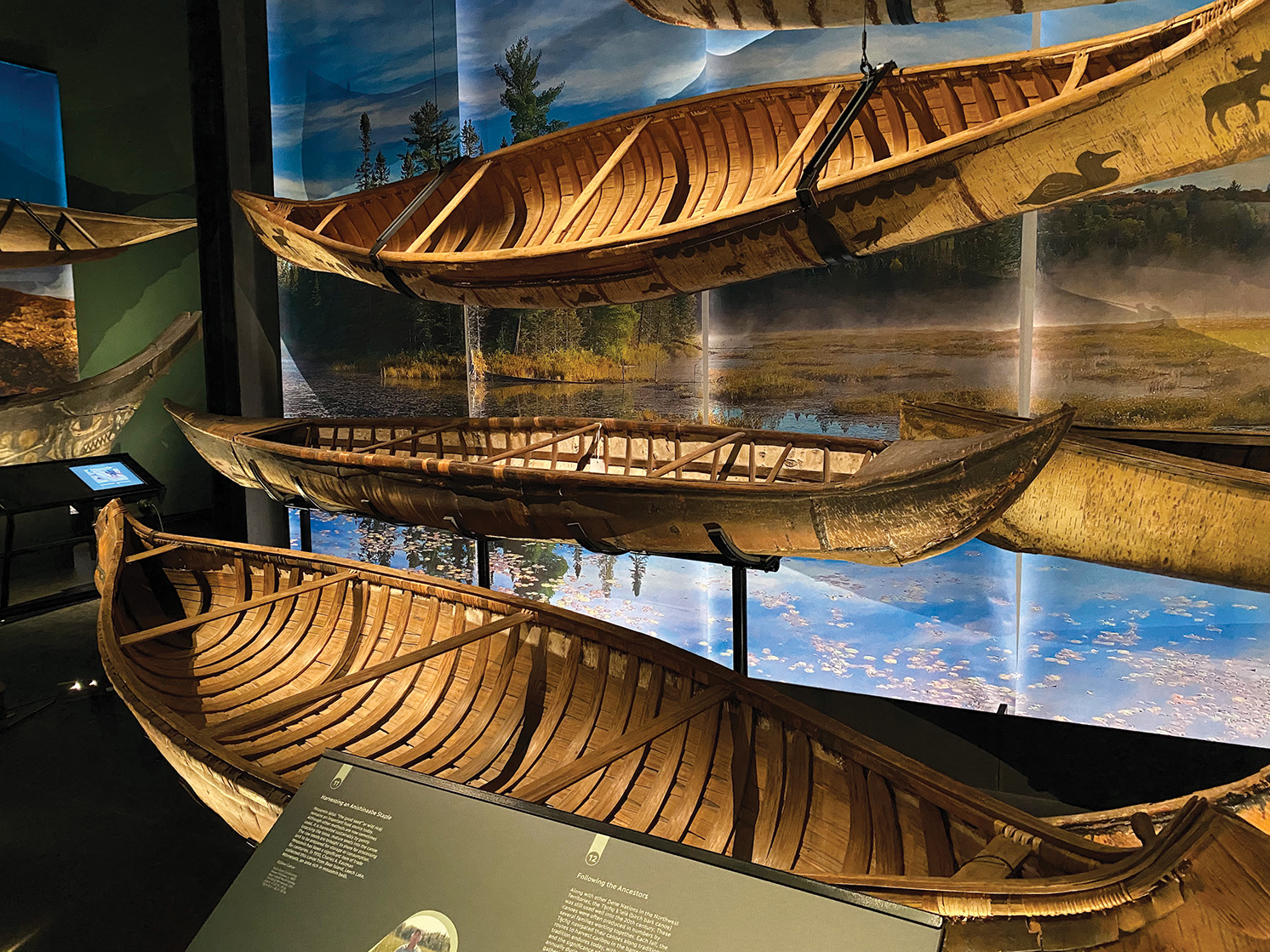
Part of the exhibited collections are many historic birchbark canoes and (just visible at left) dugouts.
While every canoe and kayak in the museum has a story, each boat is also a record of skills, technology, and resources coming together to form a required object. This is true for both the indigenous watercraft collections as well as the commercially manufactured boats, and the variety of canoe- and kayak-building tools and methods are highlighted throughout the exhibits. As many wooden canoe factories have closed in the past 100 years, many of their building molds have been preserved in the CCM’s collections.
The museum is quintessentially Canadian. Nearly every country has ancient watercraft traditions that persisted into modern times, but it is hard to think of another country so large and diverse where paddled watercraft are held so closely to national identity. Reflected in the map of waterways in the exhibit space is how critical travel by water was in Canada before roads, rail, and aircraft. These same canoe routes also facilitated the colonialization and settling of much of Canada.
One easily senses the close connection the museum has with indigenous canoe and kayak builders. The museum doesn’t just house old canoes and kayaks, it actively seeks to collaborate with the people and communities behind these craft. The museum has a 100-year-old Inuit kayak from Baffin Island, but it has also just commissioned and received another, built by Inuit from this region. In another example, a canoe built by Algonquin elders William and Mary Commanda in the 1970s is on display right next to one built by their grandson, Chuck.
While canoes and kayaks rank right up there with coffee and tea with regards to appropriated cultural elements, their roots and diversity of form and construction are celebrated for their brilliance, and the living aspect of watercraft is highlighted everywhere, showing that the skills and knowledge behind them persist and evolve in a changing world.
Other aspects of the new facility include a conference hall, a research library and archives, and a large workspace for classes such as canoe- and kayak-building, paddle-making, and canoe restoration. CCM also sponsors canoe skills camps. Other amenities include a gift shop with a bookstore and a café with indoor and outdoor seating and even a fireplace.
Kirk Wipper died in 2011. I’m not sure he had any inkling of what the museum might become in the next decade or so, but through his remarkable abilities and sense of urgency and foresight, he laid the foundations for what it is today: A world-class museum celebrating art, culture, design, technology, and life on the water. 
Harvey Golden is a boatbuilder who for many years has specialized in historic kayak replicas. His research, which has been extensive, has resulted in two books: Kayaks of Greenland and Kayaks of Alaska. He lives in Portland, Oregon, where until 2023 he ran the Lincoln Street Kayak and Canoe Museum. For more information, see www.traditionalkayaks.com.