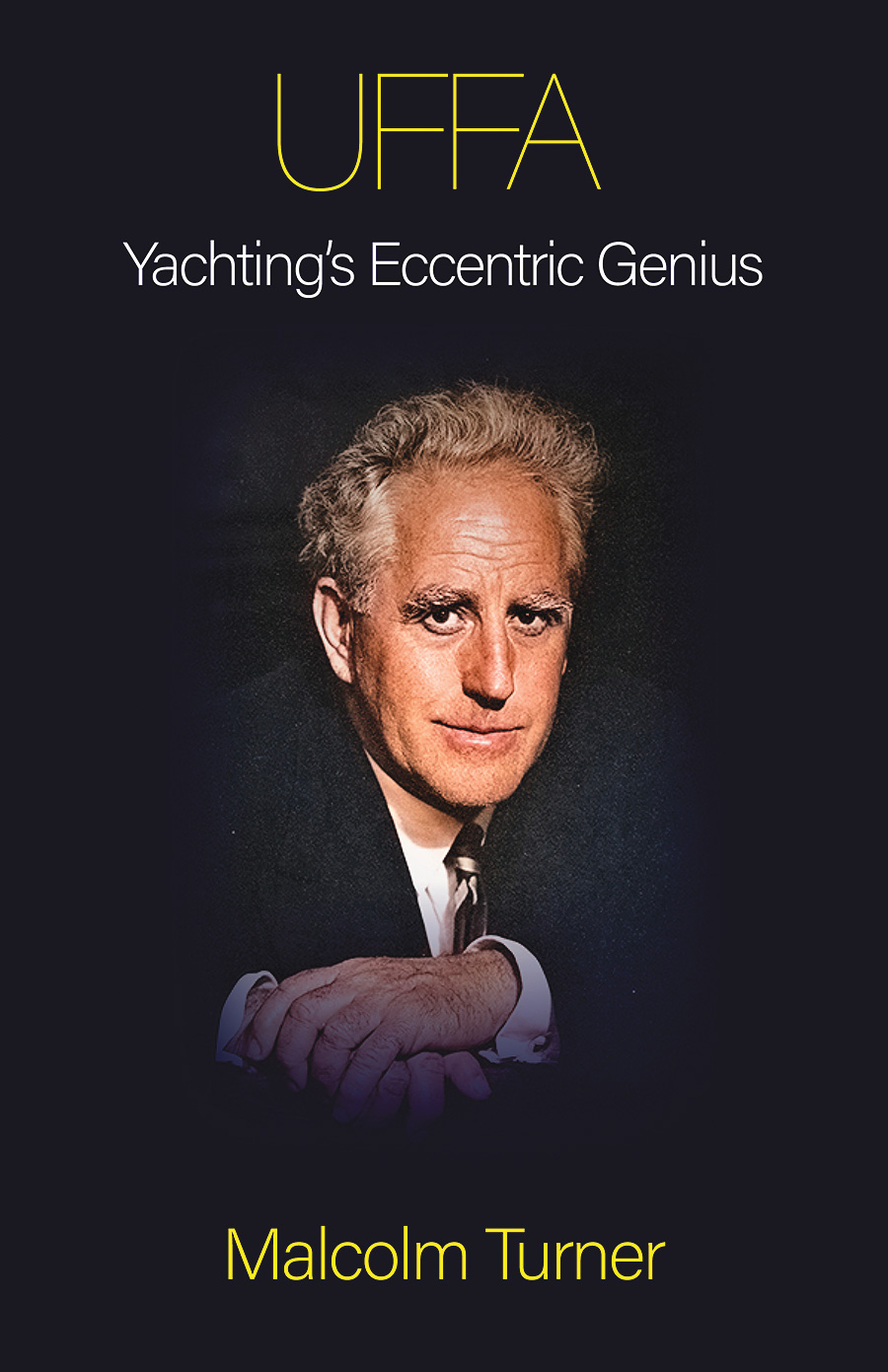
Uffa Fox: Yachting’s Eccentric Genius, by Malcolm Turner, SunRise Publishing, 124 City Rd., London EC1 2NX, U.K. 288 pp., illus., £15.99 in the U.K.; $24.99 in the U.S.
Available from The WoodenBoat Store (www.woodenboatstore.com)
Can you separate the art from the artist? This is a question that is fiercely debated when it comes to artists, musicians, writers, and even actors. Could it apply to yacht designers too? It’s an issue that was at the fore of my mind as I read the latest biography of the famous British yacht designer Uffa Fox by Malcolm Turner.
Back in 2011, I wrote a four-part series of articles about Fox for this very magazine (see WB Nos. 221–224). I had originally chosen the subject because I was in thrall to the great man: a working-class legend who transformed dinghy sailing through his visionary designs and fine craftsmanship. A fearless renegade who took on the establishment and poked fun at social norms. My kind of man.
But the more I read about him—and particularly his attitudes towards women—the more uncomfortable I felt. By the end of my research, I concluded he was an arrogant, self-obsessed misogynist who abused his wives and took his workers and creditors on a merry dance. Quite frankly, I was glad to be done with him.
For Fox’s admirers—of which there are plenty—that disregard for other people’s opinions is what made him great, even if it meant upsetting a few people along the way. It’s a discussion that goes to the heart of the art-versus-artist debate, and Fox wouldn’t have lasted five minutes in the age of #MeToo. Can you judge historic figures by modern moral standards?

Uffa Fox sails an International Canoe in the United States.
Not that you get much moral agonizing in this book. Turner is clearly a fan, and there are repeated references to Fox as “the most celebrated and successful yacht designer in the world” and “the best designer of his generation and, arguably, any generation.” It’s not clear what measure the author is using, but it seems obvious to me that Fox can’t be regarded as more successful than designers such as Nathanael Herreshoff, Olin Stephens, William Fife, Charles Nicholson, and G.L. Watson, to name just a few.
In a similar vein, Turner makes the bold claim that Fox’s Flying Fifteen is “the largest fixed-keel class in the world,” with more than 4,000 boats built. A quick search on Google shows that there are more than 4,000 Folkboats in the world, while the J24 is even more numerous, with 5,500 boats built. But this is exactly the kind of exaggeration in which Fox reveled; he was never shy to blow his own trumpet.
These quibbles aside, this is a workmanlike biography. Fox makes a compelling subject, and his life is packed with good stories. One of my favorites is when, at age 21, he takes nine young Sea Scouts on a week’s cruise out of Cowes in a 30′ open whaler. Although the parents have been told they are heading to nearby Poole, Fox has a secret plan: to sail across the English Channel to France and up the Seine to Paris. They have a wild ride across the channel, visit Le Havre and Rouen, sleeping rough and scavenging food on the way, but have to turn around just 30 miles short of Paris. They arrive back in Cowes after nearly two weeks away and Fox is astonished at the fuss caused by anxious parents and the Sea Scout committee, which resigns en masse. It’s an exemplary story, for, as Turner puts it:
“Throughout his life, Uffa inspired others to help him do remarkable things that were challenging, but not always wise. He never suffered from a moment’s self-doubt and had astonishing powers of persuasion: once an idea took hold, nothing could extinguish it.”
Along the way, he annoys the hell out of countless people: employers, the army, his bank, suppliers, customers, employees, council officials, and anyone at the receiving end of his endless practical jokes. Even his most loyal staff draw the line at having work meetings in an open-plan toilet while doing their business. He clearly thinks he is above the law and, once he has a car, ignores speed limits and traffic signs. At one point he is recorded as breaking the speed limit while riding a horse, but talks his way out of it. When he takes a dislike to cyclists using the public footpath across his land, he shoots the front wheel off a passing bike and the cyclists duly take the hint. He even fires an “elephant gun” at the Royal Navy and gets away with it.
It goes without saying that he is a serial adulterer and unfaithful to all three of his long-suffering wives—who are expected to put up with it, even while bailing him out financially. When the photographer Eileen Ramsay went to take his picture at his Commodore’s House overlooking Cowes Harbor—by which time Uffa was 61—she complained that he tried to push her into every bedroom in the house.
His attitude toward women is perhaps best expressed in a letter he wrote as a young man to a prospective employer, in which he makes all kinds of grand claims for himself, before concluding that “a faint heart never won a fat woman” and embarking on a pointless rant about how fat women are “better” than thin ones. You might excuse him by saying that was acceptable behavior those days, but the evidence suggests otherwise. The yard kept the letter but didn’t give him a job.
Yet Fox also inspired a devoted following. The list of his supporters includes notable figures such as Max Aitken, Weston Martyr, Bobby Somerset, Ted Heath, Prince (now King) Charles, and Prince Philip.

Uffa and associates inspect the first of the Firefly dinghies.
For this is the man who revolutionized dinghy racing by perfecting the concept of a planing dinghy; the man who designed popular dinghies such as the Firefly, the Flying Fifteen, the Albacore, the National 18, the Jolly Boat, and (in the U.S.) the O’Day Daysailer; the man responsible for developing such innovations as the kicking strap (aka boom vang), trapeze, tiller extension, and diamond shrouds. The man who created the spectacular airborne lifeboats, which saved hundreds of lives. The man who (with the help of his first wife, Alma, a schoolteacher) wrote a lyrical set of books of yacht designs, which have become collector’s items.

During World War II, Uffa designed an airborne lifeboat that could be dropped from airplanes to rescue downed aviators.
Turner doesn’t go into great detail about boatbuilding techniques or even the many smaller classes Fox designed during his career, preferring to focus on his royal connections and his (undoubtedly hilarious) escapades. He is best at his first-hand interviews with people who worked with Fox, drawing surprisingly warm tributes from several of his secretaries, including his last one, Cindy Betley, who said: “Working for Uffa was fun. You never got paid, but it was still fun. I was a secretary-cum-dogsbody. It was long hours, but I didn’t mind.”

Uffa at the drafting board.
And this from the harbormaster’s son, Rodney Barton: “You could relax with Uffa. I learnt so much from him, he was my university of life. One minute you were talking to Prince Philip, and the next the man who swept the yard. It stood me in good stead the rest of my life.”
Much hated, much loved, Uffa always makes good copy. And while I might take exception to him being described as “the most successful yacht designer in the world,” I do agree with the book’s subtitle. Uffa certainly was eccentric and he was, by most measures, a genius. ![]()
Nic Compton is a regular contributor to WoodenBoat. His article on the sloop MALUKA appears in this issue 296.
