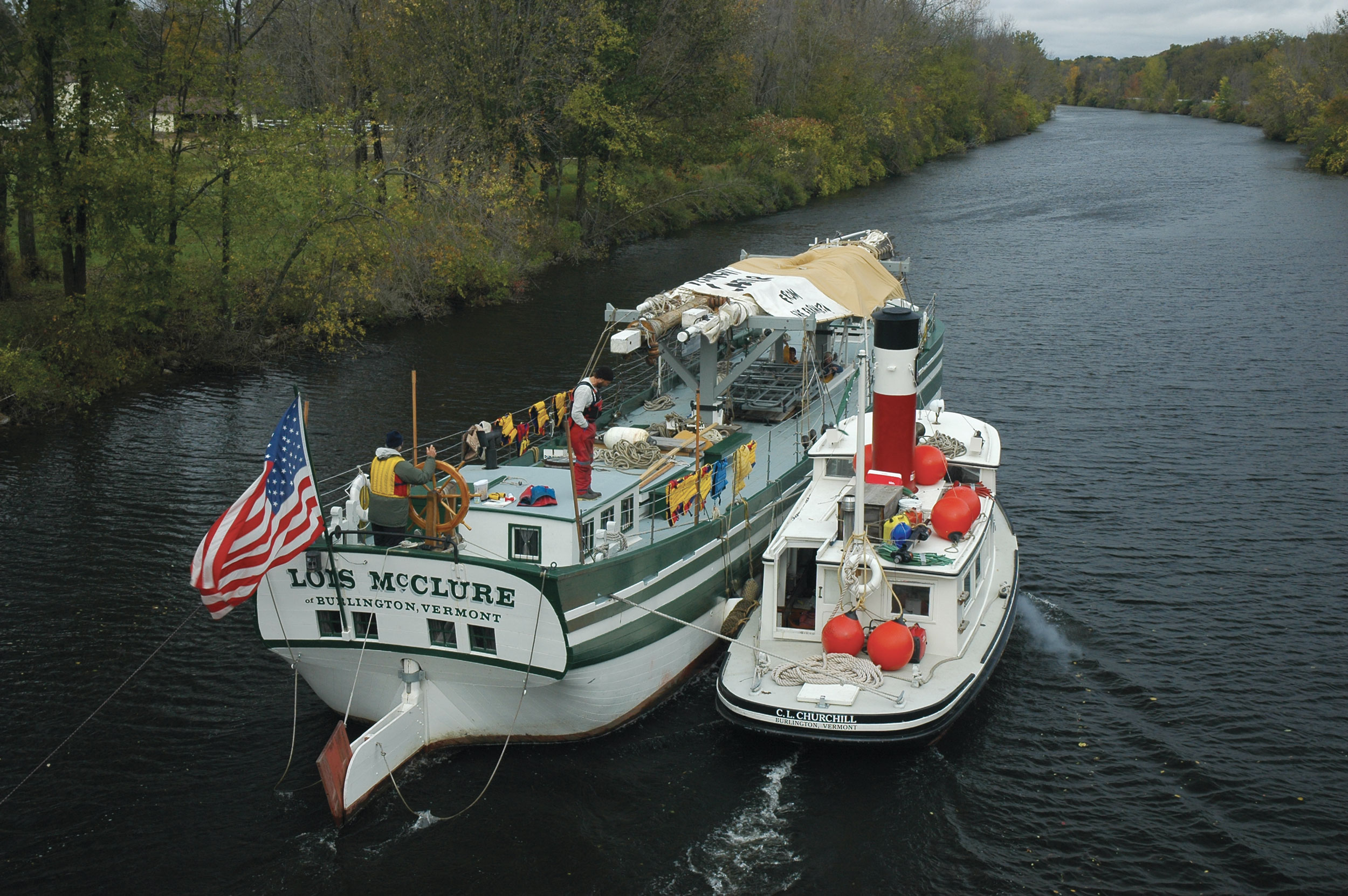
Photographs courtesy of Lake Champlain Maritime MuseumFor 20 years, beginning in June 2004, the tugboat C.L. CHURCHILL served as the towboat for the schooner LOIS McCLURE, which operated from the Lake Champlain Maritime Museum (LCMM) in Vermont.
It was a great day in June 2004 when the Shelburne Shipyard offered to lend their ex-yard tug, the C.L. CHURCHILL, to the Lake Champlain Maritime Museum (LCMM) as towboat for its 88′ replica Lake Champlain canal schooner LOIS McCLURE. At 34′, the workboat looked perfect for the job, with her wooden, hard-chined hull, traditional tugboat wheelhouse, tall stack, and high bow with low stern.
LCMM director Art Cohn and I took her out for a trial run in Shelburne Bay. We opened up her Ford Lehmann diesel to about 1,500 rpm so that it was delivering a good percentage of its 120 hp, and the tug churned through the water at about 8 knots. I noted with satisfaction that there was no hint of a rooster tail. Evidently, her big propeller was well submerged, down in deep-enough water so that it would be able to do real work. With a look at the shaft, we saw that her propeller was left-handed—that is, when viewed from astern, it turned counter-clockwise. This is a bit unusual; normally, when you back down a single-screw boat with a more-common right-handed propeller, the stern walks to port. We would need to remember that the CHURCHILL’s stern would tend to go the other way.
Jack Gilbert, the CHURCHILL’s designer, had certainly given her a high bow and a very low stern. I wondered if all that freeboard at the bow was really necessary, and if she had enough freeboard at the stern. Time told that both dimensions were perfect.
And time would tell other things: that the CHURCHILL would steer steadily when towing, but, like most tugs, would require more attention to the helm when running free; that she would be an efficient towboat, economical on fuel; and that in a rare beam sea of just the wrong size, probably made by a wake rather than the wind, she could roll her steering stool right over.
Photographs courtesy of Lake Champlain Maritime MuseumThe McCLURE was most maneuverable when being towed on the hip—that is, with the tug secured alongside the schooner at the stern. With the tug’s stern about 6′ abaft the McCLURE’s stern, the tug’s propeller and rudder had ample leverage for turning the schooner.
The CHURCHILL is arranged with her steering wheel on the starboard side of the pilothouse. There is a midship companionway leading down forward into the forecastle, which has a head. The pilothouse has a high bunk athwartship. To port, a short ladder leads aft, down into the cabin, with its upper and lower bunks to starboard and a small table with two chairs to port. Farther aft is a galley and a companionway to the stern deck. A doorway leads forward into the engine room under the pilothouse.
We knew we’d have to do some fancy maneuvering with the canal schooner when visiting all manner of harbors, so we acquired a second towboat, a 17′ inflatable with a 50-hp Honda outboard motor. Because of the duties we envisioned for this craft, we named her OOCHER. The two of us at the wheels of the McCLURE and CHURCHILL were connected by handheld radios, and so was OOCHER’s operator when she was brought into play.
When towing the McCLURE in relatively open water, such as on Lake Champlain, the wider reaches of the St. Lawrence River, or across the corner of Lake Ontario, we put the schooner on the hawser astern, with OOCHER trailing her. For the hawser, we used 200′ of extra-big polypropylene line, which is heavy enough so that its catenary is mostly in the water but still floats. On the CHURCHILL, the towline was bent into a large galvanized thimble on a bridle, and the ends of the bridle were secured to wooden quarter bitts, and backed up to big steel cleats that we put in halfway up the side decks. On the schooner, we secured the bitter end of the towline on one of the bitts at the bow with a hitch that could be let go under strain if necessary (it never was). Towing on the hawser is good for rough water but it limits maneuverability.
Photographs courtesy of Lake Champlain Maritime MuseumAuthor Roger Taylor is shown here at the helm of the LOIS McCLURE alongside LCMM director Art Cohn.
Shortening the towline to, say, 75′ helped with control, but for best maneuverability, the CHURCHILL towed the McCLURE on the hip—that is, with the tug secured alongside the schooner at the stern. Then we’d bring OOCHER to the tug’s nice, low stern, from which it was easy for the OOCHER crew to transfer to their boat if she was needed for reconnaissance or maneuvering.
At first for hip-towing, we tied up the tug toed in, with her bow turned a bit toward the schooner, but experience showed that we could achieve better balance for steering with the vessels parallel—and that it was best to secure the tug far enough aft so that her stern was some 6′ abaft the stern of the McCLURE. That position gives the tug’s propeller and rudder leverage for turning the schooner.
Instead of using the conventional three-line towboat tie-up, with headrope led well forward, towline led aft from the bow of the tug, and a stern line, we chose to tie her up with four lines: bow and stern lines led abreast, and both forward and after spring lines. The aft-leading spring would be the towline, and the forward-leading spring would take the strain when backing down. This configuration worked well.
When towing on the hawser, we conned the vessels from the tug, but when towing on the hip, we conned from the McCLURE’s wheel, because with the canal schooner’s freeboard of about 6′ (she was lightly loaded with 11 tons of stone) visibility from the tug’s wheel in the direction of the schooner was nil.
Photographs courtesy of Lake Champlain Maritime MuseumAt times, the CHURCHILL towed on the hawser because the waterway the vessels were negotiating was too narrow to have the tug alongside the schooner.
Because the names CHURCHILL and OOCHER are both dominated by “ch” sounds that could be confused on the radio, we used the helmsman’s name for orders to the tug and the name OOCHER for addressing that vessel. We also used different orders for each towboat. Rudder orders to the CHURCHILL would be “’midships,” “left” or “right,” “full” or “half”; propeller direction was “neutral,” “ahead,” or “astern”; and speed was “idling,” “a thousand rpm,” or “fourteen-hundred rpm.” OOCHER always made up where she was needed with a head rope, heard “hold off,” “push,” or “pull,” and percentages for amount of power, such as “25 percent,” or, rarely, “100 percent.”
Most course changes were made with just the McCLURE’s rudder, but for a sharp turn, we had to use the CHURCHILL’s rudder as well. (To help her turn, we generally ran with the centerboard lowered 2′.) We found that the handiness of straight steering with just the schooner’s rudder, the tug’s rudder being left amidships, was much influenced by how precisely we tied the tug on the hip. As careful as we were to secure the tug’s lines just right, we often found that to ease the schooner’s wheel, we had to order a half spoke, or, sometimes, even a full spoke, of left or right rudder on the tug, rather than simply “’midships.” Maybe we had gremlins?
A strong head wind was a limiting factor in towing the canal schooner on the hip. Her big, bluff bow, with 6′ of freeboard and less than 2′ of draft, is vulnerable to being blown off. In a strong breeze of about 25 knots, the CHURCHILL may or may not have been able to counteract a gust that started to blow the McCLURE off course. Normally, in that much wind, we’d either be in harbor, running with it, or towing on the hawser, but I remember one occasion when we were towing on the hip, trying to get into Gaines marina at Rouses Point near the north end of Lake Champlain in such conditions, and we had to abort and sneak back outside before we started taking out fiberglass yachts. Luckily, Joe Treadwell, the marina’s boss, saw our plight and quickly came to the rescue with his high-powered, former Swans Island, Maine, lobsterboat, PRINCE OF PEACE.
Sometimes we had to tow on the hawser because the waterway we were negotiating was too narrow to allow bringing the tug alongside the schooner. An example is Canada’s Chambly Canal on the Richelieu River, whose original locks have never been enlarged, as they have been on the Champlain and Erie Canals. When we had to enter a small canal lock towing on a short hawser, we would use OOCHER as an escort tug, made up to the stern, to stop us as we eased up to the lock. We’d get long bow lines over to hold the schooner in position while the tug locked through. When it was the schooner’s turn, we’d pull her in by hand and tuck our little escort tug in under the schooner’s stern.
Photographs courtesy of Lake Champlain Maritime MuseumThe CHURCHILL’s high bow and low stern proved to be perfect. During landings, or when the C.L. CHURCHILL would come alongside, two of the schooner’s crew members were designated as “roving fenders,” one at the bow and the other at the stern; their job was to slip a fender between the schooner and whatever she might hit.
We saw little difference in our towing speed of 5 knots whether towing on the hawser or on the hip. But sometimes we needed more than 5 knots. To get into the quiet water of Montreal harbor, for instance, means bucking a St. Lawrence River current that normally approaches just about 5 knots as you make your approach. So when we called at Montreal, we got an extra towboat with a lot more horsepower than has the CHURCHILL. We kept the CHURCHILL in position on the hip, churning along, while the extra tug, on her hawser ahead, did most of the pulling. We limited the towing speed to about 8 knots, because much more would exceed the CHURCHILL’s hull speed, and she’d start to sink into her own wave. We added a long headrope to her tie-up just in case.
The most challenging maneuver we faced was making a landing either at a dock or in a lock. Almost always we landed with the tug on the hip, though sometimes conditions dictated that we land with the tug on a short hawser. Then it was just a question of bringing the schooner in alongside very slowly, again with OOCHER as escort tug. It’s like watching paint dry or grass grow; take your choice.
Landing with the tug on the hip, we tried to plan ahead so that the tug would be on the off-side of the schooner at the dock. We also stationed OOCHER on the off-side at the bow. We would make our approach to the dock at as flat an angle as the situation allowed, coasting in with the tug in neutral. We gave her “slow astern” in time to stop her where we wanted her, remembering to shove the bow in with OOCHER as necessary. If the wind was blowing us off, we could work against a spring line to bring her in or simply push wherever it was most advantageous with OOCHER.
If we had to make a landing with the CHURCHILL next to the dock, we’d simply ease in alongside with enough angle so that when the bow of the McCLURE was in, there would be room enough for the tug between the schooner’s stern and the dock. We held the schooner’s stern in place with OOCHER, backed the tug out, and then shoved the stern in with OOCHER.
Being a canal boat, the LOIS McCLURE always had plenty of fenders hanging along her sides. For making landings, we also had two crew members designated as “roving fenders,” one at the bow and the other at the stern. It was their job to slip their fender neatly between the schooner and whatever it was that she was about to hit. They were so successful at this that they almost eliminated the job of touching up paint.
Landings are simple when there is a wide, clear approach to the dock, plenty of unobstructed space for tying up, and no wind or current. If the dock’s situation demanded a perpendicular approach, or our assigned berth was only a bit longer than the schooner herself, or a gusty wind was blowing off the dock, or the river current was running through the berth, or any combination or all of the above were at play, that is when things would get interesting. But, with the CHURCHILL at her stern and OOCHER at her bow, the LOIS McCLURE is maneuverable.
Getting underway is always easier than landing. That said, there were times when, after slithering into a tight obstructed berth, I looked around and thought: how are we ever going to get out of here? We generally used OOCHER to pull the McCLURE away from the dock, often making the inflatable fast just forward of amidships and easing the schooner out sideways just until we had enough room to go ahead or astern with the CHURCHILL.
When I think of all the miles of towing the LOIS McCLURE we did with the CHURCHILL, two favorite images come to mind. One is being off-watch in the CHURCHILL towing the schooner on the long hawser, and sitting at the table in her cabin, looking out the aft companionway, watching the towline sliding through the water and leading up to the schooner’s high bow with its tumbling bow wave. The other is looking at the CHURCHILL from the schooner’s wheel when she is towing on the hip. The curve of her pilot house is just right, as is the height and rake of her tall funnel. There is the wondrous sound of her diesel, particularly at idling speed, a slow, steady pulse that speaks of strength withheld, strength ready to respond to whatever lies ahead. ![]()
Roger C. Taylor, a longtime contributor to and friend of WoodenBoat, was captain of the canal schooner LOIS McCLURE. He was also author of several books, including a two-volume biography of L. Francis Herreshoff (Mystic Seaport Museum, 2015/2019). Roger was drafting an article about the McCLURE, for WoodenBoat, when he died in 2022; his wife, Kathleen Carney, recently discovered the unpublished manuscript among his papers—coincidentally while we were preparing an article on the phased restoration of the tugboat C.L. CHURCHILL.