
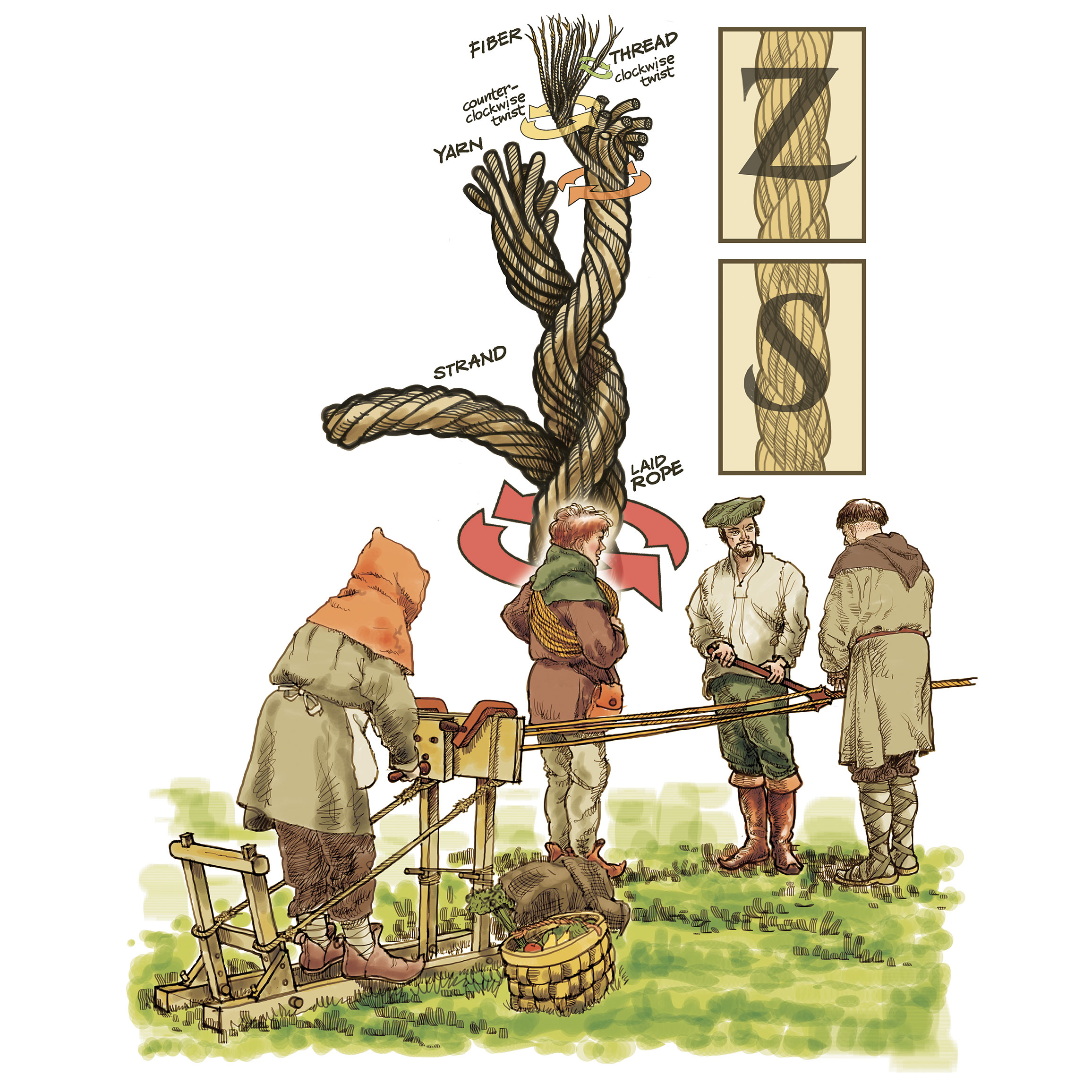
Cordage—rope—was one of the first and most necessary tools. Its use is among the first lessons of “wilderness survival” courses, as cord made from found fibers may be used for fishing lines or snares; it can lash shelter structures or be used to string a bow.
Cordage functions only under tension: Unless you count the pounding a thump-mat gets around a flopping block, it has no compression role. But this single attribute has made cordage inseparable from the progress of civilization. Rope is made from simple twisted fibers, yet it’s not so simple. There’s a subtle virtue in its twist, allowing it to flex to accommodate loading so that each fiber takes generally the same strain. A cord made of straight fibers clumped together would be pitifully weak: The weakest fiber would break and increase the load on other fibers; more breakage would occur, and failure would ensue.
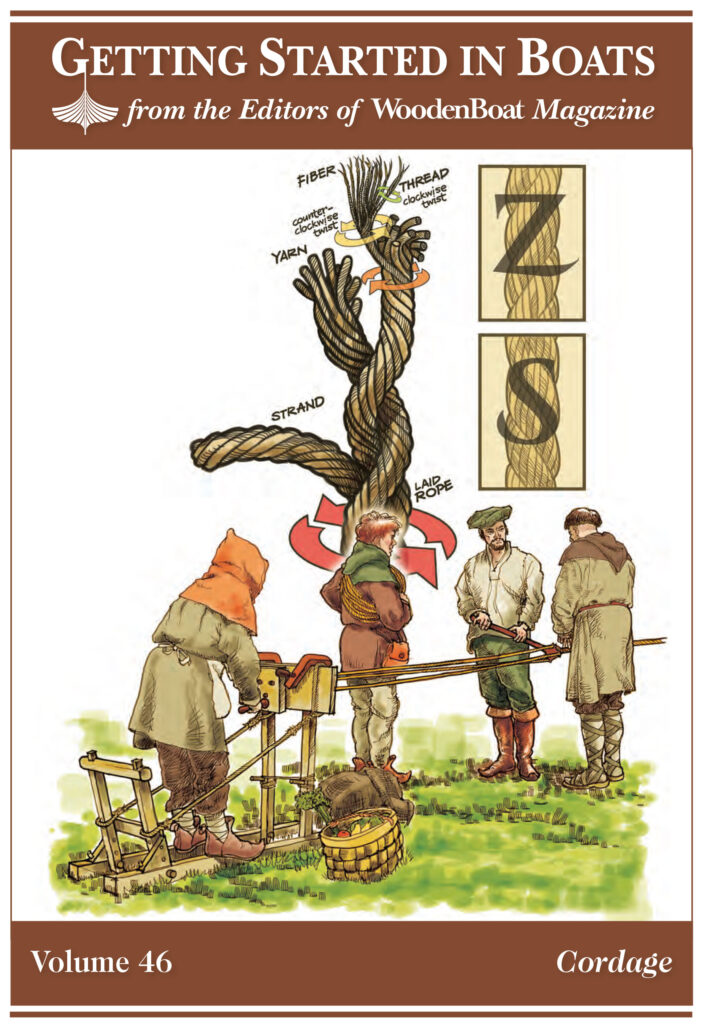
The simple twisting of either natural or synthetic fibers can create enormous tensile strength. Left-twisted gatherings of fiber are right-twisted into cords or yarns. These can be left-twisted into composite strands. The strands can then be right-twisted into a rope. Right twists are “locked” by left twists. This inter-supporting structure is called laid rope. It flexes to balance strains.
Look at a piece of laid rope carefully: Notice that the individual fibers that compose the rope are very nearly parallel to the rope’s long axis (see above). It’s an elegant structure, with strength and flexibility far greater than the sum of all the yarns within it. Understanding the harmony in a length of laid line compels us to acknowledge that our hunter-gatherer ancestors may have been hairier than us but were no less analytical and inventive.
Fiber Types
Thousands of fibers have been pressed into service for useful cordage. Every habitable ecosystem offers dozens of workable choices. Line has been made from the inner bark of trees, the parallel fibers within yucca leaves, hundreds of field and forest weeds, sisal, several species of hemp, papyrus reeds, grasses, the tendons of animal legs, and even fibers from the cocoon woven by the silkworm. For sailors, however, only a few traditional fibers are significant.
These natural fibers have a solid place in history. But natural cordage can rot when it gets wet, and it supports mold and can even be a meal for nibbling critters. Synthetic fibers are so superior in strength, durability, cost, and versatility that there is simply no viable market for natural fibers. Save for small-scale artisanal production for the most authentic of replica vessels, natural cordage has virtually disappeared. Here are a few of the most popular of natural fibers:
Hemp
Woven from several species of the cannabis plant, hemp cordage stretches less than other natural fibers. Consequently, miles of hemp rope made up the standing rigging of ships during the Age of Sail. It was not particularly rot-resistant, however, so hempen shrouds and stays were usually preserved with tar.
Manila
Woven from fibers of the abacá, a relative of the banana tree, manila was the traditional favorite for running rigging and industrial rope because of its high tensile strength and durability. It was a fiber of choice for centuries.
Cotton
Cotton fibers recommend themselves for their softness rather than their tensile strength. Cotton cordage was used where a soft “hand” (feel) was desired, as in hand-ropes, bell-pulls, and hammock netting.
The scarcity of natural fibers isn’t a disaster. We’re fortunate to have a variety of synthetic fibers with special characteristics for specific uses.
Nylon
First produced in 1935 and introduced at the pivotal 1939 New York World’s Fair, nylon was one of the first synthetic fibers. It was first used as a substitute for silk in women’s stockings. Nylon is wonderful stuff: It’s nearly impervious to UV (ultraviolet) degradation by sunlight and is resistant to most chemicals. It has a soft “hand” and high tensile strength (it’s used at high tensions for musical instrument strings). Its natural stretching property makes it an ideal choice for anchor and dock lines; it smooths out sharp pulling shocks. The same quality makes nylon a poor choice for sheets and halyards that need a constant tension. Nylon stretches.
Polyester, aka Dacron
Commercially known as Dacron or Terylene, polyester is highly UV and chemical resistant and even stronger than nylon, but it has much less “give.” This latter quality names it as the choice for all but critically high-performance sheets and halyards. Polyester is the most agreeable fiber for yacht cordage available, in its myriad lays, weaves, and blends.
Polypropylene
Polypropylene is one of the most-used plastics in the world because of its elasticity, ease of molding, and resistance to most chemicals. As a yacht cordage fiber it presents virtues and dangers. It will not absorb water and can be stowed wet, and is less dense than water, so it floats. This recommends it as a dinghy painter that will refuse to be sucked into your propeller. The cautions: This is a relatively low-strength fiber and easily degrades in sunlight, so its safe working life is indeterminate; its low melting point can be approached by simple friction, and the curve of its tensile strength falls off rapidly as the temperature rises. As a seldom-used, light-protected heaving line or lifeline, “polypro” makes sense, but it is not trustworthy over time.
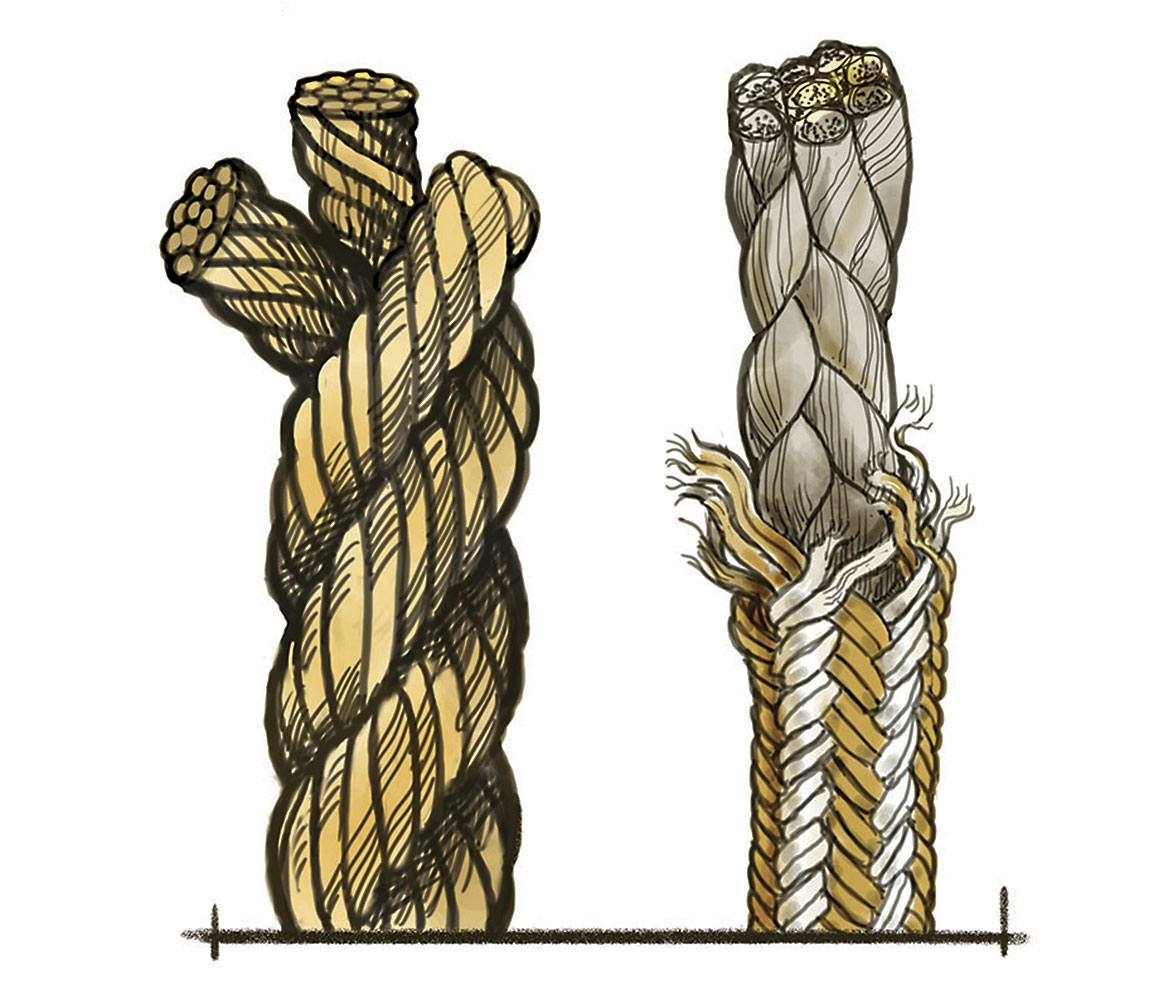
Cordage is available in two basic configurations: laid (left) and braided (right).
Rope Structure: Braid vs. Laid
Cordage was once available in a surprising variety—two, three, and four strands, hawser-laid (counterclockwise or “Z” twist) and cable-laid (clockwise or “S” twist). Today S-laid line is seldom seen, probably because using it might be disastrous: under strain an S-laid and a Z-laid line knotted or spliced together would unwind each other, creating sudden “hockles” (strand bunching) that would concentrate strain and decimate the strength of both lines.
While twisted fibers in laid rope are a wonder, the mathematical precision of cross-plaited fibers in continuously woven braid is close to a miracle. Admiral Nelson would have given his eyeteeth for a few miles of this stuff. Braid was made possible by the control of fiber thicknesses that couldn’t be duplicated in natural materials. Contemporary yacht braids are usually two-part sheath-and-core structures. The twist that generalizes the fiber tension within laid line is paralleled by the flex between outer and inner braiding. The geometry of laid rope admits a few flaws: An injury to any one strand compromises laid line disproportionally. Variations in weave and material allow braided rope to carry out specific tasks. One example: The sheath of most braided line is woven for abrasion resistance and should have a longer service life than laid line.
Defining Rope
You won’t find rope in most nautical dictionaries, except as a part of another concept, such as “rope-yarn” or “ropes-end” or “boltrope.” The word rope isn’t an accurate noun aboard a ship.
A new car changes miraculously from “new” to “pre-owned” the moment you drive it off the dealer’s lot. Rope changes from its precise nautical definition—“cordage purchased on a drum, reel or in seized coils”—to “line” as it comes aboard. It changes thereafter to the purpose it serves—perhaps as a “sheet,” “halyard,” or “nettle.” Rope retains its original name only as a collective noun, as in “learning the ropes” (distinguishing the hundreds of sheets, halyards, guys, and stays, that controlled and supported a square rig). “Hey there, pull on that rope” is lubberly language.
Wire Rope
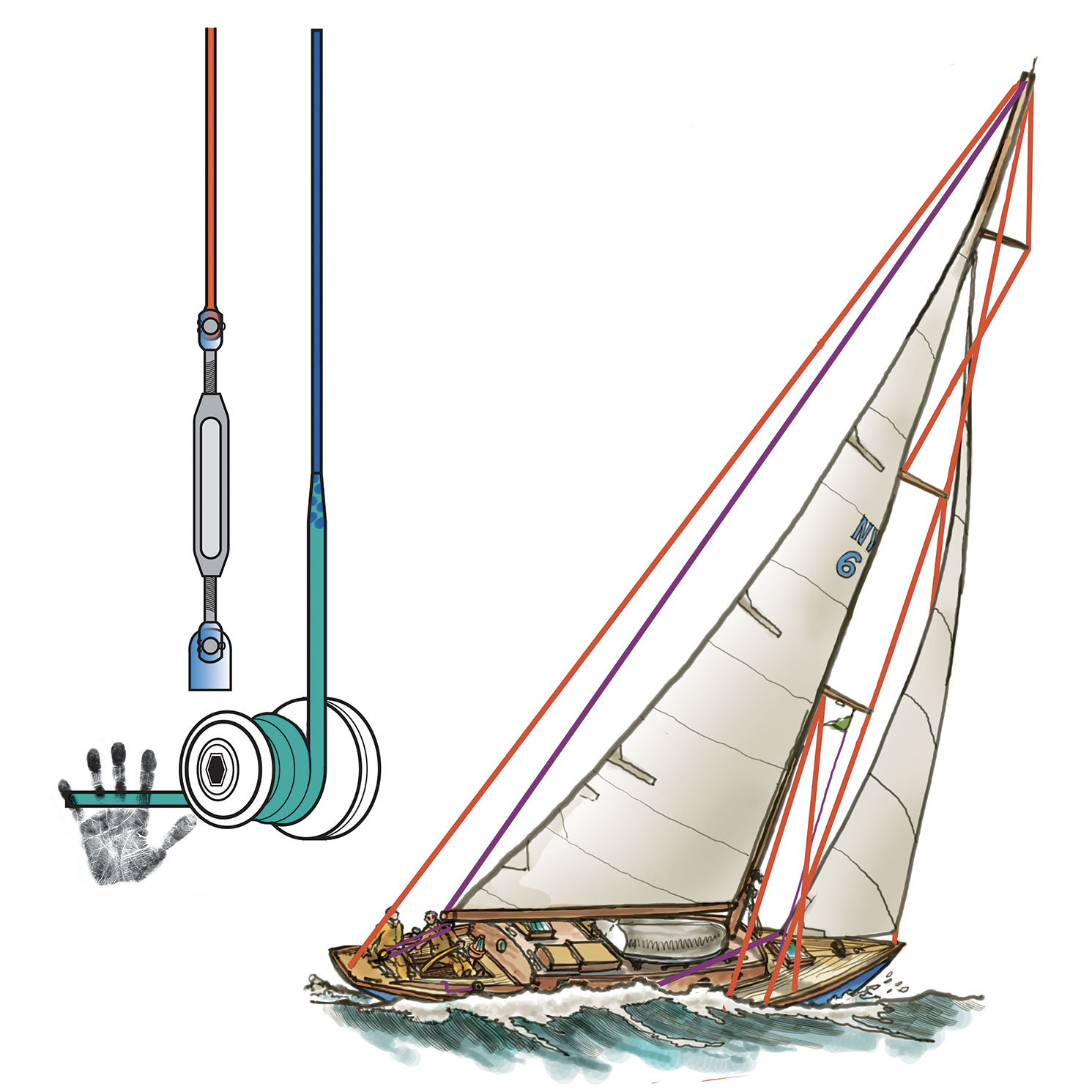
Engineers who built suspension bridges in the 1800s began using iron, then steel, twisted into flexible cables as their tension members. The tensions possible from wire rope were enormous by 19th-century standards. The clipper ships, arguably the high-water mark of American maritime commerce, began to use wire-rope standing rigging in their high-tension rigging. The downside was that when a shroud or stay parted (continuous quality control within the wire was poor), the recoiling line often cut several deckhands asunder. Our legacy from this era is stainless-steel standing rigging and wire-rope halyards (often spliced to hand-friendly polyester ends for the winch drums). Wire rope is admirably strong and stable but, by and by, it will begin to rupture from metal fatigue and produce the painfully damaging stray broken ends aptly called “needles.” Wire running rigging is quickly being supplanted by low-stretch, high-strength synthetic alternatives (see facing page).
For many decades, wire rope spliced to a soft tail made an effective low-stretch halyard that was easy on the hands. In recent years, ultra-low-stretch polyester line has replaced wire in this application, reducing weight aloft and eliminating wire marks on spars. A variety of color options allows this high-performance line to look appropriate on even classic yachts.
High-Performance Cordage
By chemically and electrically creating high-molecular-density polyesters (HMDPEs) and using braid technology to optimize the virtues of these new fibers, science has given us a range of high-performance super-lines. Their molecular theory is best left to boffins, but the general theory is not forbidding: Cook up a very long-chain polymer with especially hardy chemical bonds and process it within an environment that physically lines up the molecules lengthwise, so every bit of tensile strength is brought to bear. Coincidentally, this reduces elasticity (enemy of the carefully set sheet or halyard). The result is line stronger, more stable and abrasion resistant, and much more flexible than steel rope. Some of these special polymers are vulnerable to UV damage; the solution is to use them as a core braid surrounded by a protective conventional polyester sheath.
Early examples of these Star Wars lines were the aramids—Kevlar, Twaron, and Technora. They were great in bulletproof vests but had flaws as cordage fibers. Knotting them and running them through blocks ruptured fibers, so they had a dismaying tendency to break unexpectedly. The new generation of HMDPEs, Spectra and Dyneema, are hardier, twice as strong as polyester, and only half as elastic. Vectran, an even more specialized fiber, is even less elastic and has less tendency to “creep” (lengthen slightly over long tension). These are the caviar of high-tech line, and priced accordingly. If you paint your own bottom, you can’t afford them.
Even More Gee-Whiz
Cordage is an ancient tool, but we’re about to see a technological revolution in our own time. The first hint of this is replacing wire-rope standing rigging with high-performance cordage, which is lighter and (astonishingly) stronger and easier to handle.
The second sign of revolution is personalized cordage. Computer-driven looms can run up sheets, halyards, or standing rigging to order for your boat. Consider a halyard that tapers into an efficient diameter (the new braid is so strong that “thick” line is largely for kindness to sailors’ hands) and is color-coded along its length, so when it is winched down to the sail’s optimum height and tension, the new color is just touching the winch drum.
Care of Your Line
It’s important to keep your line healthy: Your boat—and your life—could depend on it. Modern line is resistant to most of the elements, but it is still a flexing, porous structure. Do your best to store it dry. The sea is a primordial soup, and a sopping-wet line will propagate god-knows-what in the dark. Flake out your line on a sunny day to dry it. Arrange ventilation for your line locker.
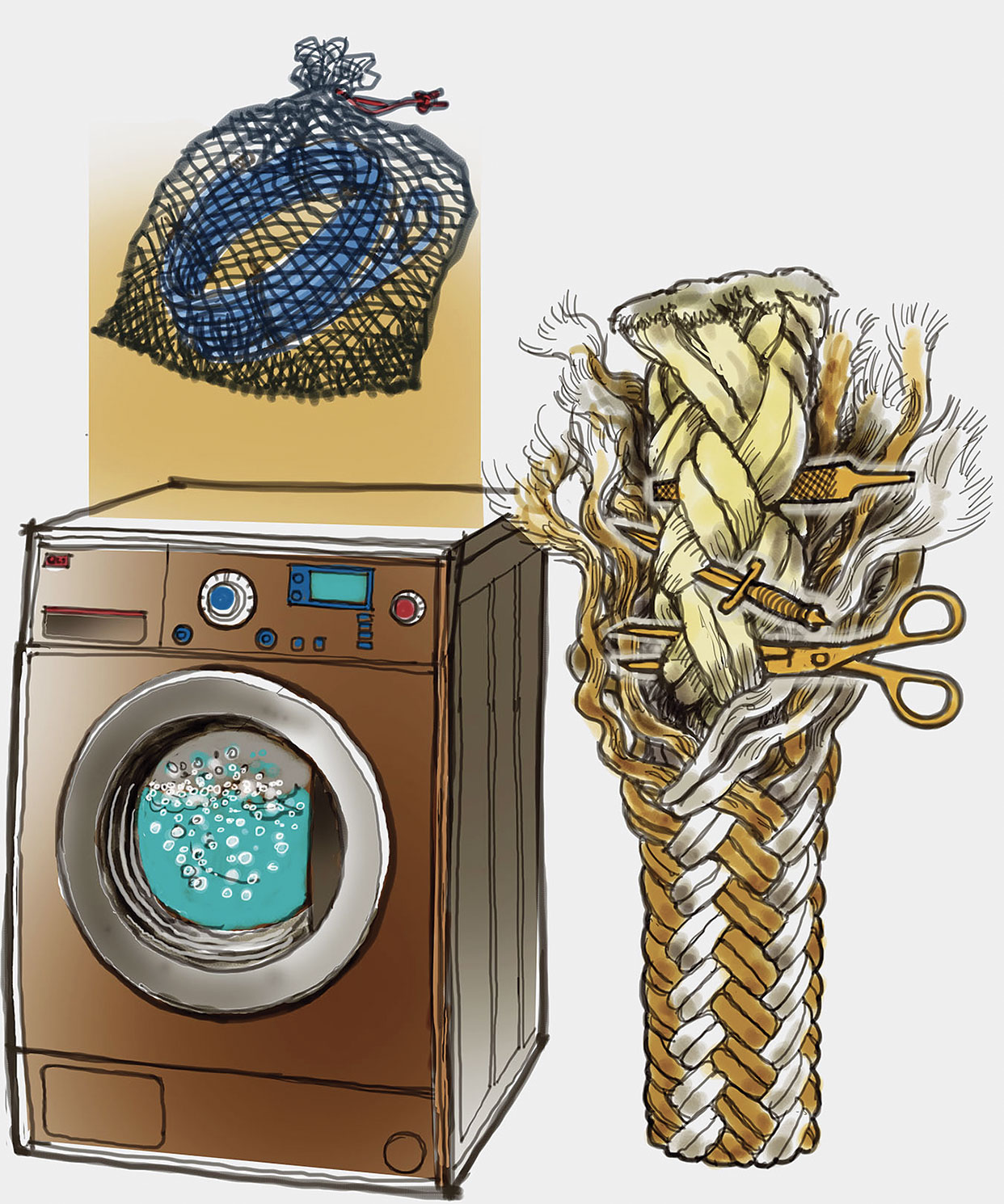
Keep it clean, too. You may not want to hear this, but your sheets need to be laundered. A porous, flexing fiber draws grit into itself, and salt water drying within the line forms crystals. Grit and crystals abrade the microscopic integrity of your line and can significantly degrade its strength. This caution is even more important for high-performance line.
When you lay up your boat for the winter, your line can and should be coiled, bound loosely with small stuff (cord), and dropped into a mesh bag. Then it can be laundered in a conventional washer with mild detergent. Some line-freaks suggest adding fabric softener, but we recoil at this pink-lace suggestion.
Keeping It Straight
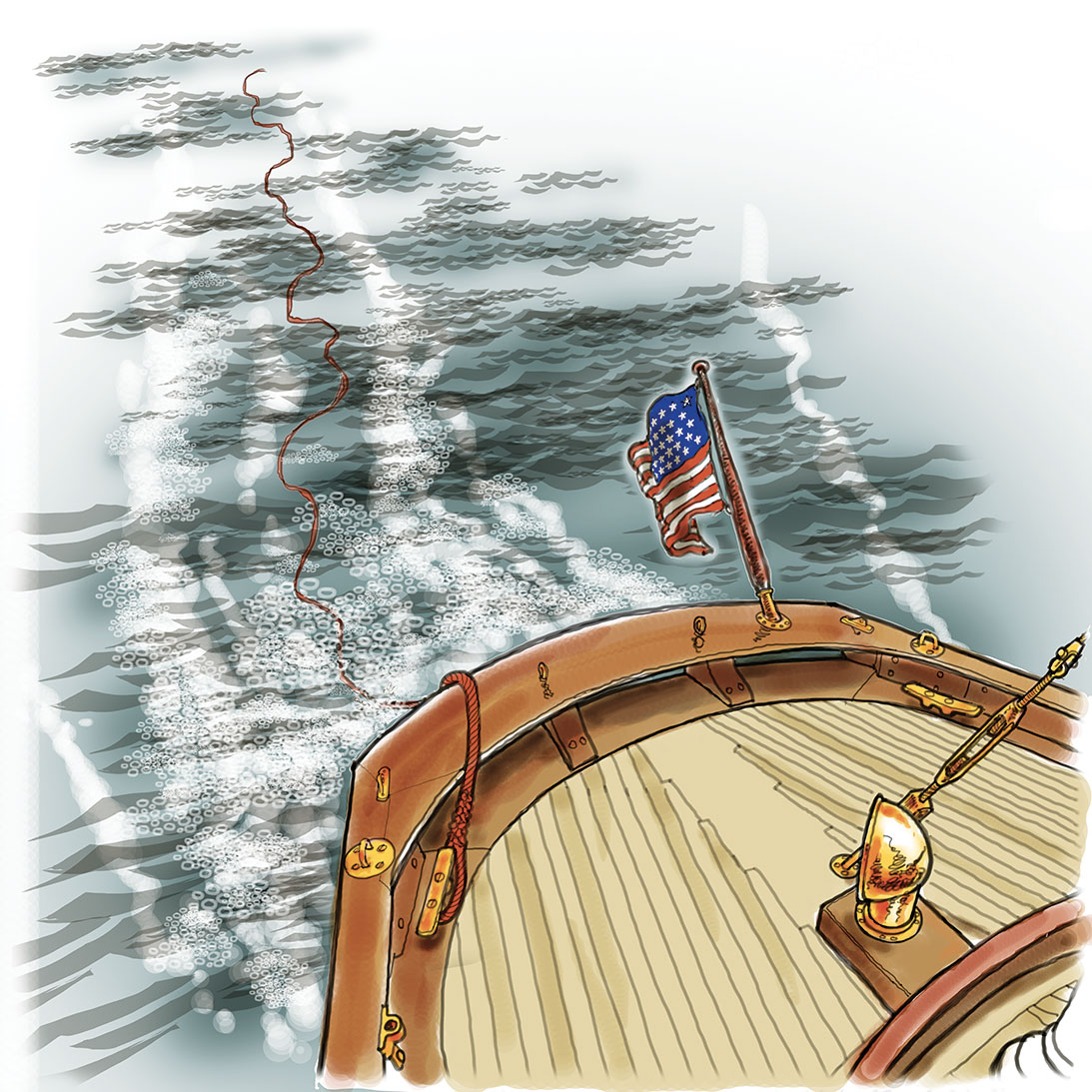
You can be an observant steward of your line locker, but kinks and hockles will appear in all your cordage by and by. Perhaps we can write this off to entropy. There’s an old, useful trick for “easing” line, relaxing tensions built up in it: On a long reach, trail line at full length behind your boat. You’re essentially creating a neutral, low-friction environment that will allow the line to shrug off its tensions. We should be so lucky.
Coils
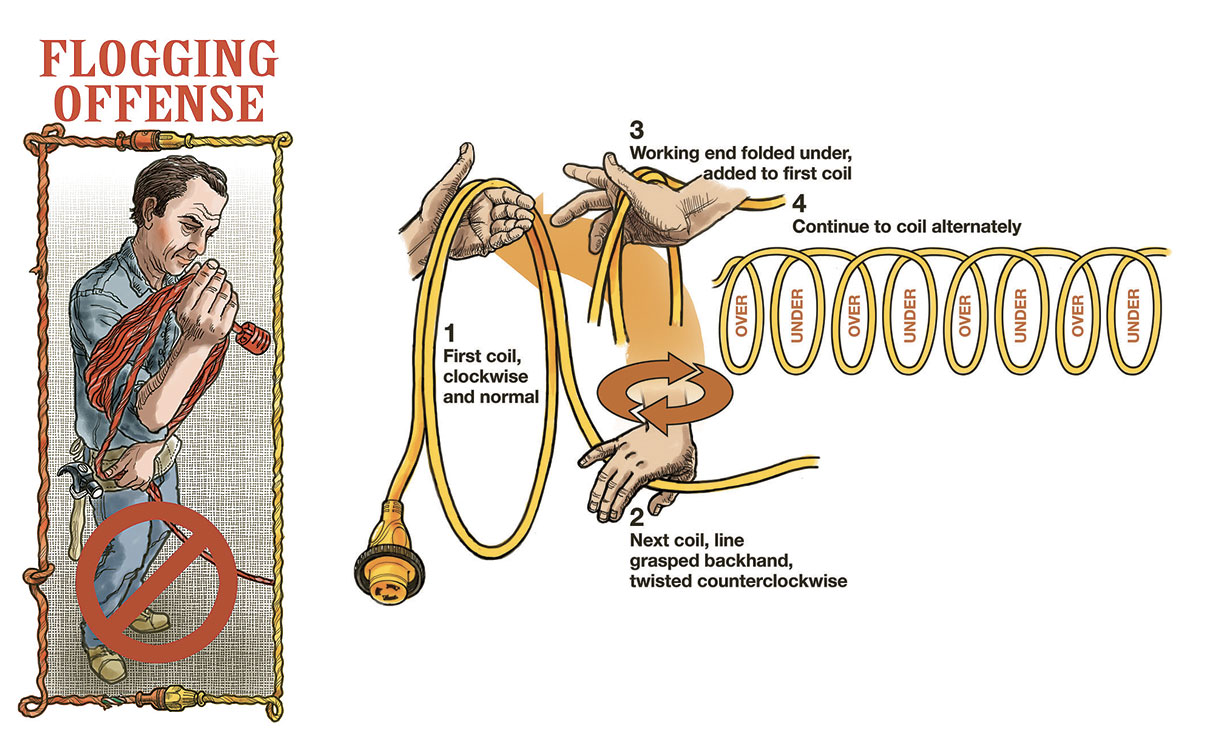
While coiling appears to be a simple concept, learning to do it correctly will prolong the life of your line. Above all else, remember this: A line should never be coiled around a forearm. Electrical cords require alternating loops for the cord to lie properly.
The prime culprit of line-kinking is bad coiling. First and most important, make it a flogging offense aboard your boat for any upstart lubber to coil anything around an elbow. This imposes multiple kinks in your line.
Set some standards for your boat: Line is to be coiled in a specific way and no other, so that any crew member will know how to “unlock” a coil and use it. Common laid line (Z-laid) can be coiled clockwise. Laid line or braid can be flaked out in a figure-eight on the deck.
High-performance line, indeed most braid, should be coiled using the alternating over-under method favored by roadies coiling sound cables. This is also the coil of choice for ship-to-shore power cords, hose, coaxial cable, and eight-plait anchor braid.
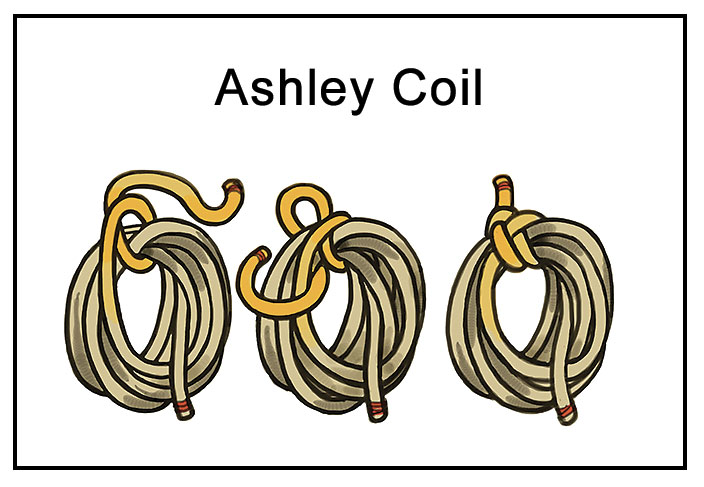
A good choice for securing a coil in laid or braided polyester or nylon is the sea gasket. If your crew expects lines to be coiled in a sea gasket, they can release the coil by feel on a dark night.
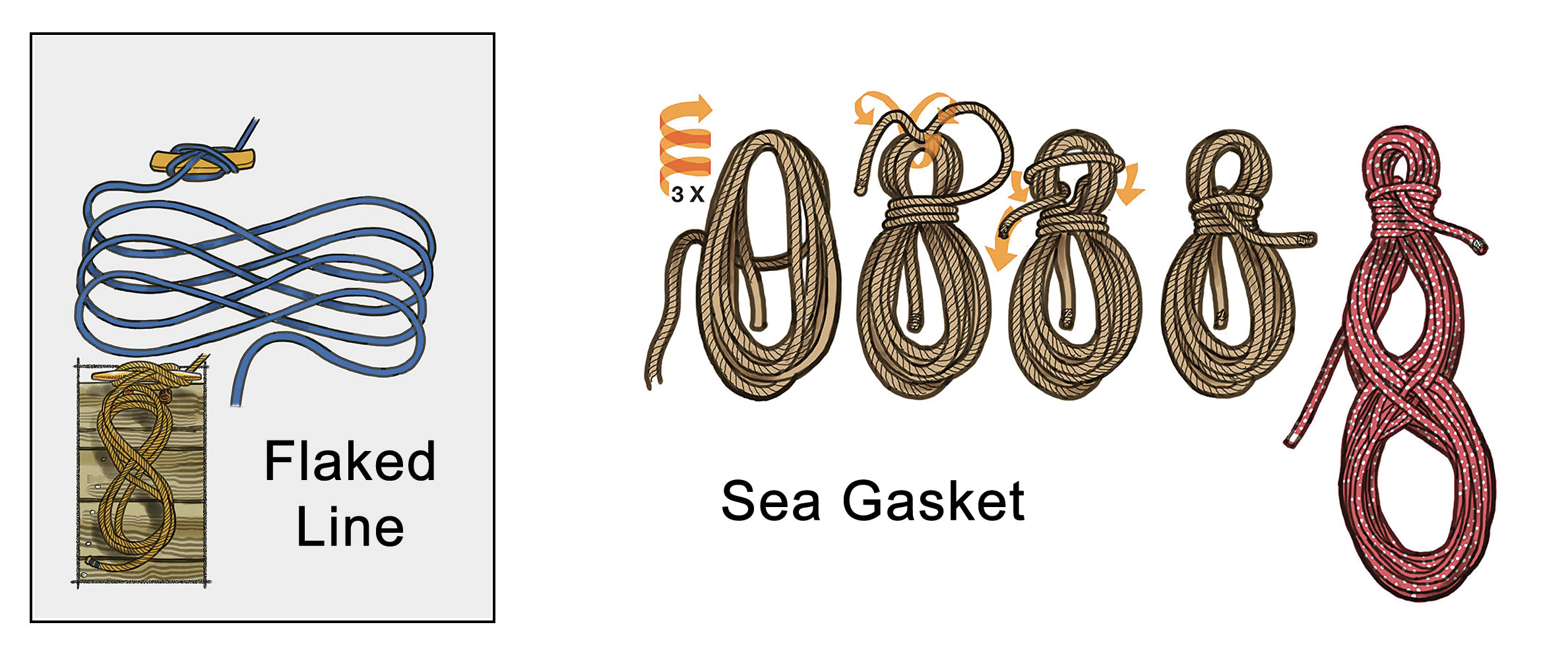
Above Left—This line is flaked out in a figure-eight pattern and ready to run. Above Right—The sea gasket is a secure way of finishing a coil, although the Ashley coil (above) is a common alternative. Whatever your method, be consistent on your boat so lines will be available quickly.
Power cords, hose, and co-axial cable should not be secured with a sea gasket but stoppered with cord or Velcro bands attached to one end.
The Ditty Bag
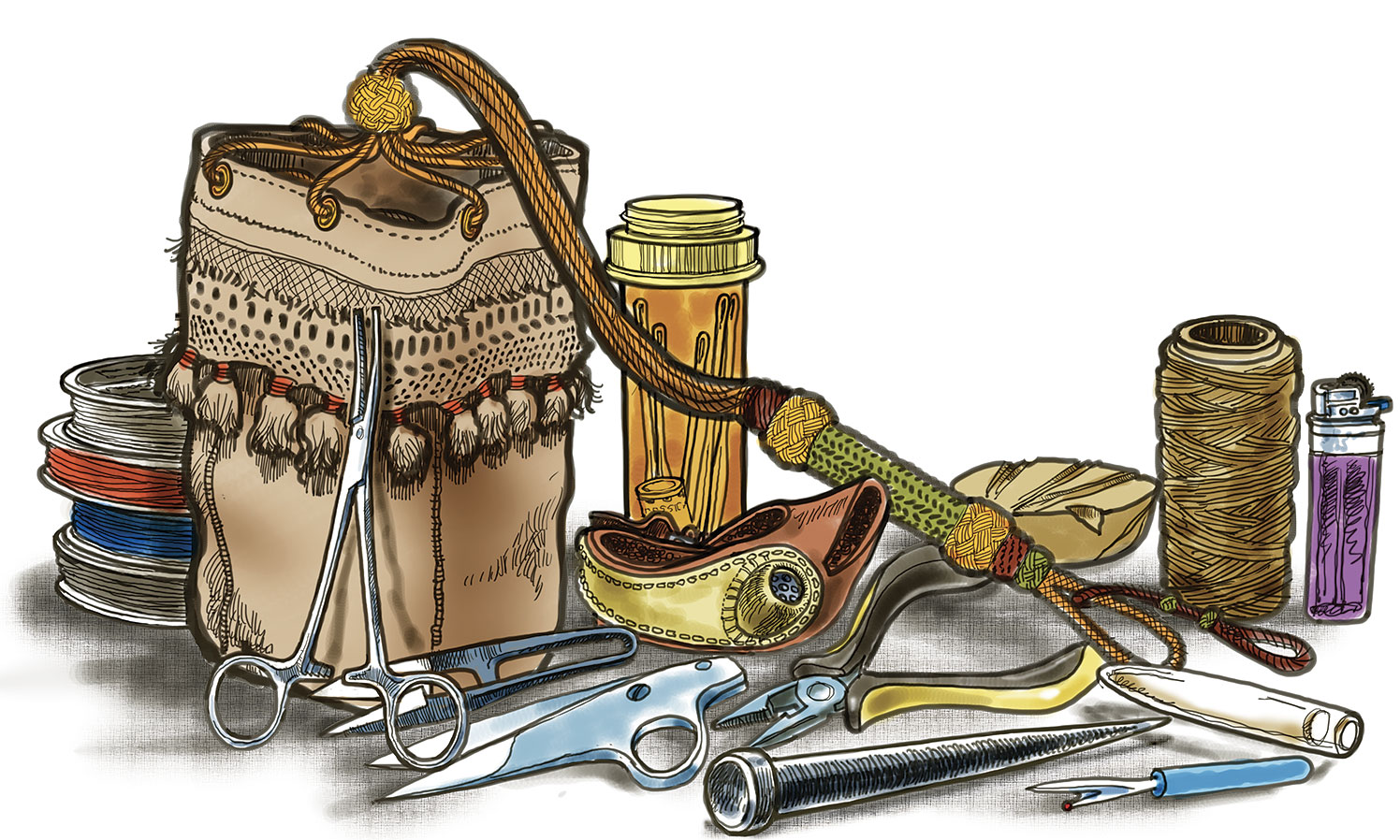
An essential possession for any sailor, the ditty bag gathers the tools and materials necessary to care for line. The origin of the name is lost, though it may be a linguistic variation on the British naval phrase “commodity bag.” These were intensely personal items. Sailors personalized their ditty bags with complex macramé drawstrings, delicate canvas-edge tatting, and embroidery. Go thou and do likewise.
The skills of linework are a lifetime learning project, beyond our scope. But suggesting many of the common tools a useful ditty bag might contain will be helpful to your cordage education:
• Waxed sailmaker’s twine
• Sail needles of various sizes—a screw-top pill bottle, retaining the desiccant capsule, is a wise needle holder in the salt-air environment
• Upholsterer’s and cushionmaker’s curved needles
• Beeswax (for stiffening thread ends)
• Sailmaker’s palm
• Small needle-nose pliers with side-cutter
• Spools of small stuff—tarred marline, hard-laid braided cord, etc.
• Butane lighter for fusing synthetic line ends
• Thread snips for delicate trimming
• Small scissors
• Seam ripper
• Marlinespike
• Variety of braided-line splicing fids
• Variety of shackles and fittings
• Double-sided Velcro tape
• A few pieces of tanned leather
• A pair of hemostats (locking medical clamps useful for working through strands and firming up decorative knots)