
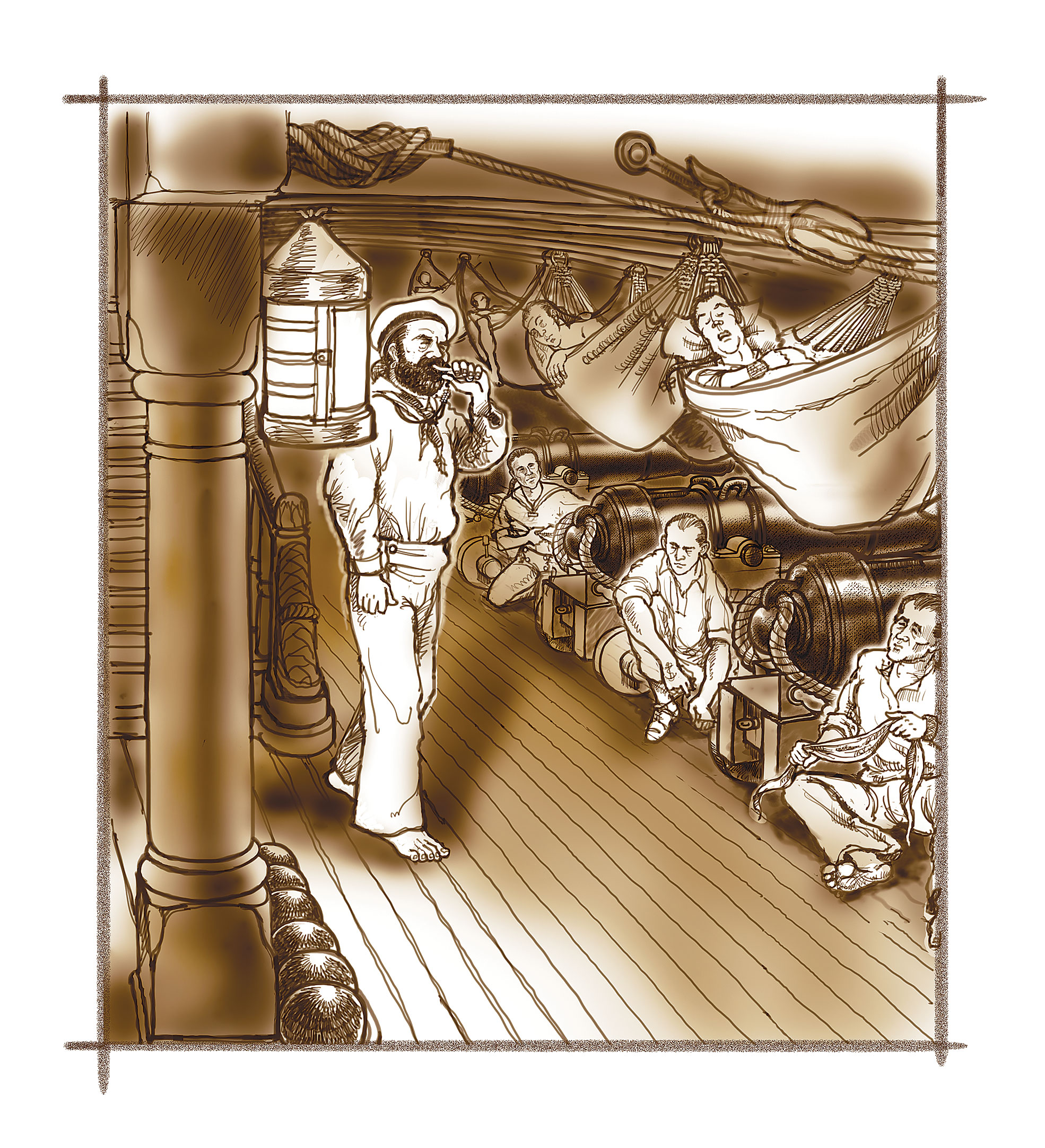
This is the bosun’s traditional call to the sleeping watch below: “Wakey wakey! Rouse out, you sleepers, out and down! Here I come with a sharp knife and a clear conscience!” Sound sleepers found themselves dumped on the deck, their hammock line cut by the bosun’s knife. Rouse out!
A boat nodding by a dock or a mooring has its own small life, murmuring in its sleep like a dreaming dog. Your wakey wakey should reflect a thoughtful and prepared boating style. How you wake up and deploy your lines, systems, and precautions should make clear sailing easier.
Pre-Flight
“All pilots—professional airline pilots, Piper Cub civil aviators, and hotshot fighter pilots—share a ritual: the Pre-Flight Checklist. They’ve gone through the same or similar lists thousands of times, yet they persist, and they usually recite it out loud. The reason is simple: There are intricate combinations of failure that can become a toxic cascade because a simple valve wasn’t closed or a switch was set to a wrong position. They know it’s possible to overlook something out of sheer, dumb familiarity. They can forget. So can you.
If the pros won’t neglect basic checklists, someone getting started in a new discipline might do well to develop a similar respect for human failings. A good prevoyage checklist is part of your wake-up. Make it a ritual, before you drop a single dockline, to go through your pre-flight checklist.
Break it Down
Parcel out areas of importance. You can’t possibly include every necessary item on your checklist, but the breakdown into spheres of concern will prompt you to remember details for this voyage or this particular combination of weather and passage. You’ll find your own mnemonics— your memory aids. Here are some areas upon which to focus:
Hull
Check the integrity of the hull, rudder, and centerboard. Also, check which through-hull fittings must be opened and closed to leave the dock with confidence. As in:
• Open Through-Hull Valve To Heat Exchanger
Deck
What might go wrong on the deck to jeopardize safe sailing? What hatches should be dogged (locked) and what should be undogged for quick access? It’s an accepted scientific principle that an engine will fail at the worst possible time; that’s when you need working sails, right now.
• Remove And Stow Mainsail Cover And Jib Bag In Lazarette
Stowage
Be specific about stowage locations; this is a task list for your crew. If your canvaswork extends to shrouds around handholds, flaps over dodger windows, snoods covering binnacle, winches, or windlasses, this is the place to call for a check.
Rigging
Standing and running rigging deserve careful scrutiny. Your checklist might even call for a visual inspection of all shackle pins and cotter pins. This is also a good place to specify ready-to-hand essentials:
• Uncoil and flake down mainsheet; clear and overhaul jibsheets.
• Detach main halyard from starboard stanchion base and attach to mainsail head; check for clear running.
Crew
Certainty about the crew’s safety, comfort, and ability to perform is a hallmark of good skippers. What does every crew need every time? Plenty of water ready to drink, for starters. There should also be ample sunscreen onboard: Inexperienced sailors don’t realize the destructive strength of ultraviolet light amplified by reflections off the water. PFDs should be checked for a good fit, and the crew should either wear them at all times or know where to find them when the time comes. Antinausea meds should be encouraged, and crew members with prescription meds should have them readily available. Sunglasses, hats, clothing appropriate to warm or cool weather, and foul weather gear should be quickly available.
Make some decisions about how you want your crew to stow personal gear securely. This is not a trivial consideration: Cosmetics, toothpaste, or loose papers shifting all over the cabin sole in a seaway are an internal hazard to navigation.
Orientation and Task
As a skipper, it’s your responsibility to make certain every shipmate knows where to lay hands on the emergency tiller, manual bilge pump, first aid kit, and other critical items.
Green or able-bodied, all of your shipmates should know how to operate your particular head—valves to holding tank or open water, flushing, clearing, and how to reset the head valves so the head doesn’t siphon water into the boat while underway!
If you’re the skipper, it’s your responsibility to assign tasks. Crew members should know what’s expected, what they should do, and what they shouldn’t do. Watching under the sail for traffic may sound basic but it’s a critical task.
Safety
It’s all about safety. All of this. But there should be a specific part of the checklist for cataclysms, which are the very times you don’t want to run about finding what you need. Check for fire extinguisher gauges “in the green,” up-to-date flares, restocked first-aid kit, throwable flotation in the cockpit, and the man-overboard hoist on deck and affixed to stern pulpit.
Navigation
You may be a paper-chart traditionalist (this is WoodenBoat, after all) or a GPS geek, but the principle is the same: Lay out or boot up the charts you’ll need. If you’re among the digitari, locate your backup paper charts. You never know.
Eyeball navigation and dead-reckoning are just as important as charts and plotters: Your best binoculars should be hanging safely within reach, and you should have quick, sure access to your tide charts, dividers, chart plotter or parallel rules, and a calculator. Check your masthead weathervane and your telltales.
Weather
Spend time with NOAA weather before you make a move. We grant that their predictions aren’t always spot-on. They have, however, this virtue: They err on the heavy side, so if the indicators are ambivalent, they’ll predict a storm sooner than a light breeze. Know what you might meet out beyond wading depth.
If you’re the skipper, the crew’s comfort is your burden; give a thought to extra fleeces, blankets, sun hats, gloves, sunblock, cabin heater, and cabin fans.
Engine
Power installations in sailboats are seldom simple. The fluid hull shape and the milled, hex-bolted, brutal aesthetic of engines are seldom a comfortable mating. You must know where your power’s soft spots lie: Have you had problems with fuel, current, overheating, transmission? Identify what could go wrong and reflect your concern in the checklist.
Generally, you should always check the fuel level, crankcase oil (level and “color”), coolant and heat exchanger, and belt tensions. This isn’t overhauling a stopwatch; it’s ticking off the primary vulnerabilities. It’s never a waste of time to check for anything that might fall on or near the propeller shaft, even if you must hang upside down for a few moments.
Electricity: Mooring
If your boat lives at a mooring ball, you should check the levels of your batteries, consult your voltmeter, and maybe even employ a hygrometer to test the specific density of the battery water.
Electricity: Slip
If your boat resides at a dock or slip, you’ll likely be shifting from AC shore power to DC internal power. Remember the bitter argument between DC Edison and AC Tesla, and reflect that crossing over is not simple. Go through the steps carefully. When you’re ready to drop lines, detach the heavy shore cable after the power has been turned off at the shore breaker box and figure-8 coil the cable to take aboard or leave in the dock locker—your choice, your checklist. Marine three-contact plugs are positive locks, so if you neglect this detail, your voyage will be short and ignominious.
Shore Contact
Have you filed a float plan? Does each crew member’s spouse, partner, children, boss, doctor, AA sponsor, or stockbroker know where the crew will be? Will the voyage take the crew out of cell-phone range? Do you have alternate objectives or routes? Is your insurance paid up? Just as the transition between AC and DC is tricky, it’s also disorienting to step from a constantly connected, largely abstract shore life to a simpler but more immediate world of necessity and seamanship. If you’re in charge, recognize this and help your crew to make adjustments. Ashore, we tend to rely on infrastructure to protect us from mishap. Afloat, we pretty much take care of our own well-being and safety. Admittedly, it involves risk and limited skills. But getting away from the shore and from the grid of normal fallbacks is refreshing. It’s also a way we reset our heart’s instruments.
The Crew Meeting
You may, like Odysseus, sail with the same heroic souls for years, but most recreational voyages are salad events—a mix of experienced mellow veggies and crisp greens. It’s therefore important to orient everyone before getting underway, appointing people to tasks and positions that fit their skills and abilities. The crew meeting is the time to do this, and it also presents an opportunity to point out the locations of seacocks, emergency gear, and basic necessities—and to ask and answer questions.


