New introduction coming from Matt….


JUNIPER

Photos by Brad Tinius

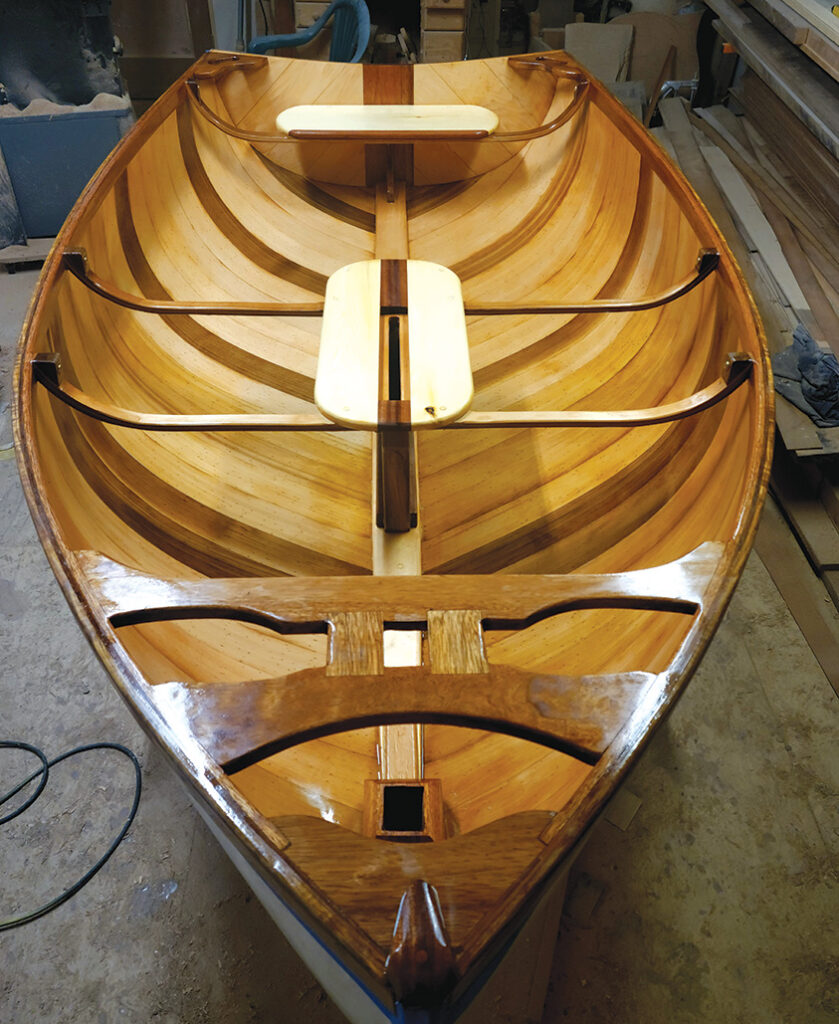
For 40 years, Brad Tinius lived on Hat Island and commuted by boat to his wooden-boat-repair shop in Everett, Washington. While he covered a lot of ground in his daily 6-mile passage across Possession Sound, he was no stranger to long crossings: he had sailed from Australia to Washington and on several occasions sailed between Washington and Hawaii, homeward bound in 2021 with his two daughters, who were then 18 and 21. Brad has a granddaughter now, Juniper, who is five years old. She and her parents also live on an island, Bali, but visit Hat Island, where Brad now has a boat for her. He designed the 8′ × 4′ sailing dinghy by carving a half model and taking the lines from it. He cold-molded the hull with three ⁵⁄₆₄″ layers of western red cedar. The finished boat, rigged for sail, weighs just 47 lbs and has been christened JUNIPER.


Kaholo paddleboard

Photo by George Brindle

George Brindle has a successful engineering business, but his hobby seems to attract every bit as much attention: “Not a day goes by without someone reaching out about something I’m building.” In his home workshop in Bragg Creek, a woodsy hamlet west of Calgary, Alberta, Canada, he has built paddleboards and kayaks as well as an outboard skiff and a rowing wherry. This past winter, he built a 12′6″ Chesapeake Light Craft Kaholo paddleboard. Working from plans and a frame kit, he spent about 75 hours on the project. He painted the hull white, and, for eye-catching color, applied patterned orange cloth and blue grip pads to the deck. His wife, Jenny, is the happy owner of the paddleboard, finished in March 2025. She’ll be paddling it on the local mountain lakes as soon as the ice clears and the water warms.


ECLIPSE

Photos by Viktor Steimle

Nearly 40 years ago, Viktor Steimle and his wife enjoyed what he remembers as “the best holidays of our life,” kayak-camping with a second-hand Klepper in Sweden and Norway. After they had their two children, they switched to a 17′ canoe to accommodate the family and continued cruising. Now retired, with time on his hands and a bit of woodworking experience to his credit, Viktor has built his first boat, a Mill Creek 13 decked kayak, from a Chesapeake Light Craft kit. The kit went together easily, with only two moments that called for a bit of head-scratching. He launched the kayak on April 8, 2024, the day a total solar eclipse darkened the skies over his home in Sainte Catherine de Hatley in southern Québec, Canada. He paddles ECLIPSE on the waters of Magog Lake that surround the peninsula he lives on.


PETRICHOR

Photos by Dylan Spaulding

As a youngster, Dylan Spaulding built a canoe and a kayak with his father. A few years after his father died in 2015, Dylan decided to build a boat not only to honor his father’s memory but also to share his affection for boats and cruising with the child he and his wife were about to have. Dylan ordered a Northeaster Dory kit from Chesapeake Light Craft. The kit he chose provided the CNC-cut plywood pieces, leaving him to build the rest of the boat from scratch. The project took six years to complete. His son, Henry, wasn’t born when work started on the boat, but before it was finished, he was old enough to help with the sanding. The dory was launched in November 2024 and christened PETRICHOR, a term for the smell of rain fallen on dry soil. Dylan and his family trailer her to waters around their Sacramento, California, home.


IDYL

Photos Courtesy of Tom Regan

In 2002, Tom Regan established Grapeview Point Boat Works in Allyn, Washington, and has been building and restoring boats—for other people. In May 2022, he began work on a boat for himself and his wife. The plans he chose were for Iain Oughtred’s Haiku sharpie, inspired by EGRET, the shoal-water workboat Commodore Ralph Munroe designed for himself in 1886 for use in Biscayne Bay, Florida. With a length on deck of 30′, a sparred length of 37′, and a beam of 7′9″, Oughtred’s double-ender was larger than EGRET and most of the other boats Tom had built. Launched in June 2024, IDYL is usually day sailed but has comfortable accommodations, including a wood stove, for multi-day cruises in Puget Sound waters. Oughtred’s drawings include a well for an outboard motor, but Tom prefers to use the yuloh he built for auxiliary power.


KID

Photos by Tyler Rhodes

What do you do when you don’t have a shop big enough to build the boat you’ve been dreaming of? For Cecil Rhodes of Victoria, British Columbia, Canada, the answer was easy: build the tender for it first. He’d build the big boat when he found the space for it and, in the meantime, he got to work—with his family—on a Gartside pram dinghy, design No. 206. Cecil built his 8′ × 3′10″ tender in the traditional manner, as specified in the plans, with nine cedar strakes on 19 steam-bent oak frames. His wife, Holly, specialized in handling the framing stock fresh out of the steambox. His granddaughter, Mya, kept morale high during the tedious task of spiling, and his adult children—Kristin, Tyler, and Telah—helped buck more than 350 copper rivets. KID was launched in March 2025 in Victoria’s Gorge Waterway.


PADDLE CAT

Photos by John Leadbetter

John Leadbetter of Lyman, Maine, a builder by trade, has built six plywood kayaks. Two of them were to his own designs, and he skipped the drawing phase and went straight to laying out plywood panels. Inspired by a WoodenBoat article about pattinos, an Italian type of rowing catamaran, he built PADDLE CAT, a variation for stand-up paddling. He made the hulls with ¼″ cabinet-grade birch plywood left over from his kayak projects and trimmed them with mahogany salvaged from the pallets used to ship the lauan plywood he bought for other projects. The deck is also made of recycled mahogany. He built the 16′4″ × 36″ catamaran over the spring and summer of 2024 and launched her in August on Kezar Lake in southwestern Maine.


TRIM

Photos by Rodger Louwman

In 1898, Thomas Fleming Day, then the editor of The Rudder magazine, promised his readers, “in a moment of mental hilarity,” to design a boat that would be “all a boat should be, and something more.” His promise was not forgotten, and after receiving a steady stream of demands for the design, he went to work. With help from yacht designer Charles D. Mower, Day produced the Sea Bird yawl, meant to be “a safe, handy cruiser.” Greg Wall of Somerville, Australia, with only a kayak and a dinghy to his credit as a boatbuilder, bought the plans from The WoodenBoat Store and acquired a copy of the 33-page booklet How to Build a Cruising Yawl, published by The Rudder in the 1930s. Over the course of two years, he built his 25′7″ Sea Bird, TRIM, and now sails her on the waters around Victoria, in southeastern Australia.


SKOOKUM

Photos by Kayleen Turner

On March 20, 2025, 16 boats set out from Antigua on a race to sail around the world. The current record for a sailing circumnavigation is 40 days, but this fleet will see the winner cross the finish line in about a year. The boats in this first Mini Globe Race are all Class Globe 5.80 plywood solo racing yachts with a length of 18′ 8″ on deck (see Currents, WB No. 301). The class was conceived by the Australian sailor Don McIntyre and the boat was designed by Janusz Maderski of Poland. Josh Kali of Seattle, Washington, built his SKOOKUM from a kit produced by B&B Yachts, spent two years on the project, and launched her in October, 2024. To get to the race start, he trailered the boat to North Carolina, and sailed to Antigua, covering 1,350 nautical miles in 22 days, averaging 21⁄2 knots. It was a good warm-up for the 28,000 miles of the race.


Green Bay Duck Hunting Boat

Photos by Richard Shank (top); Patrick Dengat (bottom)

In the 1870s, when Dan Kidney of De Pere, Wisconsin, was in his early 30s, he whittled decoys and built a skiff for himself so he could go duck hunting. A Chicago sportsman saw Dan’s work and bought both the decoys and the boat. By 1905 Dan Kidney & Sons, Inc. was building thousands of boats and shipping them worldwide from its sprawling De Pere factory. The 14′ Green Bay Duck Hunting Boat, according to a circa-1920 catalog, then cost $48 and had been in production for 35 years with more than 6,000 sold. One of them, built around 1890, was donated to Urban Boat Builders, a nonprofit in St. Paul, Minnesota, that teaches life skills to youth through boatbuilding. The restoration required replacing nearly half of the original boat and was completed in January 2025. The duckboat will be sold in a fundraiser or donated to the Wisconsin Canoe Museum in Spooner.


MANITOU

Photos by Isabelle Ball

MANITOU, a 20′ center-console outboard launch built by George Luzier Boat Builders in 1984, is more than a beautiful boat well worth saving; it is a piece of history for Sarasota, Florida. For Jeff Ball, who restored her, she is steeped in his childhood memories. MANITOU was commissioned by Dr. Bill Kennedy, who asked George for a slightly longer version of JUDITH C, built in 1979 by George for Jeff’s father, Pat. As a child, Jeff accompanied his father on visits to the Luzier shop to have lunch with George. Jeff later worked with his father to build a 24′ cuddy-cabin boat that George designed. After acquiring MANITOU from Dr. Kennedy in 2023, Jeff restored her in George’s shop, which Pat had purchased before George died in 2020 at the age of 96. After Jeff replaced MANITOU’s frames, keelson, and bottom, he rebuilt her console and its bench. She was relaunched in April 2024.


VIGILANCE

Photos by Stirling & Son

VIGILANCE, a 78′ fishing trawler built in Brixham, Devon, England, was launched in 1926. According to the registered charity that now owns her, she “represented the pinnacle of trawler design and proved it with her record-breaking speed.” Boats of her type were not meant to last long and were usually scrapped after a decade of hard use. VIGILANCE’s glory days lasted 11 years until steam power superseded sail, but she survived by serving varied roles. In 1997, she was moored at the Isle of Man, the last of her kind. Brixham sailing enthusiasts brought her home. For the past two years, Stirling & Son, a traditional shipyard in Plymouth, has been rebuilding VIGILANCE from the keel up. For the many crooks required, 40 oak trees were felled and 400 oaks were planted in their stead. VIGILANCE was relaunched in March 2025 and returned to Brixham for fitting out for her centennial.


These pages, along with the Boat Launchings section of www.­woodenboat.com, are dedicated to sharing recently launched wooden boats built or restored by our readers. If you’ve launched a boat within the past year, please email us at launchings@woodenboat.com, or write us at Launchings, WoodenBoat, P.O. Box 78, Brooklin, ME 04616.

Please include the following information:

  1. The boat’s length and beam;
  2. The name of its design class or type;
  3. The names of the designer, builder, owner, and photographer;
  4. Your mailing address along with an email address or phone number;
  5. The port or place of intended use;
  6. Date of launching; and
  7. A few sentences describing the construction or restoration. Send no more than five photographs (jpg images at 300 dpi) and enclose a SASE if you want anything returned.

Hints for taking good photos of your boat

  1. Set your camera for high-resolution images. We prefer jpg format, at 300 dpi minimum.
  2. Stow fenders and extraneous gear out of the camera’s view. Ensure the deck is clean and uncluttered.
  3. Take your photographs in mid-angle sunlight for best results. Mid-morning or mid-afternoon usually work well.
  4. Keep the horizon level and the background simple and scenic so your boat stands out from its surroundings.
  5. Take some pictures of the boat underway and some at rest. Often a vertical format works well for sailboats. Shoot a lot of images, then send us your five favorites.

We enjoy learning of your work—it affirms the vitality of the wooden boat community. We receive so many submissions that there is not room in the magazine for all of them to be published. Launchings not printed in the magazine can be seen at www.woodenboat.com/boat-launchingsArticle ends.