
Table of Contents
CORNISH PILCHARDS TODAY
By Keith Harris, Gilles Millot, Jenny Bennett
The humble pilchard was once a fundamental source of food and income for the people of Cornwall, England. However, the twentieth century has witnessed a swift and almost total decline in both the catches and the subsequent processing. The Pilchard Works of Newlyn, now a working museum, is the sole survivor of a once county-wide industry.
ERIC TABARLY AND PEN DUICK : A LOVE STORY
By Frantois Chevalier, Jacques Taglang, William Collier
Launched in Scotland in 1898, Yum celebrated her centenary as Pen Duick in Brittany in 1998. Almost as famous as her owner, Eric Tabarly who was lost at sea less than a month after the birthday gathering, Pen Duick’s story is one of survival against the odds. Here, it is followed by a brief appreciation of Eric Tabarly’s talents as a designer, and an evocation from last year’s Fife gatherings.
ELISSA – A THREE-MASTED SCOTTISH BARQUE RELAUNCHED IN TEXAS
By Patricia Bellis Bixel
Launched in 1877 from the Alexander Hall & Co. yard in Aberdeen as a tramp cargo-carrier, the iron-hulled Elissa ended her commercial career trading contraband goods in the Mediterranean. Thanks to two American maritime specialists who recognized her and knew something of her history, and to the subsequent efforts of a historical foundation in Galveston, Texas, Elissa was saved from the scrapyard, and has been restored to sail.
THE THAMES BARGES
By Tom Cunliffe
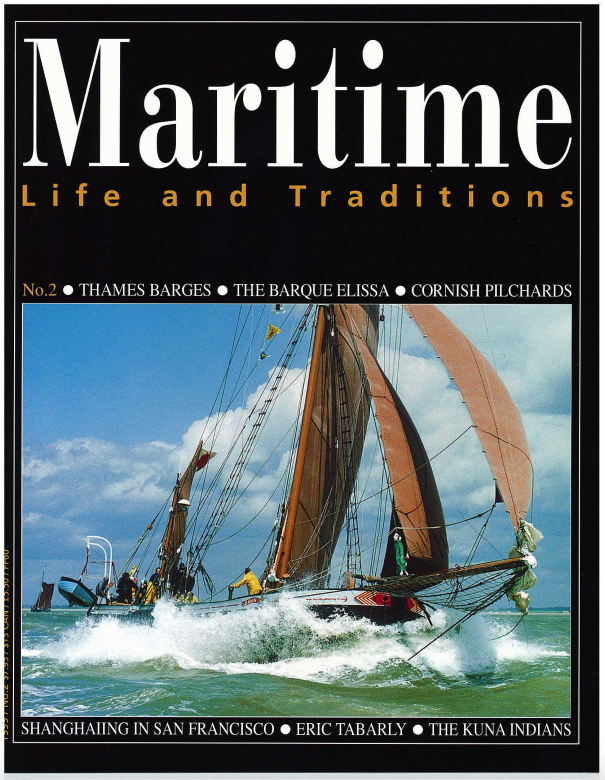
The history, construction, rig, performance, trade, manoeuvring, and on-board life of the unique cargo carriers of southeast England. Flat-bottomed with a large and versatile sprit rig, and lifting leeboards, the Thames barge was perfectly adapted to its environment and trade, and through the nineteenth century was the principal provider of commercial carriage to and from London.
SHANGHAI DAYS IN SAN FRANCISCO
By Bill Pickelhaupt
Between 1850 and 1910, the act of forcibly recruiting ocean-going crews from the city of San Francisco involved people from all walks of life, and all levels of society. This profitable, albeit illegal, trade infiltrated the very core of the community and spawned legendary stories and almost mythical personalities. Its demise was only brought about by a worldwide change in economics and technology.
THE KUNA AND THE ULU
By Tom Zydler
In the San Blas islands of the Caribbean, the Kuna Indians are among the world?s few remaining indigenous tribal people. Their way of life has evolved and yet they still maintain traditions, customs, and daily structures that have formed their society for centuries. A maritime people, the Kuna spend their days in and around boats, none more important to them than their dugout sailing canoes, known locally as ulus.