
 The Dory Heritage Project
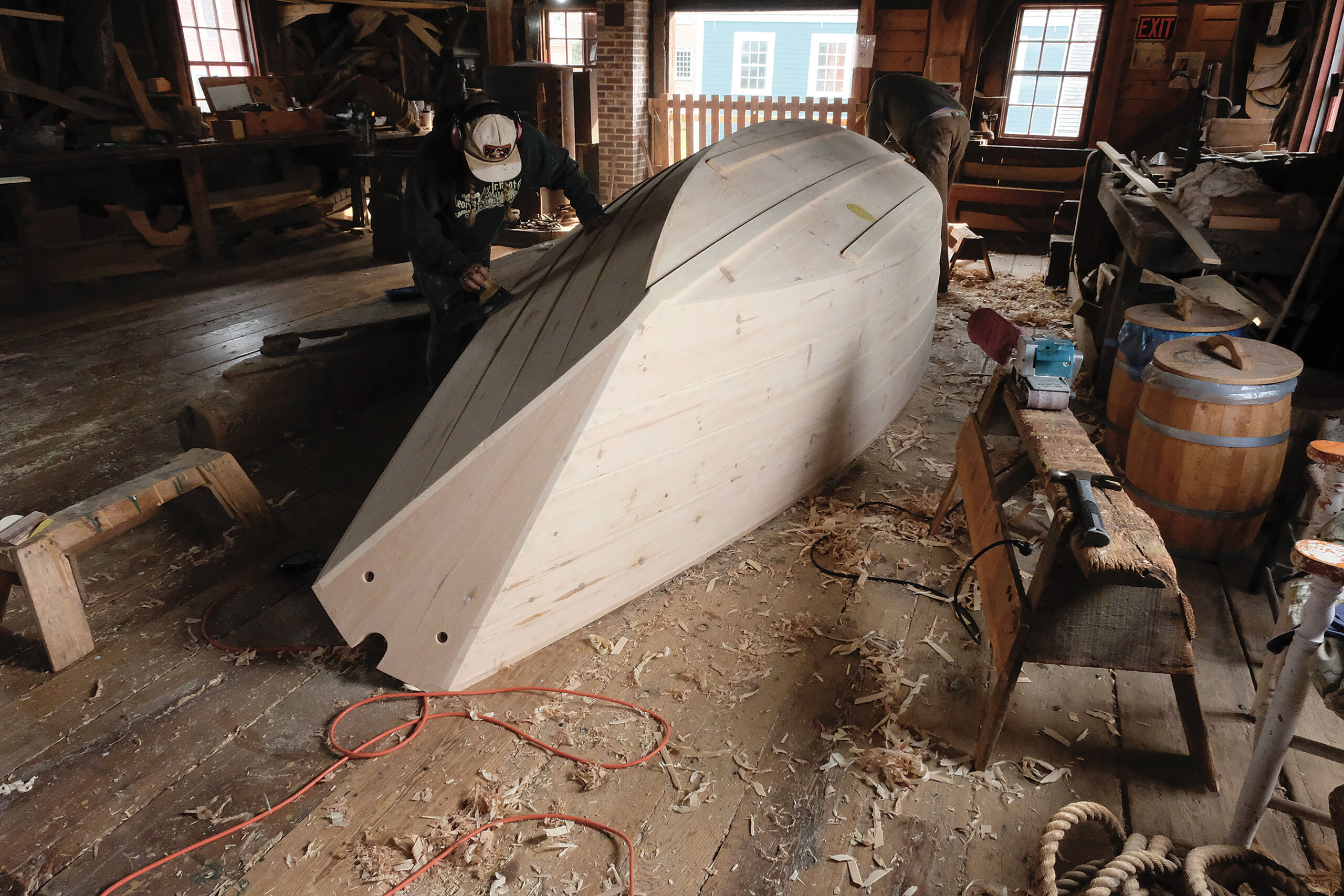
The Shelburne Dory Shop, located in the Nova Scotia town’s Museums by the Sea since 1989, continues unbroken dory construction traditions dating to 1880.
In 2019, when the boatbuilder Brad Dimock, who specializes in Grand Canyon river-running dories, was teaching at WoodenBoat School in Maine, he took a side trip to Shelburne, Nova Scotia, to see the Shelburne Dory Shop and write about its work (see WB No. 273). During his visit, he befriended Milford Buchanan, the boatbuilder who was then carrying on the traditions established at a boatshop by Isaac Crowell in 1880. Brad also learned that Milford’s tenure at the shop would soon be coming to an end with his retirement, risking the disappearance of centuries-old techniques.
Realizing that Milford was the custodian of the purest dory-building tradition known to exist—and that he had no apprentice to carry it on—Brad sprang into action. His initial plan was to travel to Shelburne and build one more dory with Milford to document the traditions so that the knowledge would not be lost. Brad asked Cricket Rust, his partner at Fretwater Boatworks in Flagstaff, Arizona, to join him. He also approached me, as a dory builder maintaining the tradition at Lowell’s Boat Shop in Amesbury, Massachusetts, to do the same, and in addition we formed what we called the Dory Heritage Project. I suggested that we also invite Douglas Brooks of Vergennes, Vermont, to the team, given his experience of recording—and publishing accounts of—the nearly extinct Japanese traditional boatbuilding traditions he has studied for much of his life.
One would think that building a rather simple boat such as a dory would be straightforward for any boatbuilder; however, the remaining traditions have variations, and each has its own nuances. The project team traveled to Shelburne to capture every nuance of Milford’s process, from lofting parts to shaping floors and plans, using tools and methods largely undocumented except in Milford’s mind.
 The Dory Heritage Project
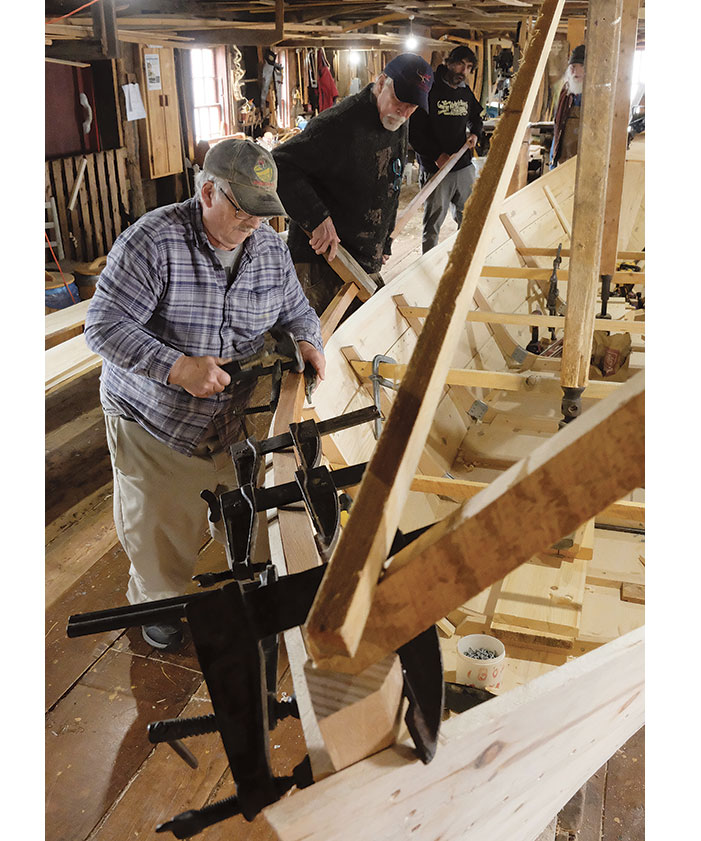
Milford Buchanan (left), who is soon to retire, installs a heavy inwale while Brad Dimock induces twist and Graham McKay minds the after end. Dimock and McKay, two of the principals of the Dory Heritage Project, documented Buchanan’s methods.
Fundraising for the Shelburne project has been done entirely through social media and a John Gardner Grant from the Traditional Small Craft Association. With that support, our team set out in May 2023 for Shelburne for a two-week dory construction. The results of that effort can be seen in our recently published book, How the Old Fella Done It, sales of which will support future work by the Dory Heritage Project.
While some might think that Milford is the “old fella” of the title, for Milford the old fella was most often Bill Cox, who taught Milford how to build dories. Part of what makes the Shelburne tradition genuine is that Milford has varied the process very little from what Cox taught him, and he was very keen to ensure that he related to us the process just as it had been taught to him. Cox, in turn, learned from Sidney Mahaney, who began working at the shop in 1914 only 34 years after its founding in 1880, meaning that he potentially worked with some of the shop’s original builders. The boatshop closed in 1971, but it was resurrected as the Shelburne Dory Shop in the town’s Museums by the Sea in 1983, and Mahaney continued building dories there until 1993. His son, Curtis, took over after his retirement, and then Milford learned from Curtis Mahaney. It is a rare example of a short and unbroken lineage of boatbuilders, each passing on the tradition over more than a century.
We consider this dory only the first of the Dory Heritage Project’s accomplishments. We hope to replicate this approach to document other endangered traditions, among them the other dory-building legacies at Lunenburg, Nova Scotia; in Massachusetts both at Lowell’s Boat Shop and in Gloucester; and even at Saint-Pierre and Miquelon, the French territorial archipelago just south of Newfoundland. We envision combining these findings into one greater publication that compares and contrasts methodologies. Another potential project involves building a river dory out West, in Brad and Cricket’s territory, with a prolific builder who is also nearing retirement with no heir-apparent. Somewhat off the dory line, but in the same vein, I am pursuing a project in the Azores to build an Azorean whaleboat (see related article, page 62) and record the process in a book building on the work of Bruce Halabisky and Lance Lee in Twice Round the Loggerhead: The Culture of Whaling in the Azores (Mystic Seaport Museum, 1999).
While the name may be deceiving, we do not want to limit the work of the Dory Heritage Project strictly to dories. The team is open to recording any boat type or tradition that is threatened with extinction. We are always inspired by the work of John Gardner, the boatbuilder and maritime historian whose books on dories and small boats are invaluable resources for builders today, nearly half a century after he published them. Those books exist only because he had the presence of mind to record boats that he saw disappearing; we still see boats and building traditions disappearing today, and our hope is that we can get as many of them recorded for posterity as possible.
Graham McKay is a boatbuilder and the executive director of Lowell’s Boat Shop in Amesbury, Massachusetts, founded in 1793 and the oldest continually operated boatshop in the United States. See also www.douglasbrooksboatbuilding.com. The book How the Old Fella Done It is available at The WoodenBoat Store or the Lowell’s Boat Shop website.
Around the Yards
 Nic Compton
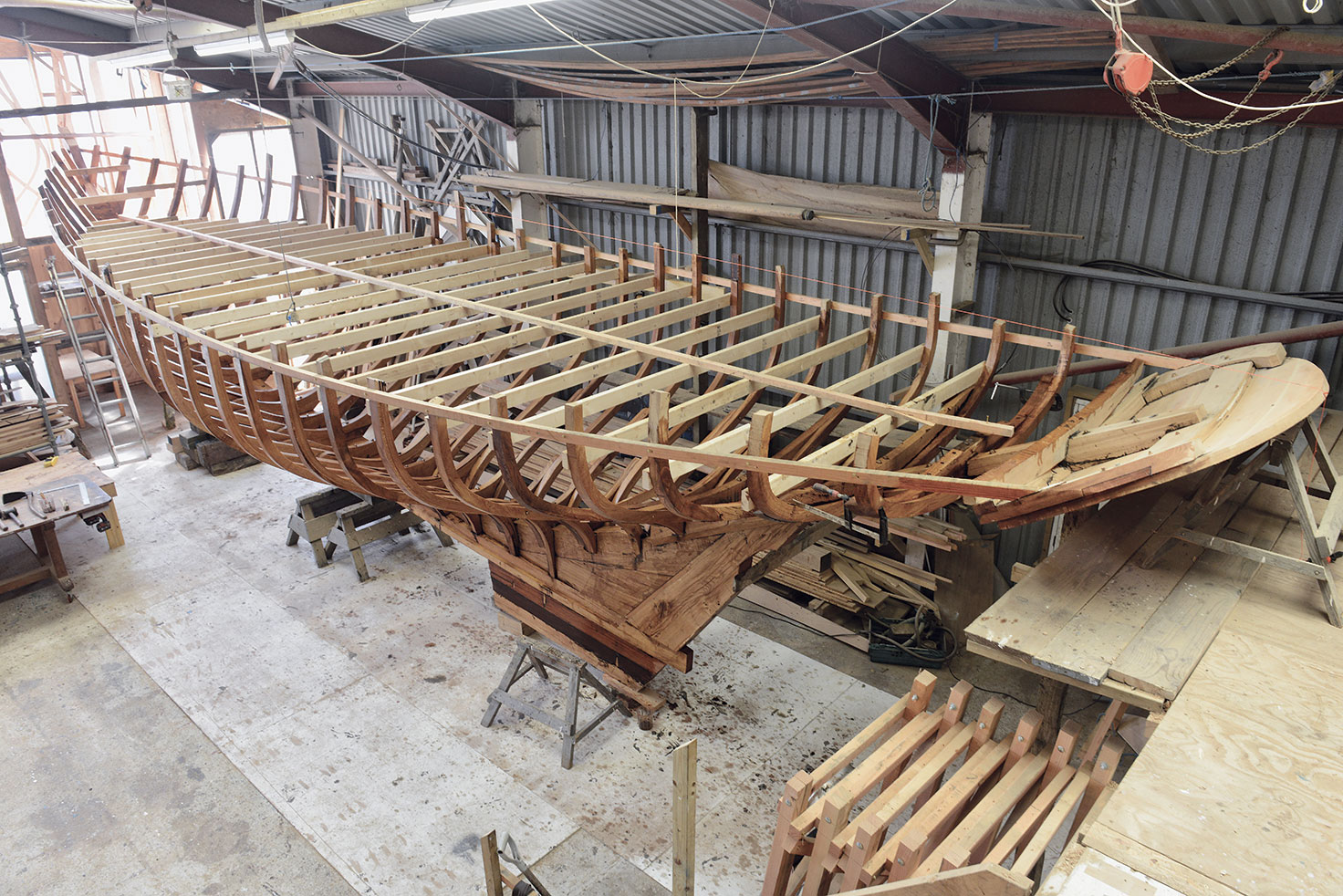
A 47′ LOA John G. Alden–designed Malabar IV is under construction at Ben Harris & Co. in Cornwall, England.
◼︎ “Boatbuilders don’t usually get to choose the boats they build—that is generally the owner’s prerogative,” Nic Compton writes from England. “British boatbuilder Ben Harris decided to buck that trend and build the boat of his dreams ‘on spec’—or at least to start it with the hope that some visionary owner would take up the challenge and fund the project’s completion. The boat? Nothing less than a 47‘ LOA John Alden Malabar IV schooner. The deadline? Summer 2027, when Ben hopes the boat will compete in the Fastnet Race alongside Leo Goolden’s recently restored Albert Strange cutter TALLY HO (see WB 302).
“It’s a tall order, but if anyone can get it done, it’s this quietly determined boatbuilder. Over the past decade or so, Ben Harris & Co. (www.benharrisboats.co.uk) in Cornwall has produced an impressive line of finely crafted wooden boats, including the 24‘ PANACEA (see WB No. 268) and the 34′ CONSTANCE (see WB No. 290). Earlier this year, the stars aligned, and Ben decided it was finally time to throw caution to the wind and launch his most ambitious project to date. ‘I’ve wanted to build an Alden schooner for a long time,’ he says. ‘For me, they represent the pinnacle of wooden boat building. Earlier this year, everything fell into place: the wood had seasoned, we had space in the workshop, and several interns from boatbuilding schools wanted to come over to learn traditional boatbuilding skills.’
“Indeed, interns have proven crucial to the project, supplying the necessary labor in return for hands-on experience of building a traditional yacht, a relatively rare event these days, especially on this scale. It started with Remi Guillet, a French furnituremaker studying boatbuilding at the Ateliers de l’Enfer in Douarnenez. Remi was already at the yard when Ben decided to go ahead, and he made a half model, helped to loft the lines, and started building the floor timbers and frames in short order.
“When I visited Ben’s yard in July, the centerline timbers and frames were all set up, with the stem poking out into its own purpose-built extension. And what a fabulous sight it was: the skeleton of a magnificent oceangoing boat, looking surprisingly dainty for a 47-footer. So sculptural was this structure that it wouldn’t have looked out of place on exhibit at the Tate galleries.
 Nic Compton
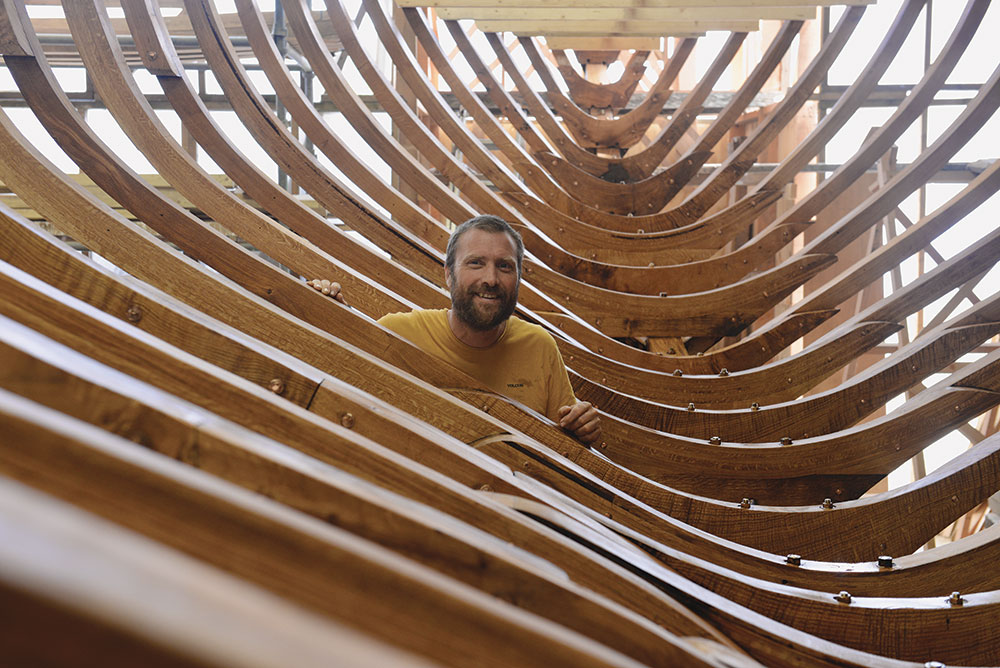
Ben Harris hopes to sail the yacht in the 2027 Fastnet Race.
“Ben and his team have made a few minor changes to the original specifications to plans ordered from the MIT Museum, including using a combination of grown- and laminated-oak frames instead of the original steam-bent ones—all carefully calculated to Lloyd’s scantling rules with the assistance of yard intern Corin Nelson Smith, a recent graduate in yacht design and production. The plans called for an almost full-length cast-iron ballast keel, which would have to have been cast by a foundry, but instead the yard will cast its own shorter lead keel.
“The yard was a buzz of activity when I visited, with three full-time boatbuilders working on restoration projects and two interns doing voluntary work on the schooner. ‘I’m from Maine, where there’s no shortage of boatyards,’ said Wyatt Bruce, who is halfway through the boatbuilding and restoration courses at the IYRS School of Technology and Trades in Newport, Rhode Island. ‘But I was curious about English boatbuilding. They are still sailing Alden schooners where I come from, but no one is building new ones. I was attracted by the scale of the project and the idea of cutting sawn frames, instead of steamed timbers.’
“One catalyst for the Malabar IV project was Goolden’s announcement that he intends to enter TALLY HO [see WB No. 302] in the 2027 Fastnet to mark 100 years since she won the race. TALLY HO won on handicap, but the first boat over the line was LA GOLETA, an Alden Malabar VIII. Ben’s dream is to complete his new boat in time to also enter the 2027 race and re-create the friendly rivalry between TALLY HO and a Malabar schooner.
“Although Ben’s Malabar IV is unlikely to be completely finished by the race date (July 24, 2027), he is hoping to have the hull, rig, and engine completed in time. The race is now on to find an owner willing to take the helm.”
 Abernethy & Gaudin Boatbuilders
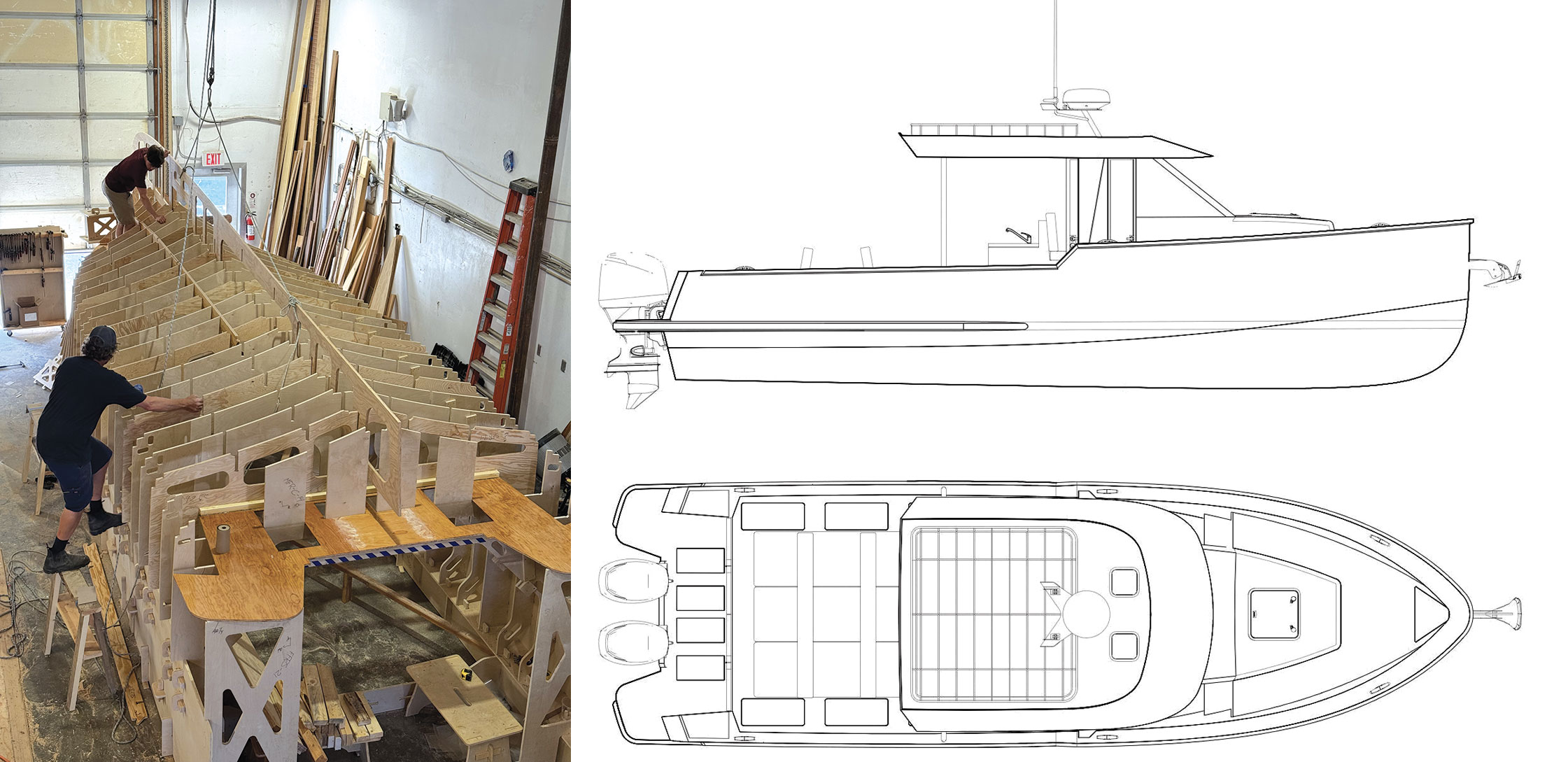
Left—A new 30′ coastal cruiser designed by Greg Marshall of Victoria, British Columbia, is under construction at Abernethy & Gaudin Boatbuilders in nearby Sidney. Above—The boat, built for versatility, draws on locally available materials.
◼︎ “Not long after WoodenBoat published a feature on ZEST, the 62′ Bill Garden–designed power cruiser we had the privilege to restore (see WB No. 294) for naval architect Greg Marshall of Victoria, we received a call from a local man interested in having a new wooden boat built,” Rob Abernethy writes from Abernethy & Gaudin Boatbuilders Ltd. in Sidney, British Columbia, Canada. “It was actually Greg who first received the call from Chris Raper, who had in mind a custom design for a versatile and seaworthy 30‘ wooden coastal cruiser with ample space for summer cruising with grandchildren, dinners with friends, and adventurous fishing trips. A true Swiss Army knife of a boat.
“The earlier article wasn’t just about ZEST; it was equally about the special relationship between Abernethy & Gaudin and Greg’s design office. Greg’s gears started turning right away, and with a concept in mind he started sketching. With very few revisions, all three of us—Chris, Greg, and I—agreed: we had something special here. The inspiration for the hull design comes from LINNET, another well-known Garden-designed yacht that is renowned for her handling and surprisingly small wake. This new design, modified to have a plumb stem, will be scaled down, but we are confident those characteristics will remain.”
The yard hopes the boat, which is expected to launch in spring 2026, will also promote boatbuilding in British Columbia using local, renewable resources. “The West Coast has always been shaped by its connection to the sea and to wood,” Rob wrote. “Our forests produce some of the finest boatbuilding timber in the world: western red and Alaska yellow cedars, Douglas-fir, and Sitka spruce. It only makes sense to use and celebrate these resources in modern designs.
“Over the years, we have specialized in high-end wooden boat restorations and new construction, always striving to combine traditional craftsmanship with innovative techniques. We believe the future of wooden boat building lies in balancing heritage with technology. One of the biggest challenges in wooden boat building is the labor cost, which is often the reason wooden boats aren’t built in North America the way they once were. We worked closely with Greg’s team to come up with a construction plan that is time-saving and high-quality. Clever design, paired with tried-and-true building methods, is the key. Our CNC machine has played a big role in this. Already, we’ve seen excellent results: our knock-together, reusable mold for the 30-footer’s hull went together in just 16 man-hours—and it is accurate to within 1⁄16″.
“We’re building the prototype of what Greg is calling the Aspiration 30 now, using 100 percent B.C.-sourced wood. The new cruiser will be powered by twin 150-hp outboards, though that can be customized based on owner needs. The plan is to have Chris and his family out on the water next summer and to have a design ready to reproduce efficiently and affordably, without compromising on craftsmanship.”
Abernethy & Gaudin Boatbuilders, Ltd., 111–2031 Malaview Ave., Sidney, BC, V8L 5X6, Canada; 250–544–9090.
 Daniel Caparrós Torres
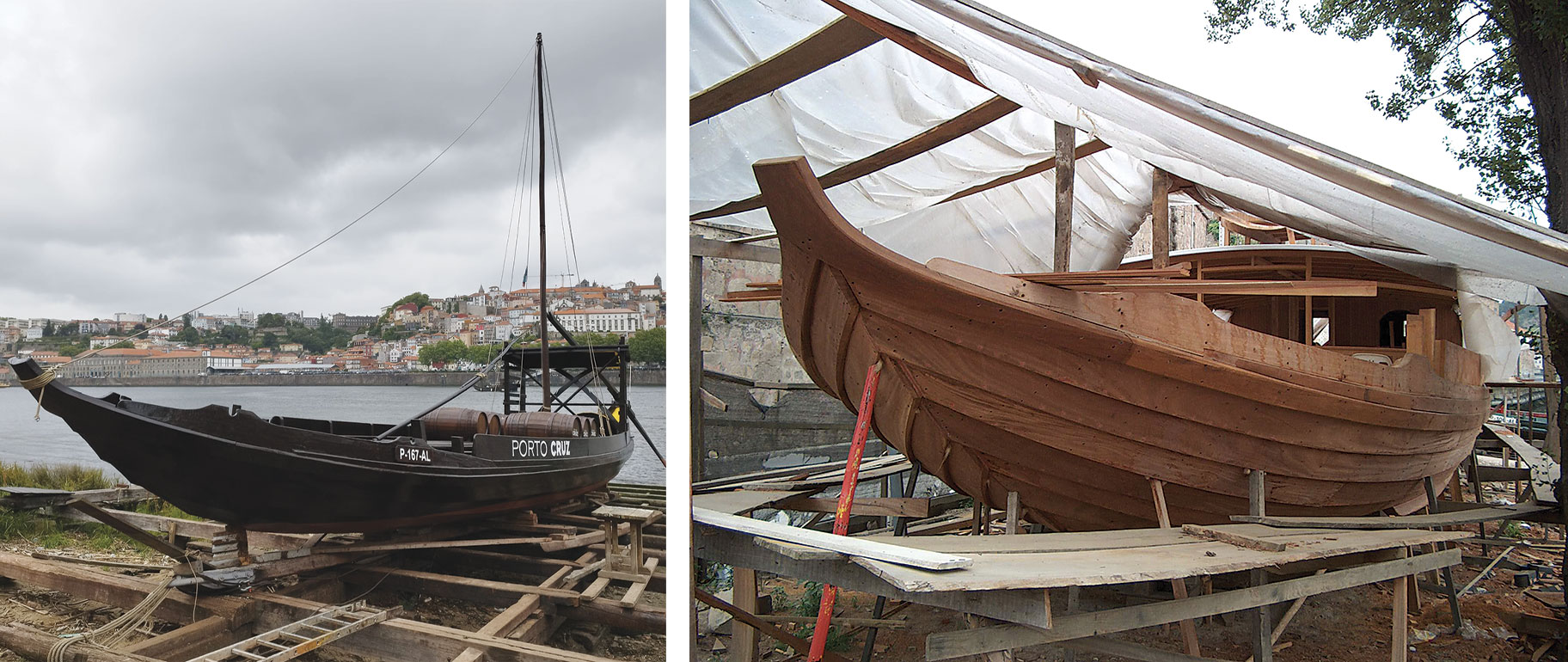
Left—A tradition of rabelos, which once carried barrels of port wine on the River Douro in Portugal, is being kept alive by the boatyard Socrenaval in Porto. Above—Occasionally, the yard builds a new rabelo to join the fleet of about 30 that the yard maintains.
◼︎ “Drift down Porto’s cobbled alleys, carried on the tide of tourists, and you soon reach the river’s edge, staring at the broad sweep of the Douro,” Daniel Caparrós Torres writes from northern Portugal. “From the Ribeira, the old waterfront quarter, the river opens beneath the iron span of the Luiz I Bridge—an early feat of engineering by Gustave Eiffel that still links the two banks high above the waterline. Across the river, Vila Nova de Gaia tumbles downhill in uneven terraces: apartment blocks, fading wine estates, wooded slopes slipping toward the quay. At water level, port wine lodges stand in neat rows beside the old loading docks. Today they serve as backdrops for selfies and tastings, but for centuries they were the backbone of a river economy largely based on port wine that shaped Porto’s identity.
“Tucked into the curve of Gaia’s cais—its riverfront quays—stands Socrenaval, the last shipyard on the Douro still devoted to rabelos, the flat-bottomed wooden boats that once ferried barrels of port to Gaia’s cellars (see WB No. 112). At first glance the yard looks modest: a couple of containers, a wooden ramp into the water, a canopy for shade. Yet this is how boats have always been built here—outdoors, with the river in sight.
“Founded more than a century ago, Socrenaval is among the last boatyards building wooden boats in northern Portugal. Its survival has never been guaranteed. António Sousa, who left a career at a French multinational corporation to take over the family yard, recalls nearly two decades of pressure from local authorities eager to reclaim the waterfront. ‘It was a somber period,’ he says, one that threatened ‘the dismantling of the yard and the loss of identity in the historic center of Vila Nova de Gaia.’
“In 2022, an agreement allowed Socrenaval to remain on its historic site. Since then, Sousa says, the municipality has begun to recognize its cultural value as a guardian of wooden boat building traditions. The yard now employs 10 people—‘a team of shipwrights and caulkers,’ as he puts it—who restore about 30 boats a year, with the occasional new construction. ‘All the traditional sailing rabelos moored on the banks of the Douro were built by our company,’ he adds with pride.
“The rabelos themselves are long, flat-bottomed boats, usually about 65′ LOA, built with overlapping planks and steered by an espadela—a long sweep oar mounted at the stern. Once, they carried port wine from the Upper Douro to the lodges, or warehouses, of Gaia; now they serve as floating symbols of a history that refuses to fade. Each June, they return for the São João regatta, part race, part festival, part act of remembrance.
“But Socrenaval has never confined itself to rabelos alone. Decades ago, the company began to diversify, building river cruisers modeled on traditional craft. Its latest project is XÁVEGA, a sleek wooden boat inspired by the beach-launched fishing craft of the central coast region used for a seine fishing technique called arte xávega. With clean lines and modern finishes, it shows how heritage can be reimagined for contemporary use. ‘The conservation of maritime heritage is, in itself, a source of great pride,’ Sousa says.
“These days his focus is on renewal. Plans are in place to redevelop the yard to upgrade facilities while preserving the essence of wooden ship building. A bid is underway for national heritage recognition and as part of UNESCO’s cultural listings. In the meantime, Socrenaval keeps its gates open to school groups and tourists from around the world. Visibility, Sousa believes, is part of survival.
“Once, 13 shipyards lined the river between the Luiz I Bridge and the fishing quarter of Afurada. Today, only Socrenaval remains. But as long as there is a yard, there will be someone to caulk the seams of a rabelo. And if the rabelos keep sailing, the river will keep remembering.”
Offcuts
 Bruce Kemp
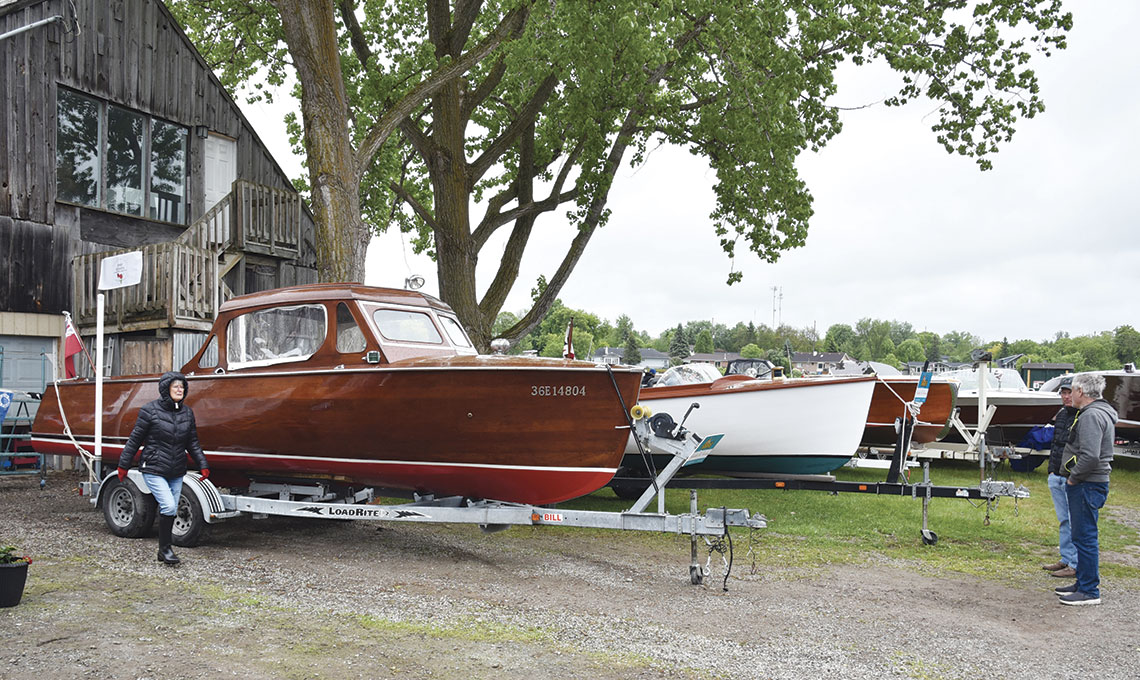
A new event, the Merrickville Wooden Boat Show, was held in Ontario, Canada, in May.
◼︎ “Cold and rainy weather didn’t stop nearly a thousand people from attending the new Merrickville Wooden Boat Show at the end of May,” Bruce Kemp writes from Ontario, Canada. “Andrew Lee, the owner and lead boatbuilder at Sirens Boatworks, which sponsored the show, told me that one couple from Manitoba, nearly 1,000 miles to the west, even changed their plans so their visit to the area would coincide with the boat show.
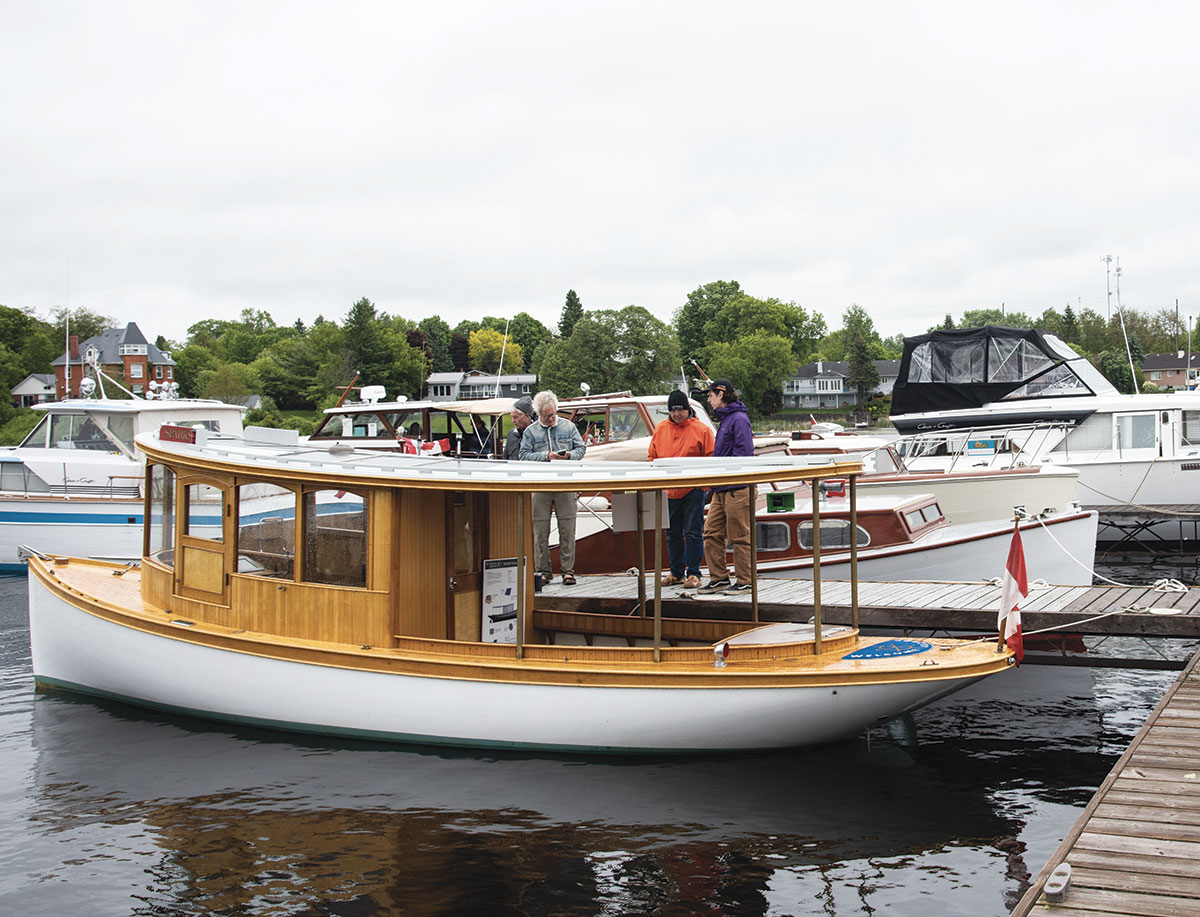
“Sixty-five boats—40 ashore and 25 in the water—were on display, including AQUA VELVA, a mint-condition Greavette owned by Rick Hughes of Gravenhurst. ‘He’s worked with Dwight [Boyd] from Clarion Boat of Muskoka,’ Andrew said. ‘He’s in the loop and he’s done the job. Just a fantastic boat.’ A 1959 classic Riva was also among the featured boats. So were two boats that have been the subject of features in WoodenBoat: SPARKS, Ted Moores’s 30′ 3″ all-electric fantail launch, which Greg Rössel wrote about in WB No. 219; and SKIPPER, a classic 1949 runabout whose reconstruction at Sirens Boatworks after a devastating fire was the subject of my article in WB No. 281. Most of the boats afloat could be boarded for closer inspection.
 Bruce Kemp
SPARKS, an all-electric fantail launch, was one of the boats in the on-the-water portion of the show.
“A Merrickville resident and first-time boat restorer, Nick Previsich, showed off the 1962 production mahogany runabout that he had recently completed and wheeled out of his backyard shop. ‘I thought the show was fabulous,’ he said. ‘The weather was crap, but hey, that’s spring in Canada. Despite the weather, there was a steady coming and going that made the day worthwhile.’ Also, a local club brought in a large display of ship models, everything from destroyers and cruise ships to fully submersible U-boats.
“‘We’re pretty happy,’ Lee said in a post-show meet-up. ‘I got a better turnout than I expected.’ Some builders who took a wait-and-see approach have already called to book spots for next year. Lee and his wife, Ashley, who handled most of the organization, got a lot of support from the Manotick Classic Boat Club, which is based just north of Merrickville and is also on the Rideau Canal. They’re intending for the show to become an annual end-of-May event.”
Sirens Boatworks, 253 Amelia St., Merrickville, ON, K0G 1N0, Canada, 613–661–6964.
 Michael Jones
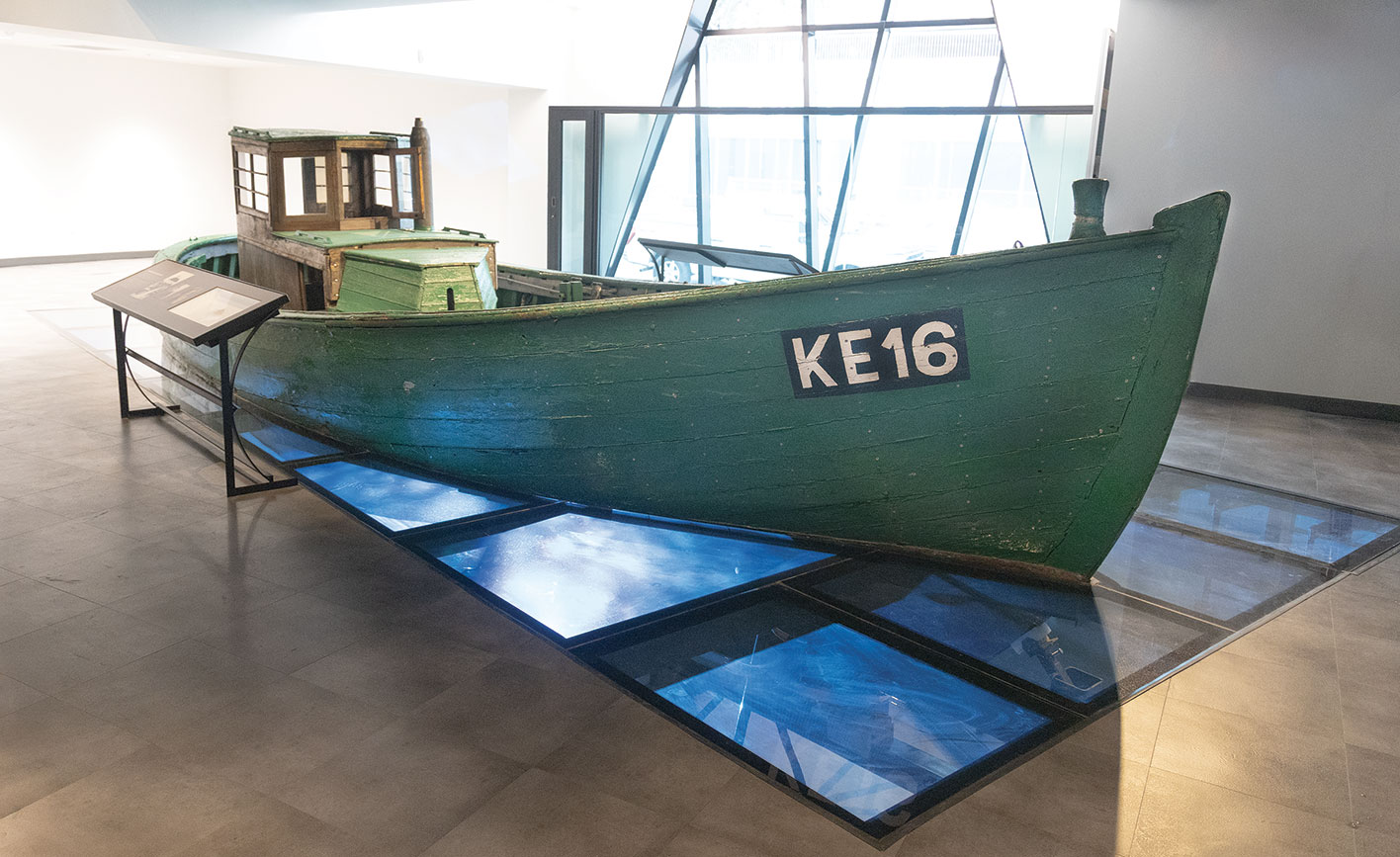
During the German occupation of Denmark, the 1930s fishing boat THOR was one of many boats that in August 1943 smuggled Jewish citizens to safety in Sweden. She has recently been placed on display at The Florida Holocaust Museum in St. Petersburg.
◼︎ Michael Jones writes from Florida about his work to conserve a Danish rescue boat for The Florida Holocaust Museum (TFHM) in St. Petersburg: “One October evening in 1943, during the third year of German occupation of Denmark, Erik Olsen slipped his boat THOR out of Køge harbor for a night of fishing. But this was not a normal night; he carried a Jewish family of four, who were hidden aboard, across the Öresund to neutral Sweden and safety. Similar acts of courage occurred on hundreds of boats along the working waterfront of Denmark that month, when Danish citizens acted in defiance of Nazi Germany’s plans to deport the Danish Jewish community to concentration camps. In a three-week period, 90 percent of the country’s Jewish population, or 7,200 people, were transported to safety in Sweden.
“Eight decades later, descendants of those Danish survivors found THOR, one of the few rescue boats still in existence. Through the dedication of Irene Weiss and Margot Benstock, THOR was transported from Denmark to St. Petersburg, and preparations began for it to be featured in TFHM to preserve and commemorate acts of courage and compassion. While modifications of the museum’s building were being made, work began on stabilizing THOR, a classic Danish double-ended fishing boat 34‘ LOA with a 13‘ beam. THOR is oak-framed with iron-fastened pine planking, a small pilothouse aft, a small deckhouse covering the engine, and a live well amidships. She was built in the 1930s to a traditional design little changed from earlier sailing fish boats.
“Overseeing the boat’s transition from an old working vessel to a museum exhibit is Peter Fix, an archaeological watercraft conservator with Texas A&M University. To prepare the boat for being lifted by crane into a custom-built cradle, we added plank fastenings and temporary athwartships bracing to the framing, which was in good condition, with no repairs necessary. We removed the engine, which was not original. We also took out a massive engine-driven windlass, which late in the boat’s working life had been installed over the live well for eel fishing.
“In December 2024, THOR was fitted into the cradle, trucked into downtown St. Petersburg, and fitted into its permanent berth inside the museum. Once in place, structural repairs were made to the pilothouse, and the cabintop over the engineroom was rebuilt matching original construction methods. The boat’s original decking consisted of individual removable panels made up of athwartships planking with caulked seams. These panels were not fastened down, so they were removed, cleaned, and reset by Texas A&M conservators, who also reconditioned the pilothouse windows and doors.
“TFHM will reopen September 9, 2025, with THOR featured as the centerpiece on the first floor along with one of the few remaining railroad boxcars of the type used by the Nazis to transport prisoners to concentration camps. THOR is a powerful symbol of what individuals with courage can do in the face of injustice.”
For more information, contact The Florida Holocaust Museum, 55 5th St. S., St. Petersburg, FL 33701.
 Jane Crosen
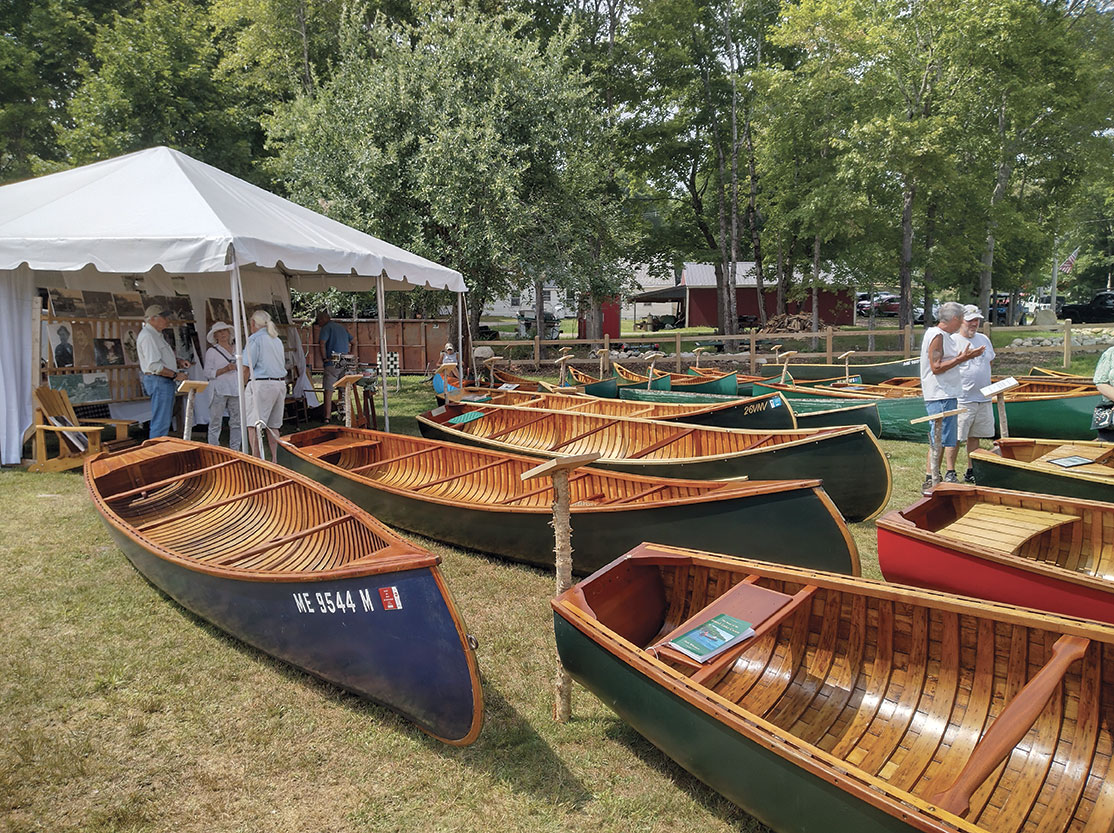
A July folk art festival in Grand Lake Stream, Maine, highlighted 29 of the area’s distinctive wood-and-canvas canoes.
◼︎ WoodenBoat’s copyeditor, Jane Crosen, and friend Andrea Olsen of Grand Lake Stream report on a “family gathering” of 29 canoes at the Grand Lake Stream Folk Art Festival in July: “Canoes, canoes, canoes—square-sterned Grand Lakers and double-enders. The display showed the evolution of the Grand Lake canoe, from the early builders in the 1920s until today, the most comprehensive collection exhibited in the festival’s history. Canvas-covered double-ender guide canoes predating the Grand Lakers were also represented.
“The Grand Lake Stream Folk Art Festival began in 1995 as an event showcasing the area’s natural beauty and unique heritage, incorporating folk art and music with an outdoorsy theme. Founders Cathy and Bill Shamel and Sophie Melanson still coordinate the festival, helped by volunteers from the community and beyond. The canoe exhibit this year was organized by Steve Keith, a Grand Lake Stream resident. Keith’s first double-ender guide canoe, displayed at the festival, was the 17′ 6″ Flying Cloud, featured in Benjamin Mendlowitz’s 1998 Calendar of Wooden Boats.
“Bill Shamel, who established Shamel Canoe Works, taught Grand Laker canoe building at WoodenBoat School for six years. His wife Cathy’s father, Lawrence ‘Pop’ Moore, was one of the four featured family lineages in the Grand Lake Stream exhibit, along with the Bacon, Sprague, and Wheaton families. Fastened to a thwart on each canoe representing these multigeneration lineages was a copy of Dale Wheaton’s newly published book, The Story of the Grand Lake Canoe, with a string marking the chapter featuring each builder and design. Dale, a noted guide and storyteller, completed and published his longtime project just days before he died in November 2024.
“The canoe display drew over 2,600 visitors, guides, builders, boatowners, and family members who passed through the festival sharing stories. Some labels were updated on the spot as builders compared notes on specific characteristics of the older boats on display and the lineages they represented.
“There was skill both in building and adapting the canoes as motors added speed and challenge on nearby 14,000-acre West Grand Lake and island-strewn Big Lake. The exhibit included a mint-condition Grand Lake canoe designed and built by brothers Kenny and Basil Wheaton in 1947. Two early motors were also on display: a Johnson Water Bug from the 1920s, and a 2.5-hp Johnson Sea Horse from the 1950s.
“Several traditional double-enders were in the display: an early guide canoe designed and built by Herbert ‘Beaver’ Bacon for famed guide Earl Bonness, circa 1930s; a 20′ guide canoe designed and bult by Old Town Canoe Company in 1976, loaned by Art Wheaton; and the oldest, circa 1880s–90s, a blue courting canoe designed and built by J.R. Robertson, used on the Charles River in Boston, and restored by Steve Keith.”
For more information, see www.grandlakestreamfolkartfestival.com.
Across the bar
◼︎ Brian Fagan, 88, July 1, 2025, Santa Barbara, California. A native of England, Mr. Fagan was an archaeologist who received his PhD from Pembroke College, Cambridge. He emigrated to the United States in 1966 and a year later became a professor at University of California, Santa Barbara, where he worked until his retirement. He wrote more than 50 books, including textbooks and academic works but also popular takes on archaeology. An avid sailor, his work included some explorations of maritime themes, for example, Fish on Friday: Feasting, Fasting, and the Discovery of the New World (Basic Books, 2006); Beyond the Blue Horizon: How the Earliest Mariners Unlocked the Secrets of the Ocean (Bloomsbury Press, 2012); Fishing: How the Sea Fed Civilization (Yale University Press, 2017). He also published well-regarded cruising guides to the California coast. His oeuvre included one WoodenBoat article, “Claud Worth: Eye Surgeon, Victorian Gentleman, Yachtsman,” published in WB No. 131, which told of the pioneering English sailor’s cruising adventures. 