
 Leo Goolden
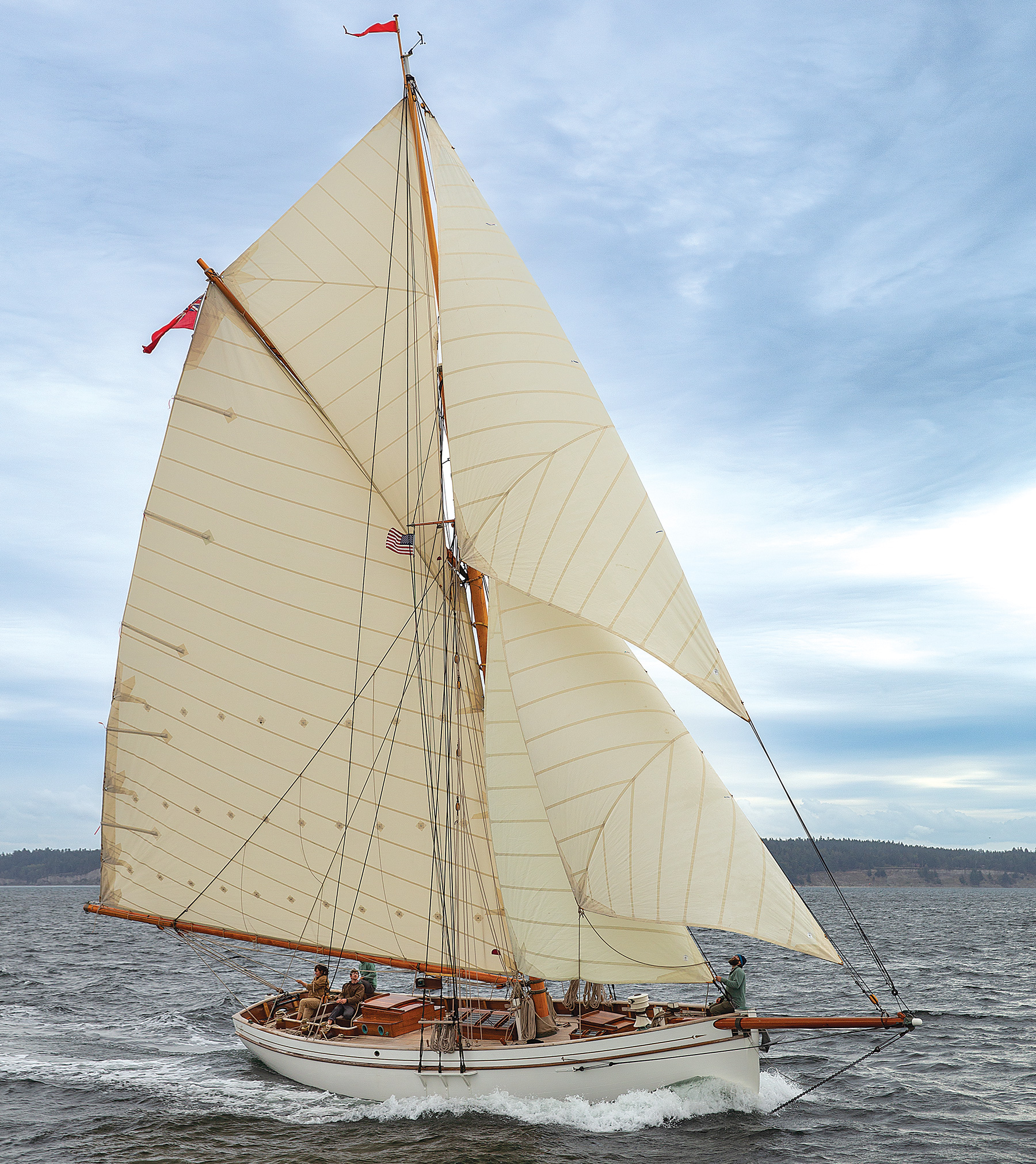
TALLY HO, the 1927 Fastnet Race winner, was relaunched in April 2024 in Port Townsend, Washington. Top right—Leo Goolden’s first YouTube video, from which this still photo was taken, documented his first encounter with the yacht in 2017.
Thad Danielson, a Massachusetts boatbuilder, knows exactly how close to oblivion the 1910 British yacht TALLY HO was in 2017, just before the English boatbuilder and sailor Leo Goolden bought her for $1.
A shadow of her former self, the yacht had lived through numerous changes, including an ignoble conversion to a commercial fish boat operating out of Brookings, Oregon, far from any yachting center. By the early 2010s, she had been all but abandoned after a man who bought her, and formed a nonprofit organization for her restoration, died before his dream could even get started.
She limped along, but in time the marina boatyard seized her for unpaid bills and hauled her out for auction or destruction. Hurriedly, an association based in England that is devoted to TALLY HO’s designer, Albert Strange (1855–1917), founded a limited liability company—with Danielson among its principals—to acquire the 47′6″ × 12′10″ × 7′ hull. The idea was to hold her for the arrival of a hoped-for messiah. A good-hearted volunteer got a rain cover on her and even put up a small sign about her illustrious yachting history: she was launched as BETTY in 1910 but she won the 1927 Fastnet Race after being given the name she still carries today. Nevertheless, the boatyard’s patience, already thin, was running out. If she wasn’t gone by June 2017, the yard was prepared to break her up and be done with it.
“The obvious expectation, or hope,” Danielson said, “was that some multimillionaire would want to bring it up to some big yard in England,” with a vision of a full-blown restoration, followed by sunny Mediterranean classic-yacht regattas and, the dream was, maybe even another run at the Fastnet Race.
“But nobody of that sort showed up.”
 Leo Goolden
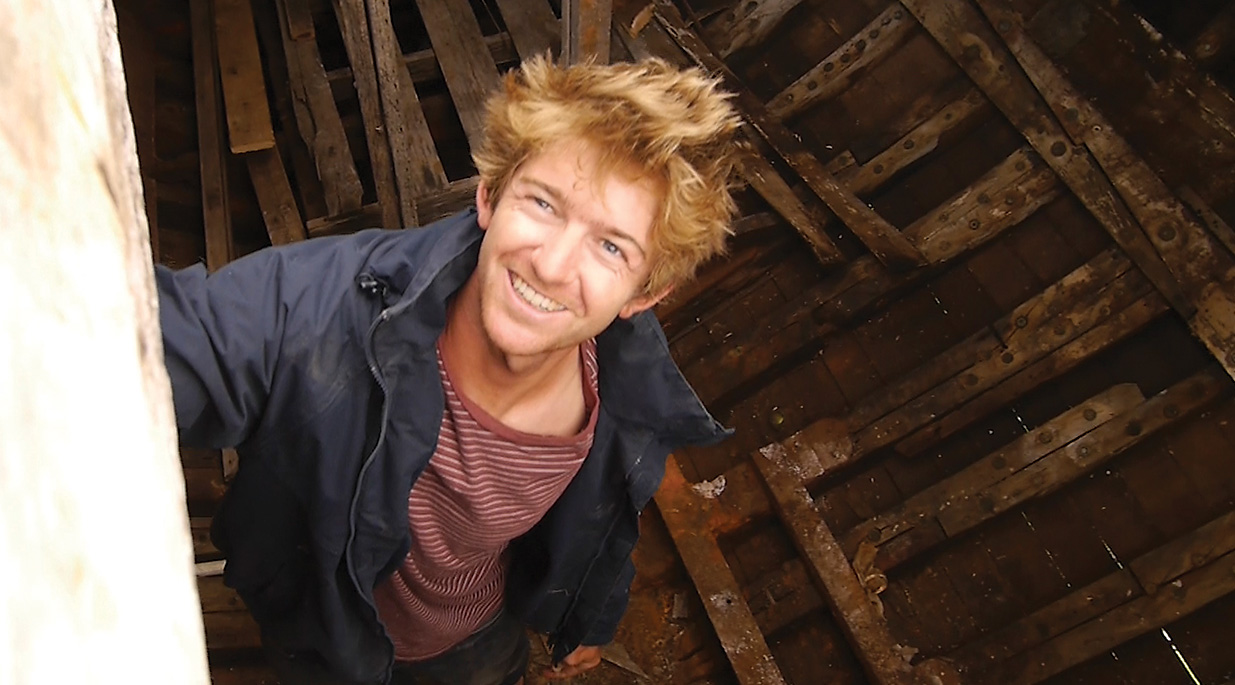
Leo Goolden’s first YouTube video, from which this still photo was taken, documented his first encounter with the yacht in 2017.
Instead, a skinny English 27-year-old, who was decidedly not a millionaire, stepped up. Goolden made an overture to the Albert Strange Association (ASA; www.albertstrange.org) to say his interest in the boat was serious and that he wanted to have a look at her. He didn’t come from wealth, but he was as convincing as he was frugal, having squirreled away enough savings to at least get started on a major project of the kind he was looking for. He had traveled extensively before going to work alongside such noted traditional boatbuilders as Luke Powell and Ashley Butler in southwest England while living on the cheap. He restored a Nordic Folkboat and sailed her across the Atlantic, then gained extensive sea experience as a paid professional crew, including time as skipper, on large sailing yachts. The ASA leadership remained skeptical of him, “but he was persistent,” Danielson said.
Danielson at the time owned SEA HARMONY, a 33′ Strange-designed yawl of 1936, and was the most active U.S. member of ASA. He was also the closest member to TALLY HO, so the association flew him out to Seattle, Washington, to show the boat. He met up with a family friend of Goolden’s who happened to live in Sequim on the state’s Olympic Peninsula, not far from Port Townsend, and when the two of them went to the airport to pick up Goolden for the long drive to the southern Oregon coast, Danielson was surprised to see him emerge in company with another guy. His companion was a photographer who had left some camera equipment aboard the three-masted schooner ADIX during the Antigua Classic Yacht Regatta, and Goolden, then ADIX’s bosun, had arranged to meet him at the airport en route to return the gear. They had gotten into a conversation about the famous but decrepit yacht that Goolden had come to inspect and perhaps save.
 Neil Rabinowitz
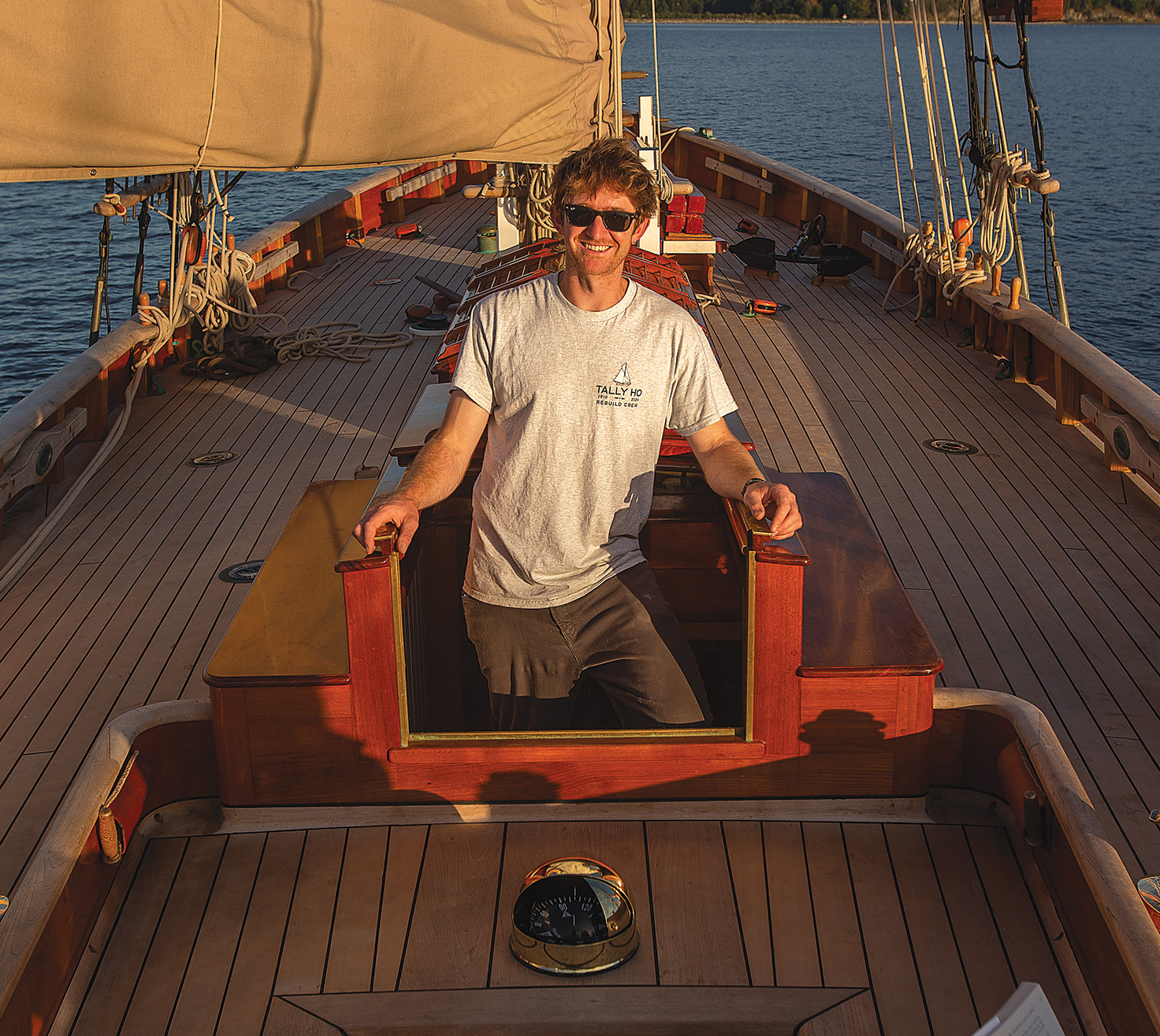
Goolden spent seven years leading a thorough reconstruction of the boat, documented in more than 200 videos.
The conversation continued when all four went out for breakfast. As the photographer was about to leave, Danielson recalls, he went to his car, pulled a couple of video cameras out of the trunk, and gave them to Goolden with encouragement to document whatever he decided to do.
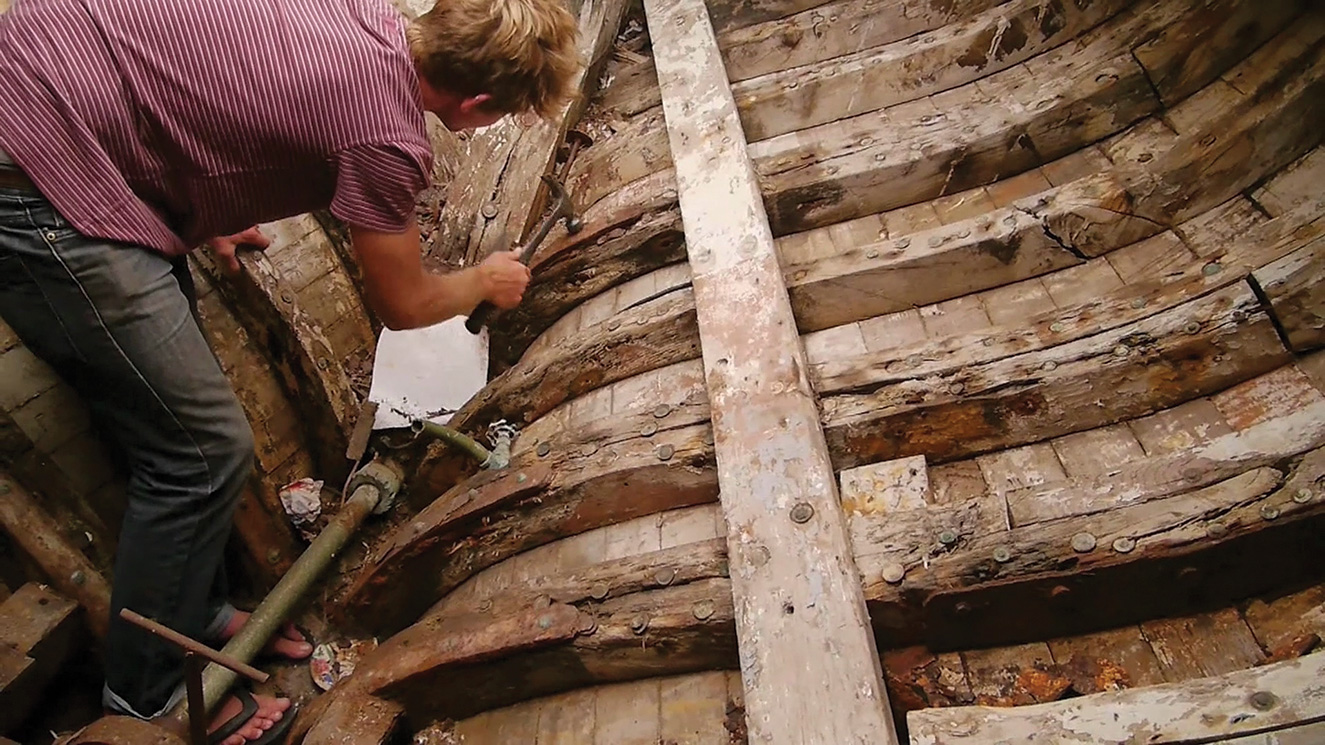
The photographer was probably not the first, and certainly not the last, to be captivated by Goolden’s considerable charm. The boatbuilder soon tried his hand at videography, and his relentless confidence and positivity came through in his very first footage, which documented his initial encounter with TALLY HO in June 2017. He proved to be remarkably photogenic, with an ease in front of the camera and behind it, an LED-bright smile, a tussled ruff of unruly hair, and a wry sense of humor. “Oh, my God—overwhelming to see the amount of work to do here,” he said on camera in that first footage, “but what a beautiful boat.” He poked and prodded, and by the end he was pulling pieces of rotten teak planking out of the deck by hand. The hull planking wasn’t much better.
 Neil Rabinowitz
Goolden knew at the time of his first visit that the boat would require a great deal of work, but it turned out to be even more extensive than he had thought.
As Danielson recalls it, they looked the boat over carefully for quite a while that day. “At the end, we were all kind of done,” he said. “We got the cover more or less back on. We were just about ready to leave, and Leo said, ‘I’m not ready yet. I want to go back just by myself, just go and sit in there and think about it.’ Which is what he did. And about 20 minutes later, he came out and said, ‘Well, I think I’m going to do it.’”
Danielson said that TALLY HO’s long story would certainly have ended in Brookings if Goolden hadn’t come along. “He knew what he was looking at,” he said. “He’s an impressive person, just really by how nice and natural and confident he is. He was wonderful. He was a lovely person.”
 Neil Rabinowitz
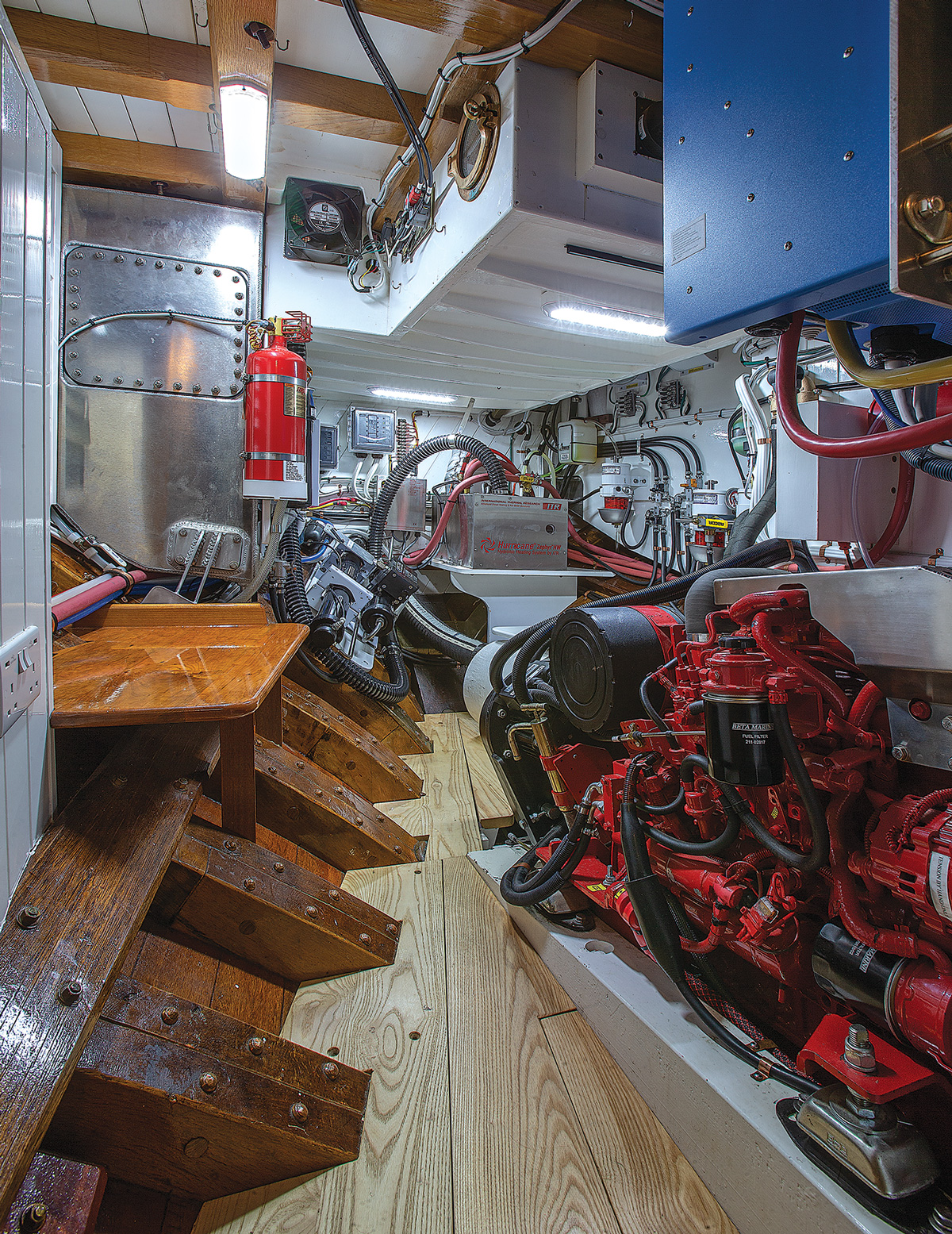
The area shown in the photo above “as found” is now a thoroughly modern engineroom with a modified Beta Marine 85-hp diesel as a key component of a parallel hybrid system allowing electric or diesel propulsion.
On that day, several foundational pieces of what became an intricately complex puzzle came together: a boatbuilder with bona fide skills; a supportive friend with a large and freely available workshop in Sequim, a town that is not only not halfway around the world from Brookings but also within reach of Port Townsend’s wooden-boatbuilding professionals and suppliers; and a right-place-at-the-right-time foray into the quickly opening brave new world of social media.
A Staggering Success
Remarkably, seven years later, in April 2024—and it should be said only seven years later, since the restoration proved to be an enormous undertaking—TALLY HO was gleaming during her relaunching in Port Townsend. She was essentially a new boat, looking every inch the yacht she had been born as. True, only a few pieces of her original material remained: bits of original teak recycled as a saloon table and interior trim, a few teak transom planks reused in making a new transom, a thoroughly reconditioned original cast-iron foredeck windlass, a little hardware, and not much else. Goolden studied photographs from 1926 and 1927 to restore her gaff-cutter rig, which sometime in that period had been enlarged for better light-air performance by adding a fidded topmast to receive a jackyard topsail and a larger outer jib in her three-headsail configuration.
 Neil Rabinowitz
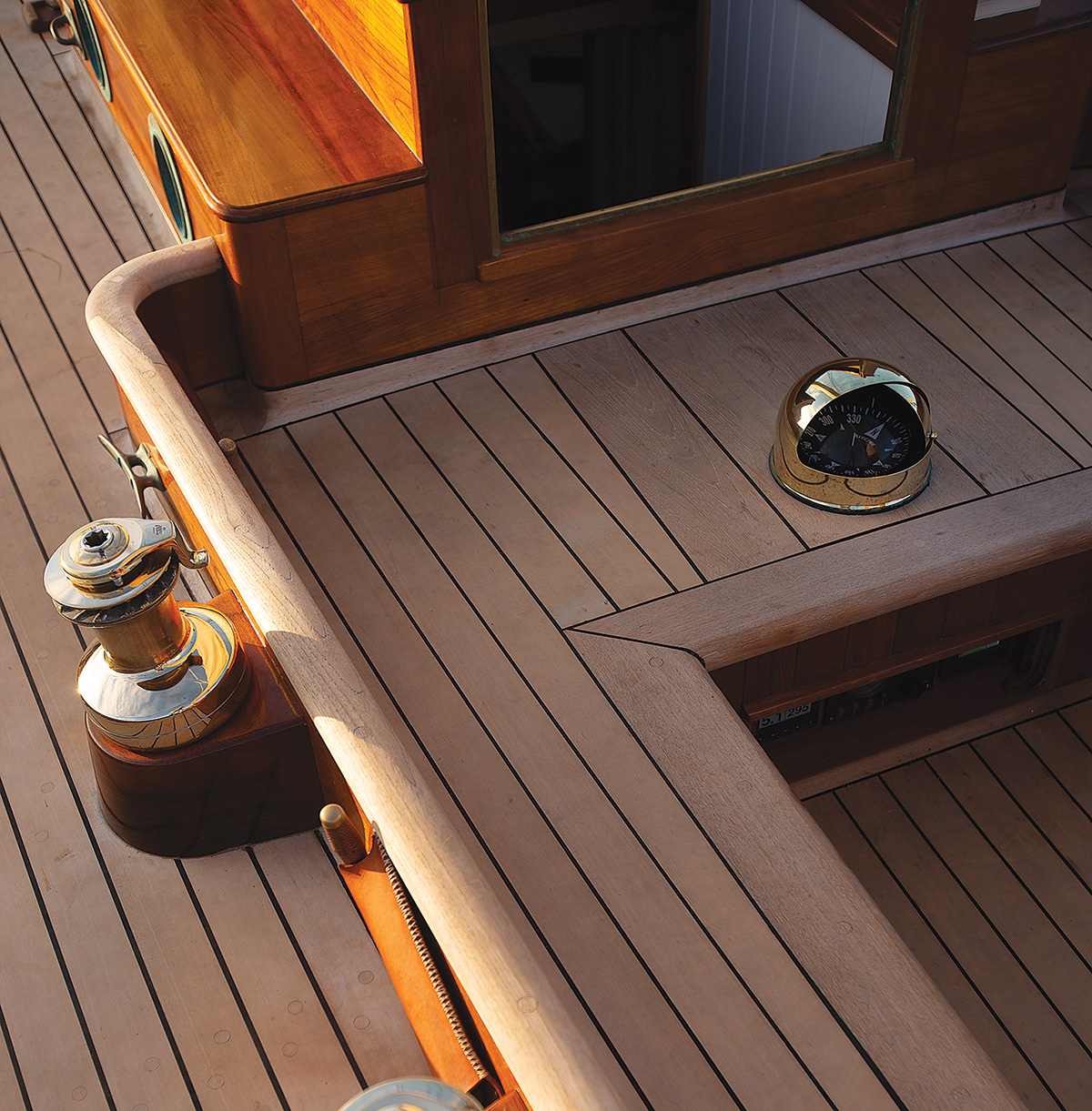
Goolden’s exterior restoration respected the yacht’s original appearance and aesthetics. New teak deck structures replicated the original ones. The deck is traditionally laid, using Alaska yellow cedar, with teak kingplanks and covering boards.
After relaunching, her first sailing sea trials later that spring were off Port Townsend. Goolden’s first real adventure with her was a summer voyage from Puget Sound to the remote islands of Haida Gwaii off British Columbia, Canada, during which she proved to be well appointed and adept for the kind of world cruising, and also classic yacht racing, that he had envisioned.
He had respected her pedigree in the exterior restoration. Belowdeck, however, nothing original remained; it was a blank slate, and he took advantage of that opportunity to make a modern yacht out of her, with a fully appointed galley, a comfortable saloon with a woodstove in a tiled surround, and the latest in equipment. She had remarkably few bugs to shake out, either in her rigging or in her elaborate systems, and she returned to Puget Sound in time for the annual Port Townsend Wooden Boat Festival.
 Neil Rabinowitz
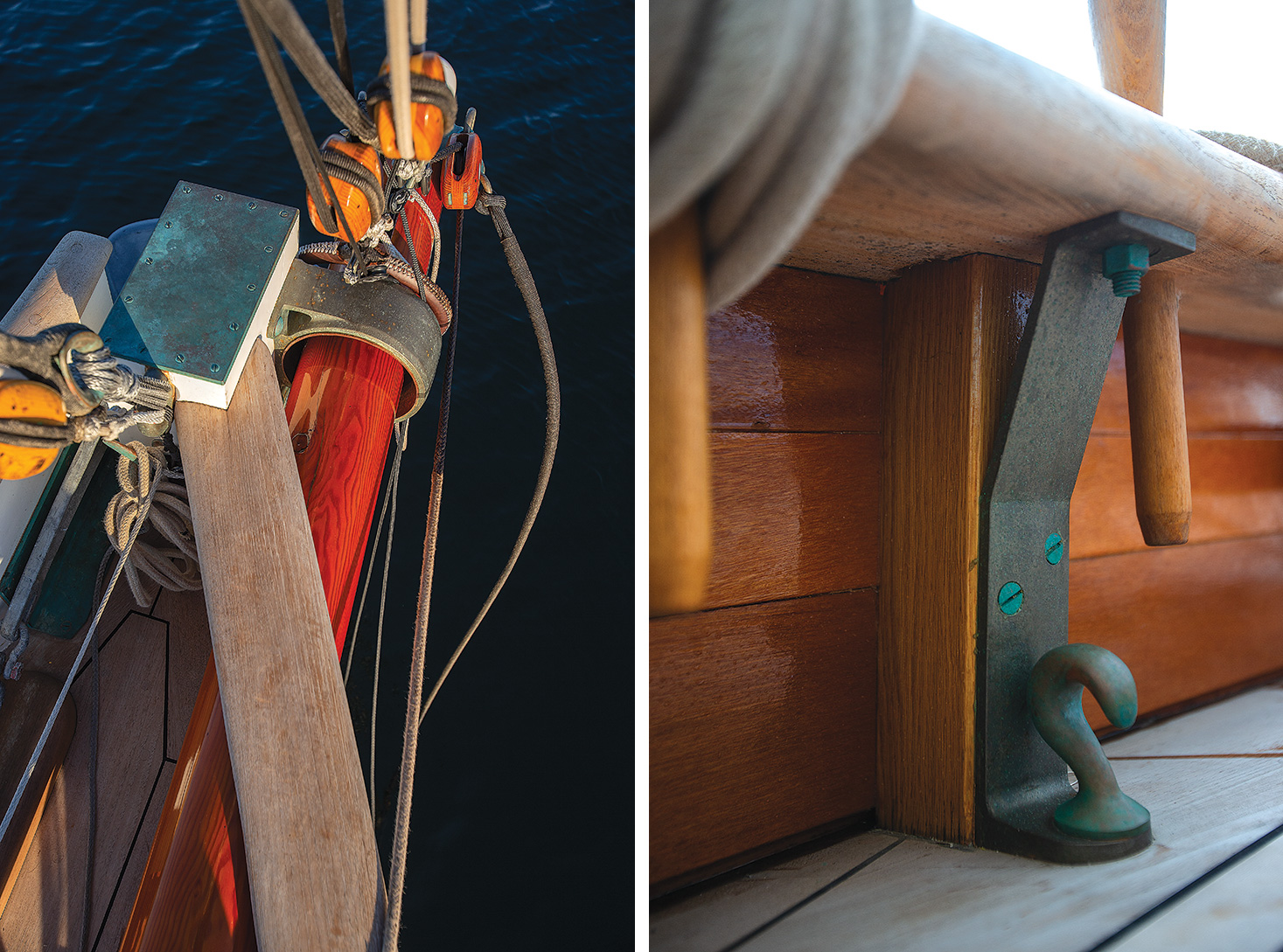
Left—The bowsprit retracts through custom bronze fittings. Right—Sway hooks built into bulwark stanchion braces are among the rig-handling fittings matching TALLY HO’s era.
Throughout the years of restoration, Goolden produced videos with amazing regularity for his YouTube channel, with the promise of more to come during his voyages. In No. 203, released just after the 2024 festival, he announced a new goal: he would take TALLY HO back home to England, hoping to arrive by 2027 in time to sail the Fastnet Race on the centennial of the one in which she made yachting history by being the first of only two finishers in notoriously rough conditions. The homecoming would no doubt be a thunderous one.
In the first year or so of his work on the boat and his videos, Goolden was a remarkably solitary figure. He worked largely alone, talking into a camera as he built a shed over the boat, organized his friend’s crowded workshop for its new purpose, built a loft where he could live, and started the hard and dirty work of tearing out rotten wood, removing keelbolts and bilge concrete, and learning that less than he expected—and far less than he hoped—could be saved.
 Neil Rabinowitz
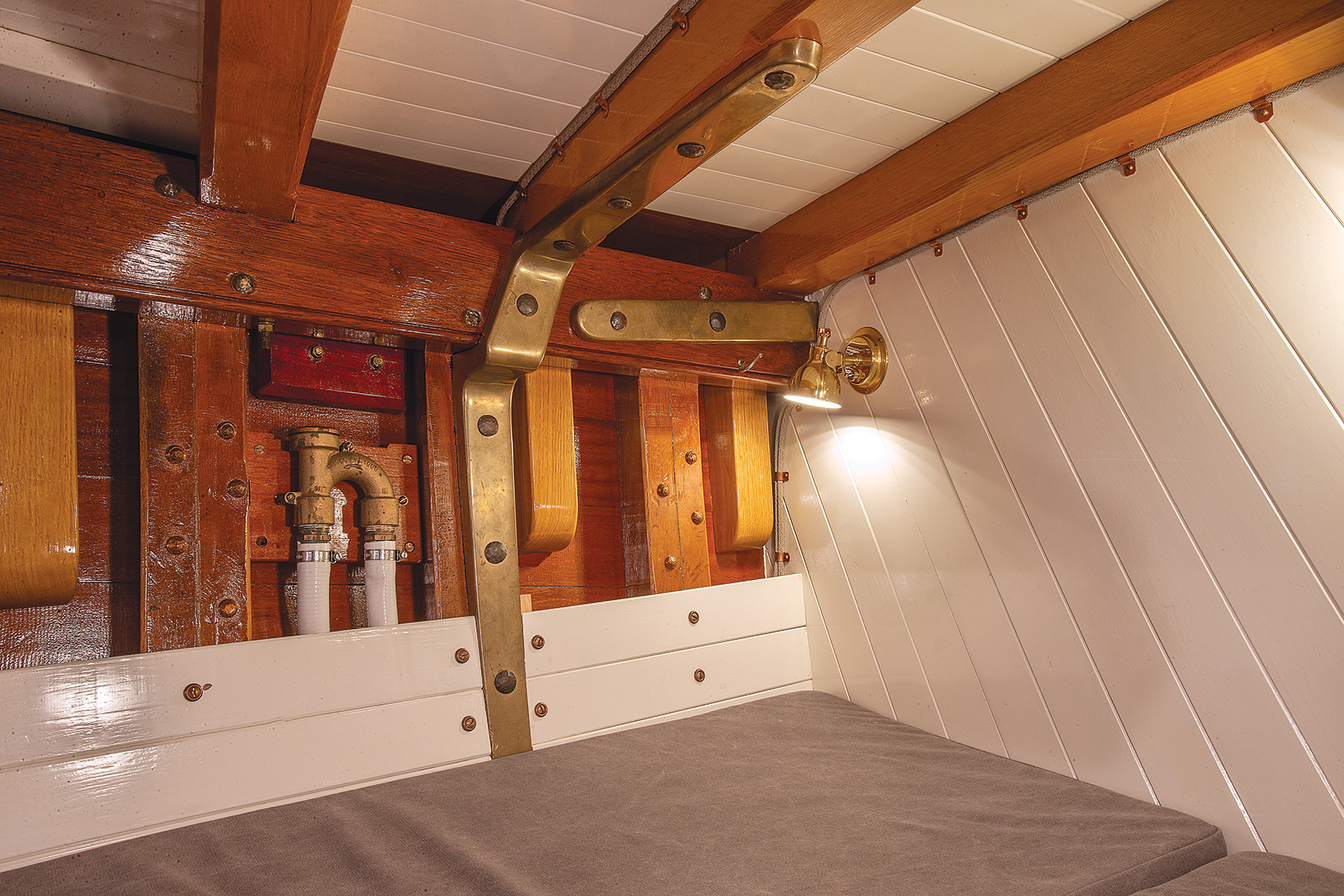
Bronze hanging and lodging knees, plus floors, were fabricated by Port Townsend Foundry to replace iron original fittings.
Right away, he demonstrated a knack for video editing—his unusual soundtracks started with No. 1’s sort of Greek bouzouki string number—and for explaining technical material in accurate but easy-to-understand terms. All of his charm and humor showed up from the beginning. Donations started to roll in early. His YouTube videos started to take off, especially after the Covid-19 pandemic left isolated people searching for good online content; today, he has more than 500,000 subscriptions. Advertising revenue followed, plus donations via the monetization platform Patreon. Also, volunteer workers showed up fairly early. One guy (almost everyone in the videos is, frustratingly, on a first-name-only basis) came in from Australia because of the videos and helped install a massive shipsaw that Goolden had acquired. A nearby farm gave him a forklift on long-term loan. Later, a very game firefighter from Maryland volunteered to drive across the continent to deliver a load of white oak.
 Neil Rabinowitz
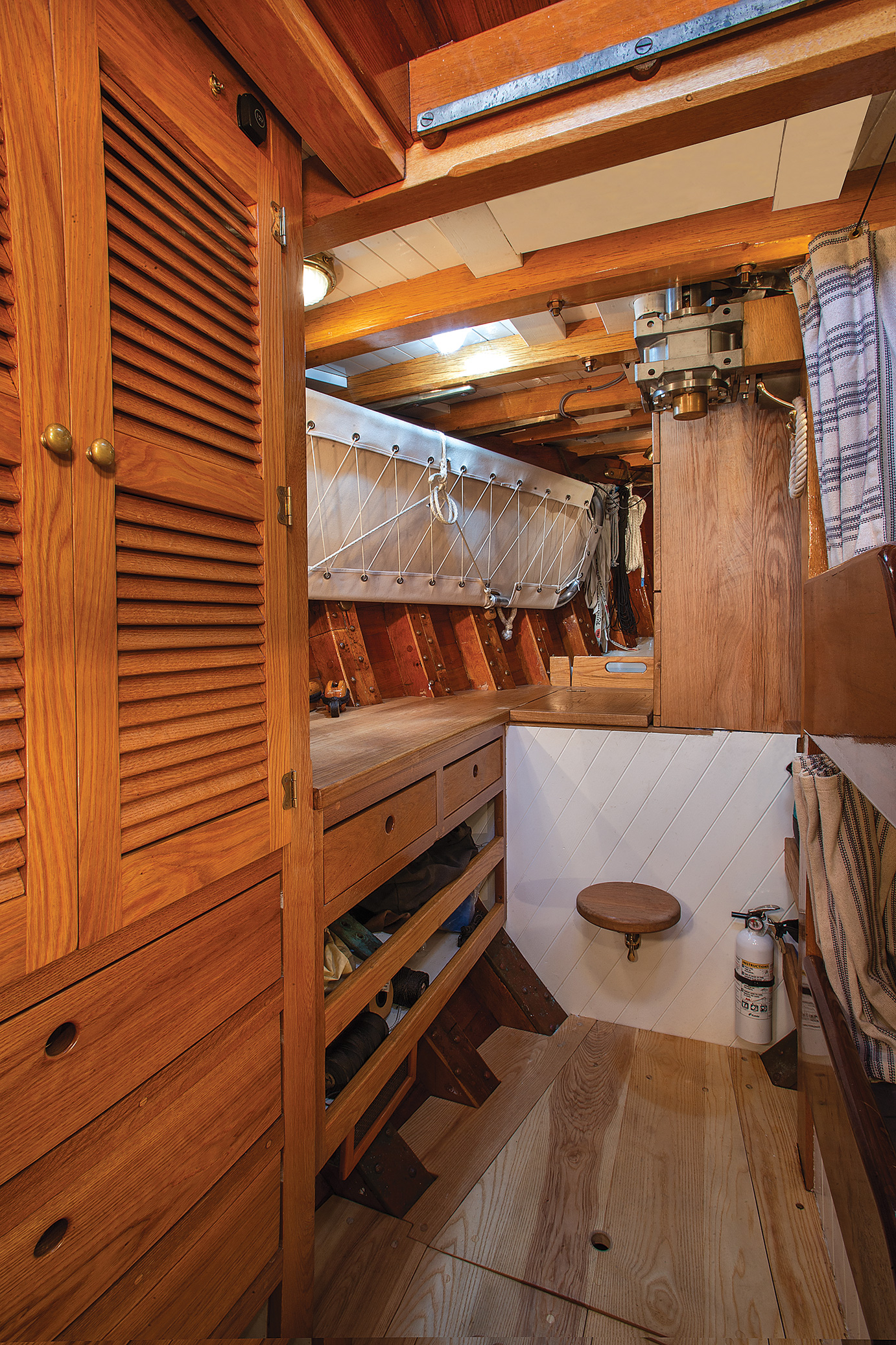
Live-oak double-sawn frames replaced the yacht’s English elm original ones. The deckbeams are of white oak. A double-berth enclosed bunk (also visible at right) is to starboard, with a pipe berth over the workbench to port.
As important as Goolden’s boatbuilding skills and any amount of charm were, the sophistication of the videos played a crucial role throughout TALLY HO’s successful restoration.
“I imagined it would be a much lower-budget rough-and-ready, quick-and-dirty project,” Goolden told me around the time of the launching. “And I also didn’t think we’d have to go so deep in the actual rebuild. I thought we were going to be able to save the centerline.” But the original English elm backbone timbers were too far gone, and he replaced them all using purpleheart (and wrote about replacing his keel in WB No. 267). He thought the bulk of the hull work would be in replacing all the double-sawn and single-sawn English oak frames. He ended up having to reloft the hull first to restore its symmetry. Using live oak, which had less curvature than the elm of a century ago that is impossible to find today, he made them all double-sawn frames for strength. He replanked the entire hull, using wana for all but the sheerstrakes, which are of angelique. The deck and deck frame, too, were clearly in need of replacement; he chose white oak for the beams and carlins, angelique for the beam shelves, and 2″-square Alaska yellow cedar for the traditionally laid and caulked semi-sprung deck planks, which are nibbed into both the teak covering boards and kingplanks.
 Neil Rabinowitz
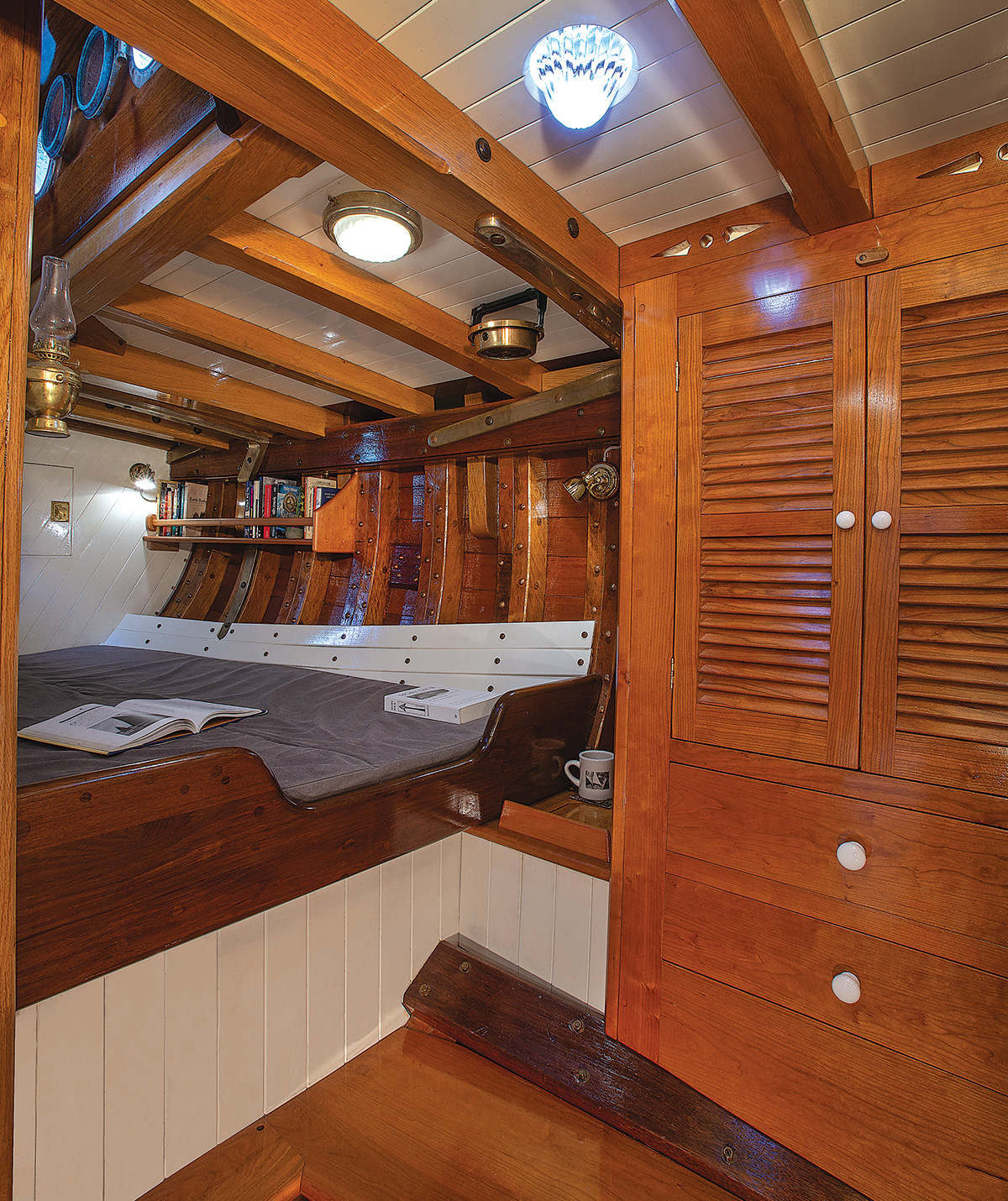
The owner’s stateroom is partly below the main companionway to port.
“There’s a sense that it could have happened anywhere in the world where there’s the skills and the resources to build a boat like this,” he said. “But, I mean, first off, that doesn’t leave that many places, really. There’s a handful in the States and a handful in the U.K. Being British and doing this project in America, I found that in my experience American people are incredibly generous on the whole and very welcoming and giving. They see a youngish guy from a different country here taking on an ambitious project, and I think that welcoming, giving spirit comes through even online.”
Video viewers gave donations not only of funding but also of labor. When I visited him in Sequim after the 2018 wooden boat festival (see my interview with him at www.woodenboat.com/online-exclusives/leo-goolden-and-tally-ho-restoration, the cars out front had license plates from as far away as Michigan. And the public fascination with his YouTube channel started to pay off better than he ever imagined.
 Neil Rabinowitz
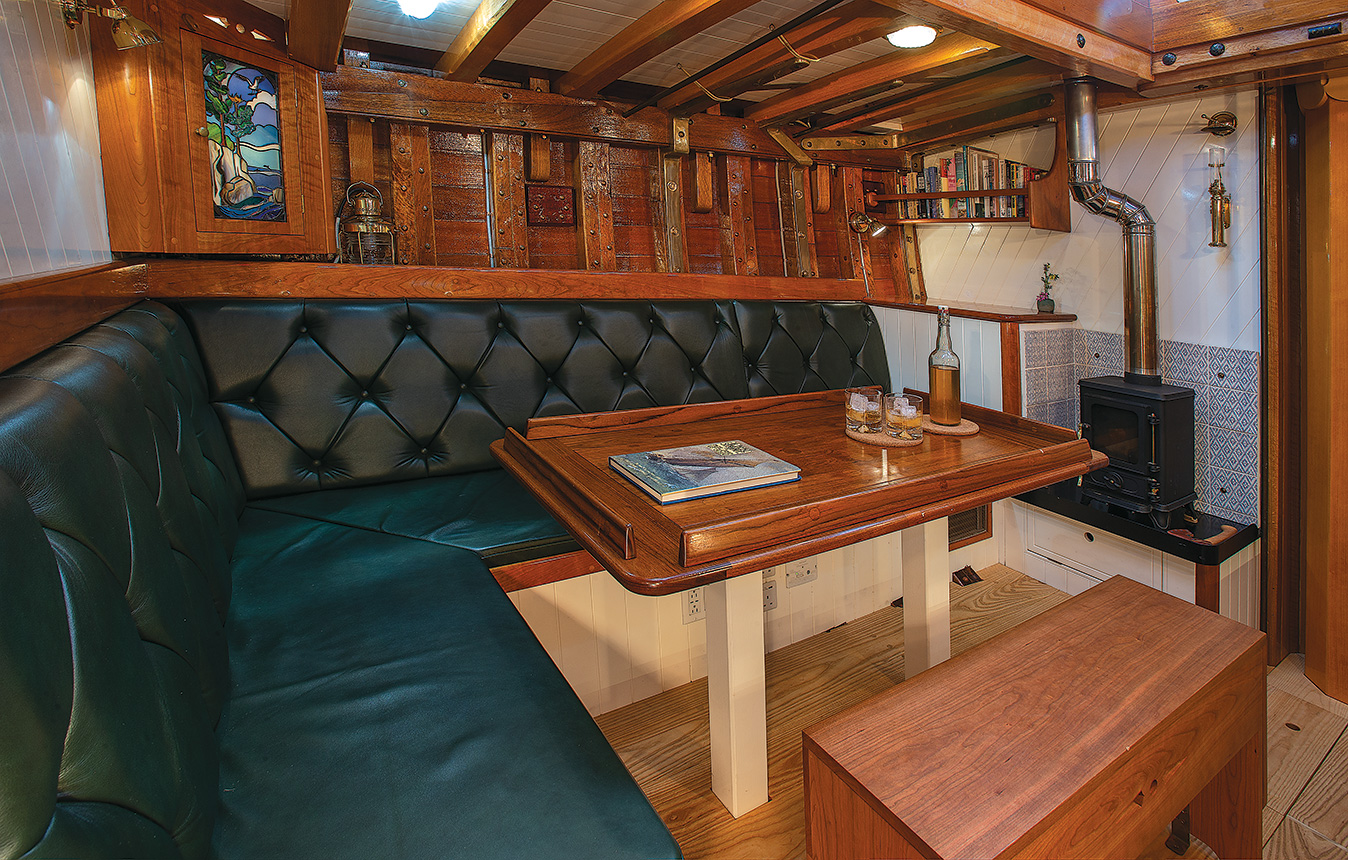
A cast-iron woodstove provides comfortable heat in the saloon; the boat also has a hydronic heating system, using hot water to heat copper pipes throughout the boat. The stained-glass locker front was made by a Port Townsend artisan.
“As the community grew around the project, and was supporting it, I just found I was able to get better materials and then later on hire people to help,” he said. For the final two or three years, he relied on a core group of independent contractors. “At every stage, whatever resources I had, it seemed like I should do the best job I could with those resources. So, we ended up doing a much higher-caliber rebuild than I had ever imagined, which has been amazing. It’s also meant that it’s taken a lot longer, which has been a challenge in itself. I wasn’t expecting to be away from the U.K. for this long, or living in one spot for this long, or not sailing for this long. It’s been a huge challenge.”
As the intensity of the project grew, he ran afoul of county zoning rules and neighbors in Sequim who were none too pleased to have an active shipyard next door. “It was really incredibly stressful for a while, and it made the project a lot harder for a time,” Goolden said. But with increasing support via the YouTube channel, a move to Port Townsend became a real possibility. “Suddenly everything fell into place,” he said. “It became clear that that was absolutely the right thing to do for the project. The resources are a lot closer and it’s just a more professional environment.”
 Neil Rabinowitz
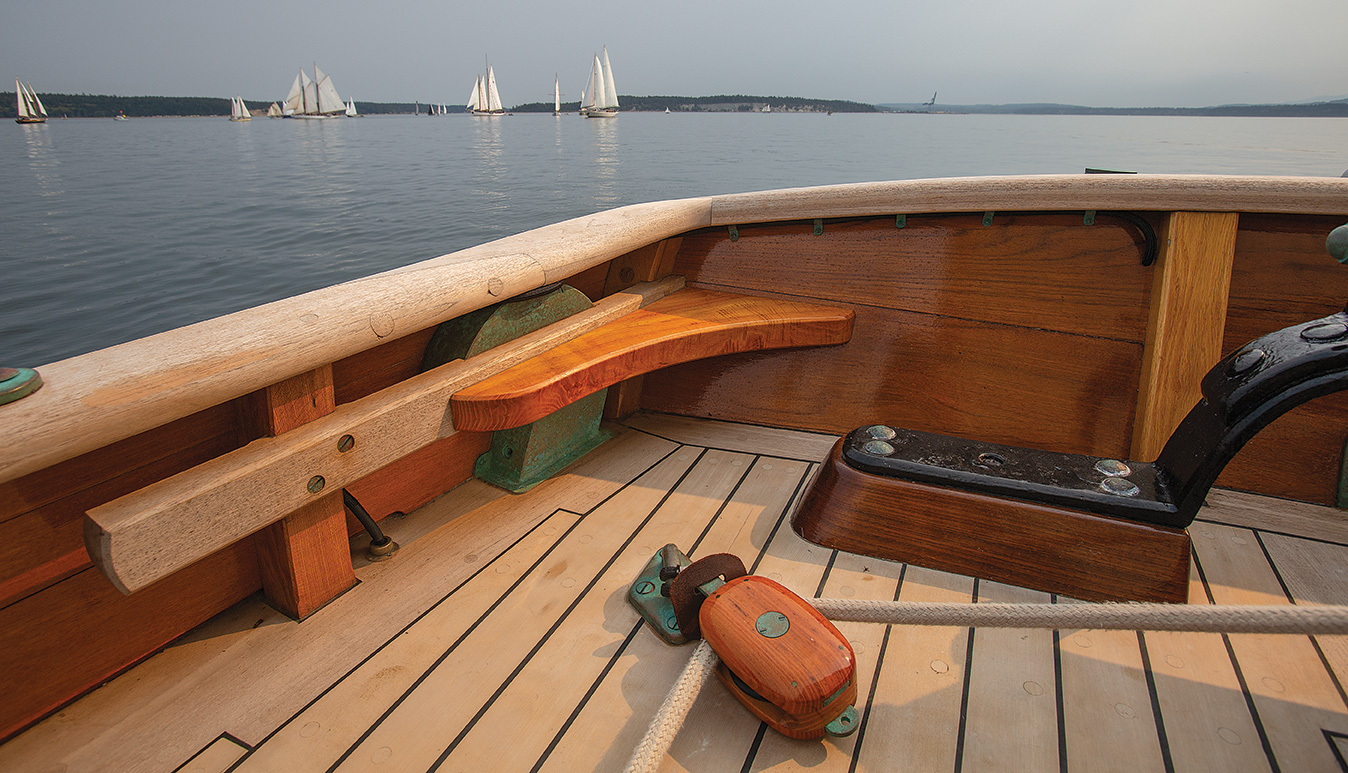
Teak caprails reflect the original configuration of the boat. Teak was used extensively in the original hull, some of which was repurposed for such things as cabin trim.
The Team
Legions of people have come and gone during the seven years of the reconstruction, some of whom started off as volunteer apprentices and later were paid. Many of them were young, both men and women. In the final two years, they were all independent contractors.
For example, one volunteer who became a contractor was George Saris, who was in college for media studies in Wisconsin and found Goolden’s videos online during the isolation of the Covid-19 shutdowns. He was also a woodworker, so after graduating he reached out to the project. “I was just thinking I was going to do probably a couple of months, but I meshed well with the crew. I really enjoyed the work.” He stayed for years.
 Neil Rabinowitz
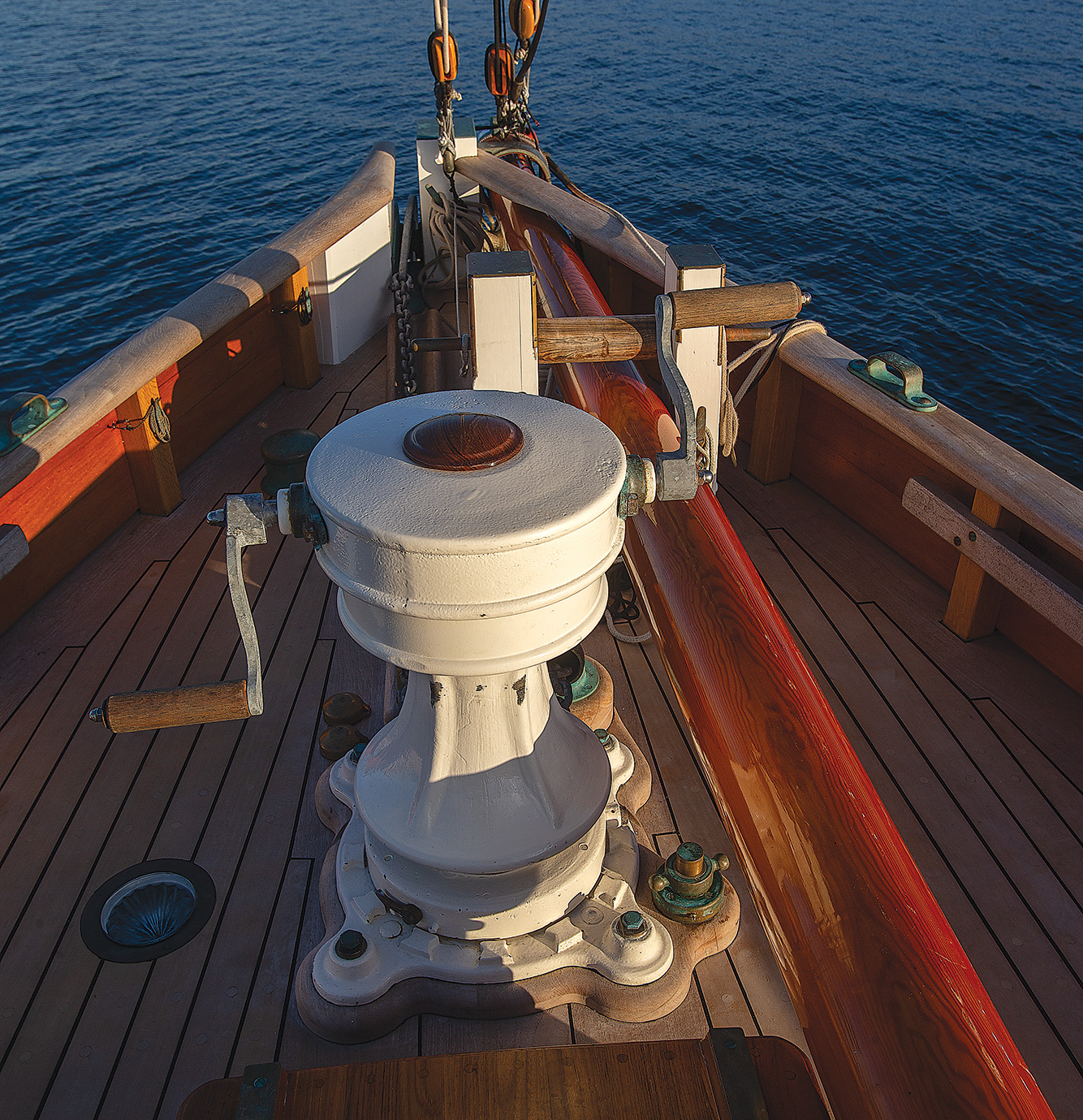
The original foredeck capstan’s challenging restoration was undertaken by Keith Rucker in Georgia, who made 25 videos of the project for his own YouTube channel.
Saris had training in drone photography and video editing, too. “I had a lot of classes in basic film production stuff, editing, sound, all that kind of thing. I was decently good at it, but when I first came into Leo’s office and saw him using Adobe Premiere, it was like watching a master playing piano. It was incredible. The way he edits is almost like he’s typing a letter. This project is an amazing example of the way the internet, as a new technology, can be used to preserve the disappearing arts of things like wooden boat building.”
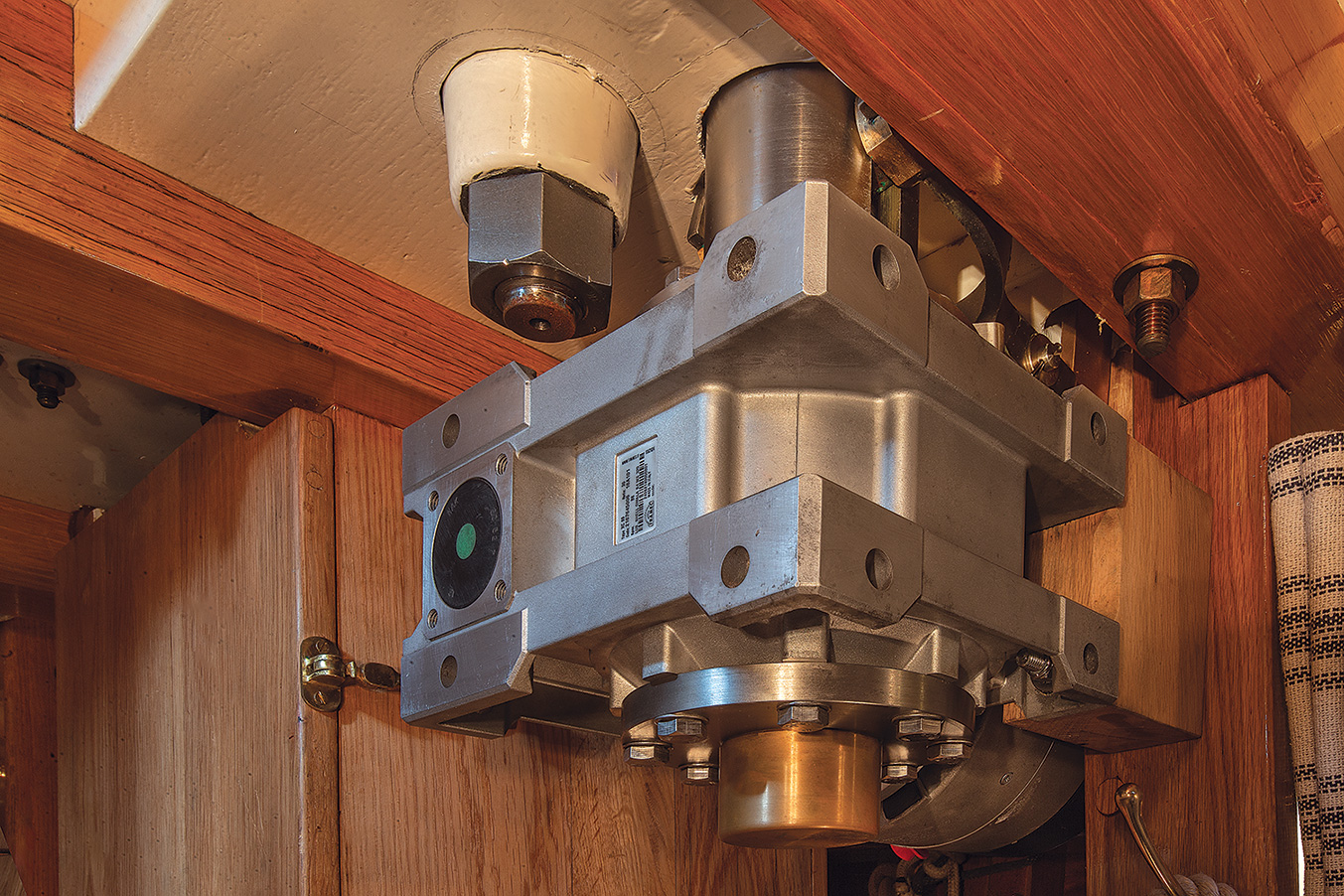
The online presence also found surprising connections, especially those of like-minded people. When Goolden sent TALLY HO’s cast-iron foredeck capstan to Florida to be refurbished, the company there eventually suggested a better choice might be Keith Rucker at Vintage Machinery in Georgia, which has a widespread online reputation. Rucker not only took on that daunting project but also made the capstan’s restoration the subject of 25 videos for his own compelling YouTube channel. “This was challenging,” he said. “This was probably the most difficult part that I’ve ever had to take apart in my life. It fought me the whole way.” And that’s saying something for a guy who deals with massive machines and who, judging by the videos, has an astounding metalworking shop and expertise to match it. Rucker machined the shaft and some other replacement parts, and he had a friend cast a new iron capping piece to replace one that was already broken and then shattered during its difficult removal. He refurbished everything that he could. With Dave Webster of Webster Boat Machinery in Cornwall, England, he refitted the capstan for Goolden’s specified optional electric power in addition to restoring the original twin-hand-crank gearing. Of all the infinite internet rabbit holes you could stumble into, Goolden’s and Rucker’s are exemplary, and rare—they make you want to go there.
 Neil Rabinowitz
Part of the capstan project involved the complicated addition of belowdeck electric power as an alternative to using the original hand-crank system.
Many did go there. For some of the young volunteers, the TALLY HO experience proved to be life-changing. “It was one of the most incredible learning experiences that I can remember,” Saris said. “It was an incredibly tight-knit group of people, and the knowledge there and the willingness to share that knowledge was incredible. And Leo, of course, is a great mentor.” He is planning to stay in the Pacific Northwest and hoping to combine his media work with woodworking in some way. “I do love woodworking,” he said, “and because I love it, I’m not sure that it’s what I want to do for a job.”
Another young volunteer was Patrick Kingshill, who had finished graduate school in sculpture in Santa Fe, New Mexico, long before he started with TALLY HO as a volunteer in his early 30s. “I had just started to get some representation in galleries and in design firms, but then the Covid-19 pandemic kind of shut all that down,” he said. He sent Goolden a portfolio of his mixed-media ceramic and wood pieces, and he was shocked to get a reply. For the final few years, he became a paid independent contractor.
 Neil Rabinowitz
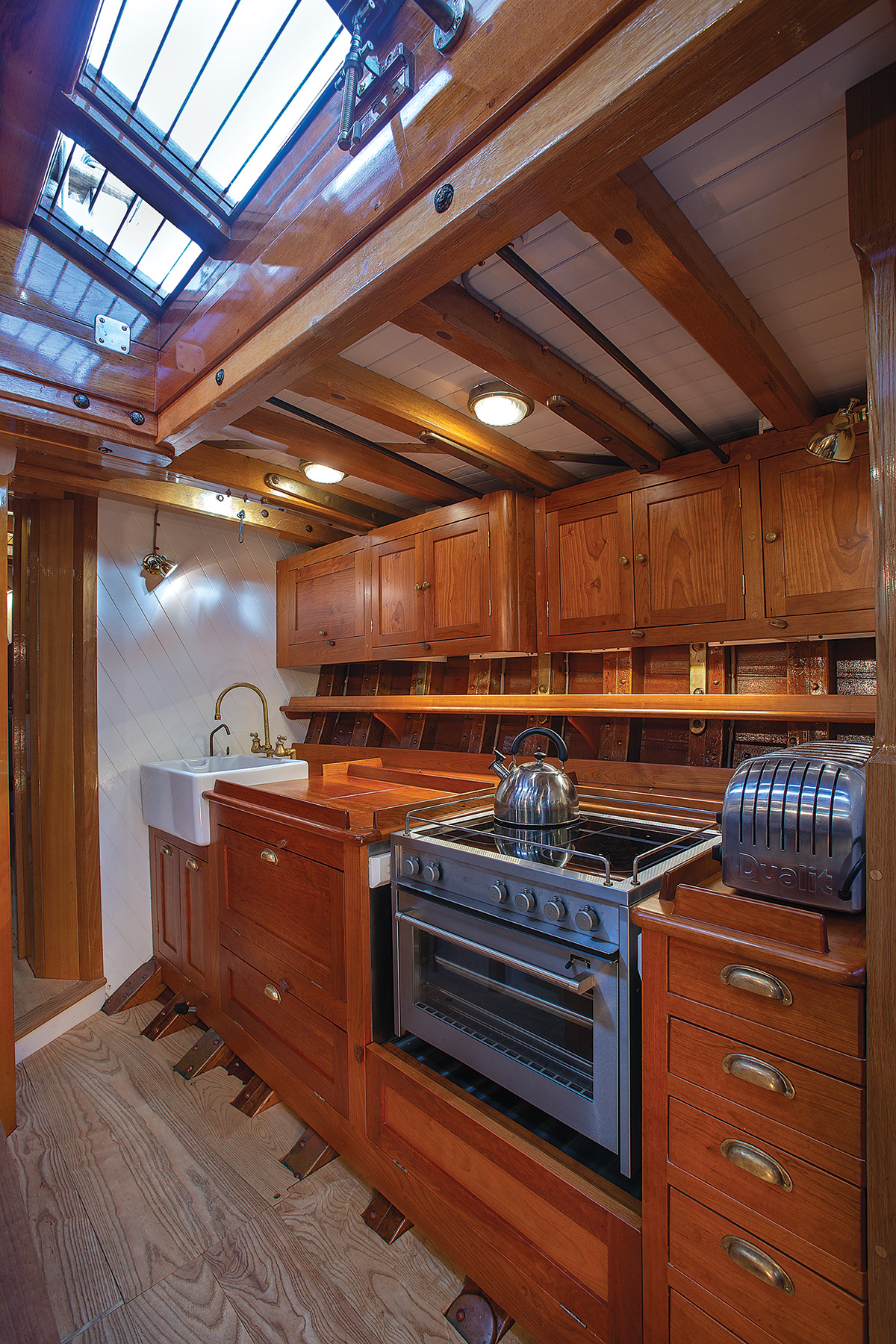
TALLY HO’s fully appointed galley runs the length of the starboard side of the main cabin forward
of the navigation station and opposite the settee.
“It was very, very foreign to me, but really what drew me to the project was the woodworking, and it was the highest caliber of woodworking,” Kingshill said. He especially recalls helping a team install the heavy angelique bilge stringers and the day Goolden asked him to make the maststep. “TALLY HO is a huge part of my life,” he said. “It’s given me so much purpose and drive. I’m constantly really grateful toward Leo for sharing this insanely rare opportunity with a guy like me. A boat of this pedigree, with its history and all of the fans watching—there’s a lot of pressure on us to do really, really excellent work. Leo is somebody that is really good at guiding that standard of excellence. We have so much fun at work—it’s like, how is it that we can do such a freaking cool project and have so much support? I mean, it’s pretty amazing.
“It’s like, I just kind of emailed my favorite YouTuber a handful of years ago, and it was the most positive life derailment that I’ve had,” Kingshill said. “What I’ve got for myself now is a very full life as a boatbuilder and hopefully a professional sailor.” He, and several others of the team, joined Goolden’s sojourn to Haida Gwaii, and Kingshill has visions of crewing on ocean passages.
Symbiosis
Goolden also drew extensively on the resources of veterans of the Port Townsend marine trades. Early on, Pete Langley’s Port Townsend Foundry made numerous cast-bronze fittings, including floors, hanging knees, and lodging knees, and later deck and rigging fittings, including a bronze tiller. TALLY HO’s Sitka-spruce spars were made by Robert d’Arcy and Douglas Jones, who are longtime boatbuilders in Port Townsend. Her systems were installed by Joe Smith’s Ocean Systems company, working with a young independent contractor, Erika Ensminger, a recent graduate of the Northwest School of Wooden Boat Building’s fairly new marine systems program. Among Goolden’s other independent contractors was Patrick Mahon, who built the yacht’s teak deck structures and wrote about them in WB No. 298.
 Neil Rabinowitz
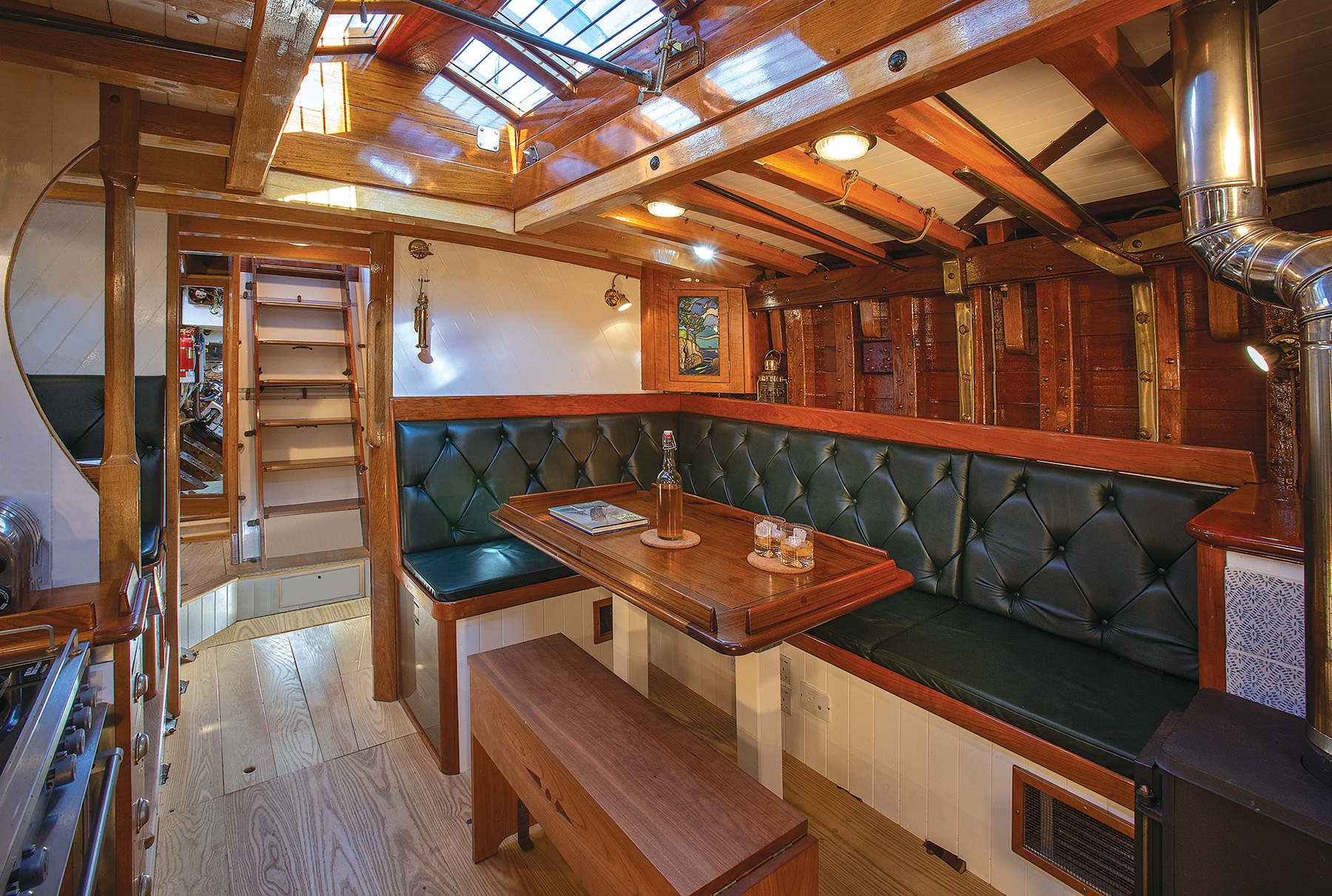
A long butterfly-hatch skylight makes the main cabin’s galley and saloon an inviting space. None of the original boat’s interior survived, leaving a blank slate for a modern-yacht accommodation plan for the world cruising Goolden has in mind.
“I was really impressed with the crew he put together,” Mahon said. “His management skills were very good. The jobs and tasks he gave to people fit their skills set. When I started, I was the new kid on the block, but I was also the oldest person there by far.” From his perspective, constructing two companionways and a large butterfly hatch as close as possible to original specifications was a rare job and one to savor: “In 50 years of shipwrighting and boatbuilding, that doesn’t come along all the time.”
Mahon had visited Goolden in Sequim early on and declined to participate in the long, hard project of replanking, but he agreed to build the deck structures, which he could do comfortably in his own shop. Nevertheless, he had an inkling that Goolden eventually would have to move TALLY HO to Port Townsend: “There was no way he was going to be able to finish it and launch it from there,” he said. When Goolden did make the move, people noticed. “People who don’t know Port Townsend were always saying, ‘Oh, he’s going to put Port Townsend on the map.’ But Port Townsend was already on the map—he came here because of the skills that were here.” In some ways, even TALLY HO’s launching was “just another day in the shipyard,” he said. The thorough restoration of WESTERN FLYER (see WB No. 300) had been completed after Goolden got there, and after TALLY HO was launched the William Fife III–designed schooner LATIFA (see WB No. 286) moved into her former shed for a refit. Hundred-year-old halibut schooners are routinely hauled for work after their Alaska seasons. It’s a busy place for a wide variety of boats, a great many of them of wooden construction.
 Neil Rabinowitz
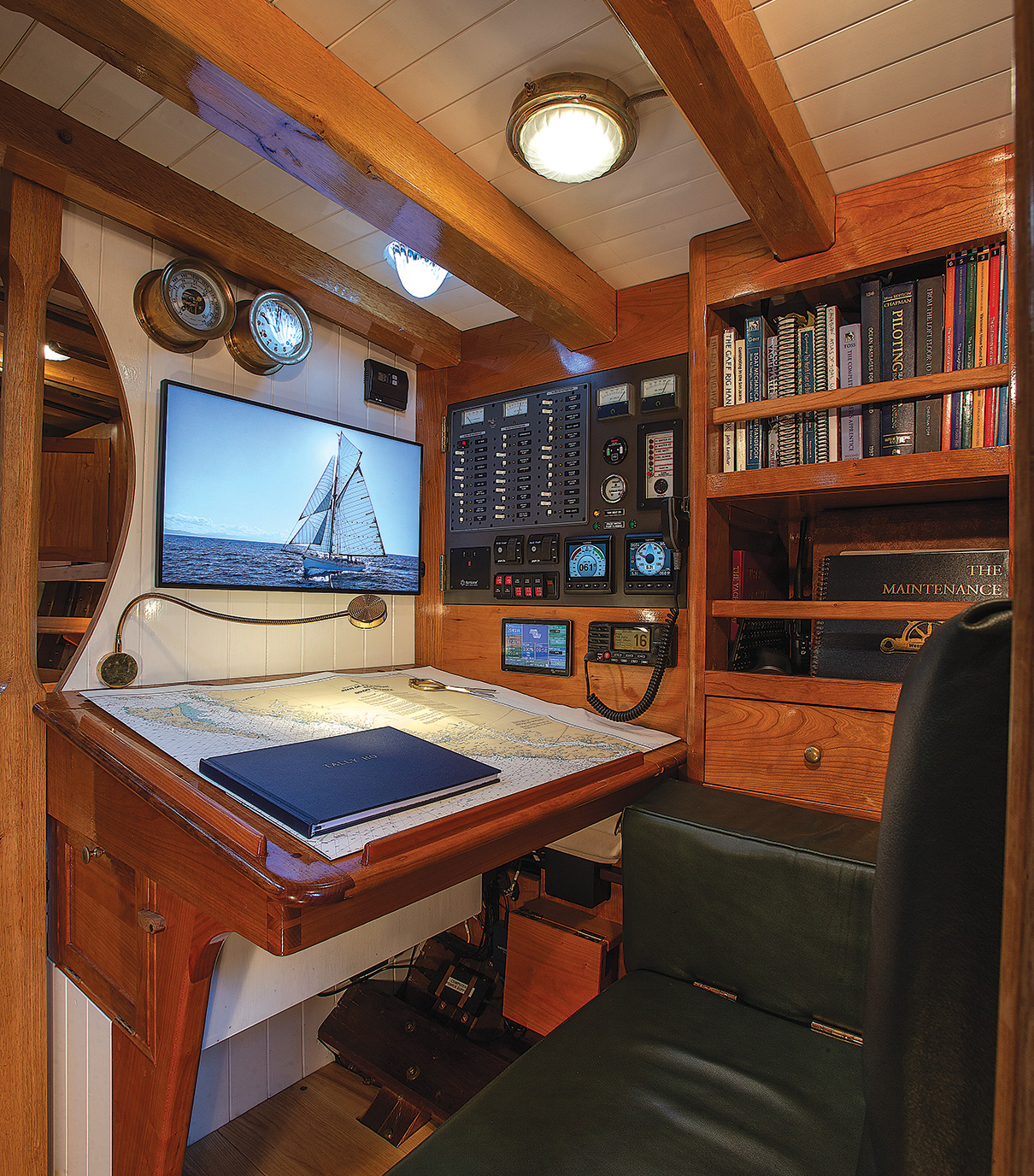
The navigation station, which is to starboard at the foot of the main companionway, is a comfortable workstation. Goolden will use the large display not only for supplementing the traditional celestial navigation he prefers but also for video editing.
Smith, who has been in the Port Townsend area for nearly 40 years working on boats, including his own fish boat, saw an emerging opportunity in systems work and went to The Landing School in Maine to complete its program in the subject. “I’ve always worked on boats, and I ran fishing boats in Alaska, and owned my own 50′ wood troller-longliner,” he said. Going to the school earned him American Boat & Yacht Council certification in electrical, diesel, air conditioning, and refrigeration systems, plus a National Marine Electronics Association certification for marine electronic installations. In 2007, he started Ocean Systems, which he eventually moved into a shop right next door to where TALLY HO ended up, and Goolden hired him.
“I oversaw all the installations on TALLY HO,” he said, working with Erika Ensminger. Goolden had chosen and purchased the engine components and had bolted the engine in place, but Smith took it from there.
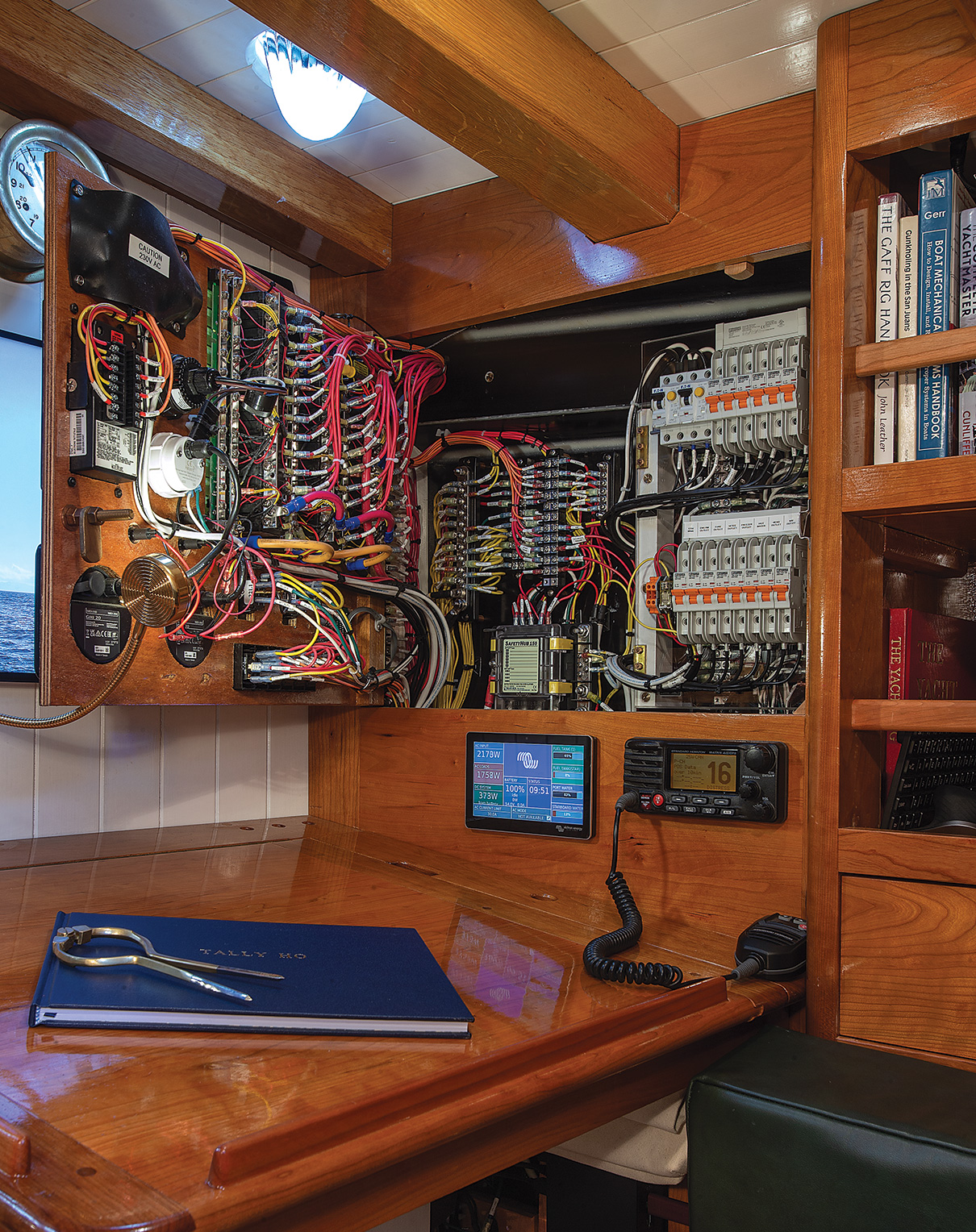
“I’d call it a fairly complex installation, because it has a parallel hybrid propulsion system,” Smith said. The spacious engineroom accommodates a Beta Marine four-cylinder, 85-hp diesel engine modified by Graeme Hawksley of Hybrid Marine International, based in England, which gives the yacht a 7.5-knot top speed. The engine carries two 10kW Vectra electric motors mounted aft, and they double as generators. When the diesel engine is running and the electric motors are clutched in, they charge the eight Victron Energy Smart lithium-iron-phosphate, 25.6V, 200Ah batteries arranged behind the companionway ladder, totaling 40kW capacity, plus two 12V batteries, one for house power and one for the engine’s starter. A shaft clutch allows the diesel engine to be taken offline, enabling the electric motors to be used as the sole propulsion source, providing 27 hp for a top speed of 5 knots, for use when power is needed for a relatively short time, as when coming into a marina. The electric motors can also be powered by the diesel engine without turning the propeller shaft, enabling them to serve as a stand-alone 20kW generator. In addition, while sailing with no power running, the propeller shaft can rotate freely, with the 22″ variable-pitch propeller acting as a turbine to supply electricity to the batteries via the hybrid motors. If the electric system fails for some reason, the diesel can still run. If the diesel fails, a full charge on the batteries would allow electric power for propulsion. The electrical system can be connected to shore power anywhere in the world. Even though Goolden vows to use traditional celestial navigation, the boat’s sophisticated electronics include radar, AIS, and GPS systems, with a large multifunction display that can also be used as a video editing terminal.
 Neil Rabinowitz
Having a hybrid diesel-electric power system and extensive lithium-iron-phosphate battery banks opened the way for sophisticated electronics aboard the boat, supporting video production and internet uploads.
The entire boat is heated by a diesel-powered Hurricane Zephyr 33,000-btu hydronic heating system by International Thermal Research, using copper piping to distribute hot-water heat throughout the boat—even the hanging locker. It also supplies on-demand hot water to the galley and head taps. The engineroom also houses a Spectra watermaker.
“People don’t really understand how much work went into those systems,” Smith said. It was nearly a full-time job for him for two years. “I bought a copper tubing bending machine to make bent copper drains in the sink in the aft cabin because it was going to be exposed, and it had to look just right. I made handmade, bent, heated towel racks. All the little P-clamps to hold the wires in—I bought copper banding and a punch tool and made all my own.
“Leo really had a clear idea about the quality of workmanship he wanted,” Smith said. “There was just never any pressure to cut corners or rush to meet a deadline. Leo just wanted me to do my best work. I work on a lot of different boats for a lot of different types of clients, but it’s very seldom that you get that leeway to do your best job, and be creative, and really come up with good solutions, not just good-enough solutions. It was a great project. I loved it.”
Zeal Chimenti, who grew up in the Port Townsend area and had his first boatbuilding experience at the age of 17 while helping to rebuild the hull of the B.B. Crowninshield–designed schooner MARTHA, was one of the core group of boatbuilders in the project’s final couple of years. Among his jobs were installing the kingplanks, covering boards, the laid deck, the rudder, and the fife rail at the mast. “I was really delighted to be asked if I was interested in being part of the crew,” he said. “A lot of people ask, is there a specific part of the project that was particularly interesting. But for me, I guess it’s just the general idea of being a part of a project where there are so many skilled tradesmen working on it.
 Neil Rabinowitz
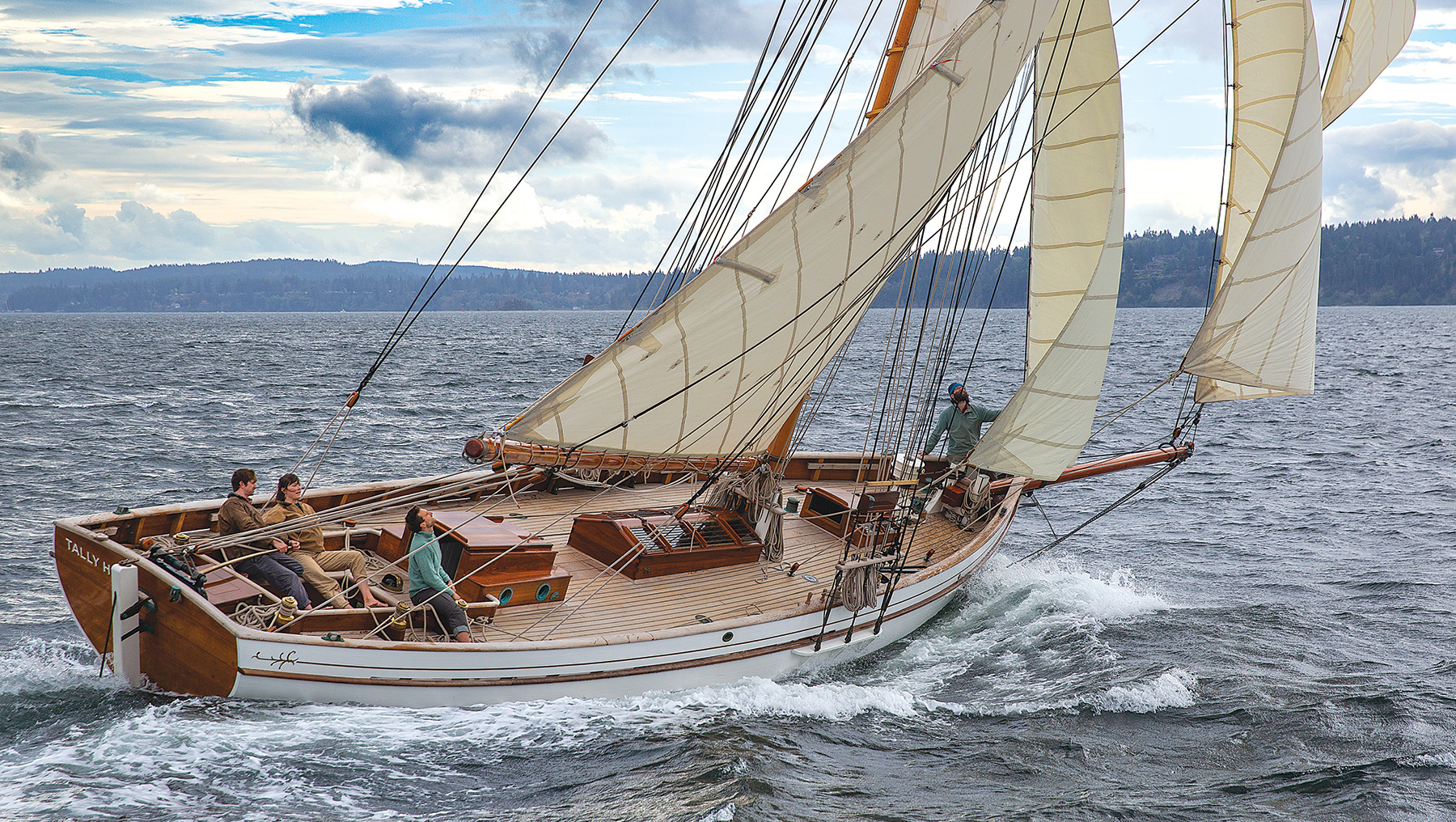
Goolden has set his cap on entering TALLY HO in the 2027 Fastnet Race in England, marking the centennial of her first-place finish. He reconstructed her rig as it was in 1927.
“One of the things that I appreciated,” Chimenti said, “was the nature of the project and how it was funded. With most projects, working in the industry, you’re working with time and a budget, and there’s ‘the best,’ then there’s ‘adequate,’ and there’s somewhere in between, and then below that there’s ‘good enough,’ which is, it’s strong and safe, and that’s all it needs to be. With TALLY HO, it was really awesome to be part of a project where you could go far beyond good enough. You can go to something that’s going to last another hundred years. One of the biggest things that I took away from getting to work on TALLY was being able to do things to such a high standard of work where you can really bring the art back into it.”
Bob Downes, too, had long experience already in Port Townsend. Originally from Florida, he had kicked around on various projects in Alaska and elsewhere before going to work on the schooner ADVENTURESS refits in 2013 (see WB No. 232), as Chimenti did as an employee at Haven Boat Works. Downes was a volunteer then, and he next went to work for Brion Toss Yacht Riggers for five years. He left to work as a rigger on the MARYLAND DOVE project at the Chesapeake Bay Maritime Museum for two years, always with the intention of returning to Port Townsend. He worked with Goolden as an independent contractor in collaboration with Ian Weedman, Brion Toss’s successor as the rigging company’s proprietor, to construct TALLY HO’s rig from the bottom up.
“I had just come off this scratch-build on a traditional rig that really dialed in to the perspective of how different it is building a traditional rig for a new boat, versus refreshing or rebuilding,” Downes said. “It’s several orders of magnitude more work in the planning and decision-making. It’s like every single, minute decision has to be made starting at first principles.” He, too, was on the Haida Gwaii voyage, and he reported that very few problems came up with the boat’s rig or systems. He’s eager to sail more with Goolden and hoping for a Fastnet Race berth.
 Neil Rabinowitz
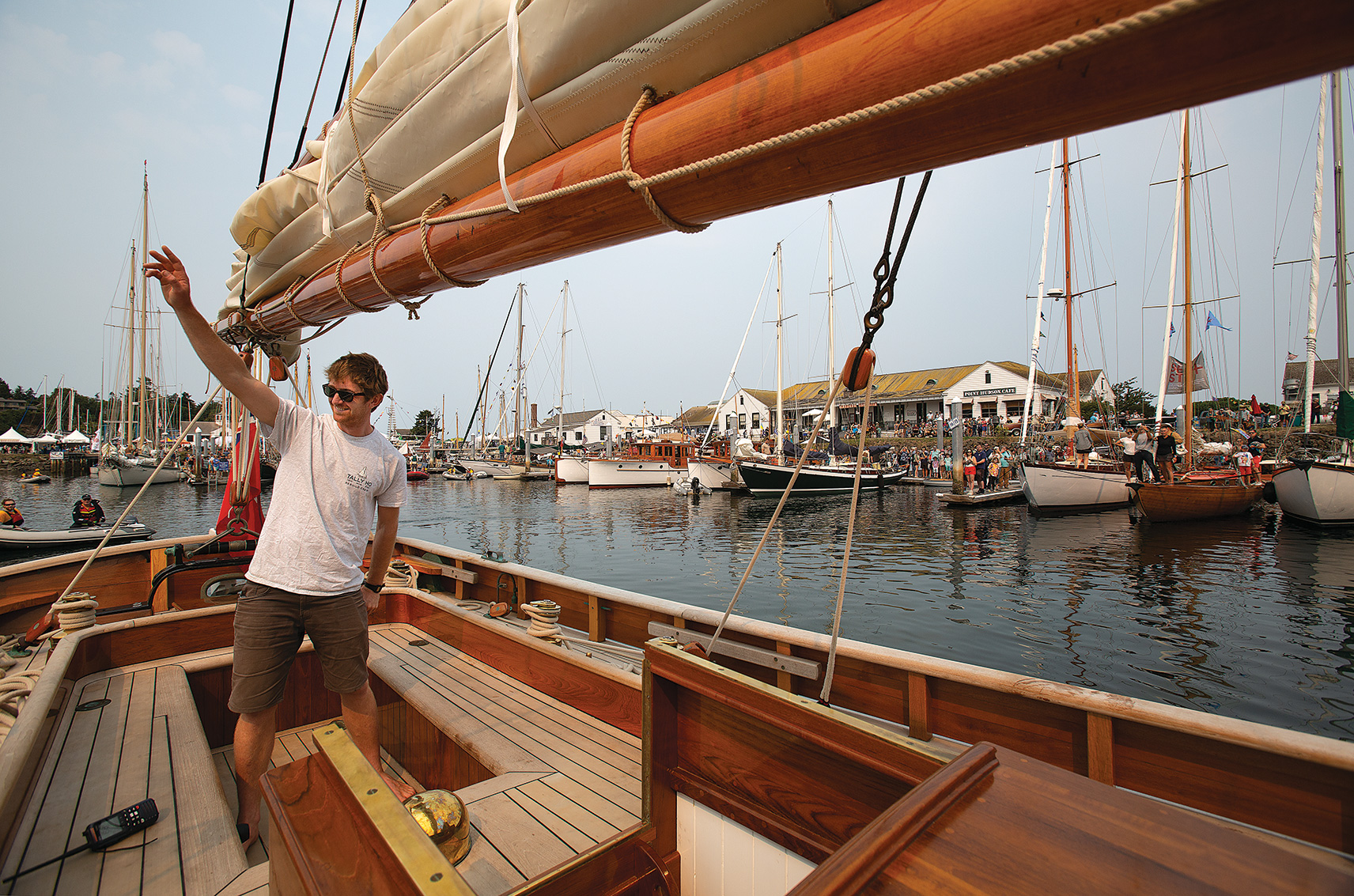
Goolden and his crew returned to Puget Sound from their Haida Gwaii voyage in time for the September 2024 Port Townsend Wooden Boat Festival. The boat’s systems and rig had very few problems to work out after a wide variety of conditions.
It’s not unusual for marine trades workers to participate in sea trials, but it is almost unheard of for them to go for extensive cruises with the owners; almost all of the core group at launching were able to sail at least to the San Juan Islands, and Downes and Kingshill were aboard for the entire Haida Gwaii trek. Some went on to the next job, including one contractor, Nic Taylor, who went to work for Haven Boat Works full-time. Joe Smith went back to his company’s pressing systems work. Zeal Chimenti took some time to work on the house he’s building. Even as the launching approached, some of the team’s conversation turned to what was next.
One adjustment that Downes had to make was in taking time for the constant video presence. Having to set up cameras for important tasks—which Goolden couldn’t always get to himself—and standing for interviews meant taking time away from the skilled work he was being paid for. “So a big part of it,” he said, “was just kind of convincing my inner brain that this is a valuable thing to do. This is how the bills are getting paid. And it’s really worth the time.”
Goolden said he, too, had learned from working alongside the team. “I’ve learned a lot, a huge amount from doing this project, and a lot from the people I’ve been working with here,” he said, “but a lot of the things I’ve learned, I’d say, are adjacent to boatbuilding. I think project management is the big one. In the late stages of the project, I was really a project manager much more than a boatbuilder. But also video editing, obviously fundraising, social media work—but, yeah, project management’s probably the biggest one. I’m sure that experience is going to be useful just in life in general. I think this project will probably lead to some interesting opportunities, potentially, in the future.”
“It’s kind of a unique situation,” Downes said, “because he is like a project manager and yard manager and owner. That said, I think he’s well suited for it. Those parts, they informed each other in a certain way, but you could also see the struggle between those different sides. How you’re thinking about which way to go in any particular part of the design is so different with this project than a normal one, where you have a wealthy owner with certain demands on the owner of a yard, and you’re deciding between the economics versus quality and time factors of making decisions.” The imperative for video also exerted an influence. As Downes put it, “At this project, it’s like, ‘Well, the higher the standard of work, the more engaging content it makes.’ It’s like it’s an upward spiral of demands on the project.”
Those videos were a new wrinkle for Mahon. “That’s such a new concept to old folks like me, that you would do something like that. He did it really well. They’re just amazing; I think I’m as impressed with his videography and his storytelling skills as with the shipwrighting part of it.”
Coda
After writing about Goolden’s project five years ago and visiting from time to time, I find myself wondering, even now, whether Goolden ever goes below alone on TALLY HO, as he did when he first saw her, just to sit there for 20 minutes and contemplate all that has been achieved and what comes next. Goolden—like a skier thinking three turns ahead, a surfer waiting for the right wave, a musician breaking into improvisation, a sail racing tactician adapting to shifting conditions—shares a reluctance to overplan, relying instead on honing natural instincts. As Downes put it, “Leo’s mantra is, ‘I’ve got no plan and I’m sticking to it.’” The wise never overpromise and therefore never underdeliver.
But, just as when he sat in TALLY HO’s decaying interior in Brookings, the foundational pieces are there. A high respect for skill and craftsmanship in wooden boats is sure to be an element. A traditional rig demands a certain kind of sail handling; he’ll again need to build a team. Videos are almost certain to be part of it. But he has a caveat: “I will say that, for me, videography comes second to storytelling. Storytelling is the more important skill, the thing which draws people to a project.”
Storytelling, when it comes naturally in whatever medium, is as young as the teller but as old as the seas. 
Tom Jackson is WoodenBoat’s senior editor.