Penny Fee is a classic British wherry reinterpreted for glued-lapstrake construction—or, as her designer Iain Oughtred would say, clinker. This building method is well-suited to amateur construction—materials are easily obtainable, arcane boatbuilding techniques such as steam-bending frames are not required, and the final product is both beautiful to behold and easy to own. Because plywood lends dimensional stability to the planking, there’s no worry of planks shrinking, swelling, or splitting, which may make a difference to you as she won’t have the need for the “taking up” (allowing planks to swell until it no longer takes on water) period customary with boats of solid wood.
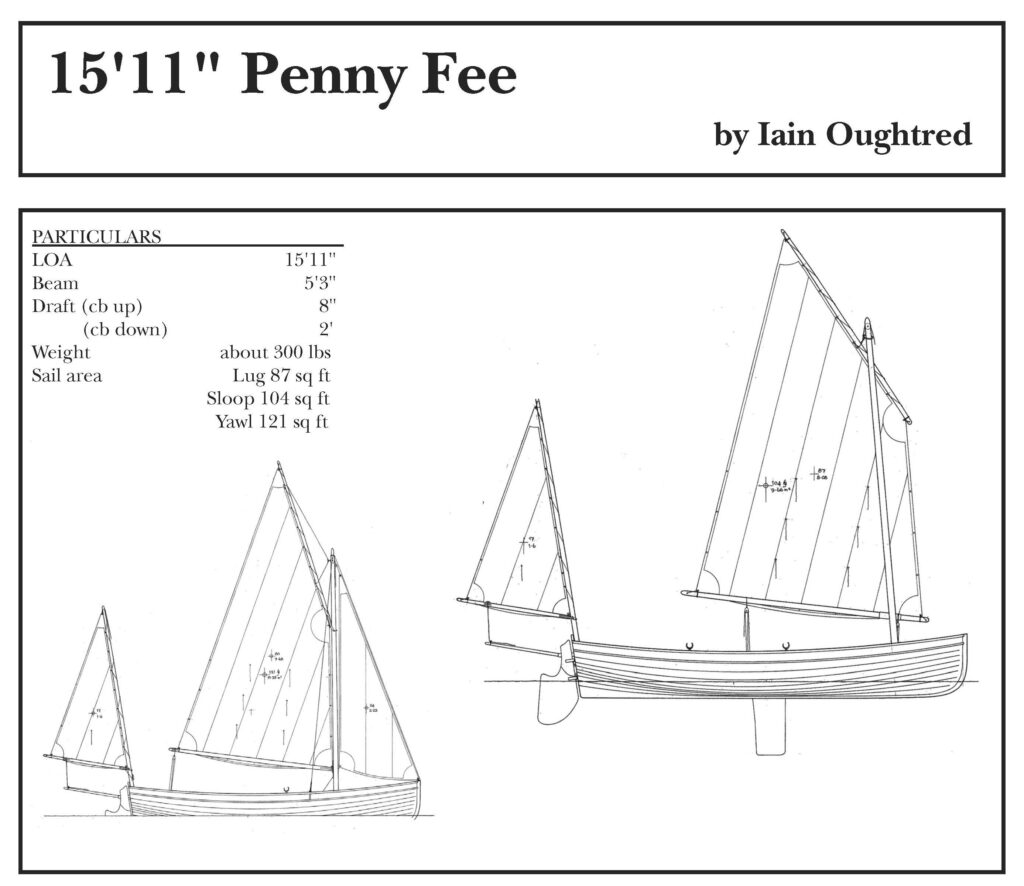
15′11″ Penny Fee

DESCRIPTION
Hull type: Round-bottomed, transom-sterned
Rig: Gaff and lug options, with and without yawl rigs
Construction: Glued-lapstrake plywood

PERFORMANCE
Suitable for protected waters
Intended capacity: 1-4
Trailerable
Propulsion: Sail, oars

BUILDING DATA
Skill needed: Intermediate
Lofting required: No

PLANS DATA
No. of sheets: 8
Supplemental information: 16 pages
Level of Detail: Above average
Plans Format: Print
Cost per set: $231
Plan No. 151
Related Publications:
Clinker Plywood Boatbuilding Manual, by Iain Oughtred
How to Build Glued-Lapstrake Wooden Boats, by John Brooks & Ruth Ann Hill

Particulars

LOA:  15′11″
Beam:  5′3″
Draft:  (cb up) 8″, (cb down) 2′
Weight:  about 300 lbs
Sail area:  Lug 87 sq ft, Sloop 104 sq ft, Yawl 121 sq ft