
Thames barges hold an iconic place in British maritime history. For over 100 years, these mighty beasts of burden charged up and down the River Thames and the surrounding coasts, carrying vast amounts of cargo between London and outlying areas. Their flat bottoms and shallow drafts—just 3′ for an 80′- to 90′-long hull—meant they could access remote rivers and tributaries and simply sit on the mud when the tide went out. Most were built of wood until steel took over in the later years.
Thames barges carried a highly evolved rig composed of an enormous, loose-footed mainsail set on a sprit; the sail could be reefed from the bottom when carrying a high cargo or simply brailed to the mast when not needed. Above that was a large topsail, which could be set on its own. A self-tacking staysail helped going to windward, while a small mizzen, set as far aft as possible, ensured the boat didn’t miss a tack. The total sail area was more than 3,000 sq ft (bigger than a tennis court), and the type’s top speed was over 13 knots.
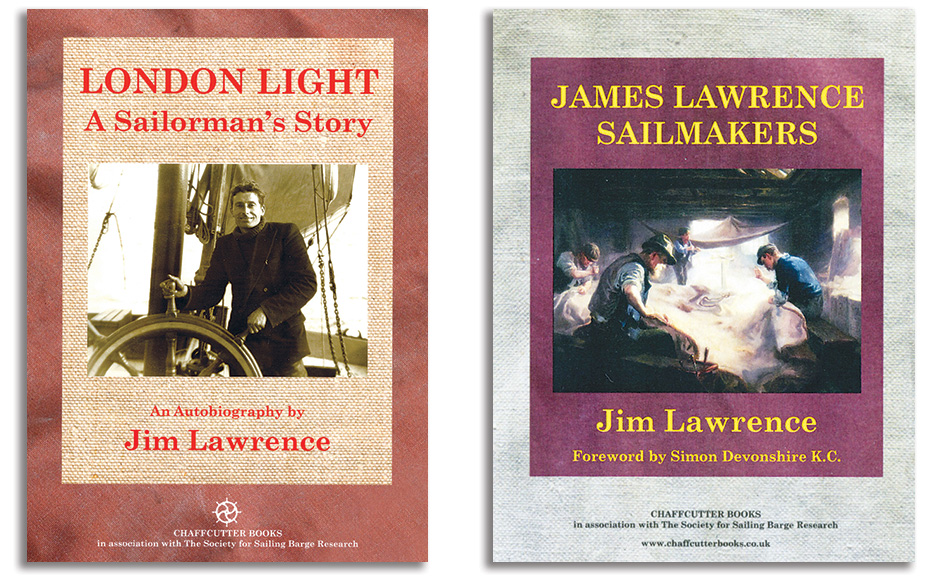
Those are the bare facts, which you can find in a basic book of nautical history. To put flesh on those bones, you can read these two books by James Lawrence, who was better known in the classic-boat world as the maker of the best traditional sails that money could buy but who spent 15 years working on cargo-carrying barges before switching to charter work and, ultimately, opening a sail loft for all traditional craft.
 Chaffcutter Books
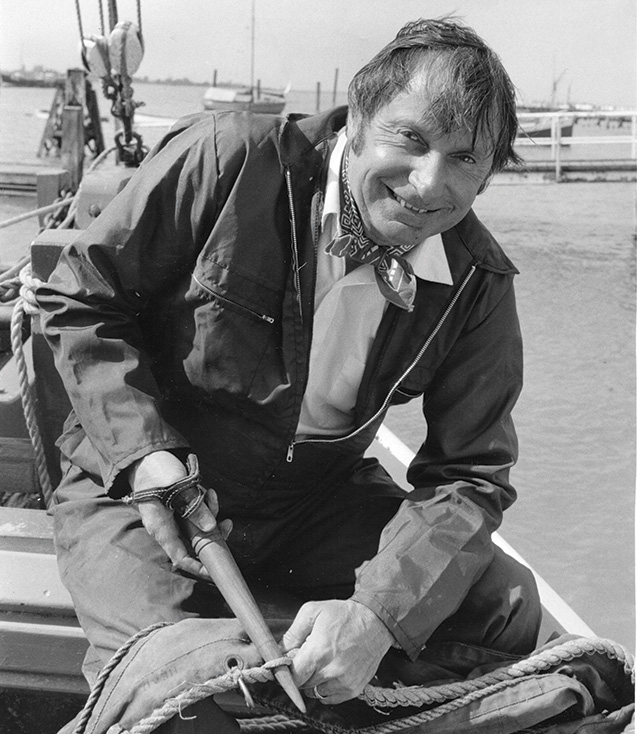
James “Jim” Lawrence, shown here working on a sail on the bawley THISTLE while wearing his trademark red neckerchief, specialized in making traditional-looking sails that combined historic techniques with good performance.
London Light: A Sailorman’s Story tells the tale of those early years. Born in Colchester, Essex, Jim was fascinated from a young age by the busy scrum of working boats that docked at the town quay, known as the Hythe. His first “boat” was the garden gate, which he took off its hinges and carried a mile to float on a nearby stream, seemingly undeterred when it promptly capsized. In 1944, at age 11, he built his first “barge” from a pair of old aircraft fuel tanks that he and his friends lashed together to create a basic catamaran. The sails were made from old barrage balloons and parachute cloth also acquired from the local dump. Their first cargo was a load of blackberries that they transported 2 miles downriver to Rowhedge, where a “Mrs. Maudesley” paid them 4½ pennies per pound and turned them into jam to sell in her grocery store.
Determined “not to let school interfere with our education,” he got a job at age 15 as third hand on the sailing barge GLADYS. One of his first tasks, and a clear test of his mettle, was to climb the 100′-tall mast and fit a flag to the masthead. He did so without hesitation and was soon swinging in the rigging for hours, “just for the fun of it.”
Most of this book is a rich evocation of what it was like to work on the barges, with a good sprinkling of factual information interspersed with often-humorous anecdotes. Jim was a great storyteller, with a bosun’s bag full of stories and a kindly twinkle in his eye, always ready to see the positive side of life. As a local paper put it, he was the sort of person “with whom a chance meeting never failed to brighten your day.” He was also incredibly talented, and at age 18 he was given his first command, becoming the youngest skipper in the Thames barge fleet.
One of his regular runs was collecting wheat from London to take to the Marriages flour mill in Colchester, then returning to London laden with flour. To reach the mill, the barge had to be “poked up” 2 miles of river with poles, or “quants,” usually operated by retired bargemen known as “hufflers.” They also had to “shoot” four bridges, all of which had to be carefully judged so that you passed under at exactly the right state of the tide, so that there was enough water when the barge was fully laden and enough air draft when sailing “light.” It wasn’t uncommon for barges to get stuck under the bridges and for the fire brigade to be called in to help extricate them.
 Chaffcutter Books
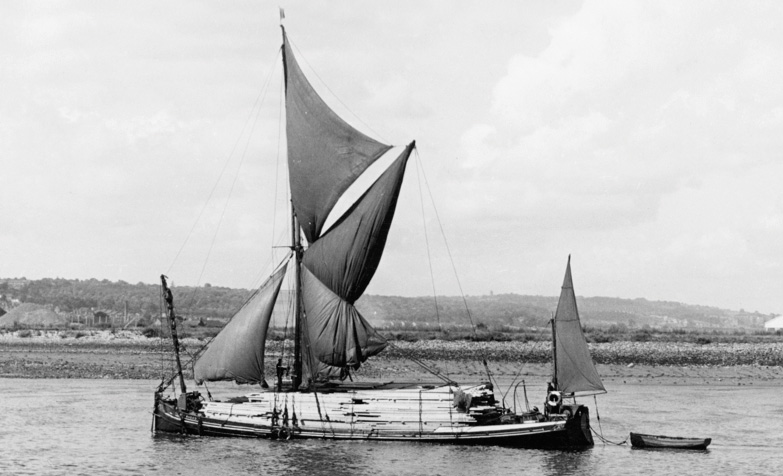
Jim’s first command, at age 18, was the Thames barge GEORGE SMEED, shown here laden with 95 tons of timber. Note the mainsail reefed and brailed to clear the cargo.
Another interesting barge technique was “drudging,” whereby an anchor was laid with a short amount of chain and the barge was allowed to swing bow-first into the current. The anchor was then dragged over the river bed, as the boat was pulled downstream backwards, negotiating several bridges along the way. The only time this method went wrong was when the anchor snagged an enormous electric cable just upstream of London Bridge, and Jim had to cautiously unhook it.
One of the most memorable parts of the book is a 13-page section titled “A Winter’s Tale,” in which Jim describes a typical passage on the barge MEMORY, from Ipswich to London and back, in January 1958. It took them three days to sail up to Surrey Docks, including negotiating a river full of commercial traffic, where being under sail did not give you priority and where you had to “duck and dive” as best you could. The docks themselves were “complete chaos” where sailing wasn’t allowed and MEMORY had to be hauled into position to receive her 155 tons of grain. It took three more days to sail back to Ipswich, with both the side decks awash with sea water. The passage brilliantly conveys the uncertainty and constant state of alertness needed to operate these huge vessels with just “one man and a boy”—or, in this case, just two boys.
 Chaffcutter Books
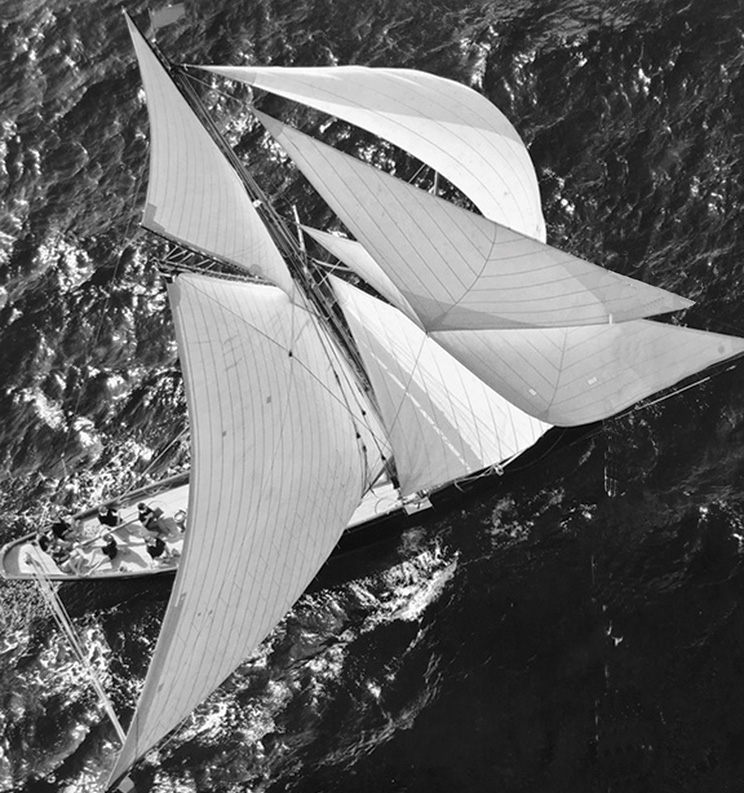
The Camper & Nicholson cutter MARIGOLD is among the astonishing succession of vessels—from workboats to yachts—for which James Lawrence made sails.
It was the last days of carrying cargo under sail on the Thames, and in 1963 Jim switched to charter work. The last sailing barge to carry cargo was the mighty CAMBRIA in 1970. Jim opened a sail loft specializing in making traditional sails in 1971, and never looked back. During a 26-year career, he made sails for all manner of craft, from small dinghies to square riggers, including his biggest commission, the four-masted cruise ship SEA CLOUD, which set 30 sails totalling 32,000 sq ft of canvas. He also made historically accurate sails for several television series and films, including for the 140′ brigantine SØREN LARSEN, which featured in the BBC series The Onedin Line.
It is this part of his career that Jim’s second book, James Lawrence Sailmakers, covers in great detail. As ever, there is interesting technical information about the way sails are made, but most of the book describes the astonishing succession of boats he worked on, from the Camper & Nicholson cutter MARIGOLD to the William Fife 19-Meter yacht MARIQUITA, and dozens more besides. And it’s not just boats: there’s also the escapologist jacket, the Punch and Judy tent, and the mayor’s cloak he made. But perhaps more important, there is the worldwide community of young sailmakers he took on, who went on to set up their own sail lofts, thereby continuing his legacy.
Jim retired in 1998 and had a happy retirement sailing his bawley SAXONIA. He died in January 2024, while his second book was in production, but his publisher, Richard Walsh of Chaffcutter Books, has done a fine job of bringing it all together and maintaining Jim’s inimitable voice. 
Nic Compton is a regular contributor to WoodenBoat.