
 Alison Langley
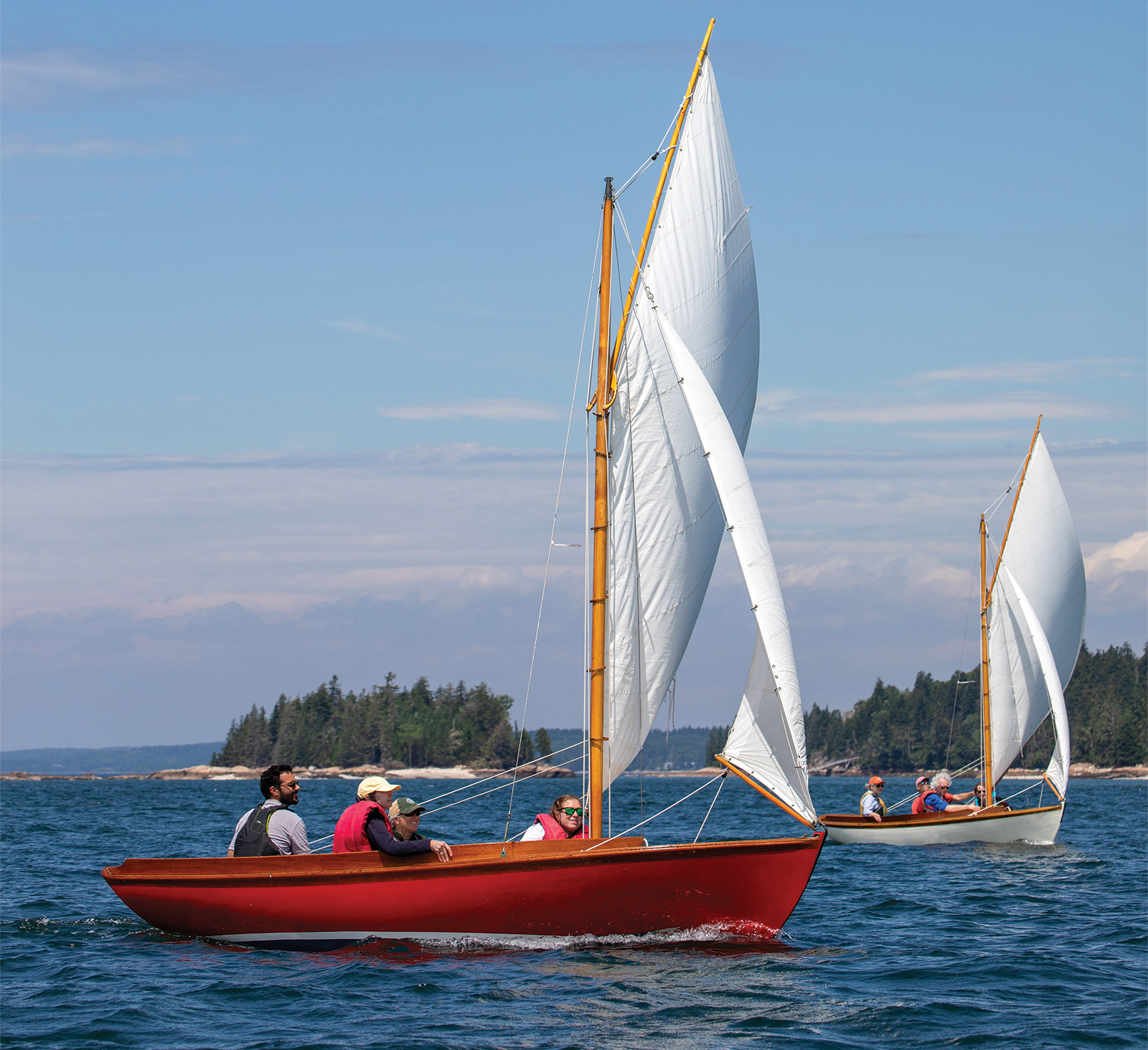
A pair of Haven 12½s, FOX (red boat) and CONNIE, sail in company during a course at WoodenBoat School in July 2024. Havens, which were designed in 1984, and the Herreshoff 12½ that inspired them, are the core boats of WoodenBoat School’s sailing program. They are considered in some circles to be the best all-around sailboat of their size ever designed.
From brokerage advertisements to cocktail-party boat talk, it’s a line of praise so often heard that it sometimes feels like rote hyperbole: “The Herreshoff 12½ is the best sailboat of its size ever designed.” These diminutive yachts, measuring 12½′ on the waterline and 15′10″ overall, were introduced by the Herreshoff Manufacturing Company (HMCo.) in 1914 as the Buzzards Bay Boys’ Boat. They were designed, as the name implies, for teaching the fundamentals of sailing and yachting to young men on the often-boisterous waters of Buzzards Bay, Massachusetts.
In the ensuing years, they proved to be equally effective at delivering the lessons of sailing to young women and adults, to be much more than a training boat, and to be suitable for waters beyond Buzzards Bay. “The 12½,” said Jon Wilson, who founded WoodenBoat magazine in 1974, “is the ideal small boat.” Jon, and the community that grew up around this magazine, held this belief so dearly that, when he founded WoodenBoat School in 1981 as an extension of the magazine, “the 12½,” he said, “was the obvious first choice” as the core boat for the school’s sailing and seamanship program.
By the time the school was established, the magazine had outgrown the small off-grid cabin in Brooksville, Maine, in which Jon had begun the enterprise. He had moved it four times—first to a larger building in Brooksville, from which it was driven by a fire; then to a nearby schoolhouse, then to a former inn in nearby Brooklin that today serves as WoodenBoat School’s dormitory and kitchen; and finally to a disused 64-acre waterfront estate down the road—a property that is still the business’s headquarters.
 Alison Langley
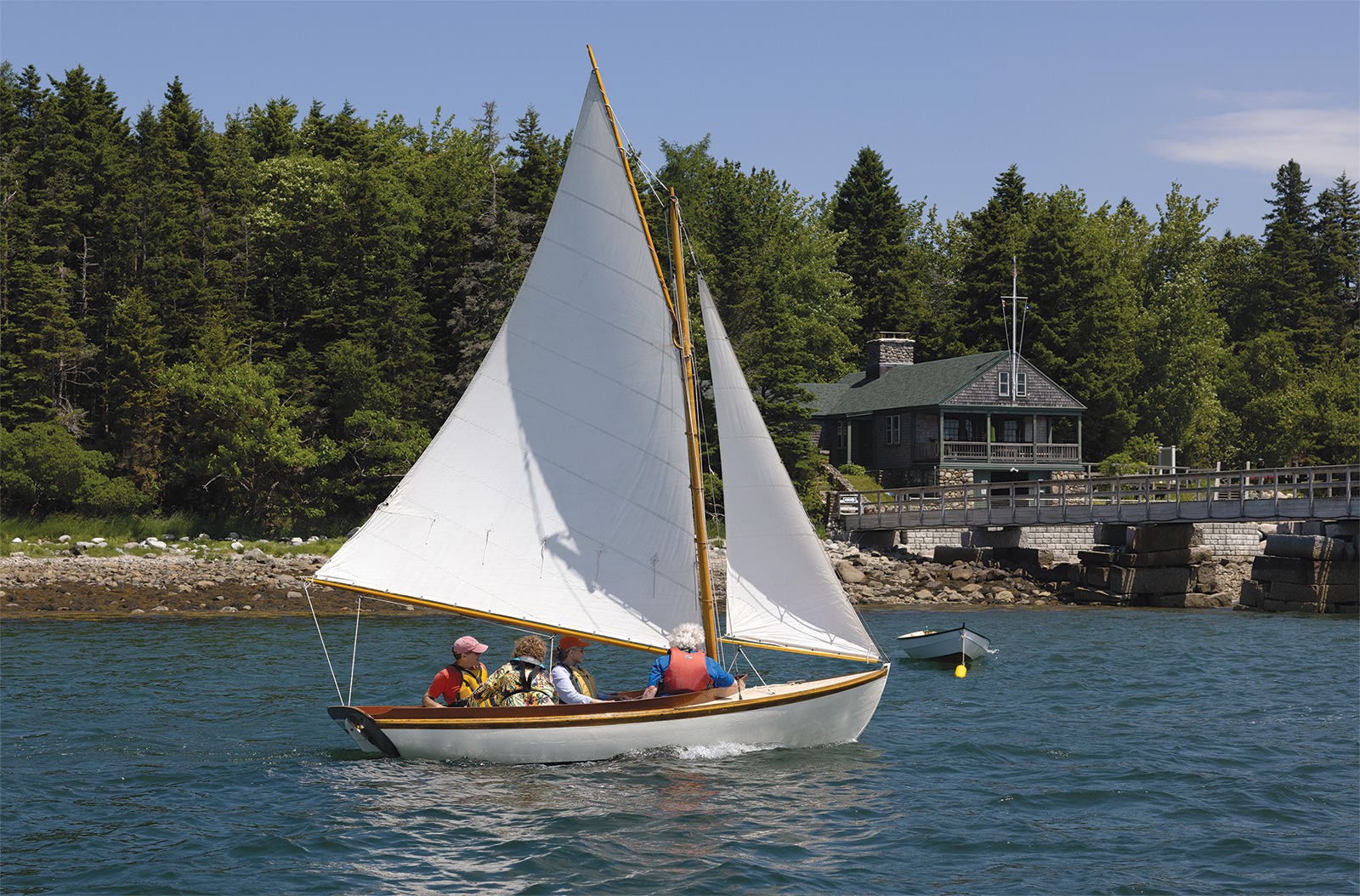
CONNIE sails near the WoodenBoat School pier. At the top of the pier is WoodenBoat’s iconic boathouse, which combines sleeping, kitchen, classroom, and boat-storage space.
The new waterfront property’s main building was a large, white hilltop mansion. This would become the office building. Down the drive from that was a three-bay brick barn, which would become the workshops of the fledgling WoodenBoat School. And at the waterfront were the laid-up granite supports for a long, abandoned pier jutting out into Great Cove from the coziest waterfront cabin you ever did see.
The school got a toehold in its first year, under the direction of Peter Anderheggen, with a handful of classes in the barn. But Jon envisioned it having a “broad base,” rather than a tight focus on traditional wooden boat building. This broadening came about under the next director, Ben Ellison, and continued under his successors, first Rich Hilsinger and then Eric Stockinger. The school would expand to teach crafts related to boatbuilding, such as ropework, carving, and casting. It would explore emerging technologies, such as sheathed-strip construction and vacuum-bagging. And it would have an on-water program at the core of which would be a fleet of Herreshoff 121⁄2s.
“It was,” said Jon, an “aspirational vision,” rather than a carefully forecast business plan.
 Alison Langley
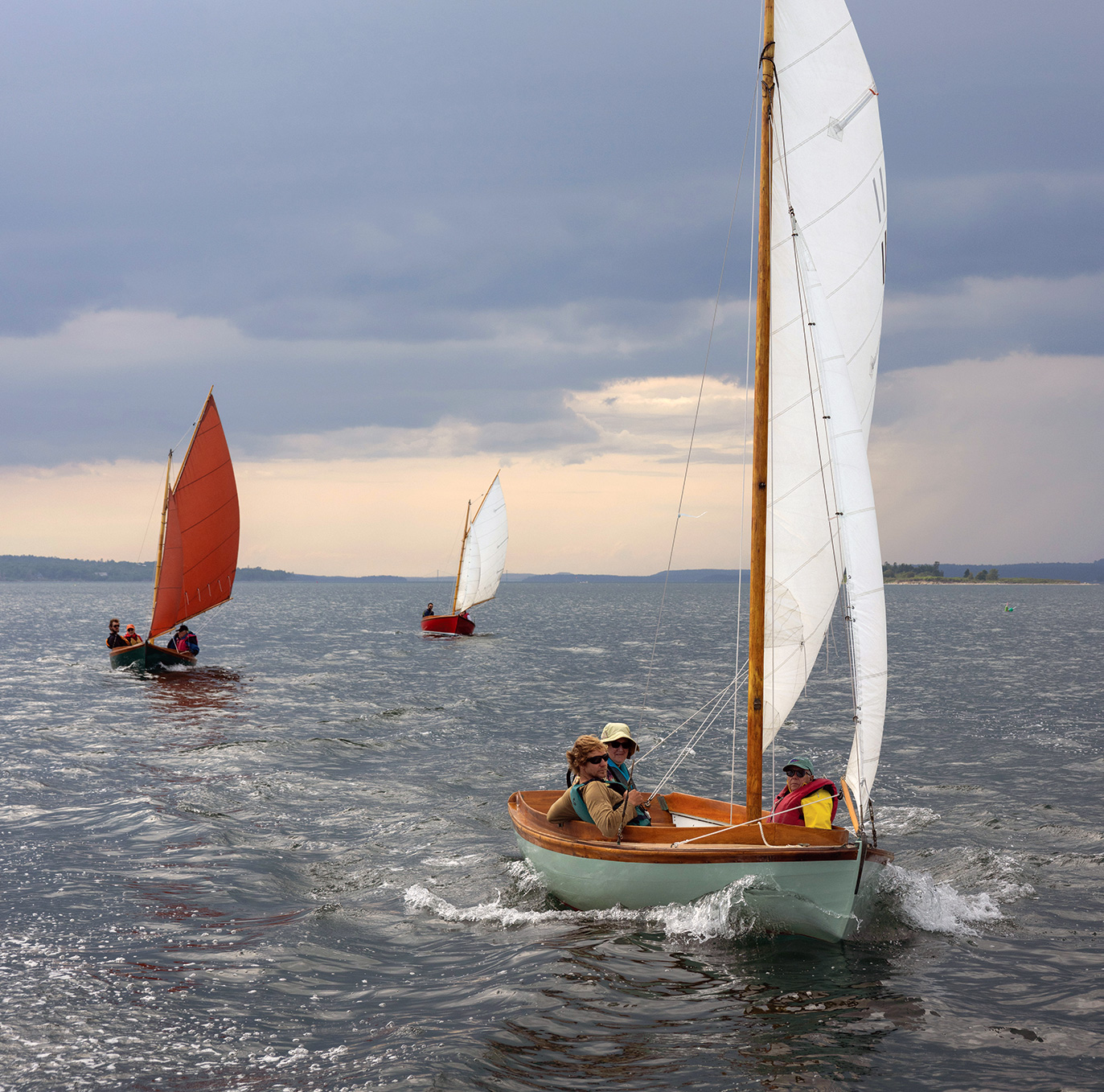
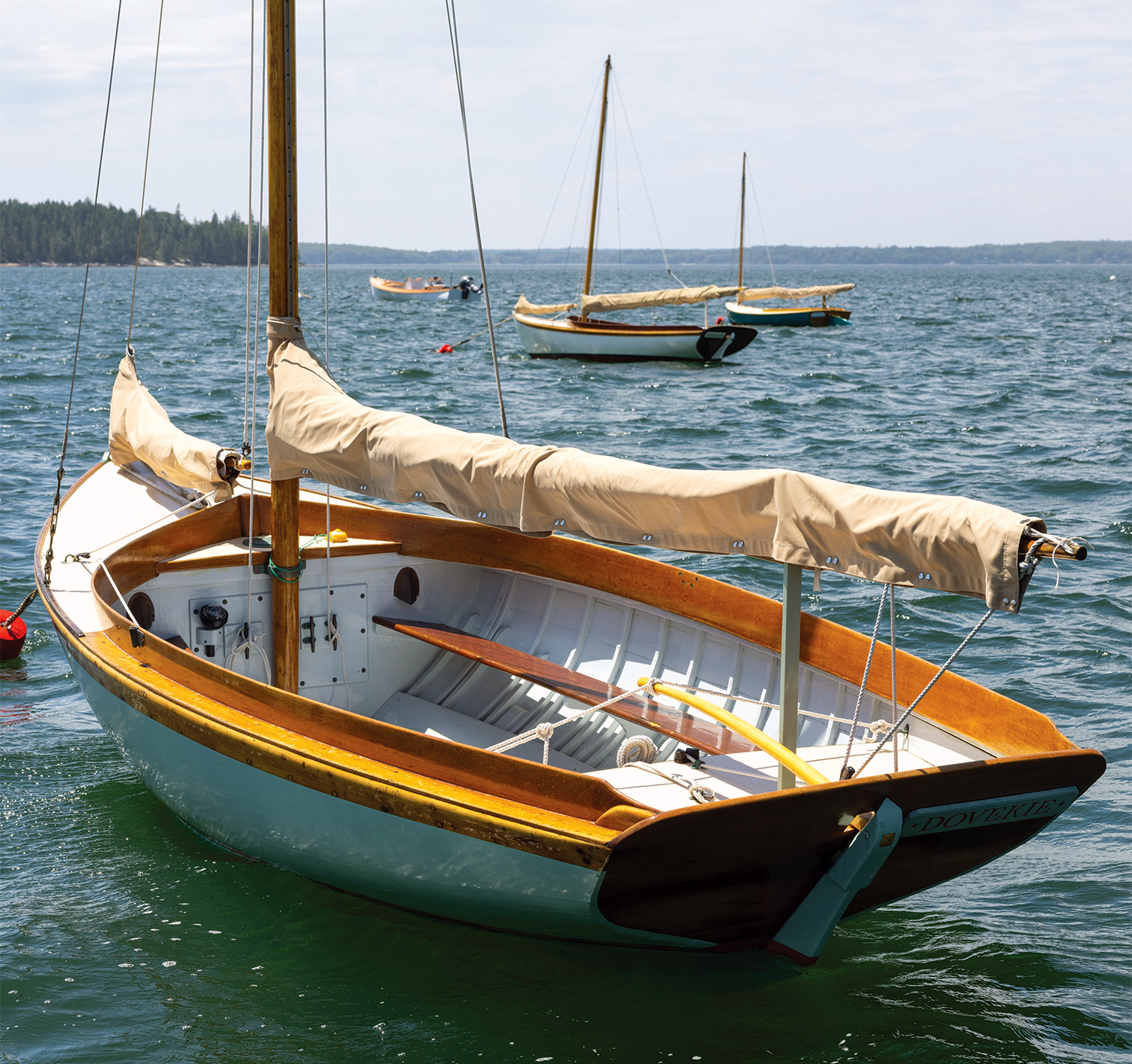
The Herreshoff 12½ DOVEKIE leads the Havens FOX and CRACKERJACK home from a morning of sailing instruction. Students will practice a few mooring landings before heading to the boathouse for lunch; then it’s back to the boats for an afternoon of more instruction.
Think of the Herreshoff 12½ as a small version of a large yacht. It has a displacement hull with 2′6″ of draft, a transom-hung rudder, and 750 lbs of outside lead ballast bolted to its bottom. Like all of HMCo.’s designs, it began life as a carefully carved half model by Nathanael G. Herreshoff, to be precisely measured and scaled to full size. Two designs would come from this model: the 12½, and the larger Fish class (20′9″ LOA). Interestingly, Herreshoff seems to have had neither of these lengths in mind when carving the model, because if you scale up the actual model directly, its size lands right between those two boats.
Between 1914 and 1943, HMCo. built 364 Herreshoff 12½s. The company then engaged the Quincy Adams Yacht Yard to build 51 more through 1948—though these boats carry Herreshoff builder’s plates and hull numbers. Cape Cod Shipbuilding, which acquired the rights to the design at the end of the Quincy Adams run, built 35 more wooden hulls through 1950, when they transitioned the design to fiberglass and called it the Doughdish. Among the cognoscenti, the Quincy Adams boats are considered to have some quirks, to which we shall return.
Jon’s aspirational vision for a fleet of 12½s forming the core of a seamanship program lagged behind the actual beginning of WoodenBoat School. The fleet, said Jon, “wasn’t able to take shape until we had a pier.” The pier construction took place in 1985, and with it came a busy waterfront that included a classroom and sleeping space for instructors and staff in that cozy cabin at the top of the pier.
What design qualities drew Jon, and the greater community, to this boat for this purpose? First, he said, it had built-in flotation encased in two chambers, one in the bow and one in the stern. While most of these chambers have been compromised in some form or other, with the stern one now typically serving as a locker and the one in the bow sometimes doing so, it’s clear that Herreshoff was thinking about safety; such flotation was often an afterthought in small boats at that time.
Another interesting safety feature was that the early 12½s had extra-thick seats of cedar, which were designed to float out of the boats, in four pieces, as flotation devices, in the event of a swamping. “Think of how fast a loose lifejacket would blow away,” Jon said. WoodenBoat School students are required to wear lifejackets in the boats, but this floating-seat safety consideration must have been a relief to the parents of those Buzzards Bay boys in 1914. Jon, despite his adventuresome business inclinations, describes himself as “risk averse” when it comes to on-water safety. “I was definitely aware of the risk” of running a program on the water. The fact that the Herreshoff 12½s were built by the best wooden boat builders of the day, with thoughtful safety considerations, was a large factor in its adoption by WoodenBoat School.
 Mit Museum/Hart Nautical Collections
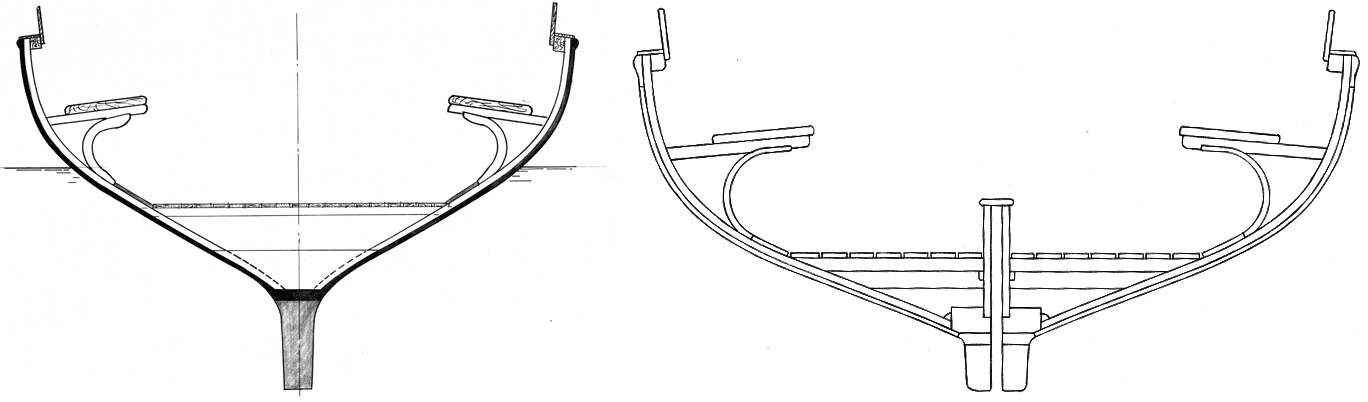
Havens and Herreshoffs share an equal place in the WoodenBoat School fleet. Instructor Jane Ahlfeld notes a subtly greater initial stability in the Havens—an observation supported by this midship-section comparison. The Herreshoff boat (left), with its relatively deep lead keel, has slack bilges; the Haven (right), with its shallower draft, has firmer bilges and thus greater form stability.
Jon noted other details of these boats that made them a good choice for the school: They had oarlock sockets, so could be rowed when the wind died. They automatically round up into the wind during a knockdown or when the tiller is let go. They have a self-tacking jib and a mainsail, which gives both the crew and skipper a lesson in sail trim; it also teaches the dynamics of the most common sail plan on today’s sailboats. “It’s an amazing teaching lab,” Jon said. “People were changed by these boats.”
Indeed, Jon’s friend and mentor Joel White was deeply influenced by his own Herreshoff 12½, SHADOW, which he learned to sail, mostly on his own, at age 15 or 16. This experience culminated in a sort of personal graduation ceremony, a multi-night cruise around Deer Isle in Penobscot Bay. Joel slept aboard, out of touch with his family for the duration of the several-day adventure. He went on to an illustrious career as an MIT-trained naval architect and yacht builder as proprietor of Brooklin Boat Yard, which is just a mile or so from WoodenBoat’s waterfront. Jon and Joel’s friendship was vital to the magazine’s early successes. Joel, who died in 1997, had in fact helped to arrange the sale of the company’s current property to Jon. For many years he wrote the magazine’s design-review section. And two of the many boats he designed—the Nutshell Pram and the Shellback Dinghy—are staples of both the WoodenBoat School waterfront and the WoodenBoat Store plans catalog. And, notable for this discussion, he designed the enormously popular Haven 12½—a Herreshoff 12½ derivative and near-lookalike that has a centerboard rather than a full keel.
 Alison Langley
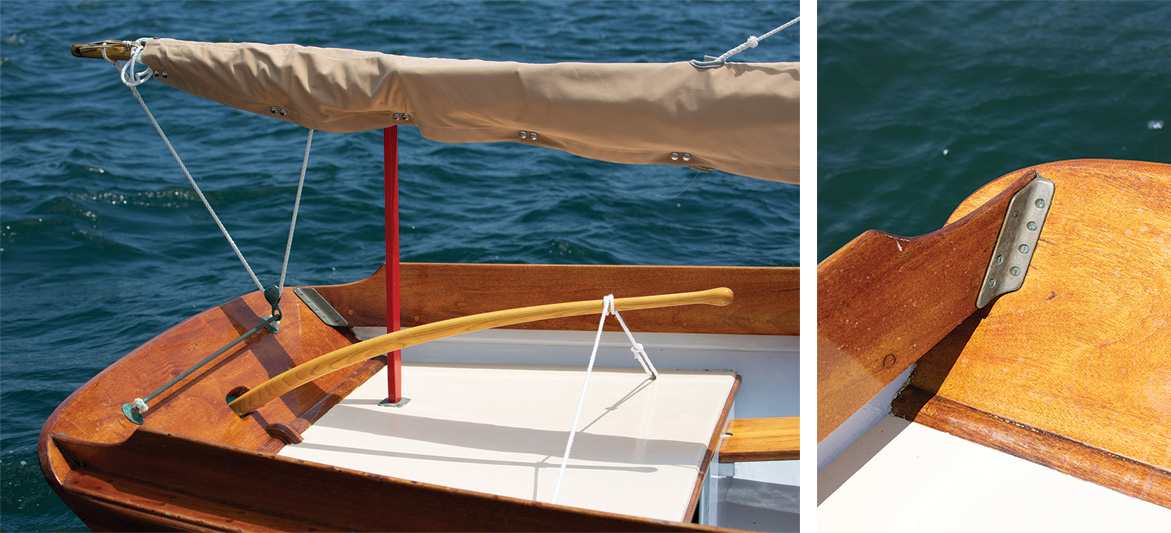
The Havens and Herreshoffs are identical in their simple, functional details. Boom crutches are standard features, as is the tiller aperture in the transom. The afterdeck, in the original design, enclosed a flotation tank; today, this space is typically given over to storage. Right—Elegant purpose-cast brackets join the coaming to the transom. Accurate reproduction hardware for Havens and Herreshoffs is available from J.M. Reineck & Son (www.bronzeblocks.com).
Jon remembers the new design’s conception this way: Sam Neel, a design client of Joel’s, “wanted a Herreshoff-looking boat that had a centerboard, so he could come closer to shore.” He also wanted to be able to trailer the boat between Brooklin and his New Hampshire freshwater cottage. To maintain the original design’s stability characteristics while reducing the draft, Joel gave the new boat more beam than the Herreshoff hull, firmer bilges, and a centerboard that operated through a slot in the shallower ballast keel. The boat draws just 1′6″, compared with the Herreshoff 12½’s 2′6″. Joel and Sam agreed to call the new design the Haven 12½ in deference to the classic waterfront Brooklin neighborhood of small cottages called the Haven Colony, where Sam summered and whose yacht club is a longtime home to a fleet of Herreshoff 12½s that still race every summer. (Joel shared credit for this design with Nathanael G. Herreshoff, and did the same for the Flatfish—a centerboard derivative of the Fish class.)
 Alison Langley
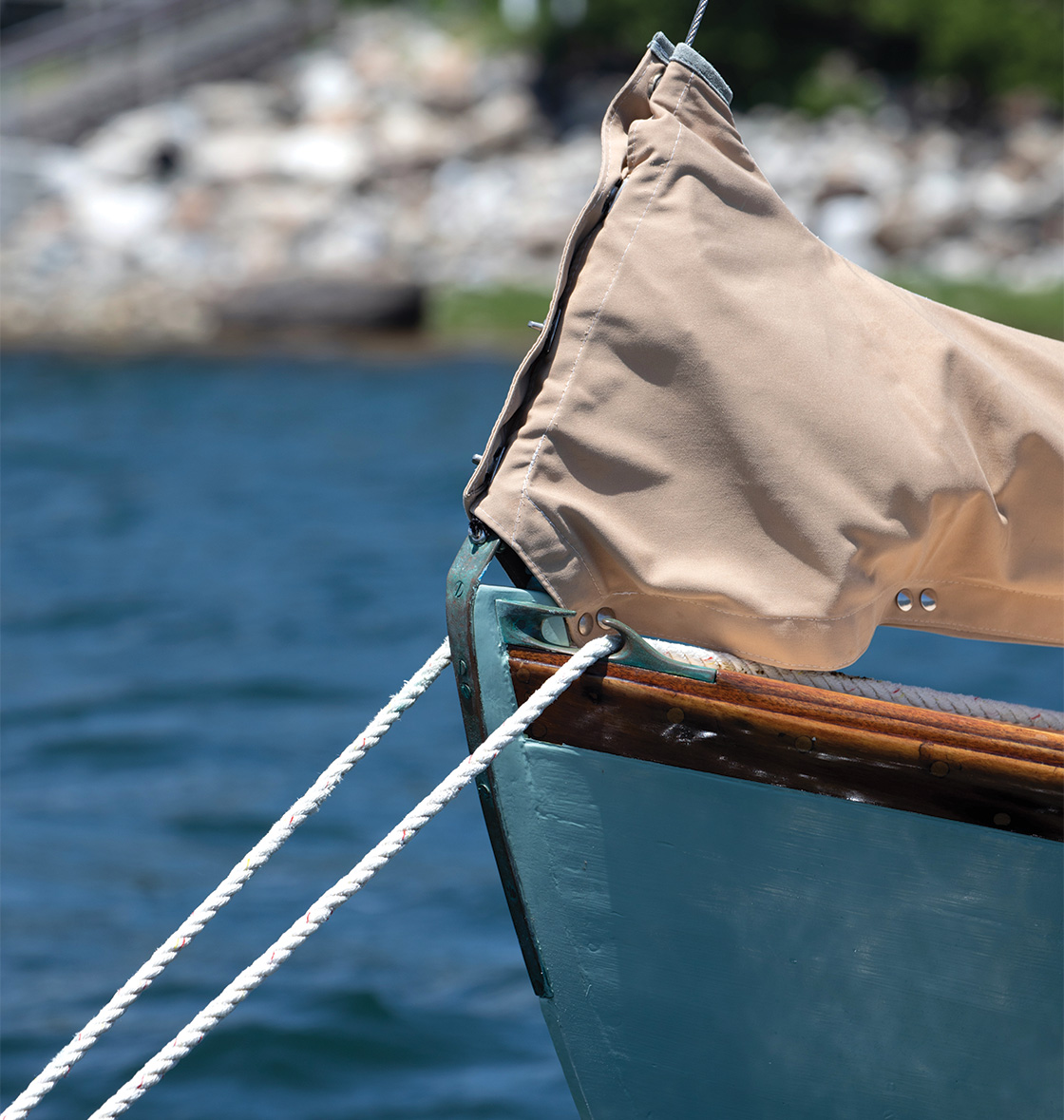
Another signature element of both the Havens and Herreshoffs is the paired bronze bow chocks that fair into the toerail.
Maynard Bray, longtime technical editor of WoodenBoat and another member of the magazine’s early brain trust, collaborated to some extent on the design, and built most of the first Haven. He then arranged for his wife, Anne, to copiously photograph its construction, and wrote a book about how to build it. The boat is a seemingly complex and ambitious project even for an experienced builder, but so detailed were Joel’s drawings and Maynard’s instructions that they have guided the building of hundreds—perhaps thousands—of Haven 12½s worldwide—many by first-time builders. The WoodenBoat Store’s study-plans description, written by Maynard, describes it this way: “In fact, however, it is not very complicated; it simply requires care and concentration. We have done everything we could to make the building process understandable: the plans for the Haven 12½ are very detailed, and they include full-sized templates for the hull molds, transom, and other key pieces. The need for lofting is thus eliminated.”
WoodenBoat School itself, in a series of classes, built several Havens in the late 1990s and early 2000s. Two of these, FOX and CRACKERJACK, are of cold-molded construction. The Haven, today, is an equal companion to the Herreshoff 12½ in the school’s fleet, which includes three Haven 12½s and one currently operational Herreshoff. Two other school-owned Herreshoffs are the subject of a survey and repair class up in the shops, and the original Haven, PETREL, recently joined the school’s fleet as a donation and was forecast to be in commission by the time this article is published.
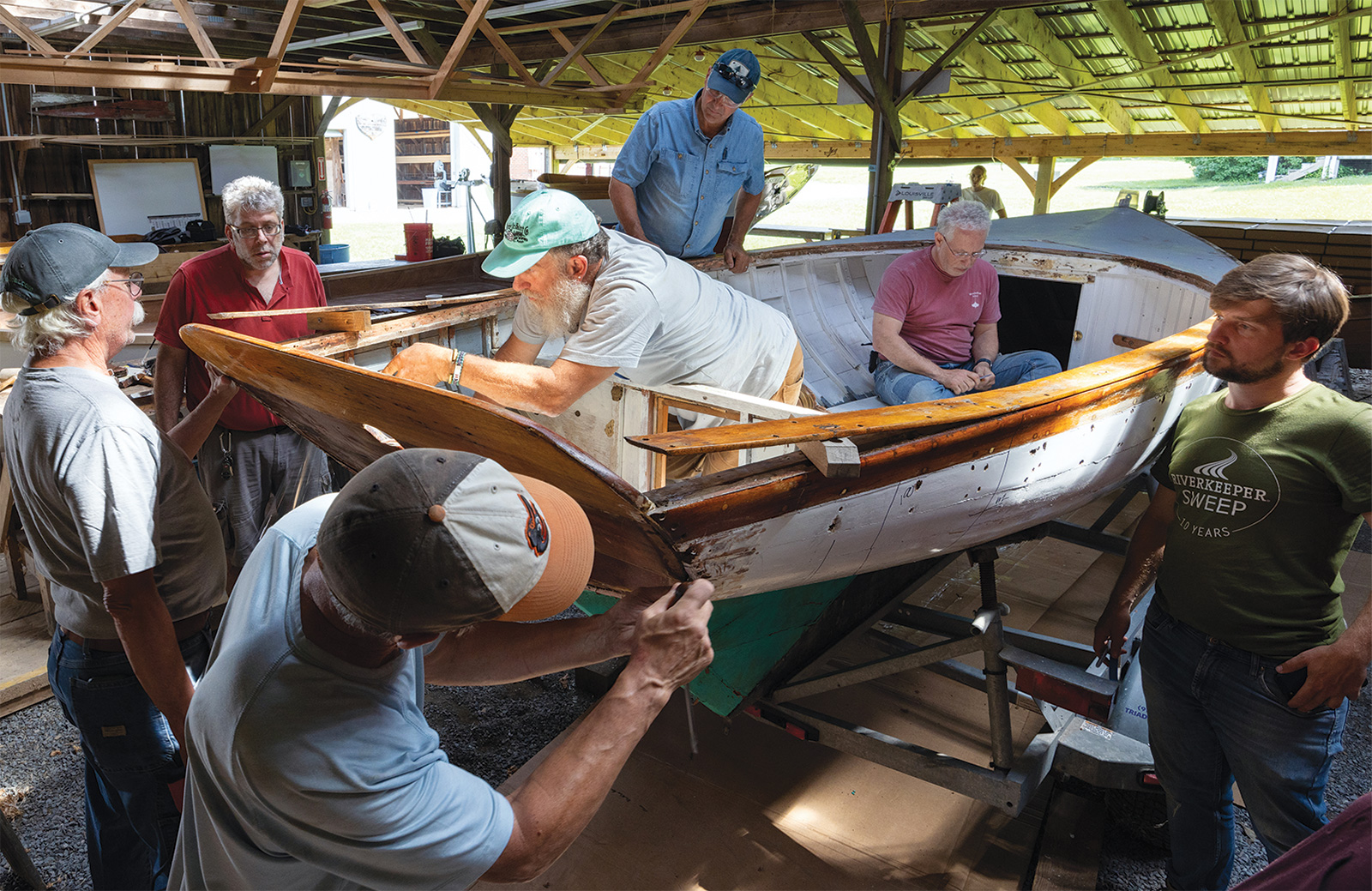
In somewhat the reverse of the school-founding timeline, this core waterfront design has found its way to the shops as a centerpiece teaching tool. Under the direction of shipwright Pat Mahon, a crew of students spent two weeks during the 2024 season surveying HMCo. hull No. 2008, a Herreshoff 12½ that was given to the school a few years back. They then devised, and began executing, a repair plan.
 Alison Langley
A WoodenBoat School class in July 2024, taught by Pat Mahon (standing at the transom, in the blue cap) conducted a thorough survey of Herreshoff Hull No. 2008, a Quincy Adams–built Herreshoff 12½. After this, they developed a repair plan and removed floor timbers, some planking, and the transom. Transom replacement was well underway at the end of the two-week class; the project will continue in future classes.
Pat described the boat as “a good example of a very poorly maintained 12½.” It is one of the 51 hulls built for Herreshoff by the Quincy Adams yard, and its quirks were illuminated during a lunchtime visit I made to the class early in the second week. My colleague Tom Jackson, WoodenBoat’s senior editor, was there. He has a discerning eye for sheerlines, and remarked to Pat that this boat’s seemed to have a hump near the bow. Pat confirmed this, noting that all of the Quincy Adams boats have this trait. Later, Maynard speculated that it was likely not a measuring error, but rather was due to that area of the hulls having squeezed together when removed from the building jig; we all resolved that it would be good to measure the beam at that location, and compare it with the designed measurement.
Such are the archaeological lessons of digging into old boats, and the Herreshoff 12½ provides deep teaching in this regard. I tend to revere some builders of the past as fussy perfectionists, but the reality is that they were running businesses and many were building to a price—not cutting corners, necessarily, but saving where it made sense. Hull No. 2008, the Quincy Adams boat, revealed another secret when the paint was stripped away: the hull was planked in a patchwork collection of cedar and mahogany. Pat postulated that this variegated planking was probably original, because in all the bottom planks there were eight screws at each frame crossing—the original four, plus four more that were bored in a hasty sister-refastening.
“It’s a good boat for the purpose of the class,” Pat said. Any bigger, and it would be difficult to get anything done. By day two, week two, they had gotten a lot done. They had ripped out floors, planks, and the transom, and were soon to drop the ballast keel and glue up a new transom blank, drifting it together with more durable bronze pins rather than the original galvanized steel. This project would come after the transom shape was confirmed. There were two other Herreshoff-built 12½s in storage—subjects of a future class—and these provided a good comparison to the Quincy boats. “All of the Herreshoff transoms are identical,” Pat said, “The Quincy boats aren’t even close.”
Under sail, the differences among Herreshoffs, Havens, and Quincy Adams boats are hard to discern.
There is no person better placed than Jane Ahlfeld to describe the educational and performance nuances of the Herreshoff and Haven 12½s. The 2024 season marked her 35th year of teaching at WoodenBoat School. A former first-grade teacher, and now an information technology consultant in the off season, she’s taught thousands of people how to sail on the WoodenBoat waterfront. Why, I wondered, does she like teaching in 12½s?
“They are a comfortable boat for four adults,” Jane said. “They are responsive, so the feedback to the student is immediate. The helm is really sensitive,” she said. Give the tiller a little pull or a push, and the boat responds. “The student is going to see the result immediately.” In a bigger boat, she observed, a student often oversteers because the result of helm inputs is not so immediate. Jane has also taught for WoodenBoat aboard the 90′ LOA schooner MARY DAY, an experience that provides a handy illustration of her point. “The response time on MARY DAY’s helm is so much different,” she said. “A student starts turning the helm, and nothing happens. So they keep turning the helm. You have to wait at least 30 seconds to see what happens. The 12½ is instantaneous; you turn the helm, the boat moves.”
There’s a sense of safety, she said, because even though the boat is heeling over, there’s a point at which it is “happy—it’s where it wants to sit. It’s not a tender, tippy boat; it’s a nice stable platform.” She does draw a stability distinction between the Herreshoff boats and the Havens: “I’m a Haven girl. When I sail a Herreshoff I’m always surprised by how quickly they heel over. With the Haven, it’s slower. It’s very subtle.” Because their shallow draft requires a firmer turn to their bilges, and because some of their shallower draft is compensated for by greater beam, the Haven hull has greater initial stability. “I don’t think a lot of people would pick it up, but I’ve sailed in both boats so much that I can feel the difference,” Jane said.
And what about crew capacity? “Three students and a teacher,” Jane said, “is the ideal crew complement for teaching in a 12½. I’ve done five on windy days, but that’s too many.” She continued, “The beauty is that you can easily solo them, because of that self-tacking jib.”
The self-tacking jib is set on a club that attaches to a cast-bronze tack hook on the after face of the stemhead. The jib’s clew attaches directly to the club. Jane is quick to recite the reminder her teaching colleague Jenny Bennett delivered to students years ago: “It is a self-tacking jib, not a self-tending jib.” Although the club, which is rigged to use its sheet as a traveler, takes care of itself when coming through stays, one still must trim that sail to match the trim of the mainsail. And sail trim, says Jane, greatly affects helm balance in both a Herreshoff and a Haven. The jib feeds air to the back side of the main; an overtrimmed jib will backwind the main, suggesting that it’s luffing when it isn’t.
 Alison Langley
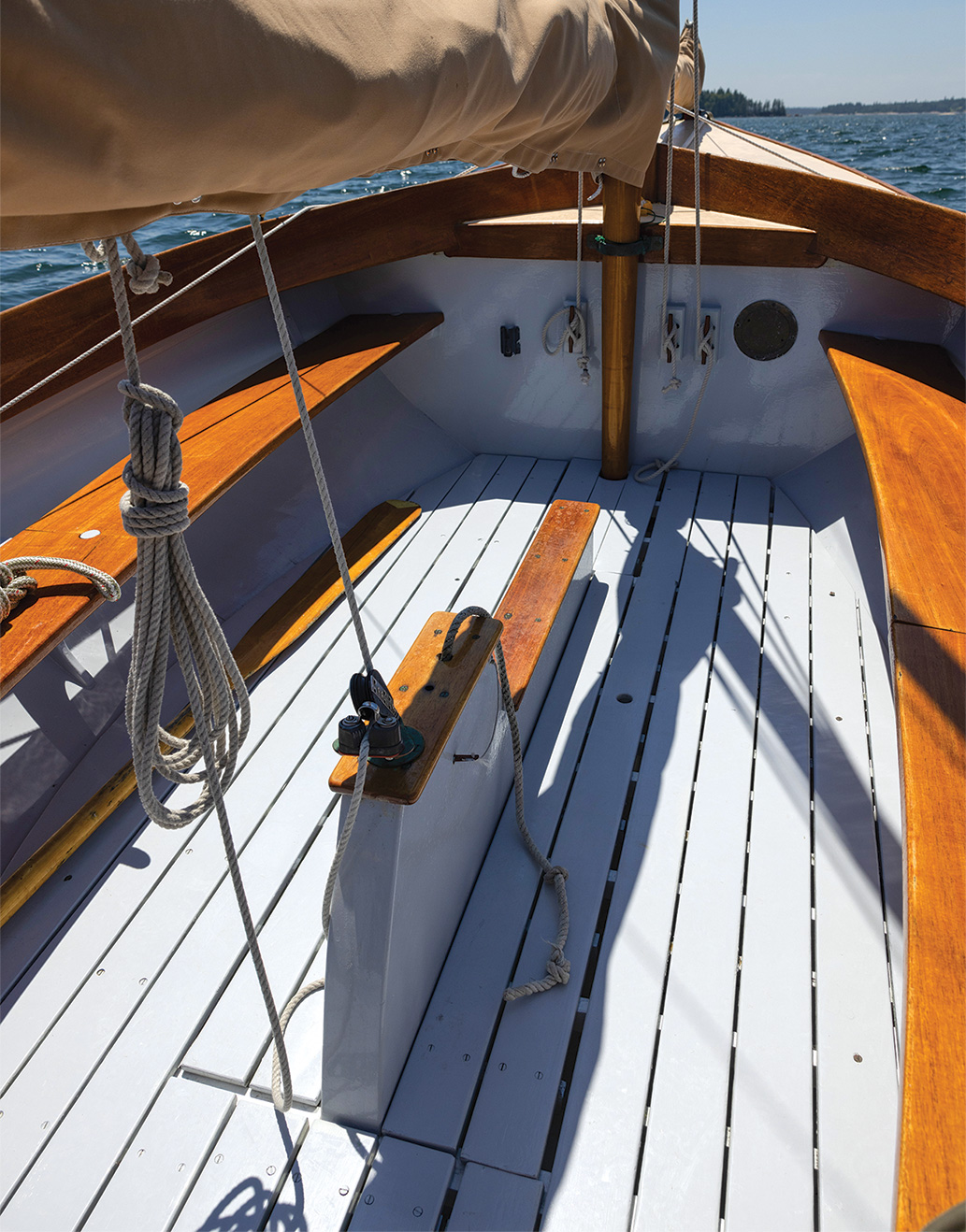
The Haven 12½’s centerboard trunk does not intrude on the cockpit. Rather, it provides a handy footrest, as well as a place to secure the mainsheet block.
Herreshoffs and Havens can be rigged with either gaff or Bermudan mainsails. All of WoodenBoat School’s Herreshoff 12½s (WE THREE, SEAL, and DOVEKIE) happen to be Bermudan-rigged, while all of its Havens (ALLENE, CONNIE, FOX, and CRACKERJACK ) are gaff-rigged. Jane prefers the gaff rig, though acknowledges that the Bermudan-rigged boats can sail closer to the wind. It’s her instructor’s instincts: She’d rather encounter a squall in a gaffer, “because of the ability to scandalize,” or drop the peak of the sail. “It’s an immediate reef, in a big way. You’ve taken at least one-third of the sail area away, if not more.” A gaff-rigged 12½ is also easier to set up alone, because its short mast is easier to step at the ramp than a tall Bermudan one. Jane also says WoodenBoat School’s gaff-rigged boats have more sail-shape control than the Bermudan boats. But “boat for boat,” she says, “they’re pretty much the same, speed-wise.”
Jon’s early vision for a boat that would serve a wide range of abilities has proven itself with the Herreshoffs and Havens. Jane says she has had students who are ready to solo after one day in the boat—though that’s rare. She recalls one not-so-risk-averse pupil whose other recreational endeavors included camping by slinging a bivouac sack high up on a rock wall. That student soloed on her first evening. Others may take a few days. And some, said Jane, “don’t know which way to push the tiller at the end of the week.” Skill levels vary; the 12½ serves them all.
Jane said that on high-wind days she reefs “often, and early.” She said 12 knots of wind is ideal for a reef—that performance does not suffer with one “tuck” at this wind velocity. “Many people think that’s too early, but the boat is more manageable. And I’m teaching beginners. I’ve found no performance degradation, and I don’t wait until 15.” She did say that if the breeze drops to 10, “you’re feeling sluggish” with a reef.
 Alison Langley
The Herreshoff 12½’s mainsheet leads from the transom—a slightly less ergonomic configuration than the Haven 12½’s. At rest, however, the boats are nearly identical, save for the Haven’s centerboard trunk and subtle shape differences in the transoms.
After all this praise, I asked Jane about the boats’ drawbacks. “Their price?” she said, phrasing the answer more like a question than a statement. A hull for either a Haven or Herreshoff might take 1,000 hours to build, before rigging and fitting out. Several area builders, including Artisan Boatworks in Rockport, Maine, and Eric Dow in Brooklin, have earned reputations for finely built Havens and Herreshoffs. Eric has turned out more than 50 Havens, and probably repaired or restored more Herreshoffs than anyone. Artisan builds exquisite hulls to both designs, and has done careful restorations of originals. One veteran builder and restorer of both types notes that the hours for a new build versus a restoration, full keel versus centerboard, and traditional versus cold-molded, are all similar, in the 1,600-hour range. At $65 per hour, that comes to $104,000 in labor. Materials, including premier reproduction hardware from J.M. Reineck and Son, a custom-fitted Triad trailer, and a paddle and boathook from Shaw & Tenney, comes to about $40,000, for a total cost of $144,000. The boat is quite popular with amateur builders looking to invest their own hours.
For his part, Jon remembered a visit to WoodenBoat School by the naval architect Bill Garden nearly 10 years after the school had started. Bill went for a sail in one of WoodenBoat School’s Herreshoff 12½s and was reportedly unimpressed with the boat’s speed. “This is one of the slowest boats I’ve ever been in,” Jon recalls Bill saying. It’s an interesting perspective, and with hindsight seems more a matter of design priorities than a poke at the boat itself. “Bill would have had a fine-lined, fin-keeled, narrow, shallow hull. He was more of a sporty guy,” Jon said. And he notes that Bill was not commenting from the perspective of someone concerned with training people of varying skill levels, from all over. “There was no question, though, that Bill knew they were safe boats. They were designed to bring a bunch of boys home after a day on Buzzards Bay.”
Jane’s decades of observation have, in a large way, proven Jon’s vision. “To me,” Jon said, “the 12½ is the ‘commencement craft.’ You can learn everything you need in it.” In other words, if you can competently sail a Herreshoff 12½, you’ve graduated.
“I often apologize to students in my course introduction,” Jane said. “I say to them, ‘I’m sorry, but we’re introducing you to one of the best small boats there is. It’s hard to go back to a lesser boat. You’re going to get comfortable in this. It’s the cream of the crop.’ I can’t imagine a better boat to learn sailing.”
“The Herreshoff 12½, and then the Haven,” Jon told me, “was always the small-boat epitome—the embodiment of what we wanted to do.”
Despite all this theory and proof, Maynard Bray’s assessment of the boat’s enduring appeal might be most on-point. He and I were having a long discussion one afternoon about the designs’ minute details and history, when he paused for a few moments, and then, piercing the talk of sail trim, stability, safety, and construction, crystallized the draw of these boats in one carefully landed emotional nugget: “The one thing that makes these boats so popular is that they’re so damn beautiful!” 
Matthew P. Murphy is editor of WoodenBoat.
To view our recently released WoodenBoat Legends video documenting the enduring appeal of WoodenBoat School’s Haven and Herreshoff 12½s, join our Mastering Skills membership site (skills.woodenboat.com) or subscribe to our newly enhanced digital edition (www.woodenboat.com).